1718 | P a g e
ARTIFICIAL INTELLIGENCE BASED MACHINE
LEARNING ASSISTANCE FOR SELF-DRIVING CAR
USING RASPBERRY PI
M V Rajesh
1, B. Venkateswararao
21
UG Student,Department of Electrical and Electronics Engineering
2
Associate Professor,Department of Electrical and Electronics Engineering
V R Siddhartha Engineering College (A), Vijayawada-520007, A.P., (India)
ABSTRACT
Now a day to drive a car is difficult task in urban areas due to increased traffic, driving for long distances is
panic and also driving with too short of a safety distance is a common problem in road traffic, frequently with
traffic accidents as a consequence to avoid these problems self-driving car is one of the solution. A self-driving
car is a vehicle that is capable of sensing its environment and navigating without human input. These
self-driving cars have mountable deviceskeeping a sufficient safe distance. A conceptual study was performed in
order to selectthe components for the integration of the self-driving car. Based on the results of this study, a
workingprototype of a flexible, self-driving car was designed, built and tested. The self-driving car is assisted by
using artificial intelligence based machine learning. A Raspberry Pi single-board computer is used for
dataacquisition and processing. The alerts are shown on an LED-matrix display mounted on the rear ofthe
self-driving car. The device software is written in Python and provides automatic operation withoutrequiring any
user intervention. The results indicate that prediction in autonomous mode gives an accuracy of 60-70% and in
training mode gives an accuracy of 86%.
Keywords:safety distance; self-driving car; artificial intelligence; Raspberry Pi
I. INTRODUCTION
Driving at a too short of a safety distance is a common problem in road traffic and presents one ofthe principal
causes of traffic accidents. The drivers often tend to drive too close to the leadingvehicle, because they are
unaware of the distance required to stop the vehicle at the given velocity andbecause they inadvertently wish to
increase the traffic throughput and, thus, shorten the trip time. Onthe other hand, the commonly-known scenario
involves impatient drivers on multi-lane motorwayswho try to force the vehicles in front of them off the fast
lane by intentional “tailgating”. The constantimprovement of road vehicle performance and the inclusion of
driver-assistance systems may increasethe problem even further, as it gives the drivers a false confidence in their
vehicle’s abilities to stopand prevent the impact consequences. This leads to frequent rear-end collisions, often
withdevastating consequences and even fatal injuries.On selected spots on the highways, there are also test
fields that allowthe drivers to self-evaluate their safety distance. To avoid the above mentioned problem one of
1719 | P a g e
Home Automation System. The main objective of these Home Automation systems (HAS) using internet ofthings (IoT) is to inhibit automatic and electronic control of household features activity and appliances. wide
range connectivity and energy efficient control of the home appliances in a user-friendly manner, connectivity,
scalability, power saving can be achieved by the use of Raspberry Pi, which acts as an interface between the
hardware and the software of the entire system which can be connected to number of peripherals using USB
ports or HDMI port and GPIO, it can be connected to the internet using the Ethernet port or by Wi-Fi
connectivity. In 2016,Madhusudhanan. R andDivyaSubramaniyan etc. al use the Artificial Intelligence
Algorithms for Home Assistant. In this they say that the major purpose of any automation system or artificial
system is to reduce human labor, effort, time and errors due to his/her negligence. The major goal of this project
is to design and implement an Intelligent Home Assistant in a same device (via world –wide-web) or even any
mode of Internet-Access, which gives the ability to control your home appliances and to perform task or service
for an individual. These tasks or may be services are based on user input, on location and also the ability to
access information from variety of online sources. Various sensor based control for this application is being
added to improve the security and also the ability to make more accurate decisions. In 2016,Vaishnavi S. Gunge
and Pratibha S. Yalagi presents a low cost and flexible home control and monitoring system using an embedded
microprocessor and microcontroller, with IP connectivity for accessing and controlling devices and appliances
remotely using Smart phone application. The proposed system does not require a dedicated server PC with
respect to similar systems and offers a novel communication protocol to monitor and control the home
environment with more than just the switching functionality. To demonstrate the feasibility and effectiveness of
this system, devices such as light switches, power plug, temperature sensor and current sensor can be integrated
with the home control system.
Many authors apply the Raspberry PI for Home Automation, in this paper Raspberry PI is used for Self-driving
cars with artificial intelligence. The work described in this paper was initiated to develop a device forcontinuous
safety distance monitoring and proper movement of the traffic. The aim of this paper is to give an overview
about raspberry pi based on intelligent systems and also to use for self-driving car. The main aim of future
technology is to automate everything but coming to cars, automation is not sufficient to take real time decisions
to drive the car because humans are able to learn from previous experiences but cars can’t do it, so cars had to
learn how to drive similar to humans. This can be achieved by using Machine Learning Algorithms and one of
the ways to achieve machine learning is artificial neural networks. These are similar to neural networks in our
brain.
1720 | P a g e
Fig.2. Billions of neurons forms aNeural networkThese neurons processes information and give corresponding response. An artificial neural network also works
in the similar manner. A model diagram of both biological neuron and artificial neuron are shown below. The
inputs to the neural network are images and the outputs are movements of car (left, right, forward, reverse).
Therefore for collecting Images, processing and controlling the car we need a camera, small computer(raspberry
pi) and a motor driver.
Fig.3. A model diagram of biological neuron and artificial neuron
II. WORKING
Raspberry pi: It is a single board, low cost, high-performance computer which can replaces normal computers
for low and medium level computations and additionally it has 40 GPIO pins which can be used to take input or
to give output just like a microcontroller.
1721 | P a g e
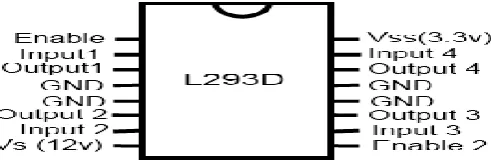
L293D:It contains two inbuilt H-bridge driver circuits. In its common mode of operation, two DC motors can bedriven simultaneously, both in forward and reverse direction. The motor operations of two motors can be
controlled by input logic at pins 2 & 7 and 10 & 15. Input logic 00 or 11 will stop the corresponding motor.
Logic 01 and 10 will rotate it in clockwise and anticlockwise directions, respectively. And the enable pins are
used to control the speed of the motors.
Fig.5. Architecture of L293D
Selection of the Components
The first components that had to be selected carefully are the processing computer and a Camera, becausethese
represents a significant cost and effects the performance of neural network, so a 8MP camera module and
raspberry pi 3 are used for collection of required data and processing of collected data. The next component is
power supply which is portable and supports the 2.1amps requirement of raspberry pi and around 1A for two
motors, so a 20000mah, 3.1A MI power bank is chosen. Finally a motor driver which can act as an interface
between raspberry pi and motorsis required so L293D is chosen because it is the most commonly used motor
driver IC’s from the L293 series.
Table 1: Components details
Component Manufacturer and type Cost Estimate in INR
Single board computer Raspberry pi 3 model B 3000
Power supply MI power bank (20000mah) 2200
Prototype vehicle RC Car 1500
Camera Camera module 8MP 1800
Motor driver IC L293D 200
Total Cost: 7080
Fig.6. Block diagram of self-driving car
M1
Raspberry pi
Motor Driver
M2
1722 | P a g e
Fig.7. Basic circuit diagram of self-driving carThe Working of this project is divided into three parts, they are Input unit, Processing unit and Control unit
1. Input unit: A Raspberry Pi 3 board (model B+), attached with a pi camera module is used to collect input
data
2. Processing Unit: The processing unit (computer) handles multiple tasks: receiving data from Raspberry Pi camera, neural network training and prediction(steering) and sending instructions to motors through motor
driver. Initially car is trained in a specific path, while training a path camera takes the images of the path and
raspberry pi stores the images along with direction. These images and directions are used to train the Neural
Network.The neural network is trained using the images from the camera at the time of training. Once it is fully
trained, it only needs to load trained parameters afterwards, and thus prediction can be very fast.It has 3 layers,
they areInput layer, Hidden layer and Output layer. The input layer takes the images as input and each image is
of size 640x480 pixels. Only lower half of the input image is used for training and prediction purposes. So
640x240 pixels is fed to input layer. Therefore number of nodes in input layer=153600. There are 20 nodes in
hidden layer. The number of nodes in the hidden layer is chosen fairly arbitrary.The Back Propagation
Algorithm performs Training, Calculating Error, and Modifying Weights between 3 layers. The BP algorithm
starts with computing the output layer, which is the only one where desired outputs are available. The error rate
in the output layer is calculated based on the difference between the desiredoutput and the actual output.Sigmoid
function has been used as a non-linear neuron activation function. Finally the Output Layer contain four nodes
where each node corresponds to the steering control instructions: left, right, forward and reverse
1723 | P a g e
Fig.8. A Neural network with Single hidden layer.III. RESULTS
Prediction in autonomous mode gives an accuracy of 60-70% and in training mode gives an accuracy of
86%
1724 | P a g e
Fig.10. Proto type of self-driving car (b)IV. CONCLUSIONS
This system is very useful for each and every human being. Mistakes are being done by each and every human
being often. This will act as an error reducer for each and every human artificially. Mostly, useful for physically
challenged person who are not able to drive the cars and those who need assistance in driving the cars.
REFERENCES
[1] Elaine Rich, Kelvin Knight, Shiva Shankar B-Nair, “Artificial Intelligence”, MC Graw Hill Publication,
“2013”.
[2] Steven Hickson, “Voice Control and Face Recognition on the Raspberry Pi”[online], Available
athttp://stevenhickson.blogspot.com.
[3] Raspbian[online], Available at http://www.raspbian.org/.
[4] Raspberry Pi 1 Model B. Available online: https://www.raspberrypi.org/products/model-b/ (accessed on19
January 2016).
[5] Jain, S.; Vaibhav, A.; Goyal, L. “Raspberry Pi Based Interactive Home Automation System Through
E-mail”, In Proceedings of the 2014 International Conference on Optimization, Reliability, and Information
Technology(ICROIT), Faridabad, India, 6–8 February 2014; pp. 277–280.
[6] Upton, E.; Halfacree, G. Raspberry Pi User Guide;
[7] Chowdhury, M.N.; Nooman, M.S.; Sarker, S.,“Access Control of Door and Home Security by Raspberry
PiThrough Internet”. Int. J. Sci. Eng. Res. 2013, 4, 550–558.
[8] Monika M Patel, Mehul A Jajal, Dixita B vataliya, "Home automation using Raspberry Pi, "International