Philippe Schlenker , Emmanuel Chemla, Kaus Zuberbühler
Final version to appear in Trends in Cognitive Sciences
Abstract.
A field of primate linguistics is gradually emerging. It combines general questions and tools from theoretical linguistics with rich data gathered in experimental primatology. Analyses of several monkey systems have uncovered very simple morphological and syntactic rules, and they have led to the development of a primate semantics which asks new questions about the division of semantic labor between the literal meaning of monkey calls, additional mechanisms of pragmatic enrichment, and the environmental context. We show that comparative studies across species may validate this program, and may in some cases help reconstruct the evolution of monkey communication over millions of years.
Keywords: primate semantics, primate call evolution, primate implicatures, primate linguistics, evolution of meaning, evolution of communication
Affiliations:
a Institut Jean-Nicod (ENS - EHESS - CNRS), Département d'Etudes Cognitives, Ecole Normale Supérieure, Paris, France ; PSL Research University.
b Department of Linguistics, New York University, New York, New York.
c Laboratoire de Sciences Cognitives et Psycholinguistique (ENS - EHESS - CNRS), Département d'Etudes Cognitives, Ecole Normale Supérieure, Paris, France ; PSL Research University.
d School of Psychology and Neuroscience, University of St Andrews, St Mary’s Quad, St Andrews, Fife, United Kingdom.
The importance of monkey calls
Although numerous species use vocalizations to transmit information to conspecifics, a great deal of research has been specifically devoted to studying primate calls. The original hope was that these studies might provide clues about the evolution of human language ([1][2][3][4]). Connections to human language remain elusive, but a rich body of field experiments combined with new theoretical work has made it possible for a field of 'primate linguistics' to start emerging [5], with new insights into the structure and especially meaning of monkey calls. (Ape calls are currently less well understood.) Extant results about monkey call syntax (see Glossary)(i.e. rules by which monkey calls are put together) are modest, but new findings about their semantics (i.e. rules by which monkey calls are interpreted) have yielded precise hypotheses about what individual calls mean and how these meanings can be combined in sequences. In addition, there are striking similarities among the calls of monkey species that diverged millions of years ago. This makes it possible to use information about the evolutionary history of monkeys (obtained by DNA methods) to reconstruct the history of some calls over millions of years – which might pave the way for an evolutionary primate linguistics.
The formal approach
How should monkey calls be studied? We argue that a key idea should be borrowed from contemporary linguistics: monkey call sequences should be studied as formal languages with syntactic rules (pertaining to their form) and semantic rules (pertaining to their meaning). From the standpoint of formal language theory, it takes extraordinarily little for something to count as a 'language': any set of strings will do. But treating an object as a formal language forces one to make precise predictions about the form, use and structure of expressions. From this methodological (and terminological) stance, it does not follow that the specific rules one will uncover are similar to those of human language – for the most part, they are not. On the other hand, this methodology makes it possible to state and test precise hypotheses about the grammar of monkey communication.
Human languages as formal languages: syntax, semantics and pragmatics
In linguistics, formal syntax sought to specify rules that predict which strings are well-formed ([6][7]; syntax in the narrow sense is concerned with the way in which words are combined, but in a broad sense it should include questions of phonology and morphology, which pertain to the organization of sounds and words). For its part, formal semantics ([8][9][10]) sought to specify rules that predict in which situations a syntactically well-formed message is true. In both fields, the formal approach was integrated into a cognitive one – almost from the beginning in syntax ([7]), and in later developments in semantics ([11][12]). For our purposes, what matters is the program of analyzing natural communication systems as formal languages rather than the specific assumptions made by one framework or another, especially since the formal properties of monkey calls are very different from those of human language (see [13] and [14] for surveys of diverse formal frameworks for syntax and semantics respectively).
A key insight of contemporary studies of meaning is that the information conveyed by a sentence is not just due to its semantics, i.e. meaning as it is linguistically encoded, but also to pragmatic inferences, which are drawn by reasoning on the speaker's motives for uttering one sentence rather than another (e.g. [15]).
case exactly one of S and S' is true), as in the sentence I will invite Ann or Mary, which usually gives rise to the inference that I will invite Ann or Mary, but not both. In other cases, by contrast, or appears to be inclusive (S or S' is true just in case at least one of S and S' is true). This is the case in the sentence I doubt that I'll invite Ann or Mary, which is understood
as: I doubt that I'll invite [Ann or Mary or both].
Rather than positing an ambiguity, contemporary linguistics has devised a better theory: the meaning of or is inclusive, but a sentence with or automatically evokes the corresponding sentence with and. As a result, if the speaker is maximally informative, and utters a sentence with or which is less informative than its competitor with and, one can infer that the latter couldn't be uttered – typically because it was false. In a simple sentence such as
I will invite Ann or Mary, or will overall convey an exclusive meaning. But it will retain its
bare inclusive meaning in I doubt that I'll invite Ann or Mary because, due to the negative expression doubt, the sentence with and is now less informative than that with or ([16][5]).
The key to this analysis is the Informativity Principle, which can be stated as follows:
If the speaker uttered a sentence S which evokes ('competes with') a sentence S', if S' is more informative than S, infer that S' is false S (for if S' were true the speaker should have uttered it).
In linguistics, the Informativity Principle is usually taken to follow from humans' ability to communicate cooperatively and to reconstruct the intentions of language users. But as we will see shortly, this principle doesn't require such mind-reading abilities, as it is solely based on a relation of competition among possible messages, and differences of informativity among some of them. Although it takes young children some time to correctly apply the Informativity Principle, this is primarily thought to be due to the difficulty of computing which sentences compete with a given sentence ([12][17]).
Monkey call sequences as formal languages
In primatology, observations and field experiments have established two points (e.g. [1][5]). (i) The species under study arrange discrete calls in constrained ways.
(ii) Some calls are naturally triggered by some situations but not others. Furthermore, field experiments establish that the monkeys themselves know this correlation and thus derive information from the calls they hear.
The first point (discrete calls are arranged in constrained ways) establishes that one can study the syntaxof monkey calls, i.e. the rules by which calls are combined (syntax in a narrow sense) and composed (of sounds and possibly morphemes – phonology and morphology). This falls within a more general program of animal syntax, which has led to the common claim ([18][19][20]) that many animal systems can be analyzed as a sub-class of so-called finite-state languages, a simple model which was briefly considered for human language but decidedly refuted in the 1950's ([5]). Most results in primate syntax are thought to be compatible with this general claim (but see [21]). Salient results, compatible with the finite-state language claim, are worth mentioning.
First, there are cases of call-internal (and thus morphological) structure: in Campbell's monkeys, the suffix -oo can be added to two roots, krak and hok ([22][23]). In Diana monkeys, the A call can be used alone, but it also serves to form the complex calls LA,
HA, and RA, which are targeted as units by the operation of repetition, thus yielding LA LA
Second, there are simple rules of call sequencing (syntax in the narrow sense) in various species (see [5] for an overview). Thus in Campbell's monkeys, the call boom
usually appears as a pair at the very beginning of a sequence. Black-and-white Colobus monkey calls include snorts and roars, which may appear singly or be combined; but in the latter case, a single snort is followed by a series of roars, and the opposite pattern is not found. It is an open question whether constraints on production (or perception) could explain these patterns. And in several cases, what initially appeared as a complex syntax was re-analyzed in a deflationary fashion when call meaning was studied, as we will see below in the case of Titi calls.
The second point mentioned above (monkey calls convey information) naturally leads to the project of a semantic analysis of calls. But if the notion of an animal syntax might be uncontroversial, talk of a "primate semantics" is probably more surprising. First, we wrote above that semantics is concerned with the conditions under which a well-formed message is true. But is it appropriate to say that monkey call sequences are "true" or "false" in certain situations? The issue is terminological: observational and experimental data clearly argue for a bipartition of calls among "appropriate" vs. "inappropriate" ones in a given situation; under any name, this means that these calls have a semantics – which is unsurprising since they clearly convey information. Second, can one postulate the existence of a meaning when there is no evidence of an intention to mean something? Here there is a discrepancy between the pre-theoretical notion of meaning, which involves intentionality, and the technical notion used in linguistics, which assimilates the meaning of an expression to the bi-partition it establishes among situations in which it is true vs. false. It is this lean notion of meaning that we employ below ([5]; see [26] for a different view).
While this notion of meaning is the one that comes out of formal linguistics, within primatology there has been much recent debate about the existence in primates of so-called "functionally referential" signals (the adverb "functionally" was included to avoid commitments about the psychological underpinnings of such signals). First, functionally referential signals are supposed to be context-specific, in the sense that they are triggered by some stimuli but not others (let us call this "Context specificity"). The intuition is that these specific triggers correspond (for the senders) to the reference of the signals. In addition, functionally referential signals must elicit responses even in the absence of these stimuli ([27][29][30]) (let us call this "Stimulus independence"). This is essential to show that receivers interpret the signal itself, rather the stimuli it may be associated with: even in the absence of an eagle, a monkey eagle alarm call should trigger an eagle-appropriate reaction in conspecifics. It is also often posited ([27]) that the aspect of the context that triggers the signal should be external to the caller (let us call this "Externality requirement"). The intuition is that reference should be reference to an external reality. Finally, functional reference is often associated with the idea that the signal should have a noun-like denotation, pertaining for instance to predator classes (eagles, leopards, etc.), but not, say, to something less concrete such as response urgency (let us call this the "Nominal requirement").
On the other hand, at this point our discussion says nothing of the existence of a monkey pragmatics, as the very notion of a pragmatics might presuppose cognitive abilities that go beyond the monkeys' capacities; but we will see below that there might be evidence for a monkey proto-pragmatics.
Semantic questions
What is the meaning of individual calls?
Turning to substantive semantic questions, we introduce two theoretical problems raised by three case studies. First, what is the meaning of individual calls? A rich example is afforded by Campbell's monkeys of the Tai Forest (Figure 1a). Male adults have non-predation-related call, boom. And they use a call krak to raise leopard alerts, and hok for raptor alerts. But as mentioned, they also have suffixed calls: krak-oo is used for unspecific alerts, and hok-oo for non-ground disturbances. The challenge is to assign meanings to boom, krak, hok, and -oo.
Further complexity is added by Campbell's call use on Tiwai Island, where leopards haven't been seen for decades: the Tai calls are used, but krak raises unspecific alerts (as does
krak-oo), rather than leopard alerts. Should we conclude that meaning is subject to a kind of
dialectal variation – as it is for pants in American English (meaning "trousers") vs. British English (meaning "underpants")?
How are the meanings of individual calls combined?
Once one understands what meaning individual calls have, it remains to ask how these meanings can be combined. Semanticists say that an expression is compositional if its meaning is derived from that of its parts. Interestingly, several monkey cases challenge compositionality ([31][5]).
In Putty-nosed monkeys (Figure 1b), which have their own non-predation-related
booms, pyows alone are used for unspecific alerts, while hacks alone are associated with
raptors (or possibly high arousal). But sequences containing a few pyows followed by a few
hacks trigger group movement, rather than predator-appropriate reactions. Is the meaning of
these pyow-hack sequences derived from the meaning of their parts, or should they be treated as a non-compositional idiom, such as kick the bucket (which means die and involves no kicking and no bucket)?
A radical compositionality problem arises in Titi monkeys (Figure 1c). With two calls (A and B) re-arranged in various ways, their sequences encode information about both predator type (cat, raptor) and predator location (on the ground, in the canopy). Do these sequences have a complex syntax, and should they be treated as very long idioms?
Semantic analyses
We argue that in almost all cases, concatenated calls each contribute their meaning independently from the others, with the result that a sequence is interpreted as the conjunction of its calls ([5][32]); furthermore, no dialectal variation in call meaning is needed. But a key ingredient, justified in three case studies ([5]), is that the interpretation of a call or call sequence can be pragmatically enriched by competition with others(see Box 1).
Notably, calls are subject to a version of the Informativity Principle mentioned above: if a call C2 is more informative than a call C1, then whenever possible C2 should be preferred to
Importantly, this Informativity Principle need not involve an ability to reconstruct conspecifics' intentions: its effects can be obtained as soon as a rule of competition among calls can take into account a relation of informativity. Still, the potential presence of an Informativity Principle in monkey languages and in human language raises interesting questions about their (joint or separate) evolutionary origin.
Analyzing Campbell's meanings
Let us now see how the Informativity Principle can help analyze Campbell's calls (Figure 1a; Box 1; [23]). As a first step, we take krak to trigger unspecific alerts, and hok to trigger non-ground alerts. As a second step, to analyze the meaning of the suffix -oo, we assume that if R
is krak or hok,R–oo indicates a weak alert of the R-type. Thus hok-oo indicates a weak (-oo)
non-ground (hok) alert – which is more informative than hok.
It is in the third step that we make crucial use of the Informativity Principle: hok
competes with other calls, and because hok-oo (pertaining to weak non-ground alerts rather than to any non-ground alert) is more specific, the meaning of hok is enriched to hok but not
hok-oo: it only applies to aerial (hok) non-weak (not hok-oo) alerts – hence the raptor uses.
By the same logic, the unspecific alert krak competes with krak-oo, but also with hok.Due to this competition with two more informative calls, in the end krak can only be used for serious
(not krak-oo) ground (not hok) disturbances. This comes very close to the leopard uses
observed in Tai.
The last step is to account for the different use of krak on Tiwai island, where it raises unspecific alerts. Strikingly, this use just corresponds to the basic (unenriched) meaning of
krak. The question is why this bare meaning fails to be pragmatically enriched on Tiwai. A plausible answer is that this would yield a useless meaning due to the absence of serious ground predators. Without the pragmatic enrichment, we are left with the literal and general meaning of krak on Tiwai island.
Analyzing Putty-nosed meanings
Turning to Putty-nosed pyow-hack sequences, we may treat them as (non-compositional) idioms, memorized as whole units. But this is unsatisfying because these sequences are slow and come in many varieties, depending on the number of repetitions. An alternative is to posit that these sequences have a weak literal meaning, but that it is pragmatically enriched by an Urgency Principle, which mandates that within a sentence, calls that convey information about the location of a threat come before those that don't(Figure 1b; [33]). Specifically, we take pyows to trigger unspecific alerts, and hacks to warn of (serious) non-ground, movement-related events. Semantically, then, a pyow-hack sequence warns of a non-ground, movement-related event, e.g. the impending movement of an attacking raptor, or of the (arboreal) monkeys themselves. But if a raptor were present, hacks would convey information about the location of the threat and hence (by the Urgency Principle) it should come before pyows. This explains why pyow-hack sequences are indicative of group movement; no idioms are posited, but competition principles are crucial (see [33] for a more detailed analysis). The Urgency Principle is speculative at this point, but it is noteworthy that it might explain some constraints on alert calls found in other species, notably in birds ([28][34][35]).
Analyzing Titi meanings
Since the B-call is used in predatory and non-predatory situations alike, we take it to trigger an unspecific alert. In field experiments, the A-call triggers a looking up behavior, so we posit that it is indicative of serious non-ground alerts. These assumptions explain why we find B+-sequences (i.e. a series of B-calls) in cat on the ground situations, and A+-sequences (i.e. a series of A-calls) in raptor in the canopy situations.
But why do we find A+ B+
(i.e. a series of A-calls followed by a series of B-calls) in
raptor on the ground situations? A remark about hunting techniques proves essential: raptors
on the ground probably attack by flying, hence the serious non-ground alerts A+
. Still, being on the ground isn't a typical hunting position, and after a while the alert stops being serious, which only leaves B as a possibility. In cat in the canopy situations, we find AB+
sequences (i.e. an A-call followed by a series of B-calls), possibly because a serious non-ground danger is indicated, which then transitions to a weaker danger because a cat becomes less dangerous after detection ([1]).
If this analysis is on the right track, the apparent complexity of Titi sequences reflects the interaction between simple meanings and the evolution of the contextual environment as the sequence is produced, rather than a complex syntax/semantics interaction or very long idioms.
As can be seen, a unifying theme of these various studies is the division of informational labor between semantics, pragmatics and the environmental context – which in the cases discussed makes it possible to maintain particularly simple individual meanings and composition rules.
Reconstructing the evolutionary history of calls
While the comparative analysis of monkey calls brings out some common theoretical themes, it also highlights numerous shared properties at the level of call form and function. In fact, comparative studies of monkey calls have long been used to reconstruct phylogenies (i.e. the 'family trees' of monkey species), with results that often converge with DNA methods ([38][39]). But one can turn the problem on its head and start from established phylogenies to reconstruct call evolution. This promises to offer a window into the evolution of form and meaning in simple communication systems.
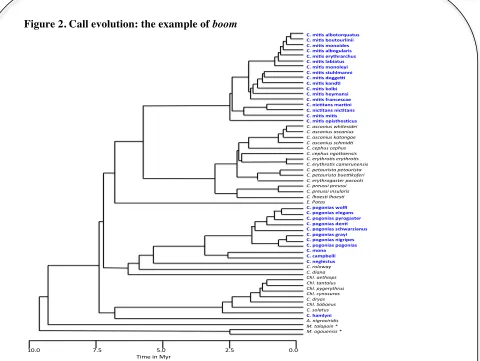
Initial results are striking. Booms are non-predation-related calls present in many subspecies of cercopithecines, including Campbell's and Putty-nosed monkeys (Figure 2). Inspection of their distribution is strongly indicative of their presence in the most recent common ancestor of entire subgroups: booms probably existed several million years ago ([5][40]). Thus while comparative monkey semantics might not directly illuminate the evolution of human language, it could yield striking insights into the evolution of meaning in simpler systems.
Concluding remarks and future perspectives
We take this discussion to suggest that general questions and tools from formal linguistics can prove fruitful in the analysis of the form and especially meaning of monkey calls. This program could be extended to other systems of animal communication as well. For instance, bird calls/songs have been argued to display interesting phonological ([41][42]), syntactic ([19][43]) and semantic ([34][35]) properties, and we mentioned in our discussion of the Urgency Principle that they might be studied from a pragmatic perspective as well. In addition, it has been argued that birds can learn morphological patterns of affixation (involving prefixes and suffixes) in artificial languages ([44]).
understanding of monkey calls is certainly a pre-condition to a meaningful comparison with human language (see Box 2).
Box 1. How does one argue for a semantic analysis?
It is sometimes thought that postulating meanings in monkeys is necessarily ad hoc because the subjects cannot be asked what they have in mind when they produce a call. This objection is based on several misconceptions.
• First, even in human linguistics one can't just ask subjects what the meaning of a word is: while they have intuitions about the truth conditions of sentences, the meaning of a word is a theoretical construct that must be supported by indirect evidence. A case in point is the word or, discussed in the text: speakers have no reliable intuitions as to whether the meaning they have in mind is inclusive or exclusive. Rather, it is by investigating the truth conditions of numerous sentences that linguists concluded that or is inclusive, and that its exclusive use is derived by the Informativity Principle. Similarly, primate semantics starts from the analysis of truth conditions; the main difference is that information about these is much harder to obtain than in adult humans. A closer point of comparison pertains to meaning in children, where experimental methods are needed to elicit truth conditions ([46]).
• Second, as in every scientific endeavor there are two main criteria of success for a theory: its parsimony; and its ability to make correct predictions ([28][45]). To be concrete, consider the case of Campbell's krak (Box 1a), and compare two theories:
(i) krak has a ground threat meaning in the Tai forest, but a meaning of general alert on Tiwai island (Dialectal Variation Theory);
(ii) krak has a general alert meaning on both sites, but is enriched by the Informativity Principle when this does not yield a useless meaning (Uniform Theory).
–If independent motivation for the Informativity Principle can be found, the Uniform Theory can be taken to be more parsimonious.
Box 2. What is the relation between monkey languages and human language?
We argue in the text that the methods of formal linguistics can prove useful in the investigation of monkey languages, but that it does not follow that the latter share non-trivial properties with human language. There are important dissimilarities and some limited similarities between the two systems ([5][28][47][48]).
• Morphology and syntax: word-internal and sentence-internal structure is extremely limited in the species we have studied (but see [21]): calls are limited to two components (e.g. krak+-oo), and there is no evidence that sequences have a complex structure. By contrast, human language has arbitrarily complex words (e.g. anti-dis-establish-ment-ari-an-ism), and highly sophisticated syntactic structures ([6][7][48]). Furthermore, monkey languages display numerous cases of call repetition, which have no equivalent in human language.
• Semantics: unlike most human words, call meanings that have been posited so far usually pertain to threats, although this is partly due to a selection bias (for female social calls, see [24][25]). Call-internal composition seems to exist in Campbell's monkeys (krak-oo) and possibly beyond, but remains limited ([28][32]). There is no real evidence of non-trivial composition of meaning sequence-internally, as each call can be taken as an individual sentence, interpreted independently from the others.
• Pragmatics: while there is no clear evidence for an ability to represent communicative intentions in monkeys, we postulated in the text an Informativity Principle that is similar in form to one found in human language, but their evolutionary relationship is unclear.
Figure 2. Call evolution: the example of boom
C. mi&s albotorquatus C. mi&s boutourlinii
C. mi&s monoides
C. mi&s albogularis C. mi&s erythrarchus C. mi&s labiatus C. mi&s monoleyi C. mi&s stuhlmanni C. mi&s dogge7 C. mi&s kand& C. mi&s kolbi C. mi&s heymansi C. mi&s francescae C. nic&tans mar&ni C. nic&tans nic&tans C. mi&s mi&s C. mi&s opisthos&cus
C. ascanius whitesidei C. ascanius ascanius C. ascanius katangae C. ascanius schmid2 C. cephus cephus C. cephus ngo5oensis C. erythro2s erythro2s C. erythro2s camerunensis C. petaurista petaurista C. petaurista bue9koferi C. erythrogaster pococki C. preussi preussi C. preussi insularis C. lhoes2 lhoes2 E. Patas
C. pogonias wolfi C. pogonias elegans
C. pogonias pyrogaster
C. pogonias den&
C. pogonias schwarzianus C. pogonias grayi C. pogonias nigripes
C. pogonias pogonias
C. mona C. campbelli C. neglectus C. roloway C. diana Chl. aethiops Chl. tantalus Chl. pygerythrus Chl. cynosuros C. dryas Chl. Sabaeus C. solatus C. hamlyni A. nigroviridis M. talapoin * M. ogouensis *
10.0 7.5 5.0 2.5 0.0 Time in Myr
Trends
• Data gathered in field experiments provide detailed information about the form and function of monkey calls, especially the situations that trigger them and the information that conspecifics derive from them.
• While monkey calls radically differ from human language, their form and meaning can be illuminated using general tools from formal linguistics (morphology, syntax, semantics). • Meaning studies should explain how monkey calls can encode information, thanks in particular to three components: the literal meaning of calls, knowledge of the environmental context, and some rules of competition among calls according to which more informative calls are normally preferred to less specific ones.
• Evolutionary connections between monkey calls and human language are unclear, but within monkey species the evolutionary history of calls can sometimes be traced over millions of years.
Outstanding Questions
• Phonology: The sound system of monkey calls should be investigated for itself, but also to determine whether some syntactic constraints are reducible to properties of the
articulatory/perceptual system.
• Morphology: Beyond Campbell's and Diana monkeys, can further cases of call-internal structure be found?
• Syntax: Can monkey syntax be analyzed by way of 'finite-state' languages, and if so which subclass of these is appropriate? Is there evidence for a level of sentence structure beyond the concatenation of individual calls?
• Lexical semantics: What constraints are there on possible call meanings? Which of these constraints come from limitations of monkey conceptual abilities? Do calls provide
information about the environment, or about actions to be taken, as is standard in
game-theoretic studies of meaning?
• Combinatorial semantics: Can all call sequences be analyzed with a minimal rule of combination, with each call contributing its meaning independently from the others? If not, what happens when syntactically complex expressions are interpreted: is their meaning compositional or non-compositional?
• Competition-based pragmatics: Can direct evidence be provided for principles of
competition among calls, such as the Informativity and Urgency Principles? Should one
re-analyze unspecific alert calls as having instead specific meanings about actions, e.g. 'look up'
(if a threat comes from above) and 'look around' (if the threat is unspecified or comes from below)?
• Intentional pragmatics: How much does primate pragmatics involve a theory of mind? In particular, are there audience effects whereby monkeys adapt their calls to the perceived belief state of their audience?
• Evolution: Can the evolution of further calls (such as cercopithecine booms) be traced over
millions of years? Can formal analyses of meaning evolution (especially within evolutionary
Glossary
Combinatorial semantics: field of semantics concerned with the literal meaning of complex
expressions in language – and by extension the object of study of this field.
Convergent evolution: the independent evolution in two species of a feature that was not
present in their most recent common ancestor.
Evolution by common descent: the existence in two species of a feature that they inherited
from their most recent common ancestor.
Evolutionary game theory: branch of game theory concerned with the ways in which some
strategies come to dominate others in social change or in biological evolution.
Informativity Principle: pragmatic principle that specifies that if a certain expression
evokes a more informative one, the speaker can utter the less informative expression only if he is not in a position to utter the more informative one, usually because it is false.
Lexical semantics: field of semantics concerned with the literal meaning of elementary
expressions in language – and by extension the object of study of this field.
Morphology: field of linguistics concerned with the internal structure of words in language –
and by extension the object of study of this field.
Phonology: field of linguistics concerned with the organization of sounds in language – and
by extension the object of study of this field.
Phylogeny: evolutionary relationships among various species. A phylogenetic tree represents
these relationships by way of a tree-like diagrams (as in Figure 2) in which the descendants of a given species appear under it in the tree (or to its right, as in Figure 2).
Pragmatics: field of linguistics concerned with the various ways in which the literal
meaning of an expression can be enriched by reasoning on the speaker's reasons for choosing it over alternative expressions; by extension, the object of study of this field.
Finite-state languages: formal languages that can be recognized by finite state machines,
which just contain a list of states and a specification of which state to go to when reading a given word. This model was shown in the 1950's to be insufficiently rich to handle human languages.
Semantics: field of linguistics concerned with the literal meaning of expressions in language;
by extension, the object of study of this field.
Syntax: field of linguistics concerned with the structure of sentences in language, in
Acknowledgments
We are very grateful to Editor Rebecca Schwarzlose as well as to three anonymous referees for very helpful comments and criticisms. For helpful feedback, we would also like to thank Guillaume Dezecache, Nathan Klinedinst, and Brent Strickland. Lucie Ravaux helped with the preparation of the final text. We are very grateful to our collaborators for their contributions to the studies summarized here, in particular: Kate Arnold; Cristiane Cäsar; James Fuller; Jean-Pierre Gautier; Sumir Keenan; Jeremy Kuhn; Alban Lemasson; Karim Ouattara; Lucie Ravaux; Robin Ryder; Anne Schel; Claudia Stephan; and Dunja Veselinović.
Grant acknowledgments:
Chemla and Schlenker: Research by Schlenker and Chemla was conducted at Institut
d’Etudes Cognitives, Ecole Normale Supérieure – PSL Research University. Institut d’Etudes Cognitives is supported by grants ANR-10-LABX-0087 IEC et ANR-10-IDEX-0001-02 PSL.
Schlenker: The research leading to these results received funding from the European
Research Coucil under the European Union’s Seventh Framework Programme (FP/2007-2013) / ERC Grant Agreement n°324115-FRONTSEM (PI:Schlenker).
Zuberbühler: The research leading to these results received funding from the European
References
[1] Zuberbühler, K. (2009) Survivor signals: the biology and psychology of animal alarm calling. Advances
in the Study of Behavior 40: 277-322
[2] Zuberbühler, K. (2003) Referential signalling in non-human primates: cognitive precursors and limitations for the evolution of language. Advances in the Study of Behavior 33: 265-307
[3] Fitch, W. T. and Zuberbühler, K. (2013) Primate precursors to human language: beyond discontinuity.
The Evolution of Emotional Communication: From Sounds in Nonhuman Mammals to Speech and Music
in Man, 26-48
[4] Seyfarth, R. M., and Cheney, D. L. (2014) The evolution of language from social cognition. Current
Opinion in Neurobiology 28: 5–9
[5] Schlenker, P. et al. (2016) Formal Monkey Linguistics. Theoretical Linguistics 42,1-2:1–90, DOI: 10.1515/tl-2016-0001
[6] Chomsky, N. (1957) Syntactic Structures. The Hague: Mouton
[7] Chomsky, N. (1965) Aspects of the Theory of Syntax, Cambridge, Massachusetts: MIT Press [8] Montague, R. (1970a) English as a Formal Language. In Visentini, B. et al. (eds.) Linguaggi nella
società e nella tecnica. Milan: Edizioni di Comunità. 189-224 [9] Montague, R. (1970b) Universal grammar. Theoria 36: 373-398 [10] Davidson, D. (1967) Truth and Meaning. Synthese 17: 304–23
[11] Bott, O. et al. (2011) The application of experimental methods in semantics. In C. Maienborn, K. von Heusinger & P. Portner (eds.), An International Handbook of Natural Language and Meaning, 303-319. Berlin: Mouton de Gruyter
[12] Chemla, E. and Singh R. (2014) Remarks on the experimental turn in the study of scalar implicature: Part
I. Language and Linguistics Compass 8(9): 387-399 & Part II. Language and Linguistics Compass 8(9):
373-386
[13] Jacobs, J, von Stechow, A, ternefeld, W. and Vennemann T., eds (1993) Syntax: an International
Handbook of Contemporary Research, Vol. 1. Berlin: de Gruyter
[14] Maienborn, C., von Heusinger, K. and Portner, P., eds (2011a) Semantics. An international handbook of
natural language meaning; Volume 1. Berlin, New York: Mouton de Gruyter
[15] Schlenker, P. (2016) The Semantics/Pragmatics Interface. In: Aloni, Maria and Dekker, Paul (eds), The
Cambridge Handbook of Formal Semantics. http://dx.doi.org/10.1017/CBO9781139236157.023
[16] Horn, L. R. (1972) On the Semantic Properties of Logical Operators in English. Ph.D. thesis, UCLA, Los Angeles
[17] Barner, D. et al. (2011) Accessing the unsaid: The role of scalar alternatives in children’s pragmatic inference. Cognition 118, 87–96
[18] Fitch, W. T. (2010) The Evolution of Language. Cambridge: Cambridge University Press
[19] Berwick, R. et al. (2011) Songs to syntax: the linguistics of birdsong. Trends in Cognitive Sciences 15 (3): 113-121
[21] Kershenbaum A. et al. (2014) Animal vocal sequences: not the Markov chains we thought they were.
Proceedings of the Royal Society of London B: Biological Sciences 281(1792): 20141370
[22] Ouattara, K. et al. (2009a) Campbell’s monkeys use affixation to alter call meaning. PLoS ONE 4(11): e7808
[23] Schlenker, P. et al. (2014) Monkey semantics: two ‘dialects’ of Campbell’s monkey alarm calls.
Linguistics and Philosophy 37(6): 439-501
[24] Candiotti, A. et al. (2012) Context-related call combinations in female Diana monkeys. Animal
Cognition 15: 327-339.
[25] Coye, C. et al. (2016) Morphologically structured vocalizations in female Diana monkeys. Animal
Behaviour 115: 97-105
[26] Scott-Phillips, T. C. (2015) Meaning in animal and human communication. Animal Cognition, 18, 801– 805.
[27] Macedonia, J.M. and Evans C.S. (1993) Variation among mammalian alarm call systems and the problem of meaning in animal signals. Ethology 93:177–197
[28] Schlenker, P. (2016) Formal Monkey Linguistics: the Debate. (Replies to commentaries). Theoretical
Linguistics 42, 1-2:173–201, DOI: 10.1515/tl-2016-0010
[29] Wheeler, B. C. and Fischer J. (2012) Functionally referential signals: a promising paradigm whose time has passed. Evolutionary Anthropology 21: 195-205
[30] Scarantino, A. and Clay Z. (2015) Contextually variable signals can be functionally referential. Anim
Behav 100:e1–e8
[31] Arnold, K. and Zuberbühler K. (2008) Meaningful call combinations in a non-human primate. Current
Biology 18(5): R202–R203
[32] Sauerland, U. (2016) On the Definition of Sentence. Commentary, Theoretical Linguistics
[33] Schlenker, P. (2016) Pyow-Hack Revisited: Two Analyses of Putty-nosed Monkey Alarm Calls. Lingua
171: 1-23
[34] Suzuki, T. N. et al. (2016) Experimental evidence for compositional syntax in bird calls. Nature
communications 7
[35] Engesser, S. (2016) Meaningful call combinations and compositional processing in the southern pied babbler. Proceedings of the National Academy of Sciences, 201600970
[36] Schlenker, P. (2016) Titi Semantics: Context and Meaning in Titi Monkey Call Sequences. Natural
Language & Linguistic Theory doi:10.1007/s11049-016-9337-9
[37] Cäsar, C. (2013) Titi monkey call sequences vary with predator location and type. Biology letters 9(5): 20130535
[38] Cap, H. (2008) Male vocal behavior and phylogeny in deer. Cladistics 24: 917-931
[39] Gautier, J-P. (1988) Interspecific affinities among guenons as deduced from vocalizations. In Gautier-Hion, A., Bourlière, F., Gautier, J.P. & Kingdon (Eds.), A Primate Radiation - Evolutionary Radiation of
the African Guenons (pp. 194-226). Cambridge University Press
[40] Guschanski, K. (2013) Next-Generation Museomics Disentangles One of the Largest Primate Radiations.
Systematic Biology 62(4): 539-554
[41] Engesser, S. (2015) Experimental evidence for phonemic contrasts in a nonhuman vocal system. PLoS Biol, 13(6), e1002171
[43] Collier, K. et al (2014). Language evolution: syntax before phonology?. In Proc. R. Soc. B (Vol. 281, No. 1788, p. 20140263). The Royal Society
[44] Chen, J. et al. (2016) Zebra finches are able to learn affixation-like patterns. Animal cognition, 19(1), 65-73
[45] Jäger, G. (2016) Grice, Occam, Darwin. Theoretical Linguistics
[46] Crain, S. and Thornton, R. (1998) Investigations in universal grammar: A guide to experiments in the
acquisition of syntax and semantics. Cambridge: The MIT Press
[47] Rizzi, L. (2016) Monkey morpho-syntax and merge-based systems. Commentary, Theoretical Linguistics