APPLICATION AND IMPLEMENTATION OF BIG
DATA IN MEDICAL SCIENCE
1
Dr. Gagandeep Jagdev,
2Rupandeep Kaur,
3Dr. Vijay Laxmi
1
Dept. of Computer Science, Punjabi University Guru Kashi College, Damdama Sahib (PB).
2
Research Scholar (M.Phil. Comp. Applications), Guru Kashi University, Talwandi Sabo (PB).
3
UCCA, Guru Kashi University, Talwandi Sabo (PB).
ABSTRACT
Medically related data underwent a huge increase in the past few decades. This tremendous increase in clinical data is referred to as a big data in medical science. These huge medical datasets bring many challenges related to storage, processing and analysis of data. Today almost 80% of data in medical sector is unstructured, but is clinically relevant. Data is scattered in the form of individual EMRs, doctor’s notes, at imaging and scanning centers and at medical stores. There is a need to get access to this valuable data and collect it in order to utilize it in the best possible manner. It is often noticed that people do not get proper treatment on time and their health gets worsened to such an extent that one has to undergo through expensive and painful medical diagnosis and treatment. Healthcare analytics if used efficiently has an enormous potential to minimize the expenditure of treatment, forecast outbreak of epidemics, shun preventable diseases and develop the overall health quality of life. Just as we people leave digital trails these days, so do our cells and have been doing so for decades as a result of biomedical research. This data, much of it stored as genetic transcripts in huge public databases, constitutes a goldmine for research and drug development. In coming ten years, eighty percent of the work people do in medicine will be replaced by technology. And medicine will not look anything like what it does today. This research paper is concerned with mining the gigantic self-constructed medical database and come out with efficient results by writing scripts and queries via Apache Hadoop framework to gain timely insight of different deadly diseases having different causes to ensure well-being of humans according to famous saying: “Prevention is better than cure”.
Keywords- Apache Hadoop framework, Big Data, EMR (Electronic Medical Record), HIS
(Healthcare Information System), Map-Reduce.
I. INTRODUCTION
Big data are rapidly all over the place. Everyone seems to be collecting, analyzing, and making money from it.
No matter whether we are talking about analyzing zillions of Google search queries to predict flu outbreaks, or
zillions of phone records to detect signs of terrorist activity, or zillions of airline stats to find the best time to buy
the digital era, it promises to solve virtually any problem like crime, public health, the evolution of grammar,
etc. Data in digital form has received a growing significance in both business and private domain. During early
beginnings of email usage in the late 1970s and early 1980s, it took a while to set up a connection via a slow
modem and then type a message on a black and white screen using a line editor and next sending the message
off, and finally shutting down the connection again. The number of characters making up the message during
that time was small compared to what we can put in an email today. At that time, nobody would have believed
that the same could be done at some point of time from an intelligent phone with much higher speed and
considerably bigger content. But besides digitalization and the fact that digital objects have become larger over
time, technology has also enabled faster transportation of data as well as human productions of data. The result
is so overpowering that the term ―big data‖ seems appropriate [1, 2]. Intel recently reported that in a single
Internet minute, 639,800GB of global IP data gets transferred over the Internet, which can be broken down into
emails, app downloads, e-commerce sales, music listening, video viewing, or social network status updates, and
this number will increase significantly over the next couple of years. Four features of big data often known as 4
V’s of big data are volume, velocity, variety and veracity [3, 4]. Volume refers to the huge amount of data that is
beyond the storage of a single organization. Velocity refers to the fact that data often comes in the form of
streams which do not give the user a chance to store it but has to act instantly on it. Variety means that data can
be in any form like unstructured, semi-structured or structured. Veracity refers to the fact the data may or may
not be trustworthy or uncertain [5, 21].
Health care has undergone a tremendous change in the last one decade. The entire system has been digitized to
provide fast, appropriate, on-time and effective care when compared to conventional systems as shown in Fig. 1
[6, 8, 22].
In recent years, the Indian government has increased spending in the health care industry. The government
plans to increase it even further by 2.5% of the GDP in the 12th five-year plan. As compared to other emerging
economies the amount of public funding that India invests in health care is very small. India ranks among the
last 5 countries with 6% of GDP expenditure on health care. Hospital bed density in India has been stagnating at
0.9 per 1000 population since 2005 and falls significantly short of WHO laid guidelines of 3.511 per 1000
patients’ population. Moreover, there is a huge disproportion in utilization of facilities at the village, district and
state levels with state level facilities remaining the most tensed. India is currently known to have approximately
600,000 doctors and 1.6 million nurses. This interprets into one doctor for every 1,800 people. The
recommended WHO guidelines suggest that there should be 1 doctor for every 600 people. This translates into a
resource gap of approximately 1.4 million doctors and 2.8 million nurses. There is also a clear disproportion in
the man power present in the rural and urban areas [7, 8].
II. ROLE PLAYED BY BIG DATA IN MEDICAL SCIENCE
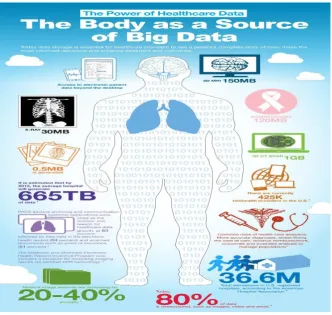
Fig. 2. Human body as a source of Big Data
Human body is a key source of Big Data as shown in Fig. 2. Health care industry is now digitizing an adequate
amount of information to readily take advantage of big data. Currently, more than 80 percent of hospitals and
more than half of all doctors use electronic medical records to collect data and organize care. Hospitals,
and warehousing it in databases. Even though businesses are leading big data applications, the public sector has
begun to be on the go, particularly in the search for effective uses of big data, with the aim of serving citizen’s
better and overcoming national challenges such as skyrocketing health care costs, job creation, natural disasters,
terrorism, and other concerns. Researchers have often argued that it would be somewhat difficult to ensure that
big data plays a central role in a health system's ability to secure improved health for its users. In particular, they
are concerned that big data involves many new challenges regarding its complexity, security, and privacy risks,
as well as the need for new technologies and human skills [5, 7, 8]. Given the implications, Big Data on health
care is not a choice but a compulsion. At the level of individual patients, it will enable faster and more holistic
decision-making, blending personal information with collective trends [9]. At the macro level, data aggregation
across regions and geographies will deliver larger samples for more statistically accurate clinical studies. And it
will enhance the overall quality of patient care while simultaneously reducing costs associated with under or
over treatment [5, 11, 13].
II. IMPACT OF BIG DATA ON HEALTH CARE SYSTEM
The popularity of big data is transforming the discussion of what is appropriate or right for a patient and right
for the healthcare environment. In keeping with these changes, we have created a holistic, patient-centered
framework that considers five key pathways to value, based on the concept that value is derived from the
balance of healthcare spend and patient impact [10, 14, 15].
A. RIGHT LIVING
Patients can build value by taking an active role in their own treatment, including disease prevention. The
right-living pathway focuses on encouraging patients to make lifestyle choices that help them remain healthy,
such as proper diet and exercise, and take an active role in their own care if they become sick.
B. CORRECT CARE
It involves ensuring that patients get the timely and appropriate treatment available. In addition to relying
heavily on protocols, right care requires a coordinated approach: across settings and providers, all caregivers
should have the same information and work toward the same goal to avoid duplication of effort and suboptimal
strategies.
C. ACCURATE PROVIDER
It proposes that patients should always be treated by high-performing professionals that are best coordinated to
the task and will achieve the best outcome. "Right provider‖ therefore has two meanings: the right match of
provider skill set to the complexity of the assignment— for instance, nurses or physicians' assistants performing
tasks that do not require a doctor—but also the specific selection of the provider with the best proven outcomes.
D. PRECISE VALUE
To fulfill the goals of precise value, providers will continuously enhance healthcare value while preserving or
improving its quality. This pathway could involve multiple measures for ensuring cost-effectiveness of care,
E. RIGHT INNOVATION
It involves the identification of new therapies and approaches to delivering care, across all aspects of the
system, and improving the innovation engines themselves. For instance, by advancing medicine and boosting
R&D productivity. To capture value in this pathway, stakeholders must make better use of prior trial data. They
could also use the data to find opportunities to improve clinical trials and traditional treatment protocols,
including those for births and inpatient surgeries [6, 12].
IV. MAP-REDUCE IN MANEUVER
Algorithm for Map-Reduce [19, 20] via pictorial representation
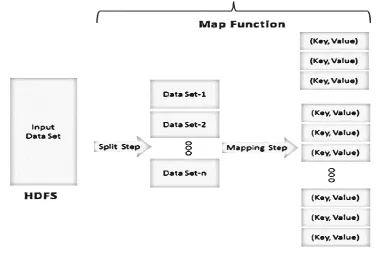
The incoming data can be alienated into n number of modules which depends upon the amount of input
data and processing power of the individual unit (Fig. 3).
All these fragmented modules are then passed over to mapper function where these modules undergo
simultaneous parallel processing (Fig. 3).
Fig. 3 MapReduce – Mapping Function
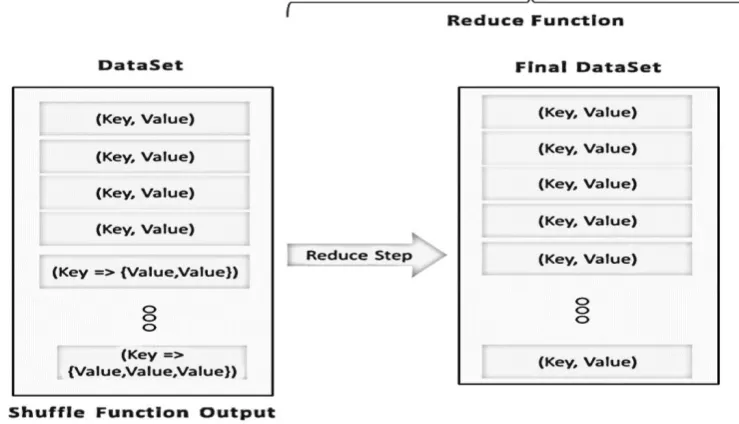
Fig. 4 MapReduce – Shuffle Function
Finally, reducer function is called which is responsible for getting the ultimate output in a reduced form
(Fig. 5).
Fig. 5 MapReduce – Reduce Function
Moreover, this technique is scalable and depending upon increase in the data to be processed, the
V. IMPLEMENTATION
A self-constructed database has been created considering the most common diseases which prevails in society.
The tool used for uploading and mining database is Hortonworks [9].
A table is created using HCatalog (in this case table name is ―medicaldb‖) as shown in Fig. 6 [16, 17].
Fig. 6 Creating Table using HCatalog
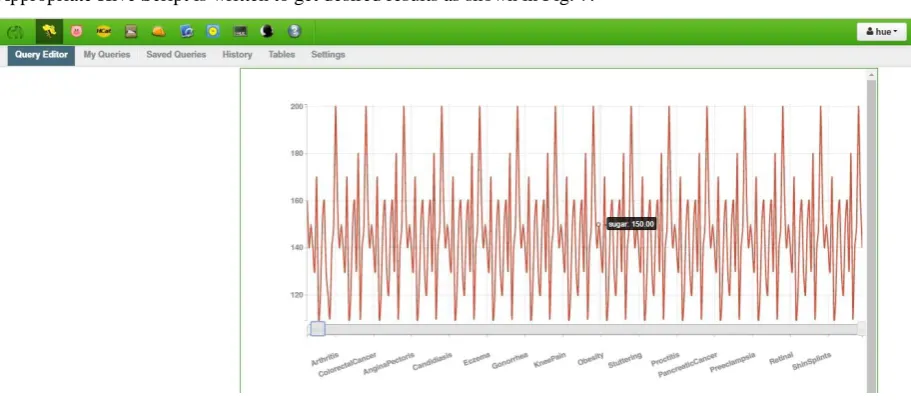
Appropriate Hive Script is written to get desired results as shown in Fig. 7.
Fig. 7 Results displayed in visualization
VI. CONCLUSION
Today, a significant proportion of the cost and time spent in the drug development process is attributable to
unsuccessful formulations. By enabling researchers to identify compounds with a higher likelihood of success,
Big Data can help reduce the cost and the time to market for new drugs. Also, by integrating learning from
medical data in the early stages of development, researchers will now be able to customize drugs to suit
Currently, information privacy concerns are the single biggest obstacle to Big Data adoption in health care.
Another is the absence of an analytics solution powerful enough to gather massive volumes of largely
unstructured health data, perform complex analyses quickly, and trigger meaningful solution, for instance,
gather all the data from ICU monitors, which today goes un-stored, put it on the Cloud, decipher significant
medical patterns that are yet undiscovered, and trigger a medical action instead of merely an alarm.
REFERENCES
[1] http://radar.oreilly.com/2012/01/what-is-big-data.html [2] www.forbes.com/sites/lisaarthur/2013/08/15/what-is-big-data/ [3] http://www.mckinsey.com/industries/pharmaceuticals-and-medical-products/our-insights/the-role-of-big-data-in-medicine [4] http://dashburst.com/infographic/big-data-volume-variety-velocity/ [5] http://www.ncbi.nlm.nih.gov/pmc/articles/PMC3848064/ [6] http://www.informationweek.in/informationweek/cio-blog/175124/healthcare-compulsion-choice [7] http://www.ncbi.nlm.nih.gov/pmc/articles/PMC3717441/ [8] http://www.datanami.com/2013/07/19/big_data_emerges_in_indian_health_care/ [9] http://hadoop.apache.org/docs/r1.2.1/hdfs_design.html[10] http://www.livemint.com/Home-Page/7evdkEgC07i96HzyDF2OTJ /Long-way-to-go-
for-benefits-from-Big-Data-in-health care-ind.html
[11] http://eandt.theiet.org/magazine/2013/03/journey-to-the-centre-of-big-data.cfm
[12] http://itbussinessconsulting.jimdo.com/2014/08/11/how-big-data-and-analytics-can-
reshape-healthcare/
[13] http://www.hissjournal.com/content/2/1/3
[14] Dr.Gagandeep Jagdev, Sukhpreet Singh, ―Applications of Big Data in Medical
Science brings revolution in managing health care of humans‖, IJEEE, Vol. 2, Spl.
Issue 1(2015), e-ISSN:1694-2310.
[15] Information Week. 2012. ―Big Data Widens Analytic Talent Gap.‖ Information Week April.
[16] R. C. Taylor, ―An overview of the Hadoop/MapReduce/HBase framework and its current applications
in bioinformatics,‖ BMC Bioinformatics, vol. 11, no. 12, article S1, 2010. View at Publisher · View
at Google Scholar · View at Scopus
[17] M. Krzywinski, I. Birol, S. J. Jones, and M. A. Marra, ―Hive plots-rational approach to
visualizing networks,‖ Briefings in Bioinformatics, vol. 13, no. 5, pp. 627–644, 2012. View at
Publisher · View at Google Scholar · View at Scopus.
[18] Heudecker, Nick. 2013. ―Hype Cycle for Big Data.‖ Gartner G00252431
[19] Edala, Seshu. 2012. ―Big Data Analytics: Not Just for Big Business Anymore.‖ Forbes.
[20] Dean, Jeffery, and Ghemawat Sanjay. 2004. ―MapReduce: Simplified Data Processing on
[21] Kaisler, S., Armour, F., Espinosa, J. A., & Money, W. (2013). Big Data: Issues and
Challenges Moving Forward. International Conference on System Sciences (pp. 995-1004).
Hawaii:IEEE Computer Soceity.
[22] Katal, A., Wazid, M., & Goudar, R. H. (2013). Big Data: Issues, Challenges, Tools and
Good Practices. IEEE, 404-409.
About the author
Dr. Gagandeep Jagdev is a faculty member in Dept. of Computer Science, Punjabi University Guru Kashi
College, Damdama Sahib (PB). His total teaching experience is above 10 years and has above 90 international
and national publications in reputed journals and conferences to his credit. He is also a member of editorial
board of four international peer reviewed journals. His field of expertise is Big Data, ANN, Biometrics, RFID,