Recent developments in track reconstruction and hadron
identi-fication at MPD
A.Mudrokh1and A.Zinchenko1
1Joint Institute for Nuclear Research, Dubna, Russia
Abstract.A Monte Carlo simulation of real detector effects with as many details as pos-sible has been carried out instead of a simplified Geant point smearing approach during the study of the detector performance. Some results of realistic simulation of the MPD
TPC (Time Projection Chamber) including digitization in central Au+Au collisions have
been obtained. Particle identification (PID) has been tuned to account for modifications in the track reconstruction. Some results on hadron identification in the TPC and TOF (Time Of Flight) detectors with realistically simulated response have been also obtained.
1 Introduction
Figure 1. Schematic view of the MPD detector
The MPD detector is a large acceptance spectrometer for heavy-ion collisions study at NICA. The main scientific goal of the NICA/MPD project is to explore the phase diagram of strongly interacting matter in the region of highly compressed and hot baryonic matter [1]. For this purpose an excellent tracking and particle identification (PID) performance over a significant fraction of the final state phase-space are required.
The Time Projection Chamber (TPC) is the main MPD tracking detector. It covers the barrel and endcap parts of MPD: its geometrical acceptance limit|η| =2. TPC is responsible for particle mo-mentum measurements, vertex determination, two track separation,dE/dxmeasurements and particle identification.
Charged hadrons can be identified in MPD by the TPC and TOF detectors. The mass of the particle is used as an identification parameter, which can be obtained by combining the measurements of its time of flight (from TOF) and its momentum (from TPC).
A new approach based on the full simulation of the detector physics and response is required in order to get realistic estimates of the MPD performance instead of a simplified approach at the smeared hit production level. Most of the physics simulation results obtained so far have been produced for the midrapidity region|η|<1. An extension of the MPD tracking (and PID) capability up to|η|<2 would allow us, for example, to increase the proton yield in the event by 50% which is important in the search for the critical end point.
In this paper only the first results of the TPC tracking and TPC+TOF hadron identification perfor-mance studies are presented based on the realistic detector response simulation and respectively tuned cluster, hit, track finding and particle identification procedures.
2 Realistic simulation of MPD TPC
Data processing model during the MPD TPC simulation consists of the following steps: event gen-eration, particle transport, TPC response simulation, cluster (hit) finding, tracking anddE/dx recon-struction and physics analysis.
The UrQMD event generator is used as an input for simulation in this study. The transport of particles through the detector is handled by the Geant3 package.
The following processes are considered in the TPC microsimulation procedure: primary ionization simulation, drift and diffusion of ionization electrons, gas gain fluctuations, pad response, electronics shaping and signal digitization.
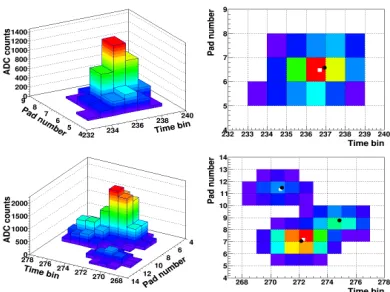
Figure 2. 3D and 2D views of single and triple track clusters
The response of the readout electronics (i.e.shaping preamplifier with 180 ns FWHM shaping time) is folded with the electron drift time distribution. Finally, all the pad signals are digitized in ADCs with the 12-bit accuracy.
The cluster (hit) finding procedure includes the following steps: finding preclusters, finding sep-arated local maxima using the "peak-and-valley" approach, reconstruction of the coordinates of the found local maxima via center-of-gravities and edge effects corrections.
The "peak-and-valley" approach consists in finding local maxima ("peaks") in the chargevstime binvspad number domain diagram (figure 2) separated by sufficiently deep "valleys". The obtained results are shown in figure 3 where the position resolution along the pad row (transverse direction) is plotted as a function of the pad row crossing angle. The spatial resolution along this direction degrades faster in the outer part of TPC where the pad height is larger.
Figure 3. Position resolution along the pad rows for tracks withpt>0.1 GeV/c and dip an-gle below 45 deg
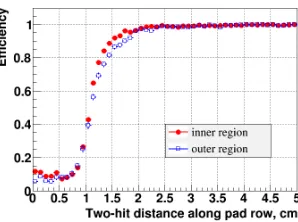
Figure 4 demonstrates 2-hit separation capability of the MPD TPC along the pad row direction. The efficiency weakly depends on whether hit is registered in the inner or outer part of the TPC.
The track reconstruction method is based on the Kalman filtering technique. In figure 4 the effi -ciency of track reconstruction is plotted as a function of transverse momentum for primary particles. The comparison of the realistic simulation with the one obtained with the simplified method,i.e.with Geant points smeared in the transverse direction, shows us the difference between two methods. The observed drop in the TPC tracking efficiency at transverse momenta pt <200 MeV/c is presumably due to a larger crossing angle of low-pttracks and a higher probability to cross inefficient regions at sector boundaries.
Figure 4. Two-hit resolution along the pad row direction (on the left) and track reconstruction efficiency as a function ofptfor primary particles (on the right)
3 Particle identification (PID) in MPD detector
One of the main requirements to the MPD experiment to be successful is to provide efficient particle identification. For instance, hadrons (p±, π± andK±) should be identified over a momentum range from 100 MeV/c to 3 GeV/c. To ensure that, the energy deposit (from TPC) and mass of particle (from TPC and TOF) are used for reconstructed tracks to get partial (TPC) or combined (TPC+TOF) probabilities of being a particle of a certain specie as explained below. As it has been already men-tioned, the detailed microsimulation of the TPC required additional PID tuning which was done on the simulated sample of central (impact parameterb=0−3 fm) Au+Au collisions at √s=6.5 GeV/c from the UrQMD (ver. 3.4) event generator.
The general idea of particle identification can be illustrated by the definition of the partial proba-bility from the TPC. Charged particles can be identified by the value of their truncated mean energy depositdE/dxplotted as a function of the full momentum (figure 5, left). For each small interval of momentum (50 MeV/c) we can produce a normalized energy deposit distribution which is adE/dx -profile for all considered particles in units of the mean piondE/dxexpected for this momentum. As it can be seen from the right plot of figure 5, the normalized energy deposit distribution is a set of (almost) normal distributions, and the main part of the PID task is to parameterize the mutual arrange-ment of these normal distributions in the whole moarrange-mentum interval,i.e. to determine the expected mean values, widths and amplitudes of the distributions. Given the PID parameterizations exist, for a reconstructed track with momentumpand energy depositdE/dxwe can obtain a vector of probabili-ties to belong to each of the particle species.
Currently, such parameterizations have been produced for TPC and TOF identification, but the set of used detectors can be expanded in future.
Momentum, GeV/c 1
−
10 1
Energy deposit, ADC counts
10000 20000 30000 40000 50000 60000 1 10 2 10 3 10 4 10
Normalized energy deposit
0.5 1 1.5 2 2.5 3 3.5 4
Count 1 10 2 10 3 10
450 - 500 MeV
Figure 5.dE/dxreconstruction: energy deposit in ADC countsvsmomentum (on the left); projection of energy deposit for particles with 0.45−0.50 GeV/c momentum (on the right)
According to the general idea described above, hadron identification in MPD can be achieved using theionization energy loss (dE/dx)from the TPC. The meandE/dxcoincides with the most probable energy deposit after suppressing Landau tail using the truncation method. According to this algorithm, the projection of energy loss at a fixed momentum has a Gaussian form, which is completely defined by three parameters. The mean value of energy loss as a function of full momen-tum can be described by the Bethe-Bloch function. PID uses simplified Bethe-Bloch function with 5 parameters:
−dE
dx =a0
⎧⎪⎪⎨
⎪⎪⎩ p
p2+m2 ⎫⎪⎪⎬ ⎪⎪⎭
−a3⎧⎪⎪⎨
⎪⎪⎩a1− p
p2+m2
a3
−ln
a2+
m p
a4⎫⎪⎪⎬
⎪⎪⎭, (1)
The parameterization was done for primary particles with the number of hits per track≥10 and
|η|<1. The ratio of the reconstructed meandE/dxto the mean value expected from the approxima-tion (1) (figure 6) was determined in order to be sure that parameterizaapproxima-tion has been done correctly. The ratio has the largest deviation from 1 on the edges of momentum spectrum because of two rea-sons. First, the simplified Bethe-Bloch function does not well describe behavior of energy deposit for low momenta. And second, the data set had low statistics at high momenta. From the plotted ratio one can obtain also the relativedE/dxwidth, which is about 7% in the whole momentum interval.
Momentum, GeV/c
0 0.5 1 1.5 2 2.5 3
dedx / Pid Bethe-Bloch 0.8 0.85 0.9 0.95 1 1.05 1.1 1.15 1.2 Ratio Pions Momentum, GeV/c
0 0.5 1 1.5 2 2.5 3 3.5 4
2 ) 2 , (GeV/c 2 m 0.4 − 0.2 − 0 0.2 0.4 0.6 0.8 1 1.2 1.4 10 2 10 3 10 4 10 5 10
Figure 6.Ratio of the reconstructed meandE/dxto the value from the approximation 1 (on the left) and depen-dence of mass-squared on particle momentum (on the right).
Particle identification works much better, if TOF identificationis available. It significantly im-proves PID results for high momenta, where particles cannot be identified by thedE/dxvalue. TOF identification is based on separation of particles by their reconstructed mass-squared value, which can be calculated from particle momentum and measured time of flight (figure 6 right). Using the proce-dure, similar to the one described fordE/dx-identification, the mass-squared distributions have been produced for different momentum intervals and fitted to the gaussian functions. The obtained widths were fitted by polynomials for every particle specie as it can be seen in figure 6, where the red lines show 3σmass intervals for different particles.
p (GeV/c)
0.0 0.5 1.0 1.5 2.0 2.5 3.0
Efficiency 0.0 0.2 0.4 0.6 0.8 1.0 1.2 + p + π + K p (GeV/c)
0.0 0.5 1.0 1.5 2.0 2.5 3.0
Contamination 0.0 0.1 0.2 0.3 0.4 0.5 0.6 0.7 0.8 0.9 1.0 + p + π + K
Figure 7. Combined efficiency (on the left) and contamination (on the right) of positive charged particles as a function of full momentum
4 Conclusions
The MPD TPC cluster finder method based on the detailed microsimulation procedure has been de-veloped. Simulation results have been compared with the ones obtained with the gaussian smearing approach. Further work on the reconstruction algorithm fine tuning is foreseen.
PID parameterizations have been also obtained. Efficientπ/Kseparation up to 1.5 GeV/c andπ/p separation up to 3 GeV/c has been demonstrated.
As a continuation of this work, the extension of the track reconstruction and particle identification up to|η|=2 is planned.