1056
Canadian Family Physician • Le Médecin de famille canadien Vol 53: june • juin 2007Résumés de recherche
Résumé imprimé, texte sur le web
Place à l’amélioration
Expérience des patients du Québec concernant les
soins primaires à la veille de réformes majeures
Jeannie L. Haggerty
PhDRaynald Pineault
MD PhDMarie-Dominique Beaulieu
MD MScYvon Brunelle
MAJosée Gauthier
MScFrançois Goulet
MDJean Rodrigue
MDRésumé
OBJECTIF Déterminer les différences d’accessibilité, de continuité des soins et de coordination des
services selon l’expérience des patients du Québec à la veille de réformes majeures, et fournir les données de base qui permettront d’évaluer les effets des réformes.TYPE D’éTuDE Enquête transversale à plusieurs niveaux portant sur la pratique.
CONTEXTE On a choisi au hasard 100 établissements de soins primaires de divers milieux: ville, banlieue,
campagne et régions éloignées dans 5 régions sanitaires du Québec.PARTICIPANTs Dans chaque clinique, on a choisi 4 médecins et 20 patients consécutifs de chaque
médecin.PRINCIPAuX PARAmÈTREs éTuDIés Réponses des patients à l’Outil d’évaluation des soins primaires,
un questionnaire auto-administré qui évalue l’affiliation patient-soignant, l’accessibilité, la continuité relationnelle, la coordination entre soins primaires et spécialisés, et le fait que les patients sont ou non l’objet de promotion de la santé et de services préventifs.RésuLTATs Au total, 3441 patients ont participé (taux d’acceptation de 87%) dans 100 cliniques (taux de
réponse de 64%). L’accès au médecin habituel en temps opportun était difficile, seulement 10% se disant confiants de pouvoir être reçus en moins de 24 heures en cas de maladie soudaine. Le temps d’attente moyen pour rencontrer un médecin était de 24 jours. La coordination des soins avec les spécialistes était tout au plus acceptable. Les patients avec médecins de famille rapportaient que ceux-ci avaient abordé seulement 56% des questions de promotion et de prévention de la santé appropriées pour leur âge et leur sexe et ceux sans médecins de famille rapportaient que les médecins avaient abordé encore beaucoup moins de ces questions (38%). La plupart des patients se disaient très confiants que leur médecin les connaissaient bien et qu’il s’occuperait du suivi au-delà des rencontres cliniques (continuité relationnelle). Faisaient exception ceux qui n’avaient pas de médecin de famille (16% du total et 34% des patients des cliniques sans rendez-vous).CONCLusION Cette enquête révèle de sérieux problèmes d’accessibilité. Il est urgent d’apporter des
correctifs pour éviter que la confiance des patients dans le système de santé ne subisse une baisse, même si les patients disent avoir une excellente relation avec leur médecin. Il y a également place à l’amélioration pour la promotion de la santé, lesservices préventifs et la coordination avec les spécialistes; on doit aussi accorder une attention particulière à la situation des patients sans médecin de famille.
POINTs DE REPÈRE Du RéDACTEuR
•
Cette étude concerne un point très important de la
réforme des soins de santé, soit la nécessité d’avoir
une vue claire de la situation actuelle si on veut
effectuer les bons changements et vérifier si ces
changements apportent les effets désirés.
•
Les résultats de l’étude indiquent que dans
l’orga-nisation des soins de santé au Québec, il y a place à
beaucoup d’amélioration, en ce qui concerne
notam-ment l’accessibilité aux soins, la promotion de la
santé et les services préventifs.
Cet article a fait l’objet d’une révision par des pairs.
Le texte intégral est accessible en anglais à
www.cfpc.ca/cfp
Research Abstracts
Print short, Web long
Room for improvement
Patients’ experiences of primary care in Quebec before major reforms
Jeannie L. Haggerty
PhDRaynald Pineault
MD PhDMarie-Dominique Beaulieu
MD MScYvon Brunelle
MAJosée Gauthier
MScFrançois Goulet
MDJean Rodrigue
MDABsTRACT
OBJECTIVE To investigate variations in accessibility, continuity of care, and coordination of services as
experienced by patients in Quebec on the eve of major reforms, and to provide baseline information against which reforms could be measured.DEsIGN Multilevel cross-sectional survey of practice.
sETTING One hundred primary health care settings were randomly selected in urban, suburban, rural, and
remote locations in 5 health regions in Quebec.PARTICIPANTs In each clinic, we chose up to 4 physicians and 20 consecutive patients consulting each
physician.mAIN OuTCOmE mEAsuREs Patients’ responses to a self-administered questionnaire, the Primary
Care Assessment Tool, that assessed patient-provider affiliation, accessibility, relational continuity, coordination of primary and specialty care, and whether patients received health promotion and preventive services.REsuLTs A total of 3441 patients participated (87% acceptance rate) in 100 clinics (64% response rate).
Timely access was difficult; only 10% expressed confidence they could be seen by their regular doctors within a day if they became suddenly ill. Average waiting time for a doctor’s appointment was 24 days. Coordination of care with specialists was at minimally acceptable levels. Patients with family physicians recalled them addressing only 56% of the health promotion and preventive issues appropriate for their age and sex, and patients without family physicians recalled physicians addressing substantially fewer (38%). Most patients reported they were highly confident that their physicians knew them well and would manage their care beyond clinical encounters (relational continuity). The exception was the 16% of patients overall who did not have family physicians (34% of patients at walk-in clinics).CONCLusION This survey highlights serious problems with accessibility. Improvement is needed urgently
to avoid deterioration of patients’ confidence in the health system even though patients rate their relationships with their physician highly. Health promotion, preventive services, and coordination with specialists also needed to be improved, and careful thought must be given to the plight of those without family physicians.EDITOR’s KEY POINTs
•
This study addresses a very important step in health
care reform, as it is crucial to have an understanding
of the baseline in order to make the right changes
and determine whether those changes have had the
desired effects.
•
This study found that, in the Quebec health care
settings studied, there was much room for
improve-ment, particularly in the areas of accessibility to
health care and provision of health promotion and
preventive services. Patients who had regular family
physicians fared better than those who did not.
This article has been peer reviewed.
Vol 53: june • juin 2007 Canadian Family Physician • Le Médecin de famille canadien
2001:e.1
Room for improvement
Research
I
n 2000, the Commission d’étude sur les services de santé et services sociaux1 found Quebec’s health caresystem deficient with regard to accessibility, con-tinuity, and coordination of care. Like other such com-missions, this one identified better organization and delivery of primary care as the key solution.1-5 The First
Ministers’ Health Accord in 2000 allocated $800 million over 5 years to accelerate change in primary care,6 and
in 2002, Quebec’s Ministry of Health and Social Services created and accredited family medicine groups (FMGs) to strengthen primary care.
Quebec is divided into 170 subregions, each of which is associated with a Centre local de services commun-autaires (CLSC), or local community health centre, that provides health and social services to a defined area. The scope of services varies with the needs of the popu-lation, and many metropolitan CLSCs do not offer gen-eral medical services. Approximately 15% of primary care services are provided through CLSCs and the rest are provided through physician-run clinics and private practices that are the norm elsewhere in Canada.
Although Statistics Canada has provided informa-tion on access to health services and the proporinforma-tion of Canadians who have family physicians,7,8 the Canadian
Community Health Survey did not provide information in enough detail to permit assessment of primary care overall. The purpose of our study was to survey primary care sites in Quebec to investigate patients’ experiences with primary care before reforms in order to establish a baseline against which reforms could be measured.
mETHODs
We conducted a cross-sectional, multilevel survey of primary care settings, physicians, and patients from December 2001 to October 2002 in 5 health regions of Quebec: Montreal, Montérégie, Bas-Saint-Laurent, Côte-Nord, and Gaspésie. We used a listing of primary care clinics compiled in 20009 and the 170 CLSCs to classify
sites into urban, suburban, rural, and remote geographic
areas. Then we used systematic random sampling to ensure that within each geographic area our study sam-ple had 10% solo practices, 65% group practices, and 15% CLSCs.
Eligible sites were those that offered general med-ical services to an undifferentiated clientele and had not undergone major changes in the last year. An addi-tional eligibility criterion, added after data collection began, was that at least two thirds of clinic patients could respond in English or French. Within each clinic, depending on size, we selected up to 4 physicians who had practised general medicine there at least 1 day a week for at least 1 year and recruited 20 consecutive patients consulting each physician on a certain clinic day. We chose representative days; for example, if a clinic offered walk-in and scheduled care, we sampled patients from both. Data collection sometimes spanned more than 1 day; collection was stopped after 5 half-days if 20 patients were not recruited.
Eligible patients were those able to complete a self- administered questionnaire in English or French (transla-tion validated). Parents or guardians of children younger than 18 years responded to questionnaires about their children’s care. Research technicians recruited patients on-site and administered the questionnaire face-to-face if patients had difficulty filling it in by themselves (n = 216, 6%). Most patients completed the questionnaires in the waiting room, but some (37%) opted to mail back their responses later. Sensitivity analysis showed no sys-tematic differences in patients’ reported experiences by method or timing of administration.
Patients’ experiences were assessed principally through the Primary Care Assessment Tool (PCAT),10
which measures strength of patient-provider affiliation, degree of confidence in being seen within a day for a new problem (first-contact accessibility), confidence that providers know the medical history and personal situa-tion and will manage care on an ongoing basis (relational continuity) and work well with specialists (coordination of care), and patients’ recall of having received prevent-ive care. Responses on the PCAT can be valid even if patients do not have regular providers. The question-naire included the scale for organizational accessibility from the Primary Care Assessment Survey.11 All questions
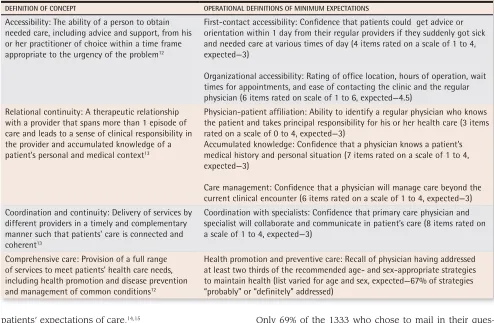
related to patients’ regular care providers or, for those without regular providers, physicians or clinics being con-sulted that day. Conceptual and operational definitions of the constructs are listed in Table 1.12,13
Responses to each PCAT item were ratings on a scale of 1 to 4: 1—definitely not, 2—probably not, 3—probably, and 4—definitely. For each dimension scale we calcu-lated the mean of the items. To facilitate interpretation of results, we established the quality standard as a mean of 3.0 (“probably”) for each item as the minimum level that should be expected for each attribute of care. The minimum level represented a quantitative expression of
Dr Haggerty is an Associate Professor in the Department of Community Health Sciences at the University of Sherbrooke in Quebec. Dr Pineault is an Emeritus Professor in the Department of Social and Preventive Medicine at the University of Montreal in Quebec. Dr Beaulieu is a Professor in the Department of Family Medicine at the University of Montreal. Mr Brunelle is on staff at the Ministry of Health and Social Services in Quebec city, Que.
patients’ expectations of care.14,15
Physicians completed the provider version of the PCAT, which assessed their usual first-contact accessibil-ity, accumulated knowledge of patients, case manage-ment responsibility, coordination of care, and provision of preventive services. Physicians’ secretaries provided dates of their third-next available appointments.16
All descriptive results were weighted (inverse of the sampling fraction for clinics) to be representative of the regions in which clinics were sampled. We present the mean response to each attribute and the proportion of patients who rated it above or below the expected min-imum level. We conducted subanalyses to look for the effects of various patient characteristics.
The study received ethical approval from the University of Montreal’s Hospital Research Centre and from several CLSCs that required local approval.
REsuLTs
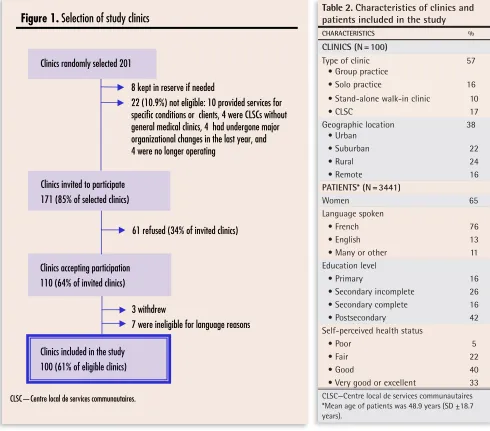
The final participation rate among eligible clinics was 61% (100 of 164) (Figure 1). The study sample included 10 clinics that identified themselves as stand-alone walk- in clinics. A total of 221 physicians contributed an aver-age of 18 (median 20)patients in clinics and 12 patients (median 12) in CLSCs. Of the 4764 patients contacted, 93% were eligible and 89% consented to participate.
Only 69% of the 1333 who chose to mail in their ques-tionnaires did so. The final patient response rate among eligible patients was 87% (n = 3441). Table 2 shows the distribution of clinics and characteristics of patients. Patients’ characteristics were typical of those seen in primary care.
About 77% of patients were consulting their regu-lar providers on the study day. Overall, 16% did not have regular physicians, but in Montreal 22% did not; in walk-in clinics 34% did not. Surprisingly, 44% of walk-in clinic patients identified clinic doctors as the physicians responsible for most of their care; in most cases (85%), these doctors shared that perception.
Table 3 shows mean patient ratings of experiences relative to minimum expected levels of care for the 7 dimensions assessed. Patients’ confidence in first-contact accessibility falls strikingly below the minimum expected level. Only 10.4% expressed confidence they could be seen within a day by their regular providers. Chances were better if patients were sick during clinics’ open hours (67% were confident they would be seen).
Ratings of organizational accessibility were better, but ratings of individual components varied greatly. While 85% rated convenience of office location as very good or excellent, only 48% rated waiting time for an appointment as very good or excellent, and only 46% rated ease of contacting a physician by telephone as very good or excellent. Average wait to the third-next
Table 1.
Conceptual and operational definitions of minimum expectations for core dimensions of primary health care
DEFINITION OF CONCEPT OPERATIONAL DEFINITIONS OF MINIMUM EXPECTATIONS
Accessibility: The ability of a person to obtain needed care, including advice and support, from his or her practitioner of choice within a time frame appropriate to the urgency of the problem12
First-contact accessibility: Confidence that patients could get advice or orientation within 1 day from their regular providers if they suddenly got sick and needed care at various times of day (4 items rated on a scale of 1 to 4, expected—3)
Organizational accessibility: Rating of office location, hours of operation, wait times for appointments, and ease of contacting the clinic and the regular physician (6 items rated on scale of 1 to 6, expected—4.5)
Relational continuity: A therapeutic relationship with a provider that spans more than 1 episode of care and leads to a sense of clinical responsibility in the provider and accumulated knowledge of a patient’s personal and medical context13
Physician-patient affiliation: Ability to identify a regular physician who knows the patient and takes principal responsibility for his or her health care (3 items rated on a scale of 0 to 4, expected—3)
Accumulated knowledge: Confidence that a physician knows a patient’s medical history and personal situation (7 items rated on a scale of 1 to 4, expected—3)
Care management: Confidence that a physician will manage care beyond the current clinical encounter (6 items rated on a scale of 1 to 4, expected—3) Coordination and continuity: Delivery of services by
different providers in a timely and complementary manner such that patients’ care is connected and coherent13
Coordination with specialists: Confidence that primary care physician and specialist will collaborate and communicate in patient’s care (8 items rated on a scale of 1 to 4, expected—3)
Comprehensive care: Provision of a full range of services to meet patients’ health care needs, including health promotion and disease prevention and management of common conditions12
Vol 53: june • juin 2007 Canadian Family Physician • Le Médecin de famille canadien
2001:e.3
Room for improvement
Research
Figure 1.
Selection of study clinics
Clinics randomly selected 201
8 kept in reserve if needed
22 (10.9%) not eligible: 10 provided services for
specific conditions or clients, 4 were CLSCs without
general medical clinics, 4 had undergone major
organizational changes in the last year, and
4 were no longer operating
Clinics invited to participate
171 (85% of selected clinics)
Clinics accepting participation
110 (64% of invited clinics)
61 refused (34% of invited clinics)
3 withdrew
7 were ineligible for language reasons
Clinics included in the study
100 (61% of eligible clinics)
CLSC—Centre local de services communautaires.
Table 2.
Characteristics of clinics and
patients included in the study
CHARACTERISTICS %
CLINICS (N = 100)
Type of clinic
• Group practice 57 • Solo practice 16 • Stand-alone walk-in clinic 10
• CLSC 17
Geographic location
• Urban 38 • Suburban 22 • Rural 24 • Remote 16
PATIENTS* (N = 3441)
Women 65 Language spoken
• French 76 • English 13 • Many or other 11 Education level
• Primary 16 • Secondary incomplete 26 • Secondary complete 16 • Postsecondary 42 Self-perceived health status
• Poor 5
• Fair 22
• Good 40
• Very good or excellent 33
CLSC—Centre local de services communautaires *Mean age of patients was 48.9 years (SD ±18.7 years).
Table 3.
Mean level of patients’ experience of core dimensions of primary care
ASPECT OF CARE MEAN RATING (SD) % WHO RATED IT BELOW EXPECTED LEVEL
Accessibility
• First-contact accessibility (rated on a scale of 1 to 4, expected—3) 2.21 (0.61) 89.9 • Organizational accessibility (rated on a scale of 1 to 6, expected—4.5) 4.61 (0.89) 38.6 Relational continuity
• Physician-patient affiliation (rated on a scale of 0 to 4, expected—3) 3.44 (1.19) 16.2 • Accumulated knowledge (rated on a scale of 1 to 4, expected—3) 3.28 (0.70) 26.5
• Care management (rated on a scale of 1 to 4, expected—3) 3.26 (0.52) 23.7
Coordination
• Coordination with specialists (rated on a scale of 1 to 4, expected—3) 3.22 (0.83) 30.0 Comprehensive care (health promotion)
• Health promotion and preventive care (each strategy rated on a scale of 1 to 4,
expected—67%* of age- and sex- appropriate strategies rated as probably [3] or definitely [4] addressed)
56.4* (29.6) 57.4
available appointment was 24 days (SD 22 days, median wait time 19 days, range 0 to 167 days); only 19% of physicians were available within 7 days. These statistics exclude the 5% of physicians never available by appoint-ment and the 5% where delays exceeded 6 months. Study physicians largely agreed with patients’ percep-tions of accessibility: only 12% reported being able to see patients within a day for sudden illness.
Relational continuity, accumulated knowledge, and care management were well within acceptable levels. Not surprisingly, patients without regular physicians had significantly less confidence in these aspects of care than those with regular physicians did (that physicians knew their personal and medical context 2.5 vs 3.4 on a scale of 4—definitely to 1—definitely not, t = 64, P < .001, or would manage their care beyond the clinical encoun-ter 2.9 vs 3.4, t = 16.9, P < .001).
The 60% of patients who had seen specialists within the last 2 years rated coordination of care at minimum acceptable levels. Patients whose primary care providers helped make specialist appointments (almost half) rated
coordination of care higher than those whose providers did not (3.4 vs 2.4 on a scale of 1 to 4, t = 34, P < .001). For 26% of patients, the last specialist visit had not been referred by their regular providers, but about two thirds of these patients were nonetheless optimistic that their providers knew of the visit and its results.
On average, patients recalled that their physicians had addressed 56% (SD 30%) of the health promotion and preventive care issues appropriate for their age and sex (eg, nutrition, vaccinations, and mental health for all; safety for children; exercise, smoking, and alcohol for adults; osteoporosis for women; and prevention of falls for the elderly).17 Among those without regular
phys-icians, only 38% of health issues had been addressed; among those with regular physicians about 64% had been addressed (t = 13, P < .001). By contrast, physicians reported “usually” addressing each issue; only a few indicated they addressed them “occasionally.”
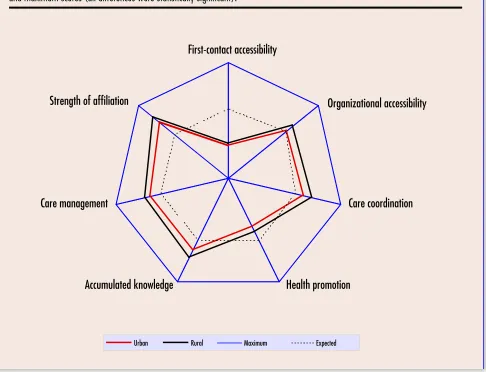
Finally, we found significant differences by geo-graphic area (Figure 2). Rural patients reported signifi-cantly better experiences than urban patients did for all
Figure 2.
Mean level of patients’ experience:
Comparison of urban and rural patients’ ratings relative to minimum expected
and maximum scores (all differences were statistically significant).
Urban Rural Maximum Expected
Strength of affiliation
Care management
Accumulated knowledge
Health promotion
Vol 53: june • juin 2007 Canadian Family Physician • Le Médecin de famille canadien
2001:e.5
Room for improvement
Research
attributes of care. While there were also differences by type of clinic, geographic differences were more consist-ent. For instance, while urban and suburban CLSCs were similar to urban practices with respect to accessibility, CLSCs in remote areas were rated highly accessible.
DIsCussION
Before this study, policy makers and the public perceived primary care in Quebec as unresponsive, fragmented, and uncoordinated with other levels of the health care system. Our study corroborates perceptions that pri-mary care is unresponsive to the need for timely access and that coordination and health promotion barely meet minimum expectations. Patients expressed high levels of confidence in their relationships with their regular phys-icians, however, and these relationships translated into better coordination and comprehensiveness of care.
The large number of patients without family phys-icians is very worrisome (approximately 1 in 4 patients in Montreal). Patients without family physicians are less likely to get recommended preventive services and experience considerably poorer access to health care and continuity and coordination of care.18,19 The plight
of those without regular physicians is critical and should be a major policy concern, especially in Quebec.
Patients are not confident they could be seen by their regular physicians or clinics within a day for sudden ill-ness, especially at night or on weekends. While a 1-day wait might seem unreasonable to some physicians, cer-tainly an average wait of 24 days for an appointment is not acceptable. Although most physicians have alter-nate arrangements for urgent care, patients depend on doctors’ secretaries for information on these, and this information varies greatly across practices.
Walk-in clinics, surprisingly, provide continuity of care for a large proportion of patients. Our results might not be generalizable, however, as some walk-in clin-ics were excluded from our sample because none of the rotating physicians worked a full day and others were inaccessible by telephone. Nonetheless, these clinics meet a need for patients without regular doctors, many of whom have figured out how to use them to achieve continuity of care. Studies have shown that the tech- nical quality of care in walk-in clinics is as good or bet-ter than that in family medicine clinics.20
Has primary care changed
since reforms in Quebec?
How much is primary care likely to have changed since reforms were implemented in Quebec? Family medi-cine groups have extended clinic hours and explicit agreements with other institutions for smooth transi-tions between various levels of care; accessibility and continuity are expected to improve. As of March 2006,
there were 103 accredited FMGs (personal communi-cation from Dr Jean-Guy Émond, President of the FMG Implementation Support Group), but the vast majority of Quebec’s population is not served by FMGs. It is unlikely the portrait of care we found in 2002 has changed sub-stantially since then.
How different is Quebec’s health care system from systems in the rest of Canada? The PCAT questionnaire was also used in 4 rural communities in Nova Scotia in 1999. When asked whether they could be seen within a day if they got sick, Nova Scotians’ mean response was 2.5 (“maybe”), compared with 1.9 (“probably not”) in Quebec, according to the Nova Scotia Primary Health Care Department. Overall, the picture was more posi-tive in Nova Scotia than in Quebec, and this could be related to physician-patient affiliation. According to the 2003 Canadian Community Health Survey,7 94% of Nova
Scotians had regular doctors, while only 76% of people had them in Quebec (86% had them in Canada as a whole).
Access to health care is similar across Canada. According to the 2003 Canadian Community Health Survey,7 24% of Canadians needing immediate care for
minor health problems reported having difficulty access-ing care.7 Difficulty accessing care was reported by 26%
of patients in Quebec, one of the highest rates, although similar to other provinces, with only Saskatchewan (17%), Alberta (22%), and British Columbia (21%) report-ing lower rates. As in our survey, the most common problems across the country were difficulty contacting physicians or nurses and long waiting times for appoint-ments.
A 2004 survey of primary care and patients’ per-ceptions of health systems carried out in 5 countries found that while Canada was second only to the United Kingdom in removing financial barriers, Canadians faced the greatest organizational barriers, with 25% of adult patients waiting longer than 6 days for care compared with 2% in New Zealand, 7% in Australia, 13% in the United Kingdom, and 19% in the United States.21 Only
in the United States did a higher percentage of respond-ents believe it was very or somewhat difficult to get care on nights, weekends, or holidays without going to emer-gency departments (63% vs 59% in Canada).
Limitations
It appears that patients with good relationships with their physicians are more tolerant, so their reports might be positively biased. Finally, it is critical to keep in mind that inferences drawn from the results of the study apply only to service users, not to the population in general.
Conclusion
This survey highlights the fact that there is much room for improvement in accessibility to primary care servi-ces. People with regular primary care physicians have good continuity of care, experience acceptable coordina-tion with specialists, and receive preventive care. Those without regular physicians have considerably worse experiences of care.
Acknowledgment
The work presented in this article should be attributed to the Department of Family Medicine at the University of Montreal in Quebec. The study was funded by the Canadian Health Services Research Foundation, the Quebec Health Research Foundation, the Regional Health Authority of Montreal-Centre, and the Dr Sadok Besrour Research Chair in Family Medicine. Direct in-kind sup-port was provided by the Institut national de santé pub-lique du Québec, the Collège des médecins du Québec, the Fédération des médecins omnipraticiens du Québec, the Regional Health Authorities of Bas-Saint-Laurent and Côte-Nord, and the Quebec Ministry of Health and Social Services. During the study, Dr Haggerty was appointed to the Department of Family Medicine at the University of Montreal and was supported as a research scholar (Junior 1) by the Quebec Health Research Foundation. Dr Beaulieu held the endowed Dr Sadok Besrour Research Chair in Family Medicine.
Contributors
Drs Haggerty, Pineault, Beaulieu, Goulet, and
Rodrigue, Mr Brunelle, and Ms Gauthier contributed to concept and design of the study; data gathering, analysis, and interpretation; and preparing the manuscript for sub-mission.
Competing interests
None declared
Correspondence to:Dr Jeannie Haggerty, Associate
Professor and Canada Research Chair, Département des Sciences de la santé communautaire, Université
Sherbooke, Complexe St-Charles, Bureau 354, tour Est, 1111, rue St-Charles Ouest, Longueuil, QC J4K 5G4;
tele-phone 450 466-5000, extension 3682; fax 450 651-6589; e-mail [email protected]
References
1. Clair M, editor. Commission d’étude sur les services de santé et les services soci-aux: les solutions émergentes. Rapport et recommandations. Quebec city, Que: Government of Quebec; 2000.
2. Sinclair DG, editor. Looking back, looking forward: the Ontario Health Services Restructuring Commission (1996-2000). A legacy report. Toronto, Ont: Government of Ontario; 2000.
3. Fyke KJ, Commission on Medicare, editors. Caring for Medicare: sustaining a quality system. Regina, Sask: Policy and Planning Branch, Saskatchewan Health; 2001.
4. Premier’s Advisory Council on Health. A framework for reform. Report of the Premier’s Advisory Council on Health. Edmonton, Alta: Government of Alberta;
2001. Available from: www.health.gov.ab.ca/resources/publications/
PACH_report_final.pdf. Accessed 2007 March 30.
5. Romanow RJ. Building on values—the future of health care in Canada. Final report. Ottawa, Ont: Commission on the Future of Health Care in Canada; 2002.
6. Health Canada. Primary Health Care Transition Fund. Ottawa, Ont: Health Canada; 2004.
7. Statistics Canada. Access to health services in Canada, 2003. Ottawa, Ont: Statistics Canada; 2004.
8. Sanmartin C, Berthelot J-M, White K, Health Analysis and Measurement Group. Access to health care services in Canada, 2001. Ottawa, Ont: Statistics Canada; 2002.
9. Demers M, Brunelle Y. Organisation de l’omnipratique au Québec entre 1994 et 1999. Quebec, Que: Ministère de la Santé et des Services sociaux; 2000. 10. Cassady CE, Starfield B, Hurtado MP, Berk RA, Nanda JP, Friedenberg LA.
Measuring consumer experiences with primary care. Pediatrics 2000;105(4 Pt 2):998-1003.
11. Safran DG, Kosinski M, Tarlov AR, Rogers WH, Taira DH, Lieberman N, et al. The Primary Care Assessment Survey: tests of data quality and measurement performance. Med Care 1998;36(5):728-39.
12. Haggerty J, Burge F, Gass D, Lévesque JF, Beaulieu MD, Pineault R, et al.
Operational definitions of attributes of primary health care to be evaluated: results of a consensus among Canadian experts. Montreal, Que: University of Montreal; 2005.
13. Haggerty JL, Reid RJ, Freeman GK, Starfield BH, Adair CE, McKendry R. Continuity of care: a multidisciplinary review. BMJ 2003;327(7425):1219-21. 14. Beaulieu MD. What do patients want from their GP? Common expectations
beyond cultural differences. Br J Gen Pract 2000;50(460):860-1.
15. Kravitz RL, Bell RA, Azari R, Kelly-Reif S, Krupat E, Thom DH. Direct obser-vation of requests for clinical services in office practice: what do patients want and do they get it? Arch Intern Med 2003;163(14):1673-81. 16. Institute for Healthcare Improvement. Measures: primary care access.
Third next available appointment. Cambridge, Mass: Institute for Healthcare
Improvement; 2005. Available from: http://www.ihi.org/IHI/Topics/
OfficePractices/Access/Measures/. Accessed 2005 November 15. 17. Canadian Task Force on the Periodic Health Examination. The Canadian
guide to clinical preventive health care. Ottawa, Ont: Canada Communication Group; 1994.
18. Flocke S, Stange KC, Zyzanski SJ. The association of attributes of primary care with the delivery of clinical preventive services. Med Care 1998;36(8 Suppl):AS21-30.
19. Ettner SL. The relationship between continuity of care and the health behaviors of patients: does having a usual physician make a difference? Med Care 1999;37(6):547-55.
20. Hutchison B, Ostbye T, Barnsley J, Stewart M, Mathews M, Campbell MK, et al. Patient satisfaction and quality of care in walk-in clinics, family prac-tices and emergency departments: the Ontario Walk-In Clinic Study. CMAJ 2003;168:977-83.
21. Schoen C, Osborn R, Huynh PT, Doty M, Davis K, Zapert K, et al. Primary care and health system performance: adults’ experiences in five countries.
Health Aff (Millwood) 2004;Suppl web exclusives:W4–487-503.