AN EVALUATION OF THE MULTIPLE CROSSOVER AND SIDE- CHAIN HYPOTHESES BASED ON AN ANALYSIS OF ALPHA
DERIVATIVES FROM THE Ab-P COMPLEXES I N MAIZE'
JOHN R. LAUGHNAN
Departments of Botany and Agronomy, University of Illinois, Urbana, Illinois
Received June 12, 1961
ARIOUS gene complexes which behave as alleles of A , in maize, and which Vcarry the general designation Ab, give rise infrequently, but consistently, to a characteristic mutant form, designated Ad or alpha (a), with intermediate effects on plant and aleurone phenotype. The occurrence of this mutant form is associated with one of the two types of recombinants for spanning marker loci with a far higher frequency than anticipated on the basis of coincidental ex- change in the marked segment (LAUGHNAN 1949, 1952a, 1955a). It was con- cluded that alpha is itself one element of a linked complex that also includes a member, designated beta ( p ) , whose phenotypic effect on plant and aleurone is full purple and is, on most criteria, indistinguishable from the total effect of the Ab complex itself. The isolation (LAUGHNAN 1956, 1961) of the beta element from the various Ab complexes in strands whose recombinant markers are com- plementary to those carrying the alpha isolate confirms both the interpretation of alpha and beta as closely linked but separable elements, and the assignment of sequences to the members.
However, as it stands, the scheme described above does not provide an obvious explanation for the infrequent but regular occurrence, from these same Ab com- plexes, of alpha-carrying strands that are nonrecombinants for the marker loci (LAUGHNAN 1949, 1952a, 1955a, c, 1961). The purpose of this report is to con- sider, for their bearing on the origin of the nonrecombinant alpha cases, certain specific mechanisms which have been proposed to account for the occurrence of somewhat similar exceptions in Neurospora (GILES 1951 ; MITCHELL 1955; ST.
LAWRENCE 1956; FREESE 1957; CASE and GILES 1958; STADLER 1959), in Asper- gillus (PRITCHARD 1955, 1960a, b; CALEF 1957), in yeast (ROMAN and JACOB 1958), in bacteriophage (STREISINGER and FRANKLIN 1956; CHASE and DOER-
M A N N 1958), in maize (STADLER and NUFFER 1953; EMMERLING 1958), and in
Drosophila
(DEMEREC
1926, 1928; CHOVNICK 1958).In most of these studies single-strand analysis of wild-type recombinants from heterozygotes involving two closely linked, functionally related mutants gave consistently anomalous distributions for the outside marker combinations. Data
(Table 1) on meiotic recombination between two cysteineless mutants ( STADLER 1959) in Neurospora are typical of inconsistencies encountered in similar in-
1 Supported by National Science Foundation Grant No. (3-3294.
1348 J O H N R. L A U G H N A N
TABLE 1
Distribution of marker combinations among cysteine-independent spores f r o m the
c ys-c/c ys-t heterozygote*
Cross Selection
Strand types with respect to marker loci Recombinants Nonrecombinants
u n vlo
+
+
U n+
+
Y bu n cys-c
+
* * Cysteine No. 18 25 68 26+
cys-t ylo independent percent 13.1 18.3 49.6 19.0~ ~~
* This table is adapted from STADLER 1959.
* * Map distances established by conventional Crossover iinalysis of progeny from this cross: u n 2.1 CYS 5.6 1.20.
vestigations of other loci. If, for example, it is held that the selected cysteine independent arises by some mechanism not involving the participation of both cysteineless cistrons, an argument which is at odds with the observation that self (within strain or homoallelic) crosses yield prototrophs with extreme rarity, or not at all, we find that among prototrophs the frequency (31.4 percent) of strands that are recombinant for the outside markers is far in excess of the pre- dicted value (7.7 percent) for coincidental exchange based on the genetic map length of the un-ylo segment. On the other hand, the argument that the CYS
independent results from conventional exchange between homologues within the cys cistron. which involves the assumption that cys-c and cys-t occupy dif- ferent sites, is at variance with the high frequency of strands that are non- recombinant for the outside markers, and with the near equality of the two recombinant classes. In this and in other studies yielding similar contradictory results, it is evident that the event giving rise to nonmutant progeny has neither the characteristics of gene mutation nor of conventional crossing over but might be considered to have attributes of both.
The various schemes proposed to explain these unusual results have, in addi- tion, had to take account of the unexpected occurrence of aberrant asci in tetrad analyses of individuals heterozygous for closely linked loci. Thus, again using the studies on the cysteine mutants (STADLER 1959) as an example, tetrad analysis of the cys-c/cys-t trans heterozygote gave three asci, of the 153 analyzed, that carried a cysteine independent spore pair. Backcross tests of the nine cysteineless strains from these asci established that the cys-c cys-t double mutant, expected if the recombinational event giving rise to the wild type were reciprocal, was not represented. Similar anomalous results, featuring the absence of the comple- mentary recombinant type, have been obtained at other loci in Neurospora
DERIVATIVES O F Ab-P COMPLEXES 1349 The hypotheses
Two basic schemes have been proposed to account for the occurrence, as a nonreciprocal recombinant, of the wild-type revertant from the type ml/m2
heterozygote, and for the unexpected distributions of outside markers among such recombinants. These models are treated here in some detail so that we may consider, in the sections that follow, whether they represent valid explanations for the anomalous alpha derivatives in maize.
Single mechanism: According to this scheme both reversion to independence, and recombination for outside markers, are ascribable to the same basic phenom- enon. On the basis of extensive analyses of mitotic ana meiotic recombinants within the ad8 cistron in Aspergillus, PRITCHARD (1955, 1960a,b) has proposed that recombination takes place in localized regions of effective pairing. The evi- dence he presents for a linear separation of the various mutant forms in this cistron is convincing. Assuming that the adenine independents which are selected in his experiments result from crossing over between mutational sites in various trans heterozygotes (e.g. adS/adII) the excessive recombination for outside markers among these revertants (negative interference) is explained on the basis of multiple exchanges within a short, effectively paired region which spans the
ad cistron. On the hypothesis of localized, effective pairing, the apparent high negative chromosome interfermce observed among the selected revertants does not imply that one crossover enhances the probability of another in its neighbor- hood but rather follows logically from the assumption that ( a ) effective pairing in the vicinity of the adenine locus occurs in only a small fraction of the cell population sampled, and (b) when pairing is realized, the probability of ex- change within the paired region is sufficiently high (PRITCHARD estimates 0.6) to account easily for the occurrence of multiple crossover strands.
On a copy-choice model the author ( PRITCHAKD 1960a) proposes that duplica- tion of the two new strands progresses simultaneously and that switches in copy from one template to the other, which may occur only within the paired segment, are highly correlated in Aspergillus, thus accoanting for the regular occurrence there of reciprocal recombinants. PRITCHARD’S suggestion that nonreciprocal re- combination, as encountered notably in Neurospora and yeast, may be attributed to slight displacement of the point of switching of one duplicating strand with respect to the other, is not unlike the explanation offered by FREESE (1957) who also postulates regions of localized, intimate pairing within which multiple switches may occur at the time of duplication; but on the latter scheme the two duplicating strands need not have equal numbers of switch points within the pairing region.
Since maize does not offer the opportunity of tetrad analysis, it is not possible to say whether the exceptional alpha occurrences are reciprocal, nonreciprocal or both. The essential feature of the schemes based on a single mechanism, SO far
1350 J O H N R . L A U G H N A N
reversion event and the excessive recombination for outside markers among the selected revertants. Specifically, on this hypothesis, the alpha isolations from A b compounds in maize are all attributable to crossing over; accordingly, those that are nonrecombinants for markers must represent isolations on strands that have been involved in an even number of exchanges in the marked segment.
Sepnrate mechanisms: The various schemes that fall in this category assume that reversion at the locus under investigation, and the excessive recombination for outside markers noted among the selected revertants, are due to different mechanisms. However, since there is a high correlation between reversion and recombination for outside markers, it must be assumed that both events are favored by a third condition which is satisfied in some, but not all, individuals of the population under investigation.
Perhaps the most appealing basis on which to argue separate events is to consign them to different spatial realms. Thus, ROMAN and JACOB (1958) favor the concept of a branched chromosome to explain the correlation between re- version at the isoleucine locus and recombination between the histidine-1 and tryptophane-2 marker loci in yeast, and in particular to account for the differen- tial effect of ultraviolet radiation on these two processes. According to this model, in the trans heterozygote involving two isoleucine mutants designated ia and io,
the latter are considered to represent defects at different sites in a DNA side chain (cistron). The selected isoleucine-independent revertant results from re- combination between the differently-defective side chains to produce one that is functionally normal, though it is clear that this event itself must be nonreciprocal to explain the observation that the complementary double-mutant type does not occur simultaneously. The abnormally high rate of recombination for outside markers among the revertants is explained by assuming that both the hypo- thetical side-chain event and conventional crossing over in the protein backbone are favored when some third condition, such as intimate pairing of homologues in the isoleucine region, obtains. On this scheme, ultraviolet radiation is held to affect differentially the side-chain and backbone events, though the authors agree that the results are not inconsistent with a scheme, such as that proposed by
FREESE (1957)
,
involving a single mechanism without the assumption of side chains.In testing the fit of the maize results to predictions based on this hypothesis it should be emphasized ihat this scheme does not provide for a linear separation of closely linked, mutant sites along the backbone of the chromosome and hence prohibits the occurrence of a revertant as a result of a conventional crossover. Therefore, neither of the recombinant marker classes should be favored on this account though they may still be disproportionate if the two kinds of side-chain reversions have different frequencies and if the frequencies of coincidental cross- overs in the marked segments to left and right are different.
DERIVATIVES O F Ab-P COMPLEXES 1351
and favors such a model to explain the results obtained from the analysis of the cysteineless mutants; thus, in the case of the cys-clcys-t heterozygote, one homologue carries an impaired cys-c side chain and an adjacent side chain that is normal for the cys-t impairment, while the other homologue carries the com- plementary condition. Although this model suffers the disadvantage of spatia1 discontinuity within the cistron, it allows for the occurrence of reversion either as a result of a crossover in the backbone or as a result of side-chain events. According to this scheme the alpha and beta members of Ab complexes in maize are considered to reside in different but adjacent side chains.
In her original report on the pyridoxine mutants, MITCHELL (1955) proposed that the occurrence, in asci from trans pdx/pdxp heterozyogtes, of occasional pyridoxine independent spore pairs unaccompanied by the reciprocal double- mutant type might be attributed to gene conversion (WINKLER 1930) leading to the recovery, in a single duplicating strand, of the normal counterparts of both mutant forms, for which she did not assume linear separation. Since gene con- version itself will not account for the excessive recombination of outside markers encountered among the revertants in single strand analyses, it was assumed that both gene conversion and crossing over are favored by a particular circumstance, held to prevail in some cells of the population but not in others, such as intimate pairing between homologues in the neighborhood of the pyridoxine locus. Un- fortunately, the term “gene conversion” has come into widespread use to iden- tify, in a general way, those recombinational phenomena which, though they are correlated with exchanges between outside markers, can not be the product of conventional crossing over alone. But considered from a n operational standpoint, “gene conversion” has usually been defined loosely or not at all, and has come into use to describe results, in much the same way that “position effect” may be used to describe a phenomenon, but not to explain it. I n the writer’s opinion, if the term “gene conversion” has been loosely defined, or misapplied, the fault lies mainly in the lack of a convincing conceptual basis for the phenomenon. Gene conversion is held to mean (WINKLER 1930) that alleles in heterozygotes are able to convert inter se their counterparts in homologues, thus to explain the occasional exceptional ratios encountered in asci (LINDEGREN 1949,1953, 1955). But the most reasonable basis for the occurrence of such an event is by partial o r
1352 J O H N R. L A U G H N A N
conversion and the more clearly defined recombinational mechanisms discussed above and for obvious reasons the writer prefers to deal with the latter types of hypothetical models.
The Ab complexes in maize
Three Ab complexes of separate origin have been the objects of intensive genetic analyses. One of these, here designated Ab-Ec, is the original Ab of Ecuador ex- traction whose unusual phenotypic effects were described by EMERSON and ANDERSON (1932). The other two, having the general designation Ab-P, and referred to specifically as Ab-Lima and Ab-Cusco, were originally isolated from Peruvian accessions; they have a similar basic structure though they exhibit slight differences in action which indicate that they are not identical.
It has been established (LAUGHNAN 1952a, 1955a) that both the Ab-Ec and Ab-P forms are complexes consisting of separable alpha and beta elements, but it is also evident, from previous investigations, that these complexes exhibit rather remarkable differences which may be summarized as follows:
( a ) The alpha element of the Ab-P complexes is decidedly weaker in its effect on plant and aleurone pigmentation than that of Ab-Ec.
(b) Crossover analysis reveals that the sequence of alpha and beta elements in the Ab-P complexes is the reverse of that in Ab-Ec; thus, using the symbol C to designate the centromere, the order of members in the Ab-Ec complex is C:
,:p
whereas the sequence of members in the Ab-P complexes is C:P: U .(c) Whereas the Ab-Ec and Ab-P complexes yield alpha derivatives that are recombinants for marker loci with similar frequencies (ca. 3
x
lo-'), there is a tenfold difference in the frequency of occurrence of the non- recombinant alpha derivatives from the Ab-Ec complex (ca.5
X IO-') as compared with that from the Ab-P complexes (ca.5 X
I O 4 ) .Analyses (LAUGHNAN 195213, 195513) of the derivatives from homozygous Ab-Ec individuals, and from certain heterozygotes involving Ab-Ec, indicate that alpha and beta, or the segments in which they reside, are members of an adjacent duplication in which the genetic materials are ordered in the same sequence; it is evident that Ab-Ec, like Bar in Drosophila melanogaster, is a tandem, serial duplication whose members engage in oblique synapsis with homologous ele- ments of the homologue. Moreover, similar evidence (LAUGHNAN 1955a, 1961 ) from Ab-P homozygotes establishes that the beta- and alpha-carrying segments of this complex engage in oblique synapsis, indicating that they too are members of a tandem, serial duplication. Finally, the occurrence of viable alpha deriva- tives from Ab-Ec/Ab-P heterozygotes (LAUGHNAN 1955a) establishes that these complexes are not simply gross inversions with respect to each other, but rather that they have their genetic material ordered in the same sequence but with the alpha and beta segments interchanged as represented below (the numbers here have the significance only of indicating sequence of genetic material) :
Ab-Ec A b-P
cy
P
P
lYDERIVATIVES O F Ab-P COMPLEXES 1353
On the basis of these models for the two complexes there is no difficulty in accounting for the occurrence of the recombinant alpha (pale) derivative; since alpha is the left-most element of the Ab-Ec complex it is isolable on a strand that is recombinant for the distal marker locus, and conversely, crossover isolation of
alpha from the Ab-P complex is associated with recombination for the proximal marker. The pale phenotype of both crossover isolates is thus assignable to loss, to the complementary crossover strand, of the purple-acting beta element which masks the alpha effect when they are associated in the complex.
But the isolation of alpha (or loss of beta effect) from these complexes as a nonrecombinant for the marker loci does not follow from simple inspection of the model presented above and therefore requires special consideration. One of the mechanisms proposed to account for the occurrence of the nonrecombinant alpha derivatives is gene mutation of the beta member to a null level. Such a qualitative change in the beta member, rendering it impotent in the production of pigment, would lead directly to the expression of the adjacent alpha member; and since, on this hypothesis, the homologue does not participate in the muta- tional event, the alpha occurrence, except for randomly distributed, coincidental exchanges, would not be associated with recombination for marker loci.
This possibility has been explored experimentally using three separate ap- proaches :
(a) Beta elements, isolated by crossing over from the alpha member of Ab-P complexes, were subjected to mutational analysis in heterozygotes with the complex from which they were derived, to analyze for the hypothetical beta mutational event (LAUGHNAN 1957,1961).
(b) The frequency of occurrence of the nonrecombinant alpha was investi- gated in a synthetic complex of a:A constitution in which the A member was substituted for beta in the
a:p
complex of Ab-Ec (LAUGHNAN 1961). (c) Nonrecombinant alpha derivatives, along with corresponding crossover isolates from both complexes, were themselves subjected to crossover analyses in attempts to isolate the hypothetical null form of beta which is presumed, on the gene mutation hypothesis, to be present in the alpha of nonrecombinant origin ( SARMA 1959).These investigations indicate ( LAUGHNAN 1955c, 1961 ) that mutation of the beta member of the Ab complexes to a null form, if it occurs at all, is so infrequent that it can not be the mechanism responsible for the occurrence of the vast majority of nonrecombinant alpha derivatives.
1354 J O H N R . LAUGHNAN
case may be, there are rare occurrences of revertants that no longer require the metabolite. These revertants are the highly selected sample of the population which is the object of further genetic analyses. Since the individual mutant strains themselves show only negligible rates of reversion, the selection of revert- ants from the heterozygote appears to enforce the participation of both homo- logues in the reversion event. On the other hand, the A b complexes in maize carry the alpha and beta sites in a single homologue in what, by analogy, might be considered the cis phase; in pursuing the analysis of derivatives from such a complex, attention is focused on the isolation of the alpha member, an event which, unlike the reversion dealt with in the microorganisms, need not neces- sarily involve the homologue.
The figure below provides a map of a portion of the long arm of chromosome 3 in maize, including the A locus and the various marker loci employed in the
7.1 0.25 12.8
T A Sh Et
experiments to be discussed. The symbol T refers to translocation 2-3d (ANDER- SON and BRINK 1940) which has been used extensively to mark a segment proxi- mal to the A locus; it refers specifically to a 23 chromosome carrying the A locus in the interchanged portion of chromosome 3. In translocation heterozygotes, the symbol N will refer to a noninterchanged chromosome 3 . Since marked heterozy- gotes to be analyzed for alpha occurrences were routinely crossed with homozy- gous testers not carrying the translocation, the presence or absence of the inter- changed chromosome in exceptional off spring was easily determined by the presence or absence of 50 percent aborted pollen, the former of which is typically associated with plants that are heterozygous for the translocation; and since ears
of plants heterozygous for this translocation regularly exhibit abortion of half of their ovules, the pollen classification referred to above was routinely confirmed by scoring the ears of exceptional individuals for the aborted condition. The shz
(shrunken-2) factor, which in homozygous recessive condition effects a drastic collapse of the mature endosperm, is distal to A and marks a segment whose genetic length is only one-quarter unit. Because of its close proximity to A , sh,
has been preferred as a marker to the recessive factor et (etched endosperm, virescent seedling), but as we shall see, the latter may be used to advantage in certain instances. It should be observed that the genetic lengths of the T and sh
marked segments on either side of the A locus, 7.1 and 0.25 units, respectively, are almost exactly the same as the corresponding segments, 6.0 and 0.2, on either side of the ad8 cistron, defined by the markers bi (biotinless) and y (yellow), in PRITCHARD’S ( 1960b) studies with Aspergillus.
DERIVATIVES O F Ab-P COMPLEXES 1355
alternative model, according to which the primary and secondary events are based on separate mechanisms, will be referred to as the side-chain hypothesis. In pursuing the analysis we may anticipate obtaining the answers to two different but not unrelated questions: ( a ) is it possible to explain the occurrence of both the recombinant and nonrecombinant alpha isolates according to one, both, or neither of these two hypotheses, and (b) if neither scheme represents a plausible explanation for the alpha occurrences, to what extent do the available data bear on whether these mechanisms may n'evertheless operate in maize?
Evidence from deficiency heterozygotes
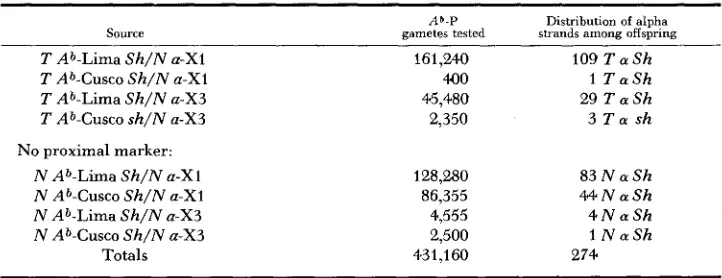
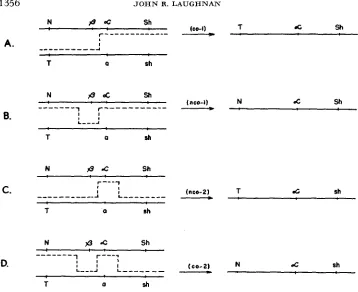
According to the multiple-exchange hypothesis, the alpha component of the marked heterozygote carrying the beta: alpha complex in one homologue and recessive a (associated with colorless phenotype) in the other, may be isolated as an apparent nonrecombinant for the marker loci in one of two ways, both of which involve double crossover strands (Figures lB, I C ) . One of these carries the parental markers of the Ab-P chromosome while the reciprocal event leads to a n alpha strand carrying the parental markers of the homologue. But in either case one of the exchanges, hereafter referred to as the primary event, must occur within the complex, that is, between the beta and alpha members. If both the recombinant and nonrecombinant alpha derivatives are dependent on a crossover between the beta and alpha members, it would be anticipated that Ab-P/Df a-X hemizygous individuals, in which the homologue is deficient for a segment of the chromosome including the A locus and in which, therefore, the opportunity for synapsis of the beta: alpha complex and hence for exchanges between homologues in that region is removed, would yield no alpha off spring.
The data presented in Table 2 are pertinent to this argument; they concern both Ab-Lima and Ab-Cusco in hemizygotes involving a-XI and a-X3, which are of X-ray origin ( STADLER and ROMAN 1948) and are known to be deficient for a
TABLE 2
Alpha derivatives f r o m hemizygous Ab-P/Df a-Xi individuals
Ab-P Distribution of alpha
Source gametes tested strands among offspring
T Ab-Lima S h / N a-X1 T Ab-Cusco S h / N a-XI T Ab-Lima S h / N a-X3 T Ab-Cusco sh/N a-X3
No proximal marker:
N Ab-Lima S h / N a-X1 N Ab-Cusco S h / N a-XI N Ab-Lima S h / N a-X3
N Ab-Cusco S h / N a-X3
Totals
161,240
400
45,480 2.350
128,280 86,355 4,555 2,500 4.31,160
1 0 9 T a S h
1 T a s h 2 9 T a S h 3 T a s h
83 N a s h H N a S h 4 N a S h 1 N a S h 274
1356 JOHN R. LAUGHNAN
B.
T 9 sh
N
a 4
ShC.
T a rh
(CO-I)
-
(nco-I)
____)
(nco- 2)
( C O - 2 )
___)
T f i sh
N
T .c sh
N rc sh
FIGURE 1.-Theoretical expectations for types of alpha-carrying strands from Ab-P/a hetero- zygotes on the multiple-exchange hypothesis. According to this scheme, all alpha isolations are attributable to the primary event, a crossover between beta and alpha members, held to occur when a relatively short segment involving the A region is effectively paired. The various combi- nations for marker loci among the alpha strands are functions of the number and position of additional exchanges (secondary events) within the effectively paired region. Complementary strands are not shown but, since the studies reported here deal with single strand analysis, it makes no difference whether the events diagrammed above result from switches on a copy-choice model or from exchanges between previously duplicated strands. The systematic basis for nco and CO designation of alpha-carrying strands with regard to marker combinations is explained in a footnote to Table 3.
DERIVATIVES O F Ab-P COMPLEXES 1357
We shall come later to the independent question of whether the multiple ex- change hypothesis is valid for maize.
Although both a-X1 and a-X3 occurred among the progeny of X-ray treated pollen carrying A , and the genetic evidence indicating that they are deficiencies is decisive, it has not been possible to identify them cytologically. Moreover, there is no known proximal marker sufficiently close to A to define accurately the left-most limits of these deletions. W e have therefore made appropriate crosses to analyze for alpha occurrences among the progeny of a special type of hypoploid in which one of the chromosome 3 homologues is deficient for almost all of the long arm of chromosome 3 and the other is involved in the translocation 2-3d interchange. Owing to nondisjunction in the second division of the micro- spore, hypoploid individuals occur regularly among the progeny of pollen parents carrying reciprocal translocations involving the A and B type chromosomes (ROMAN 1947). The hypoploid of interest here (Figure 2) was produced by crossing homozygous T Ab-Lima Sh egg parents with pollen parents carrying the A-B translocation known as T-B3a, in which almost all of the long arm of chromosme 3 is translocated to the centric portion of the B chromosome. These plants are easily distinguished from their genetically balanced sibs since they are poor in vigor, are about one third to one half normal height, and exhibit charac- teristic morphological deviations from normal. Moreover, they show the high frequency of abortion (70-80 percent) of both pollen and ovules predicted from their unusual chromosome constitution. It should be emphasized that the TP: ash segment of these hypoploids (see Figure 2) has no homologous segment with which to pair and that the 23 chromosome, of which it is a part, is expected to be involved exclusively in synapsis with the chromosome 2 homologue.
Yet, among the relatively small population of 6,900 tested Ab-Lima gametes from backcrosses of these hypoploids with homozygous N a sh pollen, there were five alpha occurrences. Further analysis has confirmed that these cases are legiti- mate and that all are of the expected nonrecombinant type: T 01 Sh. Although
the cases are too few to provide a reliable estimate of the frequency of the event, the rate as it stands compares favorably with that of alpha cases from the a-X hemizygotes (Table 2 ) . The occurrence of alpha derivatives from this hypoploid, in which crossovers in the T
p:
01 Sh segment are not possible, is critical evidence32
2
- - - -
36
-
FIGURE 2.-Diagrammatic representation of the hypoploid individual in which one of the chromosome 3 homologues is deficient for most of the long arm of chromosome 3. See text for
1358 J O H N R. LAUGHNAN
indicating that the primary crossover event assumed on the multiple-exchange hypothesis is not required for nonrecombinant alpha isolation.
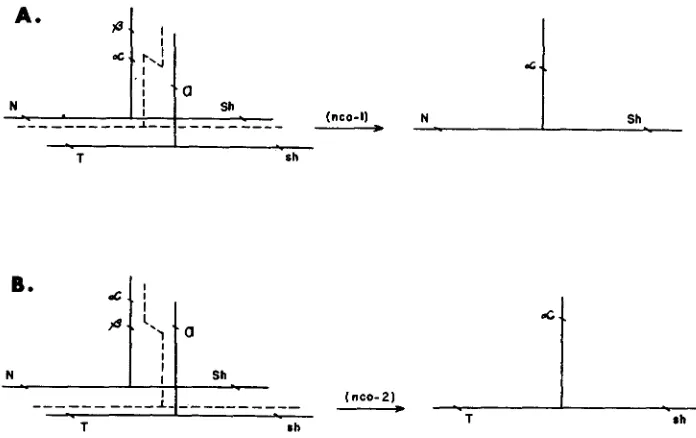
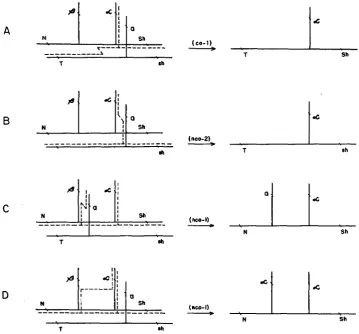
These results have a bearing also on the validity of the side-chain mechanism for the origin of nonrecombinant alpha cases. The more conservative version of this hypothesis, according to which the beta- and alpha-carrying segments are adjacent members in a single side chain, is illustrated in Figure 3. According to
this scheme the primary event, leading to alpha isolation, is an exchange (or a switch on the copy-choice model) involving the side chains of homologous chro- mosomes, whereas the secondary events. tending toward the randomizing of marker combinations, are considered to be crossovers occurring coincidentally between the backbones of homologues. We see from Figure 3 that regardless of the sequence assumed for alpha and beta in the side chain, the corresponding side chain of the homologue must be involved in the alpha isolation. From the data presented above having to do with alpha occurrences from the Ab-P/a-X hemizygotes (Table 2) and from the T-B hypoploid, neither of which provides the required homologous side chain, it is obvious that the conservative side-chain hypothesis can not be the basis for the occurrence of the great majority of alpha cases.
The modified version of the side-chain hypothesis would have the alpha and
B.
rh
( n c o - 2 )
-
.c
T rh
DERIVATIVES O F Ab-P COMPLEXES 1359
beta segments in separate but adjacent side branches. On this model, spatial separation of these elements permits the isolation of alpha by a primary event (crossover) in the backbone (Figure 4A) and, since alpha can not be isolated by the reciprocal backbone event, this scheme accommodates the observation, to be noted in the next section, that one of the two types of alpha recombinants is far more frequent than the other. Assuming that the side branch carrying the reces- sive a allele may pair with either the beta or alpha segment, this model also permits isolation of alpha by two additional types of primary event, each involv- ing the side chains of both homologues (Figures
4B
and4C).
However, since these three possibilities for alpha isolation involve participation of both homo- logues in the A region, it is obvious that they can not explain the occurrence ofA
B
C
T r h
~ . .
..
"i.'i
/D'*.
-. .. I C ,_D
(nco-I)
----
----
---A--__----
-
N Sh
T sh
1360 J O H N R. L A U G H N A N
nonrecombinant alpha derivatives from the deficiency heterozygotes discussed above.
In fact, among the various mechanisms based on models presented here, only one (Figure
4D)
will account for the occurrence of alpha derivatives without involving the homologue. It requires the assumption that the beta and alpha segments are homologous, and that copy-choice events (or exchanges) may take place between the adjacent beta and alpha side chains. Though this supposition may at first appear to be unwarranted, there is some justification for considering it a legitimate interpretation since there is independent evidence ( LAUGHNAN1955a,b) indicating that the beta and alpha members of both Ab-Ec and Ab-P are tandem, serial duplications. The event illustrated in Figure
4D
would satisfy the evidence so far presented, since it is expected to yield nonrecombinant alpha isolations ( C Y : C Y ) by a mechanism not requiring participation of the homologue. However, this hypothesis may be considered valid only if the other types of alpha isolations illustrated in Figures4A,
4B
and4C
are realized among progeny of Ab-P/a heterozygotes.To summarize then, since the multiple-exchange hypothesis and the conserva- tive side-chain hypothesis require the involvement of the homologue in the pri- mary event they are not adequate to explain the nonrecombinant alpha cases among the progeny of Ab-P/a-X and T-B3a hypoploid individuals, but this does not necessarily eliminate them as explanations for alpha cases from nondeficient Ab-P heterozygotes or homozygotes. The modified side-chain hypo thesis, which allocates alpha and beta to separate side chains, will account for nonrecombinant alpha occurrences from the deficiency heterozygotes but is acceptable only if certain other types of alpha isolations, predicted on this model, are obtained from nondeficient heterozygotes. In the analysis which follows, data on alpha isolates from various Ab-P heterozygotes are considered for their bearing on the validity of these several hypotheses.
Evidence from
A”-P
heterozygotesThe data reported in this section are from balanced heterozygotes in which the homologue of the Ab-P chromosome carries various other alleles. Unlike the hemizygotes dealt with in the foregoing section, these heterozygotes offer no impediment to occurrence of the primary event responsible for alpha isolation, and our concern here is with the distributions of marker combinations among alpha isolates and particularly with the fit of these distributions to predictions based on the proposed models.
DERIVATIVES O F Ab-P COMPLEXES 1361
TABLE 3
Constitutions of alpha-bearing strands from Ab-P/a individuals marked with
T and sh or with T and et
T 7.1 p : a 0.25 S h 12.8 E t
A6.P Number and distribution of alpha strands among offspring
Source gametes tested nco-l* nco-2* co-1 co-2'
N Ab-Lima S h / T a s h 30,390 2 0 N a S h O T a s h 4 T a S h O N a s h
N Ab-Lima sh/T a S h 53,190 24 0 12 0
T Ab-Lima S h / N a sh 462,810 185 0 4.6 0
Totals 546,390 229 0 62 0
N Ab-Cusco S h / T a sh 38,410 14 0 3 0
N Ab-Cusco sh/T a S h 56,950 13 0 22 0
T Ab-Cusco S h / N a s h 1,750 1 0 1 0
T Ab-Cusco sh/N a S h 18,760 6 0 7 0
Totals 115,870 34 0 33 0
T Ab-Lima E t / N a et 2!36,130 109 1 43 9
' As illustrated by the strand constitutions provided in the first row of this table, here and in similar tables to follow, nco-1 refers to a strand carrying the nonrecombinant markers of the parental Ab--P chromosome; nco-2 refers to a strand carrying the parental markers of its homqlogue; co-1 refers to a recombinant strand that carries the distal marker of the parental Ab-P chromosome and the proximal marker of its homologue; and co-2 refers to a recombinant strand that carries the proximal marker of the parental Ab-P chromosome and the distal marker of its homologue.
and for almost half of those from Ab-Cusco heterozygotes. Since the marked seg- ment is less than eight units it is apparent that the recombinant event is not inde- pendent of the event that isolates alpha. Thus the alpha isolates of co-1 type are consistent with the argument that beta and alpha are left and right members respectively of the parental complex and that alpha may be isolated by a cross- over (primary event), but this of course begs an explanation of the far more frequent nonrecombinant nco-1 type.
According to the multiple-exchange hypothesis which assumes that the pri- mary event is a crossover between beta and alpha members (Figure 1A) t h e nco-l type strand is the result of a second crossover to the left of beta (Figure l B ) , thus reconstituting the parental marker combination. W e note, however, that this model also calls for the occurrence of nco-2 type alpha isolations (Figure 1 C ) as a result of the alternative type of double exchange having the second crossover between (Y and sh; and co-2 alpha strands are expected to result from triple
1362 J O H N R. L A U G H N A N
to the rarity of secondary crossover events in the relatively short a-sh segment. The data in the last row of Table 3 concerning alpha strands from T and et marked Ah-Lima parents are pertinent to this question since the near equality of the marked segments in this heterozygote (this time the distal segment is longer than the proximal) should, on the multiple-exchange hypothesis, lead to the isolation of equivalent numbers of double crossover nco-1 and nco-2 alpha strands. However, this expectation is not realized; the nco-I type strands far ex- ceed the nco-2 type, of which there is only one, and moreover, even the CO-2 class. which on this hypothesis is attributable to a triple crossover, is more frequent than the nco-2 type.
Data from other types of Ab-P heterozygotes indicate that the distribution of recombinants among alpha progeny noted in Table 3 is not specifically identified with the Ab-P/a heterozygote. Table 4 summarizes the relevant data on strand constitutions of 27 alpha isolates from Ab-Lima and Ab-Cusco heterozygotes in which the homologue carries the standard A allele; and similar analyses of 78 alpha strands from heterozygotes in which isolated beta members ( LAUGHNAN
1961) are carried in the homologue, are given in Table 5. Among the total of 105 alpha strands obtained in these two experiments, 81 are of the nco-l type but there was not a single case of the nco-2 type nonrecombinant which, accord- ing to the multiple-exchange hypothesis, is expected to be equally frequent, or nearly so.
T A B L E 4
Constitutions of alpha-bearing strands from A’)-P/A indiuiduals marked with T and sh or with T and et
A b P Number and dirtnbution of alpha strands among offspring
Source gametes tested nco-1 nco-2 CO-l CO-2.
N Ab-Lima s h / T A S h
T Ab-Lima S h / N A sh N Ab-Cusco sh/T A S h
N Ab-Lima E t / T A et N Ah-Lima e t / T A Et T Ah-Lima E t / N A et
N Ab-Cusco E t / T A et Totals
5,460 19,225
22,600
4,000 550 585
2,075 54,495
2 4
9
3
e
1
2 23
TABLE 5
Constitutions of alpha-bearing strands f r o m T and sh marked heterozygotes inuoluing the Ab-Lima complex and isolated beta elements
A b - P Number and distribution of alpha strands among offspring
Source gametes tested nco-l nco-2 CO-l C W L
T Ab-Lima S h / N p-Lima sk 98,520 38 0 11 0
T Ab-Lima S h / N ,&Cusco sh 49,135 20 0 9 0
DERIVATIVES O F Ab-P COMPLEXES 1363
It is concluded that multiple exchanges within localized regions of pairing which we have seen cannot account for the nonrecombinant alpha isolations from hemizygotes, are also an unsatisfactory explanation for the occurrence of nonrecombinant alpha derivatives from balanced heterozygotes. It is obvious that recombination in the A region of chromosome 3 in maize does not follow the pattern of negative intereference which PRITCHARD ( 1960a) proposed for Asper- gillus and has generalized to other organisms ( 1960b).
The hypothesis of localized pairing segments was suggested to account for the occurrence of apparent multiple exchanges (negative interference) in short seg- ments. Since the data presented here indicate either an absence or extreme rarity of such multiple exchanges, there is reason to doubt that crossing over in maize takes place in localized regions of intimate pairing; the hypothesis will accom- modate the data only if it is assumed that withing such a pairing segment there is sufficient positive interference to prevent the occurrence of more than a single exchange, and under these circumstances there is no compelling reason to favor the hypothesis as an alternative to the conventional view.
The conservative side-chain hypothesis. which we have seen can not account for alpha isolations from deficiency heterozygotes, predicts (Figure 3) that among the alpha progeny of Ab-P heterozygotes one of the two possible nonrecombinant types for markers should predominate. The data of Tables 3, 4, and 5 show an overwhelming majority of the nco-1 class and would seem to indicate that on this hypothesis the alpha locus is proximal to beta in the side chain (Figure 3A). Since on this model the primary event that isolates alpha is exclusively a side-chain phenomenon it is expected that the marker constitutions of alpha isolates will be determined solely by the pattern of coincidental backbone crossovers within the paired segment straddling the A locus. If this pairing segment is short relative to the marked segments, as assumed by the hypothesis of localized pairing, the distribution of these coincidental exchanges on either side of the point of attach- ment of the alpha-beta side chain is expected to be random; if, alternatively, the length of pairing segment approaches or exceeds the length of the marked segments themselves, as on the conventional view, the distribution of coincidental crossovers to left and right of the alpha-beta side chain should be proportional to the lengths of the marked segments themselves.
Inspection of the data in Tables 3 , 4 , and 5 indicates that neither of these pre- dictions is satisfied. Considering only the recombinant classes for marker loci we note that the ratios for co-1:co-2 recombinants among alpha strands from T and
sh marked Ab-Lima and Ab-Cusco parents, respectively, are 83:O and 35:0, and that the corresponding ratio for T and et marked Ab-Lima individuals is 4 4 9 . These results are clearly in conflict with the expectation, based on a restricted pairing segment, of near equality of the two classes. The data from T and sh
marked parents are not in disagreement with predictions based on the assumption that all of the marked region is available for exchange since in this instance only 3.4 percent of the recombinants are expected to fall in the co-2 class (the a-sh
1364 JOHN R. L A U G H N A N
of the recombinant alpha strands should be of the CO-2 type (the a-et map value, 13.1, is about 65 percent of the T-et segment, 20.2). But the data in the last row of Table 3 are in disagreement with this prediction since only nine (1 7 percent) of the 52 recombinant strands are of the CO-2 type. Thus, regardless of the length we assume for the effective pairing segment, the actual data on frequencies of recombination among alpha isolates are contradictory and lead to the conclusion that the conservative side-chain hypothesis is unacceptable.
As noted in a previous section, the modified side-chain hypothesis, which assumes that alpha and beta are carried on separate side chains, is the only scheme among the ones considered here that will satisfactorily account for non- recombinant alpha occurrences from deficiency heterozygotes. Moreover, if the sequence of alpha and beta side chains is T
p:
CY sh, as represented in Figure 4, the occurrence of nco-1 and CO-1 alpha recombinants from nondeficient Ab-P heterozygotes (Tables 3, 4, and 5) is anticipated; the former (nco-1) are inter- pretable as primarily the result of an event involving the beta and alpha side chains of the A b homologue (Figure LED), whereas the latter (CO-1) are expected to result primarily from backbone crossovers of one type (Figure 4A) between the beta and alpha side chains. However, according to this scheme, Ab-P heterozy- gotes are expected to yield alpha derivatives as a result of two additional primary events, both occurring at the side-chain level. One of these involves a switch in copy (or exchange) between homologous side chains carrying the beta and the recessive a elements (Figure 4C) and is expected to yield occasional nco-1 strands carrying the a: CY type complex; the other involves the alpha side chain in a corre-sponding event and leads to isolations of alpha in nco-2 type strands (Figure 4B). The data are clearly not in agreement with the latter prediction since among the 625 alpha isolations reported in Tables 3, 4, and 5, only one nco-2 type strand was isolated and this occurred among the progeny of a T and et marked parent. The a : a type complex, whose isolation in nco-1 type strands is anticipated from the alternative event, should exhibit the dotted type of mutability since it carries the recessive a allele which mutates to A in the presence of Dt (RHOADES 1938). Mutable alpha derivatives have been identified but have occurred almost exclu- sively among the CO-1 class, indicating that the occurrence of the a: CY complex is attributable to conventional crossing over rather than to side-chain events.
Purely hypothetical considerations (WINGE 1955; SCHWARTZ 1955; TAYLOR
1957) suggest an endless array of possible variations on the branched chromo- some model. If, however, the two alternative schemes treated here may be con- sidered to incorporate the basic recombinational features of side-chain models in general, the data justify the conclusion that the anomalous, nonrecombinant alpha isolations are not attributable to primary events in side chains. Indeed, the evidence from these studies is opposed to the view that genetic material in maize is located in branches of the chromosome that offer the opportunity for recombi- nation at that level.
Euidence from inuersion-3a heterozygotes
DERIVATIVES O F Ah-P COMPLEXES 1365
zygotes in which one chromosome 3 member, either normal or interchanged, carries the beta: alpha complex and the other carries the recessive a allele in the differential segment of the paracentric inversion-3a. The breakpoints of this inversion have been placed on the cytological map of the long arm of chromo- some 3 at 3L 0.4 and 3L 0.95 (RHOADES and DEMPSEY 1953; personal communi- cation) ; the proximal point of exchange is to the left of Zg, (liguleless-2) and the distal break is to the right of et, such that the Ig, T , a, sh and et loci are all within the inverted segment which includes a minimum of 61 units of the genetic map. The distal breakpoint of this inversion is about 15 map units beyond A , which means that this segment represents about one fourth of the genetic length of the inversion. As expected, balanced products of single crossovers within the in- verted segment are not found among the backcross progeny of plants heterozy- gous for this inversion, but double crossover strands are recovered in 1.1 percent of functional male gametophytes and in 1.8 percent of functional female gameto- phytes (RHOADES and
DEMPSEY
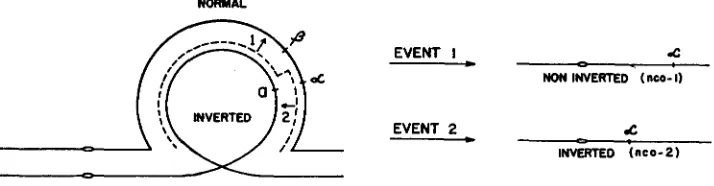
1953).Inversion-3a heterozygotes offer a n ideal opportunity to test the hypothesis of multiple exchange since strands involved in a single exchange or in odd numbers of exchanges within the inverted segment of these heterozygotes will not be repre- sented among the off spring. Accordingly, the products of single exchanges be- tween the beta and alpha members, which ordinarily would be scored as recombi- nant alpha strands, should be eliminated from the progeny of these individuals. But according to the hypothesis of localized pairing, which would account for the alpha nonrecombinant class as the result of double exchanges in a short, effec- tively paired segment spanning the A locus, the Ab-P inversion heterozygotes should yield nonrecombinant alpha progeny. The expected distribution of these nonrecombinant alpha strands may be deduced by a consideration of the events illustrated in Figure 5 which gives a diagrammatic representation of the inversion heterozygote in which the beta: alpha complex is carried in a noninterchanged
NORMAL
EVENT 1
-
EVENT 2
_L
c
NON INVERTED ( nco- I)
-
FIGURE 5.-Pairing configuration in the heterozygous, paracentric inversion-3a individual
1366 J O H N R. LAUGHNAN
chromosome 3. Assuming the initial occurrence (primary event) of a switch in copy (or an exchange) between beta and alpha, a second such event within the differential segment may be either to the left (event 1) or right (event 2 ) of the Ab complex. As shown in Figure 5 , the first of these is expected to isolate alpha in a noninverted strand (nco-1) whereas the second should lead to alpha isolations in the inverted homologue (nco-2). If, according to the multiple-exchange hy- pothesis, the effective pairing region is short relative to the segments located to the left and right of the complex and within the inversion, these two types of nonrecombinant alpha strands are expected to be equally frequent. However, if the frequencies of the two types of secondary crossovers are held to be propor- tional to the lengths of the marked segments within which they may occur, the nco-1 type alpha strand is expected to be three or four times more frequent than the nco-2 type; and if account is taken of the likely effect of chromosomal inter- ference the discrepancy between the frequencies of these two types should be even greater.
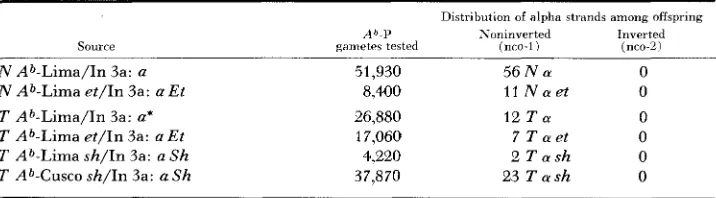
The distributions of alpha derivative: among backcross progenies of Ab-P inversion heterozygotes are given in Table 6. It should be noted that the allocation of an alpha strand to the nco-1 or nco-2 class in this instance does not require gene markers since there is no difficulty in making this determination on the basis of pollen abortion in the two types; thus, individuals which are heterozy- gous for an alpha-carrying strand of nco-2 type (inverted) and a normal a strand contributed by the tester parent, should regularly exhibit from 15 to 20 percent pollen abortion, while the nco-1 type plant, which carries two normal chromo- somes 3 , is expected to have normal pollen. The data in the first two rows of Table 6, which deal with alpha strands derived from inversion heterozygotes in which the Ab-Lima complex is carried in a noninterchanged chromosome, are not in agreement with the multiple exchange hypothesis since there were 67 isolations of the nco-1 type and not a single case of the nco-2 type alpha strand predicted on this model. However, even though there were no nco-2 type alpha derivatives among the progeny of these inversion heterozygotes, it is not unlikely that some of the nco-l alpha isolates represent double crossovers of the conventional type
TABLE 6
Alpha deriuatiues from heterozygotes carrying A’1-P in a normal or interchanged chromosome and recessiue a in the inverted segment of Inversion-3a
Source
Distribution of alpha strands among offspring
A”P Noninverted Inverted
gametes tested (nco-1) (nco-2)
N Ab-Lima/In 3a: a N Ab-Lima e t / I n 3a: a Et 7‘ Ab-Lima/In 3a: a*
T Ab-Lima et/In 3a: a Et
T Ab-Lima sh/In 3a: a S h T Ab-Cusco sh/In 3a: a Sh
51,930 5 6 N a 0
8.400 1 1 N a e t 0
26,880 l 2 T a 0
17,060 7 T a e t 0
4,220 2 T a s h 0
37,870 23 T a s h 0
DERIVATIVES O F Ab-P COMPLEXES 1367
since there is a relatively long region to the left of the primary event, but still within the differential segment of the inversion, available for the secondary event.
The frequency of nonrecombinant alpha occurrences ( c a . one per 900 tested gametes) from these inversion heterozygotes is higher than that for any genotype we have tested so far. Since it may be calculated from data in the original report ( RHOADES and DEMPSEY 1953) that double crossovers within the differential segment of inversion-3a heterozygotes are realized with a frequency only about one fifth of that expected for corresponding events in noninversion heterozygotes, the observed high frequency of alpha occurrences in these studies is itself at odds with the argument that the nonrecombinant alpha occurrences are primarily
attributable to double crossovers of the conventional type.
The data in the last four rows of Table 6 may be taken as further evidence against the multiple-exchange hypothesis. The alpha strands recovered here derive from inversion heterozygotes in which the Ab complex is carried in a n interchanged 23, noninverted chromosome. If it is assumed that effective pairing segments are highly localized, consideration of the rather complicated configura- tion expected in these heterozygotes leads to the expectation of equal numbers of nco-1 (50 percent aborted pollen in this instance) and nco-2 (15 to 20 percent aborted pollen) alpha derivatives. And if the effective pairing segment is rela- tively extended, as on the conventional view, it can be shown that these hetero- zygotes should still yield nearly equivalent numbers of alpha strands of these two types, in addition to a third class carrying alpha on a reconstituted normal chromosome 3. However, the pertinent data in Table 6 indicate that alpha isola- tions from these heterozygotes occur exclusively in association with nco- 1 type strands.
These observations support the conclusion, reached on the basis of evidence from hemizygotes and balanced heterozygotes, that the hypothesis of multiple exchange in localized regions of pairing is not a satisfactory explanation for the occurrence of the nonrecombinant alpha derivatives. Beyond this, the evidence from inversion heterozygotes suggests that the mechanism involved in the iso- lation of nonrecombinant alpha derivatives does not require exchange between homologues, a conclusion which was first suggested by the evidence from deficiency heterozygotes.
1368 J O H N R. L A U G H N A N
heterozygote may reduce the initial frequency of side-chain events between homologues, and (b) the side-chain event is correlated positively with backbone events which would lead to disproportionate elimination of the former from the progeny.
Referring once more to Figure 3A we note that on the conservative side-chain hypothesis, the primary event isolates alpha on the side chain of a strand carrying the parental markers of the Ab-P chromosome (nco-1)
.
Since, on this model, alpha and beta reside in the same branch only one type of primary event is possible. In inversion heterozygotes of the type illustrated in Figure 5 this event should lead to isolations predominantly of the nco-l type in which the alpha element is carried in a normal chromosome. Alpha strands with single coincidental cross- overs in the inversion would be eliminated and the only basis for the isolation of alpha in the inverted homologue (nco-2) would be a coincidental double crossover in adjacent regions of the backbone. While, except for the absence of the nco-2 class, the data given in Table 6 are not seriously in conflict with this scheme, it should be recognized that the test involved here is not an exacting one and that the more critical evidence from hemizygotes and balanced heterozygotes could not be accommodated on this hypothesis. Moreover, it is significant to note (see Figure 3A) that if the a member is assumed to pair indiscriminately with alpha or beta in the homologous side branch, the side-chain event in the latter instance should isolate an a : a complex which, as we have already seen, is expected to mutate in response to the Dt gene. Forty-seven of the 11 1 alpha isolations from inversion heterozygotes listed in Table 6 have been tested for Dt-induced muta- bility and all but one of these proved to be stable. The single mutable case may be considered the result of a primary crossover event isolating the a: a complex, accompanied by a coincidental exchange to reconstitute the nco-l strand type. The data from inversion heterozygotes afford a critical test of the modified side-chain hypothesis since according to this scheme side-chain events (Figures 4B, 4C, and 4D) in such heterozygotes (see Figure 5 ) should lead not only toa:a and a : a isolates in the noninverted (nco-I) chromosome but also to nco-2
type derivatives in which alpha is carried in the inverted homologue. However, these predictions are not realized since, as already noted, nco-2 type alpha isolates are not represented among the progeny of inversion heterozygotes (Table 6)
that produced 11 1 nco-1 type alpha derivatives. Moreover, as noted above, muta- bility tests of 47 of these derivatives indicate that only one is likely to have the constitution a : a ; as pointed out in the preceding paragraph, this case may be explained on conventional grounds as the result of a double crossover.
To summarize, the evidence from inversion heterozygotes, like that from hemizygotes and balanced heterozygotes, indicates that neither the multiple- exchange hypothesis nor the side-chain hypothesis is adequate to account for the origin of nonrecombinant alpha derivatives from the Ab-P complexes.
D I S C U S S I O N
DERIVATIVES O F Ab-P COMPLEXES 1369
not infrequently encountered, evidence from several microorganisms that proto- trophs, expected to arise as a result of crossover events, are too frequently iso- lated as nonrecombinants for marker loci. The experiments described here were undertaken to determine whether the nonrecombinant alpha derivatives from Ab-P complexes, which show similar deviations from the expected pattern, might reasonably be attributed to either of these mechanisms. The evidence leads to the conclusion that neither of these mechanisms will satisfactorily account for the exceptional alpha isolations. The writer is strongly inclined toward the further conclusion, which is not identical with the first, that the phenomena in question do not occur in maize, but it is apparent that certain considerations, aside from the one that these studies involve only one segment of the maize genome, argue in favor of a less sweeping statement.
The data from Ab-P/a-X hemizygotes and from the T-B hypoploid indicate that isolation of the alpha component is possible without participation of the homologue. The only reasonable conclusion to be reached from this finding is that some kind of intrachromosomal mechanism is involved in these alpha occur- rences. However, unless the assumption is made that nonrecombinant alpha strands arise by only one mechanism, the evidence from the deficiency hetero- zygotes has no critical bearing on the validity of the multiple-exchange and side- chain hypotheses, since, assuming a multiple origin, this background would screen effectively against cases originating by either of these latter mechanisms, but would not be expected to eliminate, or even diminish, those cases arising by the intrachromosomal event. In this connection it should be noted that the fre- quency of nonrecombinant alpha occurrences is at least as high among the progeny of hemizygotes as among the off spring of sib, balanced heterozygotes ( LAUGHNAN 1961 )
.
This observation favors a single origin (intrachromosomal) for these derivatives but, so far as the deficiency experiments are concerned, may be regarded as circumstantial evidence only since it could be argued that some kind of compensating influence is involved in the multiple origin of alpha exceptions.Unlike the deficiency heterozygotes, the balanced Ab-P heterozygotes and the Ab-P inversion heterozygotes should pose little or no hindrance to the primary alpha-isolating events assumed for either the multiple-exchange hypothesis or the side-chain models. Nevertheless, the distribution of recombinant and non- recombinant alpha strands from these backgrounds is inconsistent with the patterns predicted by these schemes, and the conclusion is warranted that they are not involved in the origin of the anomalous alpha derivatives.
1370 J O H N R. L A U G H N A N
and beta elements, is oriented in side chains that represent lateral extensions of the chromosome backbone and are subject to recombinational events inter se, is untenable.
It is conceivable that the phenomenon of localized pairing may exist in maize even though there is no compelling reason, from the studies reported here, to assume it. PRITCHARD’S analyses of recombination within the ad8 cistron and nearby segments in Aspergillus, and his conclusions from these studies, may suggest that the hypothesis of localized pairing should not be abandoned at this time f o r maize even though it appears that in this material multiple exchanges are not realized within the hypothetical effectively paired region.
!Occasional reference has been made in this presentation to an intrachromo- soma1 mechanism involved in the origin of alpha nonrecombinants. The evidence on alpha derivatives from the deficiency heterozygotes clearly indicates that such a phenomenon is involved, and the results obtained from the balanced and in- version heterozygotes are consistent with this conclusion. Preliminary consider-
ation has been given to such a mechanism in other publications (LAUGHNAN 1955c, 1957, 1961) and a detailed treatment is in preparation at this time.
SUMMARY
A detailed analysis of the distributions of alpha-carrying strands among the progeny of Ab-P parents carrying the beta: alpha complex was undertaken. In particular, the fit of these distributions to expectations on the hypothesis of multiple exchange in localized regions of pairing, and on two alternative side- chain models, was investigated.
The yield of alpha derivatives from Ab-P/a-X deficiency heterozygotes and from T-B hypoploid individuals indicates that isolation of alpha from the beta: alpha complex does not require participation of the homologue, and indicates that the origm of the vast majority of alpha nonrecombinants is attributable to an intrachromosomal mechanism.
The distributions of recombinant and nonrecombinant alpha strands from various balanced Ab-P heterozygotes, and from individuals carrying the Ab-P complex in a normal or interchanged chromosome and the recessive a allele in an inversion-3a homologue, are inconsistent with expectations on both the multiple-exchange hypothesis and the side-chain models.
It is concluded that ( a ) multiple exchanges within short chromosomal seg- ments either do not occur in maize or occur so rarely that they were not apparent in the studies reported here, and ( b ) the assumption that alpha and beta, and presumably the genetic material in general in maize, are oriented in side chains that are subject to recombinational events is untenable.
LITERATURE CITED
ANDERSON, E. G., and R. A. BRINK, 1940 Translocations in maize involving chromosome 3.
Effect on linkage maps of selection of crossovers between closely linked markers. Genetics 25 : 299-309.
CALEF, E., 1957