Priority Based Disk Scheduling Algorithm
C.Mallikarjuna
1, K. Sudheer Babu
2, Dr. P. Chitti Babu
3Assistant Professor, Department of Master of Computer Applications, APGCCS, Rajampet, Kadapa, AndhraPradesh, India.1
Assistant Professor, Department of Master of Computer Applications, APGCCS, Rajampet, Kadapa, AndhraPradesh, India 2
Professor, Department of Master of Computer Applications, APGCCS, Rajampet, Kadapa, AndhraPradesh, India 3
ABSTRACT: Processor speed and memory size are increasing day by day several times faster than disk speed. The difference between these two identifies that disk I/O performance could become a very important factor concerning system performance. In operating systems, seek time is very crucial. Since all device I/O requests are linked in queues, if the seek time increases the system performance gets degraded. So we need certain algorithms for serving disk requests more efficiently. These algorithms are used for scheduling the various requests regarding the disks with less time and finally the system shows the better performance. In this paper we proposed a new algorithm for disk scheduling which is quite new when compared with the existing disk scheduling algorithms.
KEYWORDS:Seek Time, Scheduling, Disk Scheduling, Priority.
I. INTRODUCTION
For a multiprogramming system with many processes, the disk queue may often have several pending requests. Thus, when one request is completed, the operating system chooses which pending request to service next. All these things should be performed by incorporating one disk scheduling algorithm. In operating system disk scheduling is major concern to access the hard disk. By using disk scheduling we can access or speed up the accessing process of hard disk. Disk scheduling is the problem of deciding which particular request for data by your computer from your hard drive should be served first.
II. RELATEDWORK
In this section we describe the related work regarding proposed disk scheduling algorithm. According to the proposed Disk Scheduling Algorithm, threads are scheduled to run based on their scheduling priority. We have also explained here how to categorize various disk requests in to many types and which priority values can be assigned to them. Each thread is assigned a scheduling priority. The priority levels range is from zero (lowest priority) to 31 (highest priority). The priority class and priority level are combined to form the base priority of a thread. The priority of each thread is determined by the following criteria.
The priority class of its process
The priority level of the thread within the priority class of its process
Priority Class
Each process belongs to one of the following priority classes.
IDLE_PRIORITY_CLASS
BELOW_NORMAL_PRIORITY_CLASS
NORMAL_PRIORITY_CLASS
ABOVE_NORMAL_PRIORITY_CLASS
HIGH_PRIORITY_CLASS
DOI: 10.15680/IJIRSET.2014.030924
Priority Level
The following are priority levels within each priority class.
THREAD_PRIORITY_IDLE
THREAD_PRIORITY_LOWEST
THREAD_PRIORITY_BELOW_NORMAL
THREAD_PRIORITY_NORMAL
THREAD_PRIORITY_ABOVE_NORMAL
THREAD_PRIORITY_HIGHEST
THREAD_PRIORITY_TIME_CRITICAL
Base Priority
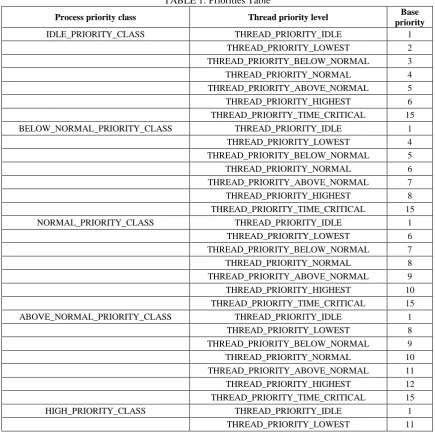
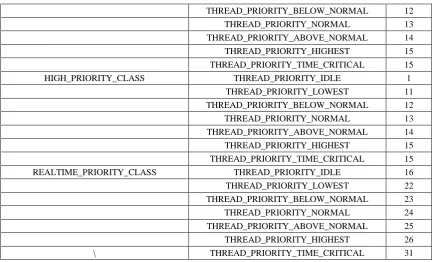
The process priority class and thread priority level are combined to form the base priority of each thread. The following table shows the base priority for combinations of process priority class and thread priority value.
TABLE 1: Priorities Table
Process priority class Thread priority level Base
priority
IDLE_PRIORITY_CLASS THREAD_PRIORITY_IDLE 1
THREAD_PRIORITY_LOWEST 2
THREAD_PRIORITY_BELOW_NORMAL 3
THREAD_PRIORITY_NORMAL 4
THREAD_PRIORITY_ABOVE_NORMAL 5
THREAD_PRIORITY_HIGHEST 6
THREAD_PRIORITY_TIME_CRITICAL 15
BELOW_NORMAL_PRIORITY_CLASS THREAD_PRIORITY_IDLE 1
THREAD_PRIORITY_LOWEST 4
THREAD_PRIORITY_BELOW_NORMAL 5
THREAD_PRIORITY_NORMAL 6
THREAD_PRIORITY_ABOVE_NORMAL 7
THREAD_PRIORITY_HIGHEST 8
THREAD_PRIORITY_TIME_CRITICAL 15
NORMAL_PRIORITY_CLASS THREAD_PRIORITY_IDLE 1
THREAD_PRIORITY_LOWEST 6
THREAD_PRIORITY_BELOW_NORMAL 7
THREAD_PRIORITY_NORMAL 8
THREAD_PRIORITY_ABOVE_NORMAL 9
THREAD_PRIORITY_HIGHEST 10
THREAD_PRIORITY_TIME_CRITICAL 15
ABOVE_NORMAL_PRIORITY_CLASS THREAD_PRIORITY_IDLE 1
THREAD_PRIORITY_LOWEST 8
THREAD_PRIORITY_BELOW_NORMAL 9
THREAD_PRIORITY_NORMAL 10
THREAD_PRIORITY_ABOVE_NORMAL 11
THREAD_PRIORITY_HIGHEST 12
THREAD_PRIORITY_TIME_CRITICAL 15
HIGH_PRIORITY_CLASS THREAD_PRIORITY_IDLE 1
THREAD_PRIORITY_BELOW_NORMAL 12
THREAD_PRIORITY_NORMAL 13
THREAD_PRIORITY_ABOVE_NORMAL 14
THREAD_PRIORITY_HIGHEST 15
THREAD_PRIORITY_TIME_CRITICAL 15
HIGH_PRIORITY_CLASS THREAD_PRIORITY_IDLE 1
THREAD_PRIORITY_LOWEST 11
THREAD_PRIORITY_BELOW_NORMAL 12
THREAD_PRIORITY_NORMAL 13
THREAD_PRIORITY_ABOVE_NORMAL 14
THREAD_PRIORITY_HIGHEST 15
THREAD_PRIORITY_TIME_CRITICAL 15
REALTIME_PRIORITY_CLASS THREAD_PRIORITY_IDLE 16
THREAD_PRIORITY_LOWEST 22
THREAD_PRIORITY_BELOW_NORMAL 23
THREAD_PRIORITY_NORMAL 24
THREAD_PRIORITY_ABOVE_NORMAL 25
THREAD_PRIORITY_HIGHEST 26
\ THREAD_PRIORITY_TIME_CRITICAL 31
Table 1 describes about the various process priority classes and their respective priority values.
III.PROPOSEDDISKSCHEDULINGALGORITHM
In this section the proposed Disk Scheduling Algorithm is described. The principle of this algorithm is –“The disk requests which has highest priority will be served first”. So before applying this algorithm we sort disk requests based on their priority values. According to the priority values each disk request will be served and the head movement is calculated. Like that all the disk requests will be served which are waiting in a disk queue. Finally the head movement is calculated for each served disk requests.
Assumptions
In this algorithm we made following assumptions.
Each Read/Write request must be assign with some priority.
The disk request which has assigned highest priority that can be serviced first.
The disk head is not moving till end of the disk and is moved further towards the request.
The disk requests can be processed in both directions i.e. either in forward direction and backward direction.
Algorithm
Priority Disk scheduling algorithm (n, p, dr, hc, count, diff, hm)
1. Start
2. //n is the number of disk requests which are arrived at the disk queue. 3. //p [] is an array which stores the priority values of various disk requests. 4. //dr [] is an array which stores the cylinder numbers of different disk requests. 5. //hc is a variable which currently holds the value of current head position. 6. //various disk requests are sorting based on priority value.
7. // diff is a variable which calculates the difference between current head position and high priority cylinder number. 8. for i=0 to n-1do
DOI: 10.15680/IJIRSET.2014.030924
9. Display hm value; 10. Stop.
IV.EXPERIMENTALRESULTS
In this section we will discuss about experimental results of the proposed Disk Scheduling Algorithm with an example. And also, we have mentioned the comparison results of the proposed Disk Scheduling Algorithm with the existing Disk Scheduling Algorithms like FCFS, SSTF, SCAN, CSCAN, LOOK, and CLOOK.
Table-2 consists of the information about various disk requests on various cylinder numbers and their priority values which are currently waited in a disk queue. And the current head position is 53.
TABLE 2: Disk Requests.
Cylinder No 98 183 37 122 14 124 65 67
Priority 6 8 1 5 2 7 3 4
Table-3 consists of the information about the sorted disk requests based on their priority values.
TABLE 3: Sorting Disk Requests Based on Priority.
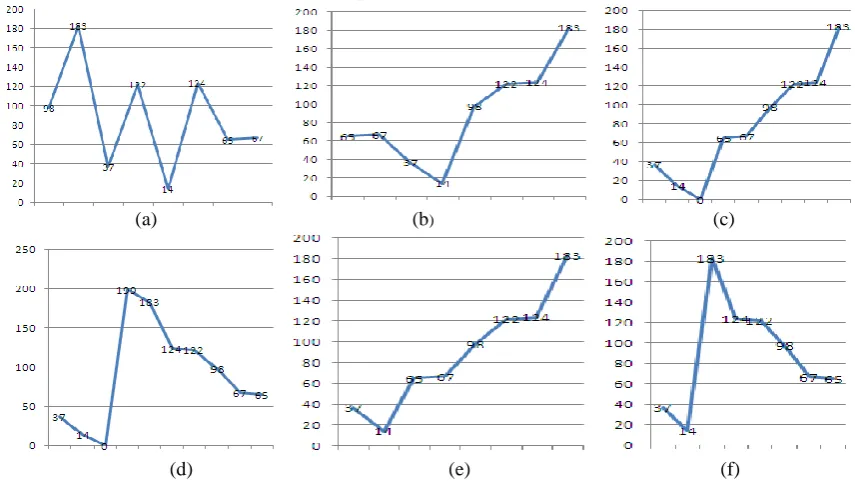
The Figure-1 shows, graphical representation of various disk scheduling algorithms for the example which is mentioned in table-2. The Figure 1-(a),(b),(c),(d),(e),(f) shows the order of servicing disk requests according to the FCFS,SSTF,SCAN,C-SCAN,LOOK,C-LOOK respectively.
(a) (b) (c)
(d) (e) (f)
Figure 1: Graphical Representation of various disk scheduling algorithms.
Figure-2 shows the graphical representation of proposed disk scheduling Algorithm i.e. “Priority Based Disk Scheduling Algorithm” and the order of disk requests which are get serviced.
Cylinder No 37 14 65 67 122 98 124 183
Figure 2: Priority Based Disk Scheduling.
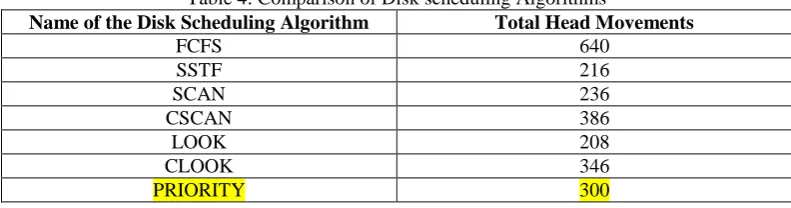
Table-4 shows the details about head movements of different disk scheduling algorithms including “Priority disk scheduling algorithm”.
Table 4: Comparison of Disk scheduling Algorithms
Name of the Disk Scheduling Algorithm Total Head Movements
FCFS 640
SSTF 216
SCAN 236
CSCAN 386
LOOK 208
CLOOK 346
PRIORITY 300
Limitations
A major problem with Priority Disk Scheduling algorithm is “indefinite blocking or starvation”. That is a request which has lowest priority that can be waited for indefinite time period to make process. Any way we can overcome this problem of indefinite blockage of low priority request with aging. Aging is a technique of gradually increasing the priority of disk requests which is waiting for a long time.
V. CONCLUSIONS
In this paper we have proposed a new Disk Scheduling Algorithm named as “Priority Based Disk Scheduling Algorithm” which works purely on the basis of priority. According to this, a disk request which is having highest priority can be served first. So in this way all the high priority disk requests can be served before, when compared with the low priority disk requests. Perhaps the disk request which is having highest priority is not waiting for so much time to do service. It is proved very easily that this scheduling algorithm is better than some of the existing algorithms
.
REFERENCES
[1] W. Stallings, "Operating Systems", 4th Edition. , Pearson Education Pvt. Ltd., 2007, ISBN 81-7808-503-8.
[2] Robert Geist, Stephen Daniel, "A Continuum of Disk Scheduling Algorithms" ACM Transactions on Computer Systems" Vol. 5, No. 1, Feb 1987, pp. 77-92
[3] A. Silberschatz, P. B. Galvin, and G. Gagne, "Operating System Concepts", 7th Edition. , John Wiley and Sons Inc, 2005, ISBN 0-471- 69466-5.
[4] L.F. Bic and A.C. Shaw,” Principles of Operating Systems”, Prentice-Hall/Pearson Education, 2003. [5] A.S. Tanenbaum, “Modern Operating Systems”, Prentice-Hall, 1996.
DOI: 10.15680/IJIRSET.2014.030924
BIOGRAPHY
C. Mallikarjuna1 holds two master degrees, first one in Computer Applications, and the other in Computer Science Engineering, currently working as Assistant Professor in the Department of M.C.A, Annamacharya P.G college of Computer Studies, Rajampeta, Kadapa Dist., A.P.
K. Sudheer Babu2 has completed master degrees in both Information Technology, and Computer Science Engineering. At present working as Assistant Professor in the Department of M.C.A, Annamacharya P.G college of Computer Studies, Rajampeta, Kadapa Dist., A.P.
Dr. P. Chitti Babu is currently working as Professor & Principal, Annamacharya PG College of Computer Studies, Rajampet, AndhraPradesh. He received his Master's Degree in Computer Applications (MCA) from SV University, Tirupathi. He has completed M.Tech in Computer Science &Engineering from Acharya Nagarjuna Univeristy, Guntur, India. He has