GRAPHICS PROCESSING UNIT BASED PARALLEL COPY MOVE IMAGE FORGERY DETECTION SCHEME
AHMAD UWAYS BIN ZULKURNAIN
A project report submitted in partial fulfilment of the requirements for the award of the degree of Master of Computer Science (Information Security)
Faculty of Computing Universiti Teknologi Malaysia
iii
iv
ACKNOWLEDGEMENT
Thank you to Dr. Mohd Fo’ad Rohani for his guidance, support and understanding. He is extremely accommodating and sincere in helping me complete the project.
Thank you to my wife and parents for their support. Without them, I could not have completed this project.
Finally, thank you to all my course mates who have given me feedback and were gracious enough to share their knowledge which helped me successfully execute this project.
v
ABSTRACT
vi
ABSTRAK
vii
TABLE OF CONTENTS
CHAPTER TITLE PAGE
DECLARATION ii
DEDICATION iii
ACKNOWLEDGEMENT iv
ABSTRACT v
ABSTRAK vi
TABLE OF CONTENTS vii
LIST OF TABLES xii
LIST OF FIGURES xiii
LIST OF ABBREVIATIONS xiv
LIST OF SYMBOLS xv
LIST OF APPENDICES xvi
1 INTRODUCTION 1
1.1 Introduction 1
1.2 Problem Background 3
1.3 Problem Statement 5
1.4 Research Questions 5
1.5 Project Aim 6
1.6 Project Objectives 6
1.7 Project Scope 6
1.8 Importance of Project 7
1.9 Thesis Organization 7
2 LITERATURE REVIEW 9
2.1 Introduction 9
2.2 Previous Works 10
2.3 Block based Methods 11
viii
2.3.1.1 Principal Component Transfor-mation with Blur Moment
In-variants 11
2.3.1.2 Gaussian Pyramid with Hu
Mo-ments 12
2.3.1.3 Scale Invariant Feature
Trans-form and Zernike Moments 12 2.3.2 Dimensionality reduction-based 12
2.3.2.1 Principal Component Analysis and Singular Value
Decomposi-tion 13
2.3.2.2 Discrete Wavelet Transform and Kernel Principal Component
Analysis 13
2.3.2.3 Principal Component
Analysis-Eigen Value Decomposition 13
2.3.3 Intensity-based 14
2.3.3.1 Additive White Gaussian Noise 14 2.3.3.2 Color Dependent Feature
Vec-tors with One Dimensional
De-scriptors 14
2.3.3.3 Relative Intensity 15
2.3.4 Frequency-based 15
2.3.4.1 Discrete Cosine Transform 15 2.3.4.2 Discrete Wavelet Transform 16 2.3.4.3 Fourier Mellin Transform 16 2.3.4.4 Polar Harmonic Transform 17 2.3.4.5 Discrete Curvelet Transform 17
2.3.5 Others 17
2.4 Comparison of Block Based Detection Schemes 18
2.5 Current Issues 18
2.5.1 Robustness against Post-Processing and
Geometric Transformations 18
2.5.2 Computation Time 20
2.5.3 Standardization of Datasets 21
2.5.4 Duplicate Matching 21
2.6 Components of Block Based Algorithms 21
2.6.1 Image Segmentation 22
ix
2.6.3 Forgery Detection Techniques 23
2.6.3.1 Radix Sort 23
2.6.3.2 Counting Bloom Filters 24
2.7 Parallelization Efforts on CPU 25
2.8 Parallelization on GPU 26
2.8.1 Data Management 27
2.8.2 Parallelization Models 27
2.8.3 Research Direction 28
2.9 Summary 28
3 RESEARCH METHODOLOGY 30
3.1 Introduction 30
3.2 Research Flow 31
3.3 Research Framework 32
3.4 Designing a Copy Move Image Forgery Detection
Scheme 32
3.4.1 Image Segmentation 32
3.4.2 Determination of Feature Extraction
Technique 34
3.4.3 Determination of Feature Extraction
Pa-rameters 34
3.5 Determination of Dataset 35
3.5.1 Existing Datasets 35
3.5.2 Self-built Dataset 36
3.5.3 Selection and Rationale 36
3.5.4 Image Selection 37
3.5.5 Image Manipulation 37
3.6 Development of prototype 38
3.7 Integration of Radix Sort and Counting Bloom
Filters 38
3.8 Experimental Setup 38
3.9 Experimental Procedure 39
3.9.1 Similarity Analysis using Radix Sort 39 3.9.2 Similarity Analysis using Counting
Bloom Filters 39
3.10 Results Comparison 39
3.10.1 Detection Rate 40
3.10.2 Detection Positive Rate 40
x
3.11 Summary 41
4 DESIGN AND IMPLEMENTATION 42
4.1 Introduction 42
4.2 CPU/GPU Architecture 42
4.3 Image Segmentation 44
4.4 Feature Extraction 44
4.4.1 Image Sub-channel Calculation 45
4.4.2 Discrete Cosine Transform 45
4.4.3 Quantization 46
4.5 Counting Bloom Filter 47
4.5.1 Duplicate Detection 47
4.5.2 Thresholds 48
4.5.3 Noise Removal 49
4.6 Final Forgery Decision 49
4.7 Summary 49
5 RESULTS AND ANALYSIS 51
5.1 Introduction 51
5.2 Execution Time 51
5.2.1 Feature Extraction 52
5.2.2 Practical Improvements 52
5.3 Forgery Detection 53
5.3.1 Impact of Memory Consumption 54
5.4 Detection Rate and Robustness 54
5.4.1 Partial Detection 55
5.4.2 Noisy Detection 56
5.4.3 JPEG Compression 56
5.4.4 Rotation and Scaling 57
5.5 Strengths and Weaknesses of Detection Scheme 59 5.6 Importance of Forgery Decision Mechanism 60
5.7 Summary 60
6 CONCLUSIONS AND FUTURE WORK 61
6.1 Introduction 61
6.2 Achievements 61
6.3 Contributions 62
xi
6.5 Concluding Remarks 62
6.6 Recommendation for Future Work 64
REFERENCES 65
xii
LIST OF TABLES
TABLE NO. TITLE PAGE
2.1 Comparison of Block Based Copy Move Image Forgery
Detection Schemes 19
3.1 Overview of Project Framework 33
xiii
LIST OF FIGURES
FIGURE NO. TITLE PAGE
1.1 Copy Move Image Forgery Detection Process 2
2.1 Copy Move Image Forgery Detection Approaches 10
2.2 Most Significant Digit (MSD) Radix Sort 24
2.3 Counting Bloom Filter 25
3.1 The Research Flow 31
4.1 Detection Scheme 43
4.2 Design for Counting Bloom Filter 47
4.3 Preliminary Detection Result 49
4.4 Detection Result After Density Check 50
4.5 Final Forgery Detection 50
5.1 Feature Extraction Times For Images of Different Sizes 52 5.2 Duplicate Detection Times Using Radix Sort And Bloom
Filter 53
5.3 Copy Move Forgery Detection Samples and Results 55
5.4 Partial Detection of Image Forgery 57
5.5 Noisy Detection of Image Forgery 58
5.6 Detection Results with Various JPEG Compression Levels 59
A.1 Project 1 Gantt Chart 68
A.2 Project 2 Gantt Chart 69
B.1 Original Image 70
B.2 Copy Move Forged Image 70
B.3 Copy Moved Regions 70
B.4 Copy Moved Pixels 71
B.5 Spliced Region 1 71
xiv
LIST OF ABBREVIATIONS
AWGN – Additive White Gaussian Noise
CASIA – Institute of Automation, Chinese Academy of Sciences CPU – Central Processing Unit
CUDA – Compute Unified Device Architecture DCT – Discrete Cosine Transform
DWT – Discrete Wavelet Transform DyWT – Dyadic Wavelet Transform FFT – Fast Fourier Transform FMT – Fourier-Mellin Transform GPU – Graphics Processing Unit
I/O – Input/Output
IMD – Image Manipulation Dataset IPC – Instructions Per Cycle
JPEG – Joint Photographic Experts Group KPCA – Kernel Principal Component Analysis LBP – Local Binary Pattern
LSD – Least Significant Digit
MIMD – Multiple Instruction, Multiple Data MSD – Most Significant Digit
PCA – Principal Component Analysis
PCA-EVD – Principal Component Analysis-Eigen Value Decomposition PCT – Principal Component Transformation
PHT – Polar Harmonic Transform
xv
LIST OF SYMBOLS
b – Block size
r – Radius
M – Image dimension
N – Alternate image dimension
Rdetection – Detection rate
Rf alse – False detection rate
x – X-coordinate of image
y – Y-coordinate of image
p – Pixel
Y0 – Luma channel
R0 – Red channel
G0 – Green channel
B0 – Blue channel
G – DCT coefficient matrix
Q – Quantization matrix
xvi
LIST OF APPENDICES
APPENDIX TITLE PAGE
A Gantt Chart Project 1 and Gantt Chart Project 2 68
B Image Manipulation Dataset Sample Image 70
C GPU Kernel 72
D Discrete Cosine Transform 74
E Counting Bloom Filter Implementation Using std::map 78
F Duplicate Detection 80
G Noise Removal Algorithm 82
CHAPTER 1
INTRODUCTION
1.1 Introduction
Image forgery detection is needed to prevent alteration of images and restore some trust in digital images (Farid, 2009). It is applied in areas such as journalism, digital forensic science, and surveillance systems (Gupta, Saxena and Vasistha, 2013). The availability of powerful image processing and editing software makes it easy to create, alter, and manipulate digital images (Fridrich, Soukal and Luk´aˇs, 2003). With that, the issue of verifying the authenticity and integrity of digital images is becoming increasingly important. There are two categories of image forgery detection techniques: active and passive. Active, also known as intrusive, detection techniques require a form of digital signature to be embedded in the image at the instance of its creation. However, not all digital devices are able to implant such signatures when capturing images (Muhammad et al., 2011). On the other hand, passive, also referred to as non-intrusive or blind, approaches examine the image blindly without reliance on any embedded information. Although a passive approach has wider scope of usefulness, it is a computationally expensive process (Khan and Kulkarni, 2010).
2
The purpose of block based copy move image forgery detection is to avoid an exhaustive comparison of pixels, which is impractical for large images which are made up of millions of pixels. Segmenting the image into blocks reduces the number of features which need to be compared. In order to produce small but accurate representation of blocks, many feature extraction techniques have been proposed such as Discrete Cosine Transform (DCT) (Fridrich et al., 2003), Principal Component Analysis (PCA) (Farid and Popescu, 2004), Discrete Wavelet Transform (DWT) (Bashar et al., 2010), Singular Value Decomposition (SVD) (Ting and Rang-ding, 2009), and Fourier-Mellin Transform (FMT) (Bayramet al., 2009). Some hybrids and sub-variations of the aforementioned techniques have also been proposed. Although many approaches have been proposed, there are still issues that need to be solved.
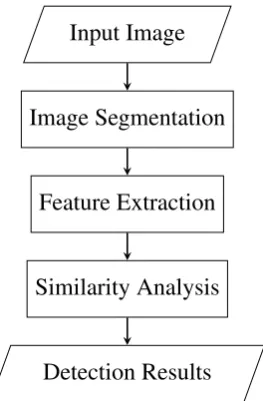
Before the issues that exist in block based approaches to copy move image forgery detection can be explored, the processes within a block based detection scheme must first be identified and explained. The common flow of block based copy move forgery detection can be seen in Figure 1.1. The input for the detection scheme is an image suspected to contain copy move forgery. Firstly, the image is segmented into overlapping blocks to separate the different image regions. The image region within each block is then goes through a feature extraction process which transforms raw pixel information into a set of image features. The resulting set of image features is then subjected to a similarity analysis process which identifies pairs of highly similar or identical image features. The final output of the detection scheme is a set of blocks suspected to be duplicates of one another.
Input Image
Image Segmentation
Feature Extraction
Similarity Analysis
Detection Results
3
A robust copy move image forgery detection scheme needs to be invariant to post-processing of the tampered image and geometric transformations of the the copy moved image regions. From Figure 1.1, feature extraction and similarity analysis are the most important processes and thus have been the focus of research in this field. As research progresses towards developing more robust methods of feature extraction, the algorithms being proposed have higher and higher time complexity. The complex transformations used to create feature vectors of image blocks require high computation time. The feature vectors produced during the feature extraction process are also complex and require some form of normalization or quantization before similarity analysis can be done, requiring extra rounds of calculations which increases computation time. As for the similarity analysis process, an efficient technique is needed to quickly identify duplicate image features within the set of obtained feature vectors.
1.2 Problem Background
Computation time is currently a serious issue in copy move image forgery detection, especially in real-time and near-real time applications. Resorting to less complex algorithms for feature extraction results in lower successful detection rate and higher false detection rate. These less complex algorithms are also less robust when confronted with post-processing of the tampered image and geometric transforms on the the copy moved portions of the image. Hence, it is not a viable solution because it decreases the overall success and accuracy of forgery detection. It is also possible to reduce the dimensions of an image before it is analyzed to gain a smaller search space. However, doing so causes data loss of image detail resulting in less accurate detection. One method of preserving the robustness of copy move image forgery detection while improving performance is through parallelization of the feature extraction process. Parallelization reduces the impact of high algorithmic time complexity and allows the total time required for forgery detection to scale with the hardware running the detection scheme.
4
block matching because lexicographical sorting has been proven to be effective without major drawbacks in terms of accuracy. However, the issue with lexicographical sorting is its computation time (Bayram, Sencar and Memon, 2009). Bayram, Sencar and Memon (2009) showed that identifying duplicate features using a counting bloom filter is much faster than lexicographical sorting. Despite this, there have not been any thorough investigations into how bloom filters perform in terms of resulting successful detection rate or false positive rate.
Currently, there exist some versions of copy move image forgery detection schemes using Central Processing Unit (CPU) based parallelization. Sridevi, Mala and Sandeep (2012) developed a parallelization algorithm based on Java threads executed on CPU. Modern CPUs offer high clockspeeds and Instructions Per Cycle (IPC) count and possess excellent pipelining capabilities to process a large number of threads simultaneously despite their limited number of physical processing cores. With the existence of Graphics Processing Unit (GPU) general purpose computing interfaces, it is possible to leverage a large number of GPU processing cores to execute tasks traditionally limited to CPUs. GPUs are designed specifically to process graphical data and are thus highly suited for image processing. GPUs have lower clockspeeds and IPC compared to CPUs but possess a large number of physical cores that can be used for processing. There has been use of GPUs to accelerate the radix sort of a copy move image forgery detection scheme, but there is currently no research into using GPU optimized counting bloom filters for copy move image forgery detection. There is also currently no algorithm to describe how copy move image forgery detection can be fully parallelized using a GPU. It is not possible to achieve the same optimization level by applying the same algorithms developed for CPU parallelization to GPU assisted computing because of issues such as host to device communication latency and separated memory. Thus, an algorithm must be designed specifically for the GPU in order to be optimal.
5
bloom filters also needs to consider forgery detection under different scenarios such as post-processing of tampered image and geometric transformations of forged image regions.
1.3 Problem Statement
Robust feature extraction techniques used in block based copy move image forgery detection require a high computation time. There is a need for reduced computation time for detection schemes to be practical for use with large images and in real time environments. Utilization of GPU to compute the processes can highly parallelize the tasks involved to reduce computation time. Current CPU based algorithms that have been designed are not suitable to be directly adopted in a GPU based scheme. It must be determined how a parallel copy move image forgery detection scheme can be designed for use with a GPU. Counting bloom filter is faster than radix sort in processing feature vector matrix to identify duplicates. Evaluation of counting bloom filter in copy move image forgery detection scheme must be done to determine its effectiveness. To test the performance of counting bloom filter, a detection scheme which supports both radix sort and counting bloom filter needs to be developed.
1.4 Research Questions
The main research question to be answered in this study is:
”Are counting bloom filters an effective technique for duplicate matching in a GPU based copy move image forgery detection scheme?”
The supporting research questions are:
i. How can a GPU based copy move image forgery detection scheme using overlapping block technique be designed?
6
iii. How can a radix sort be incorporated into a GPU based scheme?
iv. How can a counting bloom filter be developed for use with a GPU based detection scheme?
v. How does a parallel counting bloom filter perform in duplicate matching compare to radix sort?
1.5 Project Aim
The project aim is to improve the performance of copy move image forgery detection through GPU parallelization and evaluate alternative similarity analysis techniques by comparing the performance of similarity analysis using counting bloom filter with radix sort.
1.6 Project Objectives
The objectives for this research are as follows:
i. To design a parallel GPU based algorithm for copy move image forgery detection using overlapping block technique.
ii. To develop a copy move image forgery detection scheme based on the designed GPU algorithm which supports forgery detection using counting bloom filters and radix sort.
iii. To compare the performance of parallelized counting bloom filters with radix sort in performing forgery detection.
1.7 Project Scope
The scopes of this project are as follows:
7
approaches for copy move image forgery detection.
ii. The parallel approach proposed will be specific to the type of GPU architecture and software framework for GPU programming in this project, which is based on Nvidia discrete graphics cards and Compute Unified Device Architecture (CUDA) platform.
iii. The project will not propose a new method for transformation of image data into feature representations used in the feature extraction stage. Instead, quantized Discrete Cosine Transform (DCT) will be adopted as a case study for parallelization of feature extraction.
iv. The images used for evaluating forgery detection will be generated from the Image Manipulation Dataset (IMD).
v. Methods have been proposed to perform duplicate matching using k-d tree, lexicographical sorting and bloom filter. In this project, only the radix sort implementation of lexicographical sorting and counting bloom filters will be evaluated.
vi. For evaluation of the parallelized counting bloom filters, comparison will only be made with radix sort for similarity analysis. The performance will be compared in terms of detection rate, false positive rate and speed.
1.8 Importance of Project
Currently, copy move image forgery detection is needed in many fields. Of those fields, journalism and digital forensics often deals with time sensitive cases. Therefore, a faster forgery detection system will benefit organizations in dealing with their cases in a timely manner. Existence of parallelized detection scheme can also make the more complex feature extraction techniques more practical by minimizing the computation time disadvantages. This project is also a step forward towards real-time or near real-real-time image forgery detection.
1.9 Thesis Organization
8
feature extraction and similarity analysis processes within a copy move image forgery detection scheme. The aim and objectives of the project are defined. Finally, The project scopes are defined and a the benefits of the project are explained.
In Chapter 2, previously done works in the field of copy move image forgery detection are reviewed and critically analyzed. An explanation of the current issues that exist within this area of research is presented. The study of past works also identifies the existing methods which meet the criteria for robustness and are suitable to be used with a GPU. The issues of performance with block matching techniques is also further explored. Finally, a study of GPU parallelization is done to help determine how it can be applied to copy move image forgery detection.
REFERENCES
Abd-Elhafiez, W. M. and Gharibi, W. (2012). Color Image Compression Algorithm Based on the DCT Blocks. International Journal of Computer Science Issues (IJCSI). 9(4).
Bashar, M., Noda, K., Ohnishi, N. and Mori, K. (2010).Exploring Duplicated Regions in Natural Images. doi:10.1109/TIP.2010.2046599.
Bayram, S., Sencar, H. T. and Memon, N. (2009). An efficient and robust method for detecting copy-move forgery. InAcoustics, Speech and Signal Processing, 2009. ICASSP 2009. IEEE International Conference on. IEEE, 1053–1056.
Bradski, G. and Kaehler, A. (2008). Learning OpenCV: Computer vision with the OpenCV library. ” O’Reilly Media, Inc.”.
Bravo-Solorio, S. and Nandi, A. K. (2011). Automated detection and localisation of duplicated regions affected by reflection, rotation and scaling in image forensics. Signal Processing. 91(8), 1759–1770.
Christlein, V., Riess, C., Jordan, J. and Angelopoulou, E. (2012). An evaluation of popular copy-move forgery detection approaches. Information Forensics and Security, IEEE Transactions on. 7(6), 1841–1854.
Farid, A. and Popescu, A. (2004). Exposing digital forgeries by detecting duplicated image regions. Technical report. Technical Report, TR2004-515, Department of Computer Science, Dartmouth College, Hanover, New Hampshire.
Farid, H. (2009). Image forgery detection.Signal Processing Magazine, IEEE. 26(2), 16–25.
Fridrich, J., Soukal, D. and Luk´aˇs, J. (2003). Detection of copy-move forgery in digital images. InProceedings of Digital Forensic Research Workshop. Citeseer.
Ghorbani, M., Firouzmand, M. and Faraahi, A. (2011). DWT-DCT (QCD) based copy-move image forgery detection. InSystems, Signals and Image Processing (IWSSIP), 2011 18th International Conference on. IEEE, 1–4.
66
International Journal of Engineering Research and Applications. 3(2), 94–97.
Jablin, T. B. (2013). Automatic Parallelization for GPUs. Ph.D. Thesis. Princeton University.
Jenkins, B. (2012). Spookyhash: a 128-bit noncryptographic hash. Retrievable at http://burtleburtle.net/bob/hash/spooky.html.
Khan, S. and Kulkarni, A. (2010). Reduced time complexity for detection of copy-move forgery using discrete wavelet transform.International Journal of Computer Applications. 6(7), 31–36.
Kirsch, A. and Mitzenmacher, M. (2006). Less hashing, same performance: Building a better bloom filter. InIn Proc. the 14th Annual European Symposium on Algorithms (ESA 2006. 456–467.
Li, L., Li, S. and Wang, J. (2012). Copy-move forgery detection based on PHT. In Information and Communication Technologies (WICT), 2012 World Congress on. Oct. 1061–1065. doi:10.1109/WICT.2012.6409232.
Li, L., Li, S., Zhu, H., Chu, S.-C., Roddick, J. F. and Pan, J.-S. (2013). An Efficient Scheme for Detecting Copymove Forged Images by Local Binary Patterns.Journal of Information Hiding and Multimedia Signal Processing. 4(1), 46–56.
Lin, H.-J., Wang, C.-W., Kao, Y.-T.et al. (2009). Fast copy-move forgery detection. WSEAS Transactions on Signal Processing. 5(5), 188–197.
Luo, W., Huang, J. and Qiu, G. (2006). Robust detection of region-duplication forgery in digital image. In Pattern Recognition, 2006. ICPR 2006. 18th International Conference on, vol. 4. IEEE, 746–749.
Mahdian, B. and Saic, S. (2007). Detection of copy–move forgery using a method based on blur moment invariants.Forensic science international. 171(2), 180–189. Mohamadian, Z. and Pouyan, A. (2013). Detection of Duplication Forgery in
Digital Images in Uniform and Non-uniform Regions. InComputer Modelling and Simulation (UKSim), 2013 UKSim 15th International Conference on. April. 455– 460. doi:10.1109/UKSim.2013.94.
Muhammad, G., Hussain, M., Khawaji, K. and Bebis, G. (2011). Blind copy move image forgery detection using dyadic undecimated wavelet transform. In Digital Signal Processing (DSP), 2011 17th International Conference on. IEEE, 1–6.
Popescu, A. C. and Farid, H. (2005). Exposing digital forgeries in color filter array interpolated images.IEEE Transactions on Signal Processing. 53(10), 3948–3959. Qiao, M., Sung, A., Liu, Q. and Ribeiro, B. (2011). A novel approach for detection
67
Advanced Engineering Computing and Applications in Sciences. 44–47.
Salam, A. T. and Ghazali, B. S. (2013). STATE OF THE ART OF COPY-MOVE FORGERY DETECTION TECHNIQUES: A REVIEW. International Journal of Computer Science Issues (IJCSI). 10(6).
Selvapeter, P. J. and Hordijk, W. (2009). Cellular automata for image noise filtering. InNature & Biologically Inspired Computing, 2009. NaBIC 2009. World Congress on. IEEE, 193–197.
Singh, J. and Raman, B. (2012). A high performance copy-move image forgery detection scheme on GPU. InProceedings of the International Conference on Soft Computing for Problem Solving (SocProS 2011) December 20-22, 2011. Springer, 239–246.
Sridevi, M., Mala, C. and Sandeep, S. (2012). Copy-move image forgery detection in a parallel environment.Computer Science & Information Technology (CS & IT). 52, 19–29.
Ting, Z. and Rang-ding, W. (2009). Copy-Move Forgery Detection Based on SVD in Digital Image. InImage and Signal Processing, 2009. CISP ’09. 2nd International Congress on. Oct. 1–5. doi:10.1109/CISP.2009.5301325.
Wang, J., Liu, G., Li, H., Dai, Y. and Wang, Z. (2009). Detection of Image Region Duplication Forgery Using Model with Circle Block. In Multimedia Information Networking and Security, 2009. MINES ’09. International Conference on, vol. 1. Nov. 25–29. doi:10.1109/MINES.2009.142.
Welsh, T., Ashikhmin, M. and Mueller, K. (2002). Transferring Color to Greyscale Images. ACM Trans. Graph. 21(3), 277–280. ISSN 0730-0301. doi:10.1145/ 566654.566576. Retrievable at http://doi.acm.org/10.1145/566654.566576.
Zhang, J., Feng, Z. and Su, Y. (2008). A new approach for detecting Copy-Move forgery in digital images. InCommunication Systems, 2008. ICCS 2008. 11th IEEE Singapore International Conference on. Nov. 362–366. doi:10.1109/ICCS.2008. 4737205.