Cloud Service Recommendation Approach Using Group
Consensus Experiences and Contextual Data
Dr. Hlaing Phyu Phyu Mon
Faculty of Information Science, University of Computer Studies (Meiktila), Myanmar
Abstract
Owing to increase in the number of cloud services with various kinds of service attributes in cloud computing environment, it is usually hard for the users to request suitable service attributes for a service they want. This paper recommends some suitable service attributes by learning user context attributes and group experiences. K-means clustering is adopted to classify historical user groups context attributes and the context itemsets obtained from k-clusters are further mined using associative mining between context and service properties oriented to cloud services to recommend what service attributes should be requested according to context properties of current user. In addition, user groups subjective experiences are also considered upon recommended service list to reduce the exception differences. Finally, the proposed approach
is validated and compared with proficient service prediction
approach called CAMF.
Keywords
Cloud Service, Context Attribute, K-Means Clustering, Associative Mining, Subjective Experience
I. Introduction
Selecting suitable quality attributes for a service request is usually hard for normal cloud users due to growing number of cloud service providers with different persuasive quality of services
attributes. To address this difficulty, many scholarly works (Li et
al., 2016; Shangguang et al., 2015; Chengyin et al., 2015) have been addressing to help the users by recommending suitable service attribute for their service requests. In this case, there are two types of approaches which can be conducted with this recommendation.
The first type of approaches is sole consideration of objective
factors in potential quality attributes recommendation without using any user subjective preference or experience. However, the cloud services are too highly virtualized to cope with conventional
evaluation methods and tools of cloud environments (Wei et al.,
2015). Therefore, the researchers become interest in second type
of approaches that take into account the cloud users‟ subjective
experiences and historical user context attributes to recommend quality service attributes. Furthermore, they strongly believe that the subjective assessments and experiences of cloud user group would be more trustable for new cloud user than the guarantees claimed by cloud service providers or suggestions issued by sole objective recommendation approaches.
However, there are some drawbacks in user subjective assessment recommendation approaches because subjective experiences are not able to use in real-time analysis and also their evaluation
results may not be reasonable for all types of users (Wei et al., 2015; Lina et al., 2015) because the cloud services are being
used by various kinds of users around the world with their own
specific needs. Therefore, in this paper, in old users‟ assessment
and experiences evaluation, we consider their context attributes to
learn what kind of QoS (quality of service) attributes are usually
demanded by cloud users depending on their different context characteristics.
This paper proposes a service recommendation approach to recommend essential service attributes for a service request, our approach focuses on user context information and historical user experiences about how they feel previous service recommendation
results. There are three main steps in our approach. The first is
to cluster the user’s context information to classify user context
structures. We then analyze that which context pairs usually demand for what kind of quality attributes. With context and
service attribute associative relations, we further deduce what kind of quality attributes should be asked that can be compatible with current user request. In addition to recommending quality attributes, we try to validate these results with user group consensus experience so as to prevent biased or unreliable recommendation results which are usually produced by quantitative cloud service parties or recommending algorithms. For the sake of this later group consensus evaluation, our recommended QoS attributes, which could exactly serve as the quality levels advertised by cloud providers, could effectively be suggested to novice or non-expert cloud users, who have no idea in choosing suitable quality attributes for their services.
The rest of the paper is organized with following sections. Literature
review is studied in Section II and preliminaries of this paper are discussed in section III. The proposed approach, service quality model is explained in detail and it is captioned as Section IV. The section V is to explain about validation process of proposed
approach with experimental results. This paper is finally concluded
in Section VI alongside with future work explanation.
II. Literature Review
Recent advances presented by other related works are discussed as literature review. The service quality attributes are predicted
by the researchers (Chengyin et al., 2015 [3]) to rank cloud
services using advanced particle swarm optimization algorithm that learns QoS records of close neighbor users to determine the preference relations among cloud services. Similarly, the other
study (Wei et al., 2014 [17]) predicted qualified services using
local neighbourhood matrix factorization. They found a set of highly relevant local neighbours to predict QoS needs of current users. A service composition system is developed which could automatically reuse user input to be able to identify a proper value for an input parameter of a user with the inputs of other end-users
(Shaohua et al., 2015 [13]). The optimum cloud availability zone is selected by learning user satisfaction levels (Merve et al., 2015 [11]). Their model was built from historical usage data for each
availability zone, and updated those data as the nature of the zones.
The research work (Bipin et al., 2015 [2]) also used user experience about QoS so as to automatically mine and identify QoE (Quality of Experience) attributes from the web. The researches (Hei Chia et al., 2015 [6]; Wei-Li et al., 2011 [17]; Wang et al., 2007 [16]) used group preferences and consensus agreement upon
historical user QoS experience. Some research works focus on user content or context information in considering QoS ranking
presented content-based web service recommendation system. They considered simultaneously both rating data and semantic content data of web services using a probabilistic generative model
and collaborative filtering. The context of objective and user
subjective assessments is considered to calculate the similarity
between different contexts (Lie et al., 2015). Then, credible cloud
services were selected according to aggregated user subjective assessments and objective assessments obtained from quantitative performance testing parties.
The study (Kuang et al., 2016 [7]) presented a QoS-aware approach
to predict multimedia service quality using association rules. They
also use user context structure to find other similar context user’s personalized QoS service. The difference between our and their
approach is that we additionally filter the recommended data using
historical user groups experience to get more accurate consensus agreement on the recommended QoS attribute. As a result, we could prevent malicious recommendation which is either usually or accidently made by some unreliable users or recommendation methods.
III. Preliminaries
A. Cloud Services
In multi-tenant cloud computing environments, the sharing of services, experiences, historical usage and group decision promotes to achieve user satisfaction upon competitive cloud services. Cloud services provide multi-functional and
non-functional attributes (called quality of service) to be compatible
with their virtualized world as well as to make cloud users satisfy most so as to compete the markets. The cloud services are running under different application domains, such as e-commerce, retail
services, engineering design, scientific investigations, etc (Louise et al., 2015). As the benefit of cloud computing, many cloud users
around the world can share their experiences and feelings using different invocation methods under various context structures.
B. QoS-based Cloud Service
QoS is only one way to describe quality level of a cloud service guaranteed by cloud providers. It is also a decisive factor to discriminate appropriate services from functionally equivalent
cloud services (Farsandaj, et al., 2012). The key considerations
about quality of cloud services by cloud providers are response
time, resource utilization, availability, security and cost (Louise
et al., 2015). In this paper, our QoS recommendation approach
focuses on those five quality attributes.
C. Context Data and Association Rules
Context is kind of information which can express all user’s
activities and behaviours (Kuang et al., 2016). In this paper,
we consider user context information into two types, static and
temporal context. The user profile such as gender, age, etc., is
regarded as static information while service invocation information
such as invocation environment (location, time, etc), computing environment (device, software, hardware requirement), and service parameters (service type, input, output, etc), are defined
as temporal context.
The associative rules mining was firstly introduced in the study (Agrawal et al., 1993) and they are used to learn the relations
between associative data such as historical usage and transactions. Every rule is composed by two different set of items, called itemsets, X and Y. X is composed of partial subsets of items I={i1,i2,….,in}. The implication of association rule is a form of X => Y where X
and Y are non-empty subsets of I and X ∩ Y = ɸ (Victoria et al. [15], 2012). A typical application is to find shopping pairs which
usually buy together according to shopping transactions and a rule is like {butter, bread}=>{milk}, if a user buys butter and bread, he/she will also buy milk with v% where v is numeric value1. In this case, we can see that X is the antecedent and Y is consequent. In order to select interesting rules from a set of all possible rules,
constraints on various measures of significance and interest are
used. The best-known constraints are minimum thresholds on
support and confidence such as supp(X) and conf(X =>Y). The support supp(X) of an itemset X can be defined as the proportion
of transactions in the database which contains the itemset X. The
confidence value conf(X =>Y) is the proportion of the transactions
that contains X which also contains Y and can be calculated as
conf(X=>Y) = supp (X U Y) / supp( X ).
IV. Service Recommendation Approach
A. Quality Related Service (QoS) Recommendation Model
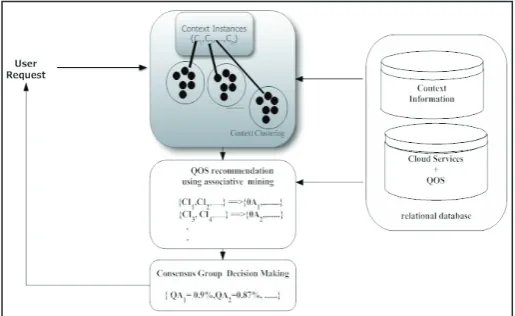
The overall architecture of service recommendation, which is
composed of three main processes, is depicted in fig. 1. The first
process creates k-clusters upon similarity distances among different user context attributes. It then issues context itemsets according to cluster members of k-clusters. The heart of this model is service recommendation process that utilizes associative rule mining on context itemsets obtained from context clustering process. This
recommendation process recommends qualified attributes which are highly supposed to be requested for a specific service with higher
possibilities than the threshold number. This threshold number is
usually specified by a human expert or automatically determined
by the condition which the quality metric qaj is dependent on the user context property CPu. As the final process of this model, QoS
consensus decision maker makes the decisions about the quality levels depending on the recommended QoS attributes released by previous QoS recommending process. To accomplish this task,
it uses SAM algorithm to understand the conflicts of group’s
opinions as well as to reach multi-group consensus. In this way, this model can prevent malicious incentives advertised by cloud providers just only to compete the market without actual servings to the users. As the output, QoS list that will be required for users”
current service request, is finally recommended to the user. Each
QoS from that list is then rated with fuzzy value obtained from all opinions of that QoS service attribute.
Fig. 1: Service Recommendation Model
B. Context Clustering using K-means Algorithm
according to training data set CPg, context attribute of group
users. Depending on the diversities of context information (e.g.,
invocation location, service type, resource, etc) of current cloud user and historical context information of cloud user groups, we
first cluster the historical records based on the similarity of two
context properties compared with similar context of current user. Deducing the assumption from historical events is more reasonable to the needs of current problem because the historical experience could help to improve valuable assumptions under similar context with current user.
We adopt K-means clustering, a method of vector quantization and
create the clusters whose mean yields the lease of within-cluster
sum of squares, called squared Euclidean distance (see in Eq.1)
to intuitively calculate the nearest similarity among the elements
(a an b in Eq.1) of same cluster and obvious dissimilarities among
the elements of different clusters.
∑
==
ni
a
b
b
a
sim
1 2
)
,
(
)
,
(
(1)The distance between two elements (called as points in K-means
algorithm) of a cluster shows the differences between historical context instances by grouping into K clusters. The processing steps of K-means algorithm are as follows:
Select K cluster centers for each cluster. 1.
Calculate the distance between each data point and cluster 2.
centers.
Assign the data point to the cluster center whose distance from
3.
the cluster center is minimum of all the cluster centers.
Recalculate new cluster center using Eq. (2), where ci means 4.
the number of data point in ith cluster.
∑
== ci j i i
i c x
V
1
/
1 (2)
Recalculate the distance using Eq. (1) between each data
5.
point and new obtained cluster centers.
Go to step 3 and repeat the process until the centroids no
6.
longer move.
At the end of clustering, K context clusters are obtained, and we then calculate the distances between the points which represent each context instance of current user and the centroid of each
user in order to get the shortest distance between them. By this
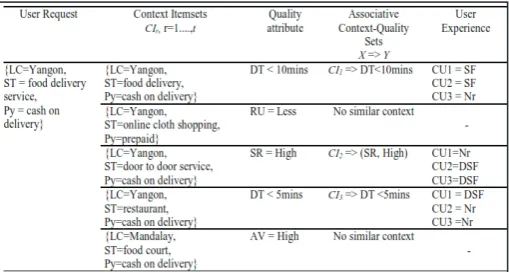
way, we obtain context itemsets CI={CIr, r=1,…,t} (See second
column in Table 1) with t number of itemsets which can be used as further references such as contextual transactions for associative QoS recommendation.
C. Association Rule Mining Between Context and QoS Attribute
Association rule mining is measuring the interestingness between items in large scale transactional data. In this process, we are going to mine correlated QoS attributes from context itemsets obtained from previous K-means clustering with X antecedent, which are context itemsets CI={cir,r = 1,…,t} and Y consequent named as Q which considers upon correlated quality attributes from QAu requested by the user. We then use associative rule
mining technique which comprises of the following tasks.
Finding the frequent itemsets (X =>Y) in this example,
1.
(CIr=> Qj) whose support (supp(X)) and confidence (conf(X))
must satisfy minimum corresponding threshold support and
confidence value.
If some value (let C in this example) from the itemsets CI
2. r can
satisfy this condition Ci/C > a, where a is a threshold number, we can deduce as the quality attribute Qj is dependent on that context attribute C of CIr itemsets.
Go to step 2 for each CI
3. r in CI and find the subset of CI which
Qj will dependent on.
Go to step 3 for each Q
4. j of Q to find the dependency relations
from a Qj to a corresponding subset of CI.
Table 1: Sample Synthetic Data for Associative Mining Between Context and Quality Attribute With User Experience
As the output of context quality associative rule mining, we will obtain quality attribute QAg ={QAg,1,….,m} (e.g., fourth column
of Table 1) which is dependent on the context attributes issued
by a specific user group U={Uq, q=1..,h} (e.g., fifth column of
Table1). The recommended quality attributes, which are resulted from learning user group’s context structure, is further analyzed using user group’s consensus agreement so as to get accurate and universal acceptable quality attribute with reliable value which can practically be supported by the cloud providers.
D. Multi-group Quality Service Consensus Agreement Similarity Aggregation Method (SAM) is utilized to classify conflicts arisen within a group and also to resolve these conflicts
and uncertainties with average similarity among them. In our approach, we apply SAM to consider actual consensus suggestions issued by service user group rather than the persuasive incentive advertised by the provider. That is because the cloud provider might intentionally or accidently advertise their services with impractical quality attributes in order to attract more customers. On the other hand, we can see consensus similarity value as associated weightings on each QoS attribute of recommended list. In this case,
we consider three QoS statuses (DoNotSatisfy, Normal, Satisfy)
to express user experiences in different levels. “Satisfy” means that the provider serves the services with same quality level as they guarantee and their service performance is more attractive
than that of other service providers. The “DoNotSatisfy” comment
indicates that the actual QoS value of a cloud service provided by a cloud service provider is different from the value that the service provider has advertised. For example, these providers claim that their delivery time will be within 10 mins although the
actual received time is over 20mins, etc. “Normal” means that
the user feels that the service provider marginally provides the services with the quality they announced. In table 1, sample user experiences upon obtained associative context-quality rules, are
described and final value for those quality attribute are evaluated
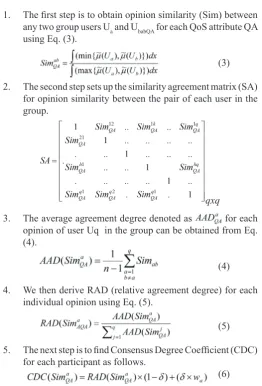
1. The first step is to obtain opinion similarity (Sim) between any two group users Ua and UbabQA for each QoS attribute QA
using Eq. (3).
(3)
2. The second step sets up the similarity agreement matrix (SA)
for opinion similarity between the pair of each user in the group.
qxq
3. The average agreement degree denoted as for each
opinion of user Uq in the group can be obtained from Eq. (4).
(4)
4. We then derive RAD (relative agreement degree) for each individual opinion using Eq. (5).
(5)
5. The next step is to find Consensus Degree Coefficient (CDC)
for each participant as follows.
(6)
where, d is a control variable to show the relation between the imperfect opinions of the users and the experts, wa is a weight variable to each opinion to be able to tune according to the condition of agreement results.
6. This step, finally, aggregates all fuzzy consensus opinions obtained from CDC according to Eq. (7) and denoted as GCA (group consensus agreement). The purpose is to get overall
fuzzy number of combining all opinions of every user for service attribute QAi.
∑
=
=
qk
k AQA a
AQA
Sim
Sim
CDC
GCA
1
*
)
(
(7)As the output of this process, each QoS attribute now has own fuzzy consensus opinion evaluation. The next step is to make this opinion value as weighting value of recommended QoS list. The user can now choose QoS attribute with corresponding weighting
value (e.g, QAg = x%) which describes the priority or trustable level of each QoS attribute. In Table 1, according to group consensus experiences evaluation, CI1 will be recommended as highest priority while CI2 is suggested as lowest priority attribute.
V. Experimental Results
Due to no standard benchmark for verifiable QoS recommendation
problems, the evaluation criteria “RecommendationAccuracy” is derived to verify the accuracy of recommendation results by
analyzing the expected recommendation of cloud services (denoted
as E), the accurate recommended results from the recommend list
(named as A) and the total number of all correct services in the recommend list (denoted as N) according to following Eq. (8).
(8)
In experimental works, as described in earlier section, we
consider five quality attributes such as response time, resource utilization, availability, security and cost with 738 cloud services
with different quality attributes for each cloud service. The data used in these experiments is partially collected from real cloud
services such as CloudHarmony[19] and CloudSleuth[20] and
partially generated synthetic data based on real cloud services and subjective assessments from 50 cloud users.
We conduct two experimental cases by asking 43 cloud users
to request the cloud services with 10 alternative cloud quality attributes and ask to leave his/her experiences/opinions upon system recommendation. To evaluate the accuracy performance, 120 random cloud services are separately issued in the experimental environments.
The first experimental case is for analyzing the accuracy of
recommended results measured with each different quality attribute under three application domains such as weather, e-commerce
and news. The total recommendation accuracy of five quality
attributes for each application domain is listed in Table 2. In this table, we can see different accuracy between our recommendation
approach with group consensus evaluation (named as RWGCA) and our approach without it (denoted as RNGCA). This table
data proves that group consensus decision can make the results to be more trustable.
Table 2: Recommendation Accuracy Result for Three Application Domains
QoS Attributes E-commerce News Weather
RWGCA RNGCA RWGCA RNGCA RWGCA RNGCA
Cost 0.95 0.66 0.82 0.61 0.83 0.60
Resource Utilization 0.53 0.33 0.83 0.48 0.80 0.37
Availability 0.81 0.71 0.72 0.68 0.83 0.52
Security 0.92 0.65 0.83 0.62 0.92 0.63
Response Time 0.98 0.62 0.95 0.43 0.91 0.58 In fig. 2, the recommendation accuracy for five QoS attributes
are collected from average accuracy of each quality attribute with different
number of service requests. These accuracy results are averaged
from the results obtained from each different domain. With the
increase in the number of service requests, the recommendation precisions of all attributes moderately rise. The worst accuracy
for all attributes is around 0.53 and the highest accuracy for all approach are nearly 0.98. The accuracy rates of all attributes in
different number of requests are different with slight distinctions due to trustable group consensus evaluation upon associative recommendation.
Fig. 2: Recommendation Accuracy of Different Quality Attributes
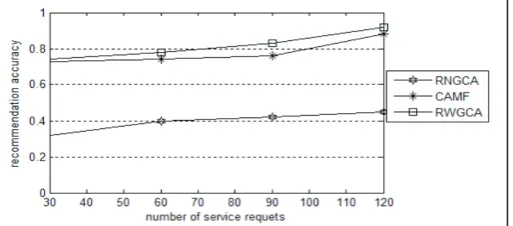
We conduct next experiment to compare our recommendation
Matrix Factorization (CAMF) (Kuang et al., 2016). In this
experiment, we separate our approach into two types as described earlier such as with and without group consensus evaluation. The
experimental settings are same as first experimental case did. In Figure 3, according to the experimental results obtained from each different approach, CAMF approach is significantly higher than RNGCA approach because CAMP approach is superior QoS
recommendation approach using associative rules and matrix factorization upon QoS experience. However, when it compares
with our RWGCA, which uses group consensus evaluation upon
recommended results, its results are moderately lower than our approach. Therefore, we can conclude that our approach surpasses
this efficient approach with superior consideration of multi
group consensus evaluation and could even achieve trustable recommendation results with higher accuracy rate.
Fig. 3: Recommendation Accuracy Comparisons With Other
Approach
VI. Conclusion and Future Work
In summary, this paper proposes a way to recommend QoS attributes with trustable results which need to be investigated for
specific services. The experiments are validated with real cloud services and prove the efficiency of our approach compared with other proficient approach. As future work, we intend to extend
user group consensus opinions not only to evaluate subjective information but also as an evaluation tool for objective assessments used by quantities performance of cloud parties. In addition, in the
aspect of user subjective assessment, we will filter out potentially
biased subjective assessments using more powerful techniques so as to recommend trustworthy recommended services to the users without malicious user attacks.
References
[1] Agrawal, R.; Imielinski, T.; Swami, A., N.,"Mining association rules between sets of items in large databases", SIGMOD Conference, ACM Press, pp. 207–216, 2009.
[2] Bipin, U.; Ying, Z.,"Quality of experience: User’s perception about web services", IEEE transactions on services computing, Vol. 8, No. 3, pp. 410-421, 2012.
[3] Chengyin, M.; Jifu, C.; Dave, T.; Jinfu, C.; Xiaoyuan, X., "Search-based QoS ranking prediction for web services in cloud environments", Future Generation Computer Systems,
Vol. 50, pp. 111-126, 2015.
[4] Chiclana, F.; Herrera, F.; Herrera-Viedma, E.,"Integrating
multiplicative preference relations in a multipurpose
decision-making model based on fuzzy preference relations", Fuzzy Sets and Systems, Vol. 122, pp. 277–291, 2001.
[5] Farsandaj, K.; Ding, C.,"Scatter/gather browsing of Web service QoS data", Future Gener. Comput. Syst, Vol. 28, No. 7, pp. 1145–1154, 2012.
[6] Hei-Chia, W.; Wei-Pin, C.; Suei-Chih, W.,"QoS-driven selection of web service considering group preference",
Computer Networks, Vol. 93, pp. 111-124, 2015.
[7] Kuang, L.; Zhifang, L.; Wentao, F.; Haoneng, H.; Zhang B.,"Multimedia services quality prediction based on the association mining between context and QoS properties", Signal processing, Vol. 120, pp. 767-776, 2016.
[8] Lie, Q.; Yan, W.; Mehmet, L L. et al.,"CCCloud:
Context-aware and credible cloud service selection based on subjective
assessment and objective assessment", IEEE transactions on service computing, Vol. 8, No. 3, pp. 369-383, 2015. [9] Lina, Y.; Quan, Z. S.; Anee. H. H. N. et al.,"Unified Collaborative
and Content-based web service recommendation", IEEE transactions on service computing, Vol.8, No. 3, pp. 453-466, 2015.
[10] Louise, M.; Bhavani, T.; Jia. Z.,"Services in the cloud, IEEE transactions on services computing”, Vol. 8, No. 2, pp. 172-174, 2015.
[11] Merve, U.; Stefania, T.; Yurdaer, N. D. et al.,"Selecting optimum cloud availability Zones by learning user satisfaction levels", IEEE transactions on services computing, Vol. 8, No. 2, pp. 199-211, 2015.
[12] Shangguang, W.; Zhibin, Z.; Zhengping, W., et al., "Reputation
Measurement and Malicious Feedback Rating Prevention in
Web Service Recommendation Systems", IEEE Transactions on service computing, Vol. 8, No. 10, pp. 755-767, 2015. [13] Shaohua, W.; Ying, Z.; Iman, K.; et al.,"Automatic Reuse
of User Inputs to Services among End-Users in Service Composition", IEEE transactions on service computing, Vol. 8, No. 3, pp. 343-355, 2015.
[14] Shuai, D.; Chengyi, X.; Qiong, C.; Kaile, Z., et al., QoS-aware
resource matching and recommendation for cloud computing
systems", Applied Mathematics and Computation, Vol. 247, pp. 941-950, 2014.
[15] Victoria, N.; Rafael, B.,"Finding association rules in semantic web data, Knowledge-based systems", Vol. 25, pp. 51-62,
2012.
[16] Wang, H, C.; Lee, C, S.; Ho, T. H.,"Combining subjective and
objective QoS factors for personalized web service selection,
Expert Systems with Applications", Vol. 32, pp. 571-584, 2007.
[17] Wei, L.; Jianwei, Y.; Ying, L.; Zhaohui, W.,"Efficient web
service QoS prediction using local neighbourhood matrix
factorization", Engineering Applications of Artificial Intelligence, Vol. 38, pp. 14-23, 2014.
[18] Wei-Li, L.; Chi-Chun, L.; Kuo-Ming, C.; Nick, G.,"Multi-group QoS consensus for web services", Journal of Computer and System Sciences, Vol. 77, pp. 223-243, 2011.
[19] [Online] Available: http://www.cloudharmony.com
[20] [Online] Available: http://www.cloudsleuth.net
Dr. Hlaing Phyu Phyu Mon received
her B.S degree in physic, from University of Meiktila, Myanmar and her M.S degree and Ph.D (IT) degree in information technology from University of Computer Studies (Yangon) in 2006. Now, she is a professor, dean of faculty of information science at University of Computer Studies (Meiktila),