Jurnal Teknologi, 48(E) Jun 2008: 161–168 © Universiti Teknologi Malaysia
USING COGNITIVE TOOLS TO ENHANCE UNDERSTANDING IN DIFFERENTIAL EQUATIONS
ZALEHA ISMAIL1 & MOHD KHALID KASMIN2
Abstract. This paper reports a research conducted to understand the development of concepts on differential equations in a learning environment supported with a cognitive tool developed known as DEgraf. The students’ levels of understanding were analyzed via concept mapping as introduced by Novak. Their written solutions on various problems were examined and transformed to concept maps which were used as tools to understand their levels of understanding. Results showed the cognitive structures in terms of mathematical relationships and the number of concepts made by the students. These cognitive structures illustrare the students quality of relational understanding. The study showed that active learning environments incorporating the use of a cognitive tool may lead to the development of relational or conceptual understanding.
Keywords: Meaningful learning; concept maps; relational understanding; cognitive tools; differential equations
Abstrak. Artikel ini melaporkan satu kajian yang bertujuan untuk memahami perkembangan konsep persamaan pembeza dalam suasana pembelajaran yang disokong oleh alat kognitif yang telah dibangunkan dan dinamakan DEgraf.Tahap kefahaman pelajar dianalisis melalui peta konsep yang diperkenalkan oleh Novak. Kerja bertulis beberapa masalah yang dihasilkan pelajar diteliti dan diterjemahkan kepada peta konsep untuk digunakan bagi memahami tahap kefahaman. Kajian menghasilkan struktur kognitif yang terdiri daripada pelbagai konsep dan hubungan antara konsep. Struktur kognitif dapat menggambarkan kualiti kefahaman relational pelajar. Kajian menunjukkan penggunaan alat kognitif dalam suasana pembelajaran yang aktif boleh membantu perkembangan kefahaman relational atau konseptual pelajar.
Kata kunci: Pembelajaran bermakna; peta konsep; kefahaman relational; alat kognitif; persamaan pembeza
1.0 INTRODUCTION
In mathematics learning, the quality of an individual’s thinking is represented by his understanding. Studies on student’s thinking or understanding have been given much attention by many researchers (Skemp, 1971; Novak & Gowin, 1984; Hiebert & Carpenter, 1992; Pirie & Kieren, 1994; Godino, 1996; Kilpatrick, Hoyles &
1 Faculty of Education, Universiti Teknologi Malaysia, 81310 UTM Skudai, Johor Bahru, Malaysia
Email: [email protected]
2 Faculty of Science, Universiti Teknologi Malaysia, 81310 UTM Skudai, Johor Bahru, Malaysia
Skovsmose, 2005)). Some theories on understanding are classified as of organismic orientation such as Ausubel meaninful learning theory, Skemp’s relational and instrumental understanding and Piaget’s theory on cognitive development. Skemp (1976) suggested that learning should achieved relational understanding. However, there are some views that support both instrumental and relational understanding are important since they support one another (Heid, 1988).
Tall (1986) evaluated Skemp’s theory on understanding as equivalent to Ausubel’s meaningful and rote learning. According to Ausubel, meaningful learning occurs when new knowledge is assimilated to the existing cognitive structures. Ausubel’s idea on meaningful learning is similar to relational understanding whereby in both cases learning occur by the development of schemas or cognitive structures in a student’s mind. Knowledge that is acquired through memorization will not be assimilated to the existing cognitive structures. In other words new knowledge will not be properly linked to the concepts available in the cognitive structures. Moreover knowledge build from memorization cannot be retained for a long period of time compared to those learnt meaningfully. Rote learning occurs when the learner made no conscious effort to relate new knowledge with existing conceptual framework or with any element that has been previously developed in the cognitive structures. Ausuble views seriously the role of the existing cognitive structures in learning process as reflected in his suggestion to “Ascertain what your student knows and teach him accordingly.” (Ausubel, 1968). Ausubel considers knowledge is stored in an organized manner. Cognitive structure plays a role in the development of relationship between new and old elements developing into hierarchical conceptions. In other words, a spesific knowledge is linked with a more general concept. Briefly, a cognitive structure represent a person’s thinking on a certain body of knowledge.
cognitive structures do not only provide information on how they think and what they know, most importantly, they will influence their future construction of knowledge. This paper reports a research which essentially investigate the development of students’ understanding on differential equations in a computer based environment.
2.0 METHODOLOGY
The study involved 19 students majoring in mathematics, three males and sixteen females. They have completed college level calculus courses and during the study were enrolled in a two credit introductory differential equations course. This course was conducted both through conventional lectures and computer laboratory activities. The computer activities required the students to solve problems designed for computer-based activities developed by experienced lecturers. A software named DEgraf that was developed for the purpose of this study for helping the students to solve the problems. For the whole semester we had eight computer sessions, each lasted for about 100 minutes. The students worked in pairs or in groups of three depending on the availability of computers.
This qualitative research used multiple methods of collecting data. One method is document analysis based on students’ written laboratory reports which were used for the purpose of eliciting the product of students’ understanding in the form of cognitive structures. Since the solutions of differential equations are complex and lengthy, concept mapping is employed to analyze and interpret the data. Concept maps that were introduced by Novak and Gowin (1984) are considered practicle and effective to display concepts and their relationships (Noor Azlan, Zaleha & Hassan, 1995; Moreno & Azcarate, 1996; Canas, Novak & Gonzalez, 2004). A concept map is a network of concepts’ labels joined by linking words to form propositions that express relations between concepts. A concept map can be constructed based on students’ writing to evaluate their level of understanding by making inferences on how they organize and think about related concepts as stated by Greeno (1978), Romberg and Carpenter (1986). The type of concepts and their relations as well as the number of concepts and their relations on a concept map can represent an individual’s cognitive structure on some knowledge.
3.0 UNDERSTANDING LINEAR MOTION PROBLEM
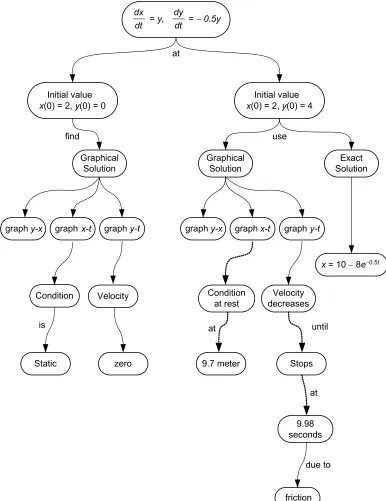
Incorrect statements which led to false relationships between concepts are indicated with dotted lines.
One of the problems investigated is on linear motion system. This problem presented a system of differential equations in two different cases and is stated as follows:
A car moved on a plane with friction is modeled by the equation:
0.5
dy dx
y y
dt = dt = −
In this problem, two initial values are given:
(a) x(0) = 2 and y(0) = 0 (The car is released at initial position x = 2) (b) x(0) = 2 and y(0) = 4 (The car is released at initial position x = 2
and initial velocity y = 4)
(i) Without using DEgraf, plot the graph of yx, xt and yt for –10 ≤ x ≤ 10, –10 ≤ y ≤ 10, and 0 ≤ t ≤ 10 at initial value (a). Repeat for initial value (b) using DEgraf.
(ii) Base on the graphs, state the position of the car when it stops, the time it takes to stop and its velocity at t =2, 4, 6, and 8.
(iii) Explain the motion pattern for each initial values. (iv) Derive the algebraic solutions for each case.
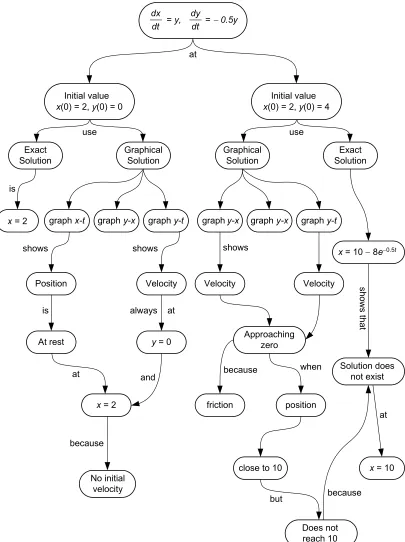
The discussions on this problem by two groups of students, namely the high achievers group and low achievers group are displayed in two concept maps. All links that were made by the high achievers group are mathematically acceptable including the parts that are not solved with computers. On the other hand, low achievers group made four mistakes as shown by the dotted lines. Mistakes were related to interpreting the graphs of x-t and y-t in terms of the position and velocity for the linear system. Moreover this group only managed to analyze the first part of the problem using graphs, whereas the other group used graphs and algebraic solutions. Furthermore, the concept map of the high achievers indicates that they also explained the phenomenon of the system using “no initial velocity” and “friction.” For this particular problem, the high achievers group came out with 23 concepts whereas the low achievers group used 19 concepts in their written lab reports. In terms of relations between concepts, the high achievers group made 40 compared to 22 made by the low achievers group.
4.0 DISCUSSION
Figure 1 Concept map for linear motion problem, High-Achiever Group Initial value
x(0) = 2,y(0) = 0
at
Exact Solution
use
Approaching zero
No initial velocity
Solution does not exist is
shows shows shows
sho
w
s
that
always at is
at and because
because
when
but because at
dx
dt = y,
dy
dt =− 0.5y
Initial value
x(0) = 2,y(0) = 4
Graphical Solution
Exact Solution use
Graphical Solution
x = 2
Position
At rest y = 0
x = 2
graphx-t graphy-x graphy-t graphy-x graphy-x graphy-t
Velocity Velocity Velocity
friction position
close to 10
x = 10− 8e−0.5t
x = 10
Figure 2 Concept map for linear motion problem, Low-Achiever Group Initial value
x(0) = 2,y(0) = 0
at
find
is at until
due to
dx
dt = y,
dy
dt =− 0.5y
Initial value
x(0) = 2,y(0) = 4
Graphical Solution
Exact Solution use
Graphical Solution
Condition
Static zero
graphy-x graphx-t graphy-t graphy-x graphx-t graphy-t
Velocity Condition at rest
Velocity decreases
9.7 meter Stops
9.98 seconds
x = 10− 8e−0.5t
after they engaged in computer laboratory activies. Their abilities to solve non routine problems with a cognitive tool like DEgraf which is difficult to be solved manually suggest that the software played an important role in enhancing understanding. The concepts used also show their approach in solving the problem involve incorporating algebraic, graphical and numerical methods that were highlighted during lectures. The limitations of an algebraic solution as a technique to solve differential equations is obviously needed to be fasilitated with the use of computers.
Overall, the differences between number of concepts and relations made between the high achievers group and the low achievers group are significant. Concept maps showed that the number of concepts in every problem used by the high achievers group exceed those of the low achievers group. Concepts used by the high achievers group are clear, relevant and organized and therefore convenient for the researcher to construct the concept map. Their existing concepts have been used to develop new concepts or have been applied in new situations during problem solving. Interestingly, the high achievers frequently provide explanations on why the system or phenomena behaved that way with rational argument and not limited on explaining how things happened as portrayed by the low achievers. This suggest that in a computer based learning, the high achievers group achieved relational understanding as pointed by Skemp (1971).
The high achievers group explored the problems beyond what were needed in the problem statement. The low achievers group never made this effort. The high achievers group hardly made any mathematical errors. Some errors made by the low achievers group were resulted from analysing graphs in the static mode that have been printed earlier. The errors could be avoided if they had remembered the dynamical state when the graphs were plotted with DEgraf.
5.0 CONCLUSION
ACKNOWLEDGEMENT
The main author would like to thank Universiti Teknologi Malaysia for providing computer laboratory facilities to make the study possible. A special word of thanks to Professor Dr Ismail Kailani who acted as the author’s supervisor in completing the main part of this work which is a thesis to meet the requirement of doctor of philosophy.
REFERENCES
Ausubel, D. P. 1968. Educational Psychology: A Cognitive View. New York: Holt, Rinehart and Winston. Canas, A. J., J. D. Novak dan F. M. Gonzalez (Eds). 2004. Concept Maps: Theory, Methodology, Technology. Proc.
of the First Int. Conference on Concept Mapping. Pamplona, Spain.
Dubinsky, E. 1991. Reflective Abstraction. In D.O. Tall: Advance Mathematical Thinking. Dordrecht: Kluwer, 95-126.
Godino, J. D. 1996. Mathematical Concepts, their Meanings and Understanding. Proceeding of the 20th International Convention on Mathematics Education Psychological Group. Volume II. Valencia; 417-424.
Greeno, J. G. 1978. Understanding and Procedural Knowledge in Mathematics. Educational Psychology. 12(13): 262-283.
Heid, M. K. 1988. Resequencing Skills and Concepts in Applied Calculus using the Computer as a Tool.
Journal for Research in Mathematics Education. 19(1): 3-25.
Hiebert, J. dan T. P. Carpenter. 1992. Learning and Teaching with Understanding. In : D. A. Grouws. Handbook of Research in Mathematics Teaching and Learning. New York: Macmillan, 65-96.
Kilpatrick, J., C. Hoyles dan O. Skovsmose. 2005. Meaning in Mathematics Education. NY: Springer
Kirschner, P. A. dan G. Erkens. 2006. Cognitive Tools and Mindtools for Collaborative Learning. Journal of Educational Computing Research. 35(2): 199-209.
Kong, S. C. 2008. The Development of a Cognitive Tool for Teaching and Learning Fractions in the Mathematics Classroom: A Design-based Study. Computers & Education. 5(2): 886-899.
Moreno, M. dan C. Azcarate. 1996. Teaching Differential Equations to Biology and Chemistry Students: An Overview on Methodology of Qualitative Research: A Case Study. Proceeding on the 20th International Convention of Mathematics Education Psychological Group. Volume IV. Valencia; 11-18.
Noor Azlan Ahmad Zanzali, Zaleha Ismail dan Hassan Hushin. 1995. Concept Mapping: An Approach to Meaningful Learning. Jurnal Pendidikan. Universiti Teknologi Malaysia. 1(1): 62-71.
Novak, J. D. dan D. B. Gowin. 1984. Learning How to Learn. Cambridge: Cambridge University Press. Pirie, S. E. B. dan T. E. Kieren. 1994. Beyond Metaphor: Formalising in Mathematical Understanding within
Constructivists Environments. For the Learning of Mathematics. 14(1): 39-43.
Romberg, T. A. and Carpenter, T. P. 1986. Research on Teaching and Learning Mathematics: 2 Disciplines of Scientific Inquiry. In: M. C. Wittrock. Handbook of Research on Mathematics Teaching and Learning. Macmillan Publishing Company. 850-873.
Skemp, R. R. 1971. The Psychology of Learning Mathematics. Harmondsworth: Penguin Books.
Tall. 1986. Building and Testing a Cognitive Approach to the Calculus Using Interactive Computer Graphics. Ph.D Thesis. Warwick University. Unpublished.
Tall. 1991. Recent Developments in the use of Computers to Visualize and Symbolize Calculus Concepts. In L. C. Leinbach, J. R. Hundhausen, A. M. Ostebee, L. J. Senechal, D. B.Small. The Laboratory Approach to Teaching Calculus. The Mathematical Association of America; 15-26.