Malaysian Journal of Fundamental & Applied Sciences
available online at http://mjfas.ibnusina.utm.my
Sticker Systems Over Monoids
N.A. Mohd Sebry1*,N. Z. A. Hamzah 2, N.H. Sarmin1,2, W.H. Fong 2 and S. Turaev3
1Department of Mathematical Sciences, Faculty of Science, UTM, 81310 UTM Johor Bahru,Johor, Malaysia,
2IbnuSina Institute for Fundamental Science Studies, Faculty of Science, UTM, 81310 UTM Johor Bahru,Johor, Malaysia, 3Faculty of Computer Science and Informational Technology, Universiti Putra Malaysia, Malaysia.
Received 26 November 2012, Revised 5 January 2012, Accepted 12 April 2012, Available online 28 April 2012
ABSTRACT
Molecular computing has gained many interests among researchers since Head introduced the first theoretical model for DNA based computation using the splicing operation in 1987. Another model for DNA computing was proposed by using the sticker operation which Adlemanused in his successful experiment for the computation of Hamiltonian paths in a graph: a double stranded DNA sequence is composed by prolonging to the left and to the right a sequence of (single or double) symbols by using given single stranded strings or even more complex dominoes with sticky ends, gluing these ends together with the sticky ends of the current sequence according to a complementarity relation. According to this sticker operation, a language generative mechanism, called a sticker system, can be defined: a set of (incomplete) stranded sequences (axioms) and a set of pairs of single or double-stranded complementary sequences are given. The initial sequences are prolonged to the left and to the right by using sequences from the latter set, respectively. The iterations of these prolongations produce “computations” of possibly arbitrary length. These processes stop when a complete double stranded sequence is obtained. Sticker systems will generate only regular languages without restrictions. Additional restrictions can be imposed on the matching pairs of strands to obtain more powerful languages. Several types of sticker systems are shown to have the same power as regular grammars; one type is found to represent all linear languages whereas another one is proved to be able to represent any recursively enumerable language. The main aim of this research is to introduce and study sticker systems over monoids in which with each sticker operation, an element of a monoid is associated and a complete double stranded sequence is considered to be valid if the computation of the associated elements of the monoid produces the neutral element. Moreover, the sticker system over monoids is defined in this study.
| Sticker operation| Valence grammar | Valence sticker system | H system |
® 2012 IbnuSina Institute. All rights reserved.
1. INTRODUCTION
The first DNA computation experiment was successfully performed by Adleman in 1994 [1] and he has proved that DNA computing is possible. The sticker system is introduced in [2] as a formal language model for the self-assembly (annealing and ligation operations)phase of Adleman’s experiment [1]. The basic operation of sticker systems isthe sticking operation [2, 3, 4, 5] that forms double stranded DNA sequences fromblocks of arbitrary shape of DNA single strands. The sticker system model uses no enzymes, employs reusable DNA and has a random access memory that requires no strandextension [5, 6]. The interest of this research is to extend the DNA sticker systems over some monoids. Some new concepts of DNA sticker systems over monoids are introduced in this paper.
Corresponding author at:
E-mail address: [email protected] (Nurul Afidah Mohd Sebry)
2. PRELIMINARIES
2.1 Sticker Operation
A DNA sequence is a double stranded sequence which is composed of adenine (A), thymine (T), cytosine (C) and guanine (G). The bonding between the bases follows the restriction of the base pairing proposed by Watson–Crick in 1953 [7] where A is paired with T and C
is paired with G. The basic formalism of sticker operation is that, two single strands of DNA glued together to form double stranded DNA sequence. This gluing operation will continue as long as more single stranded DNA sequence is added in the solution.
Consider the alphabet 𝑉𝑉(a finite set of symbols) and a symmetric biological relation 𝜌𝜌, where 𝜌𝜌 ⊆ 𝑉𝑉 ×𝑉𝑉. Let # be a special symbol not in 𝑉𝑉, denoting an empty space (the blank symbol). The symbol 𝑉𝑉∗ denotes the setof all strings of symbol over 𝑉𝑉. It is also considered that the alphabet 𝑉𝑉is ofabstract DNA bases {a, t, c, g} and a relation𝜌𝜌 ⊆ 𝑉𝑉 ×𝑉𝑉 over𝑉𝑉represent thecomplementary relation(a complements to t and c complements to g). The matching base pairs of double stranded molecules of DNA
can be represented as�𝑥𝑥𝑥𝑥1
x2 is the lower strand. Also, x1 is complement to x2.
If𝑥𝑥=�𝑥𝑥𝑥𝑥1
2�and𝑦𝑦=�
𝑦𝑦1
𝑦𝑦2�, then the concatenation of x and y is denoted by𝑥𝑥𝑦𝑦=�𝑥𝑥𝑥𝑥1
2� �
𝑦𝑦1
𝑦𝑦2� or 𝑥𝑥𝑦𝑦=�
𝑥𝑥1𝑦𝑦1
𝑥𝑥2𝑦𝑦2�. Using the elements of𝑉𝑉 ∪#, the following set of composite symbols is constructed:
�𝑉𝑉𝑉𝑉�= ��𝑎𝑎𝑏𝑏� │𝑎𝑎,𝑏𝑏 ∈ 𝑉𝑉, (𝑎𝑎,𝑏𝑏)∈ 𝜌𝜌�,
�#𝑉𝑉�= ��#𝑏𝑏� │𝑏𝑏 ∈ 𝑉𝑉�,�𝑉𝑉#�= ��𝑎𝑎#� │𝑎𝑎 ∈ 𝑉𝑉�.
The Watson-Crick domain is denoted by 𝑊𝑊𝑊𝑊𝜌𝜌(𝑉𝑉),
which is associated to the alphabet 𝑉𝑉and the
complementary relation 𝜌𝜌. For example, if we have two strings of 𝑤𝑤1 =𝑥𝑥1𝑥𝑥2⋯ 𝑥𝑥𝑛𝑛and𝑤𝑤2=𝑦𝑦1𝑦𝑦2⋯ 𝑦𝑦𝑛𝑛, then the concatenation of the strings𝑤𝑤1and𝑤𝑤2is equal to 𝑤𝑤1𝑤𝑤2=
�𝑥𝑥1
𝑦𝑦1� �
𝑥𝑥2
𝑦𝑦2� ⋯ �
𝑥𝑥𝑛𝑛
𝑦𝑦𝑛𝑛� ∈ 𝑊𝑊𝑊𝑊𝜌𝜌(𝑉𝑉) and is simplified as�
𝑤𝑤1
𝑤𝑤2�. The element�𝑤𝑤𝑤𝑤1
2� ∈ 𝑊𝑊𝑊𝑊𝜌𝜌(𝑉𝑉)is called a well-formed double
stranded sequence (or simply double stranded sequence) or molecules [4, 8]. Here, 𝑤𝑤1is called the upper strand and 𝑤𝑤2 is called the lower strand. Note that, the length of 𝑤𝑤1 and
𝑤𝑤2 are equal and they are symmetric over the relation𝜌𝜌,
which is (𝑥𝑥𝑖𝑖,𝑦𝑦𝑖𝑖)∈ 𝜌𝜌 for𝑖𝑖= 1, 2,⋯,𝑛𝑛. By means of symmetry, (𝑦𝑦𝑖𝑖,𝑥𝑥𝑖𝑖)∈ 𝜌𝜌for1, 2,⋯,𝑛𝑛 is also defined.
The concept of incomplete molecules is used in this paper as an abstraction of DNA molecules with sticky ends [4, 6]. These molecules consist of mixed DNA molecules with double and single strands. The incomplete molecule is the element of the set:
𝑊𝑊𝜌𝜌(𝑉𝑉) =𝐿𝐿𝜌𝜌(𝑉𝑉)∪ 𝑅𝑅𝜌𝜌 (𝑉𝑉)∪ 𝐿𝐿𝑅𝑅𝜌𝜌(𝑉𝑉)
where;
𝐿𝐿𝜌𝜌(𝑉𝑉) = ��𝑉𝑉𝜆𝜆∗� ∪ �𝑉𝑉𝜆𝜆∗�� �𝑉𝑉𝑉𝑉�
𝜌𝜌 ∗
,
𝑅𝑅𝜌𝜌(𝑉𝑉) = �𝑉𝑉𝑉𝑉�
𝜌𝜌 ∗
��𝑉𝑉𝜆𝜆∗� ∪ �𝑉𝑉𝜆𝜆∗��,
𝐿𝐿𝑅𝑅𝜌𝜌(𝑉𝑉) = ��𝑉𝑉𝜆𝜆∗� ∪ �𝑉𝑉𝜆𝜆∗�� �𝑉𝑉𝑉𝑉�
𝜌𝜌
+
��𝑉𝑉𝜆𝜆∗� ∪ �𝑉𝑉𝜆𝜆∗��.
.
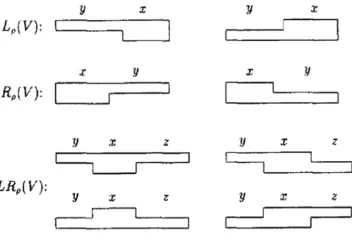
From the given set of 𝑊𝑊𝜌𝜌(𝑉𝑉), we can illustrate two basic types of possible shapes of elements in 𝑊𝑊𝜌𝜌(𝑉𝑉)as the following:
i) Left single strand and right double strand (𝐿𝐿𝜌𝜌(𝑉𝑉)), ii) Left double strand and right single strand (𝑅𝑅𝜌𝜌(𝑉𝑉)). The third type of possible shape (𝐿𝐿𝑅𝑅𝜌𝜌(𝑉𝑉)) can be obtained by extending the first two basic types of elements in 𝑊𝑊𝜌𝜌(𝑉𝑉). Figure 1illustrates the possible shapes of the three types of incomplete molecules [4].
There are eight possible shapes of dominoes used in sticking operation which can lead to different cases when stacked to the other. Notice that, in all cases we have a double stranded sequence of ‘x’ and an overhang sequence of ‘y’ or ‘y and z’. The sticky ends are placed either in the
lower strand or in the upper strand. However, for the third type which is 𝐿𝐿𝑅𝑅𝜌𝜌(𝑉𝑉), its element which is x is in
�𝑉𝑉𝑉𝑉�𝜌𝜌+and is called well-started double stranded sequence.
Fig. 1 Possible Shapes of Dominoes
The two strands of dominoes in 𝑊𝑊𝜌𝜌(𝑉𝑉)might have different length and it is useful to indicate the blank space by the symbol #. A partial operation 𝜇𝜇stimulates the concatenation and the ligation or annealing operation among the elements of 𝑊𝑊𝜌𝜌(𝑉𝑉). The operation is known as sticking operation which is the primary implements of the sticker systems [6]. The elements of 𝑊𝑊𝜌𝜌(𝑉𝑉)can be prolonged to the left or to the right with a brick or dominoes providing the complementarity between the corresponding sticky ends of dominoes. The process of prolongation will continue until complete double stranded molecule is obtained.
It is easy to see that there are eight possible cases of sticker operation obtained from the elements of
𝑊𝑊𝜌𝜌(𝑉𝑉)which is illustrated in Figure 2.
Fig. 2 Eight Possible Cases of Sticker Operation
The sticker operation discussed is a language operation of formal languages that stimulates concatenation operation and annealing operation of the incomplete molecules [6] of 𝑊𝑊𝜌𝜌(𝑉𝑉)to the complete double stranded molecule. The sticker operation is the primary implement of the sticker system as discussed in the next section.
2.2 Sticker System
The experiment done by Adleman [1] in 1994 for solving Hamiltonian Path Problem (HPP) initiated the study of sticker system by Kari et al. [2].
experiment. The term regular sticker system was first used in [2] and was then extended to bidirectional sticker systems in [5]. However, both concepts were merged to sticker system as in [4] and the term ‘sticker system’ will be used in this paper.
When forming new molecules, the initial strands called axioms and a well started sequence are utilized and prolonged either to the left or to the right direction by the process of the operation 𝜇𝜇[8]. Starting from the axiom and iteratively using the operation of sticking, strands are prolonged by using dominoes or bricks in order to obtain a complete double stranded sequence [9]. In [4], Paun et al. has defined sticker system in a very general form and the formal definition of sticker system in this paper will follow the definition in [4] and will also make use of the definition given by Kari et al. in [2] and [5].
A sticker system is a construct of 4-tuple
𝛾𝛾= (𝑉𝑉,𝜌𝜌,𝐴𝐴,𝐷𝐷)
where𝑉𝑉is an alphabet, endowed with the symmetric relation𝜌𝜌 ⊆ 𝑉𝑉 ×𝑉𝑉 in 𝑉𝑉, 𝐴𝐴 is a finite subset of axioms (𝑊𝑊𝜌𝜌(𝑉𝑉)), and 𝐷𝐷is a finite set of pairs(𝐵𝐵𝑑𝑑,𝐵𝐵𝑢𝑢) where 𝐵𝐵𝑑𝑑and
𝐵𝐵𝑢𝑢are finite subsets of upper and lower stickers of the
forms�#𝑉𝑉�+and�𝑉𝑉#�+, respectively.
To implement the systems, the mechanism of the sticker system starts from the axiom 𝐴𝐴and uses the pairs of
𝐵𝐵𝑑𝑑and 𝐵𝐵𝑢𝑢to prolong the strands to the left or to the right
according to sticker operation 𝜇𝜇in order to obtain a set of double stranded sequence in 𝑊𝑊𝑊𝑊𝜌𝜌(𝑉𝑉) (a complete molecule). The prolongation process will continue until there is no blank symbol present where a complete double stranded sequence is obtained [2, 3].
For a given sticker system𝛾𝛾= (𝑉𝑉,𝜌𝜌,𝐴𝐴,𝐵𝐵𝑑𝑑,𝐵𝐵𝑢𝑢)and two sequences 𝑥𝑥,𝑦𝑦 ∈ 𝑊𝑊𝜌𝜌(𝑉𝑉), we write,
𝑥𝑥 ⟹∗𝑦𝑦if and only if 𝑦𝑦= 𝜇𝜇�𝐵𝐵
𝑑𝑑,𝜇𝜇(𝑥𝑥,𝐵𝐵𝑢𝑢)�.
Note that,𝜇𝜇�𝐵𝐵𝑑𝑑,𝜇𝜇(𝑥𝑥,𝐵𝐵𝑢𝑢)�= 𝜇𝜇(𝜇𝜇(𝐵𝐵𝑑𝑑,𝑥𝑥),𝐵𝐵𝑢𝑢)because the prolongation to the left is independent with the prolongation to the right [2]. By⟹∗, we denote the reflexive and transitive closure of the relation ⟹.
A sequence 𝑥𝑥1⟹ 𝑥𝑥2⟹ ⋯ ⟹ 𝑥𝑥𝑘𝑘, where 𝑥𝑥1∈ 𝐴𝐴, is called a computation in𝛾𝛾 with length 𝑘𝑘 −1 (notice that, we start from 𝑥𝑥1∈ 𝐴𝐴). If𝑥𝑥𝑘𝑘 ∈ 𝑊𝑊𝑊𝑊𝜌𝜌(𝑉𝑉), where no sticky end and hence blank symbol is present in the last string of composite symbol, the above computation is considered as complete.
A complete computation of sticker system will produce a complete string, denoted by 𝑤𝑤 ∈ 𝑊𝑊𝑊𝑊𝜌𝜌(𝑉𝑉). Sticker system will generate the set of all possible languages of the completed strings. The language of all such strings in the sticker operation is the language generated by 𝛾𝛾and is called as sticker language. Sticker language is explained in the next section.
2.3 Sticker Language
The sticker language is a language generating device based on the sticker operation which is an abstract model of the annealing operation occurring in DNA computing [2, 5].
The language generated by a sticker system consist of all strings formed by the set of upper strands of all complete molecule derived from the axioms for which an exactly matching sequence of lower stickers can be found [5, 10].
Sticker system will generate only regular languages (but not all of them) without restrictions [9]. Some restrictions have been introduced in [2, 4, 8, 11] on matching pairs of strands to obtained more powerful languages of sticker systems such as primitive sticker language, balance sticker language, and primitive balance sticker language.
The sticker language is the set of all possible languages (from complete molecules) generated by sticker system. Let 𝛾𝛾= (𝑉𝑉,𝜌𝜌,𝐴𝐴,𝐷𝐷)be a sticker system, the unrestricted molecular language generated by 𝛾𝛾is defined in [11] as follows:
𝑀𝑀𝐿𝐿(𝛾𝛾) = {(𝑥𝑥,𝑦𝑦)∈ 𝜌𝜌 |(𝑥𝑥,𝑦𝑦)is a computation of 𝛾𝛾}. Furthermore, the unrestricted sticker language generated by 𝛾𝛾is the projection onto the first (upper) component of the molecular language, because of the complementarity relation of 𝜌𝜌. The language is denoted as
𝐿𝐿(𝛾𝛾)and is defined by:
𝐿𝐿(𝛾𝛾) = {𝑤𝑤 ∈ 𝑊𝑊𝑊𝑊𝜌𝜌(𝑉𝑉)| 𝑥𝑥 ⟹∗𝑤𝑤,𝑥𝑥 ∈ 𝐴𝐴}.
In this research,SL will denote sticker language. Only complete computation (the set of all upper strands of all complete molecules) as defined above will be considered when defining SL. The similarity of this process to Adleman’s experiment can be found in [2].
There are six families of languages generated by sticker systems which are sticker languages, primitive sticker languages, balanced sticker languages, primitive balanced sticker languages, coherent sticker languages, and fair sticker languages denoted by SL, PSL, BSL, PBSL, CSL
and FSL respectively. The definitions of these families of languages are well defined in [2].
It is a fact that the families of languages generated by sticker systems are strictly included in the family of regular languages,SL ⊆ REG, PSL ⊆REG, BSL ⊆ REG, PBSL ⊆ REG, CSL ⊆ REG, and FSL ⊆ REG. The proof ofthese lemmas can be found in [2].
Below is an example to illustrate how sticking operation works on a sticker system.
Example 1Given a sticker system𝛾𝛾= (𝑉𝑉,𝜌𝜌,𝐴𝐴,𝐷𝐷)with 𝑉𝑉=
{𝑎𝑎,𝑏𝑏},𝜌𝜌= {(𝑎𝑎,𝑎𝑎), (𝑏𝑏,𝑏𝑏)}, 𝐴𝐴=��𝑏𝑏𝑏𝑏��𝑎𝑎#��, and𝐷𝐷=
��𝑎𝑎#��𝑎𝑎#�,�𝑎𝑎#��𝑏𝑏#�,�𝑎𝑎#��#𝑎𝑎�,�#𝑏𝑏��.
Startingwith 𝐴𝐴=��𝑏𝑏𝑏𝑏��𝑎𝑎#��, then the strings in 𝐷𝐷 (of complementarity) are used repeatedly to obtain another new molecule. The computations are depicted in the following:
1. �𝑏𝑏𝑏𝑏��𝑎𝑎#� ⟶ �#𝑎𝑎��𝑎𝑎#� ⟹ �𝑏𝑏𝑏𝑏��𝑎𝑎𝑎𝑎��#𝑎𝑎�,
2. �𝑏𝑏𝑏𝑏��𝑎𝑎𝑎𝑎��#𝑎𝑎� ⟶ �𝑎𝑎#��𝑏𝑏#� ⟹ �𝑏𝑏𝑏𝑏��𝑎𝑎𝑎𝑎�2�𝑏𝑏#�,
3. �𝑏𝑏
𝑏𝑏��𝑎𝑎𝑎𝑎�
2 �𝑏𝑏
#� ⟶ �#𝑏𝑏� ⟹ �𝑏𝑏𝑏𝑏��𝑎𝑎𝑎𝑎�
2 �𝑏𝑏
From the solution, the language of the sticker system is defined asfollows:
𝑀𝑀𝐿𝐿(𝛾𝛾) =��𝑏𝑏𝑏𝑏��𝑎𝑎𝑎𝑎�2�𝑏𝑏𝑏𝑏��and𝐿𝐿(𝛾𝛾) = {𝑏𝑏𝑎𝑎2𝑏𝑏}. The second notation of sticker language which is
𝐿𝐿(𝛾𝛾)is used throughout the paper. The following section recalls the definition and properties of monoids.
2.4 Monoids
In abstract algebra, an algebraic structure consists of one or more sets, called underlying sets or carriers or sorts, closed under one or more operations, satisfying some axioms where monoid is grouped in a group-like structure.
Definition 1 [12]:Monoid
An algebraic structure, M is said to be a monoid if it satisfies the following properties:
i)Closure: M is closed with respect to operation∗, that
is𝑎𝑎,𝑏𝑏 ∈ 𝑀𝑀 ⟹(𝑎𝑎,𝑏𝑏)∈ 𝑀𝑀for every 𝑎𝑎,𝑏𝑏 ∈ 𝑀𝑀.
ii)Associativity: The binary operation ∗is associative in
M, that is𝑎𝑎 ∗(𝑏𝑏 ∗ 𝑐𝑐) = (𝑎𝑎 ∗ 𝑏𝑏)∗ 𝑐𝑐for every𝑎𝑎,𝑏𝑏,𝑐𝑐 ∈
𝑀𝑀.
iii) Identity: There exist an element𝑒𝑒 ∈ 𝑀𝑀, such
that𝑎𝑎 ∗ 𝑒𝑒=𝑒𝑒 ∗ 𝑎𝑎=𝑎𝑎 for every𝑎𝑎 ∈ 𝑀𝑀.
The sticker system is first associated with the properties of monoid, M to see if the operation of sticking preserves the operation of monoid. It is obvious that, the sticker system 𝛾𝛾satisfies the conditions as a monoid.
2.5 Grammar
To study languages mathematically, a mechanism is needed to describe them. In this section, the notion of grammar is introduced as it is considered a common and powerful tool [13] to describe languages produced by the complete computation of sticker systems over monoids. The basic grammars investigated in formal language theory which is Chomsky grammar is discussed and hence it exhibit the relationship between numbers of language families by the Chomsky hierarchy.
The definition of grammar and Chomsky grammar is listed in the following.
Definition 2 [13]:Grammar
A grammar G is defined as a quadruple G = (V, T, S, P)
where
V is a finite set of objects called variables,
Tis a finite set of objects called terminal symbols,
𝑆𝑆 ∈ 𝑉𝑉isa special symbol called the start variable,
andP is a finite set of production rules. The setsV and T are nonempty and disjoint.
Definition 3[14] Chomsky Grammar
A Chomsky grammar is a quadruple G = (N, T, S, P) where
N is a finite set of nonterminal symbols,
T is a finite set of terminal symbols,
𝑆𝑆 ∈ 𝑉𝑉is a special symbol called the start symbol,
andP is a finite set of production rules.
The setsN and T are nonempty and disjoint. The set P is a finite set of pairs (u, v) where 𝑢𝑢,𝑣𝑣 ∈(𝑁𝑁 ∪ 𝑇𝑇)∗, such that u
contains at least one symbol from N. In this paper, the production rules are written in the form of𝑢𝑢 ⟶ 𝑣𝑣where u is an element of(𝑁𝑁 ∪ 𝑇𝑇)+, and v is in(𝑁𝑁 ∪ 𝑇𝑇)∗.
The set of languages generated by Chomsky grammar, G, is denoted by𝐿𝐿(𝐺𝐺)and is defined as follows:
𝐿𝐿(𝐺𝐺) = {𝑤𝑤 ∈ 𝑇𝑇∗;𝑆𝑆 ⟹∗𝑤𝑤}.
A number of language families are encountered which are recursively enumerable language, context-sensitive language, context-free language and regular languages. The languages are generated by regular grammars, context-free grammars, context-sensitive grammars and unrestricted grammars respectively and the grammarsmake up the Chomsky hierarchy, named after Noam Chomsky, a founder of formal language theory [13]. The families of finite, regular, linear, free, context-sensitive and recursively enumerable languages are denoted by FIN, REG, LIN, CF, CS, and RE respectively. They are said to form the Chomsky hierarchy because of the following inclusion: FIN⊆ REG ⊆ LIN ⊆ CF ⊆CS⊆ RE.
Among the language families which are of interest are the context sensitive language (CS), context-free language (CF), and regular language (REG). The characterization of the regular language concerning the generative capacity of sticker system will be investigated.
2.6 Valence Grammar and Extended Valence H
System
Grammar with regulated rewriting was first introduced by Paun [14], and is termed as valence grammar. In a valence grammar, each production of a Chomsky grammar is associated with an integer value, and computes the value of a derivation by adding the valences, and the valence of the production is only considered if the valences of the productions used add to zero [15].
Definition 4 [14]: Valence Grammar
A valence grammar over monoid is a quintuple
G = (N, T, S, P, M) where N, T, S are specified as in context-free grammar. M = (M, ⋄) is a monoid with neutral element, eand binary operation ⋄. The set P is a finite set of pairsr = (P, m) with a context-free rule Pand 𝑚𝑚 ∈ 𝑀𝑀. The language 𝐿𝐿(𝐺𝐺)generated by G is called valence language and is defined as
𝐿𝐿(𝐺𝐺) = {𝑤𝑤| 𝑤𝑤 ∈ 𝑇𝑇∗, (𝑠𝑠,𝑒𝑒)⟹∗(𝑤𝑤,𝑒𝑒)}.
The operation of sticker system is designed by a language generating mechanism so that the valence of the productions used added to zero or one according to additive or multiplicative valence grammar respectively.
valence sticker language are introduced with respect to the respective valence grammars.
The set of sticker system with monoid operation is used where for each sticker operation, an element of a monoid is associated and the value of monoid is computed from two used strings to produce a new string.
An extended H system over groups(ℤ, +, 0) and(ℚ+,
•
, 1) have been introduced in [16] and is known as an extended valence H systems. The definition of extended valence H system has been defined in [16] which discusses the computational power of H systems with valences. In the system, a number is associated with initial strings and the numbers are computed with new produced string. Below is the definition of extended valence H system.Definition 5 [16]: Extended Valence H Systems
Let(𝑀𝑀,⋄,𝑒𝑒)be a group with operation ⋄and the identity e. An extended valence H system over M is a construct
𝛾𝛾= (𝑉𝑉,𝑇𝑇,𝐴𝐴,𝑅𝑅), where V, T, and R are as in usual extended H system and A is a finite subset of𝑉𝑉∗×𝑀𝑀.
For (𝑥𝑥,𝑣𝑣1), (𝑦𝑦,𝑣𝑣2), (𝑤𝑤,𝑣𝑣3)∈ 𝑉𝑉∗×𝑀𝑀 and𝑟𝑟 ∈ 𝑅𝑅, we
write [(𝑥𝑥,𝑣𝑣1), (𝑦𝑦,𝑣𝑣2)]⊢𝑟𝑟(𝑤𝑤,𝑣𝑣3)∈ 𝑉𝑉∗×𝑀𝑀 if and only if
(𝑥𝑥,𝑦𝑦)⊢𝑟𝑟 𝑤𝑤 and 𝑣𝑣3=𝑣𝑣1⋄ 𝑣𝑣2. Then the language generated
by the system is defined as
𝐿𝐿(𝛾𝛾) = {𝑥𝑥 ∈ 𝑇𝑇∗| (𝑥𝑥,𝑒𝑒)∈ 𝜎𝜎∗(𝐴𝐴)}.
Using the definition above, Manca and Paun [16] have defined additive H systems and multiplicative H systems to denote the operation with a group of integers and a positive rational numbers respectively.
The valence grammar introduced by Dassow and Paun in 1989 [14] will be used to introduce the concept of sticker system over monoids. The definition of extended valence H system termed by Manca and Paun in [16] is used to define valence sticker system over monoids.
3. VALENCE STICKER SYSTEM
A new definition of sticker system over monoids which is termed as valence sticker systemis introduced in this research and is given in the following:
Definition 6: Valence Sticker System
Let (𝑀𝑀,⋄,𝑒𝑒)be a monoid with operation ⋄and the identity e. A valence sticker system over a monoid, M is a construct of valence sticker system,𝑉𝑉𝑆𝑆𝑆𝑆= (𝑉𝑉,𝜌𝜌,𝐴𝐴,𝐷𝐷,𝑀𝑀) where
𝑉𝑉,𝜌𝜌,𝐴𝐴are as in the usual definition of sticker system and D
is a finite subset of(𝐵𝐵𝑑𝑑 ×𝑀𝑀,𝐵𝐵𝑢𝑢×𝑀𝑀).
For��𝑎𝑎#�,𝑣𝑣1� ∈ 𝐵𝐵𝑢𝑢×𝑀𝑀,��#𝑏𝑏�,𝑣𝑣1� ∈ 𝐵𝐵𝑑𝑑×
𝑀𝑀and��𝑎𝑎𝑏𝑏�,𝑣𝑣1⋄ 𝑣𝑣2� ∈ 𝑊𝑊𝑊𝑊𝜌𝜌(𝑉𝑉),where 𝑣𝑣1,𝑣𝑣2 ∈ 𝑀𝑀 and we
write 𝜇𝜇���𝑎𝑎#�,𝑣𝑣1�,��#𝑏𝑏�,𝑣𝑣1��=���𝑎𝑎𝑏𝑏�,𝑣𝑣1⋄ 𝑣𝑣2��if and only
if(𝑎𝑎,𝑏𝑏)∈ 𝜌𝜌.
The set of possible languages generated by valence sticker system is called valence sticker language (VSL) and is defined in the following:
𝑉𝑉𝑆𝑆𝐿𝐿(𝛾𝛾) = {𝑤𝑤| 𝑤𝑤 ∈ 𝑊𝑊𝑊𝑊𝜌𝜌(𝑉𝑉), (𝐴𝐴,𝑒𝑒)⟹∗(𝑤𝑤,𝑒𝑒)}.
where𝑤𝑤 ∈ 𝑊𝑊𝑊𝑊𝜌𝜌(𝑉𝑉) is a complete double strand, produced by iterative operation of sticking on a starting axiom, A
with elements in D. The value of the valence assigned to A
must be equal to the identity of monoid, which is e and the computation of sticker systems with the associative elements of the monoids produces the identity element, e.
We can define multiplicative valence sticker system
(𝑚𝑚𝑉𝑉𝑆𝑆𝑆𝑆) and additive valence sticker system (𝑎𝑎𝑉𝑉𝑆𝑆𝑆𝑆) when
the binary operation ⋄ are multiplicative and additive, respectively, namely 𝑀𝑀1= (ℚ+,
•
, 1) and𝑀𝑀2= (ℤ, +, 0). The definitions are in the following:𝑚𝑚𝑉𝑉𝑆𝑆𝑆𝑆= (𝑉𝑉,𝜌𝜌,𝐴𝐴,𝐷𝐷,𝑀𝑀1)where 𝑀𝑀1= (ℚ+,
•
, 1),𝑎𝑎𝑉𝑉𝑆𝑆𝑆𝑆= (𝑉𝑉,𝜌𝜌,𝐴𝐴,𝐷𝐷,𝑀𝑀2)where𝑀𝑀2= (ℤ, +, 0).
The set 𝑉𝑉,𝜌𝜌,𝐴𝐴,𝐷𝐷 are as defined in the definition of valence sticker system. The set of possible languages generated by valence multiplicative sticker system and valence additive sticker system are termed as multiplicative valence sticker language (𝑚𝑚𝑉𝑉𝑆𝑆𝐿𝐿(𝛾𝛾)) and additive valence sticker language (𝑎𝑎𝑉𝑉𝑆𝑆𝐿𝐿(𝛾𝛾)) respectively and are defined as the following:
𝑚𝑚𝑉𝑉𝑆𝑆𝐿𝐿(𝛾𝛾) = {𝑤𝑤|𝑤𝑤 ∈ 𝑊𝑊𝑊𝑊𝜌𝜌(𝑉𝑉), (𝐴𝐴, 1)⟹∗(𝑤𝑤, 1)},
𝑎𝑎𝑉𝑉𝑆𝑆𝐿𝐿(𝛾𝛾) = {𝑤𝑤|𝑤𝑤 ∈ 𝑊𝑊𝑊𝑊𝜌𝜌(𝑉𝑉), (𝐴𝐴, 0)⟹∗(𝑤𝑤, 0)}.
The idea behind this computation is with each sticker operation, an element of a monoid is associated to each axiom and the valence of monoid operation of the new string from two used strings is computed. A complete double stranded sequence produced is considered to be valid if the computation of the associated elements of the group produces the identity element of the monoids.
In the following, an example of the computation of sticker system with additive and multiplicative monoidsis given.
Example 2Given a valence sticker system
𝑉𝑉𝑆𝑆𝑆𝑆= (𝑉𝑉,𝜌𝜌,𝐴𝐴,𝐷𝐷,𝑀𝑀)with 𝑀𝑀= (ℤ, +, 0),
𝜌𝜌= {(𝑎𝑎,𝑎𝑎), (𝑏𝑏,𝑏𝑏)}, 𝐴𝐴=��𝜆𝜆𝜆𝜆�� and𝐷𝐷 ∈(𝐵𝐵𝑑𝑑×𝑀𝑀,𝐵𝐵𝑢𝑢×𝑀𝑀),
where
𝐵𝐵𝑢𝑢×𝑀𝑀=���#𝑎𝑎� �𝑎𝑎#�,−1�,��𝑏𝑏#� �#𝑏𝑏�, 1��, and
𝐵𝐵𝑢𝑢×𝑀𝑀=���#𝑎𝑎� �#𝑎𝑎�,−1�,��#𝑏𝑏� �#𝑏𝑏�, 1��.
We start with 𝐴𝐴=���𝜆𝜆
𝜆𝜆�, 0��. Then, the string ��𝑎𝑎#��𝑎𝑎#�,−1�
is joined to the starting axiom𝐴𝐴. The computations are as follows:
𝜇𝜇 ���𝜆𝜆𝜆𝜆�, 0�,��𝑎𝑎#� �𝑎𝑎#�,−1��=��𝑎𝑎#� �𝑎𝑎#�,−1�, and
𝜇𝜇 ���𝑎𝑎#� �#𝑎𝑎�,−1�,��#𝑎𝑎� �𝑎𝑎�# ,−1��=��𝑎𝑎𝑎𝑎� �𝑎𝑎𝑎𝑎�,−2�,
Using the sticker operation of𝑘𝑘𝑡𝑡ℎiterations with strings��𝑎𝑎#��𝑎𝑎#�,−1�followed by ��𝑎𝑎#��#𝑎𝑎�,−1� repeatedly, we
The string produced is a complete double stranded molecule but the added valence is not equal to the identity element, which is zero. Hence the computation is continued by using strings��𝑏𝑏#��𝑏𝑏#�, 1� and followed by ��#𝑏𝑏��#𝑏𝑏�, 1�to
produce the string of the form��𝑎𝑎𝑎𝑎�2𝑘𝑘�𝑏𝑏𝑏𝑏�2,−2𝑘𝑘+ 2�.
Also, the sticker operation with 𝑘𝑘𝑡𝑡ℎiterations using strings��𝑏𝑏#��𝑏𝑏#�, 1� and followed by ��#𝑏𝑏��#𝑏𝑏�, 1�repeatedly, is used to terminate the −2𝑘𝑘+ 2 valence of the produced
string of��𝑎𝑎𝑎𝑎�2𝑘𝑘�𝑏𝑏𝑏𝑏�2,−2𝑘𝑘+ 2�. Finally, the sticker
operation of the respective strings will
produce��𝑎𝑎𝑎𝑎�2𝑘𝑘�𝑏𝑏𝑏𝑏�2𝑘𝑘,−2𝑘𝑘+ 2𝑘𝑘= 0�which is a complete
double stranded molecule with valence equal to the identity of the monoid.
Therefore, it can easily be concluded that the language produced by the system is 𝑎𝑎𝑉𝑉𝑆𝑆𝐿𝐿(𝛾𝛾) = {𝑎𝑎2𝑘𝑘𝑏𝑏2𝑘𝑘;𝑘𝑘 ≥1}. Hence, a grammar G can be constructed
as shown in the following:
𝐺𝐺= ({𝑆𝑆}, {𝑎𝑎,𝑏𝑏},𝑆𝑆,𝑃𝑃)with productions
𝑆𝑆 ⟶ 𝑎𝑎𝑎𝑎𝑆𝑆𝑏𝑏𝑏𝑏
𝑆𝑆 ⟶ 𝜆𝜆.
From the solution, the language produced is a CF – REGlanguage.
The computation of sticker system over monoids must satisfy two conditions which are:
i) The string from the computation is only
considered if a complete double stranded molecule is produced,
ii) The valence of the complete double stranded molecule is equal to the identity of the respective monoids.
It is important to know that both conditions must be satisfied when dealing with computation of sticker system over monoids. Furthermore, the choosing of the starting axioms, 𝐴𝐴and the finite subset of pairs of 𝐵𝐵𝑑𝑑∪ 𝐵𝐵𝑢𝑢give differences to the language produced from the computation of the system. Besides, if we define𝜌𝜌of complementarity to other than identity, for example (a, b),a different language will be produced.
4. CONCLUSION
The new definition of sticker system over monoidsdefined as valence sticker system is introduced in this study. An example is given to illustrate the given definition. The language generated by the computation of valence sticker system with groups of monoid of integers and positive rational numbers are also introduced. The language of the respective valence sticker systems are obtained from the complete double stranded molecule produced from the computation.
Hence, a grammar is generated from the produced languageof the computation to classify the grammar as well
as the language to the class of Chomsky hierarchy. The computational power of sticker system can be seen through another similar example but not up to recursively enumerable language.
ACKNOWLEDGEMENT
The authors would like to acknowledge Research Management Center (RMC), UTM for the partial financial funding through Vote No. 00H48. The first and the second authors would also like to thank Ministry of Higher Education (MOHE) for MyMaster scholarship programme under the Tenth Malaysia Plan (10MP).
REFERENCES
[1] L.M. Adleman, Molecular Computations of Solutions to Combinatorial Problems. Science, 266 (1994), 1021-1024.
[2] L. Kari, G. Paun, G. Rozenberg, A. Salomaa, and S. Yu, DNA Computing, Sticker Systems and Universality. ActaInformatica. 35 (1998), 401-420.
[3] L. Kari, S. Seki, and P. Sosik, DNA Computing: Foundations and Implications for Computer Science. In G. Rozenberg, T. Back, and J. Kok, Springer-Verlag, 2010.
[4] G. Paun, and G. Rozenberg, Sticker Systems, Theoretical Computer Science, 204 (1998), 183-203.
[5] R. Freund, G. Paun, G. Rozenberg, and A. Salomaa, A Bidirectional Sticker Systems. In R. B. Altman, A. K. Dunker, L. Hunter, and T. E. Klein (Eds.), Pacific Symposium on Biocomputing. World Scientific, Singapore, 1998, 535-546.
[6] J. Xu, Y. Dong, and X. Wei, Sticker DNA Computer Model, Part 1: Theory, Chinese Science Bulletin, 2004, 49(8), 772-780.
[7] T. Audesirk, G. Audesirk, and B. E. Byers, Life on Earth, 4th
Edition, United States of America, Pearson Prentice Hall, 2006. [8] G. Rozenberg, G. Paun, and A. Salomaa, DNA Computing: A New
Computing Paradigms, New York, Springer-Verlag, 1998. [9] A. Alhazov, and M. Ferretti, Computing by Observing
Bio-Systems: The Case of Sticker Systems. In C. Ferretti, G. Mauri, and C. Zandron Eds. DNA Computing: 10th International Workshop on
DNA Computing, DNA 10, Milan, Italy, Springer-Verlag, 2004, 1-13.
[10] H. J. Hoogeboom, and N. V. Vugt, Fair Sticker Languages, ActaInformatica, 37 (2000), 213-225.
[11] N. V. Vugt, Models of Molecular Computing, University of Leiden, Ph.D. Thesis, 2002.
[12] C. B. Gupta, S. R. Singh, and S. Kumar, Advance Discrete Structure, New Delhi, I. K International Publishing House Pvt. Ltd, 2010.
[13] P. Linz, An Introduction to Formal Languages and Automata, 4th
Edition, United States of America, Jones and Bartlett Publishers, 2006.
[14] J. Dassow, and G. Paun, Regulated Rewriting in Formal Language Theory. In EATXS Monograph in Theoretical Computer Science, Springer-Verlag, 18 (1989).
[15] H. Fernau, and R. Stiebe, Regulation by Valences. In B. Rovan (Ed.), Mathematical Foundations of Computer Science 1997 22nd
International Symposium, MFCS’97 Proceedings, August 25-29, Springer-Verlag.