A Suitable Development Trend in Linear City Based On Smart Growth
A Case Study in Lanzhou Urban Area
ZHOU WEI
A project report submitted in partial fulfillment of the requirements for the
award of the degree of Master of Science (Urban and Regional Planning)
Faculty of Built Environment
Universiti Teknologi Malaysia
DEDICATION
ACKNOWLEDGMENT
Firstly, I would like to express my special thanks of gratitude to my supervisor Dr. Soheil Sabri who gave me the golden opportunity to go through this wonderful study. For his guidance, encouragement and enthusiasm, any merit in this research reported here has much to do with his help and advice.
Secondly, I would also like to thank Assoc. Prof. Dr. Foziah Johar, for her help, caring and support when I was in troubles.
Further gratitude is extended to all the staffs in Build Environment Faculty for their hard work in every day, and all well-wishers. For their encouragement, support and presence helped.
Furthermore, I would like to thank the respondents who spent their time answering this study’s questionnaire.
ABSTRACT
“Smart growth” strategy as a new urban development theory originated from United States as a way against urban sprawl. However, urban sprawl also threatens China’s urban spatial expansion process on certain extent. In this research, the issues come from spatial layout, and construction land structure is irrational in Lanzhou City, so the main purpose is to find an appropriate development trend for future development. The result should push forward an influence on introducing Smart growth theory into China’s planning system as well as assist Lanzhou city get a better development direction.
ABSTRAK
Strategi “Pertumbuhan Pintar” sebagai teori pembangunan bandar baru telah diketengahkan oleh Amerika Syarikat sebagai tentangan kepada rebakan bandar. Namun, rebakan bandar juga mengancam proses pengembangan kawasan bandar China pada tahap tertentu. Dalam kajian ini, isu-isu dari susun atur ruang dan struktur tanah pembinaan adalah tidak relevan di Bandar Lanzhou, maka tujuan utama ialah untuk mencari kecenderungan pembangunan yang sesuai untuk pembangunan pada masa hadapan. Hasil kajian seharusnya mengenengahkan pengaruh terhadap pengenalan teori Pertumbuhan Pintar ke dalam sistem perancangan China serta membantu Bandar Lanzhou mendapatkan arah pembangunan yang lebih baik.
TABLE OF CONTENT
DECLARATION ii
DEDICATION iii
ACKNOWLEDGMENT iv
ABSTRACT v
ABSTRAK vi
TABLE OF CONTENT vii
LIST OF TABLES x
LIST OF FIGURES xii
LIST OF APPENDIX xv
1 INTRODUCTION
1.1 Introduction 16
1.2 Background of Study 2
1.3 Problem Statement 4
1.3.1 Urban Area is suffering from An Uncontrolled Growth 5 1.3.2 The Current Urban Layout is Less Local Integrity 7
1.4 Research Question 8
1.5 Research Objective 9
1.6 Research Framework 9
1.7 Significance of Study 10
1.8 Research Organization 11
2 LITERATURE REVIEW
2.1 Introduction 13
2.2.2 Policy Orientation 19
2.2.3 Social Factors 20
2.2.4 Humanistic Concern 21
2.3 The Thinking of Smart Growth in United States and China 22
2.4 GIS-based Urban Growth Model 26
2.5 Simulated Smart Growth Scenario Implementation Examples
By GIS-based Model 27
2.5.1 Best Location Analysis Model 27
2.5.2 SLEUTH Model (Chesapeake Bay) 29
2.5.3 Uplan Model (San Joaquin Valley, California) 31
2.6 Summary 35
3 METHODOLOGY
3.1 Introduction 37
3.2 Methodological Framework 38
3.3 Discussion and Rationale for Choice of Methods 40
3.3.1 Justification for Raster Analysis 40
3.3.2 Justification for Questionnaire 42
3.4 Research Workflow 44
3.5 Study Area 45
3.6 Data Collection and Preparation 46
3.7 Data Analysis 47
3.8 Methodological Approach 49
3.8.1 Vector and Raster Conversion 49
3.8.2 Suitability Analysis and Scenario Simulation 50
3.8.3 Attractor, Discouragement and Mask 51
3.8.4 Raster Distance Model 55
3.8.4.1 Distance (Buffer) Standard: 56
3.8.6 Weight overlay 60
3.8.7 Extraction 62
3.8.8 Raster Logical Operation 63
3.9 Scenario Evaluation 64
3.10 Result 65
3.11 Summary 65
4 Research Finding and Discussion
4.1 Introduction 67
4.2 Scenario evaluation 68
4.2.1 Numerical Evaluation 77
4.2.1.1 Residential Land Evaluation and Measurement 77 4.2.1.2 Commercial Land Evaluation and Measurement 78 4.2.1.3 Industrial Land Evaluation and Measurement 79 4.2.1.4 Mix Land Use Evaluation and Measurement 79
4.2.2 Spatial Pattern Evaluation 80
4.3 Result Self-Appraisal 92
4.4 Self-Appraisal Judgment and Justification 93 4.5 Suitable and Appropriate Scenario Discussion 95
4.6 Summary 97
5 Conclusion and Recommendation
5.1 Summary of Finding 98
5.2 Conclusion 99
5.3 Research limitation 102
5.4 Recommendation 103
LIST OF TABLES
TABLE NO. TITLE PAGE
Table 1.1: The Main Function of Each Zoning 7 Table 2.1: The Unites States Urbanization Process 15 Table 2.2: United States City Number and Urban Population
(1940-1990) 16
Table 2.3: United States Urban, Suburban and Employment Change
(1950-1990) 17
Table 2.4: Migrant Workers Number from 2000 to 2005 in Urban Area 22
Table 2.5: Smart Growth Principles 24
Table 2.6: Smart Growth Superiority 25
Table 2.7: Case Study Summary 35
Table 3.1: The Advantages and Disadvantages in Vector Data And
Raster Data 40
Table 3.2: The Advantages and Disadvantages of Questionnaire 42 Table 3.3: Attractor, Discouragement and Mask Definition in Three
Scenarios 52
Table 3.4: Large City and Medium City Road Network Standard for
Road Width in China 56
Table 3.7: Green Area Service Radius 58
Table 4.1: Final Decision-making Theory 72
Table 4.2: Districts Land Use Characteristics in Each Scenario and
General Plan 91
LIST OF FIGURES
FIGURE NO. TITLE PAGE
Figure 1.1: The urban expansion in Las Vegas, Nevada, the United States,
from 1990 to 2010 2
Figure 1.2: Change of the Yellow River from 1949 to 2000 6
Figure 1.3: Illustration of Four Districts (1) 6
Figure 1.3: Illustration of Four Districts (1) 6
Figure 1.4: Lanzhou City’s Master Plan (2001-2010) 8
Figure 1.5: Research Framework Structure 10
Figure 2. 1: Urbanization Rate in China 1950-1994 18
Figure 2.2: Best Location Analysis Result 28
Figure 2.3: SLEUTH Model (Chesapeake Bay) Result 30 Figure 2.4: Forecasted Impacts on Resource Land for Three Scenarios
for Southeast Pennsylvania 31
Figure 2. 5: Scenario A for San Joaquin Valley 33
Figure 2. 6: Scenario B for San Joaquin Valley 33
Figure 2. 7: Scenario B+ for San Joaquin Valley 33
Figure 2. 8: Scenario C for San Joaquin Valley 33
Figure 3. 1: A General Framework for Methodology 38
Figure 3. 2: Research Workflow 44
Figure 3. 3: Administrative Structure of Lanzhou City 45
Figure 3. 5: Lanzhou city current land use map and master plan (2010-2020) 47 Figure 3.6: Economic Efficiency Scenario Ranking 47 Figure 3.7: Environmental Preservation Scenario Ranking 48
Figure 3.8: Social Equity Scenario Ranking 48
Figure 3. 9: Current Land Use from Raster Data to Vector Data 50 Figure 3.10: Current Land Use from Vector Data to Raster Data 50 Figure 3.11: An Example of Reclassification on Vacant Land Feature 59
Figure 3.12: A Sample of Weighted Overlay 60
Figure 3.13: Final Extraction Result 62
Figure 3.14: Basic Logical Relations Presentation 63 Figure 3.15: An Example of Raster Logical Operation Example 64 Figure 4.1: Economic Efficiency Scenario Land Use Suitability Models 69 Figure 4.2: Environmental Preservation Scenario Land Use Suitability
Models 70
Figure 4.3: Social Equity Scenario Land Use Suitability Models 71
Figure 4.4: Economic Efficiency Scenario 73
Figure 4.5: Environmental Preservation Scenario 73
Figure 4.6: Social Equity Scenario 74
Figure 4.7: Residential Land in General Plan 75
Figure 4 8: Commercial Land in General Plan 75
Figure 4.9: Industrial Land in General Plan 76
Figure 4.10: Residential Land Use Comparison between Scenarios and
General Plan 77
Figure 4. 11: Commercial Land Use Comparison between Scenarios and
General Plan 78
Figure 4.12: Industrial Land Use Comparison between Scenarios and General
LIST OF APPENDIX
APPENDIX TITLE PAGE
Appendix A Smart Growth Principles Ranking 112
CHAPTER 1
INTRODUCTION
1.1 Introduction
In the past century, many parts of our physical environment were getting a gradual outward migration from urban area to rural area and becoming metropolis eventually. In 2008, it was the first time the number of urban population exceeded the rural areas. The United Nations predicts that by 2050, the number of urban dwellers will reach 70% of the global population. (http://www.godeyes.cn)
development based on smart growth concept. Furthermore, the research formulates a development scenario with regards to finding a sustainable mode for future development.
1.2 Background of Study
Recalling the past few years, the view of the Earth has been constantly changing as human beings’ development, some images which were shot in different time periods can reveal the impact of cities around the world due to the large population migration and intensive urbanization.
Figure 1.1: The urban expansion in Las Vegas, Nevada, the United States,
from 1990 to 2010 (Source: Made by U.S. National Aeronautics and Space Administration's Earth Resources Satellite, 2012)
The global population explosion accelerates urbanization and urban sprawl, as a result, a lot of urban areas are already expanding into the surrounding countryside, and urban sprawl is often directly linked with serious environmental consequences (Bo, 2008). Because the expansion of the city inevitably destroys wildlife habitat, aggravates energy inefficiency, and increases the dependence on motorized transport, many urban issues emerge into people’s view (Freudenberg, et al., 2005).
Undoubtedly, urbanization as a key process is in progress in most of the developing countries. China is a typical country which has experienced a very drastic urbanization since 1987, and all the cities are full of enthusiasm to be a mega city which means consuming more resources and bringing more power into play (Yue, 2012). So, under the authorities and citizens’ great ambition, every city goes into a competition mechanism with each other and is becoming increasingly intense. As a result, urban sprawl comes to our view, for pursuing GDP growth and depending on car very much, outward spreading of a city and its suburbs forms a high segregation between residential and other uses growth. It brings a series of serious drawbacks which make many negative impacts on urban development.
community lose its vitality by crime and poverty (Freudenberg, et al., 2005).
All in all, those cities are facing up to an ordeal from fast development, how to solve the problems become more and more urgent. The linear city under a unique urban form which if suffer from urban sprawl will be heavier than other urban forms (Yang, 2009). Because the distribution of the city may create more distance in the travel, people need to spend more time and energy with vehicles to reach their destination in daily life. This study takes Lanzhou city as an example, to explore a way of making the city’s development more sustainable in the future.
Any research cannot be in progress without concept to support. Since this study focuses its efforts on finding a useful way for urban growth, the main considered concept is “smart growth” which idea was introduced in the U.S. against urban sprawl specifically. Smart growth concept was mentioned by environmentalists and planners in early phase, compared with new urbanism, and it is more concerned with overall environment. This research not only shows respect to traditional planning ideal, but also to integrate urban development into the ecosystem, human life quality and society equity accomplishing a harmonious and sustainable development. What is more, in different manage level and field, smart growth also shows a good example to build mutual connection. So this concept may lay a scientific foundation for the future development of Lanzhou city.
1.3 Problem Statement
1.3.1 Urban Area is suffering from An Uncontrolled Growth
Figure 1.2: Change of the Yellow River from 1949 to 2000
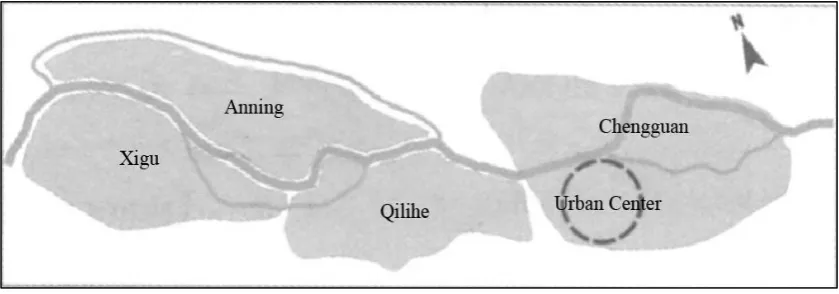
Figure 1.3: Illustration of Four Districts (1)
Lanzhou city is a typical linear valley city, to imagine the city is around 50 kilometers long only 1.8 kilometers in the narrowest area. Linear city has always distributed and extended in a strip shape. Naturally, the urban spatial shape is narrow and small with a weak sense of integrity. It means that once the city has unlimited expansion from east to west where along the direction of the Yellow River, this situation will be heavier and difficult to control than common urban sprawl, because people will waste more time and energy in such a long distance reaching to their destination in their daily life. Thus, how to develop in a rational way in the insufficient space for urban development become more and more crucial.
happened. Since the city has no way to grow, to find a way relieve the inner growth pressure is necessary.
1.3.2 The Current Urban Layout is Less Local Integrity
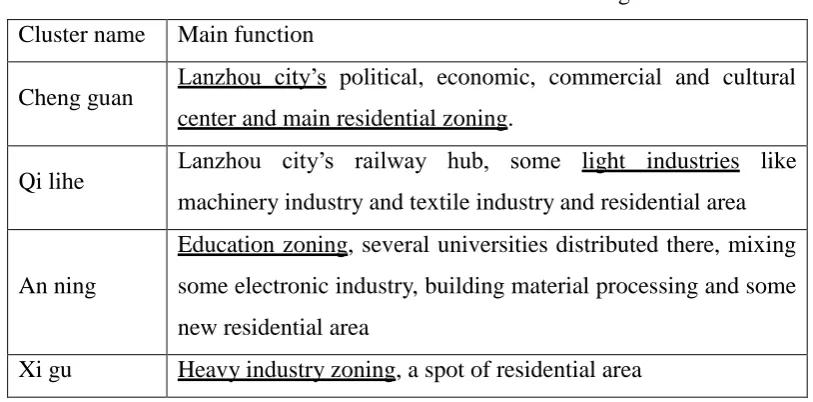
This issue is the reason which makes this kind of urban sprawl intensive and aggravated. In the four districts, each of them has distinctive characteristics which are so strong that neglect the development of other land use. Table 1.1 shows the basic land use in each zoning and highlight the main function.
Table 1.1: The Main Function of Each Zoning
Cluster name Main function
Cheng guan Lanzhou city’s political, economic, commercial and cultural center and main residential zoning.
Qi lihe Lanzhou city’s railway hub, some light industries like machinery industry and textile industry and residential area
An ning
Education zoning, several universities distributed there, mixing some electronic industry, building material processing and some new residential area
Xi gu Heavy industry zoning, a spot of residential area
Figure 1.4: Lanzhou City’s Master Plan (2001-2010)
1.4 Research Question
In general, this research starts with the purpose which tries to find the answers about these questions below:
I. To what extent is Lanzhou city’s urban area spatial expansion sustainable?
II. How can the smart growth concept contribute to create an optimal development scenario in Lanzhou city?
1.5 Research Objective
Since urban sprawl has a heavy and undeniable effect to linear city, to know the current situation and changed tendency about Lanzhou city is very important. According to Lanzhou city’s comprehensive plan in which four districts which were decided previously, the general research aim follows the existing situation to go through and find an appropriate development trend for Lanzhou city and make the city more sustainable. In order to answer the research question and reach to the main aim, three research objectives are necessary.
I. To build scenarios for urban growth representing economic efficiency, environmental protection and social equity by questionnaire result.
II. To build on models for land use allocation that explains the urban growth by using several land uses as necessary inputs.
III. To evaluate the processed data based on smart growth principles.
1.6 Research Framework
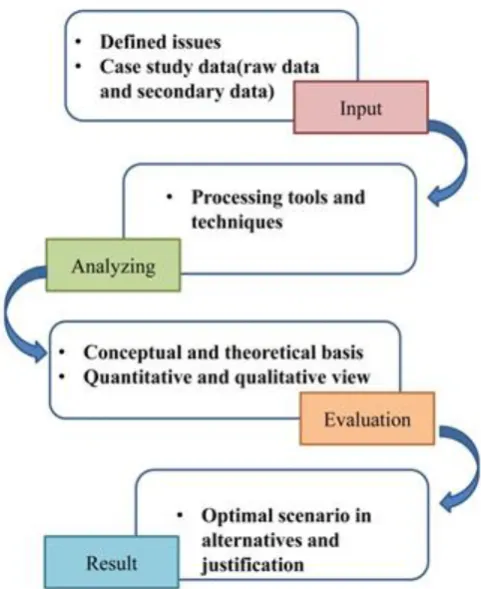
Figure 1.5: Research Framework Structure
1.7 Significance of Study
"Smart growth" strategy was thrown up with in the early 1990s in the United States in order to solve urban problems brought from spatial structure extension after suburbanization (Daniels, 2001).
In the United States, suburbanization was derived from the high income level had escaped from urban diseases, under the premise of improving the traffic conditions, as a result, suburban transferred from single residential function to multi-functions area.
unreasonable transportation flow leads to constructed area sprawl little by little.
Obviously, there is a remarkable difference between the United State and China in suburbanization which happened in a distinct way, motivation, as well as mechanically.
Despite all this, smart growth concept has advocated compact development, land use intensification, stressed on public transportation and set reasonable growth boundary as core principles. It is according with the development direction and goal in China. Thus, this study uses smart growth concept as a source of reference for formulation the scientific and rational strategy of urban spatial development in Lanzhou city, and it will bring a certain sense of inspiration and a good sample for future.
1.8 Research Organization
This study is divided to 6 chapters, each of these chapters will cover an aspect of the study; the deviation is as follow:
For chapter 1, the discussion is focus on overall view of this study, to address general issue and research objective and mention research question as well. At the end, a short description talks about study significance.
For chapter 2, a brief background covers the difference and similarity between the United States and China urbanization process. After that, to make a connection with smart growth strategy by reviewing its definition and application. Meanwhile, some case study reviews also contribute to the understanding of the methodology.
binding the thesis, this chapter also contains the tools and research methods used in data processing in this study. As a result, three intended scenarios will be built with the explanation in each step.
For chapter 4, is considering the solution of raised research question, it concentrates on support finding of the analysis with related literature review. The purpose of this chapter is to find the best scenario for Lanzhou city from alternatives.
REFERENCE
Alkheder, S., Wang, J., Shan, J., Drive, S. M., and Lafayette, W. (2006). Change Detection-Cellular Automata Method for Urban Growth Modeling.
Atkinson, M., & Kersten, M. (2010). Data-Intensive Research Theme. Barbara, S., and Site, D. (1998). GIS and Spatial Data Analysis: Converging
Perspectives, 1 2 1., 44(0), 1–26.
Batty, M., Xie, Y.,and Sun, Z. (1999). Modeling Urban Dynamics Through GIS-based cellular automata. Computers, Environment and Urban Systems, 23(3), 205–233.
Behan, K., Maoh, H., and Kanaroglou, P. (2007). Evaluating Smart Growth
Strategies with Simulations : Evidence from Hamilton , Ontario, (September). Behan, K., Maoh, H., and Kanaroglou, P. (2007). Evaluating Smart Growth Strategies
with Simulations : Evidence from Hamilton , Ontario.
Bo, L. (2008). Urban Sprawl Risk Assessment Based on Ecological Infrastructure : An Approach to Smart Conservation, (2), 1–10.
Burchell, R. W., Listokin, D., and Galley, C. C. (2000). Smart Growth : More Than a Ghost of Urban Policy Past , Less Than a Bold New Horizon. Housing Policy Debate, 11(4), 821–879.
Carlson, T. N., and Traci Arthur, S. (2000). The impact of land use — Land Cover Changes Due to Urbanization on Surface Microclimate and Hydrology: A Satellite Perspective. Global and Planetary Change, 25(1-2), 49–65.
Chang, K. Introduction to Geographic Information Systems, sixth edition, Chapter 12, Ryan Blankenship, 2012
Cheney, T. (2010). Raster Identification of Areas for Urban Village, Smart Growth Development, from
Craig W. Kelsey,(2001). Smart Growth Planning Principles and Recreation.
http://resources.arcgis.com/en/help/main/10.1/index.html#//009z0000009s0000 00
Chen, X., (2010). The history of American urbanization, Features and Implications. Choi, S., Wang, P., Delgado, E., and Ryu, S. H. (2007). Monitoring Small Area
Growth with GIS : An Application to the City of Los Angeles, 1–27.
David W. Allen. GIS Tutorial 2: Spatial Analysis Workbook, Chapter 5, ESRI press, 2009.
Daniels, T. Smart Growth: A New American Approach to Regional Planning, Planning Practice and Research, Volume 16, Issue 3-4, 2001
Enzmann, D. R., Beauchamp, N. J., and Norbash, A. (2011). Scenario planning. Journal of the American College of Radiology : JACR, 8(3), 175–9.
Ewing, R. (n.d.). Best development practices : A Primer for Smart Growth.
Freudenberg, N., Galea, S., & Vlahov, D. (2005). Beyond Urban Penalty and Urban Sprawl: Back to Living Conditions as the Focus of Urban Health. Journal of Community Health, 30(1), 1–11.
Geymen, A., and Baz, I. (2008). Monitoring Urban Growth and Detecting Land-Cover Changes on the Istanbul Metropolitan Area. Environmental Monitoring and Assessment, 136(1-3), 449–59.
Goldstein, S. M. (2000). The United States and the Republic of China, 1949–1978: Suspicious Allies, (February).
Gu, C. Economic Globalization and Urban Development in China, the Commercial Press, 1999:201.
Haeuber, R. (2000). Sprawl tales : Maryland ’ s Smart Growth Initiative and the Evolution of Growth Management, 131–147.
Harnish, M., (2010). San Joaquin Valley Blue plan process.
Herbert J. Gans (1967) “Levittown and America” from the levittowners.
Huang, H. (2007). United States“Smart growth” Strategy-A Case Study of Application and Reflection in China.pdf.
Huang.Y. (2010). Urban Development and Government Land Ownership : Global Development Outlook 2010, (March).
ICCMA (1998), Why Smart Growth: A Primer, International City/County Managem ent Association, Smart Growth Network and USEPA from
www.epa.gov/smartgrowth .
Jantz, C. a, Goetz, S. J., and Shelley, M. K. (2004). Using the SLEUTH Urban Growth Model to Simulate the Impacts of Future Policy Scenarios on Urban Land Use in the Baltimore -- Washington metropolitan area. Environment and Planning B: Planning and Design, 31(2), 251–271.
Jantz, C. a., Goetz, S. J., Donato, D., and Claggett, P. (2010). Designing and
Implementing A Regional Urban Modeling System Using the SLEUTH Cellular Urban Model. Computers, Environment and Urban Systems, 34(1), 1–16.
Jerzy M. Kozlowski, Ann Peterson, Integrated Buffer Planning: Towards
Sustainable Development ; with The Guide, illustrated, Ashgate Publishing, Ltd.,
2005.
Kelsey, C. W., (2001). Smart Growth Planning Principles and Parks and Recreation. Kityuttachai, K., Tripathi, N., Tipdecho, T., and Shrestha, R. (2013). CA-Markov
Analysis of Constrained Coastal Urban Growth Modeling: Hua Hin Seaside City, Thailand. Sustainability, 5(4), 1480–1500.
Kim, S and Margo, R. (2003). "Historical Perspectives on U.S. Economic Geography," NBER Working Papers 9594, National Bureau of Economic Research, Inc.
Kung, K., Xu, C,. and Zhou, F. (2009), From Industrialization to Urbanization: The Social Consequences of Changing Fiscal Incentives on Local Governments’
Behavior1, (March).
Margaret H. Carr, Paul Dean Zwick, Smart Land Use Analysis: The LUCIS Model Land-use Conflict Identification Strategy, illustrated, ESRI, Inc., 2007
Meyers, N. (2010). Using GIS Identify Suitable Areas for Smart Growth and Transit Oriented Development for Specific Areas with the City of Minneapolis,
Minnesota, 12.
Natural Resources Defense Council, Solving Sprawl: Models of Smart Growth in Communities across America, illustrated, Island Press, 2003
Nelson, K., Nisenson, L., Kay, M., Sobel, L., Sprague, E., Torma, T., Epa, P. A., et al. (n.d.). Getting to Smart Growth II :
Niemeier, D., Bai, S., and Handy, S. L. (2011). The Impact of Residential Growth Patterns on Vehicle Travel and Pollutant Emissions. Journal of Transport and Land Use, 4(3), 65–80.
Paul A. Longley, Michael Batty, Spatial Analysis: Modeling in a GIS Environment, illustrated, John Wiley and Sons, 1996
Piper Rae Gaubatz, Beyond the Great Wall: Urban Form and Transformation on the Chinese Frontiers, illustrated, Stanford University Press, 1996
Pullar, D., and Corcoran, J. (2005). Urban Growth Scenarios – Is the Aim to Fit Into Urban Spaces or Live in Them? David Pullar and Jonathan Corcoran, 2026(Seq 2005).
Racine, P., Cumming, S., and Denver, F. (2011). Intcing PostGIS Raster • Support for Rasters in the PostGIS Spatial Database, (September).
Ratti, C., and Richens, P. (2004). Raster Analysis of Urban Form. Environment and Planning B: Planning and Design, 31(2), 297–309.
Riefler, R. (1979). Nineteenth-Century Urbanization Patterns in the United States Schmidt, E., and Kedir, M. (2009). Urbanization and Spatial Connectivity in
Ethiopia : Urban Growth Analysis Using GIS.
Song, J., Li, X. (2006). The U.S. Urbanization Process and the Enlightenment. Urban Issue, 129, 88-92.
Sun, J. (2010). The Revealation of Smart Growth Practice in The United States. Daniels, T. Smart Growth: A New American Approach to Regional Planning,
Planning Practice and Research, Volume 16, Issue 3-4, 2001
Town, O., and Arcmap, S. (2011). Lab 7 : Data Vector Spatial Analysis, 1–23. USEPA (2003), Smart Growth Index (SGI) Model, US Environmental Protection Ag
ency from www.epa.gov/smartgrowth/sgipilot.htm
Varela, O. J., and Consultant, G. I. S. (2008). Integrating Spatial Analysis in Decision Modeling for Smart Growth Initiatives, (414).
VTPI (2005), Online TDM Encyclopedia, Victoria Transport Policy Institute from www.vtpi.org.
Walker, W. T., Gao, S., and Johnston, R. a. (2007). UPlan: Geographic Information System as Framework for Integrated Land Use Planning Model. Transportation Research Record: Journal of the Transportation Research Board, 1994(-1),
117–127.
Wan, T., Gu, Y., and Xu, J. (2011). On Spatial Layout Patterns of Harbin Songbei New District Under the Guidance of Smart Growth Theory. Applied Mechanics and Materials, 105-107, 1628–1633.
Wong, C. (2012). Paying for Urbanization in China: Challenges of Municipal Finance in the 21st Century. Economic Research Guide, (August).
Wu, Y. (2009). The Historical Process of Urbanization in China, the Status Quo and Countermeasures. Economic Research Guide, 4-10.
Yang, F. (2009). if ’ Smart ' is ' Sustainable '? An Analysis of Smart Growth Policies and Its Successful Practices.
Ye, L. (2005). What Is “Smart Growth?”--Really? Journal of Planning Literature, 19(3), 301–315.
Yue, H. and Liu, A. (2004) Control of Urban Land Expansion Progress. China Land Science, Vol. 25, No. 25, (May).
Zhang, X., Tim D., Mount and Richard N. Boisvert, (2000). Industrialization,
Zhiling Lui, Jjiangfeng Li, J. G. (2006). Urban Spatial Expansion and smart Growth Chinization, 2031, 7–10.
Zhou, Y. and John R. Logan. (2005). Suburbanization of Urban China: A Conceptual Framework