THE RELATIONSHIP BETWEEN THE MICROCLIMATE AND THE LANDSCAPE DESIGN OF THEME PARK
NORSYAZWANI BINTI MD JOHARI
A dissertation submitted in partial fulfilment of the requirements for the award of the degree of
Master of Science (Tourism Planning)
Faculty of Built Environment Universiti Teknologi Malaysia
ACKNOWLEDGEMENT
In the name of Allah, Most Gracious, Most Merciful.
Alhamdulillah, thanks to Almighty Allah for giving me the strength and willpower to complete this thesis. Without His blessings of good health, time and financial sources, this thesis could not have been completed. This thesis will help me to fulfil the requirement for the Master of Science in Tourism Planning.
Here, I would like to express my highest appreciation and gratitude to my supervisor; Dr. Hairul Nizam Bin Ismail for his continuous assistance, guidance, encouragement, patience, advices and support from the start until finish. Besides that, I am also very thankful to my other lecturers, Prof. Dr. Amran bin Hamzah, Prof. Dr. Zainab binti Khalifah and Pn. Norhazliza, who have gave all the comments and suggestions to me in completing this thesis.
ABSTRACT
ABSTRAK
TABLE OF CONTENTS
DECLARATION ii
DEDICATION iii
ACKNOWLEDGEMENT iv
ABSTRACT v
ABSTRAK vi
TABLE OF CENTENTS vii
LIST OF TABLES xii
LIST OF FIGURES xiii
LIST OF APPENDICES xvi
1 INTRODUCTION 1
1.1 Background of Study 1
1.2 Problem Statement 2
1.3 Research Objectives 3
1.4 Research Questions 3
1.5 Scope of Research 4
1.5.1 Literature review 4
1.5.2 Understanding of microclimate 4
1.5.3 Understanding landscape design of theme park 5 1.5.4 Observing landscape design with microclimate 5 1.5.5 Best practice study on Universal Studio Singapore 5
1.6.1 Stage 1- Preliminary stage 6
1.6.2 Stage 2- Data collection 6
1.6.3 Stage 3- Analysis and synthesis 6
1.6.4 Stage 4- Discussion, conclusion and recommendation 6
1.7 Research Method 8
1.7.1 Quantitative research method 8
1.7.2 Determining the sample size 8
1.7.3 Survey instrument 9
1.7.3.1 Online survey 9
1.8 Study Area 9
1.9 Significance of Study 10
1.10 Conclusion 11
2 LITERATURE REVIEW 12
2.1 Introduction 12
2.2 Microclimate 12
2.2.1 Defining microclimate 12
2.2.2 Tourist experience and perspective towards microclimate 14 2.2.3 Microclimate influence design of tourism destination 19 2.3 Landscape design of theme park 22
2.3.1 Description 22
2.3.2 Tourist experience and perspective towards landscape 22 2.3.3 Landscape influence design theme park in tourism 25 2.4 Best practice: Universal Studio Singapore 28
2.4.1 Hardscape design 28
2.4.2 Landscape design 32
3 RESEARCH METHODOLOGIES 37
3.1 Introduction 37
3.2 Initial concept of research 37
3.3 Research method 38
3.4 Semi structured interview 38
3.5 Personal observation for field work research 40 3.5.1 Hard landscape of Legoland Malaysia 41 3.5.2 Soft landscape of Legoland Malaysia 44
3.6 Online survey 44
3.7 Conclusion 45
4 DATA COLLECTION AND ANALYSIS 47
4.1 Introduction 47
4.2 Analysis 48
4.3 Tourist’s Profile 49
4.3.1 Demographics: Gender 49
4.3.2 Demographics: Age 50
4.3.3 Demographics: Nationality 51
4.4 Tourist Experience 53
4.4.1 Respondent’s frequent visit 53
4.4.2 Experience on hardscape design 54
4.4.3 Experience of softscape design 55
4.4.4 Overall comfort level for landscape 56 4.4.5 Overall satisfaction level for landscape 57
4.5 Tourist Perspective 58
4.5.1 Visit other theme park 58
4.5.5 Perspective on comfortable towards microclimate 64 4.5.6 Perspective on needs and wants towards landscape 65
4.5.7 Respondent’s dissatisfaction 66
4.5.8 Respondent’s comments and suggestions 67 4.5.9 Landscape influence towards overall experience 68 4.5.10 Landscape influence towards overall satisfaction 70 4.5.11 Overall satisfaction of landscape design 71
4.6 Conclusion 72
5 DISCUSSION, CONCLUSION AND RECOMMENDATION 73
5.1 Introduction 73
5.2 Discussion and conclusion 74
5.2.1 Discussion and conclusion on tourist’s profile 74 5.2.2 Discussion and conclusion on tourist’s experience
and perspective 75
5.2.3 Overall conclusion for all sections 76
5.3 Recommendations 76
5.3.1 Analysis climatic conditions 76
5.3.2 Evaluation direct and indirect human feelings 79
5.4 Conclusion 80
LIST OF TABLES
TABLE NO. TITLE PAGE
Table 3-1 Semi structured Interview Questions 39
Table 3-2 Feedback answer from LAr. Mr. Mior 39
Table 3-3 Bench design in Legoland Malaysia 41
Table 3-4 Covered and shelter area design in Legoland Malaysia 42
Table 3-5 Pavement design in Legoland Malaysia 42
Table 3-6 Pavement design in Legoland Malaysia 43
Table 3-7 Softscape design in Legoland Malaysia 44
Table 3-8 Main sections for the survey form 44
Table 3-9 Likert type scale ranging 45
Table 4-1 Total respondents 48
LIST OF FIGURES
FIGURE NO. TITLE PAGE
Figure 1-1 Study Approach 7
Figure 1-2 Legoland Malaysia at Nusajaya Johor Darul Takzim 10 Figure 2-1 Definition of Microclimate by Lenzholzer and Koh (2010) 13 Figure 2-2 Elements of Microclimate by Gallo (1998) 14 Figure 2-3 Minimized the negative thermal comfort impacts by Casimiro and
Calheiros (2007) 18
Figure 2-4 Climate influences on the tourism sector by D. Scotta and C. Lemieux
(2010). 20
Figure 2-5 Landscape elements by Welwyn Hatfield (2009) 26 Figure 2-6 Seven different zones in Universal Studio Singapore 27 Figure 2-7 USS theme for every zones were based on the film productions under
Universal Studio Production 28
Figure 2-8 Covered area at counter and along the walkway of Universal Studio
Singapore 29
Figure 2-9 Figure 2-9 Hollywood zone with dynamic architecture design 29 Figure 2-10 Hollywood zone with palms tree and cartoon character that turn the
Figure 2-11 Hollywood zone with paths well-known actors in the 'Walk of Fame’
that made exactly the same as the real one. 30
Figure 2-12 New York zone with projected an era after the post-modern with classic
landmark 30
Figure 2-13 Cooling elements such as water cooler and fan 31 Figure 2-14 Enormous amount of cooling elements that make tourists feel
comfortable 31
Figure 2-15 Ancient Egypt zone during the Golden Age of Egyptian Exploration in
the 1930s. 32
Figure 2-16 The Lost World zone with forest settings that reflect dinosaur habitats. 33 Figure 2-17 The hard landscape and soft landscape that reflects the microclimate 34 Figure 2-18 Summarize literature review on Microclimate 35 Figure 2-19 Summarize literature review on landscape design of theme park 35 Figure 2-20 Four aspects that supporting the relationship between microclimate and
landscape design of theme park. 36
Figure 3-1 Initial concept of research 38
Figure 4-1 Gender of Respondents 49
Figure 4-2 Age of Respondents 50
Figure 4-3 Respondent’s Origin 51
Figure 4-4 International Respondent’s Origin 52
Figure 4-5 Respondent’s frequent visit 53
to microclimate 54 Figure 4-7 Tourist experience towards soft landscape design in response to
microclimate 55
Figure 4-8 Overall respondent’s comfort level of landscape 56 Figure 4-9 Overall respondent’s satisfaction level of landscape 57
Figure 4-10 Respondents visit other theme park 58
Figure 4-11 Other theme park 59
Figure 4-12 Respondent’s perspective on the significant difference between
Legoland Malaysia and other theme park 60
Figure 4-13 Respondent’s perspective on landscape consideration towards
microclimate 61
Figure 4-14 Respondent’s perspective on the climate influence towards the activities 62 Figure 4-15 Respondent’s perspective on the landscape influence towards the
activities 63
Figure 4-16 Respondent’s perspective on comfortable feeling towards the
microclimate 64
Figure 4-17 Respondent’s perspective on needs and wants towards landscape design 65 Figure 4-18 Respondent’s dissatisfaction on the Legoland’s landscape 66 Figure 4-19 Respondents comments and suggestions on the landscape design of
Legoland Malaysia 67
Figure 4-20 Respondent’s perspective on landscape influence towards overall
Figure 4-21 Respondent’s perspective on landscape influence towards overall
experience 69
Figure 4-22 Respondent’s perspective on landscape influence towards overall
satisfaction 70
Figure 4-23 Respondent’s perspective on satisfaction of landscape design in the
theme park 71
Figure 5-1 Overall tourist’s experience graph 76
Figure 5-2 Climate aspects 77
LIST OF APPENDICES
APPENDIX TITLE PAGE
A Calculation of the sample size 89
CHAPTER 1
1 INTRODUCTION
1.1 Background of Problem
Therefore, landscape design has a significant relation with tourist experience and satisfaction that related to conformability of the park. Landscape design is referring to hard landscape and soft landscape elements that influenced by the climate and geography aspects. In addition, landscape design of theme park should able to project the overall theme that can give pleasurable and excitement feelings to tourists as well as visitors. Theme parks are considered a form of leisure activity because they provide an opportunity for entertainment during an individual’s discretionary free time (Milman, 2007). According to Milman (2007) the popularity of theme park and attractions will continue to grow, as they are increasingly associated with new vacation experiences. The research purpose is to identify the relationship between the microclimate and the landscape design of theme park by understanding the perspective and experience of tourists in creating the effective design that could enhance pleasurable feeling. Thus, it can improve the comfort, safety and attractiveness of the landscape design for theme park by fulfil the tourist needs and wants accordingly towards the climate and weather.
1.2 Problem Statement
The evolution of theme park turned the landscape design to the themed character that supposedly generates pleasurable experiences through different environment which can enhance not only the beauty aspects but also the comfortable feelings. However, what actually the tourist and visitor experiences during their visit to the theme park recently are being questioned. Are they really satisfied with the landscape design that being offered in the theme park? Are the landscape designs of Theme considering the microclimate of the place?
always forgot to bring the tourist’s needs and wants into a designing the overall landscape of theme park that can make it is more closely to the tourists. Therefore, analysing the microclimate of the place by the understanding the tourists experience and perspective can help creating the effective landscape design that can give tourists pleasurable environment and experience.
1.3 Research Objectives
In order to achieve the purpose of study, it must be supported through these four objectives which are:
1. To ensure whether the microclimate taken into account in landscape design of theme park
2. To determine whether the microclimate had influences to the landscape design and the tourists
3. To study the perspectives and experiences of tourists towards the landscape design of theme park with the local climate
4. To review the effectiveness of landscape design of theme park towards the microclimate
1.4 Research Questions
1. Did microclimate taken into account in designing landscape of theme park?
2. Did microclimate influence the landscape design of theme park and the tourists?
4. How far the effectiveness of landscape designs of theme park with consideration of microclimate?
1.5 Scope of research
This research, the scoped is focused on four most important areas that will be discussed in detail. All the four major areas are described briefly under several headings below.
1.5.1 Literature review
The literature review is needed as the initial study for the basic understanding of the definition, description, experience and perspective that involved in this entire study gathers from journals, books, magazines, thesis, articles and also internet sources. It involved the understanding of landscape design of theme park, microclimate and tourist’s experience and perspective. Detail discussions were in Chapter 2.
1.5.2 Understanding of microclimate
1.5.3 Understanding landscape design of theme park
The description about landscape design in theme park that supported by the tourist perspective based on the experience. It is also analyse the influence of the landscape towards the design of theme park in tourism destination area.
1.5.4 Observing landscape design of theme park with microclimate
Analysing the landscape design of theme park with consideration of microclimate that supported by the tourist experience To see the effectiveness of landscape design that referring to the hard landscape and soft landscape aspects of the Theme Park planning and design to improve and fulfil tourist needs.
1.5.5 Best practice study on Universal Studio Singapore
Review the landscape design of Universal Studio Singapore to have a better and wide view regarding to the consideration of microclimate in landscape design of theme park that sharing the same climatic condition with Legoland Malaysia as a case study for this research.
1.6 Study Approach
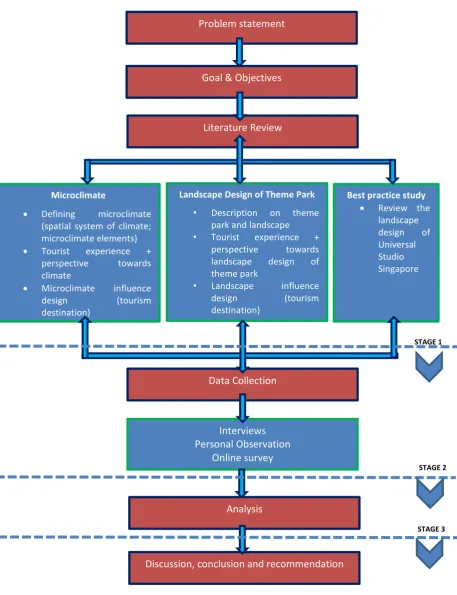
1.6.1 Stage 1- Preliminary Stages
As for the preliminary stage, the literature review of microclimate, landscape design of theme park and best practice study will be discussed in detail. The information and understanding on the topic were gathered via literature review from books, journals, and publications (secondary data collection). A research framework was also initiated at this stage to ensure the study can be done systematically.
1.6.2 Stage 2- Data Collection
The data collection involved different parameters which include the interview, personal observation and online surveys.
1.6.3 Stage 3- Analysis and Synthesis
This stage involved the analysis on the data collected during the second stage. The analysis was done using IBM SPSS Statistics 16 (frequencies and cross tabulation) to find the relationship and effectiveness between the microclimate and the landscape design in theme park. Some of the descriptive of analysis is on the percentage and frequency of the demographics (tourist profile), tourist’s experience and perspective.
1.6.4 Stage 4- Discussion, Conclusion and Recommendation
Figure 1-1 Study Approach
Best practice study
Review the landscape design of Universal Studio Singapore Problem statement
Goal & Objectives
Literature Review
Microclimate
Defining microclimate (spatial system of climate; microclimate elements)
Tourist experience + perspective towards climate
Microclimate influence design (tourism destination)
Landscape Design of Theme Park
• Description on theme park and landscape
• Tourist experience + perspective towards landscape design of theme park
• Landscape influence design (tourism destination) Data Collection Interviews Personal Observation Online survey Analysis
Discussion, conclusion and recommendation
STAGE 1
STAGE 2
1.7 Research Method
Quantitative research method was used in this study with research instruments of online survey (direct method), personal observation and interview
1.7.1 Quantitative research method
In order to measure the effectiveness of landscape design of theme park towards the microclimate, a quantitative approach was used in this research and were based on four part which are tourists profile, tourists experience, tourists perspective and tourists satisfaction. A quantitative approach is known to be much appropriate as it would provide both valid and reliable results (Ryan, 1995) and the data gathered can be faster analysed statistically using readily available computer software.
1.7.2 Determining the sample size
1.7.3 Survey instrument
1.7.3.1 Online survey
The survey form was designed with three section include 1. Section A – Tourist profile
2. Section B – Tourist experience 3. Section C – Tourist perspective
For the first section, the question was build based on the tourist profile that referred to tourist’s gender, age and nationality. This section is a big scope to analyse the typology of tourist profile that visit the theme park.
The second section was created accordingly to the tourist’s experience based on the level of safety, comfort, themes and design of landscape that being used by tourists during their visit to the theme park. This section is important to know what tourists feel to every landscape design in order to understand their needs and wants.
The last section was built to know and understand the tourist's perspective towards the landscape design with the local climate. This section derived from the experience of tourists during their visit and uses of landscape in a theme park.
1.8 Study Area
the world, Legoland Malaysia has issue regarding to the local climate that seems give unpleasant feelings to the tourists. Thus, this study area is appropriate for this research where can see how climate will react with the landscape that can have a significant impact on the comfort and satisfaction of tourists (Refer to Chapter 3 on the detailed description of the study area).
Figure 1-2 Legoland Malaysia at Nusajaya Johor Darul Takzim
1.9 Significance of Study
1.10 Conclusion
REFERENCES
Ady Milman (2007). Theme Park Tourism and Management Strategy. University of Central Florida.
Akın Aksu, Ebru Tarcan Içigen, and Rüya Ehtiyar (2010). A Comparison of Tourist Expectations and Satisfaction: A Case Study from Antalya Region of Turkey. TURIZAM Volume 14, Issue 2 66-77.
Alan, F., Brian, G., Anna, L., and Stephen, W. (2008). Managing visitor attractions. Second Edition. Elsevier Ltd.
Antti Haahti and Ugur Yavas (2004). A multi-attribute approach to Understanding image of a theme park. The case of SantaPark in Lapland. European Business Review Vol. 16 No. 4, 2004 pp. 390-397.
ASHRAE (1966). ASHRAE standard 55-66: thermal environmental conditions for human occupancy. America society of heating refrigeration and air-conditioning engineers, atlanta.
Barsky, J., & Nash, L. (2002). Evoking emotion. Affective keys to hotel loyalty. Cornell Hotel and Restaurant Administration Quarterly, 1, 39–46.
Bas Amelung, Krzysztof Blazejczyk And Andreas Matzarakis (2007). Climate change and tourism – assessment and coping strategies. Maastricht – warsaw – freiburg.
Bigne, E., L. Andreu, and J. Gnoth (2005). The Theme Park Experience: An Analysis of Pleasure, Arousal and Satisfaction. Tourism Management 26:833–844.
Boniface, B.G. and Cooper, C. (1987). The geography of travel and tourism, london, heineman.
Burton, R. (1995). Travel geography. Essex, longman.
Casimiro, E. and Calheiros, J.M. (2007) Human Health, in Climate Change in Portugal. Scenarios, Impacts and Adaptation Measures – SIAM Project, Santos F.D., Forbes K., Moita R. (editors), Gradiva Publições, Lisboa, pp 241-300.
Chieh-Yuan Tsai, and Shang-Hsuan Chung (2012). A personalized route recommendation service for theme parks using RFID information and tourist behaviour. Decision Support Systems Volume 52, Issue 2, Pages 514–527.
C. Gallo, M. Sala, and A.A.M. Sayigh (1998). Architecture: comfort and energy. Elsevier science ltd.
Coltman, M.M. (1989). Introduction to travel and tourism. New york, reinold.
Cooper, C.P. (1990). Resorts in decline. The management response. Tourism management.
D. Camuffo (2013). Microclimate for Cultural Heritage: Conservation, Restoration, and Maintenance of Indoor and Outdoor Monuments. Elsevier B.V. All rights reserved.
Dhivya Balasubramanian (2005). Sustainable Tourism Development A Compilation and Analysis of Expert Views. Hospitality and Tourism. University of Wisconsin-Stout.
De Schiller, Silvia Evans, and John Martin (1996). Training architects and planners to design with urban microclimates. Atmospheric Environment, Volume 30, Issue 3, p. 449-454.
Ehmer, P. & Heymann, E. (2008). Klimawandel und Tourismus: Wohin geht die Reise? Aktuelle Themen, 416. Frankfurt: Deutsche Bank Research.
G. Latini, R. Cocci Grifoni, PhD, and S. Tascini, PhD (2010). Thermal Comfort and Microclimates in Open Spaces. ASHRAE.
Hamilton, J.; Maddison, D. & Tol, R. (2004). The effects of climate change on international tourism. Working Paper FNU-36 (submitted). Centre for Marine and Climate Research, Hamburg.
Hamilton JM, and Lau MA (2005). The role of climate information in tourist destination choice decision-making. International Congress of Biometeorology. Hsin-You Chuo, M.S.(2002). Variations in visitors’ motivations to visit theme parks: an example from Taiwan. Ohio State University.
Hsu, C. H. C. (2003). Mature motorcoach travelers’ satisfaction: A preliminary step toward measurement development. Journal of Hospitality & Tourism Research,27(3), 291-309.
Hu Y., Ritchie J.R.B. (1993). Measuring Destination Attractiveness: A Contextual Approach. Journal of Travel Research 32 (2), 25-34.
Ichinose, T., K. Shimodozno, and K. Hanaki. (1999). Impact of anthropogenic heat on urban climate in Tokyo. Atmos. Env. 33:3897–909.
Ignacio Rodrıguez del Bosque and Hector San Martın (2008). Tourist satisfaction A cognitive-affective model. Annals of Tourism Research, Vol. 35, No. 2, pp. 551–573.
Irina Polo (1999). Theoretical exploration of theme park design. A case study application on Ontario place, Ontario. National Library of Canada.
Jacqueline M. Hamilton (2003). Climate and the Destination Choice of German Tourists. Research Unit Sustainability and Global Change FNU-15 (revised).
J. Enrique Bigne´, Luisa Andreua, and Juergen Gnothb (2005). The theme park experience: An analysis of pleasure, arousal and satisfaction. Elsevier Ltd.
J. Enrique Bigne, Luisa Andreua, and Juergen Gnothb (2005). The theme park experience: An analysis of pleasure, arousal and satisfaction. Tourism Management 26 (2005) 833–844.
Jui Chi Chang (2007). Tourists' satisfaction judgments: an investigation of emotion, equity, and attribution. Journal of Hospitality & Tourism Research.
Ken Parsons (2002). Human thermal environments: the effects of hot, moderate, and cold environments on human health, comfort and performance, second edition. Taylor & francis inc. New york.
K. Zaninovic and A. Matzarakis (2007). Climatic Changes In Thermal Comfort At The Adriatic Coast. Climate Change and Tourism – Assessment and Coping Strategies.
Lanfant,Marie-Françoise (1995). International tourism,internationalization and the challenge to identity. International tourism:identity and change.london
Lin TP, Hwang CC, Cheng HY (2006). The influence of climate information on travel arrangements. Outdoor Recreation Association, Taipei.
Lin, T.P.,Y.F. Ho, and Y.S Huang (2007). Seasonal effect of pavement on outdoor thermal environments in subtropical Taiwan. Building and Environment 42:4124-31. Lin, T.P., A. Matzarakis, and R.L. Hwang. (2010). Shading effect on long-term outdoor thermal comfort. Building and Environment 45(1):213–21.
Maddison, D. (2001). In search of warmer climates? The impact of climate change on flows of british tourists. Climatic change, 49, 193-2208.
Mansfeld, y. (1992). From motivation to actual travel. A. Tourism research, 19 (2): 399-419.
McClung, G. (1991). Theme park selection: factors influencing selection. Tourism Management, 12, 132-140.
Mike Peters And Klaus Weiermair (2000). Attractions and attracted tourists: how to satisfy today’s ‘fickle’ tourist clientele?. The journal of tourism studies
Mings, R.C. (1997). Tracking 'snowbirds' in australia: winter sun seekers in far north queensland. Australian geo. Studies, 35(2): 168-182.
Morabito, M., Cecchi, L., Modesti, P.A., Crisci, A., Orlandini, S., Maracchi, G & Gensini, G.F. (2004). The impact of hot weather conditions on tourism in Florence, Italy: the summers 2002-2003 experience. 2 nd International Workshop on Climate, Tourism and Recreation. Orthodox Academy of Crete, Kolimbari, Greece, 8–11 June 2004 (pp. 158-165).
National Meteorological Library and ArchiveFact sheet 14 (2011). Microclimates (version 01). Met Office. © Crown
Olu Ola Ogunsote and Bogda Prucnal-Ogunsote (2002). Choice of a thermal index for architectural design with climate in Nigeria. Habitat International 27 63-8.
Peter M. Burns, Jo-Anne Lester And Lyn Bibbings (2010). Tourism and visual culture: volume 1 theories and concepts. Cab international.
Peter M. Burns, Jo-Anne Lester and Lyn Bibbings (2010). Tourism and visual culture: Volume 2 Methods and Cases. CAB International
Peterson, K. (1994). Qualitative Research Methods for the Travel and Tourism Industry. In Travel, Tourism and Hospitality Research: A Handbook for Managers and Researchers, B. Ritchie and C. Goeldner, eds., pp. 487-491. United States: John Wiley & Son.
Pine, J.B. and Gilmore, J.H. (1998). “Welcome to the experience economy”. Harvard Business Review, July/August, pp. 97-105.
Roisin Donnelly (2003). Using Problem-Based Learning to Explore Qualitative Research. European Research Journal, Vol. 2, 2, 2003, pp.309-321.
Ryan, C. (1999). From the psychometrics of SERVQUAL to sex: Measurement of tourist satisfaction. In A. Pizam, & Y. Mansfeld (Eds.). Consumer behavior in travel and tourism (pp. 267–296). New York: The Haworth Hospitality Press.
Ryan S, Lowe Cn,And Hardes G (1995). A quantitative approach to quality improvement and resource allocation. J qual clin pract.
Sanda Lenzholzer and Jusuck Koh (2010). Immersed in microclimatic space: Microclimate experience and perception of spatial configurations in Dutch squares. Elsevier B.V. All rights reserved.
Scott, D. & Lemieux, C. (2009). Weather and Climate Information for Tourism. White Paper, commissioned by the World Meteorological Organisation.
Singleton, R., Straits, B., Straits, M. & McAllister, R. (1988). Approaches to Social Research. Oxford: Oxford University Press.
Susanne Becken (2010). The importance of climate and weather for tourism- literature review. Land Environment and People.
Szymanski, D. M., & Henard, D. H. (2001). Customer satisfaction: A meta-analysis of the empirical evidence. Journal of the Academy of Marketing Science, 29(1), 16– 35.
Terence Young and Robert Riley (2002). Theme Park Landscapes: Antecedents and Variations. Dumbarton Oaks Research Library and Collection Washington, D.C. Tzu-Ping Lin and Andreas Matzarakis (2008). Tourism climate and thermal comfort in Sun Moon Lake, Taiwan. Meteorological Institute, University of Freiburg.
Wirtz, J., Mattila, A. S., & Tan, R. L. P. (2000). The moderating role of target-arousal on the impact of affect on satisfaction—an examination in the context of service experiences. Journal of Retailing, 76(3), 347–365.
Zins, A. H. (2002). Consumption emotions experience quality and satisfaction: A structural analysis for complainers versus non complainers. Journal of Travel and Tourism Marketing, 12(2/3), 3–18.
Websites:
Welwyn Hatfield Borough Council, 2009. 5265_Inserts_F:Insert 5 26/06/2009 08:16 Page 4. http://www.welhat.gov.uk/CHttpHandler.ashx?id=911&p=0
http://gadgets.ndtv.com/internet/news/male-internet-users-outnumber-female-united-nations-report-422381
http://pewinternet.org/Trend-Data-(Adults)/Whos-Online.aspx