A Comparative Study Of Reading Authentic And Non-Authentic Text
Zaidah Zainal & Prema A/P Baskeran Faculty Of Education
Universiti Teknologi Malaysia
Abstract: The present study was designed to investigate the students’ reading performance when they read authentic and non-authentic text. For comparative purpose, students who obtained Band 4 in MUET had been identified and selected. These students were grouped into two groups. Each group consists of fifteen students. One group of students was given the authentic text to read and another group of students was given the non-authentic text to read. Later, they were instructed to answer the comprehension questions based on the reading text. Interviews were carried out to further explore the subjects’ responses on the two reading text types. The result of the study showed that non-authentic text was able to facilitate subjects’ comprehension process better. The results were discussed further. Suggestions for future research were also made.
Abstrak: Kajian ini bertujuan untuk menyelidik prestasi pembelajaran pelajar apabila mereka membaca teks asal dan teks yang diringkaskan. Bagi tujuan perbandingan, seramai tiga puluh pelajar yang mendapat Band 4 di dalam MUET dikenalpasti dan dipilih. Pelajar-pelajar ini dibahagikan kepada dua kumpulan. Setiap kumpulan terdiri daripada lima belas orang pelajar. Satu kumpulan pelajar diberi teks asal untuk dibaca manakala satu lagi kumpulan pelajar diberi teks yang diringkaskan untuk dibaca. Kemudian, kesemua pelajar dikehendaki menjawab soalan pemahaman berdasarkan teks yang dibaca. Temubual dijalankan keatas subjek-subjek kajian bagi menyelidik dengan lebih mendalam mengenai respon subjek-subjek tersebut untuk kedua-dua jenis teks bacaan. Daripada kajian ini, keputusan menunjukkan bahawa teks yang diringkaskan dapat meningkatkan tahap pemahaman subjek. Dapatan kajian dibincangkan dengan lebih mendalam. Cadangan-cadangan bagi kajian masa hadapan juga diutarakan dan disertakan dalam kajian ini
Keywords: authentic, non-authentic, students’ reading performance
Introduction
Since reading is not only important in developing language intuition and determining academic success and encouraging readers to extract from the writing what is important for completing certain task, it is central for learners to acquire the skill. Acquiring reading requires one to be able to comprehend the text itself. When choosing reading text, it is important to take into consideration that the aim should be to understand meaning and not form, especially when using literary texts with the emphasis being on what is being said and not necessarily on the literary form or stylistics.
Statement of the Problem
through the findings, lecturers will be able to identify the type of reading text that is most suitable for students.
Research Objectives
The objectives of this study are to:
1 Investigate whether there is a difference in performance when students read authentic and non-authentic texts.
2 Identify the type of reading text preferred by students.
3 Identify the problems faced by students in reading authentic text.
Significance of the Study
This study hopes to give suggestions to teachers on the selection of texts to be used in their lesson, that is whether they should use authentic or nonauthentic texts. If texts should be simplified, to what extend should the simplification be. Authentic texts can provide the language use within its own natural setting. Therefore, the language use in terms of vocabulary and structure is relevant for the students. It is hoped that teachers are given insights through this study in helping students by providing them (the students) with the most suitable and effective reading texts
Scope of the Study
This study will investigate students’ performance through the comparison between using authentic and non-authentic texts and find out the most effective reading texts for students. Thirty students are chosen as subjects. These students are chosen from the 1st year Faculty of Education students and they are randomly selected from all courses available in Faculty of Education. All of them obtained band 4 in MUET.
In summary, this chapter has discussed the background of the project, statement of the problem, the purpose and the research objectives that the research aims to achieve at the end of study, the significance and the scope of the study. In the following chapter, the researcher presents the literature review related to the topic of study that will be carried out.
Result
Is there a difference in performance when students read authentic and non-authentic texts?
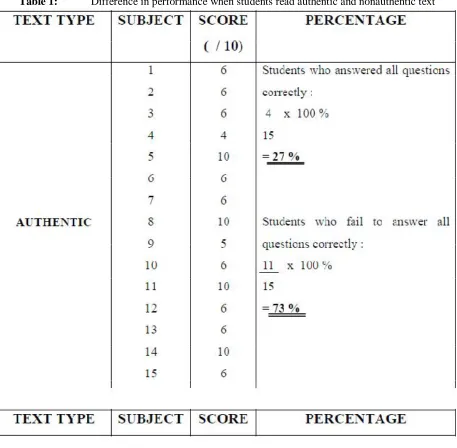
From Table 1, it can be seen that eleven out fifteen or 73% students who read the authentic text and answered the comprehension questions that follows it performed averagely. Overall, they managed to answer five out ten questions correctly. Only four students or 27% managed to answer all ten questions correctly.
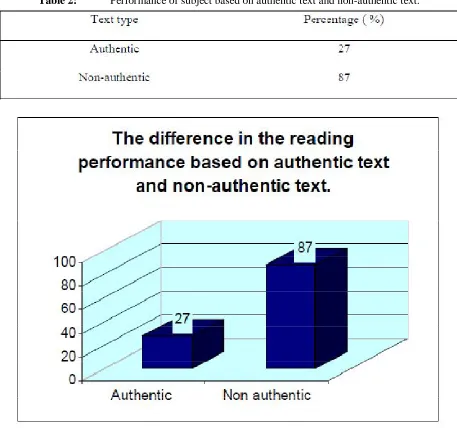
Table 2: Performance of subject based on authentic text and non-authentic text.
Figure 1: The difference in reading performance based on authentic text and non-authentic text
Discussion
The tables and graph have evidently shown that there is a difference in terms of reading performance when the students read authentic and authentic texts. The vast majority of students who read the non-authentic text did not have any problem with specific items of vocabulary, presumably because they had been simplified. Consequently the general understanding of the key ideas in the text was not affected. The students scored indeed very highly on the reading comprehension questions. The 60% of difference indeed reveals that non-authentic text can facilitate the students’ comprehension process better compared to the authentic text.
the difficulty of the text. For example, they said that they had difficulty in understanding words such as ‘crude, quirks, surge, languish and etc’. Richards (2000) stated that authentic texts often contain difficult language, unneeded vocabulary items and complex language structures, which can often create problems. Thus it proves that linguistic simplification will presumably decrease the language load a reader must grapple with, allowing the second language learner to concentrate on understanding the content of the text without being overly inhibited by difficult vocabulary or complex sentences. Therefore, it is evidently clear that students perform better when they read nonauthentic text.
Conclusion
All in all, it can be seen that the use of non-authentic reading text in comparison to authentic reading text is indeed beneficial in facilitating the students comprehension. From the analysis and findings of this research, it is evident that the non-authentic text is able to better facilitate students comprehension process as what have been through the subjects in this study. The responses given by subjects through the interviews conducted also complement the findings of this research whereby all five subjects who read the nonauthentic text agreed that non-authentic text was easy to comprehend. Throughout the study, all the subjects have managed to give their utmost cooperation and support. From the responses given by the subjects, it demonstrates that all these ten subjects who were interviewed were able to reflect upon their reading performance in order to provide reliable feedback on the use of authentic and non-authentic text reading texts. The subjects ability in transferring their reading experience into reflective accounts of what they have undergone when they used authentic or non-authentic reading text indeed provide fruitful and beneficial insights in support with the overall study as a whole.
References
Alderson, J.C. & Urguhart, A.H. (Eds.). (1984). Reading in a foreign language. Harlow, Essex: London.
Bhatia, V.K. (1983). Simplification v. easification, the case of legal texts. Applied Linguistics, 4, 42-54.
Blau, E.K. (1982). The effect of syntax on readability for ESL students in Puerto Rico. TESOL Quarterly, 16, 517-528.
Carrel, P.L. (1998). The relationship between prior knowledge and topic interest in second language reading. Reading in a Second Language, 10, 81-92.
Duquette, G.I. (1986). The effect of authentic materials in acquiring a second language. TESOL Quarterly, 43(3), 479-492.
Gonzalez, O.G. (1990). Teaching language and culture with authentic materials. (Doctoral dissertation, West Virginia University, 1990). Dissertation Abstracts International, 52(05), 1666.
Goodman, K. (1967). Reading: A psycholinguistic guessing game. Journal of the Reading Specialist, 6, 126-135.
Guariento, W.& Morley, J. (2001). Text and task authenticity in the EFL classroom. ELT Journal: English Language Teachers Journal, 55(4), 347-353.
Hafiz, F. M & Tudor, I. (1989). Extensive reading on the development of reading skills. ELT Journal: English Language Teachers Journal, 43, 4-13.
Hedge, T. (1985). Using readers in language teaching. London: Macmillian.
Honeyfield, L. (1978). Simplification. TESOL Quarterly, 11, 431-440.
Johnson, P. (1981). Effects on reading comprehension of language complexity and cultural background of a text. TESOL Quarterly, 15, 169-181.
Kienbaum, B.E, Russell, A.I., & Welty, S. ( 1986). Communicative competence in foreign language learning with authentic materials. Final Project Report. Purdue University, Calumet, Indiana. ERIC No. ED275200.
Kintsch, W. (1974). On comprehending stories. In M. Just & P. Carpenter (Eds.), Cognitive Processes in Comprehension (pp.33-62). Hillsdale, NJ: Erlbaum.
Kramsch, C. (1993). Context and culture in language teaching. Oxford: Oxford University Press.
Kramsch, C. (2000). Authenticity in the computer-mediated acquisition of L2 literacy. Language Learning & Technology, 4(2), 78-104, Retrived August 21, 2007 from http://llt.msu.edu/vol4num2/kramsch/default.html.