ABSTRACT
LOPEZ, HARRY O. Developing Non-GMO Tobacco Cultivars with Lower Alkaloid Content Using a Reverse Genetics Strategy. (Under the direction of Ralph E. Dewey.)
Nicotiana tabacum L. produces alkaloids such as nicotine that are not only responsible for the pharmacological effects of tobacco products, but also serve in the formation of nitrosated compounds which have been shown to be carcinogenic. These compounds are known as tobacco-specific-nitrosamines (TSNAs), the carcinogenic properties of which have been documented in numerous mammalian studies. Considerable interest has been shown in the development of tobacco lines (and products) with low alkaloid content. Although the value of low alkaloid-containing tobaccos is subject to debate, potential advantages for such plants include: (1) reductions in TSNA levels; (2) possible reduced potential for addictiveness; (3) utilization in smoking cessation products; and (4) as the preferred platform for
“biopharming” applications. The availability of reduced alkaloid tobaccos may be of
increasing importance in the future, as the FDA is now responsible for the regulation of tobacco products, including the authority to mandate future products to contain lower levels of nicotine. In an attempt to develop tobacco plants that produce lower alkaloid levels, we used a reverse genetic strategy to inhibit the expression of key genes in the alkaloid biosynthetic pathway. Initially, chemical mutagenesis was used to develop a population of tobacco plants with mutations randomly distributed throughout the genome. Primers were then designed for the specific PCR amplification of exons from PMT, A622 and BBL, three genes whose role in alkaloid synthesis had been previously documented, or suggested. Bioinformatic tools allowed the identification of five isoforms for PMT, two isoforms for
individual isoforms, and high throughput targeted screening was accomplished by sequencing the PCR products from individual DNA samples extracted from hundreds of mutagenized plants. We successfully identified several missense mutations in the PMT,
A622 and BBL genes, including truncation mutations in the three most abundantly transcribed BBL isoforms. Tobacco genotypes possessing some of these missense and truncation
mutations were grown in the field and assayed directly for alterations in alkaloid production. Additional characterization of the BBL gene family was also carried out using an RNA interference (RNAi) strategy. Alkaloid analysis of leaf and root tissue revealed a decrease in the levels of nicotine and other pyridine-type alkaloids in the RNAi-BBL plants. In addition, transgenic roots accumulated a novel metabolite, dihydrometanicotine (DMN), which may represent the substrate for this enzyme. Our transgenic studies demonstrated that inhibition of the BBL family is an effective means of producing low alkaloid tobacco plants. Given that RNAi-suppressed anti-BBL plants lack the growth defects or undesirable alkaloid phenotypes that researchers have observed when other steps of the nicotine pathway have been
suppressed, we believe the BBL genes to be the most favorable targets for developing tobacco plants with significantly reduced levels of nicotine and other pyridine alkaloids. Finally, our identification of knockout mutations within the three most highly transcribed
Developing Non-GMO Tobacco Cultivars with Lower Alkaloid Content Using a Reverse Genetics Strategy
by Harry O. López
A thesis submitted to the Graduate Faculty of North Carolina State University
in partial fulfillment of the requirements for the degree of
Master of Science
Crop Science
Raleigh, North Carolina 2011
APPROVED BY:
_______________________________ ______________________________ Ramsey S. Lewis Deyu Xie
________________________________ Ralph E. Dewey
ii DEDICATION
iii BIOGRAPHY
Harry O. López was born October 18, 1985 in Bayamón, Puerto Rico. He received his elementary and secondary education at Pedro Fernández and graduated from Saint Therese High School in Naranjito in 2003. He completed three years of his B.S. degree in Biology at the University of Puerto Rico-Cayey and his last year abroad at NCSU. As an undergraduate, he worked with Dr. Rebecca S. Boston for two consecutive summers (2005-2006) at NCSU
and Dr. Andrew Diener at UCLA in the summer of 2007. Upon graduation, he returned to North Carolina to study plant molecular biology at NCSU. He began working as a lab technician in Dr. Ralph E. Dewey's lab in 2008 and later, the same year, began his M.S. degree under his direction. He has participated in numerous national conferences and in
iv ACKNOWLEDGMENTS
I wish to express my sincere appreciation to my advisor, Dr. Ralph E. Dewey, for his support, advice, and encouragement during my graduate studies. Special thanks to Dr.
Ramsey S. Lewis for the hours spent working in the field and for teaching me the methods of generating and analyzing plant material for alkaloid analysis. I'm thankful to Dr. Lowell P. Bush at the University of Kentucky for kindly providing the tools to perform quantitative alkaloid analysis. I am very grateful to Dr. Steven W. Bowen for all his training and for sharing his knowledge with me. Graduate school would not have been nearly as fun without his enthusiasm and patience. In addition, I would like to thank all the members of my lab for helpful advice and discussions over the last three years. It has been a privilege to work with these talented people.
v TABLE OF CONTENTS
List of Tables ...vii
List of Figures ...ix
CHAPTER 1: INTRODUCTION AND LITERATURE REVIEW 1.1 Tobacco Alkaloids ... ... 1
1.2 Nicotine ... ... 2
1.3 Nicotine Biosynthesis ... ... 3
1.4 Tobacco Specific Nitrosamines ... 5
1.5 Tobacco Regulation ... 6
Impact on a nicotine reduction strategy for tobacco products ... 7
1.6 Uncovering essential steps in the nicotine pathway ... 9
Plant Cell Cultures and Transgenic Plants ... 10
PMT ... 10
MPO ... 12
QPT ... 14
A622 ... 16
BBL ... 18
1.7 Reverse Genetics ... 21
Traditional Chemical Mutagenesis ... 21
TILLING ... 22
SIFT ... 23
vi
1.8 Strategy for Developing Low Nicotine Cultivars ... 26
1.9 References ... 30
CHAPTER 2: DEVELOPING NON-GMO TOBACCO CULTIVARS WITH LOWER ALKALOID CONTENT USING A REVERSE GENETICS STRATEGY 2.1 Introduction ...38
2.2 Materials and Methods ...41
2.3 Results ...46
2.4 Discussion ...60
2.5 Conclusion ...65
2.6 References ...83
vii LIST OF TABLES
CHAPTER 2
Table 1. Oligonucleotide primers used in PCR and DNA sequencing for screening point
mutations in targeted alkaloid biosynthetic genes...67
Table 2. In silica analysis for the PMT, A622, BBL and QPT genes ...68
Table 3. EMS mutations identified in the PMT genes ...69
Table 4. EMS mutations identified in the A622 genes ...70
Table 5. EMS mutations identified in the BBLa gene ...71
Table 6. EMS mutations identified in the BBLb gene ...72
Table 7. EMS mutations identified in the BBLc gene ...73
Table 8. Alkaloid levels in the leaves of Burley 21 tobacco lines containing the RNAi-BBL suppression construct ... 77
Table 9. Alkaloid levels in the roots of Burley 21 tobacco lines containing the RNAi-BBL suppression construct ...80
Table 10. Alkaloid levels in the leaves of low alkaloid burley 21 tobacco lines containing the RNAi-BBL suppression construct ...81
Table 11. Alkaloid levels in the leaves of low alkaloid flue-cured 53 tobacco lines containing the RNAi-BBL suppression construct ...82
viii Table 2. Alkaloid levels in the roots of haploid flue-cured tobacco line K326 containing the RNAi-suppression construct for the BBL gene family ...106 Table 3. Alkaloid levels in the leaves of B21 tobacco lines grown at the greenhouse
ix LIST OF FIGURES
CHAPTER 1
Figure 1. The nicotine biosynthetic pathway in tobacco ... 29
CHAPTER 2 Figure 2. Total alkaloid content of field grown EMS mutant lines...74
Figure 3. BBLa fragment and expression cassette for BBL silencing in tobacco...76
Figure 4. Alkaloid analysis of B21 RNAi-BBL transgenic lines ...79
APPENDIX Figure 1A. Gene structure of the QPRT1 gene in tobacco ...89
Figure 1B. Gene structure of the A622 gene in tobacco ...91
Figure 1C. Gene structure of the PMT1a gene in tobacco ...93
Figure 1D. Gene Structure of the BBLa gene in tobacco ...95
Figure 2. Schematic representation for preparing a plant pKYLX vector using the pKYLX80 as an intermediate ...97
Figure 3. TLC and GC analysis of total alkaloid content for three greenhouse grown Burley 21 RNAi-BBL plants ...99
Figure 4. TLC separation of alkaloids in the roots of Burley 21 BBL transgenic lines...101
Figure 5. TLC separation of alkaloids in the roots of flue-cured haploid BBL transgenic lines...102
1 CHAPTER 1: LITERATURE REVIEW
Introduction
Plants produce a wide range of chemical compounds that can be divided into primary and secondary metabolites. Primary metabolites are involved in the fundamental processes for maintenance of life and growth, whereas secondary metabolites play important functions for survival in the face of stress or competition for environmental resources (Bennet and Wallsgrove, 1994). Plant secondary compounds are divided into three main categories: isoprenoids, phenolics, and nitrogen-containing special metabolites (including alkaloids). In the case of alkaloids, their chemical structures (i.e. nitrogen containing ring moieties) and their temporal and spatial occurrence are often used as criteria to separate these compounds into different classes (Nugroho and Verpoorte, 2002). Among the most thoroughly
investigated alkaloids are those categorized as pyridine and piperidine alkaloids (e.g. tobacco alkaloids), tropane alkaloids (e.g. cocaine), isoquinoline alkaloids (e.g. morphine, codeine), amines (e.g. ephedrine) and quinolinate alkaloids (e.g. quinine) (Oksman-Caldentey and Inzé, 2004).
1.1 Tobacco Alkaloids
Tobacco alkaloids are considered to be important mainly due to their pharmacological functionality in commercial tobacco products and their potential therapeutic value in
neurological disorders such as Parkinson's disease and Alzheimer's disease (Quik et al., 2008; http://www.sciencedaily.com/releases/2007/04/070404162413.htm). These alkaloids,
2 route of biosynthesis is still incompletely characterized (Goossens and Rischer, 2007). The lack of understanding of the functions of key enzymes, and the complexity of the multi-step biosynthetic pathways responsible for alkaloid production have made it difficult to elucidate the regulation of specific alkaloids within the cell. Alkaloid biosynthesis in tobacco starts from amino acids and involves dozens of metabolites and numerous enzymes. The root is the main site for the biosynthesis of tobacco alkaloids and most of biosynthetic genes
characterized to date were found to be highly expressed in this tissue (Hibi et al., 1994; Sinclair et al., 2000; Hashimoto et al.; 2007, 2011). Generally, alkaloids serve important functions in plant survival under stress environments (i.e. protection against UV light and herbivory). They accumulate at certain developmental stages and in specific organs. Also, their production is highly specific to particular families or even individual species (Bennett and Wallsgrove, 1992). In Nicotiana species, the predominant alkaloid in the leaves is nicotine (~60% of Nicotiana species), nornicotine (~40% of Nicotiana species) or anabasine (N. glauca and N. debneyi), although in roots nicotine dominates in most species (Saitoh et al., 1985). After being synthesized in the roots, alkaloids are transported though the xylem to the leaves where they accumulate within vacuoles (Saunders, 1979).
1.2 Nicotine
Research on tobacco alkaloids has primarily focused on nicotine. Nicotine is the most abundant alkaloid in cultivated tobacco (Nicotiana tabacum), typically constituting more than 90% of the total alkaloid pool. The remaining alkaloid fraction represents three additional minor components that include nornicotine, anabasine, and anatabine
3 place exclusively in the roots, where the corresponding biosynthetic enzymes can be found (Bush et al., 1999). The genetic regulation of nicotine synthesis is under control of two independent loci, NIC1 and NIC2. Double mutant plants for the NIC1NIC2 loci have
naturally reduced alkaloid content and lower expression levels of nicotine biosynthetic genes in the roots (Legg et al., 1971; Hibi et al., 1994). Therefore, nic1nic2 mutants have been a unique resource for discovering new genes involved in nicotine biosynthesis mainly through transcriptional profiling in mutant backgrounds (nic1/nic2 vs NIC1/NIC2; Cane et al., 2005; Kidd et al., 2006). Recent reports have shown that several transcription factors can activate the known structural genes in the nicotine pathway (Todd et al., 2010, Shoji et al., 2011). The most interesting one was a cluster of ethylene response factor (ERF) genes that were shown to define the NIC2 locus (Shoji et al., 2010). Members of this cluster, exemplified a gene called ERF189, appear to activate transcription by binding specifically to a GCC-box element found in the promoter region of nicotine biosynthetic genes. Also important in regulating nicotine biosynthesis is the stress-induced hormone, methyl jasmonate (MeJA), which is known to be an activator, and auxin which acts as a repressor of nicotine
biosynthetic genes (Hibi et al 1994; Baldwin 1998).
1.3 Nicotine Biosynthesis
4 by arginine decarboxylase (ADC; Figure 1). The resulting key metabolite, putrescine, is either directed to polyamine biosynthesis in one branch or to alkaloids in another branch. Putrescine-N-methyltransferase (PMT) catalyzes the conversion of putrescine to N
-methylputrescine, directing the flow away from polyamines to alkaloid biosynthesis. Thus, PMT is considered to be an important enzyme in the overall production of alkaloids since it catalyzes the first committed step in pyrrolidine ring synthesis. The product of this reaction,
N-methylputrescine, is further converted to N-methylaminobutanal by methylputrescine oxidase (MPO). Spontaneous cyclization of N-methylaminobutanal leads to the formation of
5 and BBL have been shown to be necessary for nicotine biosynthesis, the exact enzymatic steps catalyzed by these enzymes, along with their substrates and metabolites, are unknown. Both enzymes are root-specific, down-regulated in nic1nic2 mutants, jasmonate-inducible, and their suppression leads to low levels of nicotine accumulation in tobacco.
1.4 Tobacco Specific Nitrosamines
6 entirely produced by the enzymatic N-demethylation of nicotine. Current strategies for
lowering NNN levels involves reducing the abundance of its alkaloid precursor, nornicotine, in the cured leaf. This was recently accomplished by transgene-mediated suppression of nicotine N-demethylase (NND) genes (Lewis et al., 2008), and through introducing debilitating mutations in the nicotine N-demethylase (NND) genes using chemical mutagenesis (Lewis et al., 2011).
1.5 Tobacco Regulation
Although the rate of increase of tobacco consumption is declining due to health concerns and government regulations, the overall consumption is still high with over a billion daily smokers worldwide (World Health Organization, 2002). Tobacco is the leading
preventable cause of death in the United States, estimated to be responsible for more than 400,000 American deaths and resulting in over $100 billion in health care costs every year (Cokkinides et al., 2009). Moreover, cigarette smoking is responsible for 90% of lung cancer cases and other cancer-types such as oral, esophageal or pancreatic. For many years, the tobacco industry has faced a significant amount of criticism because of its special protection or lack of regulation from the government. However, on June 22, 2009, President Barack Obama signed into law the Family Smoking Prevention and Tobacco Control Act, giving the U.S Food and Drug Administration (FDA) the authority to regulate the manufacturing, marketing, and sale of tobacco products. Before this law was enacted, tobacco products were exempt from basic consumer protections, such as ingredient disclosure, product testing and restrictions on marketing. Tobacco companies are now required to provide detailed
7 constituents. This information will allow the FDA to determine how to best reduce their harm and may translate into changes in current and future tobacco products, such as the regulation of nicotine levels and mandated reductions in the levels of harmful constituents, such as TSNAs.
Nicotine is the main component that results in addiction to tobacco products (Benowitz, 2010). Historically, methods to treat nicotine addiction have had low efficacy (Fiore, 1992; Jimenez-Ruiz et al., 1998). One method frequently discussed as a potential means of reducing the addictiveness and harm associated with tobacco products is to reduce the levels of nicotine found in these products (Hatsukami et al., 2010). Through either classical breeding or molecular techniques, it's possible to generate tobacco cultivars with varying nicotine concentrations. Since transgenic tobacco is not commercially acceptable by the tobacco industry, mutation breeding strategies that reduce the amount of nicotine in commercial tobacco may be a viable option for the development of tobacco products that would fit new FDA regulations, should reduced nicotine content be mandated. In addition to cigarettes, this could have potential implications for smokeless products as well, which include chewing tobacco, oral snuff, snus and other related products. Consumption of these products in the U.S. will likely be on the rise, particularly for those smokers unable or unwilling to quit, given the reduction in health risks associated to these products (relative to smoked products) and the ubiquitous banning of smoking in public areas.
Impact on a nicotine reduction strategy for tobacco products
8 suggests that tobacco consumption can be reduced if the nicotine levels are lowered below a given addictive threshold (Benowitz and Henningfield, 1994). Now that the FDA has the authority over tobacco products, significant reductions in the nicotine content may be enacted with the aim of preventing tobacco addiction in certain groups (i.e. adolescents) or even to assist smokers in quitting. The rationale of this strategy is that the rate of tobacco-related deaths may be reduced by providing tobacco products that cannot sustain addiction. Since disease risk is positively correlated to the amount of tobacco exposure, tobacco products with low nicotine may reduce consumption or facilitate cessation and therefore, limit the exposure to harmful constituents. Concerns about such a nicotine reduction strategy, however, have also been reported. First, there is uncertainty about the ability to define a threshold dose for nicotine addiction. Some argue that any level of nicotine can potentially sustain addiction since this factor appears to be highly variable among individuals. Benowitz and Henningfield proposed a value of 0.17 mg nicotine per cigarette as the highest level to be considered in smoke products (Benowitz and Henningfield, 1994). The actual threshold dose for nicotine has not been set yet by the FDA but there is a reasonable expectation that it will be
9 potential adverse effect of the nicotine reduction strategy is the establishment of a "black market" for the illegal sale of tobacco products higher in nicotine. Although these concerns are valid and should be carefully thought out, the substantial potential reduction in death and disease caused by tobacco exposure may cause the FDA to adopt a nicotine reduction
strategy. Advances in biotechnology and plant breeding have made feasible the production of tobacco products with a wide range of nicotine concentrations.
1.6 Uncovering essential steps in the nicotine pathway
Rational strategies for understanding the biosynthesis of alkaloids in tobacco have been hampered by the limited knowledge of biosynthetic steps and regulatory mechanisms leading to their production. Further complications arise at the enzymatic level due to the low levels or instability of individual enzymes, problems in finding candidate substrates, and the redundancy of genes in the genome. Early efforts to understand alkaloid formation relied on radiolabelled precursors for the chemical elucidation of metabolites, and plant cell cultures for the isolation, purification and characterization of biosynthetic enzymes (Facchini, 2001). Current molecular techniques for the discovery of new enzymes in the pathway involve: expression pattern analysis and homology-based screening, production of recombinant
proteins for testing expected enzyme activities, and suppression or overexpression of putative enzyme candidates (Hashimoto and Yamada, 2003). Undoubtedly the most useful tool for discovering nicotine biosynthetic genes has been the low nicotine-producing mutants nic1 and nic2. Originally the PMT and A622 genes were isolated through differential screening for genes expressed in nic1nic1/nic2nic2 plants versus wild type (Hibi et al., 1994).
10 the isolation or characterization of the structural genes QPT, MPO, ADC, ODC and BBL (Song, 1997; Reed and Jelesko, 2004; Heim et al., 2007; Katoh et al., 2007; Kajikawa et al., 2011). Another useful tool has been chemical induction in the form of elicitors. In particular, methyl jasmonate has been used to activate biosynthesis of secondary metabolites and as a result novel genes involved in alkaloid production in tobacco have been identified (Goossens et al., 2003).
The discovery of the genes in the nicotine pathway has made it possible to genetically engineer the content of this alkaloid and other secondary metabolites in tobacco. Several nicotine biosynthetic genes have been used to manipulate the alkaloid profile in cell cultures and transgenic plants. In most cases, the alkaloid content has been effectively altered but often at the expense of accumulating undesirable precursors, or shifting production to related alkaloid pathways.
Plant Cell Cultures and Transgenic Plants
Plant cell cultures have been used extensively to study the activities of enzymes involved in the nicotine pathway. These systems are quite advantageous because the
metabolites are produced rapidly and in a controlled environment. Assays have been carried out in differentiated (i.e. organs like roots and shoots) and undifferentiated (i.e. callus, cell suspension) tissue, in tobacco hairy root cultures, and in tobacco plants with different levels of nicotine production (nic mutants). Cell cultures have been ideal not only to study
regulation but also to generate substantial levels of nicotine biosynthetic enzymes.
11 PMT
The putrescine N-methyltransferase (PMT) enzyme is widely known to catalyze the first committed step in the pyrrolidine ring pathway of nicotine biosynthesis, mediating the
N-methylation of putrescine. The PMT cDNA sequence was cloned from tobacco through differential screening between cDNA pools from wild type burley line B21, and the near-isogenic nic1nic2 mutant line LA B21. The PMT sequence encodes a protein with high similarity to mammalian spermidine synthase enzymes, which are involved in polyamine biosynthesis. In vitro enzyme assays demonstrated that PMT is not involved in the synthesis of polyamines but rather in alkaloid production. However, it is likely that the PMT gene evolved from the ubiquitous spermidine synthases (Hibi et al., 1994; Teuber et al., 2007). Despite sharing the same overall protein structure, the PMT gene family is fairly divergent at the N-terminal region. Members of the tobacco PMT gene family contain a series of tandem repeats that do not seem to influence enzymatic activity but are highly conserved among
Nicotiana species (Hashimoto et al., 1998). Five genes encoding PMT have been reported in the N. tabacum genome, three of which originated from N. sylvestris (PMT2, PMT3 and
PMT4) and two purportedly from a hybrid between N. tomentosiformis and N. othophora (PMT1a and PMT1b; Riechers and Timko, 1999).
Although PMT is a key enzyme in the biosynthesis of nicotine, it has not proven to be an ideal target for the purpose of manipulating the levels of nicotine in tobacco. In N.
sylvestris, overexpression of PMT was reported to increase nicotine content by 40% in the leaves compared to wild type (Satoh et al., 2001). In addition, an accumulation of N
12 same study, suppression lines for the PMT gene family caused a decrease of nicotine content but leaf and inflorescence abnormalities were observed. The latter was suggested to be due to the accumulation of putrescine and polyamines which may have a role during plant
development, or alternately the accumulation of alkaloid precursors in the pyridine branch of nicotine biosynthesis (Sato et al., 2001). In contrast to the results observed in N. sylvestris, overexpression of PMT in a common commercial cultivar of N.tabacum failed to enhance nicotine accumulation (Wang, 2011). Reducing PMT expression in cultivated tobacco by co-suppression, antisense, or RNAi technologies was effective in lowering nicotine content but lead to increases in the alkaloid anatabine (Chintapakorn and Hamill, 2003; Wang et al., 2008; 2009). Anatabine is typically a minor alkaloid in most Nicotiana species and its synthesis occurs solely from nicotinic acid through the pyridine ring pathway. Chintapakorn and Hamill (2003) showed an inverse correlation between nicotine and anatabine content in
PMT-downregulated transgenic lines which they attributed to the accumulation of precursors in the pyridine pathway of nicotine synthesis. While antisense lines showed a reduction of
13 MPO
The N-methylputrescine oxidase (MPO) catalyzes the second step in the biosynthesis of the pyrrolinium ring, which involves the oxidative deamination of N-methylputrescine to produce 4-methylaminobutanal. The latter undergoes spontaneous cyclization to give the N -methylpyrrolinium cation that supplies the pyrrolinium ring of nicotine (Figure 1). Although research on this gene has been minimal, the MPO1 cDNA was cloned, almost
simultaneously, by two different groups using distinct strategies. Katoh et al. (2007) obtained two MPO cDNA clones from a cDNA microarray experiment comparing expression in roots of wild type versus nic1nic2 double mutant plants. In contrast, Heim et al. (2007) took a homology-based approach to clone the MPO1 cDNA, then subsequently studied its
expression in root cultures of wild type and nic1nic2 mutant backgrounds. Both groups made a recombinant version of MPO1 in E.coli, and confirmed MPO activity in the presence of N -methylputrescine. In both studies the recombinant MPO showed much greater affinity for N -methylputrescine than for other structurally related amines. The MPO clones that were identified belong to small multigene family of five to six members in tobacco. This family shares high similarity to amine oxidases from various plant species, including Pisum sativum,
Arabidopsis thaliana, Glycine max and Zea mays, all ofwhich require copper for enzymatic activity.
14 (Chintapakorn and Hamill, 2003) that was attributed to the limited supply of N-methyl
pyrrolinium for nicotine formation. Since MPO expression levels are very weak in MeJA-elicited BY-2 cells, it was suggested that this cell line may have a deficiency in MPO activity that was limiting nicotine formation (Shoji and Hashimoto, 2008). To test this hypothesis, the
MPO1 gene was overexpressed in BY-2 cells. Compared to wild type BY-2 cells, MPO -overexpression lines accumulated more nicotine (24-fold increase) but the anatabine levels decreased by over 50%. In addition, the MPO gene family was silenced in hairy tobacco roots using an RNAi strategy. Since tobacco hairy roots display high expression levels of the
MPO transcripts upon MeJA treatment, suppression of the MPO gene family should, in theory, increase anatabine formation while reducing nicotine levels. Consistent with this speculation, MPO-silenced hairy root lines mimicked the tobacco-elicited BY-2 cells and
PMT suppression lines where anatabine levels dominated the alkaloid pool while nicotine became a minor fraction of the alkaloids (Shoji and Hashimoto, 2008). Therefore, the MPO enzyme serves a vital function in the synthesis of nicotine as it supplies the pyrrolinium ring required for its formation.
QPT
15 root tissue (Song, 1997). Later this cDNA was also recovered from a root library induced by MeJA from which various clones were sequenced and subsequently compared to EST sequences available in the tobacco databases (Sinclair et al., 2000). In both cases functional activity was confirmed by complementation tests. The E. coli strain nadC- lacks the ability to synthesize NAD and form colonies in the absence of nicotinic acid due to a deficiency in
QPT. Plasmids carrying the QPT clone were able to form colonies on medium lacking nicotinic acid when expressed in the mutant bacterial strain, confirming its function as QPT. The QPT gene family is highly conserved across species as it shows a high level of similarity not only across other Nicotiana species, but sequences from human, Arabidopsis, yeast and bacteria as well. Major differences in the protein sequences among species arise at the N -terminal region where Nicotiana species contain additional residues absent in other species. The tobacco QPT gene family appears to be relatively small. Southern blotting assays conducted by Sinclair et al. (2000) suggested that all QPT isoforms in tobacco originated from the N. tomentosiformis progenitor species.
Although QPT is considered a rate-limiting enzyme in nicotine biosynthesis, it's not an ideal target to reduce nicotine levels because of its role in primary metabolism. Early attempts to develop commercial tobacco lines with reduced nicotine levels targeted the QPT enzyme using transgenic technology. In this case, an antisense strategy for the
16 the Vector 21-41 line was determined in field tests where it displayed a major reduction of nicotine levels (about 20-fold ) and about two-fold increase in reducing sugars. In addition, TSNA levels from test cigarettes derived from this line were measured and compared to conventional cigarettes. Cigarettes derived from the Vector 21-41 showed a twenty-fold reduction in two of the strongest TSNAs, NNK and NNN (Xie et al., 2004). Although some degree of success was achieved in lowering nicotine levels via suppression of QPT, this approach will ultimately be limited due to the unwanted effects on primary metabolism from reducing QPT expression levels if the enzyme levels are decreased too much. Furthermore, the acceptance of Vector 21-41 as a source of low nicotine has been limited because the major tobacco companies currently refuse to use tobacco cultivars that are transgenic.
A622
The A622 enzyme, a member of the PIP family of NADPH-dependent reductases, is predicted to be involved in the late stages of nicotine biosynthesis. Although its specific function still unknown, expression analyses and transgenic plant data provide firm evidence that the enzyme is integrally involved in the synthesis of nicotine and other pyridine
alkaloids. A622 is specifically expressed in the roots and its genetic regulation is under the
NIC regulatory loci. In addition, transcript levels are repressed by auxin and induced by MeJA (Hibi et al., 1994; Shoji et al., 2002). The A622 cDNA was originally isolated from the same differential display experiment between wild type and the low-nicotine mutant
17 similarity to isoflavone reductase proteins, but does not function as one. In vitro experiments using recombinant A622 proteins have not been successful in establishing the substrate(s) for this enzyme. Nonetheless, absorption spectra analysis has demonstrated that the enzyme requires an NADPH cofactor to catalyze its putative oxidoreductase reaction (Shoji et al., 2002).
Initial efforts to generate transgenic tobacco plants with lowered A622 expression levels were unsuccessful. This was attributed, at least in part, to a build-up of nicotinic acid, high levels of which are known to be detrimental for cell survival or growth. However, successful manipulation was later achieved using tobacco hairy roots and cell cultures as model systems (Kajikawa et al., 2009). First, an inducible RNAi silencing system was used to modify A622 transcript levels in tobacco hairy roots. Using a ß-estradiol-inducible promoter construct, transgenic lines were produced that displayed a reduced nicotine
18 reported in Nicotiana glauca which accumulates anabasine rather than nicotine as the
predominant alkaloid. In this case, transgenic hairy roots of N. glauca expressing an RNAi construct for A622 down-regulation showed reduced levels of all pyridine-type alkaloids (DeBoer et al., 2009). Furthermore, exogenous addition of nicotinic acid to transgenic hairy roots of N. glauca did not restore the synthesis of pyridine alkaloids, indicating that the A622 enzyme is likely to be involved in a step after the synthesis of nicotinic acid. As for the N -glucoside metabolite that accumulated in the transgenic lines, it was suggested to be a product of cellular detoxification of nicotinic acid to avoid its undesired accumulation, as opposed to being the actual precursor for the pyridine moiety for nicotine or other pyridine alkaloids. Taken together, these results strongly suggested that A622 is involved in the synthesis of a nicotinic acid-derived metabolite that is required for pyridine alkaloid synthesis.
BBL
A gene family designated as BBL has only been very recently shown to be involved in alkaloid biosynthesis. The berberine bridge-like enzyme (BBL) is a flavin-containing oxidase predicted to be involved in the final oxidation step for nicotine production. Expression
19 minor consequence since its expression could not be detected in wild type roots. The BBLa and BBLc genes in N. tabacum seem to have originated from N. sylvestris while BBLb and
BBLd appear to have been derived from N. tomentosiformis. In addition, none of the
members of this gene family contain introns. Takashi Hashimoto and coworkers studied the impact of BBL suppression in three different systems including tobacco hairy roots, whole tobacco plants and tobacco BY-2 cells (Kajikawa et al., 2011). Constitutive downregulation of the BBL genes using an RNAi construct in both tobacco hairy roots and tobacco plants revealed not only a reduction in nicotine levels, but also an accumulation of a novel
metabolite identified as dihydrometanicotine (DMN). The authenticity of this metabolite was confirmed through various methods including gas-liquid chromatography, mass
20 alkaloids. However, DMN and other novel metabolites could not be detected in these
transgenic cell lines.
Attempts to understand the biochemical properties in the BBLs in vivo were unsuccessful. A recombinant BBLa protein was expressed in yeast and purified to test its enzymatic activity using crude cell extracts from tobacco roots and MeJA-treated cells. In neither case could conversion of its putative DMN substrate to nicotine be detected (Kajikawa et al., 2011). It was pointed out, however, that this could be due to the need of further posttranscriptional processing of the protein for its activation. Alternatively, DMN may just be a stable metabolite derived from the actual BBL substrate. Nonetheless, spectrophotometric analyses showed that the recombinant BBLa protein contains a flavin molecule bound to it, a feature commonly found in members of this enzyme family.
21 1.7 Reverse Genetics
Traditional Chemical Mutagenesis
Plant breeding often requires genetic variation in traits useful for crop improvement that are lacking in the germplasm pool for a given species. One means of generating new genetic variation is by chemical mutagenesis, followed by selection. The chemical mutagen, ethylmethane sulfonate (EMS), has been routinely used in forward mutant screens in plant research for more than half a century. This mutagen is extremely potent, easy to use, and its mutation specificity is well documented. EMS produces irreversible mutations by alkylating guanine bases, leading to a mispairing during DNA replication that yields G→A or C→T transition mutations (Greene et al., 2003). These mutations are introduced in random locations throughout the genome so any gene of interest could be potentially available for functional interrogation in reverse screens. Furthermore, there is the potential of finding a wide range of alleles that may have no effect, weaken, or completely knock out the activity of the gene(s) in question. The types of mutations that will most likely produce a phenotype of interest are categorized as nonsense, splice junction, and missense mutations. Nonsense mutations are usually rare but these are the most desired for complete gene knock out
22 are either silent or missense, where an amino acid encoded in a particular codon is unaffected (silent), or substituted for another amino acid in the protein sequence (missense). Missense mutations in conserved amino acids may affect function by destabilizing the protein (Henikoff et al., 2003).
TILLING
Interest in reverse genetics strategies has increased over the last few years due to the large amount of sequence information that has been generated by genome projects and the establishment of sensitive mutation detection methods for high-throughput screening (Henikoff and Comai, 2003).
Targeting-induced local lesions in genomes (TILLING) is a reverse genetic method developed to identify point mutations in EMS-mutagenized populations from any given organism. This method is no different from mutation breeding with respect to the end product being nontransgenic (non-GMO), and it has wide application for both functional studies as well as agricultural crop improvement (Slade et al., 2004). In the case of plants, seeds are mutagenized by treatment with EMS and the resulting M1 plants are self-fertilized to
23 cleaved by the endonuclease. Plants that comprise the DNA pool from which a mutation is observed are then screened to identify the individual plant that is carrying the mutation. In an elegant study, Slade and coworkers demonstrated the efficiency of TILLING for modifying the function of specific genes of agronomic value (waxy genes) for the improvement of wheat, a crop species with an exceptionally large genome (Slade et al., 2004). Thus
TILLING integrates all the benefits of chemical mutagenesis, including the generation of a wide variety of allelic series (missense and knock out mutations) that can be introduced into breeding lines for development of new cultivars, even in crop species with large, complex genomes.
Sorting Intolerant From Tolerant (SIFT)
24 the protein (Ng and Henikoff, 2001; 2003). Amino acid substitutions predictions range from being completely tolerated to deleterious and this is determined by a cutoff value set by the
program (˂0.05 is predicted to be deleterious).The underlying premise of SIFT is that
important amino acids in the protein sequence will be conserved throughout evolution, and therefore changes at these amino acids have the greatest likelihood for affecting protein function. The efficiency of SIFT depends, in part, on the diversity of sequences in the alignment. Closely related sequences will appear as conserved at most amino acid positions and therefore, the program will predict most substitutions to affect protein function.
However, SIFT alerts the user of this problem by calculating the median conservation of the sequences in the alignment so false positives could be easily identified for those
substitutions that do not meet the threshold (˃3.0 mean less diverse and higher false positive error rate; Ng et al., 2003). Since the SIFT program is estimated to have a 20% of false positive error rate, some of the mutations predicted to be deleterious will not affect protein function. Conversely, there will also be situations where a substitution will be predicted to be completely tolerated, when in fact it is detrimental. Nevertheless, this bioinformatics tool serves as a useful guide for selecting individuals possessing the most promising mutations for phenotypic evaluation.
Limitations of Traditional Mutagenesis
25 duplicated(Murad et al., 2002; Katoh et al., 2003). This issue of gene redundancy has limited and challenged functional gene studies in tobacco since mutations in a single gene of a multi-gene family may fail to reveal a phenotype due to compensatory function of the other
redundant family members. In some cases, inactivation of every gene of a given gene family may be needed in order to determine the function of these genes at the whole plant level.
Gene structure may also hinder the ability to find adequate mutations via traditional mutagens. For example, the exon/intron structure of genes can often make it difficult to find damaging point mutations. Even modern molecular screening technologies are limited in the amount of gene space that can be covered in a mutation screen in a cost effective manner. Many plant genes have numerous, often large, introns that fragment the genes and thus "dilute" the amount of coding sequence that can be surveyed by a particular screen.
Therefore, traditional chemical mutagenesis can still be challenging for functional studies in some situations. However, with the advent of the "genomic era", where sequencing
information has become widely available and increasingly inexpensive, highly efficient sensitive methods for mutation detection will continue to be developed, making reverse genetics approaches even more powerful in the future.
Another drawback of chemical mutagenesis is that it introduces background or secondary mutations that, in some cases, may lead to the erroneous functional
26 very difficult to uncouple this linkage even after several generations of backcrossing. One of the main challenges using the EMS, and other chemical mutagens, is determining the ideal dose to treat the population under study. If the dose is too high, it may cause sterility,
lethality and increased probability of encouraging unwanted, linked mutations to the gene of interest. Conversely, doses that are too low may alleviate these problems, yet yield a low frequency of mutations, requiring extensive screening in order to find a mutation within a gene of interest.
1.8 Strategy for developing low nicotine cultivars
Using a chemical mutagenesis strategy, we induced and identified mutations that altered or completely abolished the expression of genes catalyzing key steps in the nicotine biosynthetic pathway. A series of mutant genotypes were generated for the PMT, A622 and
BBL genes to determine the relative contribution of each gene towards nicotine production in tobacco. Selected mutant genotypes were grown in the field during the summers of 2009 and 2010 for alkaloid analysis. Due to the aforementioned issues of gene redundancy and, for
PMT and A622, gene structure difficulties, establishing contributions of these mutations on total nicotine content was problematic. Therefore, we took a transgenic approach to confirm the role of what we considered our most promising target, the BBL gene family, in the nicotine pathway. The introduction of an anti-BBLa RNAi construct into the tobacco plant not only lowered the levels of nicotine but also led to the root-specific accumulation of the novel metabolite, DMN as reported in the recent paper by Kajikawa et al. (2011). Our transgenic studies on the BBL gene family validated its role in nicotine production and
28 Figure 1. Biosynthetic pathway of nicotine: Nicotine is composed of a pyridine ring and a pyrrolinium ring which come together by the condensation of two metabolites, a nicotinic acid derivative and N-methyl pyrrolinium. Both metabolites are synthesized in two separate pathways. Nicotinic acid is synthesized through the pyridine nucleotide pathway, which is initiated by the QPT enzyme. QPT ensures the supply of the pyridine ring for the synthesis of nicotine and other pyridine-related alkaloids. N-methyl pyrrolinium is synthesized from ornithine or arginine via putrescine. PMT and MPO convert putrescine to N
-methylpyrrolinium. A622 is likely to be involved in the formation of a nicotinic acid precursor. DMN may be derived from an unknown (X) condensation product between nicotinic acid and N-methyl pyrrolinium. BBL is predicted to be involved in a late oxidation step prior nicotine formation.
30 REFERENCES
- Andersen, RA and Kemp, TR. (1985) Accumulation of 4-(N-methyl-N-nitrosamine)-1-(3-pyridyl)-1-butanone in alkaloid genotypes of Burley tobacco during postharvest processing: comparisons with N'-nitrosonornicotine and probable nitrosamine precursors. Cancer Res. 45, 5287-5293.
- Baldwin, I. T. (1998) Jasmonate-induced responses are costly but benefit plants under attack in native populations. Proc Natl. Acad. Sci. 95, 8113-8118.
- Bennett, R. and Wallsgrove, R. 1994. Secondary metabolites in plant defense mechanisms. New Phytol. 127, 617-633.
-Benowitz, N.L. (2010) Nicotine addiction. New Engl. J. Med. 362, 2295-2303. -Benowitz, N.L. and Henningfield, J.E. (1994) Establishing nicotine threshold for addiction- the implications for tobacco regulation. New Engl. J. Med. 331, 123-125. Burns, D. M., Dybing, E., Gray, N., Hetch, S., Anderson, C., Sanner, T., O'Connor, R., Djordjevic, M., Dresler, C., Hainaut, P., Jarvis, M., Opperhuizen, A., and Straif, K. (2008) Mandated lowering of toxicants in cigarette smoke: a description of the World Health Organization Tob Reg proposal. Tob Control 17, 132-141.
-Bush, L., Hempfling, W.P. and Burton, H. (1999) Biosynthesis of nicotine and related compounds. In J.W. Gorrod, P. Jacob (eds.) Analytical determination of nicotine and related compounds and their metabolites. Elsevier, New York, pp. 13-44.
31 in response to wounding of aerial tissues and methyl jasmonate treatment of cultured roots. Funct. Plant Biol. 32, 305-320.
- Chintapakorn, Y. and Hamill, J. (2003) Antisense-mediated down-regulation of putrescine N-methyltransferase activity in transgenic Nicotiana tabacum L. can lead to elevated levels of anatabine at the expense of nicotine. Plant Mol Biol. 53, 87-105.
- Cokkinides, V., Bandi, P., McMahon, C., Ward, E. et al 2011. Tobacco control in the United States: Recent progress and opportunities. CA: Cancer J. Clin 59, 153-171.
- DeBoer, K.D., Lye, J.C., Aitken, C.D., Su, A. et al (2009) The A622 gene in
Nicotianaglauca (tree tobacco): evidence for a functional role in pyridine alkaloid synthesis. Plant Mol. Biol. 69, 299-312
- Facchini, P. (2001) Alkaloid biosynthesis in plants: Biochemistry, cell biology, molecular regulation, and metabolic engineering applications. Annu. Rev. Plant Physiol. Plant Mol. Biol. 52, 29-66.
-Fiore, M.C. (1992) Trends in cigarette smoking in the United States: the epidemiology of tobacco use. Med. Clin. North Amer. 76, 289-303.
- Goossens, A., Häkkinen, S., Laakso, I., Oksman-Caldentey, K.M, et al. (2003) A functional genomics approach toward the understanding of secondary metabolism in plant cells. PNAS 100, 8595-8600.
32 - Greene, E., Codomo, C., Taylor, N., Henikoff, J., Henikoff, S. et al. (2003)
Spectrum of chemically induced mutations from large-scale reverse genetics screen in
Arabidopsis. Genetics 164, 731-740.
- Hashimoto, T. and Yamada, Y. (2003) New genes in alkaloid metabolism and transport. Current Opin. Biotech. 14, 163-168.
- Hashimoto, T., Shoji, T., Mihara, T., Tamaki, K. et al (1998) Intraspecific variability of the tandem repeats in Nicotiana putrescine N-methyltransferases. Plant Mol Biol 37, 25-37.
-Hatsukami, D.K., Perkins, K.A., LeSage, M.G., Ashley, D.L., Henningfield, J.E., Benowitz, N.L., Backinger, C.L. and Zeller, M. (2010) Nicotine reduction revisited: science and future directions. Tob Control 19, e1-e10.
- Heim, W.G., Sykes, K.A., Hildreth, S.B, Sun, J. et al (2007) Cloning and
characterization of a Nicotiana tabacum methyl putrescine oxidase transcript. Phytochem. 68, 454-463.
- Henikoff, S. and Comai, L. (2003) Single-nucleotide mutations for plant functional genomics. Annu. Rev. Plant Biol. 54, 375-401
- Henningfield, J.E, Benowitz, N.L., Slade, J., Houston, T.P. et al. (1998) Reducing the addictiveness of cigarettes. Tob Control 7, 281-293.
- Hecht, S. S. (2003) Tobacco carcinogens, their biomarkers and tobacco induced cancers. Nat. Rev. Cancer 3, 733-744.
33 - Hibi, N., Higashigushi, S., Hashimoto, T. and Yamada, Y. (1994) Gene expression in tobacco low-nicotine mutants. Plant Cell 6, 723-735
- International Agency for Research on Cancer. (1985) Monographs on the evaluation of the carcinogenic risk of chemicals to humans. IARC 37, 37-202 (IARC, Lyon)
- Jiménez-Ruiz, C., Kunze, M., and Fagerström, K.O. (1998) Nicotine replacement: a new approach to reducing tobacco-related harm. Eur. Respir. J. 11, 473-479.
- Kajikawa, M., Hirai, N. and Hashimoto, T. (2009). A PIP-family protein is required for the biosynthesis of tobacco alkaloids. Plant Mol. Biol. 69, 287-298.
- Kajikawa, M., Shoji, T., Kato, A. and Hashimoto, T. (2011) Vacuolar-localized berberine bridge enzyme-like proteins are required for a late step of nicotine biosynthesis in tobacco. Plant Physiol. 155, 2010-2022.
- Katoh, A., Yamagushi, Y., Sano, H. and Hashimoto, T. (2003) Analysis of expression sequence tags from Nicotiana sylvestris. Proc Japan Acad. 79, 151-154.
- Katoh, A., Shoji, T. and Hashimoto, T. (2007) Molecular cloning of N -methylputrescine oxidase from tobacco. Plant Cell Physiol. 48, 550-554.
- Kidd, S., Melillo, A. and Jelesko, J. (2006) The A and B loci in tobacco regulate a network of stress response genes, few of which are associated with nicotine biosynthesis. Plant Mol. Biol. 60, 699-716.
- Legg, P.D., Collins, G.B., 1971. Inheritance of per cent total alkaloids in Nicotiana
34 - Lewis, R.S., Jack, A.M., Morris, J.W., et al. (2008) RNA interference (RNAi)-induced suppression of nicotine demethylase activity reduces levels of a key carcinogen in cured tobacco leaves. Plant Biotech. J. 6, 346-354
- Lewis, R.S., Bowen, S.W., Keogh, M.R. and Dewey, R.E. (2010) Three nicotine demethylase genes mediate nornicotine biosynthesis in Nicotiana tabacum: Functional characterization of the CYP82E10 gene. Phytochem. 71, 1988-1998.
- Mackown, C., Eivazi, F., Sims, J. and Bush, L. (1984) Tobacco-specific N
-nitrosamines: Effect of burley alkaloids isolines and nitrogen fertility management. J. Agric. Food Chem. 32, 1269-1272.
- Murad, K.Y., Lim, V., Christopodulou, R., Matyasek, C.P., Lichtenstein, A. et al. (2002) The origin of tobacco's T genome is traced to a particular lineage within Nicotiana
tomentosiformis (Solanaceae). Am. J. Bot. 89, 921-928.
- Ng, P. and Henikoff, S. (2001) Predicting deleterious amino acid substitutions. Genome Res. 11, 863-874.
- Ng, P. and Henikoff, S. (2003) SIFT: Predicting amino acid changes that affect protein function. Nucl. Acids Res. 31, 3812-3814.
- Nugroho, L. and Verpoorte, R. (2002) Secondary metabolism in tobacco. Plant Cell, Tissue and Organ Cult. 68, 105-125.
35 -Quik, M., O'Leary, K., and Tanner, C.M. (2008) Nicotine and Parkinson's Disease: Implications for Therapy. Movement Disorders. 23, 1641-1652.
- Reed, D. and Jelesko, J. (2004) The A and B loci of Nicotiana tabacum have non-equivalent effects on mRNA levels of four alkaloid biosynthetic genes. Plant Sci. 167, 1123-1130.
- Riechers, D.E and Timko, M.P. (1999) Structure and expression of the gene family encoding putrescine N-methyltransferase in Nicotiana tabacum: new clues to the
evolutionary origin of cultivated tobacco. Plant Mol. Biol. 41, 387-401.
- Rogan, P.K., Faux, B.M. and Schneider, T.D. (1998) Information analysis of human splice site mutations. Human Mut.12, 153-171.
- Saitoh, F., Norma, M. and Kawashima, N. (1985) The alkaloid contents of sixty
Nicotiana species. Phytochem. 24, 477-480.
- Sato, F., Hashimoto, T., Hachiya, A., Tamura, K. et al (2000) Metabolic engineering of plant alkaloid biosynthesis. Proc. Natl. Acad. Sci. USA 98, 367-372.
-Saunders, J.A. (1979) Investigations of vacuoles isolated from tobacco. I. Quantitation of nicotine. Plant Physiol. 64, 74-78.
- Sinclair, S.J., Murphy, K.J, Birch, C.D. and Hamill, J. (2000) Molecular
characterization of quinolinate phosphosyltransferase (QPRTase) in Nicotiana. Plant Mol. Biol. 44, 603-617.
36 -Shoji, T. and Hashimoto, T. (2008) Why does anatabine, but not nicotine,
accumulate in jasmonate-elicited cultured tobacco BY-2 cells? Plant Cell Physiol. 49, 1209-1216.
- Shoji, T., Kajikawa, M. and Hashimoto, T. (2010). Clustered transcription factor genes regulate nicotine biosynthesis in tobacco. Plant Cell 22, 3390-3409.
- Slade, A., Fuerstenberg, S., Loeffler, D., Steine, M., Facciotti, D. (2004) A reverse genetic, nontransgenic approach to wheat crop improvement by TILLING. Nature Biotech. 23, 75-81.
-Steppuhn, A., Gase, K., Krock, B., Halitschke, R. and Baldwin, I. T. (2004) Nicotine's defensive function in nature. PLoS Biol. 2, e217.
-Teuber, M., Azemi, M.E., Namjoyan, F., Meier, A.C., Wodak, A., Brandt, W. and Drager, B. (2007) Putrescine N-methytransferases- a structure-function analysis. Plant Mol. Biol. 63, 787-801.
- Till, B.J., Zerr, T., Comai, L. and Henikoff, S. (2006) A protocol for TILLING and Ecotilling in plants and animals. Nature Protocols 1, 2465-2477.
-Todd, A.T, Lui, E., Polvi, S.L., Pammett, R.T. and Page J.E. (2010) A functional genomics screen identifies diverse transcription factors that regulate alkaloid biosynthesis in
Nicotiana benthamiana, Plant J. 62, 589-600.
37 -Xie, J., Song, W., Maksymowiez, W., Jin, W., Cheah, K., Chen, W., Carnes, C., Ke, J. and Conkling, M.A. (2004) Biotechnology: a tool for reduced-risk tobacco products-the nicotine experience from test tube to cigarette pack. Rec. Adv. Tob. Sci. 30, 17-37.
-Wang, B. (2011) Factors in nicotine biosynthesis in tobacco, PhD thesis, North Carolina State University.
- Wang, P., Liang, Z., Zeng, J., Sun, X. et al (2008) Generation of tobacco lines with widely different reduction in nicotine levels via RNA silencing approaches. J. Biosci. 32, 177-184.
- Wang, P., Liang, Z., Zeng, J., Miao, Z. et al (2009) Silencing of PMT caused a surge of anatabine accumulation in tobacco. Mol. Biol. Rep. 36, 2285-2289.
38 CHAPTER 2: DEVELOPING NON-GMO TOBACCO CULTIVARS WITH LOWER
ALKALOID CONTENT USING A REVERSE GENETIC STRATEGY.
2.1 Introduction
Plants produce a wide range of metabolites that can be categorized as being either primary or secondary metabolites. Primary metabolites are fundamental for growth and development, whereas secondary metabolites serve diverse physiological roles that range from attracting pollinators to protection against herbivores (Bennet and Wallsgrove, 1994). Among the multitude of secondary metabolites, tobacco alkaloids (primarily nicotine), are among the most thoroughly investigated mainly due to their pharmacological functionality in commercial tobacco products. Although tobacco remains one of the most profitable
agricultural crops, there has been a decline in consumption of tobacco products due to health concerns and government regulations. Worldwide, over a million cancer deaths per year have been attributed to the repeated use of tobacco products (Hecht, 2006). Tobacco consumers are exposed to a diverse variety of carcinogens found in tobacco and tobacco smoke. Among the most widely studied compounds in tobacco is a group of carcinogens derived from the nitrosation of nicotine and other minor alkaloids. Collectively these compounds are referred to as tobacco-specific nitrosamines (TSNAs). The principal TSNAs detected in tobacco are
39 Interest in developing tobacco products with reduced alkaloids also comes from several studies that support the idea that a substantial reduction of nicotine levels,
presumably to non-addictive levels, may be advantageous in preventing tobacco use among minors, and in helping long-term smokers to quit (Benowitz et al., 1994, 2010). In 2009, the Family Smoking Prevention and Tobacco Control Act bill was signed into law giving the U.S Food and Drug Administration (FDA) the power to regulate the manufacturing, marketing, and sale of tobacco products. The passage of this bill gave the FDA the authority to mandate reductions in the levels of nicotine and other harmful constituents, including TSNAs. Given the possibility that future tobacco products may be required to contain less nicotine (and other alkaloids) than those currently on the market, there is a need to understand the
molecular mechanisms by which alkaloids are produced and determine the most efficacious means of producing tobacco plants with reduced alkaloid content.
40 A considerable body of research has been carried out to establish the route of nicotine biosynthesis in tobacco. However, there are still some gaps in the pathway, particularly, in the final stages leading to its production. Early attempts to elucidate the structure and putative function of nicotine enzymes involved the use of radiolabelled compounds and cell cultures (Facchini, 2001). More recent approaches incorporate molecular techniques for the rapid and accurate characterization of these enzymes. Nicotine is composed of a pyridine ring and a pyrrolinium ring, each of which are obtained from separate pathways of primary
metabolism (see Chapter 1). The pyrrolinium ring is derived from putrescine which
undergoes a series of reactions involving the PMT and MPO enzymes. PMT catalyzes the N -methylation of putrescine which is considered the first committed step in the biosynthetic pathway of nicotine because it directs the flow of putrescine away from polyamines
41 pathway was discovered very recently. A berberine bridge like-enzyme (BBL) is presumably involved in a final oxidation step after the condensation of the nicotinic acid derivative and
N-methyl pyrrolinium ring (Kajikawa et al., 2011). Similar to A622, the substrate and product of the BBL catalyzed reaction have yet to be established.
In this study, chemical mutagenesis and high-throughput DNA sequencing was used to induce and identify mutations in the PMT, A622, and BBL genes as a strategy to reduce nicotine levels in tobacco. We assessed the relative contribution of several of the recovered gene mutations towards nicotine production in field studies through quantitative alkaloid analysis. Due primarily to gene redundancy issues, we found that single gene mutations had no significant effect on the alkaloid content of these plants. The most deleterious mutations were recovered for members of the BBL gene family, but the role of these genes in nicotine biosynthesis had not been confirmed at the time our study was initiated. Silencing the entire
BBL gene family via transgenic technologies confirmed the essential role of these genes in nicotine production; results that were similar to those published very recently by Kajikawa et al. (2011). In addition to reaffirming the critical role of BBL genes in alkaloid biosynthesis, the results of this work demonstrate the utility of targeting the BBL step of alkaloid
biosynthesis as being a particularly effective means of lowering the levels of nicotine within tobacco plants.
2.2 Materials and Methods
2.2.1 Developing and screening tobacco EMS mutant populations
42 mutagenized by soaking in 0.5% EMS for 12 hrs, washed with dH2O (8X) and then sown.
The resulting M1 population was self-fertilized and leaf tissue from individual M2 plants was used for the preparation of genomic DNA samples. PCR primers were designed for the specific amplification of exon regions from the PMT, A622 and BBL genes (Table 1). The PCR reaction contained 1 uL of genomic DNA (~40 ng), 10 pmoles of each primer, 0.2 mM dNTPs (Roche Applied Science) and 1.4 U of Taq DNA polymerase (New England Biolabs) in a total volume of 15 uL. PCR conditions were 94°C for 3 min, followed by 35 cycles at 94°C for 35 sec, 54°C (BBLc, PMT1b, PMT3) or 57°C (A622, BBLa, BBLb, PMT1a) for 30 sec, and 72°C for 1 min, and a final extension at 72°C for 7 min. The fidelity of the
amplification products was confirmed by electrophoresis on 1% agarose gels.
PCR products were cleaned up using the Shrimp Alkaline Phosphatase (1U/uL; Roche Applied Science) and Exonuclease I (20U/uL; New England Biolabs)protocols to prepare samples for DNA sequencing (http: //www.nucleics.com
/DNA_sequencing_support/exonucleaseI-SAP-PCR-protocol.html). PCR amplification products were directly sequenced using either nested primers or one of the original PCR primers in a cycle sequencing labeling reaction with Big Dye Terminators (Applied
Biosystems). Sequences were analyzed on an ABI 3730 DNA analyzer (Applied Biosystems) and later aligned using the AlignX tool of Vector NTI (Invitrogen). All sequences obtained were screened for single base pair changes in the coding regions of the corresponding PMT,
43 2.2.2 Selection of missense mutations for field evaluation
Missense mutations generated by the random EMS mutagenesis and identified by DNA sequencing were analyzed using the Sorting Intolerant From Tolerant (SIFT)
bioinformatics tool (Ng and Henikoff, 2001, 2003). SIFT is a sequence homology-based tool that predicts whether an amino acid substitution affects protein function by comparing protein sequences among and across species. Protein sequences are obtained from current databases to assess amino acid conservation at each position and predictions are made based on the frequency and the physical properties of any given amino acid. Individuals possessing the most promising mutations (SIFT score ˂0.05) were selected for further phenotypic evaluation in the field.
2.2.3 Field evaluation and chemical analysis
Several homozygous mutant genotypes for different A622 and BBL genes were selected for field evaluation during the summers of 2009 and 2010. The experimental design consisted of a randomized complete block design with twenty replications per mutant genotype. The respective wild type genotype (DH98-325-6) was also included for
comparison. Plants were grown following standard practices for production of commercial tobacco in North Carolina. Once matured, tobacco plants were stalk cut and air cured for 6-8 weeks in a shelter. After curing, twenty composite samples from each mutant genotype were generated and ground to powder. Quantitative alkaloid analysis was performed on the composite samples using gas chromatography (GC) as previously described by Jack et al. (2007). Alkaloid content was expressed as ug/g-1 of dry weight for total alkaloids, nicotine,
44 conducted using t-tests executed by the PROC TTEST of SAS 9.1 (SAS Institute, Inc., Cary NC).
2.2.4 Preparation of the BBL RNAi construct
An RNAi-based antisense construct directed against BBL genes was constructed in the vector pKYLX71 in a manner similar to that described by Siminszky et al. (2005). A 214 bp segment of the BBLa gene that is highly conserved among all four BBL isoforms was amplified from Nicotiana tabacum genomic DNA. To facilitate subsequent cloning steps, the primers were designed to add a HindIII and XhoI site on the ends of the sense arm
(5'-GCAAAGCTTGCACCATTTTTTGTTGCAGAAAAGC-3' and
3'-GGCCTCGAGGGCAATGGCATAATAAATTTGGC-5') and a XbaI and SacI site on the ends of the antisense arm (5'-GCATCTAGAGCACCATTTTTTGTTGCAGAAAAGC-3' and 3'-GCCGAGCTCGGCAATGGCATAATAAATTTGGC-5'). Each fragment was cloned into the pCR2.1 vector (Invitrogen) and subsequently digested with XbaI and SacI for the
antisense insertion, and with HindIII and XhoI for the sense insertion. The BBLa sense fragment was subcloned into pKYLX80, followed by the insertion of the antisense fragment. This intermediate vector enables the cloning of the sense and anti-sense fragments separated
45 the anti-BBLa cassette, and a neomycin phosphotransferase II (nptII) gene to allow for
selection of transformed plants in the presence of kanamycin (Fig. 3).
The pKYLX71 RNAi construct was introduced into Agrobacterium tumefaciens strain EHA105, and used to transform tobacco leaf disc from four distinct genetic backgrounds (Burley 21, Low Alkaloid Burley 21, LA FC 53, and haploid K 326). A.
tumefaciens was grown on solid medium containing 100 mg/mL kanamycin for selection of transformed cells and 25 mg/mL rifampicin for the elimination of contaminating bacteria. The presence of the anti-BBL gene fragments was verified through colony PCR and DNA sequence analysis of select Agrobacterium colonies. Leaf disc transformation of tobacco was performed according to well established protocols (Horsch et al., 1985). Eight primary transformants (T0 generation) per breeding line were subsequently transferred to a hydroponics unit to enable uniform growth conditions and facilitate growth of clean root tissue. For the K 326 haploid transformants, additional plants were also grown in a greenhouse.
2.2.5 Hydroponic growth of tobacco plants
46 2.2.6 Thin Layer Chromatography (TLC) analysis for BBL-RNAi transgenic plants
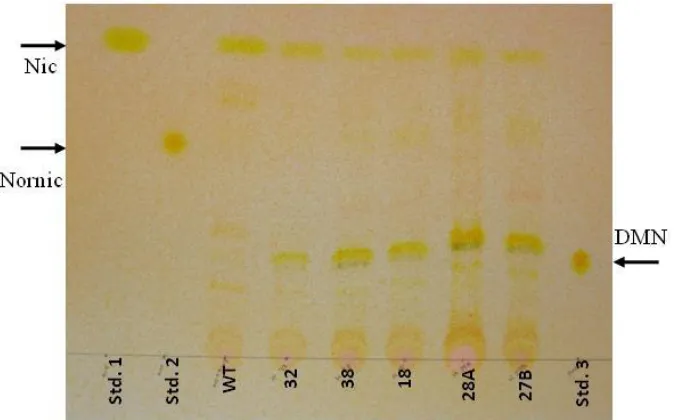
A qualitative TLC assay was used to assess the ability of the BBL-RNAi construct to reduce nicotine content and accumulate the unique DMN metabolite. Fresh roots from hydroponics or greenhouse-grown plants were incubated overnight in an oven at 60°C and allowed to dry. About 500 mg of root tissue was crushed to powder, and incubated overnight with gentle shaking in an alkaloid extraction solution (2% KOH in MeOH). The extract was subsequently filtered through Whatman #40 filter paper, and aliquots were spotted onto silica plates (20 x 20 cm Silica Gel 60 F254S; Fisher Scientific). The spotted plates were developed using a chloroform: methanol: ammonium hydroxide (85:15:2, v/v/v) solvent for about 45 min, then air dried for 1.5 hr. The plates were sprayed with 2% para-aminobenzoic acid in ethanol and exposed to cyanogen bromide until a yellowish color became visible. The presence of nicotine, nornicotine, and DMN was determined by co-migration with commercial standards.
2.2.7 Alkaloid analysis for BBL-RNAi root and leaf tissue
GC analysis was used to obtain a quantitative determination of the alkaloid concentrations of the various BBL-RNAi and control plants. Root and leaf tissue were prepared as described above for the TLC assays and shipped to the University of Kentucky for a quantitative alkaloid analysis as described by Jack et al. (2007).
2.3. Results
In silico analysis for the identification of QPT, PMT, A622, and BBL isoforms
47 genome), therefore it would be expected that most of the genes within the genome would be represented by at least two isoforms. Additional isoforms could also arise through ancient duplication events that could have originated in either ancestral parent or more recently after the formation of Nicotiana tabacum. Prior to screening for chemically induced mutations in alkaloid biosynthetic genes, it was first important to identify the different functional isoforms of each enzymatic reaction to be targeted, and the relative degree with which each is
transcribed. To accomplish this, we performed homology searches (BLASTN) against the tobacco expressed sequence tagged (EST) database found in GenBank®, using full-length sequences of previously published isoforms of PMT and A622 (Hibi et al., 1994), and QPT (Sinclair et al., 2000) as the query sequences. To identify BBL isoforms, a full-length sequence that was published in a patent application was used (referred to as NBB1 in the application of Hashimoto and Kato, 2006). In some cases, alignments were also made to the tobacco genomic sequence database of the NCSU Tobacco Genome Initiative (cultivar Hicks) to confirm that rarely expressed isoforms were legitimate genes, as opposed to being cultivar-specific polymorphic alleles, or sequencing artifacts.