STRUCTURE-SOIL-STRUCTURE INTERACTION
Chandrakanth Bolisetti1, Andrew S. Whittaker2
1Postdoctoral Associate, Idaho National Laboratory, Idaho Falls, Idaho, USA
2Professor and Chair, Department of Civil, Structural and Environmental Engineering, University at
Buffalo, The State University of New York, Buffalo, New York, USA
ABSTRACT
Adjacent structures interact through a common soil foundation during an earthquake, resulting in structure-soil-structure interaction (SSSI). This interaction can be through 1) modification of input ground motion due to the presence of adjacent structures (kinematic or wave-based SSSI), or 2) restraint on foundation response due to the presence of an adjacent building or foundation (localized SSSI). Due to the complicated nature of SSSI, few studies have investigated these phenomena, which are neither well understood nor accounted for in practice.
This paper presents an investigation of SSSI through 1) geotechnical centrifuge experiments at the NEES@UCDavis centrifuge facility, and 2) linear and nonlinear numerical simulations using the frequency-domain code SASSI and the time-domain code LS-DYNA, respectively. The investigation is performed for buildings founded on a basemat or spread footings constructed adjacent to each other. The extent of SSSI is judged by comparing the response of each structure with the corresponding baseline response, namely, its response with no adjacent structures. Three different arrangements of these buildings are considered. Experimental and numerical results show that SSSI effects have a negligible impact on the global response of the buildings considered in this study.
INTRODUCTION
Safety-related nuclear structures are rarely constructed in isolation and are often surrounded in part by other structures. During an earthquake the dynamic response of one structure can affect the response of a neighboring structure, resulting in structure-soil-structure interaction (SSSI). This interaction can be due to 1) a change in the input ground motion due to the presence, or the shaking, of a neighboring structure (kinematic or wave-based SSSI), and/or 2) a change in the foundation restraint due to the presence of an adjacent structure. Kinematic SSSI can also manifest as ‘shielding’, where the deep basements of buildings, or structures such as tunnels, protect other buildings from surface waves or inclined body waves during an earthquake. It is unknown if the effects of SSSI are significant enough to warrant consideration in analysis and design. However, in the context of performance-based earthquake engineering and seismic probabilistic risk assessment, it is important to understand this phenomenon and address it if important.
parametric analyses they concluded that SSSI effects are especially important for smaller and lighter structures situated close to heavier structures. A similar conclusion was drawn by Wong and Trifunac (1975). Both studies noted that the degree of interaction depends mainly on the type of wave interference (constructive or destructive) occurring between the scattered waves from the foundations, which is a function of the spacing and arrangement of the foundations. Some studies [e.g., Matthees and Magiera (1982), Lin et al. (1987), Qian and Beskos (1996), Padron et al. (2009), Anderson et al. (2013) and Bolisetti and Whittaker (2011)] have investigated SSSI between adjacent structures (buildings and nuclear power plants) using three-dimensional numerical methods, and most of these studies concluded that SSSI
can affect structural response. A more comprehensive list of SSSI studies can be found in Menglin et al.
(2011).
A primary reason for the lack of studies of SSSI is the unavailability of case studies either from field data or laboratory experiments. The only case study, to the knowledge of the authors, was performed by Çelebi (1993a) and Çelebi (1993b), who analyzed data recorded from two well-instrumented neighboring buildings to examine SSSI. They employed spectral analysis techniques to find correlations between the responses of the buildings to the 1987 Whittier-Narrows earthquake. The study examined the roof response, basement response, and free-field response of the buildings, and concluded that 1) the dynamic response of the building affected the basement response and the free-field response, and 2) there was considerable SSSI between the structures at specific frequencies. The latter conclusion also corroborates the findings of the study by Murakami and Luco (1977), who performed an analytical investigation of the interaction between an array of idealized shear-wall-like structures, and found that the interaction between these structures was the most prominent at the, so called, Rayleigh frequencies, which are determined by the properties of the soil and sizes of the foundation (Murakami and Luco, 1977).
THE NEES CITY BLOCK PROJECT
The US National Science Foundation (NSF) funded a research project titled ‘Seismic Performance Assessment in Dense Urban Areas’ to study the effects of SSI and SSSI in dense urban regions. This project, also known as the City Block project, involved a series of six centrifuge experiments of small-scale model buildings at the NEES@UCDavis geotechnical centrifuge facility. The first two experiments, Test 1 and Test 2, involved low- to mid-rise buildings designed to have realistic, code-conforming, dynamic properties with nonlinear behavior at the global level. These buildings were placed far apart in Test 1 and adjacent to each other in Test 2, and comparisons of the structural responses from these tests provided insight into SSSI in such structures. Test 3 and Test 4 involved buildings that were much stiffer than those in Test 1 and Test 2, and designed to exacerbate SSSI effects. Test 5 and Test 6 involved idealized linear structures founded on liquefiable soil, and the interaction between these structures was examined during liquefaction. The models in each test were subjected to several ground motions of different intensities. These ground motions included both ordinary and pulse motions with forward
directivity. The data gathered from these tests had been carefully curated in data reports (Mason et al.,
2010b; Mason et al., 2010c; Mason et al., 2011; Trombetta et al., 2011) and analyzed by members of the
City Block team (Bolisetti and Whittaker, 2015; Jones, 2013; Mason, 2011; Trombetta, 2013).
MS2F models were placed at two adjacent sides of the MS1F_2 model. The first two arrangements were tested together during Test 3 and the other two arrangements were tested during Test 4. Photographs of the corresponding test setups are presented in Figure 2. Design specifications of the models and the description of the construction and instrumentation of the test models are presented in Bolisetti and Whittaker (2015).
Figure 1: SSSI arrangements tested in Test 3 and Test 4 of the City Block project (arrows indicate direction of shaking) [adapted from Trombetta (2013)]
Figure 2: Experimental setups in the laminar box during Test 3 (left) and Test 4 (right) (shaking is along the longer side of the laminar box)
Structure-soil-structure interaction in MS1F_2 is examined by comparing the structural response in the SSSI arrangements tested during Test 3 and Test 4, to the response of the baseline model tested during Test 3. During test planning, more emphasis was laid on examining SSSI effects on MS1F_2 and therefore the baseline case of MS2F was not tested. MS2F was designed to have the same flexible-base
time period as MS1F_2 and expected to ‘transmit’ energy into the adjacent MS1F_2 model, amplify its
response during ground shaking, but remain unaffected by the presence of MS1F_2. This ‘transmitter -receiver’ hypothesis was evaluated in Test 3 and Test 4. Although the experimental study focused on SSSI effects on MS1F_2, the study presented in this paper also investigated the SSSI effects on MS2F through numerical simulations.
NUMERICAL MODELING AND ANALYSES
Given these limitations, the centrifuge tests of this study are corroborated by comprehensive, nonlinear, three-dimensional numerical analyses of the SSSI arrangements. These numerical analyses, however, do not exactly simulate the centrifuge tests. Instead, 1) the analyses are performed in the prototype scale, 2) the soil domain is assumed to be infinite, 3) the interactions between the laminar box, shaker and the centrifuge bucket are ignored, and 4) each input ground motion is applied separately and not consecutively as in the experiments, setting aside cumulative soil strain, cumulative structural damage, and changing soil properties due to consolidation. These modifications are made so that the numerical simulations provide a deeper insight into the SSSI effects. The numerical SSI analyses are performed for the SSSI arrangements presented in Figure 1, as well as for the baseline case of MS2F to provide a benchmark while examining the SSSI effects on MS2F.
The industry-standard SSI analysis codes, SASSI (Lysmer et al., 1999) and LS-DYNA (LSTC, 2013) are
used for the numerical simulations. SASSI is the most widely used numerical SSI code in the US nuclear industry and performs linear analysis in the frequency domain. LS-DYNA is a commercial finite-element program capable of nonlinear three-dimensional SSI analysis in the time domain. Soil-structure interaction analyses in LS-DYNA are performed using the direct method (Bolisetti and Whittaker, 2015; Spears and Coleman, 2014), which involves simulating a large soil domain around the structure, and enables the simulation of geometric nonlinearities such as gapping and sliding of the foundation. Unlike the experiments, the SSSI arrangements and baseline models shown in Figure 1 and Figure 2 are modeled separately for numerical simulations. The superstructures in both the codes are modeled using beam elements and lumped masses. The soil in LS-DYNA is modeled using solid elements and the *MAT_HYSTERETIC material model (LSTC, 2013). This material model features a multi-linear backbone curve and is capable of simulating soil hysteresis. Since SASSI performs linear analysis, the soil profile is modeled using equivalent-linear properties calculated using the site-response code,
SHAKE2000 (Schnabel et al., 2009). The footings of MS1F_2 and the basemat of MS2F are both
modeled using solid elements. Figure 3 presents the SASSI and LS-DYNA numerical models of the cSSSI arrangement (see Figure 1).
Figure 3: Numerical models of the cSSSI arrangement in SASSI (left) and LS-DYNA (right)
The soil domain of the LS-DYNA model shown in the figure is 218m 118m in plan (218m in the
shaking direction) and 29.5m deep. To provide perspective, the laminar box used in the City Block tests
corresponds to a soil domain that is 83m 28m in plan and 29.5m deep at the prototype scale. The
approximately infinite soil domain is simulated (Bolisetti and Whittaker, 2015). The LS-DYNA analyses
are performed for two cases: 1) the foundation (footings or basemat) is ‘tied’ to the surrounding soil and
there is no separation at the foundation-soil interface, and 2) separation is allowed at the foundation-soil interface leading to potential gapping and sliding. These two cases are modelled using two different contact models in LS-DYNA. Separation at the foundation-soil interface cannot be modelled in SASSI, since it only performs a linear analysis. Further description of the numerical models and their specifications are presented in (Bolisetti and Whittaker, 2015).
The experimental models were subjected to several ground motions during each of the City Block tests. These ground motions were chosen after a deterministic and probabilistic seismic hazard analysis by
Mason et al. (2010a) and represent the seismic hazard at downtown Los Angeles. The ground motions
include both ordinary and near-fault motions with forward directivity. Four of these input ground motions are chosen for numerical analyses in this study, and the results from two of these ground motions are presented in this paper. These ground motions, referred to as JOS_L and PRI_H, have the peak accelerations of 0.06g and 0.64g respectively. Further details regarding these ground motions and the results for other ground motions are presented in Bolisetti and Whittaker (2015).
ANALYSIS RESULTS AND COMPARISON WITH EXPERIMENTAL DATA
The degree of SSSI on each structure is judged by examining the deviation of its response (experimental or numerical) from its baseline case. No direct comparisons are made between the numerical and experimental responses because of 1) differences between the numerical models and the experimental models as described in the previous section, 2) challenges in analyzing the data from centrifuge testing, and 3) unavailability of reliable soil properties from the experiments. Instead, qualitative comparisons are made between the experimental and numerical results in terms of the degree of SSSI. This section presents an examination of acceleration response spectra at the roof of MS1F_2 and MS2F for potential SSSI effects.
MS1F_2
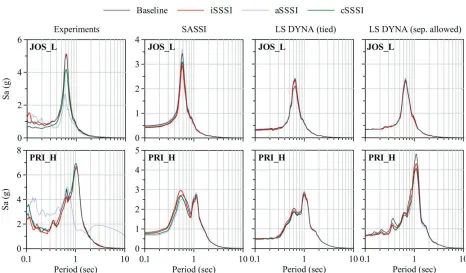
Figure 4 presents 5% damped acceleration response spectra at the roof of MS1F_2 for two ground motions calculated from 1) experiments, 2) SASSI, 3) LS-DYNA with tied foundation, and 4) LS-DYNA with separation allowed at the foundation. Figure 4 shows that the response of MS1F_2 in the aSSSI arrangement (indicated in light blue) is anomalous and is very different from the other responses. This is due to inadequate assembling of this model, which was noticed during the dismantling of the experimental setup after the experiment. The test response of MS1F_2 in the aSSSI arrangement is therefore ignored in this study. The other test results in Figure 4 show that the response of MS1F_2, for a given ground motion, is similar for all the arrangements illustrated in Figure 1. The one exception is the peak spectral acceleration in the cSSSI case for the JOS_L ground motion. However this reduction in response is not seen in the experimental results from the other ground motions, and does not indicate a general trend. Small differences in the experimental responses are attributed to variability in the material properties and input ground motion. The global response of MS1F_2 in these experiments is not affected by SSSI.
Figure 4: Acceleration response spectra at the roof of MS1F_2 calculated from the experiments and numerical simulations
The results show that the numerical predictions from SASSI and LS-DYNA agree reasonably well with the experimental results, with regards to the magnitude of SSSI effects in MS1F_2. However the numerical and experimental responses are quite different for all ground motions, especially in terms of the spectral accelerations. Although some differences are expected, they are particularly large and warrant investigation. A similar order of difference between the experimental and numerical results is seen in the analysis performed by another City Block researcher (Jones, 2013) who performed numerical simulations of Tests 3 and 4 using the program FLAC (Itasca Consulting Group, 2005). Jones (2013) found that the peak spectral accelerations calculated using the numerical programs were much smaller than those from the experiments. To explain the differences between the experimental and numerical results, Jones (2013) conducted a series of sensitivity analyses in FLAC to understand the effect of parameters such as the shear-wave velocity profile of the soil, fixed-base time period of the structure, and modulus reduction and damping and curves, on the response of the structure. These sensitivity analyses did not adequately explain the under-prediction of the numerical simulations and Jones (2013) speculated that the differences might be due to the combined resonance of the soil profile and the structure. However, the nonlinear systems (soil, structure) considered here do not resonate. Further studies are required to understand the differences between the experimental and numerical results, which are not the focus of this study.
allow gapping and sliding of the footings provide more reasonable predictions than SASSI and LS-DYNA (tied). This result is expected given that the soil around the footings is highly nonlinear.
MS2F
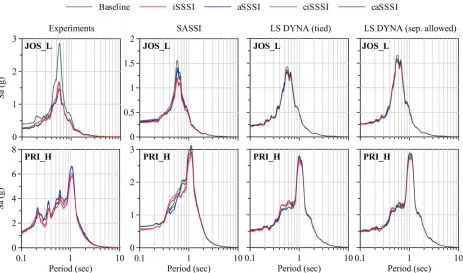
The shear wall structure, MS2F, was designed to act as a ‘transmitter’ structure to affect the response of the adjacent MS1F_2 by transmitting energy through the soil. However, the numerical and experimental responses of MS1F_2 showed negligible SSSI effects, even for the cSSSI arrangement, which comprised two MS2F models adjacent to the MS1F_2, indicating that MS2F did not perform the expected ‘transmitting’ function. Figure 5 below presents the 5% damped acceleration response spectra at the roof of MS2F for two ground motions calculated from 1) experiments, 2) SASSI, 3) LS-DYNA with tied foundation, and 4) LS-DYNA with separation allowed at the foundation.
Figure 5: Acceleration response spectra at the roof of MS2F calculated from the experiments and numerical simulations
Figure 5 shows that there is considerable variability in the experimental responses of MS2F in different arrangements for the JOS_L ground motion. Specifically, the response of the model in the anti-plane position in the cSSSI arrangement is different from response of the other models, which are similar for the JOS_L ground motion. However this behavior of the ciSSSI and caSSSI models of MS2F is not consistent with its response to the PRI_H ground motion [as well as some other ground motions as shown in Bolisetti and Whittaker (2015)]. This indicates that the SSSI effects seen in the ciSSSI and caSSSI arrangements for the JOS_L ground motion may be a result of anomalous behavior, and not interaction between the structures. The results of the numerical simulations presented in Figure 5 also show that the responses of MS2F in the different arrangements are very similar for each ground motion. Similar to MS1F_2, it can be concluded that the SSSI arrangements illustrated in Figure 1 have little to no effect on the global structural response of MS2F.
corresponding period. For the more intense ground motion, PRI_H, the nonlinear analyses using LS-DYNA result in spectral shapes that are more similar to those observed in the experiments than the linear analyses in SASSI. However the magnitude of the numerically calculated spectral accelerations are much smaller than those calculated from experimental results for these ground motions, similar to the results of MS1F_2.
CONCLUSIONS AND FUTURE WORK
The following conclusions can be made from the analysis of experimental data and the results of numerical simulations presented in this paper:
1. Accurate numerical modelling of centrifuge experiments is very difficult. It requires modelling of the
centrifuge itself, and careful determination of the soil properties when the centrifuge in flight, which is challenging.
2. Structure-soil-structure interaction, did not result in any significant change in the global structural
responses of the structures considered in Tests 3 and 4 of the City Block project. There is reasonable agreement between the experimental and numerical results in this regard.
3. The ‘transmitter-receiver’ effect, which was presumed for the design of Tests 3 and 4, was not observed since MS1F_2 and MS2F responded almost independently of each other.
4. There are significant differences between the roof responses calculated from numerical simulations
and those from experiments. Numerical simulations by another City Block researcher using FLAC also showed similar differences.
5. Of the different numerical analysis methods, only LS-DYNA with an interface that permits separation
reasonably captures the shape of the roof response spectra of MS1F_2 for the intense ground motion PRI_H. This indicates that simulating foundation nonlinearities, such as footing sliding and gapping, are important to accurately predict structural response for surface- or near-surface-mounted structures subjected to intense ground motions.
6. Structure-soil-structure interaction effects from to the modification of ground motion due to the
presence of adjacent structures (kinematic or wave-based SSSI), have a negligible effect on the global responses of low- to medium-rise structures such as those considered in Tests 3 and 4 of the City Block project. However local effects such as changes in footing or column moments are still possible due to the presence of adjacent foundations. These effects are investigated in Bolisetti and Whittaker (2015) and are not presented in this paper.
The present study on SSSI is limited to buildings subjected to vertically propagating shear waves. Further studies should include 1) examination of local effects on small foundations, such as footings, when placed adjacent to large basements and 2) shielding of the foundations from inclined waves due to the presence of large basements or underground structures, such as tunnels (shielding effects).
ACKNOWLEDGMENTS
The study presented in this paper was funded in part by the US National Science Foundation (NSF) under Grant No. CMMI-0830331. The authors gratefully acknowledge this financial support. The opinions, findings, conclusions and recommendations expressed in this paper are those of the authors alone and do not necessarily reflect the view of the NSF.
REFERENCES
Structures." Transactions: 22nd International Conference in Structural Mechanics in Reactor Technology (SMiRT-22), San Francisco, California.
Bolisetti, C., and Whittaker, A. S. (2011). "Seismic Structure-Soil-Structure Interaction in Nuclear Power
Plant Structures." Transactions: 21st International Conference in Structural Mechanics in Reactor
Technology (SMiRT-21), New Delhi, India.
Bolisetti, C., and Whittaker, A. S. (2015). "Site Response, Soil-Structure Interaction and Structure-Soil-Structure Interaction for Performance Assessment of Buildings and Nuclear Structure-Soil-Structures." MCEER-15-0002, Multidisciplinary Center for Earthquake Engineering Research (MCEER), University at Buffalo, The State University of New York, Buffalo, NY.
Çelebi, M. (1993a). "Seismic Responses of Two Adjacent Buildings. I: Data and Analyses." Journal of
Structural Engineering, 119(8), 2461-2476.
Çelebi, M. (1993b). "Seismic Responses of Two Adjacent Buildings. II: Interaction." Journal of
Structural Engineering, 119(8), 2477-2492.
Itasca Consulting Group (2005). Computer Program FLAC: Advanced, Two Dimensional Continuum Modeling for Geotechnical Analysis of Rock, Soil, and Structural Support, Itasca Consulting Group, Inc., Minneapolis, Minnesota.
Jones, K. C. (2013). "Dynamic Soil-Structure Interaction Analysis of Structures in Dense Urban Environments." Ph.D. Dissertation, University of California, Berkeley, California.
Kutter, B. L. (1995). "Recent Advances in Centrifuge Modeling of Seismic Shaking." Proceedings: Third
International Conference on Recent Advances in Geotechnical Earthquake Engineering and Soil Dynamics, April 2-7, St. Louis, Missouri.
Lin, H., -T., Roesset, J. M., and Tassoulas, J. L. (1987). "Dynamic Interaction Between Adjacent
Foundations." Earthquake Engineering and Structural Dynamics, 15, 323-343.
Livermore Software Technology Corporation (LSTC). (2013). "LS-DYNA Keyword User's Manual - Version R 7.0." Livermore Software Technology Corporation, Livermore, California.
Luco, J. E., and Contesse, L. (1973). "Dynamic Structure-Soil-Structure Interaction." Bulletin of the
Seismological Society of America, 63(4), 1289-1303.
Lysmer, J., Ostadan, F., and Chin, C. (1999). Computer Program SASSI2000 - A System for Analysis of Soil-Structure Interaction, University of California, Berkeley, California.
Mason, H. B., Kutter, B. L., Bray, J. D., Wilson, D. W., and Choy, B. Y. (2010a). "Earthquake Motion
Selection and Calibration for Use in a Geotechnical Centrifuge." Proceedings: 7th International
Conference on Physical Modelling in Geotechnics, 28th June to 1st July 2010, Campus Science City (Hönggerberg), ETH, Zurich, Switzerland.
Mason, H. B., Trombetta, N. W., Gille, S., Lund, J., Zupan, J., Jones, K. C., Puangnak, H., Bolisetti, C., Bray, J., Hutchinson, T., Fiegel, G., Kutter, B. L., and Whittaker, A. S. (2010b). "Seismic Performance Assessment in Dense Urban Environments: Centrifuge Data Report for HBM02 (Test 1)." University of California at Davis Center for Geotechnical Modeling, Davis, California.
Mason, H. B., Trombetta, N. W., Gille, S., Lund, J., Zupan, J., Jones, K. C., Puangnak, H., Bolisetti, C., Bray, J., Hutchinson, T., Fiegel, G., Kutter, B. L., and Whittaker, A. S. (2010c). "Seismic Performance Assessment in Dense Urban Environments: Centrifuge Data Report for HBM03 (Test 2)." University of California at Davis Center for Geotechnical Modeling, Davis, California.
Mason, H. B. (2011). "Seismic Performance Assessment in Dense Urban Environments." Ph.D. Dissertation, University of California, Berkeley, California.
Mason, H. B., Trombetta, N. W., Gille, S., Lund, J., Zupan, J., Jones, K. C., Puangnak, H., Bolisetti, C., Bray, J., Hutchinson, T., Fiegel, G., Kutter, B. L., and Whittaker, A. S. (2011). "Seismic Performance Assessment in Dense Urban Environments: Centrifuge Data Report for HBM04 (Test 3)." No. UCD/CGMDR-03/11, University of California at Davis Center for Geotechnical Modeling, Davis, California.
Matthees, W., and Magiera, G. (1982). "A Sensitivity Study of Seismic Structure-Soil-Structure
Menglin, L., Huaifeng, W., Xi, C., and Yongmei, Z. (2011). "Structure-Soil-Structure Interaction:
Literature Review." Soil Dynamics and Earthquake Engineering, 31, 1724-1731.
Murakami, H., and Luco, J. E. (1977). "Seismic Response of a Periodic Array of Structures." Journal of
the Engineering Mechanics Division, ASCE SM5, 103, 965-976.
Padron, L. A., Aznarez, J. J., and Maeso, O. (2009). "Dynamic Structure-Soil-Structure Interaction
between Nearby Piled Buildings under Seismic Excitation by BEM-FEM Model." Soil Dynamics
and Earthquake Engineering, 29, 1084-1096.
Qian, J., and Beskos, D. E. (1996). "Harmonic Wave Response of Two 3-D Rigid Surface Foundations." Soil Dynamics and Earthquake Engineering, 15, 95-110.
Schnabel, P. B., Lysmer, J., and Seed, H. B. (2009). Computer Program SHAKE2000: A Computer Program for the 1D Analysis of Geotechnical Earthquake Engineering Problems, University of California, Berkeley, California.
Spears, R., and Coleman, J. (2014). "Nonlinear Time Domain Soil-Structure Interaction Methodology Development." Idaho National Laboratory, Idaho Falls, Idaho.
Trombetta, N. W., Zupan, J., Bolisetti, C., Puangnak, H., Jones, K. C., Tran, J. K., Bassal, P., Bray, J., Hutchinson, T., Fiegel, G., Kutter, B. L., and Whittaker, A. S. (2011). "Seismic Performance Assessment in Dense Urban Environments: Centrifuge Data Report for NWT01 (Test 4)." in preparation, University of California at Davis Center for Geotechnical Modeling, Davis, California. Trombetta, N. W. (2013). "Seismic Soil-Foundation Structure Interaction in Urban Environments." Ph.D.
Dissertation, University of California, San Diego, California.
Wong, H. L., and Trifunac, M. D. (1975). "Two-Dimensional, Antiplane, Building-Soil-Building
Interaction for Two or More Buildings and for Incident Plane SH Waves." Bulletin of the
![Figure 1: SSSI arrangements tested in Test 3 and Test 4 of the City Block project (arrows indicate direction of shaking) [adapted from Trombetta (2013)]](https://thumb-us.123doks.com/thumbv2/123dok_us/1533751.1188058/3.612.85.535.319.450/figure-arrangements-project-indicate-direction-shaking-adapted-trombetta.webp)