ABSTRACT
KRISHNAMOORTHY, REMYA. Hardware Implementation of an XML Parser. (Under the direction of Dr.Yannis Viniotis).
Hardware Implementation of an XML Parser
by
Remya Krishnamoorthy
A thesis submitted to the Graduate Faculty of North Carolina State University
In partial fulfillment of the Requirements for the degree of
Master of Science
Computer Engineering
Raleigh, North Carolina 2008
APPROVED BY:
_______________________________ Dr.Yannis Viniotis
Chair of Advisory Committee
DEDICATION
To my matha, pitha, guru and daivam
…BIOGRAPHY
ACKNOWLEDGMENTS
I express my foremost and deepest gratitude to my advisor, Dr.Yannis Viniotis, for his unstinted support and encouragement throughout the course of my graduate studies at NCSU. I am grateful to him for believing in my capabilities, and for doing the best he could to help me pursue my interests. He has provided me invaluable guidance and direction, and has been a constant source of inspiration for making me achieve what I have.
I sincerely thank Dr. Michael Devetsikiotis, for agreeing to be on my committee and also for giving me the right guidance which helped me decide my research interests. I am also grateful to him for helping to arrange a system and cubicle, where I completed most of my thesis work. I owe my foundations in ASIC Design to Dr. Paul Franzon and I would like to thank him profusely for being on my committee.
I sincerely thank Meeta for the great support she has been throughout the course of the thesis and for her valuable time, patience and suggestions. This thesis has benefited greatly through those discussions and doubt-clearing sessions. I would also like to thank Ravi Jenkal for managing to find time to help me with all synthesis issues and queries. I greatly value his help in this regard.
The university and the department are true centers of learning, offering just about any kind of environment or facilities that one could wish for. I am thankful for the same, with a special mention to the NCSU Wolfline Night service, which ensured the timely completion of the thesis!
TABLE OF CONTENTS
LIST OF TABLES... x
LIST OF FIGURES ... xii
CHAPTER 1 ...1
XML AND XML SCHEMA ...1
1.1 Introduction to XML ...1
1.1.1 History and Evolution ...1
1.1.2 Definition and example ...2
1.1.3 Key terms and concepts ...4
1.2 Uses and importance of XML ...5
1.2.1 Uses ...5
1.2.2 Importance in networking ...6
1.2.2.1 Web-services and SOA ...7
1.2.2.2 Content-based routing ...8
1.2.2.3 Other uses ...9
1.3 Introduction to XML Schema ... 10
1.3.1 Definition and example ... 10
1.3.2 Key Concepts ... 12
1.4 Uses and Importance of XML Schema ... 13
1.4.1 Importance of the Schema ... 14
1.4.2 Advantages ... 14
1.4.3 Drawbacks ... 15
1.5 Thesis Organization ... 15
CHAPTER 2 ... 16
XML PARSING ... 16
2.1 Importance of XML parsing ... 16
2.2 Stages in XML parsing... 17
2.2.1 Well-formedness Checking ... 18
2.2.2 Schema Validation ... 22
2.2.3 XPATH/XQuery ... 23
2.3 XML parsing in software ... 23
2.3.1 Parsing models ... 23
2.3.2 Bottlenecks in software parsing ... 26
2.3.3 Possible solutions ... 27
2.3.3.1 Hardware Offload ... 27
2.3.3.2 Mixed hardware/software offload ... 27
2.4 XML parsing in hardware ... 28
2.5 Thesis problem statement ... 29
CHAPTER 3 ... 31
REQUIREMENTS ANALYSIS AND DESIGN CONSIDERATIONS ... 31
3.1 Features Implemented ... 31
3.1.1 Well-formedness Checker ... 31
3.1.2.1 Main functions ... 33
3.1.2.2 Analysis of element types ... 34
3.1.2.2.1 Basic element types... 34
3.1.2.2.2 Documentation related ... 35
3.1.2.2.3 External reference/extensions ... 35
3.1.2.2.4 Identity related constraints ... 37
3.1.2.2.5 Model group constraints ... 37
3.1.2.2.6 Lists/Unions ... 38
3.1.2.3 Complexity introduced by the schema ... 39
3.1.2.4 Implemented functions ... 42
3.2 Designs considered ... 43
3.2.1 Pre-processor based design ... 43
3.2.2 4-byte design ... 44
3.3 Selected design ... 45
3.3.1 Concept and explanation ... 45
3.3.2 Strengths ... 46
3.3.3 Drawbacks ... 47
CHAPTER 4 ... 48
DESIGN ARCHITECTURE AND DESCRIPTION ... 48
4.1 High level block diagram and explanation ... 48
4.2 Memory Organization ... 50
4.2.1 XML Memory ... 50
4.2.2 Schema Memory ... 51
4.2.3 Other memory structures ... 53
4.2.3.1 Element stack ... 53
4.2.3.2 Attribute stack ... 53
4.3 Well-formedness checker ... 54
4.3.1 FSM Controller ... 55
4.3.2 Element name validator ... 58
4.3.3 Element content validator ... 58
4.3.4 Attribute name validator ... 59
4.3.5 Attribute content validator ... 59
4.3.6 Closing element name validator... 60
4.4 Schema Validator ... 60
4.4.1 The Schema pre-processor... 61
4.4.2 Schema element name validation stage ... 62
4.4.3 Schema attribute name validation stage ... 62
4.4.4 Schema element content validation stage ... 63
4.4.5 Schema attribute content validation stage ... 64
CHAPTER 5 ... 65
DETAILED DESIGN AND SIMULATION ... 65
5.1 Memory Read module ... 65
5.1.1 Pin Interfaces ... 65
5.1.2 Detailed Architecture ... 66
5.2.1 Element name validation ... 67
5.2.1.1 Pin Interfaces ... 67
5.2.1.2 Detailed architecture and Simulation Results ... 68
5.2.2 Element content validation ... 69
5.2.2.1 Pin Interfaces ... 69
5.2.2.2 Detailed architecture and Simulation Results ... 69
5.2.3 Attribute name validation ... 70
5.2.3.1 Pin Interfaces ... 70
5.2.3.2 Detailed architecture and Simulation Results ... 71
5.2.4 Attribute content validation ... 72
5.2.4.1 Pin Interfaces ... 72
5.2.4.2 Detailed architecture Simulation Results ... 73
5.2.5 Controller module ... 74
5.2.5.1 Pin Interfaces ... 74
5.2.5.2 Detailed architecture and Simulation results ... 75
5.3 Schema Validator ... 76
5.3.1 Schema memory ... 76
5.3.1.1 Pin Interfaces ... 76
5.3.1.2 Detailed architecture and simulation results ... 77
5.3.2 Schema element name validation ... 77
5.3.2.1 Pin Interfaces ... 78
5.3.2.2 Detailed architecture and Simulation Results ... 78
5.3.3 Schema element content validation ... 79
5.3.3.1 Pin Interfaces ... 80
5.3.3.2 Detailed architecture and Simulation Results ... 80
5.3.4 Schema attribute name validation ... 81
5.3.4.1 Pin Interfaces ... 81
5.3.4.2 Detailed architecture and Simulation Results ... 82
5.3.5 Schema attribute content validation ... 83
5.3.5.1 Pin Interfaces ... 83
5.3.5.2 Detailed architecture and Simulation Results ... 84
5.3.6 Schema controller ... 85
5.3.6.1 Pin Interfaces ... 85
5.3.6.2 Detailed architecture and simulation results ... 86
CHAPTER 6 ... 88
VERIFICATION AND RESULTS ... 88
6.1 Verification Strategy ... 88
6.2 Test Cases Executed ... 90
6.2.1 Element Contents Validation ... 90
6.2.2 Attribute Contents Validation ... 91
6.2.3 Attribute Name Validation ... 91
6.2.4 Element Name Validation ... 92
6.2.5 Closing Element Name Validation ... 92
6.2.6 Well-formedness validations ... 92
6.3 Logic synthesis and results ... 93
CHAPTER 7 ... 95
FUTURE WORK AND CONCLUSION ... 95
7.1 Future Work... 95
7.1.1 Feature Additions ... 95
7.1.2 Implementation and optimizations ... 96
7.2 Conclusion ... 97
LIST OF TABLES
Table 3. 1 Main functions and implementation constraints for the well-formedness
checker ... 32
Table 3. 2 Validations not covered by well-formedness checker ... 32
Table 3. 3 Main functions and implementation constraints in the schema validation stage ... 33
Table 3. 4 Basic element types in the schema ... 35
Table 3. 5 Documentation-related element types ... 35
Table 3. 6 References/Extensions related element types ... 36
Table 3. 7 Identity related element types ... 37
Table 3. 8 Model group element types ... 38
Table 3. 9 Element types specifying lists/unions ... 38
Table 3. 10 Attributes possible within the <xsd:element> and their analysis ... 41
Table 3. 11 Summary of implemented functions in Schema validation stage ... 42
Table 4. 1Bit-wise organization of the schema memory ... 52
Table 4. 2 Special characters and their corresponding entities ... 58
Table 4. 3 Data-types supported and their constraints ... 64
Table 5. 1 Pin interfaces for the memory read module ... 65
Table 5. 2 Pin interfaces for the element name validation module ... 67
Table 5. 3 Pin interfaces for the element content validation module ... 69
Table 5. 4 Pin interfaces for the attribute name validation module ... 71
Table 5. 5 Pin interfaces for the attribute content validation module ... 72
Table 5. 6 Pin interfaces for the controller of the well-formedness checker stage ... 74
Table 5. 7 Pin interfaces to the schema memory module ... 76
Table 5. 8 Pin interfaces to the schema element name validaiton module ... 78
Table 5. 9 Pin interfaces to the schema element content validation module ... 80
Table 5. 10 Pin interfaces to the schema attribute name validation module ... 81
Table 5. 11 Pin interfaces to the schema element content validation module... 83
Table 5. 12 Pin interfaces to the schema controller module ... 85
Table 6. 1 Test cases for element contents validation ... 90
Table 6. 2 Test cases for attribute contents validation ... 91
Table 6. 3 Test cases for attribute name validaiton ... 91
Table 6. 4 Test cases for element name validation ... 92
LIST OF FIGURES
Figure 1. 1 A sample XML document ...3
Figure 1. 2 Typical Scenario before SOA ...7
Figure 1. 3 Role of web-services in networking applications ...8
Figure 1. 4Sample XML-RPC message ...9
Figure 1. 5 Sample XML document ―thesis.xml‖ ... 11
Figure 1. 6 Schema corresponding to thesis.xml - ―thesis.xsd‖ ... 12
Figure 2. 1 Role of XML parsers in networking applications ... 17
Figure 2. 2 The XML version element ... 18
Figure 2. 3 XML with duplicate root element ... 18
Figure 2. 4 XML instance illustrating open and close tags ... 19
Figure 2. 5 XML instance illustrating closing of an element ... 19
Figure 2. 6 XML instance illustrating case-sensitivity of element names ... 20
Figure 2. 7 XML instance illustrating nesting of elements ... 20
Figure 2. 8 XML element illustrating quoting of attributes ... 21
Figure 2. 9 Conceptual illustration of a push -parsing model ... 24
Figure 2. 10 Conceptual illustration of a pull-parsing model ... 24
Figure 2. 11 Conceptual illustration of an object-model parser ... 25
Figure 3. 1 XML instance definition... 40
Figure 3. 2 XML schema definition corresponding to Figure 3.1 ... 40
Figure 4. 1 High-level block diagram of the system... 49
Figure 4. 2 Block diagram of the well-formedness checker stage ... 55
Figure 4. 3 The FSM state transitions ... 57
Figure 4. 4 Block diagram of the schema validator ... 61
Figure 5. 1 Simulation output for the memory read module ... 66
Figure 5. 2 Simulation output for the element name validation module ... 68
Figure 5. 3 Simulation output for the element content validation module ... 70
Figure 5. 5 Simulation output of the attribute content validation module ... 73
Figure 5. 6 Simulation output for the controller in well-formedness checker stage ... 75
Figure 5. 7 Simulation output for the schema memory module ... 77
Figure 5. 8 Simulation output for the schema element name validation module ... 79
Figure 5. 9 Simulation output for the schema element content validation module... 81
Figure 5. 10 Simulation output for the schema attribute name validation module ... 83
Figure 5. 11 Simulation output for the schema attribute content validaiton module ... 84
Figure 5. 12 Simulation output for the schema controller module ... 86
Figure 6. 1 High-level block diagram of the testbench architecture ... 89
CHAPTER 1
XML AND XML SCHEMA
This chapter introduces the concepts of XML and XML Schema, and describes their functions and varied uses. Some light is shed on SOA and the growing importance of XML in networking applications.
1.1 Introduction to XML
The following sections outline the evolution of XML as a widely used and accepted markup language, and illustrate with an example the underlying concepts of the same.
1.1.1
History and Evolution
language that could provide the necessary flexibility and scalability to support all necessary features, while keeping the content completely separate from the display and presentation. The EXtensible Markup Language or XML was the solution announced by the W3C XML Working Group in 1996. The committee was chaired by Jon Bosak of Sun Microsystems with active participation of an XML Special Interest Group, also organized by the W3C [20].
The difference between HTML and XML is probably the first question that would arise in the minds of a web developer new to XML. To begin with, the only feature common between the two is the appearance of code in the form of structured tags. XML is like SGML in that it is not itself a markup language, but instead a specification for defining a markup language. On the other hand, HTML is an application, a markup language that is developed based on the specifications of SGML or XML (XHTML). HTML comes bound with a fixed tag set and tag semantics, and does not provide room for arbitrary structure. XML on the other hand, offers unlimited flexibility and freedom to the author of the document in terms of structure and content. The primary goal of HTML is to display data and to focus on how it looks, whereas that of XML is to describe data and to focus on what data is. Thus it would be apt to say that XML and HTML complement each other, with XML being used to structure and describe the web data and HTML to format and display the same data [21].
1.1.2
Definition and example
<?xml version="1.0"?> <MSThesis>
<department name="ECE" university = “NCSU”> <student>Remya</student>
<advisor>Dr.Viniotis</advisor>
<committee>Dr.Franzon</committee> <committee>Dr.Devetsikiotis</committee> </department>
</MSThesis>
Figure 1.1 shows an XML document with a customized structure and description of data. As can be seen, the document syntax is simple and self-describing. In order to view this information in a webpage, the display format must be specified in some other language whose function is to receive and display data. The example basically describes the details of an MS Thesis. The starting of an element in an XML is specified with the starting tag ―<‖ character. The top-most element, which in this case is ‗MSThesis‘ is the parent of all other elements in the document and is called the ―root element‖. The first ―child element‖ of the root is ‗department‘. It has two ―attributes‖, called ‗name‘ and ‗university‘ to specify details. The contents of the ‗department‘ element are the ‗student‘, ‗advisor‘ and ‗committee‘ elements. Each of these leaf-level child elements are associated with some ―content‖ which describes the value attributed to them. The XML-specific terms such as element, child, content and attributes are explained in more detail in the following section.
1.1.3
Key terms and concepts
To understand the uses and functions of XML, it is necessary to gain a preliminary understanding of the parts that comprise a document. A concise list of these is given below with reference to the example illustrated in Section 1.1.2:
1. XML Declaration – <?xml version="1.0"?>
This is always the first line in an XML document. It describes the XML version number and optionally, the character encoding that is used in the document. By default, the encoding is the ISO-8859-1(Latin-1/West European) character set. The declaration is a mandatory requirement in all XML documents [1,2].
2. Root Element – This is the element at the top-most level of the hierarchy and is the parent of all other elements in the document. The root node is unique within a given XML.
In the above example, the root element is <MSThesis>
3. Child and Parent elements (Nested elements) – A tag pair nested within another is a child element. The enclosing element is called the parent element. This parent-child structure is called a nested elements hierarchy.
In the example, the ―<department>‖ element is a child of the ―<MSThesis>‖ element. The ―<department>‖ element in turn, is the parent of ―<student>‖, ―<advisor>‖ and ―<committee>‖ child elements. If an element does not have children or further levels of hierarchy, it is called a leaf-level child.
4. Attributes – When defining an element, it is possible to specify a unique characteristic associated with it using attributes. Each attribute has a name and value associated with it. An attribute is unique within an element.
5. Content – All child elements and values which occur between the starting and ending tags of an element constitute the content of the element. The leaf-level elements can have only a value as their content.
In the example above, the root node <MSThesis> has the ―<department>‖ element as part of its contents. The content of leaf-level elements <student>, <advisor> and <committee> however, is made up only of their corresponding values.
The terms and concepts listed above would be used very frequently in the discussions that follow and are the foundation required to develop XML documents of any degree of complexity.
1.2 Uses and importance of XML
The following sections elaborate on the main uses of XML in today‘s world, and how important it is from the networking perspective.
1.2.1
Uses
Most of the uses of XML stem from the fact that XML is platform independent. This enables storing and sharing data without being concerned about the compatibility with different applications, servers, operating systems or browsers. The following is a list of the varied uses that XML can be put to [23]:
1. XML for documentation and data-sharing – The flexibility and freedom in defining the content and structure of an XML makes it human readable and understandable. XML can be written and shared in plain-text format, which provides a hardware and software independent way of sharing data.
Any required application can be used to store and retrieve data while a generic application can display the retrieved data.
3. XML for Web development – XML helps to completely separate the content and display facets in web development. The content to be displayed can be contained in multiple XML documents, while the display can be taken care of by HTML. XML can further be embedded within HTML documents in data-islands. This provides effective content management capabilities, since the content managers need not even know the existence of XML. Any change to the content will not require any change in the HTML document, software or the application, making this an easy task. Any preferred application can be used to store and retrieve data while a generic application can display the retrieved data.
4. XML for the internet – The independence with respect to platform, application and technology offered by XML, has resulted in XML technologies being adopted in web services and service oriented architecture, as the new standard for application development and integration. Such services offer rapid interoperability and seamless service re-use by establishing a standard data format and a standard interface. The utility of XML in transmission of data and services over the internet could well be considered to be the prime reason why XML has become indispensable for communication and networking today. This is also the area of maximum interest from the point of view of this thesis and hence, further elaboration of the main concepts is provided in Section 1.2.2.
1.2.2
Importance in networking
Application 1 API
A
pp
lic
at
io
n
2
A
P
I
Application 3 API
1.2.2.1
Web-services and SOA
In a typical business environment, there exist a number of disparate applications developed using a wide range of technologies. Since each of these applications may belong to different domains and developed using different technologies, the requests and responses to these applications would need coding of proprietary interfaces and usage of tools specific to each. Due to this, establishing and maintaining communication between these applications would become extremely difficult and resource consuming when the number of such applications is large [4]. Using web services and SOA, the simple invocation of a service‘s URL would suffice in order to use its capability in another application. Web services and SOA rely heavily on XML for providing this very functionality because of the inherent property of XML to be platform and application independent. Requests and responses are exchanged in the form of XML messages, which are translated back to the native format at the application end using appropriate protocols. The ability to remotely access an application by just sending a request over the internet is the key concept of Web Services [6].
The importance of web-services is further illustrated in Figures 1.2 and 1.3. Figure 1.2 shows the situation before the emergence of XML and SOA, wherein different
Application 1
A
p
p
lic
a
ti
o
n
2
Application 3 WEB SERVICES LAYER (XML, WSDL, SOAP)
applications had to interface with each other using their proprietary APIs (Application Programmable Interface). In Figure 1.3, the APIs are non-existent. A shared web-service layer now resides on top of the application layer which helps the services to easily exchange data and services without any knowledge of the technology or platform underneath.
Service Oriented Architecture is often used in conjunction with Web Services and it is used to imply a powerful framework using which applications connect, irrespective of their platform and interfaces. Instead of depending on object instantiation and method invocation to provide interoperability between applications, XML-based standard web services are created to exchange XML documents between applications using internet-based application layer protocols [7].
1.2.2.2
Content-based routing
As the name suggests, Content-based routing refers to the process of routing documents based on their content, rather than based on the header information alone. The uses of content-based routing range from load balancing based on transaction number, prioritizing messages based on the users and destinations and so on. When XML
<?xml version="1.0"?> <methodCall>
<methodName>getTransactionId</methodName> <params>
<param>
<value>1.2.3.4</value> </param>
</params> </methodCall>
documents are routed in this manner, the routing decisions are taken based on the evaluation of XPath expressions [12]. For example, to properly route XML-RPC (XML- Remote Procedure Call) messages based on the requested service, the parser identifies which service has been requested by the remote client. A simple XML-RPC request is shown in Figure 1.4. As can be observed, the service name is represented as a string in <methodname> tag. This may be the name of a file that has to be executed, a script to be run or a method to be invoked. The parser has to detect these values using XPATH/XQuery evaluation and forward it to a backend switch which can then route packets to their correct destination.
1.2.2.3
Other uses
Using XML over a network provides a bunch of additional uses and features such as:
1. Message Verification using XML Schema – The XML Schema specifies the valid elements and attributes in the XML. It also lays down the constraints on the values of these elements and attributes. By validating an incoming XML against its schema, security of data transmission can be ensured.
2. Transforming XML documents to other formats using XSLT – XSL stands for Extensible Stylesheet Language. XSLT stands for XSL Transformations. It is
basically a language that can be used to transform XML to other document types that could be recognized by standard browsers or user interfaces.
3. Providing Data Security using XML Encryption algorithms – The XML Encryption Recommendation by the W3C describes a process for encrypting data and representing the result in XML either as an XML element or element content. The result of this process is the inclusion of XML ―EncryptedData‖ elements that contain the confidential data.
1.3 Introduction to XML Schema
The following sections introduce the XML Schema illustrating its role in an XML implementation. The key features and concepts are listed and briefly explained:
1.3.1
Definition and example
The XML Schema language is also referred to as XML Schema Definition (XSD). The W3C released the Schema Recommendation in May 2001 [16]. XML Schemas provide a consistent way to validate XML. The predecessor to XML Schema was Document Type Definitions (DTD). A DTD defines the legal building blocks of an XML document, defining the document structure with a list of legal elements and attributes. XML Schema is an XML based alternative to DTDs. They include more features than the DTDs like the support for namespaces and customized datatypes. Future versions of XML will rely on XML Schema for defining XML document types. The benefits of an XML Schema will be further discussed in Section 1.4.2.
<?xml version="1.0"?>
<MSThesisxmlns="http://www.w3schools.com"
xmlns:xsi="http://www.w3.org/2001/XMLSchema-instance" xsi:schemaLocation="http://www.w3schools.com
thesis.xsd">
<XML dept="ECE" university = “NCSU”> <student>Remya</student>
<advisor>Dr.Viniotis</advisor>
<committee>Dr.Franzon</committee> <committee>Dr.Devetsikiotis</committee> </XML>
</MSThesis>
An example of an XML instance and its corresponding schema definition is shown in Figure 1.5 and Figure 1.6 respectively. The following can be observed from this example:
1. Each element and attribute in the original XML is defined in the Schema along with some valid features and values within the ―<xsd:element>‖ and ―<xsd:attribute>‖ tags respectively.
2. The child elements, as well as the attributes possible for an element must be specified within ―<xsd:complextype>‖ or ―<xsd:simpletype>‖ tags corresponding to the enclosing element. The ―<MSThesis>‖ and ―<XML>‖ elements have corresponding complexTypes ―ThesisType‖ and ―XMLType‖ because they contain other elements they contain nested elements. The other elements (student, advisor, committee) have simple types (not shown in example), because they do not contain other elements.
<xsd:schema xmlns:xsd="http://www.w3.org/2001/XMLSchema">
<xsd:element name="MSThesis" type="ThesisType"/> <xsd:complexType name="ThesisType">
<xsd:sequence>
<xsd:element name="XML" type="XMLType"/> </xsd:complexType>
<xsd:complexType name=XMLType"> <xsd:sequence>
<xsd:element name="student" type="xsd:string"/>
<xsd:element name="advisor" minOccurs="1" type=“xsd:string”/> <xsd:element name="committee" type="xsd:string" maxoccurs=“2”/> </xsd:sequence>
<xsd:attribute name="dept" type="xsd:string"/> <xsd:attribute name="univ" type="xsd:string"/> </xsd:complexType>
</xsd:schema>
3. The <xsd:schema> tag encloses the entire document and is the root element of the schema. It specifies the namespace which the elements and datatypes used in the schema come from. The attributes ―xmlns‖, ―xmlns:xsi‖ and ―xsi:schemaLocation‖ in the root element in the XML, bind the XML to the specified schema.
1.3.2
Key Concepts
To understand the features provided by the schema, a basic understanding of some of the terms and concepts is warranted.
1. Element Types – These are components of a schema, beginning with the ―<xsd:‖ declaration. They restrict the name, content and attributes of the XML instances. There are a total of 30 possible element types in a schema. Of these, the <xsd:element> and <xsd:attribute> elements are used to define the actual elements and attributes in the XML and hence, the same can be directly found and matched
from the corresponding XML. Others, like <xsd:complextype>, <xsd:sequence>, <xsd:simpleType> etc, are used to add additional features and specifications for each of these elements and attributes. Yet others may be used for documentation, grouping and so on. A detailed discussion of the same is carried out in Section 3.2.1.
2. Content Type – The tags that are defined within a set of enclosing tags form the content of the enclosing element. There is a unique list of content type elements that are possible within an enclosing element type. For instance, in the above example, the <xsd:attribute> is a valid content element within <xsd:complextype>. However, it is not valid within an <xsd:element>.
3. Attribute Type– The attributes that can be specified when defining an element type form the list of valid attribute types for that element. Again, the valid attributes for each of the 30 possible element types are different. When applied correctly, these provide unbounded scope for defining and restricting the structure of the XML. Based on the above example, ―minOccurs‖ and ―maxOccurs‖ are valid attribute types for <xsd:element>. These specify the minimum and maximum number of times respectively, that the element can occur within its enclosing element. In the example shown, the ―<advisor>‖ element must occur at least once whereas the ―<committee>‖ element can occur a maximum of two times.
A discussion and analysis of the 30 element types is provided in Section 3.1.2.3.
1.4 Uses and Importance of XML Schema
1.4.1
Importance of the Schema
The most important function of XML Schema is to define the valid elements and attributes in an XML document. Using the ―<xsd:element>‖ and ―<xsd:attribute>‖ tags, every element and attribute in an XML is defined and described in the corresponding schema. If an element or attribute in an XML is not present in the Schema, the document is invalid. Again, there are numerous features in the XML Schema recommendation to specify constraints and restrictions on the elements and attributes. It describes for example how many elements can occur and in what order they are valid within a particular parent element. There are provisions to specify datatypes, the range of valid values, defaults values and so on.
1.4.2
Advantages
XML Schemas win over DTDs with their support for datatypes and namespaces. Moreover, since they follow the XML syntax, the developer need not follow a different coding style for defining the rules. Some of the advantages are listed here:
1. XML Schemas used when creating large applications, greatly simplify modularization, resource allocation, testing and deployment.
2. XML Schemas help to secure data communication, by helping the sender of the document best describe the data in a way that the receiver will understand. The information to decipher the structure could be made available only to the intended receiver.
1.4.3
Drawbacks
From a practical perspective, the biggest hurdle for using the XML Schema is the learning curve. XML Schemas are incredibly precise and also verbose. Schema description introduces a noticeable amount of overhead to using XML for development. Again, XML validation against the Schema is time-consuming as it also requires parsing XML. However, notwithstanding the disadvantages, XML Schemas today are an indispensable part of XML development.
1.5 Thesis Organization
CHAPTER 2
XML PARSING
In this chapter we explain the concept and importance of XML Parsing, the different approaches to the problem and the logical trend towards Hardware Parsing. This background is then used to outline the goal of the thesis.
2.1 Importance of XML parsing
In the figure, a client sends data packets over the network consisting of an XML payload. The packet passes through multiple IP routers which inspect the IP headers and route packets to the intended server. The server then offloads processing onto dedicated XML processors, which validate the document and extract the necessary information from the same. Using this routing information, the packet undergoes a last hop to its final destination.
Efficient XML parsing is fundamental to network servers today. As XML payloads become more popular, more and more traffic on the server will be in XML. With more and more XML-aware devices in the network and the rapid acceptance of web-services, the need for efficient parsing becomes paramount, since it directly impacts network performance.
2.2 Stages in XML parsing
Broadly, the complete parsing and processing of an XML document can be thought of as comprising three stages, which are detailed in the following sub-sections. Though it would make logical sense to follow these stages in the given order, different
parsers may choose to implement the functionalities either in parallel, or in a different order. The first two stages are of maximum importance from the thesis perspective, because as will be become clear, the thesis presents a hardware implementation of these stages.
2.2.1
Well-formedness Checking
This stage deals with the syntactic checking of the document. There is a set of rules to be checked in order to certify that the document is well-formed. These rules are explained with the help examples.
1. XML documents must begin with an XML declaration. While it is not mandatory, it is good practice to include it anyway. It can look as simple as shown in Figure 2.2.
2. XML documents must have a unique root element. The root element was defined in Section 1.2.3. It encloses all other elements in the document and its name must be unique within the document.
<?xml version="1.0"?> <myxml>
<firstlevel> <myxml> 123 </myxml> </firstlevel>
</myxml>
<?xml version='1.0'?>
Figure 2. 2 The XML version element
The example shown in Figure 2.3 is not acceptable since the inner nested element has the same name as the root element.
3. XML elements must be closed. The open and close tag characters are highlighted in red in the XML instance shown in Figure 2.4.There must be no open elements in a well-formed XML document.
4. Start tags must have matching closing tags. The starting and ending tags are highlighted in bold in Figure 2.5. It can be noted that the closing tag need have only the element name preceded with the ‗/‘ character and need not repeat the attribute declarations of the starting tag.
5. XML elements are case-sensitive. Figure 2.6 shows an XML element that has starting and closing tags with the same name but different case. This would not be accepted by an XML Validator.
<myxml attribute1= ―123‖ attribute2= ―abc‖ > Demo of closing element
</myxml>
<
myxml attribute1= ―123‖ attribute2= ―abc‖>
Figure 2. 4 XML instance illustrating open and close tags
6. XML elements must be properly nested. The example shown in Figure 2.7 illustrates three levels of nested elements. It can be noted that at the second level, there are two elements present, and both have corresponding ending tags. However, the nesting is improper since the </second_level1> closing tag has to occur before start of the <second_level2> start tag.
7. XML attributes must be always quoted. If an attribute is present, it must have a value, even if it is an empty string. In the example shown in Figure 2.8, even
<myxml attribute1= ―123‖ attribute2= ―abc‖ > Demo of case-sensitivity
</myXMl>
<myxml>
<first_level>
<second_level1>
<third_level>
</third_level>
<second_level2>
</second_level1>
</second_level2>
</first_level>
</myxml>
Figure 2. 6 XML instance illustrating case-sensitivity of element names
though attribute2 has a value, it is not valid, since the value is not quoted. On the other hand, attribute1 is valid though its value is an empty string.
8. Element names must obey the following XML naming conventions:
a. Names must start with letters or the ―_‖ character. Names cannot start with numbers of punctuation characters.
b. After the first character, numbers and punctuation characters are allowed. c. Names cannot contain spaces.
d. Names should not contain the ―:‖ character as it is a ―reserved‖ character. e. Names cannot start with the letters ―xml‖ in any combination of case.
f. The element name must come directly after the ―<‖ without any spaces between them.
g. XML preserves white space within text.
9. Entities must be used with special characters. There are five special characters that have been identified by the W3C and entities must be used when any of these characters are to be used in the document. For example, if the starting tag character ―<‖ needs to be used in the document, it must be replaced with its corresponding entity which is ―<‖.
10.Empty elements (<img>, <p> and <br>) must use end tags like <br></br> or closed start tag like <br/>.
<myxml attribute1= ―‖ attribute2= myattribute >
11.XML Parser can ignore code within CDATA declaration. XML CDATA starts with ―<![CDATA[―and ends with‖]]>‖. CDATA is just used to add a comment in a document and does not serve any functionality.
2.2.2
Schema Validation
The validation of the XML document against the corresponding XML Schema is performed in this stage, and it is an integral part of XML parsing. A validating parser checks the document against a schema to check that the elements and attributes that occur in a document are valid. The names and contents of the elements and attributes extracted from the XML document must be checked for validity using the XML Schema. Each element and attribute that is valid in the XML finds a definition in the corresponding Schema, along with other specifications. It is the responsibility of the Schema Validator to check the adherence of the document to each of these rules. The main rules to be validated can be summarized as follows:
1. Check if the particular element or attribute is valid in the document. 2. Check if the element under consideration is a child element.
3. Check the order and number of child elements at any particular level of hierarchy in the document.
4. Check if the contents of the elements and attributes conform to the specified data-type.
5. Check if the contents of the elements and attributes conform to the specified valid range of values.
2.2.3
XPATH/XQuery
XPath and XQuery languages provide functions which can be used for navigating through an XML document and extracting required information from it. XPath 2.0/XQuery 1.0 share the same data model and operate on the abstract, logical structure (data model) of an XML document, rather than its surface syntax.
Specifically, XPath makes it possible to refer to individual parts of an XML document and provides random access to XML data for other technologies. It is an expression language for addressing portions of an XML document, or for computing values (strings, numbers, or boolean values) based on the content of an XML document. XQuery uses XPath syntax and is used to query XML data -not just XML files, but anything that can appear as XML, including databases.
2.3 XML parsing in software
In most existing scenarios, the server that receives the XML payload will run JAVA or other software to process it. The packet is offloaded to these XML offload engines, which would parse and return the document in the required format or after extracting the necessary information. The following sub-sections explore the most commonly used parsing models in software, present a detailed analysis of the main bottlenecks faced and suggest possible solutions for the same.
2.3.1
Parsing models
This section introduces and briefly describes the two parsing models on which most existing software parsers are based [17].
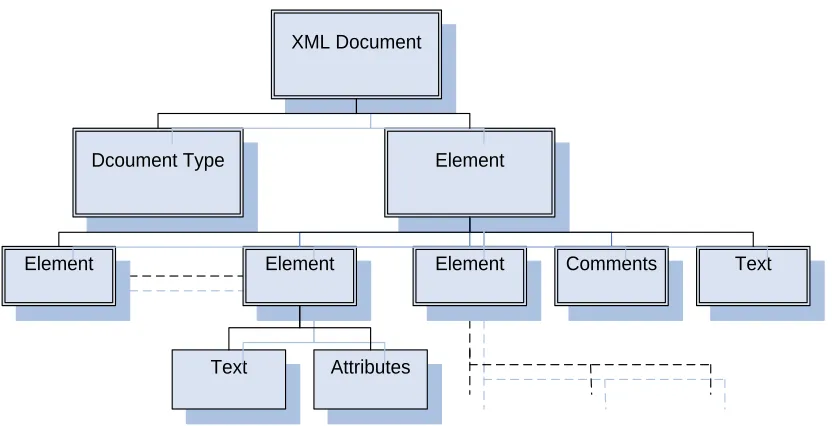
StAX). Both are event-driven parsers because they return events that the developer has to handle. Push parser implementations like SAX (Simple API for XML) return the data of the whole document in one stream and cannot be stopped. Because a SAX parser generates a transient flow of events, the XML input processing steps (parsing, recognizing, extracting, and mapping) must be performed in a single cycle. Figure 2.9 is an illustration of a SAX parser.
Pull-parsers, on the other hand, read a small amount of a document at once. The application drives the parser through the document by repeatedly requesting the next piece, which is analogous to ―pulling‖ the information when required. StAX (Streaming API for XML) is a pull-parser specification for Java. The illustration of the StAX parser is shown in the Figure 2.10.
The second type of XML parsers are object model parsers (e.g., DOM and Apache AXIOM), which not only read the data but also construct an in-memory representation of the document, which can be altered. First, the parser creates a tree-like data structure, called a DOM (Document Object Model) tree that models the XML source document. Then the application walks through the tree, searching for relevant information to
XML Extract elements attributes and characters Event Handlers Read Through Push Events XML Extract elements attributes and characters Application Read on Demand Pull Events
Figure 2. 9 Conceptual illustration of a push -parsing model
extract and further process. This last cycle can be repeated as many times as necessary, since the tree persists in memory. An illustration of a DOM parser is shown in the Figure 2.11.
Since DOM parsers mostly use SAX parsers to read in the documents, it is clear that the object model of a document is always built completely. This is a performance limitation if only data at the beginning of a document needs to be read and altered. New approaches make use of StAX pull-parser implementations to overcome this limitation and only build the tree representation of a document until the last node that was requested. Therefore, there is no need to read the complete document.
Numerous efficient implementations of these two parsing modes exist for XML parsing in non-real time applications [13,14]. However, they fail to scale up to meet performance requirements in a number of application areas in networking. These issues are further discussed in Section 2.3.2.
XML Document
Dcoument Type Element
Attributes Text
Element Element Element Comments Text
2.3.2
Bottlenecks in software parsing
Verbosity and performance continue to be the core issues in software parsers. Of these, verbosity is a cost that comes with many of XML‘s core benefits that include platform independence and human readability. Since bandwidth and disk storage are both becoming less of a concern rapidly and since verbosity has something to do with the physical structure of the document, it can be resolved to some extent. Performance, however, directly relates to improving XML processing efficiency or rather to XML parsing. Observations regarding performance issues suggest that it is not the text parsing and extracting information as such that is slow with XML, but it is the checking for well-formedness, Unicode encoding conversions and the like which make XML parsing very CPU-intensive[19]. With reference to the stages in XML Parsing that were presented in Section 2.2, this means that it is the first two stages, namely, Well-formedness Checking stage and the Schema Validation stage that are the most resource consuming, since they involve repeated iterations through the document and numerous checks for validity and semantic correctness.
2.3.3
Possible solutions
Since the motivation behind moving away from the software parser implementations is now clear, we explore some of the possible solutions in the following sections.
2.3.3.1
Hardware Offload
Traditionally, it has been observed that whenever there is an emerging performance bottleneck, the first alternative considered is custom hardware, typically an ASIC (Application Specific Integrated Circuit) or FPGA (Field Programmable Gate Array) for enhanced processing capability [22]. Dedicated ASICs performing deep content inspection and pattern matching are a prime reason why web switches and intrusion detection systems (at layer 7) can keep up with multi-GB networks. Since XML payloads are being increasingly used in Content-based routing scenarios, it is natural to look for ways to make use of ASICs to solve XML's performance issue. Other advantages of hardware offload in addition to the promise of better performance include:
1. Reducing workload of application systems 2. Accelerating processing
3. Providing specialized services
4. Enabling centralized services such as load balancing and accounting.
2.3.3.2
Mixed hardware/software offload
carried out by software. Yet another possibility is to perform a pre-evaluation on the incoming document using software, to check the complexity of the document. The pre-evaluation stage determines the improvement that could be obtained by hardware offload. Based on this evaluation, the document is offloaded to hardware or software parsers. The chief advantage of mixed parsing is that an optimal utilization can be accomplished of both hardware and software systems capabilities, by distributing the tasks in the correct manner between them.
The thesis basically presents a hardware solution to the actual validations required in the Well-formedness and schema validation stages. At the same time, much of the complex parsing of the schema is left to the Schema pre-processor, which would basically run a software application. Software processing can be afforded for this non-real-time function and it generates the pre-processed schema which is the starting point for the hardware to perform schema validation. Hence, taking into account the software pre-processing module would qualify the current implementation as a mixed parsing solution rather than a pure hardware accelerator.
2.4 XML parsing in hardware
The emergence of dedicated hardware to validate, process and route XML traffic started during 1999-2002. Initially, different vendors focused on specific areas such as speed, security and routing. The early players in the field were Data Power [18] (now owned by IBM) which had speed as the top priority, Forum Systems which aimed to tackle data security, and Sarvega (now owned by Intel) which focused on intelligent routing. The term ―XML Appliances‖ is used to collectively refer to these hardware implementations. Some alternative terminology that has been widely used to refer to XML Appliances based on their key functionality is given below:
standards-based hardware to accelerate processing. This hardware typically provides a performance boost between 10 and 100 times in the number of messages per second that can be processed.
XML security gateways (also known as XML firewalls) – Devices that support the general security standards. These appliances typically offload encryption and decryption to specialized hardware devices.
In essence, the XML Appliances offload the XML processing from the application servers which could get overtaxed by this heavily resource consuming task. After performing the required validation, translation and other required processing, the requests contained in the XML payload are forwarded to the appropriate server [8, 9, 10].
2.5
Thesis
problem statement
The thesis presents a mixed parsing solution to combat the performance bottleneck faced in XML parsing. As we had discussed in Section 2.3.2, most of the complexity in the parsing process is introduced in the validation of the XML before actually extracting information from it. Hence, rather than focusing on a complete end-to-end implementation, the idea was to implement the validating stages in XML parsing, with a throughput goal of 1Gbps. The system would check that the incoming XML document is valid in terms of well-formedness and content. In terms of the stages in XML parsing discussed in Section 2.2, the thesis presents an implementation of the first two stages, namely Well-formedness checking and Schema Validation. Existing implementations for XPath/XQuery processors could be interfaced with this design to come up with a complete parser that can process documents at Gigabit rates.
CHAPTER 3
REQUIREMENTS
ANALYSIS
AND
DESIGN CONSIDERATIONS
In this chapter, we describe in detail the set of requirements for a complete XML Validator, the subset of features selected for implementation and some ideas considered before finalizing on the design.
3.1 Features Implemented
This section describes the process of selecting features for implementation. All features that define the main functionality sought by the validation stages were completely implemented. However, numerous options and features are available for use in XML documents that would be preferable in a commercial product, but would not add much value towards helping the thesis objective. Hence, while analyzing those features, the focus was not to implement as many as possible, but rather to implement those features that would be the most throughput intensive and complex. A careful analysis of these features in the well-formedness checking stage and the schema validation stage, followed by their eventual selection or elimination is now presented.
3.1.1
Well-formedness Checker
Table 3.1 and the rules that are not considered are listed in Table 3.2.
Table 3. 1 Main functions and implementation constraints for the well-formedness checker
Rule Constraints
XML documents must begin with an XML declaration. <?xml version='1.0'?>
Only for the ―version‖ attribute is supported in the current implementation
XML documents must have a unique root element None
XML elements must be closed None
Start tags must have matching closing tags None
XML elements are case-sensitive None
XML elements must be properly nested 16 levels of nesting hierarchy supported
XML attributes must be always quoted. Implemented support for up to 8 different attributes for each element.
Element and attribute names must start with letters or underscore and have no spaces or the colon character.
None
Element names must not start with ―xml‖ in any combination of case.
None Entities must be used with special characters None Empty must be supported with closed start tag like
<br/>
None Attributes in an element must be unique None
Table 3. 2 Validations not covered by well-formedness checker
Rule Reasons
XML CDATA starts with <![CDATA[ ―and ends with‖]]>
3.1.2
Schema Validation
The Schema Validator stage validates the elements and attributes in the XML with respect to their name and value. Besides this core functionality, it is the Schema that gives enormous flexibility to the developer in terms of defining the XML‘s structure and imposing restrictions on the content. Each of the available options in XML Schema are explored in as much detail as would be practical within the thesis scope. The reasoning behind selecting or rejecting a feature and the eventual evolution of the final list of selected features is then presented.
3.1.2.1
Main functions
The basic functions of the schema have been discussed in Section 2.2.2. Due to their functional importance, all the rules are validated in this regard. Table 3.3 presents a summary of the main functions implemented in the Schema Validator stage and the constraints, if any.
Table 3. 3 Main functions and implementation constraints in the schema validation stage
Function Constraints
Element name is valid in the document
Length of the name is restricted to 32 characters
Attribute name is valid in the document
Length of the attribute name is restricted to 32 characters
Check if the element is a valid child element.
Implemented with support up to 16 levels of hierarchy.
Check the order of occurrence of child elements
Table 3. 3 Continued Check data types and values of the
elements
Implemented with constraints. Datatypes supported : string, integer, decimal, date Restrictions supported: maxlength, minInclusive, totdigits, and fracdigits. These are explained in a later section. Check data types and values of the
attributes
Implemented with constraints. Datatypes supported : string, integer, decimal, date Restrictions supported: maxlength, minInclusive, totdigits, and fracdigits. These are explained in a later section.
3.1.2.2
Analysis of element types
XML Schemas can comprise of up to 30 different elements for defining an XML and the Schema has to be carefully parsed to extract the necessary information. An analysis of these elements is carried out in the following sub-sections.
3.1.2.2.1
Basic element types
This group lists the main element types that are used to define the most functional aspects of an XML. This relates to defining the elements and attributes, defining the hierarchy of elements and specifying restrictions on the same. The list of these elements is presented in Table 3.4.
Table 3. 4 Basic element types in the schema
Element Type Details
Attribute Defines an attribute
H
complexTypeH Defines a complex type element and specifies the
elements and attributes that can occur within the parent element.
Element Defines an element
Restriction Defines restrictions on a simpleType,
simpleContent, or a complexContent
simpleType Defines a simple type and specifies the constraints and information about the values of attributes in a leaf-level elements.
H
schemaH Defines the root element of a schema
3.1.2.2.2
Documentation related
The elements in this group used to provide comments or information in the schema and are listed in Table 3.5.
Table 3. 5 Documentation-related element types
Element Type Details
Annotation Specifies the top-level element for schema comments
H
appInfoH Specifies information to be used by the
application (must go inside annotation)
H
documentationH Defines text comments in a schema (must go
inside annotation)
Since these elements are used only for providing documentation related functionality and play no part whatsoever in XML validation, they can safely be omitted from the design.
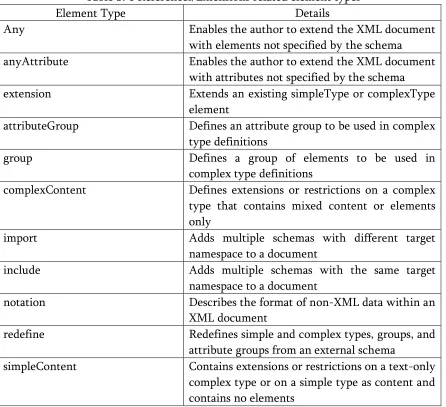
3.1.2.2.3
External reference/extensions
―simpleContent‖ and ―complexContent‖ nodes are used only to define extensions and impose restrictions on them.
References to external namespaces and documents are difficult to support in hardware, especially so at run-time. In the current implementation, these references are resolved by a pre-processor and all the necessary information is present in the loaded schema. Similarly, all extensions are also flattened out by the schema pre-processor and are included in the appropriate locations in the final schema.
Table 3. 6 References/Extensions related element types
Element Type Details
Any Enables the author to extend the XML document
with elements not specified by the schema
H
anyAttribute Enables the author to extend the XML document with attributes not specified by the schema
H
extensionH Extends an existing simpleType or complexType
element
H
attributeGroupH Defines an attribute group to be used in complex
type definitions
H
group Defines a group of elements to be used in
complex type definitions
H
complexContentH Defines extensions or restrictions on a complex
type that contains mixed content or elements only
H
importH Adds multiple schemas with different target
namespace to a document
H
includeH Adds multiple schemas with the same target
namespace to a document
H
notation Describes the format of non-XML data within an
XML document
H
redefineH Redefines simple and complex types, groups, and
attribute groups from an external schema
H
simpleContentH Contains extensions or restrictions on a text-only
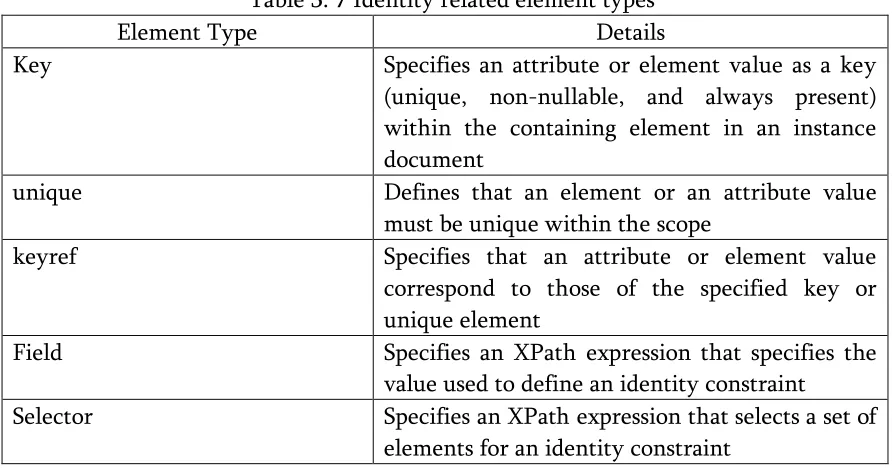
3.1.2.2.4
Identity related constraints
This group of elements validates the uniqueness of a particular element within a containing element. The list of all such elements is given in Table 3.7.
Table 3. 7 Identity related element types
Element Type Details
Key Specifies an attribute or element value as a key (unique, non-nullable, and always present) within the containing element in an instance document
H
uniqueH Defines that an element or an attribute value
must be unique within the scope
H
keyrefH Specifies that an attribute or element value
correspond to those of the specified key or unique element
Field Specifies an XPath expression that specifies the value used to define an identity constraint
Selector Specifies an XPath expression that selects a set of elements for an identity constraint
The implementation of any of these nodes at best requires the implementation of a binary search algorithm to parse through the nodes and check that the particular element is not repeated. This would be trivial but time-consuming and hence identity constraints are ignored for the purpose of the thesis. It would definitely be implementable without affecting performance too much at any later stage.
3.1.2.2.5
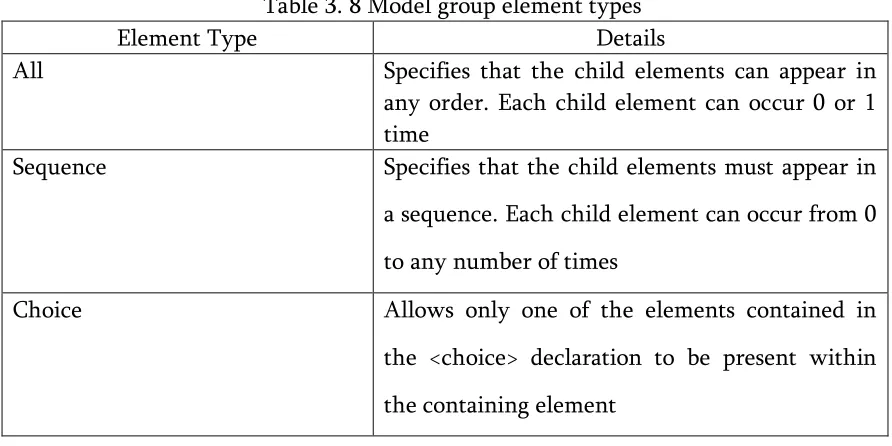
Model group constraints
Table 3. 8 Model group element types
Element Type Details
All Specifies that the child elements can appear in any order. Each child element can occur 0 or 1 time
H
SequenceH Specifies that the child elements must appear in
a sequence. Each child element can occur from 0 to any number of times
H
ChoiceH Allows only one of the elements contained in
the <choice> declaration to be present within the containing element
It was decided to implement the most frequently used constraint, namely the ―sequence‖ constraint, and in the current design, all the element hierarchies present in the XML will be assumed to be of this type. The ―choice‖ and ―all‖ constraints would require sorting of the elements so as to select one value from among a list. Implementing these features would add no value to the thesis in terms of innovation, but would considerably increase the time for completion and hence, these constraints were given lower priority for implementation.
3.1.2.2.6
Lists/Unions
The elements in this category are used to specify that the contents of an element can belong to a list or may be a union of values. Their functions are explained in Table 3.9.
Table 3. 9 Element types specifying lists/unions
Element Type Details
List Defines a simple type element as a list of values
H
unionH Defines a simple type as a collection (union) of
Some additional checking and, hence, combinational logic would get added to the design if these nodes are chosen. Since it does not really contribute anything in terms of intellectual property, and also because they are very rarely used in reality, their validation is not handled in the current implementation.
3.1.2.3
Complexity introduced by the schema
Though we have now analyzed the possible element types in an XML Schema document, more complexity and decision-making is involved because of further rules governing possibilities of elements and attributes for each of these basic element types. For instance, only certain elements are permitted at the global level, and further, each of these elements have defined for them:
1. ―content-types‖ - which specifies the list of nested elements possible for the particular enclosing element and
2. ―attribute-types‖ - which define the attribute possibilities for the element type. A detailed analysis of the content-types and attribute-types for each of these 30 elements would both be unwarranted and beyond the scope of this thesis. However, for clarity, one such element is considered and the content-types and attribute-types listed out. An analysis is then carried out to demonstrate the process of selection and rejecting features.
Explanation with example
Let us consider the node <xsd:element>, which contains information related to an element in the XML.The content-types possible for the element are:
1. annotation 2. Complextype 3. Simpletype 4. key
6. unique
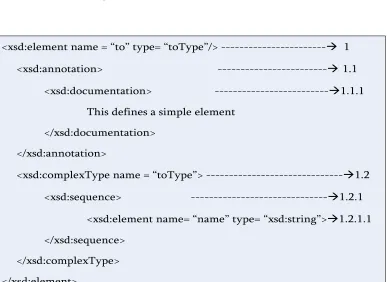
Consider the XML instance definition shown in Figure 3.1.The corresponding definition of the ―<to>‖ element in the schema is shown in Figure 3.2. The element ―<to>‖ in the XML is defined within an ―<xsd:element>‖ declaration in the schema. This element type contains <xsd:annotation> and <xsd:complexType> as contents. These are represented as 1.1 and 1.2 respectively in the example. The contents that are to be considered are now selected based on the analysis carried out in the section 3.1.2.2. Thus,
<to> <name> NCSU </name> </to>
<xsd:element name = ―to‖ type= ―toType‖/> ---à 1
<xsd:annotation> ---à 1.1
<xsd:documentation> ---à1.1.1
This defines a simple element
</xsd:documentation>
</xsd:annotation>
<xsd:complexType name = ―toType‖> ---à1.2
<xsd:sequence> ---à1.2.1
<xsd:element name= ―name‖ type= ―xsd:string‖>à1.2.1.1
</xsd:sequence>
</xsd:complexType>
</xsd:element>
Figure 3. 1 XML instance definition
among the content-types encountered, 1.2 would be selected and 1.1 rejected. In summary, from the 6 possible content types that are possible for the <xsd:element>, the ones that would be selected for implementation for the are:
1. <xsd:simpletype> and 2. <xsd:complextype>
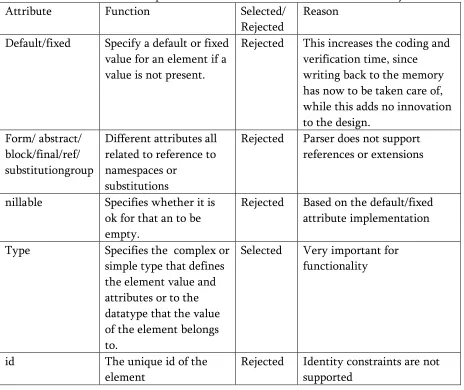
Now, the attribute possibilities within an <xsd:element> in the schema and the analysis for the same are presented in Table 3.10.
Table 3. 10 Attributes possible within the <xsd:element> and their analysis
Attribute Function Selected/
Rejected
Reason Default/fixed Specify a default or fixed
value for an element if a value is not present.
Rejected This increases the coding and verification time, since writing back to the memory has now to be taken care of, while this adds no innovation to the design.
Form/ abstract/ block/final/ref/ substitutiongroup
Different attributes all related to reference to namespaces or
substitutions
Rejected Parser does not support references or extensions
nillable Specifies whether it is ok for that an to be empty.
Rejected Based on the default/fixed attribute implementation Type Specifies the complex or
simple type that defines the element value and attributes or to the datatype that the value of the element belongs to.
Selected Very important for functionality
id The unique id of the
element
Table 3. 10 Continued maxOccurs/
minOccurs
Specifies the maximum or minimum number of times that an element can occur within an enclosing element.
Support only value of 1 for both of these attributes
1. Not one of the main functions.
2. Undue wastage of clock cycles and throughput 3. Increases the
complexity in terms of the number of possibilities to be considered, and the number of values to be remembered.
A similar kind of analysis was carried out for each of the selected element types before coming up with the final list of features in the schema.
3.1.2.4
Implemented functions
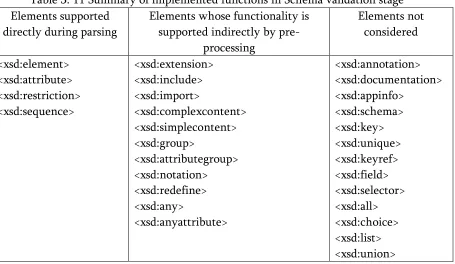
Table 3.11 summarizes the discussion and lists the implemented features in the current design, the features indirectly implemented using the pre-processor and the features not considered at all.
Table 3. 11 Summary of implemented functions in Schema validation stage Elements supported
directly during parsing
Elements whose functionality is supported indirectly by