ISSN(Online): 2320-9801
ISSN (Print): 2320-9798
I
nternational
J
ournal of
I
nnovative
R
esearch in
C
omputer
and
C
ommunication
E
ngineering
(An ISO 3297: 2007 Certified Organization)
Vol. 3, Issue 8, August 2015
A Cross-Layer Appoach for Real-Time
Multimedia Streaming on Peer-To-Peer Cloud
Adhoc Network
Sruthi.K.L.V1, S.Murugandham2
M.Phil Research Scholar, Department of Computer Science and Applications, Vivekanandha College of Arts and
Sciences for Women (Autonomous), Elayampalayam, Tiruchengode, Tamil Nadu, India.
Assistant Professor, Department of Computer Science and Applications, Vivekanandha College of Arts and
Sciences for Women (Autonomous), Elayampalayam, Tiruchengode, Tamil Nadu, India.
ABSTRACT: Cloud computing is becoming a popular platform to deliver service-based applications (SBAs) based on
service-oriented architecture (SOA) principles. Monitoring the performance and functionality of SBAs deployed on multiple Cloud providers (in what is also known as Multi-Cloud setup) and adapting them to variations/events produced by several layers (infrastructure, platform, application, service, etc.) in a coordinated manner are challenges for the research community. The proposed framework is empirically evaluated on a real-world Multi-Cloud setup. This paper proposed system addresses the cross-layer Cloud SBA monitoring by exploiting the dependencies among layers and using the event patterns concept. It supports Multi-Cloud SBA deployment by distributing a monitoring mechanism across Cloud providers. Our monitoring framework relies on an event model to specify the possible monitored SBA events in a Cloud environment, and a component model to describe component dependencies and capture system snapshots at any particular time point. The paper presents a cross-layer design for P2P over Mobile could network to manage and maintain the overlay, and select efficient routing path to multicast media streams. How to keep stable routing paths for live streaming via routing is the main concept of this paper.
KEYWORDS: Cloud Computing, Service-Oriented Architecture, Cross Layer Design, Video Streaming
I.INTRODUCTION
1.1 CLOUD COMPUTING
Cloudcomputing is internet-based computing in which large groups of remote servers are networked to allow sharing of data-processing tasks, centralized data storage, and online access to computer services or resources. Clouds
can be classified as public, private or hybrid. Cloud computing is a type of computing that relies on sharingcomputing
resources rather than having local servers or personal devices to handle applications.
The main enabling technology for cloud computing is virtualization. Virtualization software allows a physical computing device to be electronically separated into one or more "virtual" devices, each of which can be easily used and managed to perform computing tasks. Cloud computing adopts concepts from Service oriented Architecture (SOA) that can help the user break these problems into services that can be integrated to provide a solution. Cloud computing provides all of its resources as services, and makes use of the well-established standards and best practices gained in the domain of SOA to allow global and easy access to cloud services in a standardized way.
1.2 CROSS-LAYER STRUCTURE:
In communication field, cross-layer of is mainly used to pass more abundant parameters among layers of layered protocol stack to further assort with the works of each layer. The main purposes they introduce cross-layer are listed as follows.
ISSN(Online): 2320-9801
ISSN (Print): 2320-9798
I
nternational
J
ournal of
I
nnovative
R
esearch in
C
omputer
and
C
ommunication
E
ngineering
(An ISO 3297: 2007 Certified Organization)
Vol. 3, Issue 8, August 2015
In cognitive plane, they construct information acquirement model and decision-making model using cross-layer to
improve the efficiency of information perception and intelligent decision.
In control plane, network adjust is implemented fast in virtue of cross-layer parameters transmission.
1.3 CROSS-LAYER, VIRTUALIZATION AND CLOUD-COMPUTING
They consider that future Internet should include three important characteristics according to investigation and analysis.
A. Pervasiveness
Future Internet is a pervasive network and can realize convenient and fast access at anytime and anywhere for any devices. Because of the following technologies, the pervasiveness of future Internet is possible.
Intelligent terminal: it is the basic medium to achieve ubiquitous characteristic.
Mobile access: it provides convenient and efficient access mode at anytime and anywhere for intelligent
terminals.
B. Heterogeneity
The future Internet will be a heterogeneous network with the coexistence of various access technologies. Because of the following technical diversity, the heterogeneity of future Internet will exist in a long term.
Communication protocol and link: different communication protocols and links are adopted from end-edge
network, access network to core network.
Wireless protocol: there are various wireless communication protocols, such as 2G/3G, WiFi, Bluetooth and
Zigbee.
Access link: there are various access links, such xDSL, xPON, Ethernet, Cable and private communication
system.
1.4 CHALLENGES
The future Internet will emerge new challenges in the network connection of lower layer, data transmission of middle layer and intelligent service of upper layer.
A) Network Connection
Heterogeneous interconnection: because heterogeneous network and devices are always the main components
of Internet, heterogeneous interconnection mechanism is a challenge of the future Internet.
Information perception: the acquirement, transmission, storage and process of information are also a challenge
of the future Internet in physical/logical sensing units deployed in a large scale.
B) Data Transmission
Traditional Internet builds around the “narrow waist” of IP, which makes it hard to provide more abundant functional support for its upper and lower layers. Therefore, how to enhance the function of network layer to adapt the various access technologies of lower layer and support more luxuriant services of upper layer is an important challenge of the future Internet.
II.EXISTING WORK
The existing scheme is tailored to use cross-layer design to manage overlay in time. It simultaneously contributes to
The P2P management over MCANET,
The cross-layer design for network metrics,
The overlay proximity and efficient routing,
The large and instant live streaming, and
The efficient P2P lookup.
ISSN(Online): 2320-9801
ISSN (Print): 2320-9798
I
nternational
J
ournal of
I
nnovative
R
esearch in
C
omputer
and
C
ommunication
E
ngineering
(An ISO 3297: 2007 Certified Organization)
Vol. 3, Issue 8, August 2015
DRAWBACKS
Only broadcasting approach is proposed. Multicasting approach is not considered.
However, the major limitation is that IPv6-enabled nodes can work.
When a peer leaves the P2P network, it broadcasts a left message to neighbors, but the message may get lost.
Application layer and Network layer interact with each other, the nodes are connected in graph based
architecture.
III. PROPOSED WORK
The proposed system implements existing system also. In addition with proposing a novel cross-layer P2P scheme for live video streaming in MCANET, tree based multicasting option is also provided so that a single path consists of both Wired and Wireless connection. In addition, access gateways and area gateways are maintained so that a node can be reached using the correct area gateways in the dynamic network environment. Tree based architecture assists in efficient path identification and propagation. Using the architecture, Segments of single video resource can be transferred to a selected node from a set of nodes having those segments.
ADVANTAGES
Multicasting approach is considered.
IPv6 is not required to communicate between nodes.
The tree information is updated at intermediate levels of nodes so that identification of area gateways in enough to connect to a node. The area gateways maintain the changes in routing path.
Since the nodes are connected in tree based architecture, efficient traversal is possible.
IV. MODULE DESCRIPTION
The following modules are present in the project,
1. Implementation of a general sender-based broadcasting algorithm
2. Implementation of a highly efficient receiver-based broadcasting algorithm (responsibility based scheme).
3. Multi cast tree construction with Access gateway and Area gateway nodes
4. Find sender and receivers
5. Broadcast video File to receiver nodes
1. Implementation Of A General Sender-Based Algorithm
This module shows the basic structure of our proposed sender-based broadcasting algorithm. Each node schedules a broadcast for a received message if the node is selected by the sender and if it has not scheduled the same message before. Clearly, each message is broadcast once at most by a node, which is similar to general sender algorithm. In this Algorithm, a broadcast schedule can be set at any time. For example, a message can be dropped after the first reception but scheduled for broadcast the second time. In this algorithm, it is shown how to select the forwarding nodes. This module proves that, In a collision-free network, this algorithm can achieve full delivery if it uses a this algorithm to select the forwarding nodes.
2. Implementation of a highly efficient receiver-based broadcasting algorithm (Responsibility Based Scheme).
This module implements the RBS. The main idea of this Algorithm is that a node avoids broadcasting if it is not responsible for any of its neighbors. The Algorithm first uses this information to determine which neighbors have not received the message. The output of RBS determines whether or not the broadcast is redundant.
3. Multicast Tree Construction with Access Gateway and Area Gateway Nodes
ISSN(Online): 2320-9801
ISSN (Print): 2320-9798
I
nternational
J
ournal of
I
nnovative
R
esearch in
C
omputer
and
C
ommunication
E
ngineering
(An ISO 3297: 2007 Certified Organization)
Vol. 3, Issue 8, August 2015
4. Find Sender and Receivers
In this module, for the given sender node all the receiver nodes can be found out. In addition, the path between any nodes can also be found out.
5. Broadcast Video File to receiver nodes
In this module, for the given sender node all the receiver nodes retrieve the selected video file.
V.RESULT AND ANALYSIS
EXPERIMENTAL RESULT
The main objective of efficient broadcasting algorithms is to reduce the number of broadcasts. Therefore, we considered the ratio of broadcasting nodes over the total number of nodes as the metric to evaluate the performance of the proposed broadcasting algorithms. In the C#.net framework language, to evaluate this metric against two parameters: transmission range and node density. The cross layer algorithms in a mobile wireless setting are processed. The nodes were initially distributed using a uniform distribution.To incorporate device-to-device data scavenging in the Starfish prototype and evaluate its performance in the windows application, the result is efficiently satisfied. To perform three algorithm at each data rate for the broadcast infos-tation scenario, and three test runs for different fleet sizes for the info-station scenario. Broadcast info-stations use a coding rate because scavenging recovers most lost packets.
SCAVENGING EFFECTIVENESS:
To understand how well the data scavenging protocol performs in practice, it compare it against an optimal scavenging scheme. The optimal scavenging scheme assumes each device can obtain any packet received by other devices in the fleet, thus providing an upper bound on the scavenging performance. The broadcast and unicast, the number of files received by Starfish devices compared to optimal scavenging. For reference, it also include the result of files that a vehicle receives directly from the infostation assuming no scavenging. We label this as No Scavenging.
1. Many suspect that scalability with increasing cloud node density is the major challenge for info-stations.
2. Public-cloud node throughput for unicast stations degrades with the number of cloud node near the
info-station.
3. Partial file information transmission is possible to cloud nodes and so the nodes are not possible to obtain the
information.
4. The thesis provides a high-bandwidth and scalable info-station system that incorporates device-to-device data
scavenging, where nearby cloud node share data received from the info-station. It allows both broadcast and unicast throughput to scale with device density.
CHART DATA
BEFORE SCAVENGING
8 KM 48 KM 96 KM
1 90 110 1000
2 85 104 990
3 80 101 950
4 50 90 700
5 30 80 600
10 20 30 300
ISSN(Online): 2320-9801
ISSN (Print): 2320-9798
I
nternational
J
ournal of
I
nnovative
R
esearch in
C
omputer
and
C
ommunication
E
ngineering
(An ISO 3297: 2007 Certified Organization)
Vol. 3, Issue 8, August 2015
Fig : BEFORE SCANVENGING MCN
Before scavenging. The baseline performance of unicast infostations is examined with a hello message
interval of 200 ms. In this figure shows that as density increases, average public cloud throughput decreases as infostation bandwidth is shared by more mobile cloud. Assuming signal strength decreases monotonically with distance, it is roughly estimate the amount of time a cloud gets scheduled (by having the best signal strength in the fleet) as spacing/speed. We will show later how the hello interval also impacts unicast performance.
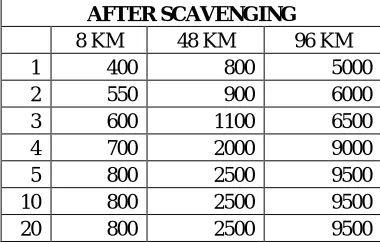
AFTER SCAVENGING
8 KM 48 KM 96 KM
1 400 800 5000
2 550 900 6000
3 600 1100 6500
4 700 2000 9000
5 800 2500 9500
10 800 2500 9500
20 800 2500 9500
After scavenging. Fig. shows that dissemination throughput after scavenging increases significantly with
mobile cloud density, similar to those observed in our testbed experiments. This is because as vehicle density increases, the infostation benefits from more multiuser diversity and therefore a greater portion of its unicast transmissions are at higher rates.
Fig . AFTER SCAVENGING MCN
BEFORE SCANVENGING [MCN]
0 200 400 600 800 1000 1200
1 2 3 4 5 6 7
Number of Mobile Cloud
A V G F il e T ra n s m is s io n [ % ] BEFORE SCAVENGING BEFORE SCAVENGING 8 KM BEFORE SCAVENGING 48 KM BEFORE SCAVENGING 96 KM
AFTER SCAVENGING [MCN]
0 2000 4000 6000 8000 10000
1 2 3 4 5 6 7
ISSN(Online): 2320-9801
ISSN (Print): 2320-9798
I
nternational
J
ournal of
I
nnovative
R
esearch in
C
omputer
and
C
ommunication
E
ngineering
(An ISO 3297: 2007 Certified Organization)
Vol. 3, Issue 8, August 2015
VI. CONCLUSION AND FUTURE ENHANCEMENTS
In this paper, we investigate how to improve the performance of video streaming service on mobile cloud network, and we present a cross-layer design for P2P live streaming in Mobile cloud network (MCNET). Our proposed scheme, Cross-layer Overlay for Multimedia Environment on P2P-MCNET (COME-P2P), integrates the routing protocol with P2P protocol for adapting real-time service to the dynamic wireless network. A combination of the Enhanced DHT and the path information is used to manage neighboring peers and derive the routing path for real-time stream delivery. The logical overlay of COME-P2P can be proximal to the physical topology based on cross-layer
design. Hence, our proposed scheme can provide a stable routing path for high data rate real-time video service.In our
proposed scheme, a cross-layer integration of streaming service, P2P cooperation, routing protocol, IPv6 and MCNET can effectively improve playback continuity when facing scalability, mobility, churn with the reasonable overhead. We demonstrate that COME-P2P has good performance on playback continuity and traffic overhead for live and high quality streaming via both the mathematical analysis and simulation results.
REFERENCES
[1]A.A. Reeves, Remote Monitoring of patients suffering from early symptoms of Dementia, in: Intl. Workshop on Wearable and Implantable Body Sensor Networks, London, UK, April 2005.
[2]N. Cen, Z. Guan, and T. Melodia, “Joint decoding of independently encoded compressive multi-view video streams,” in Proc. Picture Coding Symp. (PCS), San José, CA, USA, Dec. 2013.
[3]S. Pudlewski, T. Melodia, and A. Prasanna, “Compressed-sensing Enabled Video Streaming for Wireless Multimedia Sensor Networks,” IEEE Transactions on Mobile Computing, vol. 11, no. 6, pp. 1060–1072, June 2012.
[4]E. J. Candes and M. B. Wakin, “An Introduction to Compressive Sampling,” IEEE Signal Processing Magazine, vol. 25, no. 2, pp. 21–30, March 2008.
[5]D. Slepian and J. K. Wolf, “Noiseless Coding of Correlated Information Sources,” IEEE Transactions on Information Theory, vol. 19, no. 4, pp. 471–480, July 1973.
[6]A. D. Wyner and J. Ziv, “The Rate-distortion Function for Source Coding with Side-information at the Decoder,” IEEE Transactions on Information Theory, vol. 22, no. 1, pp. 1–10, Jan. 1976
[7]H. W. Chen, L. W. Kang, and C. S. Lu, “Dynamic Measurement Rate Allocation for Distributed Compressive Video Sensing,” Visual Communications and Image Processing, vol. 7744, pp. 1–10, July 2010
[8]X. Chen and P. Frossard, “Joint Reconstruction of Compressed Multiview Images,” in Proc. IEEE International Conference on Acoustics, Speech and Signal Processing (ICASSP), Taipei, Taiwan, April 2009.
[9]I. F. Akyildiz, T. Melodia, and K. R. Chowdhury, “A survey on wireless multimedia sensor networks,” Comput. Netw. (Elsevier), vol. 51, no. 4, pp. 921–960, Mar. 2007.