Study of Seismic Response of Column Strengthened By Angles and
Strips and Optimizing the Parameters for Deformation, Stress, Life and
Damage.
Alfiya LatheefP
1
P
, Sumayyath M. M.P
2
P
,
P
1
P
Civil Department, KT University, Thriuvananthapuram, Kerala, India
P
2
P
Asst. Professor, Civil Department, KTU University, Thriuvananthapuram, Kerala, India
Abstract
Column is structural element sustaining the weight of a building which transfer vertical load to the foundation, columns are subjected to moments as well. Seismic strengthening of column done by supporting the RC column with four steel angles are fixed at the corners of the concrete columns and steel strips are used to connect it. This paper deals with seismic analysis of the protected column by varying the parameters like no of strips, thickness of strips, size of steel angle and this parameters are optimized to find out best model in terms of life and damage.
Keywords:25Tstrengthenedcolumn, FEM, seismic analysis,
angles, steel strips
1. Introduction
The seismic hazards of building is increased .In the building column is more susceptible to seismic effect, the seismic retrofitting of column using angles and strips is a common technique, here the angles are placed at four corners of the column and are connected by strips. Strips are welded to the angles. It is the cheapest and most available technique increase the axial load capacity and available ductility of concrete columns. In this study 9 models are created using Taguchis orthogonal array by using three types of Indian standard angle sections and strips of various thickness and width are used .Which are found out by using equations.
The finite element analysis of the models is conducted. Size of angle and strip is optimized by using desirability approach method. the best model is found out which has higher seismic resistance and greater life with lesser damage.
Fig 1. Schematic view of steel cage
2. Objectives
a) Seismic effect on the column strengthened with angles and strips.
b) Effect of various parameters on the strengthening technique that is thickness of strip, no of strips, size of angles.
c) Optimize the parameters to obtain the best combination which have more seismic resistance in terms of life and damage.
3. Description of the strengthened column
Reinforced Concrete (RC) column of size
4mm, 5mm, 6mm. Number of battens selected are 6,7,8.Width of intermediate battens are determined as per design and the width of end battens determined as one and half times that of intermediate battens.
4. Design of models
The present investigation deals with the analysis of models by the Taguchi methodology. An L9 Orthogonal Array (OA) has been used to determine the importance of the factors or the parameters. The L9 OA has nine rows corresponding to nine sets of variables setting nine models with combination of different parameters were randomly repeated. Three levels of number of strips, thickness of batten and size of angles were taken for analysis. Factors and levels used in the analysis are shown below.
Table 1: Input parameters
Parameters Level 1 Level 2 Level 3
No. of strips 6 7 8
Thickness of batten(mm)
5 4 6
Size of angles 35x35x5 40x40x6 60x60x8
Table 2: Taguchi’s L9 Orthogonal Array
Model number
No. of strips
N
Thickness of batten t(mm)
Size of angle (mm)
1 6 4 35x35x5
2 6 5 40x40x6
3 6 6 60x60x8
4 7 4 40x40x6
5 7 5 60x60x8
6 7 6 35x35x5
7 8 4 60x60x8
8 8 5 35x35x5
9 8 6 40x40x6
5. Finite element analysis
Modelling of the structure done in ANSYS 14.5 and the base structure is drawn. Depth of batten for each model is calculated from the Eq. (1). Where d is the depth of batten
M′RbaR is the design moment capacity of the column, t be
the thickness of batten and fRy RisR Ryield strength of angle
section.
Depth of strip for nine models are shown in table ( 3).
d = �6 × M′ba/(t × fy) (1)
5.1 Modelling
The nine models of the column with external reinforcement were drawn in 3D. The basic dimensions of the batten and angle are given as per the Table 1. Structural steel members are given welding joint at required spaces.
Fig. 2 finite element model of model 1
5.2 Boundary Conditions
Self weight and external forces are considered as the boundary conditions. The self weight can be directly given as the option is there in the static structural analysis model. The external forces include the seismic vibration force,
.
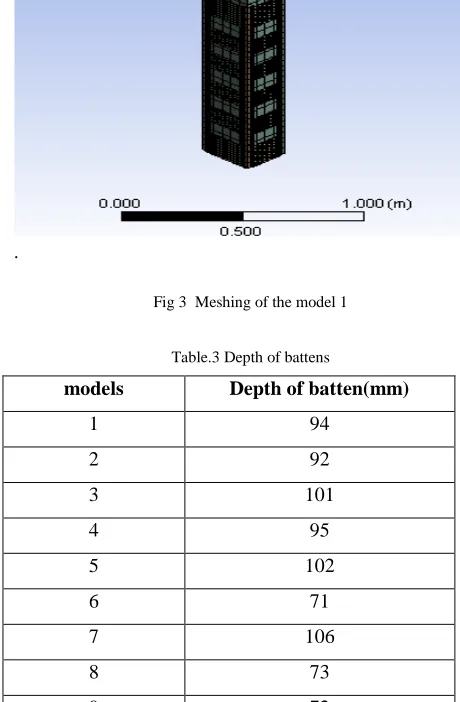
Fig 3 Meshing of the model 1
Table.3 Depth of battens
models Depth of batten(mm)
1 94
2 92
3 101
4 95
5 102
6 71
7 106
8 73
9 72
5.3 Material Selection
The material selected are concrete and structural steel from the ANSYS STATIC STRUCTURAL data base.
5.4 Solution Method
The structure is solved for deformation, stress, fatigue life and fatigue damage.
6. Result analysis
The result for each model is obtained from ANSYS static structure and the model results are obtained as given in the figures
Fig. 4 deformation result for model 1
Fig. 6 fatigue life for model 1
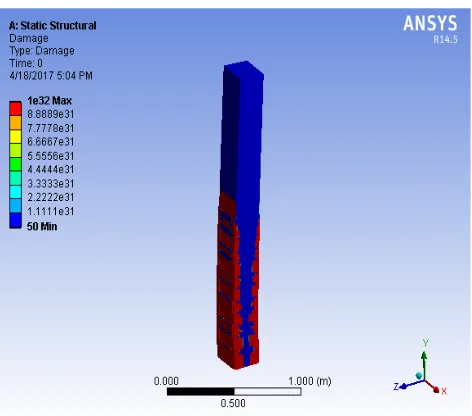
Fig. 7 fatigue damage result for model 1
The results obtained from other models are described in the Table(4).
Table. 4 Analysis results
7. Optimization of result
Desirability approach is one of the most widely used methods in industry for the optimization of multiple response processes. For each response yRiR(x), a desirability
function dRiR(yRiR) assigns numbers between 0 and 1 to the
possible values of yRiR, with dRiR(yRiR) = 0 representing a
completely undesirable value of yi and dRiR(yRiR) = 1
representing a completely desirable or ideal response value. The individual desirabilities are then combined using the geometric mean, which gives the overall desirability D.
D=(dR1R(yR1R)dR2R(yR2R)⋯dRkR(yRkR))P
1/k
P
(2)
with k denoting the number of responses. Notice that if any response yRiR is completely undesirable (dRiR(yRiR) = 0), then
the overall desirability is zero. In practice, fitted response values y^i are used in place of the yRiR.
If a response is of the "target is best" kind, then its individual desirability function di
is.
Model Max deformation (m) Max von-mises stresses (Pa)
Life damage
1 .00028148. 8.7129x10P
7
0 minimum
1x10P
32
2 .000281 8.7129x10P
7 0 min 1x10
P
32
3 .000268 1.1538x10P
7
0 min 1x10P
32
4 .0002382 1.1538x10P
7
0min 1x10P
32
5 8.8338x10P
-7 2.9427x10P 5 35145 min 28454
6 8.8136x10P
-7 4.1742x10P 5 9194.4 min 1.0876x10P 5
7 9.0208x10P
-7
2.2816x10P
5
42042min 237866
8 8.839x10P
-7 3.9048x10P 5 11909 min 83969
9 .00028694 1.3364x10P
7
0 min 1x10P
di=
�
0, yi ≤ymin
�
yi−yminymax−ymin
�
, ymin ≤yi≤ymax, r≥01, yi ≥ymin
�
(3)
The value of ‘yRjR’ was expected to be the larger the better.
When the ‘y’ exceeded a particular criteria value, which can be viewed as the requirement, the desirability value equated to 1; if the ‘y’ was less than a particular criteria value, which was unacceptable, the desirability value equaled to 0.
If a response is to be maximized instead, the individual desirability function is defined as
di=
�
1, yi ≤ymin
�
yi−ymaxymin−ymax
�
, ymin ≤yi≤ymax, r≥00, yi ≥ymin
�
(4)
Table. 5 Main effect on desirability analysis
Levels No of strips Thickness of batten
Size of angle
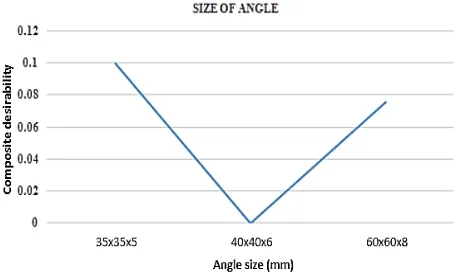
1 0 0 0.099798
2 0.102177227 0.103488735 0
3 0.050554844 0.049243334 0.075832
From optimization we got the optimum values as Number of strips : 7
Thickness of batten: 5mm
Size of angle: 35mmx35mmx5mm
Fig. 8 plot for composite desirability vs. angle size
Fig. 9 plot for composite desirability vs thickness of batten
Fig. 10 plot for composite desirability vs. No. of strips
8. Conclusion
Analysis result of the steel caged concrete structure is done and the result is shown above for the 9 taguchi models. Then the optimization of the taguchi model is done using desirability approach. The optimization is done as per the steps of desirability approach. From the optimization table the result obtained as the combination of level 2 of no. of strips, level 2 of thickness of batten and level 1 of angular size are the optimum combinations. As per the desirability approach of optimization seven battens with 5mm depth and angle with 35x35x5mm size will give best result for life and damage.
9.References
[2] N. Islam, M. M. Hoque,“strengthening of RC column by steel jacket”, Asian Transactions on Engineering (ATE), (2015),Volume 5 Issue 3 June.
[3] A.M. Tarabia, H.F. Albakry, “Strengthening of RC columns by steel angles and strips”, Alexandria Engineering Journal,(2014), volume 53,Pages 615-626
[4] Shri. Pravin B, Wag mare, “Materials and jacketing technique for retrofitting of structures”, International Journal of Advanced Engineering, (2011), Volume 1Issue 1December