4(15): 2796-2852, 2014
SCIENCEDOMAIN international www.sciencedomain.org
A Systematic Review on Prognostic Indicators
of Acute Liver Failure and Their Predictive
Value for Poor Outcome
Kama A. Wlodzimirow
1, Saeid Eslami
1,2, Ameen Abu-Hanna
1,
Martin Nieuwoudt
3and
Robert A. F. M. Chamuleau
4*1
Department of Medical Informatics, Academic Medical Center, University of Amsterdam, Amsterdam, The Netherlands.
2
Pharmaceutical research center, School of Pharmacy, Mashhad University of Medical Sciences, Mashhad, Iran.
3
South African DST/NRF Centre of Excellence in Epidemiological Modelling and Analysis, Stellenbosch, South Africa.
4
Tytgat Institute for Liver and Intestinal Research, Academic Medical Center, University of Amsterdam, Amsterdam, The Netherlands.
Authors’ contributions
All authors made substantial contributions to the study design and methods. Authors KAW, SE and RAFMC performed the literature search, evaluated studies, extracted data and analyzed data and interpreted the results. Authors KAW and RAFMC drafted the manuscript. Authors KAW, SE, AAH, MN and RAFMC were involved in revising the final manuscript, read and approved the final manuscript.
Received 14th December 2013 Accepted 19th February 2014 Published 6th March 2014
ABSTRACT
Aims: To systematically identify and summarize prognostic indicators in patients with acute liver failure and to evaluate their predictive value. To analyse a wide spectrum of indicators used worldwide for prediction of outcome in patients with acute liver failure as a starting point for a better prognostic index.
Methodology: Online databases MEDLINE® (1950-2014) and EMBASE® (1980-2014) were searched and studies published up to 01 January 2014 were considered. Articles were included if they reported original data from a clinical trial or observational study on patients with diagnosis of acute liver failure or fulminant hepatic failure and if one of their main objectives was evaluating prognostic indicators of acute liver failure outcome. Of 1835 identified studies 119 were included for detailed analysis.
Results: Based on 289 selected indicators and their effect on patient outcome following 8 categories were formed: general markers (n=32), bio-markers (n=131), hemodynamic (n=14), liver function tests (n=7), imaging/morphology (n=15), scoring systems (n=53), time intervals (n=17), and treatments (n=20). The most frequently reported indicators were: bilirubin, age creatinine, coagulopathy expressed by prothrombin time or INR and hepatic encephalopathy.
Conclusion: This review provides a large amount of information, including the extensive list of worldwide used indicators to predict outcome in patients with acute liver failure. There is large heterogeneity in prognostic indicators of acute liver failure, methods of measurement, complexity of calculation and threshold values. Based on this large list of indicators we suggest that an ideal prognostic index should preferentially be based on pathophysiological aspects and has to be applied in a dynamic way. Future studies on acute liver failure can profit from this inventory.
Keywords: Acute liver failure; fulminant hepatic failure; prognosis; predictive indicators; acute liver injury.
1. INTRODUCTION
Acute liver failure (ALF) is a syndrome with a high mortality up to 80% depending on the aetiology and the clinical experience of the reference center [1]. An early and exact assessment of the severity of ALF together with a prediction of its further development is critical in order to determine the further management of the patient. Spontaneous recovery occurs in a minority of patients with ALF. In most cases the only life saving treatment for ALF is liver transplantation (LT) with a 1 year survival of >70%. The timely identification of patients with spontaneous recovery helps prevent LT and also the need for lifelong immunosuppressive therapy. Distinguishing patients requiring LT from those who will survive receiving only intensive medical care remains challenging. This distinction is also important in light of the worldwide shortage of liver donors.
The critical decision for LT should be informed by the likelihood of spontaneous recovery, and many criteria for predicting this likelihood have been suggested. However, these criteria are not universally accepted.
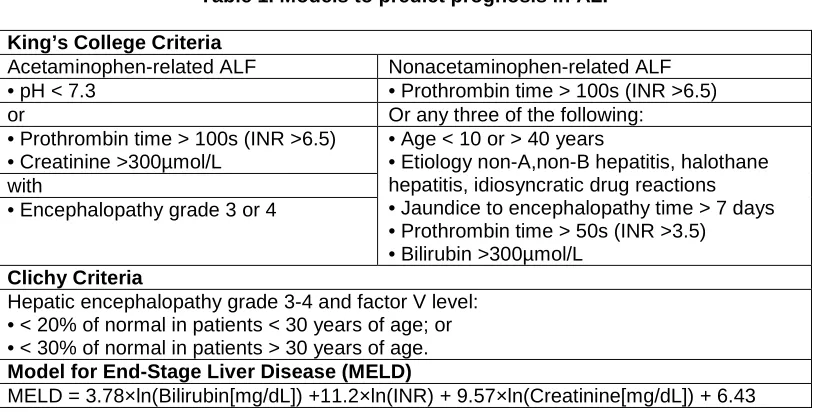
Most commonly used prognostic models (Appendix Table 1) like KCC (the King's College Criteria), Clichy criteria and MELD (Model of End-Stage Liver Disease) have shown inconsistent sensitivity and specificity. Prior reviews on paracetamol-induced ALF reported for KCC a pooled sensitivity of 58.2% and specificity of 94.6% [2] and a sensitivity range of 67%-100% and specificity range of 52%-98% [3]. Meta-analysis [4] of KCC for non-paracetamol-induced ALF reported pooled sensitivity of 68% (ranging from 13% to 96%) and specificity of 82% (ranging from 36% to 100%). Sensitivity and specificity of Clichy Criteria ranged between 58 and 86% and 56 to 100% respectively [5-8]. MELD, primarily designed to estimate mortality of cirrhotic patients undergoing transjugular intrahepatic portosystemic shunt [9], was later applied to patients with end-stage chronic liver disease [10] and used for organ allocation in patients awaiting LT [11]. Since 2003 [3] MELD is used to predict prognosis in ALF patients [12]. Recently MELD received increasing attention and is applied as predictor for ALF patients and some studies report its superiority to KCC [12]. Reported sensitivity and specificity of MELD ranges, respectively, from 54 to 96.5% and 54 to 88% [13-22].
prognostic indicators such as commonly used scoring systems as well as single predictor variables.
The aim of this review is to provide a solid starting point for the future studies on development of a better prognostic index for ALF by identifying and summarizing previously employed prognostic indicators in terms of mortality and morbidity in patients with ALF and to assess the possibility of performing meta-analysis of the clinical studies on prognostic indicators for ALF.
2. MATERIALS AND METHODS
The following databases were searched: Ovid Embase(R) (1980 to 2014), Ovid MEDLINE(R) and Ovid MEDLINE(R) In-Process & Other Non-Indexed Citations (1950 to 2014) for journal articles based on keywords in title, abstract and MeSH terms, using the following query: (prognosis OR prognostic OR predict*) AND (acute liver failure OR fulminant hepatic failure OR acute liver injury OR acute hepatic failure OR (acute on chronic AND liver failure)). The asterisk “*” indicates the wildcard that may stand for any combination of characters (including nothing), so predict* stands also for “prediction” etc. “Liver failure” and “prognosis” were MeSH terms. All duplicate articles were removed and only English-language articles were included. The final search considered studies published up to 01 January 2014. Articles were included if they reported original data from a clinical trial or observational study on patients with diagnosis of ALF or Fulminant Hepatic Failure (FHF), and if one of their main objectives was evaluating prognostic indicators of ALF outcome. We allowed search to any synonym of ALF definition without limiting search a priori and without predefining any explicit definition. Two reviewers independently screened the titles and abstracts. In the first step conference abstracts and papers, reviews, comments and case studies were excluded. Then, based on titles and abstracts studies were excluded that focused on animal models, pediatric population, hepatitis and other diseases, or studies that only evaluated therapeutic options (e.g. LT, supportive devices etc). Discrepancies between the 2 reviewers were resolved by consensus involving a third reviewer. Fig. 1 shows the search flowchart. The initial two reviewers then extracted prognostic indicators of ALF. Discrepancies between them were again resolved by consensus involving the third reviewer. A study’s statistical approach was classified as “univariate analysis”, when association was investigated between indicators and outcomes without adjusting for other possible confounders. Alternately, when association between an indicator and outcome was adjusted for other possible confounders, the approach was classified as “multivariate analysis”. Association was presented when the study reported the statistical significance level.
Fig. 1. Search flowchart
3. RESULT
Searching the online databases resulted in 1835 articles. Initial screening of titles and abstracts resulted in 154 articles for full text review, of which 119 articles were retained. Table 2 in the appendix shows the characteristic of the final studies: a total of 13743 patients were included, with the largest study including 698 patients. Among the 105 studies where gender was reported 58.8% of patients were female. In 14 studies (1390 patients) gender was not reported.
The most common etiology was viral, particularly hepatitis A and B virus, followed by paracetamol and other drug overdoses, and then autoimmune hepatitis. Etiology of disease was not reported in 7 studies.
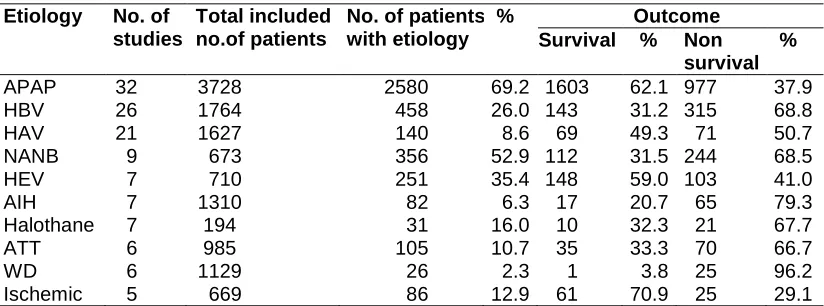
Among the studies reporting survival versus non-survival (defined as death or as combined outcome death or LT) related to etiology, the most often reported etiology was paracetamol, followed by hepatitis A and B virus. Table 1 presents the number and percentage of survived patients in 10 the most often reported etiologies. Survival was highest in patients with paracetamol overdosis and lowest in Wilson’s disease. Top 10 etiologies constitute 4115 patients, of which 53.4% survived with medical treatment only.
Survival
Table 1. Patients’ survival according to etiology
Etiology No. of studies
Total included no.of patients
No. of patients with etiology
% Outcome Survival % Non
survival %
APAP 32 3728 2580 69.2 1603 62.1 977 37.9
HBV 26 1764 458 26.0 143 31.2 315 68.8
HAV 21 1627 140 8.6 69 49.3 71 50.7
NANB 9 673 356 52.9 112 31.5 244 68.5
HEV 7 710 251 35.4 148 59.0 103 41.0
AIH 7 1310 82 6.3 17 20.7 65 79.3 Halothane 7 194 31 16.0 10 32.3 21 67.7
ATT 6 985 105 10.7 35 33.3 70 66.7
WD 6 1129 26 2.3 1 3.8 25 96.2 Ischemic 5 669 86 12.9 61 70.9 25 29.1
AIH = autoimmune hepatitis; APAP = paracetamol; ATT = Antituberculosis therapy; Halothane = halothane hepatitis; HAV, HBV, HEV = hepatitis A, B, E virus; NANB = non-A non-B hepatitis; WD =
Wilson's disease
Sixty-six studies performed univariate and 53 multivariate analysis. Twenty-nine percent of all studies were prospective, 28% retrospective, and 43% did not provide an indication of the design.
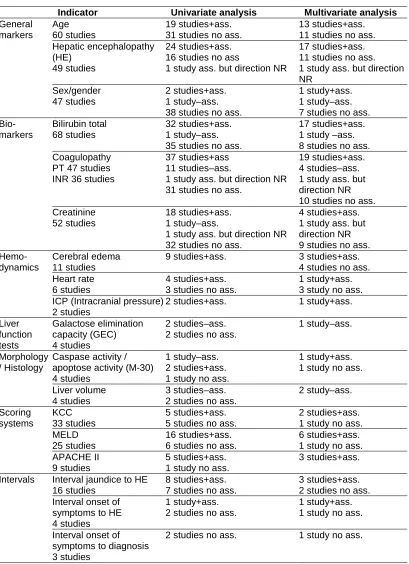
A short summary presenting the “top3” of the most often studied indicators within each category is shown in Table 2. Table 3 in appendix presents the full list of all extracted indicators together with their association with mortality and morbidity, as the result of either univariate or multivariate statistical analysis and, if reported, their intervals or cut-off values.
Notably, some studies performed separate analysis for specific subgroups of patients, such as patients with paracetamol overdosis (POD) and non paracetamol (nPOD) etiology or different outcomes such as survival versus death with or without LT (for example ref.1).
Remarkable findings for the most often studies within each category are:
General Markers (n=32): The most often studied general marker was age. One study [23] found a positive association with mortality in nPOD patients, while for POD patients no association with mortality was found. The majority of studies did not find an association between age and mortality on univariate analysis. Thirteen studies found a positive association with mortality on multivariate analysis and 11 did not. Age was considered as categorical variable in 15 studies with 8 different cut-off points, where 40 years was reported most often (4 times).
The second most often studied general marker of ALF was hepatic encephalopathy (HE). One study [24] found a positive association both on univariate analysis and on multivariate analysis only at 10-20 days following the onset of HE, while at onset of HE this association was not found. Seventeen studies showed a positive association with mortality on multivariate analyses in at least one time point in the course of the disease or in one subgroup of patients (e.g. POD on nPOD), while 11 studies did not find an association with mortality. One study [25] out of those 17 demonstrated a positive association with mortality on multivariate analysis only for a value on days 4, 8, 15 but not at admission. One study [26] found a positive association with mortality on multivariate analysis in POD and not in the nPOD subgroup.
Table 2. Top 3 of the most often studied indicators within each category
Indicator Univariate analysis Multivariate analysis
General markers
Age 60 studies
19 studies+ass. 31 studies no ass.
13 studies+ass. 11 studies no ass. Hepatic encephalopathy
(HE) 49 studies
24 studies+ass. 16 studies no ass
1 study ass. but direction NR
17 studies+ass. 11 studies no ass. 1 study ass. but direction NR
Sex/gender 47 studies
2 studies+ass. 1 study–ass. 38 studies no ass.
1 study+ass. 1 study–ass. 7 studies no ass. Bio-markers Bilirubin total 68 studies 32 studies+ass. 1 study–ass. 35 studies no ass.
17 studies+ass. 1 study –ass. 8 studies no ass. Coagulopathy
PT 47 studies INR 36 studies
37 studies+ass 11 studies–ass.
1 study ass. but direction NR 31 studies no ass.
19 studies+ass. 4 studies–ass. 1 study ass. but direction NR 10 studies no ass. Creatinine
52 studies
18 studies+ass. 1 study–ass.
1 study ass. but direction NR 32 studies no ass.
4 studies+ass. 1 study ass. but direction NR 9 studies no ass.
Hemo-dynamics
Cerebral edema 11 studies
9 studies+ass. 3 studies+ass. 4 studies no ass. Heart rate
6 studies
4 studies+ass. 3 studies no ass.
1 study+ass. 3 study no ass. ICP (Intracranial pressure)
2 studies
2 studies+ass. 1 study+ass. Liver function tests Galactose elimination capacity (GEC) 4 studies 2 studies–ass. 2 studies no ass.
1 study–ass.
Morphology / Histology
Caspase activity / apoptose activity (M-30) 4 studies
1 study–ass. 2 studies+ass. 1 study no ass.
1 study+ass. 1 study no ass. Liver volume
4 studies
3 studies–ass. 2 studies no ass.
2 study–ass. Scoring systems KCC 33 studies 5 studies+ass. 5 studies no ass.
2 studies+ass. 1 study no ass. MELD
25 studies
16 studies+ass. 6 studies no ass.
6 studies+ass. 1 study no ass. APACHE II
9 studies
5 studies+ass. 1 study no ass.
3 studies+ass. Intervals Interval jaundice to HE
16 studies
8 studies+ass. 7 studies no ass.
3 studies+ass. 2 studies no ass. Interval onset of
symptoms to HE 4 studies
1 study+ass. 2 studies no ass.
1 study+ass. 1 study no ass. Interval onset of
symptoms to diagnosis 3 studies
Table 2 Continued………
Treatments Ventilation / intubation 6 studies
6 studies+ass. Hemodialysis
4 studies
4 studies no ass. Steroids / corticosteroids
4 studies
4 studies no ass.
+ass. = significant positive association with mortality (lower/less in survivors, higher/more in non-survivors); – ass. = significant negative association with mortality (higher/more in survivors, lower/less in non-survivors);
no ass. = no significant association with mortality
Studies reporting mixed results (+/-/no association) are counted each time. NR = association with mortality not reported
The second most commonly studied bio-marker was coagulation measured by prothrombin time (PT) in seconds (s) or as prothrombin activity (%) and/or INR. One study [20] showed a positive association on univariate analysis only at 1 to 6 days after the onset of HE. One study [27] found this association in POD subgroup of patients and not in nPOD. One study [1] found this association comparing survived versus died patients, but not comparing survived versus died+LT patients. In one study [29] this association was found when PT was considered as categorical variable with a cut-off point of 50 seconds and not for 100 seconds. One study [13] demonstrated a positive association with mortality at admission as well as at the date of the highest levels of M65 (epitope of cytokeratin 18 released from destroyed cells). A negative association between coagulopathy and mortality on univariate analysis was found in 11 studies of which 4 studies [6,24,31,32] showed it in some time points, but no association in other time points. A positive association of PT with mortality on multivariate analysis was reported in 12 studies and 7 studies reported a positive association of INR and 9 studies showed no association. A negative association with mortality on multivariate analysis was showed in 4 studies, of which one study [24] found this association only at 10-20 days after onset of HE.
Twenty-nine studies described also other alternative clotting related bio-markers, such as: Antithrombin III, factor II,V,VII,VIII, fibrinogen degradation products, fibrinogen, hepaplastin, platelets, activated partial prothrombin time and thromboplastin time.
Hemodynamics (n=14): The most common studied was cerebral edema (CE), a consequence of increased intracranial pressure. Univariate analysis was performed by 9 studies and all of them found CE positively associated with mortality. Three [14,33,34] out of those 9 studies showed a positive association with mortality also on multivariate analysis but two [35,36] out of those 9 studies did not. Two other studies [37,38] also did not find an association with mortality on multivariate analysis.
The second most common studied indicator was heart rate (HR). One study [39] found a positive association only at the onset of HE, but not at admission. One study [38]found a positive association for tachycardia only on univariate but not on multivariate analysis. One study found a positive association with mortality on multivariate analysis but 3 studies did not.
The other 6 tests in this category were studied only once.
Imaging/histology (n=15): The most often studied was caspase activity=apoptose activity (M30). A positive association with mortality on univariate analysis was found in one study [13] at the date of the highest levels of M65 (epitope of cytokeratin 18 released from destroyed cells) but not at admission. A positive association with mortality on multivariate analysis was found in one study [41] for log value on day 3, but for value on day 3 no association with mortality was found.
The second commonly studied indicator was liver volume expressed as standard liver volume (SLV) or ratio of estimated liver volume (ELV/SLV). Three studies found a negative association with mortality in univariate analysis, of which 2 studies [24,42] also in multivariate analysis. Liver volume was considered as categorical variable in 4 studies with different cut-off points.
Scoring systems (n=53): The KCC was the most commonly studied scoring system. A positive associations with mortality on multivariate analysis was found in 2 studies, of which one [8] found this association only when comparing survivors with deceased patients, but no association was found when transplanted patients were also included.
The MELD score was the second most commonly studied. A positive association with mortality on univariate analysis was found in one study [20] but only at 1 to 6 days after the onset of HE and not at the onset of HE. Six studies showed a positive association with mortality on multivariate analysis and one did not. The MELD score in 11 studies was considered as categorical variable with different cut-off points, where a cut-off point of 30 was reported most often (5 times).
Modifications of the KCC and MELD were found in only single studies.
Time intervals (n=17): The most often studied was the interval from the onset of jaundice to onset of HE. Three studies found a positive association with mortality in multivariate analysis and two did not. Thirteen studies considered it as a categorical variable with different cut-off of points, of which 1 week was most often considered.
The second most often studied was interval from onset of symptoms to HE. One study [38] found a positive association with mortality on multivariate analysis and one other [30] did not, but this study considered only nPOD subgroup of patients.
Treatments (20): The most often reported was artificial ventilation/ intubation and all studies performed only univariate analysis and found a positive association with mortality.
The second most often reported were both steroid therapy and hemodialysis. All studies performed only univariate analysis but none of them found associations with mortality.
4. DISCUSSION
In this review we identified, categorized and listed prognostic indicators used for prediction of outcome in patients with ALF as used in 119 studies. One of our goals at the start of the review was to present the results in a meta-analytic way. However, due to the large heterogeneity of the findings (definitions, etiologies, case mix, and outcomes) we were forced to turn to the descriptive way. The differences in methods of indicators’ measurement and the complexity of calculation of indicators (e.g. calculation mean, median, peak, threshold values) hamper the comparability among the studies and hinder performing such quantitative analysis. Although meta-analysis is theoretically possible, the results will not be meaningful.
In our former review [43] we reported that there is a wide diversity in ALF definitions used in the literature. However, the exact implications of the differences in ALF definitions on performance of prognostic markers are unknown yet. In our other review [44] we identified, characterized and assessed the quality of newly developed prognostic models of mortality for ALF patients and provided recommendations for future research on prediction models for ALF. This review is another part of the research on ALF.
The strength of our study is its extensiveness. We summarized a large number of indicators used worldwide to predict outcome in patients with ALF. This study provides a good overview of both the commonly used indicators (like bilirubin, age, HE, PT, INR, creatinine) as well as less frequent indicators. In addition, our analysis covered a great heterogeneity of patients with ALF (or FHF) due to many different etiologies such as viral, acetaminophen overdose, autoimmune hepatitis, halothane hepatitis, Amanita phalloides toxicity, Wilson’s disease and others. A limitation of our search is that we only addressed studies in which the prognostic effect of indicators formed a main objective; we may consequently have missed studies with a more limited focus on prediction. Our study may be limited by publication bias of studies on ALF outcome evaluation.
The categories of indicators are more or less subjective, but are helpful to find a way in the large variety.
On the whole, many studies did not motivate their choice for a specific subset of indicators. The majorities of the studies were retrospective, and if the kind of the study was not reported one can assume it was retrospective, making the study limited in validity due to a lack of control in the quality of the available data.
In some studies it was not clear why the indicators that were not associated with mortality on univariate analysis were taken to the further multivariate analysis (e.g. logistic regression). In addition it was often unclear which indicators were considered as continuous and which as categorical. Also the reason to convert the continuous indicators to categorical was often not given. Furthermore the reasoning behind a certain threshold value of an indicator was not always clearly explained.
transplantation patients’ characteristics to the death group. When the groups are similar one can consider forming the group with the combined outcome of “non-survivors”.
In some cases mixed results were found when comparing the results, i.e. either positive or negative or no association with mortality. It remains intriguing why the direction of the association in various studies was incompatible, e.g. 2 studies [21,35] reported positive association with mortality for male sex but 1 study [6] a negative association, but those studies can not be directly compared because of the differences in the etiology of included patients: viral in [21,35] and non-viral in [6].
Indicators designed to measure the same underlying concept differed among the studies. For example coagulopathy which plays a crucial role in assessing of liver’s damage has been expressed by PT or INR. Of note, there are different thresholds for PT and INR values. A comparison of studies becomes then difficult, and even more difficult when in some studies PT is expressed as percentage of normal and in other as prolongation (in seconds). PT values depend on baseline values and measurement methods. However, there is large variation in laboratory assays, mainly due to the source of the used thromboplastin. For this reason INR seems to be more appropriate. However, there is no uniform standardization of measuring coagulopathy in ALF patients.
Notably, in the majority of studies a value of an indicator was measured in one time point. A. recent study [36] proposes an innovative dynamic approach for development of a prognostic model based on early changes (during first 3 days of hospitalisation) in values of variables. Since ALF is a dynamic process and admission values of prognostic variables change over time during the clinical course of the patient, such approach seems to be the right direction for future research on prediction of ALF outcome [45].
In our systematic review we extracted a very large number of variables used for prediction in ALF. We suggest that next to the most often used indicators like age, HE, bilirubin, creatinine and coagulopathy, which are already part of the most commonly accepted scoring systems such as KCC, MELD and Clichy criteria, the variables involved in the pathophysiology of ALF should be used for prediction of ALF like e.g. plasma ammonia, a contributing factor to hepatic encephalopathy, plasma lactate, representing disturbance of metabolic homeostasis and IL6/IL10 as biomarkers of the inflammatory response. In addition, we believe that incorporating promising variables involved in the pathophysiology of ALF to the dynamic approach might be a valuable step forward in predicting ALF outcome.
5. CONCLUSIONS
CONSENT
Not applicable
.
ETHICAL APPROVAL
Not applicable.
ACKNOWLEDGEMENTS
Grant support: K.W. is financially supported by a grant from insurance company Fonds NutsOhra, Zorgsubsidies, The Netherlands. The sponsor had no involvement in the data extraction, analysis and interpretation of data and in the writing of the manuscript.
COMPETING INTERESTS
Authors have declared that no competing interests exist.
REFERENCES
1. Dabos KJ, Newsome PN, Parkinson JA, Mohammed HH, Sadler IH, Plevris JN, et al. Biochemical prognostic markers of outcome in non-paracetamol-induced fulminant hepatic failure. Transplantation. 2004;77(2):200-205.
2. Craig DG, Ford AC, Hayes PC, Simpson KJ. Systematic review: Prognostic tests of paracetamol-induced acute liver failure. Aliment Pharmacol Ther. 2010;31(10):1064-1076.
3. Du WB, Pan XP, Li LJ. Prognostic models for acute liver failure. Hepatobiliary Pancreat Dis Int. 2010;9(2):122-128.
4. McPhail MJ, Wendon JA, Bernal W. Meta-analysis of performance of Kings's College Hospital Criteria in prediction of outcome in non-paracetamol-induced acute liver failure. J Hepatol. 2010;53(3):492-499.
5. Choi WC, Arnaout WC, Villamil FG, Demetriou AA, Vierling JM. Comparison of the applicability of two prognostic scoring systems in patients with fulminant hepatic failure. Korean Journal of Internal Medicine. 2007;22(2):93-100.
6. Escudie L, Francoz C, Vinel JP, Moucari R, Cournot M, Paradis V et al. Amanita phalloides poisoning: Reassessment of prognostic factors and indications for emergency liver transplantation. Journal of Hepatology. 2007;46(3):466-473.
7. Pauwels A, Mostefa-Kara N, Florent C, Levy VG. Emergency liver transplantation for acute liver failure. Evaluation of London and Clichy criteria. J Hepatol. 1993;17(1):124-127.
8. Yantorno SE, Kremers WK, Ruf AE, Trentadue JJ, Podesta LG, Villamil FG. MELD is superior to King's college and Clichy's criteria to assess prognosis in fulminant hepatic failure. Liver Transplantation. 2007;13(6):822-828.
9. Malinchoc M, Kamath PS, Gordon FD, Peine CJ, Rank J, ter Borg PC. A model to predict poor survival in patients undergoing transjugular intrahepatic portosystemic shunts. Hepatology. 2000;31(4):864-871.
10. Kamath PS, Wiesner RH, Malinchoc M, Kremers W, Therneau TM, Kosberg CL, et al.
11. Kremers WK, van IJperen M, Kim WR, Freeman RB, Harper AM, Kamath PS, et al. MELD score as a predictor of pretransplant and posttransplant survival in OPTN/UNOS status 1 patients. Hepatology. 2004;39(3):764-769.
12. Aydin C, Berk B, Fung JJ, Obaid Shakil A. Application of MELD scoring system to predict prognosis in patients with acute liver failure. Hepatology. 2003;38(Supplement S4):554.
13. Bechmann LP, Jochum C, Kocabayoglu P, Sowa JP, Kassalik M, Gieseler RK, et al. Cytokeratin 18-based modification of the MELD score improves prediction of spontaneous survival after acute liver injury. J Hepatol. 2010;53(4):639-647.
14. Dhiman RK, Jain S, Maheshwari U, Bhalla A, Sharma N, Ahluwalia J, et al. Early indicators of prognosis in fulminant hepatic failure: An assessment of the Model for End-Stage Liver Disease (MELD) and King's College Hospital Criteria. Liver Transplantation. 2007;13(6):814-821.
15. Hadem J, Stiefel P, Bahr MJ, Tillmann HL, Rifai K, Klempnauer J, et al. Prognostic Implications of Lactate, Bilirubin, and Etiology in German Patients With Acute Liver Failure. Clinical Gastroenterology and Hepatology. 2008;6(3):339-345.
16. Katoonizadeh A, Decaestecker J, Wilmer A, Aerts R, Verslype C, Vansteenbergen W et al. MELD score to predict outcome in adult patients with non-acetaminophen-induced acute liver failure. Liver International. 2007;27(3):329-334.
17. Kotoh K, Enjoji M, Kato M, Kohjima M, Nakamuta M, Takayanagi R. A new parameter using serum lactate dehydrogenase and alanine aminotransferase level is useful for predicting the prognosis of patients at an early stage of acute liver injury: A retrospective study. Comparative Hepatology. 2008;7.
18. Kumar R, Shalimar, Bhatia V, Khanal S, Sreenivas V, Gupta SD, et al. Antituberculosis therapy-induced acute liver failure: Magnitude, profile, prognosis, and predictors of outcome. Hepatology. 2010;51(5):1665-1674.
19. Pelaez-Luna M, Martinez-Salgado J, Olivera-Martinez MA. Utility of the MAYO end-stage liver disease score, King's College Criteria, and a new in-hospital mortality score in the prognosis of in-hospital mortality in acute liver failure. Transplantation Proceedings. 2006;38(3):927-929.
20. Schmidt LE, Larsen FS. MELD score as a predictor of liver failure and death in patients with acetaminophen-induced liver injury. Hepatology. 2007;45(3):789-796. 21. Taylor RM, Davern T, Munoz S, Han S-H, McGuire B, Larson AM et al. Fulminant
hepatitis A virus infection in the United States: Incidence, prognosis, and outcomes. Hepatology. 2006;44(6):1589-1597.
22. Zaman MB, Hoti E, Qasim A, Maguire D, McCormick PA, Hegarty JE, et al. MELD score as a prognostic model for listing acute liver failure patients for liver transplantation. Transplantation Proceedings. 2006;38(7):2097-2098.
23. Schiodt FV, Bondesen S, Petersen I, Dalhoff K, Ott P, Tygstrup N. Admission levels of
serum Gc-globulin: Predictive value in fulminant hepatic failure. Hepatology. 1996;23(4):713-718.
24. Sekiyama K, Yoshiba M, Inoue K, Sugata F. Prognostic value of hepatic volumetry in fulminant hepatic failure. Digestive Diseases and Sciences. 1994;39(2):240-244. 25. Miyake Y, Sakaguchi K, Iwasaki Y, Ikeda H, Makino Y, Kobashi H, et al. New
prognostic scoring model for liver transplantation in patients with non-acetaminophen-related fulminant hepatic failure. Transplantation. 2005;80(7):930-936.
26. Schiodt FV, Rossaro L, Stravitz RT, Shakil AO, Chung RT, Lee WL, et al. Gc-globulin and prognosis in acute liver failure. Liver Transplantation. 2005;11(10):1223-1227. 27. MacQuillan GC, Seyam MS, Nightingale P, Neuberger JM, Murphy N. Blood lactate
28. Chung PY, Sitrin MD, Te HS. Serum phosphorus levels predict clinical outcome in fulminant hepatic failure. Liver Transplantation. 2003;9(3):248-253.
29. Frohburg E, Stolzel U, Lenz K, Schafer JH, Tung LC, Riecken E-O. Prognostic
indicators in fulminant hepatic failure. Zeitschrift fur Gastroenterologie. 1992;30(9):571-575.
30. O'Grady JG, Alexander GJM, Hayllar KM, Williams R. Early indicators of prognosis in fulminant hepatic failure. Gastroenterology. 1989;97(2):439-445.
31. Yamagishi Y, Saito H, Tada S, Horie Y, Kato S, Ishii H et al. Value of computed tomography-derived estimated liver volume/standard liver volume ratio for predicting the prognosis of adult fulminant hepatic failure in Japan. Journal of Gastroenterology and Hepatology. 2005;20(12):1843-1849.
32. Carraro P, Burighel D, De Silvestro G, Gaiotto M, Plebani M. Early prognostic biochemical indicators of fulminant hepatic failure. International Journal of Clinical and Laboratory Research. 1998;28(3):196-199.
33. Bhatia V, Singh R, Acharya SK. Predictive value of arterial ammonia for complications and outcome in acute liver failure. Gut. 2006;55(1):98-104.
34. Acharya SK, Dasarathy S, Kumer TL, Sushma S, Prasanna KSU, Tandon A, et al. Fulminant hepatitis in a tropical population: Clinical course, cause, and early predictors of outcome. Hepatology. 1996;23(6):1448-1455.
35. Khuroo MS, Kamili S. Aetiology and prognostic factors in acute liver failure in India. Journal of Viral Hepatitis. 2003;10(3):224-231.
36. Kumar R, Shalimar, Sharma H, Goyal R, Kumar A, Khanal S, et al. Prospective derivation and validation of early dynamic model for predicting outcome in patients with acute liver failure. Gut. 2012;61(7):1068-1075.
37. Mudawi HMY, Yousif BA. Fulminant hepatic failure in an African setting: Etiology,
clinical course, and predictors of mortality. Digestive Diseases and Sciences. 2007;52(11):3266-3269.
38. Naiki T, Nakayama N, Mochida S, Oketani M, Takikawa Y, Suzuki K, et al. Novel scoring system as a useful model to predict the outcome of patients with acute liver
failure: Application to indication criteria for liver transplantation. Hepatol Res. 2012;42(1):68-75.
39. Schmidt LE, Larsen FS. Prognostic implications of hyperlactatemia, multiple organ failure, and systemic inflammatory response syndrome in patients with acetaminophen-induced acute liver failure. Critical Care Medicine. 2006;34(2):337-343.
40. Schmidt LE, Ott P, Tygstrup N. Galactose elimination capacity as a prognostic marker in patients with severe acetaminophen-induced hepatotoxicity: 10 Years' experience. Clinical Gastroenterology and Hepatology. 2004;2(5):418-424.
41. Rutherford A, King LY, Hynan LS, Vedvyas C, Lin W, Lee WM, et al. Development of an accurate index for predicting outcomes of patients with acute liver failure. Gastroenterology. 2012;143(5):1237-1243.
42. Yamagishi Y, Saito H, Ebinuma H, Kikuchi M, Ojiro K, Kanamori H, et al. A new prognostic formula for adult acute liver failure using computer tomography-derived hepatic volumetric analysis. Journal of Gastroenterology. 2009;44(6):615-623.
43. Wlodzimirow KA, Eslami S, Abu-Hanna A, Nieuwoudt M, Chamuleau RA. Systematic review: acute liver failure-one disease, more than 40 definitions. Aliment Pharmacol Ther. 2012;35(11):1245-1256.
45. Chamuleau RA, Wlodzimirow KA, Abu-Hanna A. Incorporating dynamics for predicting poor outcome in acute liver failure patients. World J Gastrointest Surg. 2012;4(12):281-283.
46. Bala L, Mehrotra M, Mohindra S, Saxena R, Khetrapal CL. Early prognostic markers for fatal fulminant hepatic failure cases with viral hepatitis: Proton nuclear magnetic resonance spectroscopic studies of serum. Dig Liver Dis. 2013;45(2):155-163.
47. Lock JF, Kotobi AN, Malinowski M, Schulz A, Jara M, Neuhaus P, et al. Predicting the prognosis in acute liver failure: results from a retrospective pilot study using the LiMAx test. Ann Hepatol. 2013;12(4):556-562.
48. Manka P, Bechmann LP, Tacke F, Sowa JP, Schlattjan M, Kalsch J et al. Serum sodium based modification of the MELD does not improve prediction of outcome in acute liver failure. BMC Gastroenterol. 2013;13:58.
49. Zhao P, Wang C, Liu W, Chen G, Liu X, Wang X, et al. Causes and outcomes of acute liver failure in china. PLoS One. 2013;8(11):80991.
50. Audimooolam VK, McPhail MJ, Sherwood R, Willars C, Bernal W, Wendon JA, et al. Elevated troponin I and its prognostic significance in acute liver failure. Crit Care. 2012;16(6):228.
51. Cholongitas E, Theocharidou E, Vasianopoulou P, Betrosian A, Shaw S, Patch D, et al. Comparison of the sequential organ failure assessment score with the King's College Hospital criteria and the model for end-stage liver disease score for the prognosis of acetaminophen-induced acute liver failure. Liver Transpl. 2012;18(4):405-412.
52. Etogo-Asse FE, Vincent RP, Hughes SA, Auzinger G, le Roux CW, Wendon J, et al. High density lipoprotein in patients with liver failure; relation to sepsis, adrenal function and outcome of illness. Liver Int. 2012;32(1):128-136.
53. Hadem J, Bockmeyer CL, Lukasz A, Pischke S, Schneider AS, Wedemeyer H, et al. Angiopoietin-2 in acute liver failure. Crit Care Med. 2012;40(5):1499-1505.
54. Kumar R, Shalimar, Sharma H, Prakash S, Panda SK, Khanal S, et al. Persistent hyperammonemia is associated with complications and poor outcomes in patients with acute liver failure. Clin Gastroenterol Hepatol. 2012;10(8):925-931.
55. Nakayama N, Oketani M, Kawamura Y, Inao M, Nagoshi S, Fujiwara K, et al. Algorithm to determine the outcome of patients with acute liver failure: A data-mining analysis using decision trees. J Gastroenterol. 2012;47(6):664-677.
56. Ohnishi A, Miyake Y, Matsushita H, Matsumoto K, Takaki A, Yasunaka T, et al. Serum levels of soluble adhesion molecules as prognostic factors for acute liver failure. Digestion. 2012;86(2):122-128.
57. Shaikh S, Qazi I, Baloch GH. Comparison of King's college hospital criteria (KCH) with model for end-stage liver disease (MELD) for predicting outcome in patients with acute liver failure. Pakistan Journal of Medical Sciences. 2012;28(4):700-705.
58. Taylor RM, Tujios S, Jinjuvadia K, Davern T, Shaikh OS, Han S et al. Short and long-term outcomes in patients with acute liver failure due to ischemic hepatitis. Dig Dis Sci. 2012;57(3):777-785.
59. Ajmera V, Xia G, Vaughan G, Forbi JC, Ganova-Raeva LM, Khudyakov Y, et al. What factors determine the severity of hepatitis A-related acute liver failure? J Viral Hepat. 2011;18(7):167-174.
60. Bretherick AD, Craig DG, Masterton G, Bates C, Davidson J, Martin K, et al. Acute liver failure in Scotland between 1992 and 2009; incidence, aetiology and outcome. QJM. 2011;104(11):945-956.
62. Berry PA, Antoniades CG, Hussain MJ, McPhail MJW, Bernal W, Vergani D, et al. Admission levels and early changes in serum interleukin-10 are predictive of poor outcome in acute liver failure and decompensated cirrhosis. Liver International. 2010;30(5):733-740.
63. Gregory B, Larson AM, Reisch J, Lee WM. Acetaminophen dose does not predict outcome in acetaminophen-induced acute liver failure. Journal of Investigative Medicine. 2010;58(5):707-710.
64. Strnad P, Zhou Q, Hanada S, Lazzeroni LC, Zhong BH, So P, et al. Keratin variants predispose to acute liver failure and adverse outcome: Race and ethnic associations. Gastroenterology. 2010;139(3):828-35.
65. Canbay A, Jochum C, Bechmann LP, Festag S, Gieseler RK, Yuksel Z, et al. Acute liver failure in a metropolitan area in Germany: A retrospective study (2002-2008). Zeitschrift fur Gastroenterologie. 2009;47(9):807-813.
66. Karvellas CJ, Pink F, McPhail M, Cross T, Auzinger G, Bernal W, et al. Predictors of bacteraemia and mortality in patients with acute liver failure. Intensive Care Med. 2009;35(8):1390-1396.
67. Merle U, Sieg O, Stremmel W, Encke J, Eisenbach C. Sensitivity and specificity of plasma disappearance rate of indocyanine green as a prognostic indicator in acute liver failure. BMC gastroenterology. 2009;9.
68. Singhal S, Chakravarty A, Das BC, Kar P. Tumour necrosis factor-alpha and soluble Fas ligand as biomarkers in non-acetaminophen-induced acute liver failure. Biomarkers. 2009;14(5):347-353.
69. Koskinas J, Deutsch M, Kountouras D, Kostopanagiotou G, Arkadopoulos N, Smyrniotis V et al. Aetiology and outcome of acute hepatic failure in Greece: Experience of two academic hospital centres. Liver International. 2008;28(6):821-827. 70. Volkmann X, Anstaett M, Hadem J, Stiefel P, Bahr MJ, Lehner F et al. Caspase
activation is associated with spontaneous recovery from acute liver failure. Hepatology. 2008;47(5):1624-1633.
71. Zheng YB, Gao ZL, Zhong F, Huang YS, Peng L, Lin BL, et al. Predictive value of serum-soluble CD154 in fulminant hepatic failure. Journal of International Medical Research. 2008;36(4):728-733.
72. Antoniades CG, Berry PA, Bruce M, Cross TJS, Portal AJ, Hussain MJ, et al. Actin-free Gc globulin: A rapidly assessed biomaker of organ dysfunction in acute liver failure and cirrhosis. Liver Transplantation. 2007;13(9):1254-1261.
73. Miyake Y, Iwasaki Y, Terada R, Takaguchi K, Sakaguchi K, Shiratori Y. Systemic inflammatory response syndrome strongly affects the prognosis of patients with fulminant hepatitis B. Journal of Gastroenterology. 2007;42(6):485-492.
74. Miyake Y, Iwasaki Y, Makino Y, Kobashi H, Takaguchi K, Ando M, et al. Prognostic factors for fatal outcomes prior to receiving liver transplantation in patients with non-acetaminophen-related fulminant hepatic failure. Journal of Gastroenterology and Hepatology. 2007;22(6):855-861.
75. Moller HJ, Gronbaek H, Schiodt FV, Holland-Fischer P, Schilsky M, Munoz S, et al. Soluble CD163 from activated macrophages predicts mortality in acute liver failure. Journal of Hepatology. 2007;47(5):671-676.
76. Okumoto K, Saito T, Onodera M, Sakamoto A, Tanaka M, Hattori E, et al. Serum levels of stem cell factor and thrombopoietin are markedly decreased in fulminant hepatic failure patients with a poor prognosis. Journal of Gastroenterology and Hepatology. 2007;22(8):1265-1270.
78. Rutherford AE, Hynan LS, Borges CB, Forcione DG, Blackard JT, Lin W, et al. Serum apoptosis markers in acute liver failure: a pilot study. Clinical Gastroenterology & Hepatology. 2007;5(12):1477-1483.
79. Schiodt FV, Bangert K, Obaid SA, McCashland T, Murray N, Hay JE, et al. Predictive
value of actin-free Gc-globulin in acute liver failure. Liver Transplantation. 2007;13(9):1324-1329.
80. Antoniades CG, Berry PA, Davies ET, Hussain M, Bernal W, Vergani D, et al. Reduced monocyte HLA-DR expression: A novel biomarker of disease severity and outcome in acetaminophen-induced acute liver failure. Hepatology. 2006;44(1):34-43. 81. Arai M, Yokosuka O, Kanda T, Fukai K, Imazeki F, Muramatsu M, et al. Serum
osteopontin levels in patients with acute liver dysfunction. Scandinavian Journal of Gastroenterology. 2006;41(1):102-110.
82. Gagliardi G, Laccania G, Boscolo A, La GP, Arrigoni M, Michielan F. Intensive Care
Unit Management of Fulminant Hepatic Failure. Transplantation Proceedings. 2006;38(5):1389-1393.
83. Lin SD, Kawakami T, Ushio A, Sato A, Sato S-I, Iwai M, et al. Ratio of circulating follistatin and activin A reflects the severity of acute liver injury and prognosis in
patients with acute liver failure. Journal of Gastroenterology and Hepatology. 2006;21(2):374-380.
84. Rutherford A, Davern T, Hay JE, Murray NG, Hassanein T, Lee WM, et al. Influence of high body mass index on outcome in acute liver failure. Clinical Gastroenterology & Hepatology. 2006;4(12):1544-1549.
85. Saxena V, Gupta A, Nagana Gowda GA, Saxena R, Yachha SK, Khetrapal CL. 1H NMR spectroscopy for the prediction of therapeutic outcome in patients with fulminant hepatic failure. NMR in biomedicine. 2006;19(5):521-526.
86. Schiodt FV, Ostapowicz G, Murray N, Satyanarana R, Zaman A, Munoz S, et al. Alpha-fetoprotein and prognosis in acute liver failure. Liver Transplantation. 2006;12(12):1776-1781.
87. Taura P, Martinez-Palli G, Martinez-Ocon J, Beltran J, Sanchez-Etayo G, Balust J, et al. Hyperlactatemia in patients with non-acetaminophen-related acute liver failure. World Journal of Gastroenterology. 2006;12(12):1949-1953.
88. Aggarwal S, Obrist W, Yonas H, Kramer D, Kang Y, Scott V, et al. Cerebral hemodynamic and metabolic profiles in fulminant hepatic failure: Relationship to outcome. Liver Transplantation. 2005;11(11):1353-1360.
89. Dabos KJ, Newsome PN, Parkinson JA, Davidson JS, Sadler IH, Plevris JN, et al. A biochemical prognostic model of outcome in paracetamol-induced acute liver injury. Transplantation. 2005;80(12):1712-1717.
90. Hiraoka A, Horiike N, Akbar S, Michitaka K, Matsuyama T, Onji M. Soluble CD163 in patients with liver diseases: Very high levels of soluble CD163 in patients with fulminant hepatic failure. Journal of Gastroenterology. 2005;40(1):52-56.
91. Christensen E, Bremmelgaard A, Bahnsen M, Andreasen PB, Tygstrup N. Prediction of fatality in fulminant hepatic failure. Scandinavian Journal of Gastroenterology. 1984;19(1):90-96.
92. Sato Y, Watanabe H, Kameyama H, Kobayashi T, Yamamoto S, Takeishi T, et al. Serum LECT2 level as a prognostic indicator in acute liver failure. Transplantation Proceedings. 2004;36(8):2359-2361.
94. Baquerizo A, Anselmo D, Shackleton C, Chen TW, Cao C, Weaver M, et al. Phosphorus ans an early predictive factor in patients with acute liver failure. Transplantation. 2003;75(12):2007-2014.
95. Ohmori S, Shiraki K, Inoue H, Okano H, Yamanaka T, Deguchi M, et al. Clinical characteristics and prognostic indicators of drug-induced fulminant hepatic failure. Hepato-Gastroenterology. 2003;50(53):1531-1534.
96. Sakurai T, Marusawa H, Satomura S, Nabeshima M, Uemoto S, Tanaka K, et al. Lens culinaris agglutinin-A-reactive alpha-fetoprotein ad a marker for liver atrophy in fulminant hepatic failure. Hepatology Research. 2003;26(2):98-105.
97. Bernal W, Donaldson N, Wyncoll D, Wendon J. Blood lactate as an early predictor of outcome in paracetamol-induced acute liver failure: A cohort study. Lancet. 2002;359(9306):558-563.
98. Hakozaki Y, Yoshiba M, Sekiyama K, Seike E, Iwamoto J, Mitani K et al. Mannose-binding lectin and the prognosis of fulminant hepatic failure caused by HBV infection. Liver. 2002;22(1):29-34.
99. Yumoto E, Higashi T, Nouso K, Nakatsukasa H, Fujiwara K, Hanafusa T, et al. Serum gamma-interferon-inducing factor (IL-18) and IL-10 levels in patients with acute hepatitis and fulminant hepatic failure. Journal of Gastroenterology & Hepatology. 2002;17(3):285-294.
100. Chawla Y, Sreedharan A, Dhiman RK, Jain S, Suri S. Portal hemodynamics in fulminant hepatic failure as assessed by duplex Doppler ultrasonography. Digestive Diseases and Sciences. 2001;46(3):504-508.
101. Shakil AO, Jones BC, Randall GL, Federle MP, Fung JJ, Rakela J. Prognostic value of abdominal CT scanning and hepatic histopathology in patients with acute liver failure. Digestive Diseases and Sciences. 2000;45(2):334-339.
102. Shakil AO, Kramer D, Mazariegos GV, Fung JJ, Rakela J. Acute liver failure: clinical features, outcome analysis, and applicability of prognostic criteria. Liver Transpl. 2000;6(2):163-169.
103. Deasy NP, Wendon J, Meire HB, Sidhu PS. The value of serial Doppler ultrasound as a predictor of clinical outcome and the need for transplantation in fulminant and severe acute liver failure. British Journal of Radiology. 1999;72:134-143.
104. Dhiman RK, Seth AK, Jain S, Chawla YK, Dilawari JB. Prognostic evaluation of early indicators in fulminant hepatic failure by multivariate analysis. Digestive Diseases and Sciences. 1998;43(6):1311-1316.
105. Mitchell I, Bihari DMBF, Chang RF, Wendon JF, Williams RF. Earlier identification of patients at risk from acetaminophen-induced acute liver failure. Critical Care Medicine. 1998;26(2):279-284.
106. Anand AC, Nightingale P, Neuberger JM. Early indicators of prognosis in fulminant
hepatic failure: An assessment of the King's criteria. Journal of Hepatology. 1997;26(1):62-68.
107. Schiodt FV, Ott P, Bondesen S, Tygstrup N. Reduced serum Gc-globulin concentrations in patients with fulminant hepatic failure: Association with multiple organ failure. Critical Care Medicine. 1997;25(8):1366-1370.
108. Huo TI, Wu JC, Sheng WY, Chan CY, Hwang SJ, Chen TZ et al. Prognostic factor analysis of fulminant and subfulminant hepatic failure in an area endemic for hepatitis B. Journal of Gastroenterology and Hepatology. 1996;11(6):560-565.
109. Izumi S, Langley PG, Wendon J, Ellis AJ, Ricardo J, Pernambuco B, et al. Coagulation
110. Acharya SK, Dasarathy S, Irshad M. Prospective study of plasma fibronectin in
fulminant hepatitis: Association with infection and mortality. J Hepatol. 1995;23(1):8-13.
111. Jain SK, Rohatgi A, Raman KK, Sharma VK. Study of serum prealbumin and serum alpha fetoprotein in cases of fulminant hepatic failure. The Journal of the Association of Physicians of India. 1995;43(7):462-463.
112. Lee WM, Galbraith RM, Watt GH, Hughes RD, Mcintire DD, Hoffman BJ, et al. Predicting Survival in Fulminant Hepatic Failure Using Serum Gc Protein Concentrations. Hepatology. 1995;21:101-105.
113. Yamasaki H, Saibara T, Maeda T, Onishi S. The arterial ketone body ratio and serum alpha-fetoprotein level in patients with acute hepatic failure. Liver. 1995;15(4):219-223. 114. Pereira LMMB, Langley PG, Hayllar KM, Tredger JM, Williams R. Coagulation factor V and VIII/V ratio as predictors of outcome in paracetamol induced fulminant hepatic failure: Relation to other prognostic indicators. Gut. 1992;33(1):98-102.
115. Nagel RA, Hayllar KM, Tredger JM, Williams R. Caffeine clearance and galactose elimination capacity as prognostic indicators in fulminant hepatic failure. European Journal of Gastroenterology and Hepatology. 1991;3(12):907-913.
116. Saibara T, Onishi S, Sone J, Yamamoto N, Shimahara Y, Mori K, et al. Arterial ketone body ratio as a possible indicator for liver transplantation in fulminant hepatic failure. Transplantation 1991;51(4):782-786.
117. Harrison PM, O'Grady JG, Keays RT, Alexander GJM, Williams R. Serial prothrombin time as prognostic indicator in paracetamol induced fulminant hepatic failure. British Medical Journal. 1990;301(6758):964-966.
118. Scaiola A, MacMathuna P, Langley PG, Gove CD, Hughes RD, Williams R. Determination of the ketone body ratio in fulminant hepatic failure. Hepato-Gastroenterology. 1990;37(4):413-416.
119. Anand AC, Irshad M, Acharya SK, Gandhi BM, Joshi YK, Tandon BN. Fibronectin in
acute and subacute hepatic failure. Journal of Clinical Gastroenterology. 1989;11(3):314-319.
120. Nandi SS, Chawla YK, Nath R, Dilawari JB. Serum and urinary zinc in fulminant hepatic failure. Journal of Gastroenterology and Hepatology. 1989;4(3):209-213. 121. Tandon BN, Joshi YK, Tandon M. Acute liver failure. Experience with 145 patients.
Journal of Clinical Gastroenterology. 1986;8(6):664-668.
122. Bihari D, Gimson AES, Lindridge J, Williams R. Lactic acidosis in fulminant hepatic
failure. Some aspects of pathogenesis and prognosis. Journal of Hepatology. 1985;1(4):405-416.
123. Gazzard BG, Henderson JM, Williams R. Factor VII levels as a guide to prognosis in fulminant hepatic failure. Gut. 1976;17(7):489-491.
124. Horak W, Waldram R, Murray-Lyon IM, Schuster E, Williams R. Kinetics of [14C]
cholic acid in fulminant hepatic failure: A prognostic test. Gastroenterology. 1976;71(5):809-813.
125. Murray-Lyon IM, Orr AH, Gazzard B, Kohn J, Williams R. Prognostic value of serum alpha-fetoprotein in fulminant hepatic failure including patients treated by charcoal haemoperfusion. Gut. 1976;17(8):576-580.
126. Ranek L, Andreasen PB, Tygstrup N. Galactose elimination capacity as a prognostic index in patients with fulminant liver failure. Gut. 1976;17(12):959-964.
127. Dymock IW, Tucker JS, Woolf IL, Poller L, Thomson JM. Coagulation studies as a prognostic index in acute liver failure. British Journal of Haematology. 1975;29(3):385-395.
APPENDIX 1
Table 1. Models to predict prognosis in ALF
King’s College Criteria
Acetaminophen-related ALF Nonacetaminophen-related ALF • pH < 7.3 • Prothrombin time > 100s (INR >6.5)
or Or any three of the following:
• Prothrombin time > 100s (INR >6.5) • Creatinine >300µmol/L
• Age < 10 or > 40 years
• Etiology non-A,non-B hepatitis, halothane hepatitis, idiosyncratic drug reactions • Jaundice to encephalopathy time > 7 days • Prothrombin time > 50s (INR >3.5)
• Bilirubin >300µmol/L with
• Encephalopathy grade 3 or 4
Clichy Criteria
Hepatic encephalopathy grade 3-4 and factor V level: • < 20% of normal in patients < 30 years of age; or • < 30% of normal in patients > 30 years of age.
Model for End-Stage Liver Disease (MELD)
APPENDIX 2
Table 2. Study characteristics
Study Materials / methods [no. of patients (no. of female), mean/median age (range of age); model; outcome]*
Etiology (number of patients)
Bala et al. 2013, India 46 24 patients (7F); med age 30 (18-56); multi; survl vs death
HAV 2, HBV 5, HEV 10, HAV+HEV 2, indeterminate (absence of virus A/B/C/E 5)
Lock et al. 2013, Germany 47 12 patients (6F); med age 49 (11-72); uni; survl vs death+LT
viral (2), toxic (3), cryptogenic (7)
Manka et al. 2013, Germany48108 patients (69F); mean age 43.4 (NR); uni; survl vs death and survl vs death+LT
indeterminate (24), miscellaneous (21; WD, Amanita, Epstein-Barr), drug (24), APAP (17), HBV (18), HAV (4)
Zhao et al. 2013, China 49 177 patients (85F); m. age NR (NR); multi; survl vs death
indeterminate (52), herbs (30), APAP (21), HBV (11), antibiotics (11), ischemic (6), extrahepatic malignancy metastasis (5), ATT (5), antineoplastic chemotherapy (5), HEV (5), alcoholism (4), severe infection of biliary tract (3), poisonous chemical agents (3), Amanita (3), drug (3), phenprocoumon (2), HAV (2), cytomegalovirus (1), Epstein– Barr (1), pregnancy (2), Budd-Chiari (1), heat stroke (1)
Audimooolam et al. 2012, UK
50 218 patients (115F); med age 36 (16-90); multi;
survl vs death
APAP (NR), hypoxic hepatitis (NR), viral (NR), drugs (cocaine (7), ecstasy (5)), AIH (NR), indeterminate (NR)
Cholongitas et al. 2012, UK 51 125 patients (73F); med age 38 (NR); multi; survl vs death+LT
APAP (125)
Etogo-Asse et al. 2012, UK 52 89 patients (44F); med age 34 (27-48); multi; survl vs death+LT
APAP (51), drug (12; Ecstasy (4), Cocaine (1), Cyprotene (1), Minoxycycline (1), Flucloxacillin (1), Valerian (1), Venlafaxine (1), Sulfasalasine (1) anti-retroviral drug (1)), pregnancy (6), HBV (3), HAV (2), WD (2), auto-immune (2), ischemic (1), Leptospirosis (1), unknown (9)
Hadem et al. 2012, Germany53
37 patients (29F); med age 34 (NR); multi; survl vs death+LT
APAP (4), viral (12), non-APAP toxic (5), indeterminate (12), others (4)
Kumar et al. 2012, India 36 cohort1: 244 patients (130F); med age 25 (13-76); cohort2: 136 patients (85F); med age 26 (13-68); multi; survl vs death
Kumar et al. 2012, India 54 295 patients (163F); med age 25 (12-76); multi; survl vs death
HEV (135), dual acute viral infection (31), HBV (31), HAV (6), ATT (7), other (78)
Naiki et al. 2012, Japan 38 cohort1: 421 patients (202F); mean age 48.6 (NR);
cohort2: 231 patients (111F); med age 54.7 (NR); multi; survl vs death
cohort1: HAV (33), HBV (178), HCV (8), other virus (3), AIH (26), drug (35), undetermined (132), no record (6)
cohort2: HAV (15), HBV (100), HCV (3), other virus (5), AIH (23), drug (33), undetermined (49), no record (3)
Nakayama et al. 2012, Japan
55 698 patients (351F), mean age 47 (NR); multi; survl
or death
HBV (271), indeterminate (90), drug (65), AIH (48), HAV (45), HCV (10), HEV (3), other viral (6), unknown (3)
Ohnishi et al. 2012, Japan 56 37 patients (22F); m. age NR (16-73); multi; survl vs death+LT
HBV (14), AIH (9), drug (5), HAV (3), indeterminate (6)
Rutherford et al. 2012, USA 41cohort 1: 250 patients (156F), med age 40 (17-78); cohort2: 250 patients (170F); med age 42 (18-87); multi; survl vs death+LT
cohort1: APAP (75), drug (56), indeterminate (33), HBV (20), AIH (26), shock (16), other (24)
cohort2: APAP (121), drug (43), indeterminate (23), HBV (9), AIH (22), shock (17), other (26)
Shaikh et al. 2012, Pakistan
57 76 patients (27F); mean age 24.6 (NR); uni; survl vs
death
HEV (9), HBV (37), HDV (14), HELP (11), ATT (5)
Taylor et al. 2012, USA 58 51 patients (32F); mean age 50 (NR); multi; survl vs death+LT
ischemic (51)
Ajmera et al. 2011, USA 59 29 patients (14F); med age 48 (21-72); uni; survl vs death+LT
HAV (29)
Bretherick et al. 2011, UK 60 514 patients (249F), mean age 39.7 (NR); multi; survl vs death+LT
NR
Khandelwal et al. 2011, USA
61 309 patients (205F), m. age NR (NR); uni; survl vs
death
APAP (199), indeterminate (110)
Bechmann et al. 2010, Germany13
68 patients (36F), mean age 42.7 (NR); uni; survl vs death+LT
HBV (13), drug (21; APAP 9), CHF (8), HAV (3), HBV/HDV (2), Amanita (2), undetermined (13), others (6)
Berry et al. 2010, UK 62 51 patients (NR), m. age NR (NR); multi; survl vs death+LT
APAP (34), SH (4), HBV (3), AIH (2), HAV (1), Budd-Chiari (1), drug (1), ATT (1), Epstein–Barr (1), WD (1), Amanita (1), ecstasy (1)
Gregory et al. 2010, USA 63 113 patients (76F), m. age NR (17-62); multi; survl vs death+LT
Kumar et al. 2010, India 18 85 patients (56F), m. age NR (13-80); multi; survl vs death
ATT (70), ATT + viral (15)
Strnad et al. 2010, USA 64 344 patients (224F), mean age 39.4 (NR); uni; survl vs death+LT
APAP (167), indeterminate (44), drug (39), viral (32), AIH (23), rare etiology (20), ischemic (19)
Canbay et al. 2009, Germany65
134 patients (84F), mean age 41, med age 38 (NR); multi; survl vs death+LT
indeterminate (28), APAP (22), drugs (22), HBV (18), phenprocoumon (9), HAV (8), HSV (2), HCV (1), HDV (1), Epstein-Barr (1),
miscellaneous (22; AIH (3), Budd-Chari, ischemic, cancer, WD, pregnancy)
Karvellas et al. 2009, Canada
66 206 patients (119F), m. age NR (NR); multi; survl vs
death
APAP (105), seronegative/undefined (47), fatty liver/HELLP (15), drug (12), HBV (10), Budd-Chiari (9), ischemia (4)
Merle et al. 2009, Germany 67 25 patients (19F), mean age 42.1 (18-80); uni; survl vs death+LT
toxic (15; APAP 11), cryptogenic (4), viral (4), ischemic (2)
Singhal et al. 2009, India 68 37 patients (20F), m. age NR (12->40); uni; survl vs death
HEV (15), no aetiology (10), HBV (4), Epstein–Barr (3), co-infection (3), HAV (1), HCV (1)
Yamagishi et al. 2009, Japan
42 30 patients (16F), m. age NR (19-83); multi; survl vs
death+LT
HBV (10), drug (7), unknown (7), AIH (3), HAV (2), HEV (1)
Hadem et al. 2008, Germany15
102 patients (72F), med age 38 (16-74); multi; survl vs death+LT
indeterminate (21), HBV (18), APAP (16), Budd-Chiari (9),
phenprocoumon (7), IDR (5), Amanita (5), WD (5), other (5), HAV (4), ischemic (“shock liver”) (4), halothane (3)
Koskinas et al. 2008, Greece
69 40 patients (28F), mean age 37.4 (15-84); uni; survl
vs death+LT
HBV (21), drug (APAP, cyproterone acetate, gold salts; 4), poisoning (Amanita, Teucrium polium; 6), unknown (5), ischemic (2), WD (1), AIH (1)
Kotoh et al. 2008, Japan 17 33 patients (15F), mean age 43.7 (NR); uni; survl vs death+LT
HBV (13), unknown (9), HAV (6), drugs other than APAP (3), WD (2)
Volkmann et al. 2008, Germany70
70 patients (52F), mean age 43 (16-77); uni; survl vs death+LT
cryptogenic (22), drug or Amanita (12), viral (11), APAP (9), Budd-Chiari (7), WD (5), mixed poisoning (3), AIH (1)
Zheng et al. 2008, China 71 25 patients (7F), m. age NR (NR); uni; survl vs death
HEV (16), unknown (7), AIH (2)
Antoniades et al. 2007, UK 72 61 patients (39F), med age 32(IQR 18-64); multi; survl vs death+LT
Choi et al. 2007, Korea 5 43 patients (28F), mean age 37 (10-75); uni; survl vs death+LT
APAP (16), indeterminate (11), drugs (5), HBV (3), HAV (2), ischemia (2), heat stroke (1), AIH (1),
WD (1), HELLP (1) Dhiman et al. 2007, India 14 144 patients (82F), mean age 31.7 (12-82); multi;
survl vs death
viral (144)
Escudie et al. 2007, France 6 27 patients (13F), mean age 48 (NR); uni; survl vs death+LT
Amanita (27)
Katoonizadeh et al. 2007, Belgium 16
99 patients (59F), mean age 42 (16-72); multi; survl vs death
cryptogenic (38), viral (29), drugs (20), AIH (4), FLoP (2), ischemic (2), WD (1), Budd-Chiari (1), HELLP (1), Amanita (1)
Miyake et al. 2007, Japan 73 31 patients (16F), med age 45 (20-74); multi; survl vs death
HBV (31)
Miyake et al. 2007, Japan 74 104 patients (62F), med age 48 (16-81); multi; survl vs dearh
HBV (32), HAV (7), HCV (2), AIH (11), drugs (16), FLoP (1), AIH (2), indeterminate (30)
Møller et al. 2007, USA 75 100 patients (74F), med age 39 (NR); uni; survl vs death
APAP (29), other (29), indeterminate (24), drug (18)
Mudawi et al. 2007, Sudan 37 37 patients (16F), mean age 38 (19-75); multi; survl vs death
SH (14), HBV (8), malaria (3), AIH (3), HEV (2), ATT (2), lymphomatous infiltration (2), FLoP (1), Budd-Chiari (1), ketoconazole (1)
Okumoto et al. 2007, Japan 7626 patients (14F), mean age 49.9 (NR); uni; survl vs death
unknown (19), HBV (5), AIH (2)
Parekh et al. 2007, USA 77 187 patients (122F), med age39 (15-81); uni; survl vs death
APAP (80), indeterminate (41), other (21), ischemia/shock (19), HBV (14), HAV (12)
Rutherford et al. 2007, USA 7867 patients (40F), med age 39 (17-76); uni; survl vs death+LT
APAP (17), viral (16), indeterminate (16), drug (12), WD (6)
Schiodt et al. 2007, USA 79 252 patients (183F), med age 38 (15-78); uni; survl vs death+LT
APAP (110), indeterminate (40), IDR (38), HBV (15), ischemic (12), others (12), AIH (9), HAV (7), WD (4), pregnancy (3), Budd-Chiari (2)
Schmidt et al. 2007, Denmark
20 124 patients (NR), m. age NR (NR); uni; survl vs
death+LT
Yantorno et al. 2007, Argentinia 8
64 patients (NR), med age 35 (18-65); multi; survl vs death, survl vs death+LT
indeterminate (19), AIH (12), drug (11), HAV (8), HBV (7), pregnancy (5), WD (2)
Antoniades et al. 2006, UK 80 50 patients (35F), med age 33 (22-42); uni; survl vs death+LT
APAP (50)
Arai et al. 2006, Japan 81 43 patients (23F), mean age 37.4 (NR); uni; survl vs death
viral (23), non-viral (20)
Bhatia et al. 2006, India 33 80 patients (51F), med age 25 (14-72); multi; survl vs death
viral (65; HEV (35)), no evident cause (10), ATT (5)
Gagliardi et al. 2006, Italy 82 23 patients (9F), mean age 35 (NR); uni; survl vs death
HBV (12), ecstasy (3), unknown (3), APAP (2), cocaine (1), leptospirosis (1), peripartum (1)
Lin et al. 2006, Japan 83 16 patients (5F), mean age 48.1 (21-69); uni; survl vs death
HBV (8), NANBNC (5), drug (2), AIH (1)
Peláez-Luna et al. 2006, Mexico 19
58 patients (41F); mean age 37 (NR); multi; survl vs death
NR
Rutherford et al. 2006, USA 84573 patients (379F), m. age NR (NR); multi; survl vs death+LT
APAP (264), indeterminate (86), viral (65), drug (63), other (44), AIH (35), WD (12), FLoP (4)
Saxena et al. 2006, India 85 22 patients (NR), m. age NR (18-55); uni; survl vs death
HEV (6), undetermined (5), HBV (4), HAV (2), HAV+HEV (2), FLoP (1), sepsis + cerebral malaria(1), ATT (1)
Schiodt et al. 2006, USA 86 206 patients (150F), med age 39 (15-78); uni; survl vs death+LT
APAP (80), indeterminate (33), IDR (31), HBV (15), ischemic (12), AIH (10), HAV (9), WD (5), other (pregnancy, Budd-Chiari, malignancy, giant-cell hepatitis; 11),
Schmidt et al. 2006, Denmark39
101 patients (69F), med age 49 (12-75); multi; survl vs death
APAP (101)
Taurá et al. 2006, Spain 87 63 patients (37F), mean age 32.7 (NR); multi; survl vs death
cryptogenic (NANBNC) (32), viral (18), MAOi (3), Rifampin+Isoniacid (2), Isoflurane (1), α-Metildopa (1), metabolic disease (4), NR (2)
Taylor et al. 2006, USA 21 29 patients (14F), mean age 48 (21-72); multi; survl vs death+LT
Zaman et al. 2006, Ireland 22 72 patients (50F), m. age NR (NR); uni; survl vs death+LT
APAP (72)
Aggarwal et al. 2005, USA 88 26 patients (18F), mean age 38 (range14-64); uni; survl vs death
APAP (10), viral (9), unknown (5), postpartum (1), halothane (1)
Dabos et al. 2005, UK 89 cohort1: 97 patients (47F), mean age 36.2 (NR); cohort2: 85 patients (44F), mean age 35.7 (NR); multi; survl vs death+LT
cohort1: APAP (97), cohort2: APAP (85)
Hiraoka et al. 2005, Japan 90 21 patients (13F), mean age 47.6 (8-73); uni; survl vs death
HBV (12), unknown (NANBNC) (5), HCV (2), drug (2)
MacQuillan et al. 2005, UK 27 83 patients (48F), mean age 37.8 (17-65); multi; survl vs death
APAP (56), SH (12), drugs (6), viral (5), indeterminate (3), veno-occlusive disease (1)
Miyake et al. 2005, UK 25 cohort1: 80 patients(47F), med age 45.5 (16-78); cohort2: 26 patients (16F), med age 61.0 (range19-81); multi; survl vs death+LT
cohort1: HBV (27), indeterminate (24), drug (15), AIH (6), HAV (5), HCV (2), FLoP (1)
cohort2: HBV (7), indeterminate (10), AIH (4), HAV (2), drug (1), ischemic (2)
Schiødt et al. 2005, USA 26 182 patients (134F), med age 38 (15-78); uni; survl vs death+LT
APAP (76), indeterminate (31), IDR (26), ischemic (11), HBV (11), HAV (8), other (8), AIH (6), pregnancy (5)
Yamagishi et al. 2005, Japan
31 24 patients (10F), mean age 38.1 (19-61) survivors,
mean age 46.3 (22-69) died; uni; survl vs death+LT
HBV (9), drug other than APAP (5), unknown (5), AIH (2), HAV (2), HEV (1)
Christensen et al. 1984, Denmark91
33 patients (19F), med age 30 (17-72); multi; survl vs death
HBV (15), halothane (8), disulfiram (3), NANB (2), FLoP (2), APAP (1), sulfamethoxazole+ thrimethoprim (1), radiotherapy+vincistine (1)
Dabos et al. 2004, UK 1 59 patients (37F), m. age NR (NR); multi; survl vs death and survl vs death+LT
non-A-E (15), drug (14), AIH (7), unknown (7), Budd-Chiari (5), WD (5), HBV (3), FLoP (2), lymphoma (1)
Kremers et al. 2004, USA 11 388 patients (270F), m. age NR (19-73); multi; survl vs death
non-APAP (312), APAP (76)
Schmidt et al. 2004, Denmark40
220 patients (143F), med age 39 (IQR 26-48); multi; survl vs death+LT
APAP (220)
Sato et al. 2004, Japan 92 6 patients (2F), mean age 49.8 (NR); uni; survl vs death