Available online: https://edupediapublications.org/journals/index.php/IJR/ P a g e | 1042
REVERSIBLE DATA HIDING IN ENCRYPTION
IMAGE BY USING MAES METHOD
1
S.Y.Aruna kumara,
2M.Priyanka,
1
M-Tech(DECS), Department of Electronics & Communication Engineering, Eluru College of
Engineering & Technology, Eluru, AP, India
2
Assistant professor, Department of Electronics & Communication Engineering, Eluru College
of Engineering & Technology, Eluru, AP, India
Abstract
The following paper proposes a novel
scheme of data hiding in encrypted images based on
lossless compression of encrypted data. In encryption
phase, the original content is encrypted into images.
As majority of the encrypted data is kept unchanged,
the quality of the decrypted image is satisfactory. In
the receiver phase, the data is successfully extracted
from the image with the help of a public key. The
receiver can further recover the original plaintext
image without any error. MAES methods, including
traditional RDH scheme and unified embedding and
scrambling scheme, are adopted to embed watermark
in the encrypted image, which can satisfy different
needs on image quality and large embedding
capacity, respectively
Keywords:
Encryption, Decryption, lossless
data, VRAE
, frame work RRBE.INTRODUCTION
In cryptography, encryption is the process of
encoding messages or information in such a way that
only authorized parties can read it. Encryption denies
the message content to the interceptor. Usually
encryption is used when one needs to keep his/her
data private. In an encryption scheme, the message or
information, referred to as plaintext, is encrypted
using an encryption algorithm, generating cipher text
that can only be read if decrypted. For technical
reasons, an encryption scheme usually uses a
pseudo-random encryption key generated by an algorithm.
Such an algorithm is necessary for the decryption of
the message because without it, any party will be able
to crack the code and access the data.
Although for a well-designed encryption scheme,
large computational resources and skill are required.
An authorised recipient can easily decrypt the
message with the key provided by the originator to
recipients, but not to unauthorised interceptors. The
rapid development of data transfer through internet
made it easier to send the data accurate and faster to
the destination. There are many transmission media
to transfer the data to destination like e-mails; at the
same time it is may be easier to modify and misuse
the valuable information through hacking. So, in
order to transfer the data securely to the destination
without any modifications, there are certain
approaches like cryptography and steganography. Let
us understand what cryptography and steganography
Available online: https://edupediapublications.org/journals/index.php/IJR/ P a g e | 1043
There are existing systems having the key tool for
information hiding which is Vacating the room after
encryption. It consists of problems such as, the
extracted data may contain errors. If there is no
availability of sufficient space then some data may be
lost & that is why the data is missing at the receiver
side which can be termed as data with error. Again
the un-availability of memory space is a big problem.
Some space is created at the time of data embedding
which is a time consuming process. In fig-(1) a
After data extraction the image recovered does not
contain the qualities of the original cover. Some
distortions are introduced into the image. But it is
possible in future that the quality may be improved as
compared to existing system.
Fig-1(a).
Vacating the room after encryption (VRAE)Previous method
Reversible data hiding techniques:
The quality of the image gets disturbed when
the data is embedded into the image. So it is expected
that after the data extraction the image quality should
be maintained just like the original image. But the
image which is obtained contains some distortions.
With regards to distortion in image, Kalker and
Williams established a rate-distortion copy for RDH,
through which they showed the rate-distortion
bounds of RDH for without memory covers and
proposed a recursive code development which,
however, does not move towards the bound .Another
promising strategy for RDH is histogram shift (HS),
in which the space is saved where data can be
embedded by shifting the bins of histogram of gray
values at Reserving Room Before Encryption Frame
work and RIT based work. In fig-(1) b and c
.Reversible data hiding is a technique of RRBE to
embed additional message into some
distortion-unacceptable cover media, such as military or
medical images, with a reversible way so that the
novel cover content can be perfectly restored after
extraction of the hidden message. As an effective and
Available online: https://edupediapublications.org/journals/index.php/IJR/ P a g e | 1044
changes the ordinary signal into incomprehensible
data, so that the general signal processing typically
takes place before encryption or after decryption.
Fig -1( b). Reserving Room Before Encryption Frame work and Fig -1( c).RIT based work
However, in some circumstances that a content
owner does not trust the supplier, the ability to
influence the encrypted data when maintaining the
plain content secret is needed. When the secret data
to be broadcasted are encrypted, a supplier without
any information of the cryptographic key may
compress the encrypted data due to the limited
channel resource. Some attempts on RDH in
encrypted images have been made. Zhang divided the
encrypted image into numerous blocks. By spinning
3 LSBs of the half of pixels in every block, space can
be created for the embedded bit.
The data extraction and image recovery proceed by
finding which part has been spinned in one block.
This process can be grasped with the help of spatial
correlation in decrypted image Hong et al.
ameliorated Zhang’s method at the decryption side by
further making use of the spatial correlation using a
different estimation equation and side match method
to gain much lower error rate. These two methods
explained above rely on spatial correlation of original
image to extract data. That is, the encrypted image
should be decrypted first before data extraction.
Zhang et al. recovered the recursive code
development for binary covers and proved that this
development can gain the rate-distortion bound as
long as the compacting algorithm reaches entropy,
which launches the correspondence between data
compression and RDH for binary covers.
A more popular method is based on difference
expansion (DE), in which the difference of each pixel
group is expanded, e.g., multiplied by 2, and thus the
least significant bits (LSBs) of the difference are
all-zero and can be used for embedding messages. So in
this way the additional data can be embedded into the
covering media which is an improvement to the
Available online: https://edupediapublications.org/journals/index.php/IJR/ P a g e | 1045
Performance analysis of a
reversible data
Data embedding in the reversible manner which
is the data embedding without any loss embeds the
data or payload into digital image in reversible
manner. After data embedding the quality of original
image may be degraded which is to be avoided. The
attractive property of dataembedding in reversible
manner is reversibility that is after data extraction the
original quality image is restored back. Reversible
data embedding hides some information in a digital
image in such a way that an approved party could
decode the hidden information and also restore the
image to its original state.
Proposed method
Modified Advance Encrypted
Standard Method
The problem of high calculation and
computational overhead, we analyze the Advanced
Encryption Standard (AES) and modify it, to reduce
the calculation of algorithm and for improving the
encryption performance. So we develop and
implement a modified AES based Algorithm for all
kind of data. The basic aim to modify AES is to
provide less computation and better security for data.
The modify AES algorithm adjusts to provide better
encryption speed. In Modified-AES the block length
and the key length are specified according to AES
specification: three key length alternatives 128, 192,
or 256 bits and block length of 128bits. We assume a
key length of 128 bits, which is most commonly
implemented. In Modified-AES encryption and
decryption process resembles to that of AES, in
account of number of rounds, data and key size. The
round function consists of four stages. To overcome
the problem of high calculation we skip the
Mixcolumn step and add the permutation.
Mixcolumn gives better security but it takes large
calculation that makes the encryption algorithm slow
.The other three junctures remain unbothered as it is
in Sumira et al : Modified Advanced Encryption
Standard For Text And Images123the AES. A single
128-bit block is the input to the encryption and
decryption algorithms . This block is a 4×4 square
matrix consisting of bytes. This block is copied into
the state array.
The state array is modified at each stage of
encryption or decryption. Similarly the128-bit key is
also depicted into a square matrix. The 128- bit key is
expressed into an array of key schedule words: each
word is of four bytes. The totals key schedule words
for ten rounds are 44 words; each round key is
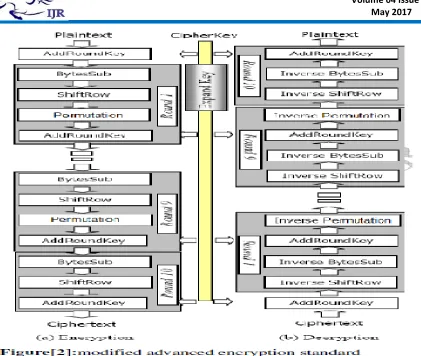
similar to one state. The block diagram of the
Modified-AES algorithm with 128 bits data is shown
Available online: https://edupediapublications.org/journals/index.php/IJR/ P a g e | 1046
The algorithm is divided into four operational blocks where we observe the data at either bytes or bit levels and the
algorithm is designed to treat any combination of data and is flexible for key size of 128 bits. These four operational
blocks represent one round of Modified-AES. There are 10 rounds for full encryption.
The four different stages that we use for
Modified-AES Algorithm are:
• Substitution bytes • Shift Rows • Permutation • Add Round Key
Substitution Bytes, Shift Rows and Add Round
Key remain unaffected as it is in the AES. Here the
important function is Permutation which is used
instead of Mixcolumn. These rounds are managed by
the following the conversions shown in
Fig.1Permutation is widely used in cryptographic
algorithms. Permutation operations are interesting
and important from both cryptographic and
architectural points of view. Tables characterize the
permutation and its contrary; the DES algorithm will
provide us permutation tables. The inputs to the IP
table consist of 64 bits. Modified-AES algorithm
takes 128 bits as input. The functions Substitution
Bytes and Shift Rows are also interpreted as 128 bits
Available online: https://edupediapublications.org/journals/index.php/IJR/ P a g e | 1047
divide the consequential bits of Shift Rows function
into two parts of 64 bits and then take each part of 64
bits as input of permutation tables and shift bits one
by one according to that table. We fetch one bit from
the source, and put it into the correct position in the
destination. Each bit of a block is subject to initial
permutation, which can be represented by the
following initial permutation
FIG-3
In the permutation table each entry indicates a specific position of a numbered input bit consisting of 64 bits in the
output. While reading the table from left to right and then from top to bottom, we observe that the 58th bit of the
64-bit block is in first position, the 50th is in second position and so forth. in fig-3
SIMULATION RESULTS
Available online: https://edupediapublications.org/journals/index.php/IJR/ P a g e | 1048
Target image
FIG-6 Before Mosaic image transformation FIG-7 After Mosaic image transformation
FIG-8 Encoding of Encryption Huffman FIG-9Decoding of decryption Huffman
Code Image Decode Image
FIG-10 Secret data Recover Image of
FIG-11 Previous and Proposed
Available online: https://edupediapublications.org/journals/index.php/IJR/ P a g e | 1049
CONCLUSION
In this paper we propose a Novel Frame Work
for RDH-EI based on MAES. Different from
previous frameworks which encrypt a plaintext image
into a ciphertext form, RIT-based RDH-EI shifts the
semantic of original image to the semantic of another
image and thus protect the privacy of the original
image. Because the encrypted image has the form of
a plaintext image, it will avoid the notation of the
curious cloud server and it is free for the cloud sever
to choose any one of RDH methods for plaintext
images to embed watermark.
We realize an MAES based method by improving the
image transformation technique in to be reversible.
By MAES, we can transform the original image to an
arbitrary selected target image with the same size,
and restore the original image from the encrypted
image in a lossless way. Two RDH methods
including PEE-based RDH and UES are adopted to
embed watermark in the encrypted image to satisfy
different needs on image quality and embedding
capacity. Several interesting problems can be
considered in the future, including how to improve
the quality of the encrypted image and how to extend
idea of MEAS to audio and video.
REFERENCES
[1] K. Hwang and D. Li, “Trusted cloud computing with secure resources and data coloring,” IEEE
Internet Comput., vol. 14, no. 5, pp. 14–22, Sep./Oct.
2010.\
[2] F. Bao, R. H. Deng, B. C. Ooi, and Y. Yang,
“Tailored reversible watermarking schemes for authentication of electronic clinical atlas,” IEEE
Trans. Inf. Technol. Biomed., vol. 9, no. 4, pp. 554–
563, Dec. 2005.
[3] F. Willems, D. Maas, and T. Kalker, “Semantic lossless source coding,” in Proc. 42nd Annu. Allerton
Conf. Commun. Control Comput., 2004,pp. 1411–
1418.
[4] W. Zhang, X. Hu, X. Li, and N. Yu, “Recursive
histogram modification:Establishing equivalency
between reversible data hiding and lossless data
compression,” IEEE Trans. Image Process., vol. 22,
no. 7, pp. 2775–2785,Jul. 2013.
[5] V. Sachnev, H. J. Kim, J. Nam, S. Suresh, and Y.
Q. Shi, “Reversible watermarking algorithm using sorting and prediction,” IEEE Trans. Circuits Syst.
Video Technol., vol. 19, no. 7, pp. 989–999, Jul.
2009.
[6] B.ou, X. Li, Y. Zhao, R. Ni, and Y. Shi, “Pairwise
prediction-error expansion for efficient reversible
data hiding,” IEEE Trans. Image Process., vol. 22,
no. 12, pp. 5010–5021, Dec. 2013.
[7] I.-C. Dragoi and D. Coltuc,
“Local-prediction-based difference expansion reversible watermarking,”
IEEE Trans. Image Process., vol. 23, no. 4, pp.
Available online: https://edupediapublications.org/journals/index.php/IJR/ P a g e | 1050
[8] Z. Ni, Y. Shi, N. Ansari, and S.Wei, “Reversible
data hiding,” IEEE Trans.Circuits Syst. Video
Technol., vol. 16, no. 3, pp. 354–362, Mar. 2006.
[9] J. Tian, “Reversible data embedding using a
difference expansion,” IEEE Trans. Circuits Syst.
Video Technol., vol. 13, no. 8, pp. 890–896, Aug.
2003.
[10] X. Hu, W. Zhang, X. Li, and N. Yu, “Minimum
rate prediction and optimized histograms
modification for reversible data hiding,” IEEE
Trans.Inf. Forensics Security, vol. 10, no. 3, 653–
664, Mar. 2015.
[11] X. Hu et al., “Fast estimation of optimal
marked-signal distribution for reversible data
hiding,” IEEE Trans. Inf. Forensics Security, vol. 8,
no. 5, pp. 779–788, May 2013.
[12] W. Zhang, X. Hu, and N. Yu, “Optimal
transition probability of reversible data hiding for
general distortionmetrics and its applications,” IEEE
Trans. Image Process., vol. 24, no. 1, pp. 294–304,
Jan. 2015.
[13] K. Ma, W. Zhang, X. Zhao, N. Yu, and F. Li,
“Reversible data hiding in encrypted images by reserving room before encryption,” IEEE Trans. Inf.
Forensics Security, vol. 8, no. 3, pp. 553–562, Mar.
2013.
[14] M. Johnson, P. Ishwar, V. M. Prabhakaran, D.
Schonberg, and K. Ramchandran, “On compressing
encrypted data,” IEEE Trans. Signal Process., vol.
52, no. 10, pp. 2992–3006, Oct. 2004.
[15] W. Liu,W. Zeng, L. Dong, andQ.Yao, “Efficient compression of encrypted grayscale images,” IEEE
Trans. Image Process., vol. 19, no. 4, pp. 1097–