Verified implementations for secure and verifiable computation
Jos´e Bacelar Almeida
Manuel Barbosa
INESC TEC and Universidade do Minho
{jba,mbb}@di.uminho.pt
Gilles Barthe
IMDEA Software InstituteGuillaume Davy
ENS Cachan and IMDEA Software InstituteFranc¸ois Dupressoir
IMDEA Software Institute
Benjamin Gr´egoire
INRIA Sophia-Antipolis
Pierre-Yves Strub
IMDEA Software Institute
Abstract
Formal verification of the security of software systems is gradually moving from the traditional focus on idealized models, to the more ambitious goal of producingverified implementations. This trend is also present in recent work targeting the verification of crypto-graphic software, but the reach of existing tools has so far been limited to cryptographic primitives, such as RSA-OAEP encryp-tion, or standalone protocols, such as SSH. This paper presents a scalable approach to formally verifying implementations of higher-level cryptographic systems, directly in the computational model.
We consider circuit-based cloud-oriented cryptographic proto-cols for secure and verifiable computation over encrypted data. Our examples share as central component Yao’s celebrated transforma-tion of a boolean circuit into an equivalent “garbled” form that can be evaluated securely in an untrusted environment. We lever-age the foundations of garbled circuits set forth by Bellare, Hoang, and Rogaway (CCS 2012, ASIACRYPT 2012) to buildverified im-plementations of garbling schemes, a verified implementation of Yao’s secure function evaluation protocol, and a verified (albeit par-tial) implementation of the verifiable computation protocol by Gen-naro, Gentry, and Parno (CRYPTO 2010). The implementations are formally verified usingEasyCrypt, a tool-assisted framework for building high-confidence cryptographic proofs, and critically rely on two novel features: a module and theory system that supports compositional reasoning, and a code extraction mechanism for gen-erating implementations from formalizations.
Keywords.Garbled Circuits, Secure Function Evaluation, Verifiable Computation, Verified Implementations,EasyCrypt.
1.
Introduction
Research on formally verifying the security of software systems was initiated almost 40 years ago, and has established a number of significant landmarks, including security proofs for separation kernels, hypervisors, virtual machines, and web browsers. For their most part, these works have focused on idealized models. However, a recent trend is to buildverified implementations. Transposing the guarantees from models to implementations offers a much higher degree of assurance, and prevents the possibility of introducing attack vectors via implementation mistakes or abstraction gaps.
The recent security controversy has placed cryptographic soft-ware under the spotlight and has raised justified concerns with re-spect to the potential exploitation ofbackdoors at two different levels: i. those that undermine the theoretical security guarantees offered by protocols included in cryptographic standards; ii. those
that thwart the practical security of cryptographic software imple-mentations. One potential way to rebuild trust in cryptographic software is to employ formal methods to rule out the existence of such backdoors, by building and deploying formally verified cryp-tographic implementations.
One application area where the adoption of this strategy is both particularly pressingandchallenging is that of cloud com-puting. Here, the need to reduce the level of trust placed in service providers can only be addressed by deploying a new generation of advanced cryptographic protocols that allow end-users to protect their data, whilst taking advantage of the technical and economic benefits of the cloud paradigm. These protocols enable secure and verifiable computation over encrypted data and can be seen as cryp-tographic virtual machines supporting arbitrary computations; to highlight this fact, we will refer to them ascryptographic systems.
Developing verified implementations of cryptographic systems seems unfathomable because their security hinges on rather sophis-ticated cryptographic constructions, whose security must itself be verified formally. We identify at least three significant challenges towards achieving this goal, and argue below that these challenges have not yet been met satistactorily by existing tools for verifying the security of cryptographic constructions such asCryptoVerif[1] and earlier versions (v0.2) ofEasyCrypt[2]; we discussF7[3] at the end of the introduction.
The first challenge is to provide support for a broader scopus of cryptographic proof techniques.EasyCryptv0.2 andCryptoVerif
excel at modelling basic game-playing techniques such as equiv-alences, failure events, reductions, eager/lazy sampling. However, a number of standard concepts and techniques from provable se-curity, such as hybrid arguments or rewinding, have resisted thus far formalization in these systems. In addition, comparatively little work has been done in formalising computational security proofs for simulation-based notions of security. Indeed, simulation-based proofs are markedly distinct from the reductionistic arguments typ-ically addressed byCryptoVeriforEasyCryptv0.2; they intrinsi-cally require existential quantification over adversarial algorithms and the ability to instantiate security models with concrete algo-rithms (the simulators) that serve as witnesses as to the validity of the security claims. Notable exceptions include formal accounts of zero-knowledge protocols [4] and computational differential pri-vacy [5]; however, these simulation-based proofs are developed in simplified settings, as further elaborated in the related work section. The second challenge is to ensure that the verification tools per-mit taming the complexity of cryptographic systems.CryptoVerif
crypto-graphic primitives, such as Full-Domain Hash signatures or OAEP, or standalone protocols, such as Kerberos or SSH. While these examples can be intricate to verify, there is a difference of scale with cryptographic systems, which typically involve several layers of cryptographic constructions. Scalability is a well-known bottle-neck for formal verification, that has been addressed with varying degrees of success over the last 40 years. However,CryptoVerif
andEasyCryptv0.2 do not offer any mechanism that specifically addresses this issue, and it is not even clear how (and which) mech-anisms used elsewhere could be added in order for formalizations to scale to larger systems.
The third challenge is to enable a new workflow of specification, validation, and prototyping for building verified implementations of cryptographic systems. To ensure that these implementations can have a practical impact, one must develop integrated environments in which cryptographers can specify cryptographic algorithms, per-form lightwheight validation (e.g., using a type-checking mecha-nism), formalize security proofs, and generate reasonably efficient implementations. What we envision here is a formal counterpart to existing prototyping systems for cryptography [6–9]. Although
CryptoVerif andEasyCryptv0.2 have made preliminary steps in this direction, they fall short of providing the functionalities that are expected by practice-oriented cryptographers (see section7).
These challenges can be summarised as an important open ques-tion: can we realistically hope to build practical verified implemen-tations of cryptographic systems in the near future?
CONTRIBUTIONS. In this paper we answer this open question pos-itively, by presenting a new version ofEasyCryptand an associated methodology that enables us to obtain the first verified implemen-tations of cryptographic systems. More specifically, we provide:
1. verified implementations of two variants of Yao’s garbled cir-cuits, following the foundational framework put forth by Bel-lare, Hoang and Rogaway [10,11], and ann-fold extension of the oblivious transfer protocol by Bellare and Micali [12], in the hashed version presented by Naor and Pinkas [13] (nbeing the size of the selection string). These are generic components that can be used in many cryptographic systems;
2. a verified implementation of Yao’s two-party secure function evaluation (SFE) protocol based on garbled circuits and obliv-ious transfer. This protocol allows two parties holding private inputsx1andx2, to jointly evaluate any functionf(x1, x2)and learn its result, whilst being assured that no additional informa-tion about their respective inputs is revealed. Two-party SFE provides a general distributed solution to the problem of com-puting over encrypted data in cloud scenarios;
3. a verified (albeit partial) implementation of a verifiable compu-tation (VC) protocol due to Gennaro, Gentry, and Parno (GGP). This protocol allows a client to delegate the computation of an arbitrary functionfto an untrusted worker, while keeping its data secretandbeing able to verify that the result is correct. It is based on Yao’s garbled circuits and fully homomorphic encryp-tion (FHE),1 and it was one of the first to address verifiability in the specific scenario of cloud computing.
1The fact that it relies on FHE explains why we only have a partial
imple-mentation: there does not yet exist a practical instantiation for this compo-nent. The modularity of our approach implies that a working implementa-tion can be derived if and when a suitable FHE scheme becomes available. We also note that that many exciting developments [14,15] have taken place in VC since the original GGP paper. However, this protocol uses Yao’s garbled circuits in a totally different way than that required by Yao’s SFE protocol, which makes it ideal for our demonstration purposes.
In addition to their practical relevance, these examples are appeal-ing because they crystallize many facets of the issues that arise in the formalization of cryptographic systems.
We adopt the latest version2 (v1.0) ofEasyCrypt, which
en-hances the initial prototype described in [2] in multiple directions. In particular, it provides a lightweight module system that is able to reflect the logical design of cryptographic systems and the modular structure of their proofs. This version also incorporates a new code generation mechanism to produce reasonably efficient functional implementations of cryptographic algorithms fromEasyCrypt de-scriptions. Using the new features ofEasyCryptand our own ex-tensions, we are able to formalize complex reasonings that arise in our examples and were previously out of reach.
Highlights of our formalization include:
• a formally verified library of generic hybrid arguments. The li-brary is based on formalizing security games as parametrisable modules, and critically uses quantification over modules. We use hybrid arguments in the security proofs for oblivious trans-fer and for garbled circuits. However, the library can be used for other purposes, and will contribute to build a broad scopus of formally verified cryptographic techniques;
• simulation-based proofs where simulators and attackers can be seen as interchangeable adversarial algorithms, which can ei-ther be concrete, existentially quantified, or universally quanti-fied. In particular, the generic statements of security for the SFE protocol involve two alternations of quantifiers, which would be challenging to handle even in a hand-written proof.
• layered security proofs in which general compositional theo-rems can be proven using abstract views of cryptographic prim-itives, and instantiations of these primitives can be proven se-cure down to one or more computational assumptions. This type of modular reasoning, which is not necessary when performing reductionistic proofs (even complex ones), is essential to permit tackling security proofs of high-level protocols.
Moreover, using the new code generation mechanism provided by
EasyCryptwe are able to derive a verified implementation for the SFE protocol, and a verified (but partial) implementation of the VC protocol. We include experimental results showing the practicality of our verified implementation of Yao’s SFE protocol.
COMPARISON WITH F7. Bhargavan et al. [3] develop a type-based approach for the verification of cryptographic implementa-tions written in a dialect of ML. Their approach is based on re-finement types, which are counterparts to assertions in typed func-tional languages, and allows proving security in a symbolic setting where cryptographic primitives are idealized. Subsequently, Four-net et al. [16] extend this approach towards proving security in the computational setting, using an intricate combination of type ab-straction and refinement types. They then use their system to build verified implementations of TLS [17]. In particular, they have cur-rently verified the TLS handshake protocol.
However, F7does not provide any support for relational nor probabilistic reasonings, both of which are central to cryptographic proofs. As a consequence, large and critical parts of cryptographic proofs cannot be stated (let alone verified) usingF7and must in-stead be carried out using pen and paper. Accordingly, there is a significant gap betweenF7statements and the provable security guarantees that are commonly sought by cryptographers. We be-lieve that this gap is not only hard to apprehend, but might also be problematic to close. As evidence, their most recent work on TLS usesEasyCrypt(v1.0) to carry out some intricate parts of the proof.
IMPLEMENTATION-LEVEL DESCRIPTIONS. It is common practice in cryptographic implementations to separate the randomness sam-pling operations from the rest of the implementation. There are two reasons for this: on one hand, general-purpose programming lan-guages are not probabilistic, and so randomness must invariably be obtained via some sort of system/library call and handled ex-plicitly; on the other hand, developers (particularly in open-source scenarios) often give the end-users the possibility (and responsibil-ity) to choose their preferred randomness sampling procedure (see, for example, the NaCl cryptographic library3).
We take the same approach, describing various cryptographic algorithms as deterministic functional operators, so that we imme-diately get for free a one-to-one mapping between theEasyCrypt
functional definitions and ML code. The randomness generation procedures, which we see as ideal specifications of the required distributions that must be available in practical applications, are de-scribed separately asEasyCryptmodules.
2.
Two-party protocols and oblivious transfer
We present a variant of a classic oblivious transfer protocol [12,13] and discuss its security proof. Its small size and relative simplicity make it a good introductory example toEasyCryptformalization.TWO-PARTYPROTOCOLS. We first start by generically defining two-party protocols, that generalize both Secure Function Evalua-tion and Oblivious Transfer, and their security. InEasyCrypt, dec-larations pertaining to abstract concepts meant to later be refined can be grouped into named theories such as the one shown in Fig-ure1. Any lemma proved in such a theory is also a lemma of any implementation (or instantiation) where the theory axioms hold.
theoryProtocol.
typeinput1, output1. typeinput2, output2.
opvalidInputs: input1→input2→bool.
opf: input1→input2→output1∗output2.
typerand1, rand2, conv.
opprot: input1→rand1→input2→rand2→conv∗output1∗output2.
. . .
endProtocol.
Figure 1: Abstract Two-Party Protocol.
Two parties want to compute afunctionalityfon their joint in-puts, each obtaining their share of the output. This may be done interactively via aprotocolprotthat may make use of additional randomness (passed in explicitly for each of the parties) and pro-duces, in addition to the result, aconversation traceof typeconv
that describes the messages publicly exchanged by the parties dur-ing the protocol execution. In addition, the input space may be re-stricted by a validity predicatevalidInputs. This predicate expresses restrictions on the adversary-provided values, typically used to ex-clude trivial attacks not encompassed by the security definition.
Following the standard approach for secure multi-party compu-tation protocols, security is defined using simulation-based defini-tions. In this case we capture honest-but-curious (or semi-honest, or passive) adversaries. We consider each party’sviewof the protocol (typically containing its randomness and the list of messages ex-changed during a run), and a notion ofleakagefor each party, mod-elling how much of that party’s input may be leaked by the protocol execution (for example, its length). Informally, we say that such a protocol is secure if each party’s view can be efficiently simulated using only its inputs, its outputs and the other party’s leakage. For-mally, we express this security notion using two games (one for each party). We display one of them in Figure2, in the form of
3http://nacl.cr.yp.to
anEasyCryptmodule. Note that modules are used to model games and experiments, but also schemes, oracles and adversaries.
Module type AdvProt
i (i ∈ {1,2}) tells us that an adversary
impersonating Partyiis defined by two procedures: i.choosethat takes no argument and chooses a full input pair for the functionality, and ii.distinguish, that uses Partyi’s view of the protocol execution to produce a boolean guess as to whether it was produced by the real system or the simulator. Since the module type is not parame-terized, the adversary is not given access to any oracles (modelling a non-adaptive adversary). We later show how oracle access can be given to both abstract and concrete modules. Note that procedures in the same module may share state, and it is therefore not neces-sary to explicitly add state to the module signature. A module that implements all procedures in a given module type is said to imple-mentthat type. Note that, for example, any module implementing
Simalso implementsSim1. We omit module types for the random-ness generatorsR1andR2, as they only provide a single procedure
gentaking some leakage and producing some randomness. We also omit the dual security game for Party 2.
The security game, modelled as moduleSec1, is explicitly pa-rameterized by two randomness-producing modulesR1andR2, a simulatorS1 and an adversaryA1. This enables the code of pro-cedures defined inSec1to make queries to any procedure that ap-pears in the module types of its parameters. However, they may not directly access the internal state or procedures that are imple-mented by concrete instances of the module parameters, when these are hidden by the module type. The game implements, in a sin-gle experiment, both the real and ideal worlds. In the real world, the protocolprot is used with adversary-provided inputs to con-struct the adversary’s view of the protocol execution. In the ideal world, the functionality is used to compute Party 1’s output, which is then passed along with Party 1’s input and Party 2’s leakage to the simulator, which produces the adversary’s view of the system. We prevent the adversary from trivially winning by denying it any advantage when it chooses invalid inputs.
A two-party protocol prot (parameterized by its randomness-producing modules) is said to be secure with leakageΦ = (φ1, φ2) whenever, for any adversaryAiimplementingAdvProti (i∈ {1,2}),
there exists a simulatorSiimplementingSimisuch that
AdvProtiΦ
prot,Si,R1,R2(Ai) =|2·Pr[Seci(R1,R2,Si,Ai) :res]−1| is small, whereresdenotes the Boolean output of proceduremain. Intuitively, the existence of such a simulatorSiimplies that the
protocol conversation and output cannot reveal any more informa-tion than the informainforma-tion revealed by the simulator’s input.
Throughout the paper we omit the indices representing random-ness generators whenever they are clear from the context.
OBLIVIOUSTRANSFERPROTOCOLS. We can now define oblivi-ous transfer, restricting our attention to a specific notion useful for constructing general SFE functionalities. To do so, weclonethe
typeleak1, leak2. opφ1: input1→leak1. opφ2: input2→leak2.
typeview1= rand1∗conv. typeview2= rand2∗conv.
module typeSim ={
proc sim1(i1: input1, o1: output1, l2: leak2) : view1 proc sim2(i2: input2, o2: output2, l1: leak1) : view2 }.
module typeSimi={
proc simi(ii: inputi, oi: outputi, l3−i: leak3−i) : viewi }.
module typeAdvProt i ={ proc choose(): input1∗input2 proc distinguish(v: viewi) :bool }.
moduleSec1(R1: Rand1, R2: Rand2, S: Sim1,A1:AdvProt 1 ) ={ proc main() :bool={
varreal, adv, view1, o1, r1, r2, i1, i2; (i1,i2) =A1.choose();
real← {$ 0,1};
if(!validInputs i1i2)
adv← {$ 0,1};
else{
if(real){
r1= R1.gen(φ1i1); r2= R2.gen(φ2i2); (conv, ) = prot i1r1i2r2; view1= (r1, conv); }else{
(o1, ) = f i1i2;
view1= S.sim1(i1, o1,φ2i2); }
adv =A1.distinguish(view1); }
return (adv =real); }
}.
Figure 2: Security of a two-party protocol protocol.
cloneProtocolasOTwith
typeinput1=bool array,
typeoutput1= msgarray,
typeleak1=int,
typeinput2= (msg∗msg)array,
typeoutput2=unit,
typeleak2=int,
opφ1(i1:bool array) = length i1,
opφ2(i2: (msg∗msg)array) = length i2,
opf (i1:bool array) (i2: (msg∗msg)array) = i1i 2.
opvalidInputs(i1:bool array) (i2: (msg∗msg)array) = 0<length i1≤nmax∧length i1= length i2,
. . .
Figure 3: Instantiating Two-Party Protocols into Abstract SFE.
This introduces an implicit quantification on the boundnin all re-sults we prove. Defining OT security is then simply a matter of instantiating the general notion of security for two-party protocols via cloning. Looking ahead, we useAdvOTito denote the resulting instance ofAdvProti(length,length), and similarly, we writeAdvOT
i the
types for adversaries against the OT instantiation.
ANOBLIVIOUSTRANSFERPROTOCOL. To define a concrete two-party OT protocol, one now only has to define the types of random-ness and conversations and the protocol itself, with its individual computation and message exchange steps.
In the following, we abuse notation and denote operators, their lifting to arrays of the same length, and their lifting to one array
argument and one scalar argument in the same way, writingv to single out array variables. For an array of pairsa, we writea0for the array of its first components (i.e.fsta), anda1for the array of its second components. We also denote multiplicatively operations in a groupGof prime orderq, using a given generatorg.
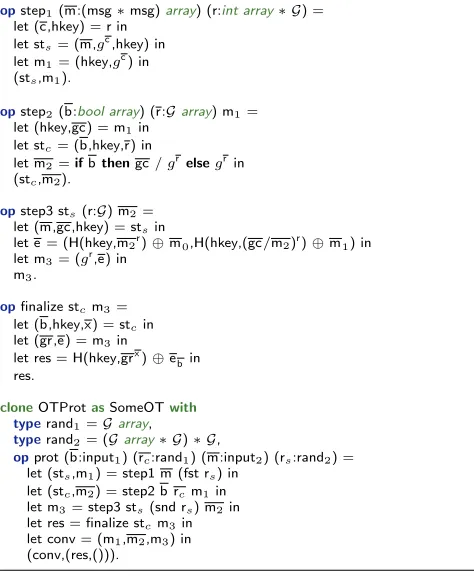
In Figure4, we describe our OT protocol in a purely functional manner, making any local state shared between the various stages of a given party explicit. For example,step1 outputs the sender’s local statests, for later use bystep3.
opstep1(m:(msg∗msg)array) (r:int array∗ G) = let (c,hkey) = r in
let sts= (m,gc,hkey) in let m1= (hkey,gc) in (sts,m1).
opstep2(b:bool array) (r:Garray) m1= let (hkey,gc) = m1in
let stc= (b,hkey,r) in
let m2=ifbthengc /grelsegrin (stc,m2).
opstep3 sts(r:G) m2= let (m,gc,hkey) = stsin
let e = (H(hkey,m2r)⊕m0,H(hkey,(gc/m2)r)⊕m1) in let m3= (gr,e) in
m3.
opfinalize stcm3= let (b,hkey,x) = stcin let (gr,e) = m3in
let res = H(hkey,grx)⊕eb in res.
cloneOTProtasSomeOTwith
typerand1=Garray,
typerand2= (Garray∗ G)∗ G,
opprot (b:input1) (rc:rand1) (m:input2) (rs:rand2) = let (sts,m1) = step1 m (fst rs) in
let (stc,m2) = step2 b rcm1in let m3= step3 sts(snd rs) m2in let res = finalize stcm3in let conv = (m1,m2,m3) in (conv,(res,())).
Figure 4: Our Concrete Oblivious Transfer Protocol.
We prove this protocol secure in the standard model via a reduc-tion to the decisional Diffie-Hellman assumpreduc-tion and an entropy-smoothing assumption on the hash function. We letAdvDDH(A)
andAdvES(A)be the advantage of an adversaryAbreaking the DDH and the Entropy Smoothing assumptions, respectively.
Theorem 1(OT-security of SomeOT). For alli ∈ {1,2}and OTiadversaryAiof typeAdvOTi against theSomeOTprotocol,
we can construct two efficient adversariesDDDH
andDES , and a efficient simulatorSsuch that
AdvOTSomeOTi ,S(Ai)≤n·AdvDDH(DDDH) +n·AdvES(DES).
Proof (Sketch).We first reduce to n-ary variants of the assump-tions, constructing adversariesDDDHn andDESn. Security against malicious senders (i = 1) is information theoretic, since the sender’s view of a protocol execution is statistically indistinguish-able from a random view. To prove security against malicious choosers (i= 2), we consider a simulatorSthat replaces the cho-sen components of the ciphertextse0ande1(instep2) by random bitstrings. The proof that the real world is computationally close to the ideal world follows the following strategy:DDDHn
is used to justify the replacement of the public keys corresponding to chosen messages by random group elements, andDESn
of random group elements by random bitstrings. We further reduce bothn-ary variants to the corresponding standard assumption using a single generic lemma described below.
USINGGENERICLEMMAS. In the proof of Theorem1, both reduc-tions first go ton-ary versions of the DDH and Entropy-Smoothing hypotheses before reducing these further to standard assumptions. Both of these two “n-ary to unary” reductions are in fact proved by simply applying a generic lemma, which we formalize inde-pendently of these particular applications as part ofEasyCrypt’s library of verified transformations. The objective of this library is to formalize often-used proof techniques once and for all, enabling the user to perform proofs “by a hybrid argument”, or “by eager sampling”, whilst formally checking that all side conditions are ful-filled at the time the lemma is applied. We now describe the generic hybrid argument used in the proof of Theorem1and others.
typeinput, output, inleaks, outleaks.
module typeOrcl ={proc o( :input) : output}.
module typeOrclb={ proc leaks( :inleaks): outleaks proc oL( :input) : output proc oR( :input) : output }.
module typeAdvHy(O
b:Orclb, O:Orcl) ={proc main () :bool}.
moduleLn(Ob:Orclb,A:AdvHy) ={
moduleO: Orcl ={. . .}(∗increment C.c and call Ob.oL∗)
moduleA’ =A(Ob, O);
proc main () :bool={C.c = 0; returnA’.main();} }.
moduleRn(Ob:Orclb,A:Adv) ={. . .(∗Same as Lnbut use Ob.oR∗)}.
opq :int.
moduleB(A:AdvHy, Ob:Orclb, O:Orcl) ={
moduleLR ={
varl, l0:int
proc orcl(m:input):output ={
varr : output;
if(l0<l) r = Ob.oL(m);
else if(l0= l) r = O.orcl(m);
elser = Ob.oR(m); l = l + 1; return r; }
}
moduleA’ =A(Ob,LR) proc main():outputA ={
varr:outputA;
LRB.l0←$ [0..q−1]; LRB.l = 0; returnA’.main(); }
}.
lemmaHybrid:∀(Ob:Orclb{C,B}) (A:AdvHy{C,B,Ob}), Pr[Ln(Ob,A): res∧C.c≤n]−Pr[Rn(Ob,A): res∧C.c≤n] = q∗(Pr[Ln(Ob,B(A)): res∧ B.l≤n∧C.c≤1]
−Pr[Rn(Ob,B(A)): res∧ B.l≤n∧C.c≤1]).
Figure 5: Abstract Definitions for Hybrid Argument.
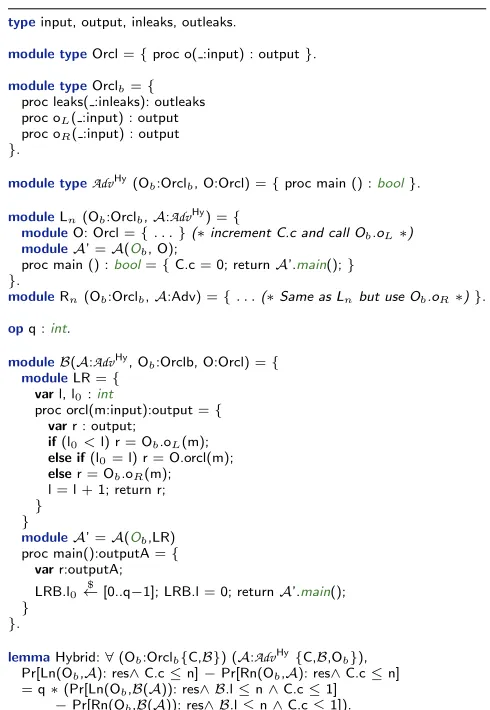
As described in Figure5, consider an adversary parametrized by two modules. The first parameterOb, implementing the
mod-ule typeOrclb, provides a leakage oracle, a left oracleoLand right
oR. The second parameterO, implementing module typeOrcl,
pro-vides a single oracleo. The goal of an adversary implementing type AdvHyis to guess in at mostnqueries toO.oif it is the left oracle
Ob.oLor the right oracleOb.oR. To express the advantage of such
an adversary, we write two modules: the first one,Ln, defines a
game where the adversary is called withO.oequal toOb.oL, the
second one,Rn, usesOb.oRinstead. BothLnandRnuse a
vari-ableC.cto count the number of queries made to their oracle by the adversary. We define the advantage of an adversaryAin dis-tinguishingOb.oLfromOb.oR as the difference of the probability
of gamesLn(Ob,A)andRn(Ob,A)returning 0. Given any
distin-guishing adversaryA, we construct a distinguishing adversaryB
that may useAbut always makes at most one query to oracleO.o. TheHybridlemma relates the advantages of any adversaryA
with the advantage of its constructed adversaryBwhenAis known to make at most qqueries toO.o. Note that the validity of the
Hybridlemma is restricted to adversaries that do not have a direct access to the counterC.c, or to the memories of Band Ob, this
is denoted by the notationAdvHy{C,B,Ob}in theEasyCryptcode.
Other lemmas shown in this paper also have such restrictions in their formalizations, but they are as expected (that is, they simply enforce a strict separation of the various protocols’, simulators’ and adversaries’ memory spaces) and we omit them for clarity. The construction ofB is generic in the underlying adversaryA, which can remain completely abstract. We underline that, for all
Aimplementing module typeAdvHy
, the partially-applied module
B(A) implements AdvHy as well and can therefore be plugged in anywhere a module of typeAdvHy is expected. This ability to generically construct over abstract schemes or adversaries is central to handling modularity inEasyCrypt.
Finally, we observe that theHybridlemma applies even to an adversary that may place queries to the individualOb.oLandOb.oR
oracles. It is of course applicable (and is in fact often applied) to adversaries that do not place such queries.
3.
Garbling schemes
Garbling schemes [10] (Figure6) are operators onfunctionalities of typefunc. Such functionalities can be evaluated on some input using anevaloperator. In addition, a functionality can begarbled using three operators (all of which may consume randomness).
funGproduces the garbled functionality,inputKproduces an input-encoding key, andoutputKproduces an output-encoding key. The garbled evaluationevalG takes a garbled functionality and some encoded input and produces the corresponding encoded output. The input-encoding and output-decoding functions are self-explanatory. In practice, we are interested in garbling functionalities encoded as
typefunc, input, output.
opeval : func→input→output.
opvalid: func→input→bool.
typerand, funcG, inputK, outputK.
opfuncG : func→rand→funcG.
opinputK : func→rand→inputK.
opoutputK: func→rand→outputK.
typeinputG, outputG.
opevalG : funcG→inputG→outputG.
opencode: inputK→input→inputG.
opdecode: outputK→outputG→output.
Figure 6: Abstract Garbling Scheme.
Boolean circuits and therefore fix thefuncandinputtypes and the
projective schemes[10], where Boolean values on each wire are encoded using a fixed-length random token. This fixes the type
funcGof garbling schemes, and theoutputKanddecodeoperators. Following theGarble1construction of Bellare et al. [10], we construct our garbling scheme using a variant of Yao’s garbled cir-cuits based on a pseudo-random permutation, via an intermediate Dual-Key Cipher (DKC) construction. We denote the DKC encryp-tion withE, and DKC decryption withD. Both take four tokens as argument: a tweak that we generate with an injective function and use as unique IV, two keys, and a plaintext (or ciphertext). Some intuition about the construction is given in AppendixA.1. We give functional specifications to the garbling algorithms in Figure7. For clarity, we denote functionalfolds using statefulforloops.
typetopo =int∗int∗int∗int array∗int array.
typeαcircuit= topo∗(int∗α∗α,α)map.
typeleak = topo.
typeinput, output =bool array.
typefunc =boolcircuit.
typefuncG = token circuit.
typeinputG, outputG = tokenarray.
opevalG f i =
let ((n,m,q,A,B),G) = f in let evalGate =λg x1x2,
let x1,0= lsb x1and x2,0= lsb x2in D (tweak g x1,0x2,0) x1x2G[g,x1,0,x2,0] in
let wires = extend i q in(∗extend the array with q zeroes∗)
let wires = map (λg, evalGate gA[g]B[g]) wires in(∗decrypt wires∗) sub wires (n + q−m) m.
typerand, inputK = ((int∗bool),token) map.
opencode iK x = init (length x) (λ k, iK[k,x[k]]).
opinputK (f:func) (r:((int∗bool),token) map) = let ((n, , , , ), ) = f in filter (λ x y, 0≤fst x<n) r.
opfuncG (f:func) (r:rand) = let ((n,m,q,A,B),G) = f in for (g,xa,xb)∈[0..q]∗bool∗bool
let a =A[g] and b =B[g] in let ta= r[a,xa] and tb= r[b,xb] in
e
G[g,ta,tb] = E (tweak g tatb) tatbr[g,G[g,xa,xb]] ((n,m,q,A,B),Ge).
Figure 7:SomeGarble: our Concrete Garbling Scheme.
SECURITY OFGARBLINGSCHEMES. The privacy property of gar-bling schemes required by Yao’s SFE protocol is more conveniently captured using a simulation-based definition. Like the security no-tions for protocols, the privacy definition for garbling schemes is parameterized by a leakage function upper-bounding the informa-tion about the funcinforma-tionality that may be leaked to the adversary. (We consider only schemes that leak at most the topology of the circuit.) Consider efficient non-adaptive adversaries that provide two proce-dures: i.choosetakes no input and outputs a pair(f,x)composed of a functionality and some input to that functionality; ii. on input a garbled circuit and garbled input pair(F,X),distinguishoutputs a bitbrepresenting the adversary’s guess as to whether he is in-teracting with the real or ideal functionality. Formally, we define theSIM-CPAΦadvantage of an adversaryAof typeAdvGbagainst garbling schemeGb=(funcG,inputK,outputK)and simulatorSas
AdvSIM-CPAΦ
Gb,R,S (A) =|2·Pr[SIM(R,S,A) :res]−1|.
A garbling schemeGbusing randomness generatorRisSIM-CPA Φ-secure if, for all adversaryAof typeAdvGb, there exists an efficient simulatorSof typeSimsuch thatAdvSIM-CPAΦ
Gb,R,S (A)is small.
typeleak.
opΦ: func→leak.
module typeSim ={
funsim(x: output, l: leak): funcG∗inputG }.
module typeAdvGb={
funchoose(): func∗input
fundistinguish(F: funcG, X: inputG) :bool
}.
moduleSIM(R: Rand, S: Sim,A:AdvGb) ={
funmain() :bool={
varreal, adv, f, x, F, X; (f,x) =A.gen query();
real← {$ 0,1};
if(!valid f x) adv← {$ 0,1};
else{
if(real){ r = R.gen(Φf); F = funcG f r;
X = encode (inputK f r) x; }else{
(F,X) = S.sim(f(x),Φf); }
adv =A.dist(F,X); }
return (adv =real); }
}.
Figure 8: Security of garbling schemes.
Following [10], we establish simulation-based security via a general result that leverages a more convenient indistinguishability-based security notion denotedIND-CPAΦtopo: we formalize a gen-eral theorem stating that, under certain restrictions on the leakage functionΦ,IND-CPAΦ-security impliesSIM-CPAΦsecurity. This result is discussed below as Lemma1.
AMODULAR PROOF. The general lemma stating thatIND-CPA -security impliesSIM-CPA-security is easily proved in a very ab-stract model, and is then as easily instantiated to our concrete gar-bling setting. We describe the abstract setting to illustrate the proof methodology enabled byEasyCryptmodules on this easy example.
module typeAdvIND={
funchoose(): ptxt∗ptxt
fundistinguish(c:ctxt):bool
}.
moduleIND (R:Rand,A:AdvIND) ={
funmain():bool={
varp0, p1, p, c, b, b’, ret, r; (p0,p1) =A.choose();
if(valid p0∧valid p1∧Φp0=Φp1){
b← {$ 0,1};
p =ifbthenp1elsep0; r = R.gen(|p|); c = enc p r; b’ =A.distinguish(c); ret = (b = adv); }
elseret← {$ 0,1}; return ret; }
}.
The module shown in Figure9is a slight generalization of the stan-dardIND-CPAsecurity notions for symmetric encryption, where some abstract leakage operatorΦreplaces the more usual check that the two adversary-provided plaintexts have the same length.We formally prove an abstract result that is applicable to any circum-stances where indistinguishability-based and simulation-based no-tions of security interact. We define theIND-CPAadvantage of an adversaryAof typeAdvINDagainst the encryption operatorenc us-ing randomness generatorRwith leakageΦas
AdvIND-CPAΦ
enc,R (A) =|2·Pr[Game IND(R,A): res]−1|
whereRis the randomness generator used in the concrete theory. In the rest of this subsection, we use the following notion of invertibility. A leakage functionΦon plaintexts (when we instanti-ate this notion on garbling schemes these plaintexts are circuits and their inputs) isefficiently invertibleif there exists an efficient al-gorithm that, given the leakage corresponding to a given plaintext, can find a plaintext consistent with that leakage.
Lemma 1(IND-CPA-security impliesSIM-CPA-security). IfΦis efficiently invertible, then for every efficientSIM-CPAadversary Aof typeAdvGb
, one can build an efficientIND-CPAadversaryB and an efficient simulatorSsuch that
AdvSIM-CPAΦ
enc,S (A) =Adv IND-CPAΦ enc (B).
Proof (Sketch). Using the inverter for Φ, B computes a second plaintext from the leakage of the one provided byAand uses this as the second part of her query in theIND-CPAgame. Similarly, simulatorSgenerates a simulated view by taking the leakage it receives and computing a plaintext consistent with it using theΦ -inverter. The proof consists in establishing thatAis called byBin a way that coincides with theSIM-CPAexperiment whenSis used in the ideal world, and is performed by code motion.
FINISHING THE PROOF. We reduce theIND-CPAΦtopo-security of
SomeGarbleto theDKC-security of the underlying DKC primitive (see [10]). In the lemma statement,cis an abstract upper bound on the size of circuits (in number of gates) that are considered valid. The lemma holds for all values ofcthat can be encoded in a token minus two bits.
Lemma 2(SomeGarbleisIND-CPAΦtopo-secure). For every effi-cientIND-CPAadversaryAof typeAdvGb−IND, we can construct a efficientDKCadversaryBsuch that
AdvIND-CPAΦtopo
SomeGarble (A)≤(c+ 1)·Adv DKC
SomeGarble(B). Proof (Sketch). The constructed adversaryB, to simulate the gar-bling scheme’s oracle, samples a wire`0 which is used as pivot in a hybrid construction where: i. all tokens that are revealed by the garbled evaluation on the adversary-chosen inputs are garbled normally, using the real DKC scheme; otherwise ii. all tokens for wires less than`0are garbled using encryptions of random tokens (instead of the real tokens representing the gates’ outputs); iii. to-kens for wire`0 uses the real-or-random DKC oracle; and iv. all tokens for wires greater than`0are garbled normally.
Here again, the generic hybrid argument (Figure 5) can be instantiated and applied without having to be proved again, yielding a reduction to an adaptive DKC adversary. A further reduction allows us to then build a non-adaptive DKC adversary, since all DKC queries made byBare in fact random and independent.
From Lemmas1and2, we can conclude with a security theorem for our garbling scheme.
Theorem 2 (SomeGarble is SIM-CPAΦtopo-secure). For every
SIM-CPAadversaryAthat implementsAdvGb, one can construct an efficient simulatorSand a DKC adversaryBsuch that
AdvSIM-CPAΦtopo
SomeGarble,S (A)≤(c+ 1)·Adv DKC
SomeGarble(B). Proof (Sketch).Lemma1allows us to construct fromAthe simu-latorSand anIND-CPAadversaryC. FromC, Lemma2allows us to constructBand conclude.
4.
Constructing a Secure SFE Protocol
We now explain how garbled circuits and oblivious transfer can be combined to provide a general secure function evaluation pro-tocol, and formalize a generic security proof, parameterized by a secure garbling scheme and a secure oblivious transfer protocol. We then instantiate the abstract argument with our concrete oblivi-ous transfer protocol (Section2) and our concrete garbling scheme (Section3) and conclude.
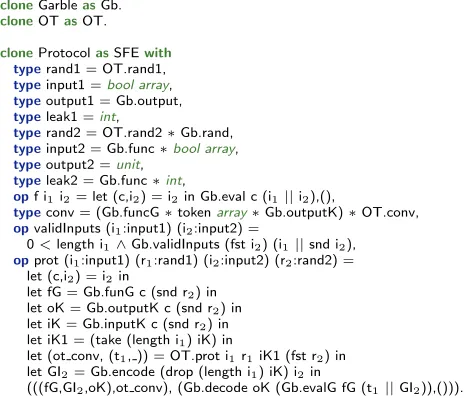
YAO’S SFE CONSTRUCTION. As discussed briefly in Section2, we model SFE as a two-party protocol. We consider the function-ality to be evaluated, encoded as a circuit, as part of Party 2’s input and set up the leakage function to let it become public. We de-note withAdvSFEi and
AdvSFEi the instantiations ofAdvProt
i and AdvProt
i to the SFE construction. We preface the definition of our
generic SFE construction with two named clones of the abstract garbling scheme and oblivious transfer theories. This allows us to essentially parameterize the SFE protocol with a garbling scheme and an oblivious transfer protocol. Instantiating these parameters is simply done by instantiating theGbandOTtheories with concrete definitions and proofs. In Figure10, we formalize a standard SFE construction detailed informally in AppendixA.1.
cloneGarbleasGb.
cloneOTasOT.
cloneProtocolasSFEwith
typerand1 = OT.rand1,
typeinput1 =bool array,
typeoutput1 = Gb.output,
typeleak1 =int,
typerand2 = OT.rand2∗Gb.rand,
typeinput2 = Gb.func∗bool array,
typeoutput2 =unit,
typeleak2 = Gb.func∗int,
opf i1i2= let (c,i2) = i2in Gb.eval c (i1||i2),(),
typeconv = (Gb.funcG∗tokenarray∗Gb.outputK)∗OT.conv,
opvalidInputs (i1:input1) (i2:input2) =
0<length i1∧Gb.validInputs (fst i2) (i1||snd i2),
opprot (i1:input1) (r1:rand1) (i2:input2) (r2:rand2) = let (c,i2) = i2in
let fG = Gb.funG c (snd r2) in let oK = Gb.outputK c (snd r2) in let iK = Gb.inputK c (snd r2) in let iK1 = (take (length i1) iK) in
let (ot conv, (t1, )) = OT.prot i1r1iK1 (fst r2) in let GI2= Gb.encode (drop (length i1) iK) i2in
(((fG,GI2,oK),ot conv), (Gb.decode oK (Gb.evalG fG (t1||GI2)),())).
Figure 10: Abstract SFE Construction.
Theorem 3 (Abstract SFE security). For any oblivious trans-fer protocolOT and any garbling scheme Gb, letSFEa be the
SFE protocol built using Yao’s construction from OT and Gb. For all randomness generators RG, RO1 and RO2, we can con-struct SFE randomness generatorsRSFE1 andRSFE2 such that, for all SFE adversaryA = (A1,A2)implementing typeAdvSFE =
(AdvSFE1 ,Adv SFE
2 ), OT simulator S
O
and garbling simulatorSG, we can construct efficient adversariesAO
= (AO
AdvOT
= (AdvOT
1 ,AdvSFE2 )andAGof typeAdvGband an efficient simulatorS, such that the following inequalities hold.
AdvSFE
1 Φ
SFEa,S(A1)≤Adv OT1Φ OT,SO(A
O
1) +Adv SIM-CPAΦ Gb,SG (A
G)
AdvSFE
2 Φ SFEa,S(
A2)≤AdvOT
2 Φ OT,SO(AO2)
Proof (Sketch). Since no additional randomness is used by the SFE protocol, the SFE randomness generators are trivially constructed from the randomness generators for OT and garbling. The proof then follows the argument sketched in [10]. From the adversaryA, we can easily constructAO
andAG
by moving some of the code from the SFE protocol into the adversary. The security assumptions on the oblivious transfer protocol and garbling scheme can then be used to build two simulatorsSO andSG. In turn, these can be combined into a valid simulatorSfor the full SFE protocol.
ACONCRETESFEPROTOCOL. Finally, we instantiateOTwith the concrete oblivious transfer protocol we proved secure in Section2 andGbwith the concrete garbling scheme we proved secure in Sec-tion3in the construction. The security proof for this concrete con-struction immediately follows from Theorems3,1and2. However, we take this opportunity to implement some instantiation-specific optimizations across abstraction boundaries and translate high-level programming constructs like maps and higher-order functions into more efficient data structures such as arrays. We also instan-tiate the constantsnandcas described further in Section6and discharge any axioms affecting them. A separate proof that our ef-ficient implementation is perfectly equivalent to the one on which we performed the security proof yields the final security theorem.
Theorem 4(Security of the concrete SFE protocol). For allSFE adversaryAagainst theConcreteSFE protocol, we construct an efficient simulatorSand efficient adversariesBDKC,BDDHandBES, such that the following inequalities hold:
AdvSFE
1 Φtopo
Concrete,S(A)≤(c+ 1)·Adv DKC
(BDKC) +ε,
AdvSFE
2 Φtopo
Concrete,S(A)≤ε, whereε=n·AdvDDH(BDDH) +n·AdvES(BES).
Proof (Sketch). By functional equivalence of theConcrete proto-col andSFE(SomeOT,SomeGarble)(calledSFEcbelow), we prove
AdvSFE
1 Φtopo
Concrete,S(A) =Adv SFE1Φ
topo
SFEc,S (A)and it suffices to bound the latter. This can be done by applying Theorem3and using the ad-versaries constructed in Theorems1and 2along with the corre-sponding bounds to conclude.
5.
Verifiable Computation
We now move to our second example of a verifiable computation protocol, in order to further demonstrate the wide applicability of our techniques. In AppendixA, the interested reader will find a de-scription of the functionality and security properties required of a verifiable computation protocol. Here we give only the highlights of how we formalize the seminal construction proposed by Gen-naro, Gentry and Parno (GGP) [18].
For the GGP protocol we require a garbling scheme that pro-vides authenticity guarantees, and so we need a slightly differ-ent construction from that presdiffer-ented in the previous sections. In-tuitively, authenticity imposes that, given one opening of the gar-bled circuit, it is infeasible to find a valid encoding of an incorrect
output. For Yao’s construction to display this property, it is neces-sary that the decoding key includes the labels for the output wires, so that garbled outputs can be checked for consistency. In our for-malisation, this consistency check is handled by a new algorithm calledvalid outG. Formalising this new garbling scheme requires little effort, as one can simply (re-)define the operators shown in Figure11and inherit all the original definitions from the formalisa-tion presented before. The resulting scheme corresponds toGarble2
in [10].
opoutputK (fn:fun t) (r:rand t) = let (n, m, q, aa, bb) = fst fn in
init m (λ i, (proj r[(n+q−m+i,false)], proj r[(n+q−m+i,true)])).
opvalid outG (oK:outputK t) (oG:outputG t) = alli (λ i x, x = fst oK[i]∨x = snd oK[i]) oG.
opdecode (oK:outputK t) (oG:outputG t) = mapi (λ i x, x=snd oK[i]) oG.
Figure 11: Modified garbling scheme
The GGP verifiable computation protocol can be explained as follows. Take the garbling of the circuit to be delegated to be a public key that is given to the worker. The authenticity property immediately yields a weak form of verifiability, whereby the del-egating party can securely outsource the computation of a single input. Verifiability is lost when more than one computation is dele-gated because, intuitively, if the worker sees more than one opening of the circuit, then it may be able tomixthe two garbled outputs it obtained to generate a new forged one. To enable the verifiable del-egation of multiple inputs using the same garbled circuit, the client in the GGP protocol encrypts each newly encoded input using a fresh FHE key pair. This ensures that, whilst the worker is still able to evaluate the garbled circuit (homomorphically) it will never be able to combine two garbled outputs into a new one: intuitively, the FHE guarantees that the different evaluations become independent, in the sense that one cannot (even homomorphically) use data from previous evaluations to produce a forgery on the next one.
Our formalisation of an abstract FHE scheme in EasyCrypt
(Figure12) is extremely simple. It is a standard public key encryp-tion scheme, for which there exists an addiencryp-tional associated algo-rithm which, given a transformation functiong, maps fresh cipher-texts encrypting any messagexto homomorphically transformed ones encryptingg(x). As shown below, for our purposes it suffices to formalize and axiomatize the homomorphism w.r.t. the concrete transformationgthat performs the evaluation of a garbled circuit. Additionally, the FHE scheme is assumed to beIND−CPA-secure.
opgen : randg t→pkey t∗skey t.
openc : pkey t→plaini t→rande t→cipheri t.
ophom eval : (inputG t→outputG t)→cipheri t→ciphero t.
opdec : skey t→ciphero t→plaino t.
axiomhomomorphic :∀f x r rg re,
Scheme.validRand f r⇒validInputs f x⇒ let fG = funG f r in
let iK = inputK f r in let xG = Input.encode iK x in let oK = outputK f r in
let (pk,sk) = gen rg in let ci = enc pk xG re in
let co = hom eval (Scheme.evalG fG) ci in dec sk co = evalG fG xG.
Figure 12: Abstract Fully-Homomorphic Encryption scheme
structure of our argument is markedly simpler than that presented in [18], as it directly relies on the formalisation of garbling schemes subsequently put forth by Bellare et al. [10,11]. On the other hand, our formalisation complements the presentation in [11], where a detailed proof is presented only for one-time secure schemes.
We show that the security of the GGP protocol can be proven solely based on the security of the underlying FHE scheme and the adaptive authenticity of the underlying garbling scheme denoted
aut1in [11]. In this form of authenticity, the attacker gets to see the garbled circuit before she chooses the input for which she wishes to produce a forged output. We do not require obliviousness in our proof. As shown in [11], this is needed for a one-time-secure variant of the GGP construction that does not rely on FHE and uses only Yao’s garbled circuits. However, it is no longer required when we can rely on FHE for privacy.
We split our presentation in two parts: first we describe the nec-essary steps to establish the correctness and authenticity properties of the garbling scheme; then we sketch the proof of security for the GGP protocol.
5.1 Correctness and authenticity of the garbling scheme
Proving the correctness of the modified garbling scheme involved little overhead with respect to the proof constructed for the original one presented in the previous sections. Indeed, the bulk of the inductive argument that establishes a correct opening of all the gates throughout the circuit is identical for both constructions, and only the final decoding operation needs to be handled differently.
Our proof of adaptive authenticity forGarble2reflects the cur-rent state of the art: to the best of our knowledge, there is curcur-rently no proof that this construction meets the notion ofaut1security proposed in [11] down to standard assumptions. Indeed, Bellare, Hoang and Rogaway point out a gap in the original proof of secu-rity of the GGP protocol that corresponds precisely to this issue. One plausible solution to this problem, suggested in [11], is to sim-ply assume thatGarble2provides this level of security. We go a bit further, and reduce the adaptive authenticity ofGarble2to a simpler property, which we callaPriv. The question of whetherGarble2
satisfiesaPrivcan be seen both as an interesting open problem and a computational assumption that underlies the security of our in-stantiation of the GGP protocol. The details follow.
Theorem 5(Adaptive Authenticity). For all efficient authenticity adversariesAagainstGarble2, we can construct efficient adver-saryBagainst theaPrivproperty ofGarble2such that:
AdvAuthGarble2(A)≤2·m·AdvaPrivGarble2(B) + 2−λ.
wheremis an upper bound on the number of output wires, andλ
is the length of the random tokens used in the dual-key cipher.
Proof (Sketch). Our proof combines the proof strategies of Bellare et al. [10] for (non-adaptive) authenticity and the proof sketch presented in the GGP paper [18] for the verifiability of the GGP protocol. We first guess (one of) the output bit(s)ithat will be flipped by the adversary’s forgery, and we also bet on which will be the correct value of this bitβ: this costs us a factor of2·min the reduction. We then rely on theaPrivproperty to jump to a final game where we replace the functionfchosen by the adversary with another functionf0. Functionf0is identical tofin all gates except output gatei, where all entries in the truth table now encode bitβ. TheaPrivproperty has been tailored to be as weak as possible and still allow this transition. It imposes that, for adversarially chosen
(f, f0, i, β)such thatfandf0are related as described above, the garblings off andf0 are indistinguishable. The attacker gets to adaptively choose an inputx, for which it will receive an encoding (under the usual restriction thatfandf0collide on inputx); and it
is also given the two decoding tokens for output biti(not the entire decoding key).
Observing that, by construction, the garbling off0is indepen-dent from the token that the adversary needs to guess in order to successfully forge (this corresponds toβ¯), the proof is completed by showing that a forgery in this final game is equivalent to guess-ing a uniformly distributed token.
5.2 GGP protocol security proof sketch
The proof of correctness for the GGP protocol is straightforward once the correctness of the underlying FHE is assumed and that of the underlying garbling scheme is proven. Similarly, as presented in [18], the privacy result follows via a hybrid argument from the
IND−CPAsecurity of the underlying FHE. We sketch here, in more detail, our security proof for the verifiability property, which is where we depart from [18] and establish an equivalent result using a simpler game hopping argument.
Theorem 6(Verifiability). For all efficient verifiability adversaries Aagainst the GGP protocol, we can construct efficient adversaries BFHE
andBGarble2
such that:
AdvVerifGGP(A)≤q2·AdvIND-CPA
FHE (BFHE) +q·AdvAuthGarble2(BGarble2). whereqis an upper bound on the number of problem generation queries placed by the adversary.
Proof (Sketch).The verifiability adversary can place up toqqueries to a problem generation oracle. Our first step in the proof is to guess which of these queries will be selected by the adversary to produce a forgery. We call this queryl. This introduces a factor ofqin the reduction. We then use the security of the underlying FHE to modify the answers to all the problem generation queries except queryl, so that the encoding provided to the adversary in encrypted form is totally unrelated to the garbled circuit that has been delegated. In this final game, the proof can be concluded by reducing directly to the (adaptive) authenticity property for the underlying garbling scheme that we have presented above.
6.
Experimental Results
In this section we present a performance evaluation of an SFE implementation generated from theEasyCryptformalisation de-scribed in Sections2to4. The major part of this implementation has been obtained via the extraction mechanism included in the more recent version ofEasyCrypt, with the exception of the low-level operations left abstract in the formalisation, namely:
• abstract core libraries such as cyclic algebraic structures, DKC encryption, or the entropy-smoothing hash ofSomeOT. These are implemented using theCryptoKitlibrary.4 As DKC scheme we use the AES-based algorithm presented by Bellare et al [10].
• a front-end that parses circuits and runs the extracted SFE code (instrumented to perform time measurements).
We fix the bound con circuit sizes to be the largestOCaml
integer (2k−1–1 on a k-bit machine), allowing us to represent circuits without having to use arbitrary precision arithmetic whilst remaining large enough to encode all practical circuits. We use this same value to instantiate n. Inputs are generated randomly usingOCaml’sRandmodule, and the cryptographic randomness is generated usingCryptoKit’s RNG.
Our preliminary results show that, whilst being slower than optimized implementations of SFE [19,20], the performance of theextractedprogram is compatible with real-world deployment, providing some evidence that the (unavoidable) overhead implied
by our formal verification and code extraction approach is not prohibitive. We now present our experimental results in details.
METHODOLOGY. In addition to the overall execution time of the SFE protocol and the splitting of the processing load between the two involved parties, we also measure various speed parameters that permit determining the weight of the underlying components: the time spent in executing the OT protocol, and the garbling and evaluation speeds for the garbling scheme. Our measured execution times do not include serialisation and communication overheads (which are out of the scope of this work), nor do they include the time to sample the randomness (which can be pre-generated). We run our experiments on an x86-64 Intel Core 2 Duo clocked at a modest 1.86 GHz with a 6MB L2 cache. The extracted code and parser are compiled withocamloptversion 4.00.1. The tests are run in isolation, using theOCamlSys.timeoperator for time readings. We run tests in batches of 100 runs each, noting the median of the times recorded in the runs.
TEST CIRCUITS AND RESULTS. Our measurements are conducted over circuits made publicly available by the cryptography group at the University of Bristol,5 precisely for the purpose of enabling
the testing and benchmarking of multiparty-computation and ho-momorphic encryption implementations. A simple conversion of the circuit format is carried out to ensure that the representation matches the conventions adopted in the formalisation.
A subset of our results are presented in Table 1, for cir-cuits COMP32 (32-bit signed number less-than comparison),
ADD32(32-bit number addition), ADD64 (64-bit number addi-tion), MUL32(32-bit number multiplication), AES (AES block cipher),SHA1(SHA-1 hash algorithm). The semantics of the eval-uation of the arithmetic circuits is that each party holds one of the operands. In theAESevaluation we have thatP1holds the128 -bit input block, whereasP2holds the128-bit secret key. Finally, in theSHA1example we model the (perhaps artificial) scenario where each party holds half of a512-bit input string.
We present the number of gates for each circuit as well as the ex-ecution times in milliseconds. A rough comparison with results pre-sented in, for example [19], where an execution of the AES circuit takes roughly 1.6 seconds (albeit including communications over-head and randomness generation time) allows us to conclude that real-world applications are within the reach of the implementations generated using the approach described in this paper. Furthermore, additional optimisation effort can lead to significant performance gains, e.g., by resorting to hardware support for low-level cryp-tographic implementations as in [20], or implementing garbled-circuit optimisations such as those allowed by XOR gates [21].
7.
Related work
We concentrate on closely related work on the verification of multi-party computation protocols and cryptographic software imple-mentations. We refer to AppendixBfor other related work in cryp-tography, and to [22] for a more extensive account of the use of formal methods in (symbolic and computational) cryptography.
Dahl and Damg˚ard et al. [23] consider the symbolic analysis of specifications extracted from two-party SFE protocol descriptions, and show that the symbolic proofs of security are computationally sound in the sense that they imply security in the standard UC model for the original protocols. This complements earlier work by Backes et al. [24], who develop computationally sound methods for protocols that use secure multi-party computation as a primitive. However, these works do not consider verified implementations.
5http://www.cs.bris.ac.uk/Research/CryptographySecurity/MPC/
WYSTERIA [25] is a new programming language for mixed-mode multiparty computations. Its design is supported by a rigor-ous pen-and-paper proof that typable programs do not leak infor-mation in unintended ways. However, their guarantees are cast in the setting of language-based security, rather than in the usual style of provable security. Independently, Pettai and Laud [26] have de-veloped a static analysis for proving that SHAREMINDapplications are secure against active adversaries. They show that programs ac-cepted by their analysis satisfy a simulation-based notion called black-box security.
There have also been efforts to use formal methods for generat-ing circuits. For instance, Holzeret al[27] present a compiler that uses CBMC to translateANSI Cprograms into circuits that can be used as inputs to the secure computation framework of Huang et al. [19]. This compiler can also be used as a front-end to our verified implementation of Yao’s protocol.
There have been many attempts to develop tools that support verified implementations. Many of these tools support proofs in the symbolic model of cryptography. There are some notable ex-ceptions, however. For instance, Cad´e and Blanchet [28] present a mechanism to generate functional code fromCryptoVerifmodels, and use it to generate a verified implementation of SSH. Similarly, Almeidaet al[29] use a verified compiler to generate a verified x86 implementation of PKCS#1 v2.1 encryption from an Easy-Cryptformalization. Finally, Kuesterset al[30] develop a frame-work to verify cryptographic applications written in Java, and use it to verify a non-trivial cloud storage system. Another practical ap-proach to achieve high-confidence cryptographic implementations is to use prototyping systems for cryptography [6–9]. In a series of works starting from [31], Akinyeleet aladvocate the conver-gence between such systems and verification tools; in particular, their latest work [32] combinesAutoBatchandEasyCryptto gen-erate verified implementations of batch verifiers.
8.
Conclusions and future work
We have demonstrated by example that it is already possible to build nearly practical verified implementations of cryptographic systems usingEasyCrypt. However, further steps are required to encourage the systematic development of verified implementations; the next logical step is to achieve a tight integration between proto-typing tools like [6–9] and verification tools likeEasyCrypt.
In addition, we believe that it will be essential to support prin-cipled approaches for verifying implementations of cryptographic systems, taking fully into account the environment in which they are deployed in the real world. This involves developing and for-malizing non-destructive compositionality results, which has re-cently been identified as a major challenge for cryptography it-self [33]. The natural starting point for this task are the existing theoretical frameworks that deal with this issue, such as the Uni-versal Composability [34] framework. More immediately, we also intend to formalize recent developments in multi-party and verifi-able computation, notably [15].
References
[1] B. Blanchet, “A computationally sound mechanized prover for secu-rity protocols,”IEEE Trans. Dependable Sec. Comput., vol. 5, no. 4, 2008.
[2] G. Barthe, B. Gr´egoire, S. Heraud, and S. Zanella-B´eguelin, “Computer-aided security proofs for the working cryptographer,” in
CRYPTO, 2011.
[3] K. Bhargavan, C. Fournet, and A. D. Gordon, “Modular verification of security protocol code by typing,” inPOPL, 2010.
Table 1: Execution times (milliseconds): total (TTime),P2stage1garbling (P2 S1 GT),P2stage1OT (P2 S1 OT),P1stage1OT (P1 S1 OT),P2stage
2OT (P2 S2 OT),P1stage2OT (P2 S1 OT) andP1stage2evaluation (P1 S2 ET).
Circuit NGates TTime P2 S1 GT P2 S1 OT P1 S1 OT P2 S2 OT P1 S2 OT P1 S2 ET
COMP32 301 253 2 48 50 102 50 1
ADD32 408 251 3 48 49 101 49 1
ADD64 824 494 6 95 97 197 97 3
MUL32 12438 356 95 47 47 98 48 22
AES 33744 1301 248 192 199 403 200 60
SHA1 106761 2825 803 366 367 744 366 180
[5] G. Barthe, G. Danezis, B. Gr´egoire, C. Kunz, and S. Z. B´eguelin, “Verified computational differential privacy with applications to smart metering,” inCSF, 2013.
[6] J. A. Akinyele, C. Garman, I. Miers, M. W. Pagano, M. Rushanan, M. Green, and A. D. Rubin, “Charm: a framework for rapidly proto-typing cryptosystems,”J. Crypt. Eng., vol. 3, no. 2, 2013.
[7] Y. Ejgenberg, M. Farbstein, M. Levy, and Y. Lindell, “SCAPI: The secure computation application programming interface,” Cryptology ePrint Archive, Report 2012/629, 2012.
[8] M. Barbosa, D. Castro, and P. F. Silva, “Compiling CAO: From cryp-tographic specifications to C implementations,” inPOST, 2014. [9] S. Browning and P. Weaver, “Designing tunable, verifiable
crypto-graphic hardware using Cryptol,” inDesign and Verification of Mi-croprocessor Systems for High-Assurance Applications, 2010. [10] M. Bellare, V. T. Hoang, and P. Rogaway, “Foundations of garbled
circuits,” inACM CCS, 2012.
[11] M. Bellare, V. Hoang, and P. Rogaway, “Adaptively secure garbling with applications to one-time programs and secure outsourcing,” in Advances in Cryptology ASIACRYPT 2012, ser. Lecture Notes in Computer Science, X. Wang and K. Sako, Eds., vol. 7658. Springer Berlin Heidelberg, 2012, pp. 134–153. [Online]. Available: http://dx.doi.org/10.1007/978-3-642-34961-4 10
[12] M. Bellare and S. Micali, “Non-interactive oblivious transfer and applications,” inCRYPTO, 1989.
[13] M. Naor and B. Pinkas, “Efficient oblivious transfer protocols,” in
SODA, 2001.
[14] R. Gennaro, C. Gentry, B. Parno, and M. Raykova, “Quadratic span programs and succinct NIZKs without PCPs,” inEUROCRYPT, 2013. [15] B. Parno, J. Howell, C. Gentry, and M. Raykova, “Pinocchio: Nearly
practical verifiable computation,” inIEEE S&P, 2013.
[16] C. Fournet, M. Kohlweiss, and P.-Y. Strub, “Modular code-based cryp-tographic verification,” inACM CCS, 2011.
[17] K. Bhargavan, C. Fournet, M. Kohlweiss, A. Pironti, and P.-Y. Strub, “Implementing TLS with verified cryptographic security,” in IEEE S&P, 2013.
[18] R. Gennaro, C. Gentry, and B. Parno, “Non-interactive verifiable com-puting: Outsourcing computation to untrusted workers,” inCRYPTO, 2010.
[19] Y. Huang, D. Evans, J. Katz, and L. Malka, “Faster secure two-party computation using garbled circuits,” inUSENIX Security, 2011. [20] M. Bellare, V. T. Hoang, S. Keelveedhi, and P. Rogaway, “Efficient
garbling from a fixed-key blockcipher,” inIEEE S&P, 2013. [21] V. Kolesnikov and T. Schneider, “Improved garbled circuit: Free xor
gates and applications,” inICALP, 2008.
[22] B. Blanchet, “Security protocol verification: Symbolic and computa-tional models,” inPOST, 2012.
[23] M. Dahl and I. Damg˚ard, “Universally composable symbolic analysis for two-party protocols based on homomorphic encryption,” in EU-ROCRYPT, 2014.
[24] M. Backes, M. Maffei, and E. Mohammadi, “Computationally sound abstraction and verification of secure multi-party computations,” in
FSTTCS, 2010.
[25] A. Rastogi, M. A. Hammer, and M. Hicks, “Wysteria: A programming language for generic, mixed-mode multiparty computations,” inIEEE S& P, May 2014.
[26] M. Pettai and P. Laud, “Automatic proofs of privacy of secure multi-party computation protocols against active adversaries,” Cryptology ePrint Archive, Report 2014/240, 2014.
[27] A. Holzer, M. Franz, S. Katzenbeisser, and H. Veith, “Secure two-party computations in ANSI C,” inACM CCS, 2012.
[28] D. Cad´e and B. Blanchet, “Proved generation of implementations from computationally secure protocol specifications,” inPOST, 2013. [29] J. B. Almeida, M. Barbosa, G. Barthe, and F. Dupressoir, “Certified
computer-aided cryptography: efficient provably secure machine code from high-level implementations,” inACM CCS, 2013.
[30] R. K¨usters, E. Scapin, T. Truderung, and J. Graf, “Extending and Applying a Framework for the Cryptographic Verification of Java Programs,” Cryptology ePrint Archive, Report 2014/038, 2014. [31] J. A. Akinyele, M. Green, S. Hohenberger, and M. W. Pagano,
“Machine-generated algorithms, proofs and software for the batch ver-ification of digital signature schemes,” inACM CCS, 2012.
[32] J. A. Akinyele, G. Barthe, B. Gr´egoire, B. Schmidt, and P.-Y. Strub, “Certified synthesis of efficient batch verifiers,” inCSF, 2014, to appear.
[33] C. E. Landwehr, D. Boneh, J. C. Mitchell, S. M. Bellovin, S. Landau, and M. E. Lesk, “Privacy and cybersecurity: The next 100 years,”
Proceedings of the IEEE, vol. 100, 2012.
[34] R. Canetti, “Universally composable security: A new paradigm for cryptographic protocols,” inFOCS, 2001.
[35] Y. Lindell and B. Pinkas, “A proof of security of Yao’s protocol for two-party computation,”J. Cryptol., vol. 22, no. 2, Apr. 2009. [36] B. Pinkas, T. Schneider, N. P. Smart, and S. C. Williams, “Secure
two-party computation is practical,” inASIACRYPT, 2009.
[37] S. Goldwasser, Y. Kalai, R. A. Popa, V. Vaikuntanathan, and N. Zel-dovich, “Reusable garbled circuits and succinct functional encryp-tion,” inSTOC, 2013.
[38] D. Malkhi, N. Nisan, B. Pinkas, and Y. Sella, “Fairplay a secure two-party computation system,” inUSENIX Security, 2004.
[39] W. Henecka, S. K¨ogl, A.-R. Sadeghi, T. Schneider, and I. Wehrenberg, “Tasty: Tool for automating secure two-party computations,” inACM CCS, 2010.
[40] Y. Lindell, B. Pinkas, and N. P. Smart, “Implementing two-party com-putation efficiently with security against malicious adversaries,” in
SCN, 2008.
[41] L. Babai, “Trading group theory for randomness,” inSTOC, 1985. [42] S. Goldwasser, S. Micali, and C. Rackoff, “The knowledge complexity
of interactive proof systems,”SIAM J. Comput., vol. 18, no. 1, 1989. [43] S. Arora and S. Safra, “Probabilistic checking of proofs; a new
char-acterization of NP,” inFOCS, 1992.
[44] L. Babai, L. Fortnow, and C. Lund, “Non-deterministic exponential time has two-prover interactive protocols,” inFOCS, 1990.
[45] L. Babai, L. Fortnow, L. A. Levin, and M. Szegedy, “Checking com-putations in polylogarithmic time,” inSTOC, 1991.
[46] J. Kilian, “A note on efficient zero-knowledge proofs and arguments (extended abstract),” inSTOC, 1992.
[47] ——, “Improved efficient arguments (preliminary version),” in
CRYPTO, 1995.
[48] S. Micali, “CS proofs (extended abstracts),” inFOCS, 1994. [49] B. Applebaum, Y. Ishai, and E. Kushilevitz, “From secrecy to