_____________________________________________________________________________________________________
*Corresponding author: E-mail: [email protected];
www.sciencedomain.org
The Awareness of Asthma and COPD among
Religious Officials
Serap Argun Baris
1*, Asli Balaban
2, Ilknur Basyigit
1, Hasim Boyaci
1,
Tugba Onyilmaz
3and Fusun Yildiz
11
Department of Pulmonary Diseases, Kocaeli University, School of Medicine, Kocaeli, Turkey.
2
Department of Pulmonary Diseases, Evliya Celebi Training and Research Hospital, Kutahya, Turkey. ³Department of Pulmonary Diseases, Private Konak Hospital, Kocaeli, Turkey.
Authors’ contributions
This work was carried out in collaboration between all authors. Authors FY and HB designed the study and wrote the protocol. Authors IB and AB collected data and managed the analyses of the study. Author IB also performed the statistical analysis. Authors TO and SAB managed the literature searches and wrote the first draft of the manuscript. Author SAB wrote the paper. All authors read and approved the final manuscript.
Article Information
DOI: 10.9734/BJMMR/2017/31282
Editor(s):
(1) Pietro Scicchitano, Cardiology Department, Hospital “F. Perinei” Altamura (Ba), Italy. (2)Chan Shen, Department of Biostatistics, MD Anderson Cancer Center, University of Texas, USA.
Reviewers:
(1) Mosharaf H. Miazi, Northern University, Bangladesh. (2)Yohana Mashalla, University of Botswana, Botswana. Complete Peer review History:http://www.sciencedomain.org/review-history/17909
Received 29th December 2016 Accepted 3rd February 2017 Published 21st February 2017
ABSTRACT
Aim: Religion has an important role for coping with various medical conditions and serious diseases. Chronic airway diseases such as asthma and COPD are associated with morbidity and mortality in our country. The aim of this study is to evaluate the awareness of COPD and asthma in religious officials.
Study Design: Retrospective study.
Place and Duration of Study: As a social responsibility project, religious officials working at Kocaeli city were invited to an educational seminar about chronic airway diseases.
Methodology: Before the seminar, participants who volunteered to join were asked to fulfill a self-administered questionnaire that includes questions about asthma and COPD. The data were analyzed retrospectively.
Results: There were 710 participants (193 (27.2%) female and 517 (72.8%) male) included the analysis. The importance of smoking in the development of COPD was known in 65.8% of the population. The role of smoking cessation in treatment (73.5%) and the role of spirometry in diagnosis (69.1%) were relatively well known. The awareness about prophylactic influenza vaccination in COPD was quite low. Totally 72.8% of the participants stated that asthma is not an infectious disease. Only 38% of the population was aware that asthma medications don’t have a risk of addiction. The information about preferred route of treatment in asthma was (95.4%) high.
Conclusion: This study suggested that awareness of asthma is higher than COPD in religious officials as similar to general population. Since people consider and respect about the opinion of religious officials in our country, we suggested that their awareness about asthma and COPD would contribute to patient education on chronic airway diseases.
Keywords: Religious official; COPD; asthma; knowledge.
1. INTRODUCTION
Chronic diseases are the important causes of mortality and morbidity worldwide which are currently account for 63% of all deaths in the world and 71% of all deaths in Turkey [1]. Chronic airway diseases including asthma and chronic obstructive pulmonary disease (COPD) are important part of the chronic diseases and they are associated with increased mortality, morbidity and economic burden [2]. However, risk factors, prevention and treatment of chronic airway diseases are not well known by patients, relatives, and even by health professionals. Lack of knowledge about these diseases can result in under-diagnosis and improper treatment.
Chronic diseases need long-term therapies. But the prevalence of non-adherence to therapies is high [3]. It is known that adherence to medications is associated with lack of knowledge about the disease and treatment; negative beliefs about medications and inadequate information about medication use [3-5].
Humans are social animals by their nature. Socialization as another name of the integration of individual with group is training and teaching process in the widest sense. Individuals learn belief and religion as well as the idea, tradition, norms, value system and life style of society in this process [6]. Religion involves beliefs, practices, and rituals related to God. Religion and health are the two most important institutions for people. Although the same people performed health and religious services in the past, religion and health are different specialized services today. The cooperation of people work in health and religious services is an important fact [7]. Both education and religion have a great importance for regulating the social relations of people with each other. Religion is a factor that
gives meaning to the life of individuals and society. It helps people to live humanely and also it helps to individuals for understanding each other [8].
It is shown that religion has an important role for coping with various medical conditions such as diabetes mellitus, renal, cardiac and respiratory diseases, cancer, AIDS and chronic pain [9]. Religious involvement is related to fewer depressive symptoms and less suicidal ideation in patients with colorectal cancer [10]. By reducing stress and negative emotions, increasing social support, and positively affecting
health behaviors, religious involvement should have a favorable impact on a host of
physical diseases and the response to treatment [11].
In Turkey, people gather in the mosque to worship, especially on Fridays and the religious officials read social messages in the sermon. It is thought that the religious officials have significant effect on society and awareness of religious officials about chronic airway diseases could affect the management and treatment adherence of the patients. The aim of this study was to evaluate the awareness of COPD and asthma in religious officials.
2. MATERIALS AND METHODS
Questionnaire included basic questions that have certain answers about etiological factors, clinical findings and treatment options of COPD and asthma. All statements included in the questionnaire were either exactly right or wrong in order to decrease inter-individual interpretation difference. Thus there were three choices for each question; yes, no and no idea.
Pulmonary function test (PFT) was performed to all volunteers in order to increase interest. A trained technician performed pulmonary function test by a portable spirometer (Koko legend) according to American Thoracic Society criteria.
Answers to questionnaire were evaluated retrospectively. The demographic characteristics and pulmonary function test results of the participants were recorded. The mean percentages of predictive values of ''Forced vital capacity (FVC), Forced Expiratory Volume in second 1 (FEV1) and FEV1/FVC were recorded.
2.1Statistical Analysis
Statistical Package for Social Sciences (SPSS.16) was used for the statistical analysis of the study. The categorical variables were presented as percentages.
3. RESULTS
There were 193 (27.2%) female, 517 (72.8%) male, totally 710 participants were enrolled. The demographic characteristics of the participants were shown in Table 1.
Table 1. Demographic characteristics and pulmonary function test results of religious
officials
n (%)
Age
(mean years)
46.15±14.5 min:18 max:81 Gender n(%) Male
Female
517 (72.8%) 193 (27.2%) Smoking n(%) Smoker
Non-smoker
249 (35.1%) 461 (64.9%) PFT, mean
percentages of predictive values
FVC, % FEV1, %
FEV1/FVC,%
97.7 ± 46.4 89.9 ± 20.4 79.4 ± 6.8
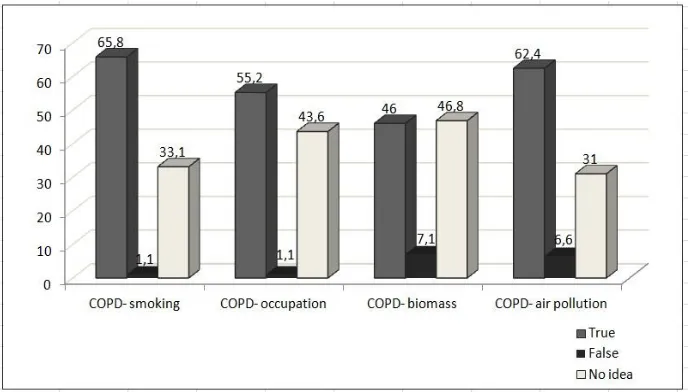
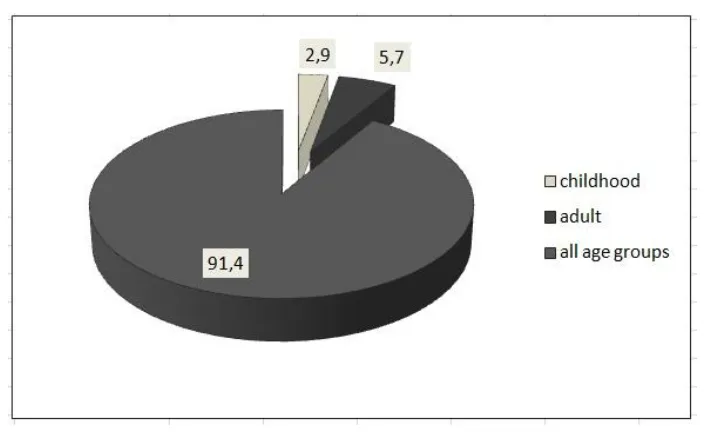
The importance of smoking in the progression of COPD and the most frequent symptoms in COPD namely cough, sputum and dyspnea were known in 65.8% and 60.6% of the population (Fig. 1). Approximately sixty percent of the participants marked that COPD is a disease that affected patients in all age groups (Fig. 2). The importance of smoking cessation in treatment of disease (73.5%) and the role spirometry in diagnosis (69.1%) were relatively well known. The role of occupational exposures, air pollution and biomass exposure on development of COPD was known respectively 55.2%, 62.4% and 46% of the participants. However, only 52% of participants stated that COPD is a lung disease, furthermore information about definition of emphysema and chronic bronchitis, role of prophylactic influenza vaccination and requirement of long-term oxygen therapy were quite low.
The accurate information about age groups that can be affected by asthma and preferred route of treatment administration in asthma were 91.4% and 95.4% respectively (Figs. 3-4).
The symptoms of asthma including cough, dyspnea and wheezing were known in 57.5% of the study population. Totally 72.8% of the participants stated that asthma is not an infectious disease and 66.7% of them said that
asthmatics can perform their daily activities (Fig. 5). Only 38% of the population stated that
asthma medications do not have risk of addiction.
4. DISCUSSION
It was found that awareness of asthma was higher than COPD in religious officials.
Information about preventive strategies such as vaccination in COPD was quite low and misconception about addiction to
inhalers is very common among study participants.
Fig. 2. The percentage of participant’s statements about age groups that COPD can be diagnosed
Fig. 4. The percentage of participant’s answers about preferred route of medication delivery in asthma
Fig. 5. Awareness of the characteristics of asthma in religious officials
Chronic diseases need long-term therapies
however the prevalence of non-adherence to treatment in chronic diseases is quite high [3]. It is known that poor adherence to medications is associated with lack of
knowledge about the disease and treatment; negative beliefs about medications and inadequate information about medication use
[3-5]. So, the education is the first step of the
chronic disease treatment strategies. It is known that both education and religion have a
People with chronic diseases tend to take advices from pharmacists, herbalists and religious officers in our country. We thought that religious officers are especially important because people usually accept and respect their opinion without any suspicion. If a religious official himself believes that asthma medication has addictive effects or vaccination is harmful in COPD, it is not possible to expect from him to advice patients regular usage of inhalers and/or vaccination. So we thought that increase the awareness and offer accurate information about chronic airway diseases to religious officers would be helpful patient education and treatment adherence in these diseases.
There are some previous studies evaluating the role of religion on health. Findings reveal significant associations between several health behaviors, and general and religious social support [12,13]. It has an important role for coping with various medical conditions and serious and fatal diseases such as diabetes mellitus, renal, cardiac and respiratory diseases, cancer, AIDS and chronic pain [9]. Also it helps on issues such as stress, psychological conflicts related with the disease and treatment adherence. Religious involvement is correlated with better overall psychological functioning, greater social support, better physical and cognitive functioning and better health behavior [11].
It is shown that individuals who participate in religious practices avoid the negative behaviors such as smoking and alcohol abuse and participants who often join to religious practices adopt a healthy lifestyle than rarely joiners [14].
Chronic obstructive pulmonary disease is a treatable and preventable chronic disease characterized by irreversible airflow limitation [15]. Although the prevalence of dyspnea and COPD are high in general population, awareness of COPD is limited [16-17]. Risk factors and treatment options of COPD are not well known by patients and health professionals. Lack of knowledge about disease causes under-diagnosis and inadequate treatment. Although, 24% of the participants report having at least one chronic respiratory symptom, the term of ‘COPD’ is identified only by 8.6% of the participants in Miravitlles et al.'s study [18]. Approximately two-fifths of the participants know about the disease by any of its three names (chronic bronchitis, emphysema and COPD), but the remaining 60% of participants know very little to nothing about
the disease [19]. Awareness of COPD is found to be as low as 17% among Canadians when compared with awareness of other major diseases such as breast cancer (95%), HIV/AIDS (95%) and Alzheimer’s disease (94%) [20]. In a study evaluating the awareness of COPD in Turkey, it is reported that nearly half of the population know COPD as a lung disease while others have no idea about COPD [21]. As similar to general population in Turkey, 52% of participants in this study stated that COPD is a lung disease.
Smoking is the most important etiological factor in COPD [15]. Nearly half of the population knows this information in Turkey, while this rate is 69% in Canada [19-21]. Other risk factors related with development of COPD are occupational exposures, biomass fuel for heating, air pollution and airway hyperresponsiveness [2]. Especially exposure to passive smoking and biomass fuel for heating are discriminative for women in non-smoker COPD patients [22]. But, it is not well known in the population. It is reported that study participants were less aware of the etiological factors such as wood smoke, dust and chemicals in Walker et al's study [19]. Approximately fifty percent of the population knows occupational exposures; air pollution and biomass exposure are risk factors of COPD [21]. The role of occupational exposures, air pollution and biomass exposure on development of COPD was known respectively 55.2%, 62.4% and 46% of the participants in our study.
in social media and televisions might be responsible for relatively high awareness of benefits of smoking cessation among participants in this study.
Most common symptoms of COPD are chronic progressive dyspnea, cough and sputum. Twenty four percent of the participants reported having at least one chronic respiratory symptom however only 60% of individuals with chronic symptoms had consulted a physician in Spain [18]. Nearly one third of the population with respiratory symptoms reported that these symptoms might be related with COPD in France [17]. The most frequent symptoms of COPD were known in 60.6% of the population in our study.
Asthma is a chronic airway disease characterized by reversible airflow limitation. Assessment of knowledge level is the first step of asthma management. Asthma can be diagnosed in all age groups [23]. The information about age group distribution of asthma and awareness of asthma as a non-infectious and non-contagious disease were higher in our study than previously conducted population-based study in Turkey (91.4% vs 80% and 72.8% vs 58%, respectively). However awareness of the hereditary feature of asthma was low. As similar, nearly fifty percent of the participants reported that they have no idea about hereditary feature of asthma in Yildiz et al' study [21].
It is known that adherence to medications is associated with lack of knowledge about the disease and treatment; negative beliefs about medications and inadequate information about medication use [3-5]. Fifty five percent of the participants had no idea about the non-additive effects of asthma medication in Turkey [21]. A misconception about additive effects of asthma medication was highest in Brazil (70%) [24]. Only 38% of the participants stated that asthma medications do not have a risk of addiction in this study. We suggested that this data is especially important in chronic airway diseases since it might lead to quit long-term medication and might increase the rate of exacerbation. It is also important that study participants acknowledge inhalation as a preferred route of medication delivery in asthma however they still have uncertainty about their addictive effects. This misconception might cause withheld of medications during asymptomatic periods in asthmatics. As we mentioned above, religious officers are important role models in our country, so their opinion are especially important for the
population. Therefore we suggested that this study is especially important as it provide accurate information on chronic airway diseases to the population who has potential to effect patients with chronic airway diseases.
5. CONCLUSION
Chronic diseases usually require lifelong medical care. The main component of patient adherence to this long-term treatment is education of patient about their disease. Clinicians may think that patients receive medical advice only from health care professionals. In fact, patients are tend to consult their condition to other patients with same disease, to pharmacists, herbalists, teachers, religious officers and take notice of their opinion especially if they promise them complete recovery from disease. It is clear that misinformation of patients would cause interruption of treatment and loss of clinical control in chronic diseases. We suggested that increasing awareness of chronic airway diseases in these profession groups might increase patient adherence to the treatment. We thought that religious officers are especially important in our country because most people accept their opinion almost without any doubt. In conclusion, we suggested that education in chronic airway diseases is not restricted to just for patients and health care professionals, it also should include whole population particularly certain professional groups that may affect behavior of patients with chronic airway diseases.
CONSENT
This was a retrospective study evaluating the results of a questionnaire that was performed voluntarily. Informed consent was obtained from all participants.
ETHICAL APPROVAL
It is not applicable.
COMPETING INTERESTS
Authors have declared that no competing interests exist.
REFERENCES
chronic noncommunicable diseases: Progress and capacity in high-burden countries. Lancet. 2010;376:1861-8. 2. Bourbeau J, Tan WC, Benedetti A, Aaron
SD, Chapman KR, Coxson HO, et al. Cancold Study Group. Canadian cohort obstructive lung disease (CanCOLD): Fulfilling the need for longitudinal observational studies in COPD. COPD. 2014;11(2):125-32.
3. Alhewiti A. Adherence to long-term therapies and beliefs about medications. Int J Family Med. 2014;2014:479596. DOİ: 10.1155/2014/479596
4. Menckeberg TT, Hugtenburg JG, Lammers JW, Raaijmakers JA, Bouvy ML. Knowledge of actions of inhaled corticosteroids in patients who did not persist drug treatment early. Int J Clin Pharm. 2012;34(2):277-81.
5. Bjermer L. The importance of continuity in inhaler device choice for asthma and chronic obstructive pulmonary disease. Respiration. 2014;88(4):346-52.
6. Okumuş E. Religion and socialization. Turkish Studies - International Periodical For The Languages, Literature and History of Turkish or Turkic. 2014;9(11):429-54. 7. Kılavuz MA. The ımportance of religious
education in the patient doctor relationship. Uludag University The Review of the Faculty of Theology. 2002;11(2):73-86. 8. Koenig HG, King DE, Carson VB.
Handbook of Religion and Health. 2nd edition. New York, NY, USA: Oxford University Press; A history of religion, medicine and healthcare. 2012;15-34. 9. Koenig HG. An 83-year-old woman with
chronic illness and strong religious beliefs. JAMA. 2002;288:487-93.
10. Shaheen Al Ahwal M, Al Zaben F, Sehlo MG, Khalifa DA, Koenig HG. Religious beliefs, practices, and health in colorectal cancer patients in Saudi Arabia. Psychooncology; 2015.
DOI: 10.1002/pon.3845 [Epub ahead of print]
11. Al Zaben F, Khalifa DA, Sehlo MG, Al Shohaib S, Binzaqr SA, Badreg AM, et al. Religious involvement and health in dialysis patients in Saudi Arabia. J Relig Health. 2015;54(2):713-30.
12. Debnam K, Holt CL, Clark EM, Roth DL, Southward P. Relationship between religious social support and general social
support with health behaviors in a national sample of African Americans. Behav Med. 2012;35(2):179-189.
13. Koenig HG. Religion, spirituality and health: the research and clinical implications. ISRN Psychiatry. 2012; 16:2012:278730.
14. Koenig HG, Hays JC, Larson DB, George LK, Cohen HJ, McCullough ME, et al. Does religious attendance prolong survival? A six-year follow-up study of 3,968 older adults. Journal of Gerontology: Medical Sciences. 1999;54:370-6.
15. Global Initiative for Chronic Obstructive Lung Disease. Global strategy for the diagnosis, management and prevention of chronic obstructive pulmonary disease, update; 2014.
16. Roche N, Perez T, Neukirch F, Carré P, Terrioux P, Pouchain D, et al. The gap between the high impact and low awareness of COPD in the population. Rev Mal Respir. 2009;26(5):521-9.
17. Roche N, Perez T, Neukirch F, Carré P, Terrioux P, Pouchain D, et al. High prevalence of COPD symptoms in the general population contrasting with low awareness of the disease. Rev Mal Respir. 2011;28(7):58-65.
18. Miravitlles M, de la Roza C, Morera J, Montemayor T, Gobartt E, Martín A, et al. Chronic respiratory symptoms, spirometry and knowledge of COPD among general population. Respir Med. 2006;100(11): 1973-80.
19. Walker SL, Saltman D, Colucci R, Martin L, Canadian Lung Association Advisory Committee. Awareness of risk factors among persons at risk for lung cancer, chronic obstructive pulmonary disease and sleep apnea: A Canadian population-based study. Can Respir J. 2010;17(6): 287-94.
20. National COPD Report card; 2005. Available:www.lung.ca/_resources/2005. copd_reportcard.pdf
(Accessed on October 29, 2010)
21. Yıldız F, Bingöl Karakoç G, Ersu Hamutçu R, Yardım N, Ekıncı B, Yorgancıoğlu A. The evaluation of asthma and COPD awareness in Turkey (GARD Turkey Project-National Control Program of Chronic Airway Diseases). Tuberk Toraks. 2013;61(3):175-82.
smoking-cessation pharmacotherapy among chronic obstructive pulmonary disease (COPD) and lung cancer patients. Current Medical Research & Opinion. 2014;30(6):1043-50. 23. Global Initiative for Asthma. Global
Strategy for Asthma Management and Prevention. Bethesda: National Institutes
of Health, National Heart, Lung, and Blood Institute; 2007.
24. Borges MC, Ferraz É, Pontes SMR, Cetlin Ade C, Caldeira RD, Silva CS, et al. Development and validation of an asthma knowledge questionnaire for use in Brazil. J Bras Pneumol. 2010;36(1):8-13.
_________________________________________________________________________________
© 2017 Baris et al.; This is an Open Access article distributed under the terms of the Creative Commons Attribution License
(http://creativecommons.org/licenses/by/4.0), which permits unrestricted use, distribution, and reproduction in any medium,
provided the original work is properly cited.
Peer-review history: