(ISSN 0022-409X)
JOURNAL
OF
RANGE MANAGEMENT
,__-/ ’ -J ---
‘---. *
-
mEnINLBoss __Y,
- -__._ _
PUBLICATION OF THE
SOCIETY FOR RANGE MANAGEMENT
Volunteer
Paper Solicitation
1981 SRM-Tulsa, Oklahoma February 8-13,1981
Papers for the 1981 SRM meeting will be solicited in ten general categories for synthesis into program units. You are encouraged to plan your participation; a formal call for titles and abstracts will be issued at a later date.
General program categories with topical annotations are: 1.
2.
3.
4.
5.
6.
7.
8.
9.
10.
Range Animals-production; diets and nutrition; wildlife; insects; other animals Range Plants-collection; selection and breeding; germination and establishment;
physiology; morphology; taxonomy
Soil and Water-range watershed management; rangeland hydrology; grazing and water management; soil fertility and management
Range Ecology and Rangeland Ecosystems-succession; fire nutrient cycling; drought; ecosystem classification
Range Management Systems-grazing systems; forest grazing; complementary forage; grazing impact
Range Inventory and Evaluation- range inventory; survey methods; condition and trend; land capability
Range Improvement and land Reclamation- renovation; seeding; brush and weed control; fertilization; reclamation and stabilization of disturbed lands
Sociological and Political Concerns-history; education; communications; technology transfer; international programs
Range Economics and Management-production costs and returns; modeling; computer utilization
Ranching Practices- ranching experiences; enterprise concerns; technology integration
The following policies will apply to volunteer papers:
1. A single individual shall not be author or senior author of more than one title per session. 2. Finished titles and abstracts will be due o/a September 15, 7980. These abstracts will be printed without further editing and will furnish the basis for selection; freshness, clarity, and discreteness of topic will carry considerable weight in the selection process.
3. Individual program segments will be 15 minutes in length. We anticipate scheduled discussion periods at strategic times; program participants are expected to attend as a condition of paper acceptance.
4. Titles and abstracts received after the due date will be considered as alternates. 5. Notification of acceptance/rejection will be in your hands by November 1,198O.
6. Undergraduate students may submit papers to the student conclave or the technical sessions.
Program Committee:
Tom Bedell jim Nichols Dennis Childs Fred Smeins
Fred Gifford Bruce Welch
Bill Krueger j.R. Wight
john Launchbaugh W. G. McCully,
SOCIETY
FOR
RANGE
MANAGEMENT
President
HAROLD F. HEADY 1864 Capistrano Ave.
Berkeley, Calif. 94707
President Elect
JOHN MERRILL XXX Ranch Route 1, Box 54 Crowley, Texas 76036
Past President
DANIEL L. MERKEL 1819 Rainbow Dr. Fort Collins, Colo. 80524
Executive Secretary
FLOYD E. KINSINGER
Society for Range Management 2760 West Fifth Ave. Denver, Colo. 80204 (303) 571-0174
Directors 1978-80
CHARLES M. JARECKI Irvine Flats Polson, Mont. 59860 WILLIAM A. LAYCOCK
130 Fairway Lane Fort Collins, Colo. 80521
1979-81
S. CLARK MARTIN 4402 E. Sixth St. Tucson, Ariz. 85711 JACK R. MILLER
7110 Siesta Dr. Missoula, Mont. 59801
1980-82
FRANK E. BUSBY Route 2 1-A Laramie, Wyo. 82071 S. WESLEY HYATT
P.O. Box 49 Hyattville, Wyo 82428
The term of office of all elected officers and directors begins in February of each year during the Society’s annual meeting.
Contribution Policy
The Society for Range Management may accept dona- tions of real and/ or personal property, subject to limitations imposed by State and Federal Law. All donations shall be subject to control by the Board of Directors and their discre- tion in utilization and application of said donations. How- ever, consideration may be given to the donor’s wishes concerning which particular fund account and/ or accounts the contribution would be applied.
We recommend that donor consult Tax Advisors in regard to any tax consideration that may result from any donation. Donations may be made by bequests, legacies, devises or transfers from private individuals, partnerships, corpora- tions, foundations, sections, organizations, estates, and trusts, or a memorial fund established as an expression of remembrance to members of real and/ or personal property. Donations can be sent to the Society for Range Manage- ment, Executive Secretary, 2760 West Fifth Avenue, Denver, Colorado 80204.
The Society for Range Management, founded in 1948 as the American Society of Range Management, is a nonprofit association incorporated under the laws of the State of Wyoming. It is recognized exempt from Federal income tax, as a scientific and educa- tional organization, under the provisions of Section 501(c)(3) of the Internal Revenue Code, and also is classed as a public foundation as described in Section 509(a)(2) of the Code. The name of the Society was changed in I97 1 by amendment of the Articles of Incorporation.
The objectives for which the corporation is established are:
-to develop an understanding of range ecosystems and of the principles applicable to
the management of range resources;
-to assist all who work with range resources to keep abreast of new findings and
techniques in the science and art of range management;
-to improve the effectiveness of range management to obtainfrom range resources the
products and values necessary for man S welfare;
-to create a public appreciation of the economic and social benefits to be obtained
from the range environment;
-to promote professional development of its members.
JOU RNAL OF
RAN GEMANAGEMENT
Published bimonthly-January, March, May, July, September, November
Copyright 1980 by the Society for Range Management
Managing Editor FLOYD E. KINSINGER
2760 West Fifth Avenue Denver, Cola. 80204 Technical Editor REX D. PIEPER
Dept. of Animal 8 Range Sciences New Mexico State University Las Cruces, N.M. 88003 Book Review Editor RICHARD E. FRANCIS
Rocky Mtn. Forest & Range Experiment Station 240 West Prospect Fort Collins, Colo. 80521 Production Editor PATRICIA G. SMITH
2760 West Fifth Avenue Denver, Colo. 80204 Editorial Board 1978-80
DONALD A. KLEBENOW, Reno, Nev. JAMES T. NICHOLS, North Platte, Neb. MICHAEL D. PITT, Vancouver, B.C. RONALD E. SOSEBEE, Lubbock, Tex. 1979-81
ROD BOVEY, College Station, Tex. NEIL FRISCHKNECHT, Provo, Utah MARTIN VAVRA, Union, Ore. HAROLD GRELEN, Pineville, La. 1980-82
HENRY MAYLAND, Kimberly, Ida. JOHN MENKE, Davis, Calif. STEPHEN SHARROW, Corvallis, Ore. PHILLIP URNESS, Logan, Utah
TABLE OF CONTENTS:
Vol. 32, No. 2, March 1980
ARTICLES 83
85
89
95
99
101
104
107
111
115
119
122
126
INDIVIDUAL SUBSCRIPTION is by membership in 129 the Society for Range Management.
LIBRARY or other INSTITUTIONAL SUBSCRIP- TIONS on a calendar year basis are $28.00 postpaid 132 to all countries. Payment from outside the United States should be remitted in US dollars by interna- 136
tional money order or draft on a New York bank. BUSINESS CORRESPONDENCE, concerning sub- scriptions, advertising, reprints, back issues, and 143 related matters, should be addressed to the Manag- ing Editor, 2760 West Fifth Avenue, Denver, Colo.
80204. 146
EDITORIAL CORRESPONDENCE, concerning
manuscripts or other editorial matters, should be 150 addressed to the Technical Editor, Dept. of Animal and Range Sciences, New Mexico State University,
President’s Address: SRM’s Future-Dreams or Opportunities by Daniel Merkel
Long-term Effects of Fire on Cactus in the Southern Mixed Prairie of Texas by Stephen C. Bunting, Henry A. Wright, and Leon F. Neuenschwander
New Collections of Range Plants from the Soviet Union by D.R. Dewey and A.P. Plummer
Brush Control and Rio Grande Turkeys in North-Central Texas by Dee A. Quinton, Alan Kent Montei, and Jerran T. Flinders
Organic Solvent-Soluble Organic Matter from Soils Underlying Native Range and and Crested Wheatgrass in Southeastern Alberta, Canada by J.F. Dormaar, A. Johnston, and S. Smoliak
Root Distribution in l- to 48-Year-Old Stripmine Spoils in Southeastern Montana
by John W. Wyatt, Douglas J. Dollhopf, and William M. Schafer
Responses of Falsemesquite, Native Grasses and Forbs, and Lehmann Lovegrass after Spraying with Picloram by S. Clark Martin and Howard L. Morton
Contributions of White Clover to the N,P, and Ca Concentration of Perennial Grasses by James W. Dobson and E.R. Beaty
Perennial Grasses and Their Response to a Wildfire in South-central Washington
by D.W. Uresk, W.H. Rickard, and J.F. Cline
Chemical Scarification, Moist Prechilling, and Thiourea Effects on Germination of 18 Shrub Species N.D. Stidham, R.M. Ahring, J. Powell and P.L. Claypool
Nitrogen Fertilization of Range: Yield, Protein Content, and Cattle Behavior by M.J. Samuel, F. Rauzi, and R.H. Hart
The Response of Native Vertebrate Populations to Crested Wheatgrass Planting and Grazing by Sheep by Timothy D. Reynolds and Charles H. Trost
Fall and Winter Diets of Feral Pigs in South Texas by J.H. Everitt and M.A. Alaniz
Food Habits of the Plains Pocket Gopher on Western Nebraska Rangeland by Dale G. Lute, Ronald M. Case, and J. Stubbendieck
Factors Influencing the Feed Intake and Liveweight Change of Beef Cattle on a Mixed Tree Savanna in the Transvaal by Ibo Zimmermann
Habitat and Dietary Relationships of the Pygmy Rabbit by Jeffrey S. Green and Jerran T. Flinders
Range Grasses and Their Small Grain Equivalents for Wind Erosion Control by Leon Lyles and Bruce E. Allison
Bite-count vs Fecal Analysis for Range Animal Diets by Kenneth D. Sanders, Bill E. Dahl, and Gretchen Scott
Microhabitat Relationships of Six Major Shrubs in Navajo National Monument, Arizona by John A. Fairchild and Jack D. Brotherson
Las Cruces, N.M. 88003. TECHNICAL NOTES
INSTRUCTIONS FOR AUTHORS appear on the
inside back cover of each issue. 157 Seasonal Concentration and Toxicity of Saponins in Alfombrilla by M. Coburn
THE JOURNAL OF RANGE MANAGEMENT (ISSN Williams and Luis C. Fierro
0022-409X) is published six times yearly for $28.00
per year by the Society for Range Management, BOOK REVIEWS 2766 West- Fifth Avenue, Denver, Cola.- 80204.
SECOND CLASS POSTAGE paid at Denver, Colo. 158 Common Texas Grasses-An Illustrated Guide by Dr. Frank W. Gould; Hand- POSTMASTER: Return entire journal wlth address book of Tropical Forage Grasses by B. Ira Judd; Plant Strategies and Vegetation change-RETURN POSTAGE GUARANTEED-to Process by J.P. Grime.
Society for Range Management, 2760 West Fifth Avenue, Denver, Colo. 80204.
President’s Address
SRM’s Future-Dreams
or Opportunities
Daniel L. Merkel
It has truly been an honor and privilege to serve you as president during the past year. I sincerely appreciated this opportunity to work for you and the profession of range management. 1 hope I have given as much to improving the world’s rangelands as I have gained from the experience you provided me.
The president’s address has been used by many of your presi- dents in the past as a State of the Society message. They have informed the membership of the important SRM programs and notable accomplishments of the last year; recognized the dedicated work of members, chapters, sections, committees, advisory council and board; and looked to the future.
These are important and topics that I would like to discuss. You have, however, had the opportunity during the year to become familiar with many of the current and recent range activities. Executive Secretary Floyd Kinsinger has outlined the current administrative situation. And like other presidents, I have been blessed with the services of many active members to whom the accomplishments of the past year belong. Anything I could say here would be inadequate to properly express my appreciation for their assistance.
Therefore, 1 want to use this opportunity to look to the future- to share my dreams for the Society for Range Management, with you. I want you to put asidethose ideas that’% can’t be done,““lt’s been tried,““That’s not the real world,“and “What’s happened to him?’ I want you to evaluate the posslblhtles if we are willing to dedicate ourselves to becoming the best of societies, Then 1 will let you separate the dreams from the opportunities in SRM’s future.
You must first recognize that we are small in number, about 5,700 today, but our mission is to improve the management of the world’s rangelands, which influence the lives of millions of individ- uals and almost every nation. We are young as an organized Society and recognized profession, but we are mature and expe- rienced among thegroupsconcerned with theenvironment. Weare poor financially, but we are rich in knowledge and dedication to our goals. We are inexperienced in the political arena; but we are recognized for our honesty and desire to do the right thing. We have determined that SRM should be the leader in rangeland issues; but we are uncomfortable when called on to act rather than react. We have said that we should exercise self-evaluation and flexibility to change the Society, when necessary, to better serve the members and public, but we resist change or breaking tradition. We provide assistance to many; but we are a pawn to no one.
To look to SRM’s future, we must evaluate thepastandpresent. You are aware that for most of civilization, rangelands have been the “forgotten resource,” that area that was left over, or, “land unsuitable for cultivation,” or as one of our members often says, “The bastard child at the family reunion.“It was not until people
became concerned about their supply ofhigh quality low cost food,
water, recreation, and energy that they recognized the value of those “wastelands.”
Then the instant experts and interested groups sprouted like cheatgrass after a fall rain. They quickly recognized, with our help, that less than desirable conditions existed on much of the world’s rangelands. They did not study the early history of range use and the progress that had been made by SRM members and others to improve rangelands that had been damaged throughout history. In place of recognizing the long, silent battle to conserveand improve our range resources, they often searched for the bad guys to wear the “black hat.” The livestock industry and range managers won the booby prize. The rancher was given credit for learning and using the three R’s-Rape, Ruin, and Run. The range managerwas pictured as being on a sagebrush picnic without his marbles.
Fortunately, we have passed the stage of people trying to estah- lish blame, and most are seeking constructive methods to speed up rangeland improvement. This almost universal support for increased authority and resources for range improvement has resulted in unprecedented response by legislative bodiesand man- agementment, research, and technical assistanceagencies. This has resulted in a more involved, better informed public to work with and respond to both through the Society and in our regular employment.
With this background, please let me outline the role I believe the Society must assume if we are to emerge as the international leader in directing this oew interest in a productive and constructive manner. We must:
I. Be rhesourceofandprovi lechnicolossirlonceonthedevelopment of rangeland policy. We should build an identity and reputation that would inspire any person responsible for legislation or policy to seek our advice and assistance. The help should then be provided by any level of the Society to any level of authority.
2. Do an even better job ofim~roving rhepublick oworeness, interna- tionally, of the function rangelands perform in the production of food and fiber; in the protection of the environment: and in meeting human needs. Although tbereisagrawinginterestinrangeimprovcment, those that are supportive and concerned represent a small percentage of the population. Many of those that seek better range conditions are not aware that improvement can result from proper management for pro- duction: and, the resource need not be excluded from use. We need to develop more innovative methods of telling people ttbat when range- land is managed properly, we can have our cake and eat it too. ,. Furrher ,he undemanding
of
and oppreciolion for the role range performs in meeting the social, cultural, and political needs of people. More than any other thing, failure to recognize these factors in our work and to identify their importance to others has limited application ofavailable technology. In thisarea, we havcagrcatdealtolearn before we arc effective in spreading the message.4. Provide the base to increase and improve the professional level of the individuals and institutions associated with the science and manage- ment of rangelands. Although the Society has established a certification program for consultants and an accredition procedure for educational institutions; provides access to the most recent technology through SRM publications and meetings; and is working to improve U.S. Civil Service employment standards we recognize there are unqualified and substandard individuals and institutions involved in range management.
5. Through programs, provide the media for technology transfer for all those interested in the science and applications of range science infor- mation. Although this was one of the major objectives of the Society’s formation, we must greatly improve the rate of field application of range research results. We must improve the way we package new technology and seek better methods of directing it to the correct audiences.
6. Develop SRM as a recognized body serving a lead role in manage- ment of the world’s rangelands. With the growing interest in and demand on the range resource, the Society must provide the leadership to improve the management of rangelands around the globe or by default allow other groups without needed range knowledge and expe- rience to assume our role. We must explore new, more innovative methods of working on an international level.
7. Take leadership in providing a forum for the dissemination and exchange of range science information. The Society’s annual meetings have long provided an excellent forum for the exchange of information among members. The Society must extend this role beyond its standard meetings and membership. There is a need for SRM to expand its role of hosting, sponsoring, or co-sponsoring important meetings address- ing range topics for more non-members.
8. Encourage a sound basic and applied research program aimed at the expansion of rangeland management knowledge. One cannot overstate the progress that has been made by the SRM Research Committee since it was formed at the 1977 summer meeting. There is more support for and interest in range research than has existed in recent history. This
new attention to range research, however, has not resulted in major increases in resources for research. The Society must, therefore, con- tinue to push for quality rangeland research.
Are these eight items dreams or opportunities? Your Board of Directors considered them reasonable and achievable responsibili- ties of the Society in 1978 when they were identified as the long- range SRM goals. The 1979 and 1980 Society’s Programs of work described initial steps to accomplish each of these. I am proud, as you should be, of the progress SRM has made in changing these goals into accomplishments. This progress has been made by dedi- cated committee members, Board of Directors, executive secretar- ies and Headquarter’s office staff under trying conditions.
In spite of this first step, we have many miles to go before we can honestly say we have assumed a leadership position that will establish SRM as the best of professional societies. This journey will require greater efforts by more of our members, an increased membership; a sound and expanded financial base, increased staff; more visible representation in the centers of government; more professional and higher standards in all range activities; improved communications within and outside the Society; more cooperative efforts with other natural resourse, interest and user groups and agencies; and, a greatly expanded international program.
Yes, we must do all this and more if we are going to capitalize and the current interest in and attention to natural resourses.
It would be easy to withdraw from our professional responsibili- ties at this time of major SRM financial crisis. The profession, Society, and world’s rangelands cannot afford for us to take the easy way out. We need to continue to move aggressively forward in accomplishing the Society’s goals, while solving our current budget problems and building a solid future financial program.
SRM’s members are the masters of the Society’s future. Dreams may pass, opportunities be missed, goals go unachieved, and future generations suffer if we fail to respond to the range management challenge of the 1980’s.
Call for Papers
The XIV International Grassland Congress will be held on the campus of the University of Kentucky, Lexington, June 15-24, 198 1. It will include seven pre- or post-Congress tours to leading forage-producing areas of the United States and Canada. The formal program will include ten plenary papers and about 300 volunteer papers. Plenary and volunteer papers will be published. Paper titles and 500-word summary statements must be submitted by May 1, 1980, to Congress headquarters in Lexington on a form included in the brochure. Write for your copy of the brochure and send your title and summary to XIV International Grassland Congress, Agricultural Sciences Center, University of Kentucky, Lexington, Ky. 40546.
Long-term Effects of Fire on Cactus in the
Southern Mixed Prairie of Texas
STEPHEN C. BUNTING, HENRY A. WRIGHT, AND LEON F. NEUENSCHWANDER
Abstract
Few brownspine pricklypear were immediately killed by the direct effects of fire. Most plants resprouted after burning in the spring, but mortality averaged 70% by the end of the fourth year after burning. Interactions of fire with insects and rodents caused most of the brownspine pricklypear mortality. Walkingstick cholla and tasajillo were more directly affected by fire than brownspine pricklypear. First-year mortality was 40 to 65%, respectively; and fourth year mortality was 57 to 80%. Mortalities of other minor species of cactus varied from 49 to 100%.
The increase of cactus on grassland ranges, particularly in the Southwest, has been a problem for many years. During a 17-year period (1932-1949) in southern Arizona, jumping cholla (Opuntia fulgida) increased from 5 to 368 plants/ha, cane cholla (0. spinosior) increased from 14 to 785 plants/ha, and Engelmann pricklypear (0. engelmannii) increased from 0 to 74 plants/ha in a grazed area (Glendening 1952). On an ungrazed area, percentage increase for cane cholla and Engelmann pricklypear were similar to the increases on a grazed area over the same period of time (Glendening 1952). These data indicate that neither reduced grazing pressure nor increasd grass competition will prevent the increase of cacti density.
However, Cook ( 1942), working in the Central Great Plains with pricklypear (0. humifusa), observed that ranges with dense stands of grass also supported high populations of Meliterc~ dentclta, a cactus feeding moth, during years with above- average precipitation. The cactus feeding moth was a major factor in reducing cactus density. Ranges in poor condition did not have high enough populations of moths to cause cactus mortality. Thus, reduced grazing pressure in combination with above-normal moisture can reduce the density of cacti, at least on the eastern edge of cacti ranges. Drouths favor cacti throughout their range (Cook 1942; Houston 1963)) and fire and animal use are left as the primary factors to control their density (Humphrey 1958).
High densities of cactus plants can reduce forage production and utilization. Rea and Pieper (1973) found that controlling walkingstick cholla (0. imbricata) on blue grama (Bouteloua grcrcilis) range increased herbage production by 20% and utilization by 9%. Bement (1968), however, was unable to show an increase in herbage production after control of plains pricklypear (0. polyacuntha).
Authors are assistant professor of range management, College of Forestry, Wildlife, and Range Sciences, University of Idaho, Moscow 83843 and Horn professor of range management, Texas Tech University, Lubbock, Texas 79409; and assistant professor of Forestry, College of Forestry, Wildlife, and Range Sciences, University of Idaho, Moscow 83843.
This research is a contribution of the College of Agricultural Sciences, Texas Tech University, Publication Number T-9-184.
Manuscript received February 16, 1978.
JOURNAL OF RANGE MANAGEMENT 33(2), March 1980
Cactus plants vary in their response to fire, depending on species, size, and how soon they are observed after a fire. In Arizona, Humphrey and Everson ( 195 1) found that 1 year after a fire the densities of Englemann pricklypear, jumping cholla, and cane cholla had decreased 9, 29, and 7%, respectively. However, Reynolds and Bohning (1956) reported that a prescribed fire reduced densities of barrel cactus (Feroctrctus rvislizeni) 67%, jumping cholla 44%, cane cholla 45% and Engelmann pricklypear 28% after 2 years. Similarly, Cable (1967) found that fire reduced densities of jumping cholla 63%, cane cholla 45%, and Engelmann pricklypear 32% by the second year after a fire. In Texas, mortality of brownspine pricklypear (0. phaeuccrnthcl) was 20% the year after burning and 68% after the second year (Heirman and Wright 1973). Thus, first year mortality is not an adequate indication of the effect of fire on cacti mortality.
Small cacti are more susceptible to fire damage than the taller plants (Dwyer and Pieper 1967; Heirman and Wright 1973). Density of walkingstick cholla less than 0.3 m tall was reduced 50%, but larger plants were not severely damaged by fire (Dwyer and Pieper 1967). Hierman and Wright (1973) found that the mortality of walkingstick cholla less than 0.3 m tall was 81%, and for those greater than 0.3 m tall, mortality was 45%. They observed little difference in the mortality of large (2 10 pads) and small (< 10 pads) brownspine pricklypear.
The purpose of this study was to measure the long-term effect of fire and drought on three major cactus species-brownspine pricklypear, walkingstick cholla, and tasajillo (0. Iepto- c*crlrlis)-and several less common species in West Texas.
Study Area and Methods
This study was conducted in Callahan, Garza, and Mitchell counties, Texas, which lie within the Southern Mixed Prairie. Topography of the Beckham Ranch, in Callahan County, is level to undulating with some areas dissected by steep canyons. The average precipitation is 66 cm. The soil is a limestone-derived stony loam. The area is dominated by little bluestem (Schizachyrium scoparium), buffalograss (Buchloe ductyloides), sideoats grama (Bouteloua curti- pendula), and Texas wintergrass (Stipu leucotrichu). Several species of oak (Quercus sp.) and ashe juniper (Juniperus ushei) are interspersed with the grasses. The large juniper had been dozed before burning.
Study sites on the Dalby Ranch, in Garza County, were located on a level area dominated by tobosagrass (Hiluriu muticu) and alkali sacaton (Sporobolus uiroides) with an overstory of walkingstick cholla and honey mesquite (Prosopis glundulosu var. glundulosu) less than 1.2 m tall. The average annual precipitation is 48 cm and the soil
is a heavy clay vertisoi.
Study sites on the Renderbrook-Spade Ranch in Mitchell County were located on a level to undulating tobosagrass-mesquite com- munity. Untreated mesquite are medium-sized trees (3 to 4 m), but had been sprayed with 2,4,5-T[2,4,5,-trichlorophenoxy) acetic acid] 6 years before the first prescribed fire. The average annual precipitation is 50 cm and the soil is a clay vertisol.
Brownspine pricklypear were permanently marked with iron stakes on prescribed spring burns on the Beckham Ranch in 197 1, and on the Renderbrook-Spade and Dalby Ranches in 1972 and 1974. Additional pricklypear plants had been marked on a wildfire that occurred on the Dalby Ranch in July, 1970. Tasajillo were permanently marked on the Renderbrook-Spade Ranch in 1973 and 1974. Walkingstick cholla were marked on two prescribed fires on the Dalby Ranch in the spring of 1973. Smaller numbers of less common cacti, devil’s pincushion (Echirlocuctw te.uensis), A4c~mmillarin yummifercr, star cactus (Cory- phtrrlthtr vilVj3crrcr), Echinocereus reichenbcrchii and Engelmann pricklypear were also marked. Mortality was based on a total of 600 brownspine pricklypear, 200 walkingstick cholla, 175 tasajillo, 79 devil’s pincushion, 66 mammilluric~ ywnmifern, 10 star cactus, and 18 Echirlocereus reichertbcrchii.
Brownspine pricklypear was divided into size classes by pad counts ( 1 - 10, 1 I-25, and >25) and cholla and tasajillo by height (50.6 m and ~0.6 m tall). Mortality was recorded during July and December each year until December, 1976. Mortality was determined by the absence of living tissue above ground on permanently marked plants on each sampling date. Subsequent mortalities were accumulative for every species on each prescribed burn. An individual cactus plant might be recorded as “dead” on one date and then resprout and be recorded as “living” on a following date. This resulted in a decline in mortality for tasajillo during some years. Chi-square analysis was used to test for differences in mortality between burned and unburned treatments and between size classes of cacti plants.
Results and Discussion
Brownspine Pricklypear
Fire caused little immediate mortality of brownspine pricklypear. The plants were usually top-killed, but within a few weeks after the burn all had resprouted. Average mortality was only 20% at 6 months after the fire. By the end of the third year, however, mortality exceeded 70% (Fig. 1). After the third year, mortality of pricklypear increased about the same rate as it did for the unburned plants.
Mortality during the first 3 years apparently was caused primarily by fire weakening the plant and making it more susceptible to damage by insects, rodents, and rabbits. Insects entered the plant through fire-scarred tissue and spread to the young living pads, opening the plant to bacterial and fungal infections. Pads sprouting from burned plant tissue often lost their vascular connection to the root system because of insect damage and decay. Plants sprouting from the root crown survived for a longer period but many of these also died. Most of the plants that survived after 3 years, however, had sprouted from the root crown.
Young pads require several weeks before the spines are fully developed. During this time they are frequently browsed by lagomorphs and rodents. This is particularly important during the winter and dry summers when other green material is scarce. The mortality of both burned and control (unburned) plants increased during years when precipitation was below average. Over 50% of one set of control pricklypear plants located on a shortgrass site died during one drought year, probably because they were easily visible and eaten by lagomorphs and rodents. Only 8% of the control plants on tobosagrass sites died during this period. The taller grasses on these sites seem to provide
88
100
80
20
OPUNTIA IMBRICATA 80
e 60
:
g 40. /f--
B”RN
OPUNTIA PHAEACANTHA
20 -
’ CONTROL
l -. l 9
100
80
20
OPUNTIA LEPTOCAULIS
_ BURN
l
-l
YEARS AFTER BURN
Fig. 1. Mortality of Opuntia phaeacantha, 0. imbricata and 0. leptocaulis qfrer prescribed burning in early spring. Mortality was caused by a combination of damage by fire, insects, and rodents.
more protection against browsing by small animals. Cactus plants growing in shortgrass (i.e. buffalograss), however, are less susceptible to fire-induced damage. Drought and drought- induced browsing may be major factors in reducing prickly pear densities on shortgrass sites.
At the end of the first year the small plants (I to IO pads) had a higher mortality than the large plants (> 10 pads), but by the end of 3 years there were no significant differences between the size classes of pricklypear (Table 1).
Walkingstick Cholla
Fiie had a more direct effect on the mortality of walkingstick cholla than on brownspine pricklypear. At the end of the first year over 40% of the walkingstick cholla plants had died. Most of the plants that died were less than or equal to 0.6 m tall. Over 60% of the shorter plants died, whereas, only 16% of the plants greater than 0.6 m tall died. At the end of 3 years, mortalities were 73 and 27%, respectively, for the short (~0.6 m) and tall (>0.6 m) plants Table 2); total mortality was 53%. Beginning with the fourth year, mortality of burned and unburned plants
increased at the same rate. In Arizona, Martin et al. (1974) reported that density of cholla may actually increase after fire as aresult ofjoints falling from the plants and taking root. This was not observed with walkingstick cholla in West Texas.
Neither drought nor the activity of rodents and insects appears to have as much effect on mortality of cholla as on pricklypear. The bases of some walkingstick cholla plants were stripped of the green epidemml tissue but most plants were able to recover. The woody interior may protect the vascular system of the plant. Mortality of control plants was about 2%lyear throughout the study.
Tasajillo
fiie. After the first year, increases in mortality of burned and control plants were the same.
Tasajillo was affected more by drought than was walkingstick cholla. During 1974 when spring and summer precipitation was 30% below average, 22% of the control plants and nearly 20% of the plants on a 2-year-old burn died. Some plants resprouted after precipitation fell the following year, accounting for the decrease in mortality after the second year (Fig. 1). Little damage was observed that might have been caused by insects or rodents to either burned or control plants.
Other Cacti Species
The numbers of several other species of cactus studied were small but some inferences on their response to fire are possible. Mortality of devil’s pincushion occurred gradually after fire. They were also attacked by rodents and insects after the epidermis was damaged by heat, resulting in the growing center being eaten from many of the plants. After 3 years,
devil’s pincushion was over 40% (Table 3).
mortality of
Table 3. Percent mortality of various cactus species in relation to years after a prescribed burn in tobosagrass (6,000 kg/ha) in West Texas.
Number of Years after bum
Species plants 1 2 3 4
Echinocuctus texewsis 30 44 49
Murntnillnrin gunwifera ;z :I 70 73 74
Echinocereus reicherlbachii 18 17 89 94 -
Cogphanthn viviparci 10 100 100 100 100
Mammillaria gummifera and Echinocereus reichenbachii plants were severely damaged by fire. At the end of the first year after burning, mortalities were 33 and 17% respectively. Two years later, mortalities were 71 and 89% and did not change appreciably thereafter. Most surviving plants were in areas with less than 1,000 kg/ha of fine fuel. Star cactus was very susceptible to fire (Table 3). This may partially explain its rare occurrence except on rocky, lightly vegetated sites.
Engelmann pricklypear plants were not seriously injured by most of the grass fires. The center of the plants usually contained light grass cover due to small animal activity. This combined with its upright growth form resulted in only the peripheral pads of Engelmann pricklypear being damaged by fire. The average size of the plants was reduced, but most individuals survived. Plants less than 0.3 m tall and plants in areas with more than 6,000 kg/ha of fine fuel reacted to fire much like brownspine pricklypear.
Conclusions
Prescribed burning effectively controlled the density of several species of cacti in West Texas. Of 8 species studied, all except Engelmann pricklypear suffered mortalities of at least 49% by the fourth year after burning. Mortality of some species was a direct effect of fire while fire-induced interactions with insects, rodents, and disease caused the mortality of other species to increase for several years after fire.
Mortality of brownspine pricklypear was 20% at the end of the first year and increased to 70% by the end of the fourth year.
Mortality increased at the same rate as natural mortality after the fourth year. At the end of the first year, percent brownspine pricklypear mortality caused by fire decreased as the size of the plant increased. However, by the end of the third year after the bum, there were no significant differences in the mortality of the different size classes of brownspine pricklypear.
Walkingstick cholla were more directly affected by fire than brownspine pricklypear. Mortality was 40% at the end of the fist year and increased to 57% by 4 years after burning. Cholla less than 0.6 m tall were much more severely affected than the taller plants. After 3 years the mortality of short and tall plants was 73 and 27%, respectively.
Mortality of tasajillo was 65% at the end of the first year and increased at the same rate as the control plants after the first year. Many plants were killed directly by fire and failed to resprout. No differences were observed in the mortality of the different size classes of tasajillo, but most were less than 0.6 m tall. Tasajillo was the most drought sensitive of the cactus species studied.
Mortality of Echiwcnctus texeruis, Mnmrnillarin gurniferc~, and Echiuocereus reichevbcrchii at the end of 3 years was 44, 73, and 94%, respectively. The interaction of other factors with fire caused mortality of these cacti to increase over this period. Star cactus, however, was killed directly by fire. All plants were dead at the end of the first year after burning.
Engelmann pricklypear was resistant to most grass fires unless there were fine fuel accumulations greater than 6,000 kg/ha. The lack of fuel beneath the canopy and the tall growth form resulted in only the outer pads being damaged. The size of the plant was reduced but most survived the fire.
Literature Cited
Bement, R.E. 1968. Plains pricklypear: relation to grazing intensity and blue grama yield on Central Great Plains. J. Range Manage. 21:83-86. Cable, D.R. 1%7. Fire effects on semi-desert grasses and shrubs. J. Range
Manage. 20:170-176.
Cook, C.W. 1942. Insects and weather as they influence growth of cactus on the Central Great Plains. F’ology 23:209-214.
Dwyer, D.D., and R.D. Pieper. 1967. Fire effects on blue grama-pinyon- juniper rangeland in New Mexico. J. Range Manage. 20:359-362. Glendening, G.E. 1952. Some quantitative data on the increase of mesquite
and cactus on a desert grassland range in southern Arizona. Ecology 33:3 19-328.
Heirman, A.L., and H.A. Wright. 1973. Fire in medium fuels of West Texas. J. Range Manage. 26:33 1-335.
Houston, W .R. 1%3. Plains pricklypear, weather, and grazing in the Northern Great Plains. Ecology 44:569-574.
Humphrey, R.R. 1958. The desert grassland, a history of vegetational change and an analysis of causes. Bot. Rev. 24:193-252.
Humphrey, R.R., and A.C. Everson. 1951. Effect of tire on a mixed grass- shrub range in southern Arizona. J. Range Manage. 4:264-266.
Martin, SC., J.L. Thames, and E.B. Fish. 1974. Changes in cactus numbers and herbage production after chaining and mesquite control. Prog. Agr. in Ariz. 2613-6.
Rea, K.H., and R.D. Pieper. 1973. Interference between cholla cactus
(Opuntiu imbricutu) (Haw) D.C.) and herbaceous range vegetation. New Mexico Agr. Exp. Sta. Res. Pap. 244. 7 p.
Reynolds, H.G., and J.W. Bohning. 1956. Effects of burning on a desert grass-shrub range in southern Arizona. Ecology 37:769-776.
Wright, H.A. 1972. Fire as a tool to manage tobosa grasslands. Proc. Tall Timbers Fire Ecol. Conf. 12:153-167.
’
New Collections
of Range Plants from the
Soviet Union
D.R. DEWEY AND A.P. PLUMMER
Abstract
Range revegetation in the temperate arid and semiarid regions of the United States has been accomplished to a considerable extent with species introduced from Asia, particularly the Soviet Union. Only a small part of the Asian range-forage germplasm has been collected and evaluated in the United States. A 45-day plant- collecting expedition was authorized during the summer of 1977 to five locations in the U.S.S.R.-Stavropol, Tselinograd, Alma Ata., Dzhambul, and Chimkent. About 1,100 seed collections were made of 250 species, most of which were grasses and legumes from arid or semiarid sites. Large collections were made of Agropyron
cristatum, A. deseriorum, A. intermedium, A. repens, Bmnus
inermis, Dactylis glomerala, k’estuca sulcata, Medicago falcata- romanica, M. saliva, and Trifolium ambiguum. All collections have been established at Logan, Utah. Preliminary observations indicate that certain collections may be useful for forage or conservation purposes on rangeland. All accessions have been entered into the National Plant Germplasm System, and seed will be available for research and evaluation purposes in 1979 or succeeding years.
The United States is a “have-not” nation with respect to native agriculturally important plant species. For example, the small grains (Triticum, Hordeum, Secale) come from Eurasia; rice (Oryzu sativa) and soybeans (Glycine max) from the Far East; and tomatoes (Lycopersicon esculentum) and potatoes (Solanum tuberosum) from South America (Harlan 1976). Even corn (Zea mays) is not indigenous to the U.S., but had its origin in Central America. We are equally dependent on other parts of the world for our major forage crops- the alfalfas (Medicago), clovers (Trifolium), and grasses (Bromus, Dactylis, Agropyron, Festuca).
Much of the revegetation of temperate arid and semiarid western rangeland has been accomplished with introduced grasses-viz. crested wheatgrass (Agropyron cristatum, A. desertorum), intermediate wheatgrass (A. intermedium, A. trichophorum), tall, wheatgrass (A. elongatum), and Russian wildrye (Elymus junceus). On the upper foothills and higher mountain ranges, restoration depends heavily on other introduced grasses including smooth bromegrass (Bromus iner’mis), meadow foxtail (Alopecurus pratensis), orchardgrass (Dactylis glomerata), and tall oatgrass (Arrhenatherum elatius).
In recent years, more emphasis has been given to the use of native plants in range revegetation (Plummer et al. 1968), and considerable sentiment prevails that native plants should be used to the exclusion of exotics. Plant breeders and range scientists must be committed to the best plant materials regardless of their geographic origin. To do otherwise would unnecessarily hinder range improvement.
Authors are research geneticist, SEA-AR, U.S. Department of Agriculture, Utah
State University, Logan, Utah 84322, and range scientist, Forest Service, U.S. Dep. Agr., Shrub Sciences Laboratory, Brigham Young University, Provo, Utah 84602.
This report is approved as Journal Paper No. 2392, Utah Agricultural Experiment Station.
Manuscript received February 13, 1979.
Although millions of acres have been seeded to crested wheatgrass, most of these seedings can be traced back to no more than a dozen introductions (Dillman 1946). The genetic base of the intermediate wheatgrass and Russian wildrye grown in the U.S. is even narrower than that of crested wheatgrass. The recent increased awareness of the genetic hazards of seeding large acreages to a single species with a narrow genetic base has stimulated the search for additional sources of grasses, forbs, and shrubs to be used in mixed plantings on range. Recognizing the need to expand the germplasm base of forage plants commonly seeded on arid rangeland, the U.S. Department of Agriculture sponsored a plant-collecting expedition to the Soviet Union. After lengthy negotiations a 45day expedition (Fig. 1) July 18-August 3 1, 1977, was authorized for two plant collectors (D.R. Dewey and A.P., Plummer) and an interpreter (L.E. Law).
Collecting Procedures
The Soviets provided land transportation and local
Fig. 1. Route of plant-collecting team in the Soviet Union in the summer of 1977.
escorts. Land transportation usually consisted of durable 4- wheel drive vehicles, which permitted access to rough off- road terrain (Fig. 2).
Most collections were made as seed. The size of individual collections ranged from less than 100 seeds to several thousand, depending on the size of the seed, its availability, and the size and nature of the population being sampled. Vegetative cuttings or seedlings were taken from some of the woody species that did not have seed at the time ofourvisit. However, all of the vegetative material was subsequently lost in a fire at the U.S. Embassy in Moscow
in
August 1977. Most collections were made in the wild, although local botanical gardens and agricultural institutes sometimes shared seeds from their collections.We usually had the services of a local botanist who provided many of the species identifications, some of which are yet in doubt. All seed was inspected by Soviet plant quarantine officers before shipment to Moscow, Upon entering the U.S., the seed was inspected by the Animal and Plant Health Inspection Service. Only one collection, Aleuropus repens, was refused admittance; the refusal was because it contained a rust not present in this country
Collecting Areas
Our itinerary called for 2 weeks in the northern foothills of the Caucasus Mountains (Stavropol), 1 week on the plains of northern Kazakhstan (Tselinograd), and 3 weeks in the mountains (Alma Ata) and desert regions (Drhambul and Chimkent) of southern Kazakhstan (Fig. 1).
The city of Stavropol served as our headquarters while collecting in the northern Caucasus region, and we collected in an area radiating about 150 km from the city. This is a rich agricultural region at 45b N Latitude (comparable to Minneapolis-St. Paul) with elevations between 200 and 800 m and annual precipitation ranging from 20 to 75 cm. The main Caucasus range is about 240 km to the south of Stavropol. The Stavropol Kray (Territory) is a climatic analog of Nebraska (C.I.A. 1974). The native vegetation consists, in part, of a rich and varied mixture of grasses (Bromus, Festuca, Agropyron, Phleum, and Bothriochloa) and legumes (Medicogo, Astragalus, Trifolium, Lotus.
Ombrychis, Vicia, and Latiyrus) (Fig. 3). Stavropol is in a transition zone where cool-season (Agropyron cristatum)
and warm-season (Bothriochloa ischaemum) grasses are
sometimes intermixed.
Tselinograd (formerly Akmolinsk) is in the heart of the “New Lands” area, where 60,000,OOO ha have been broken out of native prairie and planted largely to wheat (Triticum aestivum). Tselinograd is close to 51° N Latitude (comparable to Calgary, Canada) at an elevation of about 300 m. The Tselinograd Oblast (Region) is climatically and topographically similar to the Canadian prairies of Alberta and Saskatchewan (C.I.A., 1974). The native Tselinograd prairies are dominated by grasses (Fig. 4), principally Festucn sulcata and Stipa capillata. We were primarily interested in collecting Eiymus junceus, E. angustus, Bromus inermis, Agropyron cristatum, and Medicago falcata, none of which were particularly abundant on the
native prairie.
The three collecting areas of southern Kazakhstan- Alma Ata, Dzhambul, and Chimkent-are between 42 and 43” N Latitude (comparable to Salt Lake City, Utah) and
the areas are climatically similar to much of the
include Agropyron, Brachypodium, Dactylis, Medicago, and Vicia species.
Dzhambul is on the fringe of a great sand desert, the Moyun-Kum, the elevation of which is around 600 m. Annual precipitation is less than 20 cm. Our most productive collecting was in the sand desert (Fig. 2) where the dominant vegetation consisted of shrubs (Artemisia and
CaZZigonum), grasses (Agropyron), and legumes
(Astragalus).
Chimkent is situated 200 km southwest of Dzhambul in an arid valley (about 600 m elevation) surrounded by low mountains to 1,600 m. The area was heavily grazed by sheep, and collecting was possible only on nongrazed sites. Most collections were made in a mountainous game preserve where Agropyron, Dactylis, and Bromus species formed the major grass vegetation.
The Collections
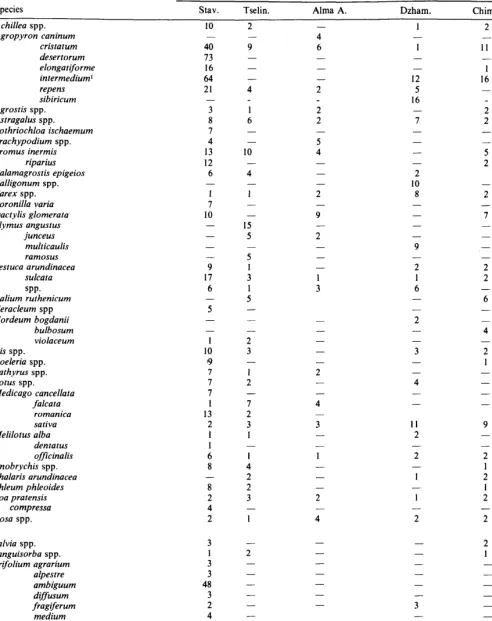
The expedition obtained 1,094 seed collections representing about 251 species from 115 genera. However, not all collections were forage species because we also gathered seeds of trees, ornamentals, and miscellaneous plants whenever the opportunity arose. Main forage collections and their areas of origin are summarized in Table 1. Only those collections that appear to be particularly important or unique are discussed below.
Grasses
The largest collections were made of the crested wheatgrasses-Agropyron cristatum, A. desertorum, and
A. sibiricum. The emphasis on crested wheatgrass reflects the senior author’s interest in the plant-breeding potential and cytogenetic characteristics of this species-complex. The 16 collections of A. sibiricum from the Moyun-Kum Desert are particularly interesting because of their ability to thrive in almost pure sand. However, when grown under favorable conditions on heavy soils at Logan, those collections did rather poorly in the establishment year when compared with other crested wheatgrasses. The spikes of Moyun-Kum A.
sibiricum are much narrower than other A. sibiricum accessions previously introduced into the U.S. A survey of the USDA Plant Inventories, which give the source of all introductions, indicates that crested wheatgrasses have not been previously introduced from the Moyun-Kum Desert.
The intermediate wheatgrasses (Agropyron intermedium and A. trichophorum) are widespread in the southern U.S.S.R. and we made many collections of those grasses (Table 1). The need to expand the germplasm base of intermediate wheatgrass is particularly critical because five of the seven bred varieties of intermediate wheatgrasses originate from one plant introduction, PI 98568 (Hanson 1972). This introduction came from the Maikop region, an area close to Stavropol. Hopefully, some of our collections from Stavropol will be as successful as PI 98568.
Some may question the need of bringing more
quackgrass
(Agropyron repens) and its close relative, A. elongatiforme
(no common name), into the United States. However, these species are extremely diverse, and they may contain strains that are less aggressive than typical North American strains. Furthermore, interspecific hybrids with A. repens as one parent are some of our most productive grasses (Dewey 1976). The Soviets are breeding and promoting A. repens in the U.S.S.R. An A. repens breeding program has recently
been initiated at the University of Wisconsin, River Falls (Louis J. Greub personal communication).
The 15 collections of Altai wildrye (Elymus angustus) should be of considerable interest to Canadian plant breed- ers and range scientists because they are conducting the only breeding program on E. angustus in North America at Swift Current, Saskatchewan (Lawrence 1970). Since our return, the Soviets have provided us with an additional 110 collec- tions. This grass is a very coarse and robust species with stiff stems up to 2 m tall. It serves well as a winter pasture because the plants extend above the snow, and it is effective in catching and holding blowing snow. Our E. angustus collec- tions should be well adapted to the Canadian prairies because they come from a climatically similar region in the Tselinograd Oblast.
Elymus ramosus (no common name) is considered to be a valuable forage grass in the U.S.S.R. (Nevski 1934). It is a low-growing, strongly rhizomatous species, and we encoun- tered it on road cuts where it effectively bound the soil. It has been introduced previously as Agropyron ramosum (because it has single spikelets typical of Agropyron) but it has never gained importance either as a forage or a conser- vation species (Weintraub 1953). A major defect of E. ramo-
sus is that it rarely produces seed. Its low seed set is probably due to the absence of compatible pollen rather than to sterility per se. Inasmuch as it is almost certainly a self-sterile species, an E. ramosus plant requires foreign pollen to pro- duce seed. Because the plants are so strongly rhizomatous, a single clone may cover a very large area and would not be exposed to pollen from other E. ramosus clones. This hypothesis can be tested very easily now that we have several sources of E. ramosus growing in close proximity.
Elymus multicaulis (no common name) has been intro- duced only once previously, in 1965 as PI 314665 and 314666. The additional nine collections from Dzhambul should provide a better estimate of the adaptation and forage value of E. multicaulis. This species is the Asian counterpart of North American beardless wildrye (E. triti-
coides) (Dewey 1972), although E. muZticauZis is considera- bly more leafy and may be the better forage grass.
A major disappointment of the expedition was our failure to make appreciable collections of Russian wildrye (Elymus
junceus). Our itinerary took us only to the fringes of the E.
junceus distribution. At Shorthandy (near Tselinograd) we were able to make seven small collections. However, the Soviets supplied seed of an improved variety, ‘Bozoisky,’ which looks impressive at Logan. Since our return to the U.S., they have supplied an additional 25 collections of E.
junceus.
According to our Soviet escort, a bromegrass specialist, the smooth bromegrass (Bromus inermis) from Tselinograd is tetraploid, 2n=28. If so, it can be much more easily manip- ulated genetically than can typical B. inermis, which is octo- ploid, 2n=56 (Carnahan and Hill 1961).
The 12 collections of thee reedgrass (Calamogrostis epi-
geios) were made with little hope of obtaining seed, because all plants appeared to be totally sterile. Nevertheless, with careful threshing, some viable seeds were obtained from each collection. This grass is strongly rhizomatous and has considerable potential for soil stabilization purposes. The low seed set under natural conditions is probably due to the lack of compatible foreign pollen. Because of its strong spreading habit, an entire colony may be made up of a single
Table 1. Forage collections obtained from the Soviet Union in 1977 by the Dewey-Plummer plant collecting expedition.
Species Stav. Tselin.
Collecting area
Alma A. Dzham. Chim. Total
Achilles spp. Agropyron caninum
cristatum desertorum elongattforme intermedium’ repens sibiricum Agrostis spp. Astragalus spp. Bothriochloa ischaemum Brachypodium spp. Bromus inermis
riparius Calamagrostis epigeios Calligonum spp. Carex spp. Coronilla varia Dactylis glomerata Elymus angustus
junceus multicaulis ramosus Festuca arundinacea
sulcata SPP* Galium ruthenicum Heracleum spp Hordeum bogdanii
bulbosum violaceum Iris spp.
Koeleria spp. Lathyrus spp. Lotus spp. Medicago cancellata
falcata romanica sativa Melilotus alba
dentatus officinalis Onobrychis spp. Phalaris arundinacea Phleum phleoides Poa pratensis
compressa Rosa spp.
10 - 40 73 16 64 21 2 - 9 - - - 4 1 6 - - 10 - 4 - 1 - - 15 5 - 5 1 3 1 5 - - - 2 3 - 1 2 - 7 2 3 1 - 1 4 2 2 3 - 1 - 2 - - - - - - - - - - 4 - - - - 4 6 2 - 11 - 1 16 - 2 2 - - 5 2 - 2 - 7 - - - - 2 2 - 6 - - 4 - 2 1 - - - - 9 - - 2 1 2 1 2 - 2 2 1 - - - - - - 2 1 - - 1 - 1 - - - - 2 2 2 - 5 4 - 12 5 16 - - - - - - 2 - 9 - 2 - - 2 10 8 - - - - - - 9 - 2 3 - - - - - 2 - - 4 - 3 - - 1 - 6 - - 2 - - 3 - - 4 - - - 2 - 4 11 2 - 2 - I - - 2 15 4 67 73 17 92 32 16 8 25 7 9 32 14 12 10 14 7 26 15 7 9 5 14 24 16 II 5 2 4 3 18 10 IO 13 7 12 15 28 4 1 12 13 5 II 10 4 11 - - - - - - - - - - - - 4 - - 3 - - - - - 5 - - - - - - 2 - - 5 4 3 3 48 3 5 4 9 3 7 5 13 5 4 7
Grand Total 907
- 3 8 7 4 13 12 6 - 1 7 10 - - - - 9 17 6 - 5 - - 10 19 7 7 7 13 2 6 8 - 8 2 4 2
Salvia spp. Sanguisorba spp.
Trtfolium agrarium alpestre ambiguum dtjjfusum fragiferum medium pratense repens SPP* Vicia angusttfolia
cracca tenutfolia tetrasperma SPP* 3 3 3 48 3 2 4 3 2 7 5 3 5 4 4
‘Includes A. trichophorum