Volume 2, Number 1 l January, 1949
Journal of
RANGE
MANAGEMENT
Field Comments on the Range Condition Method
of Forage Survey
R. R. HUMPHREY University of Arizona, Tucson, Arizona
M
ETHODS for the appraisal of na- tural resources normally undergo a period of testing and modification early in their development. This is a natural and healthy sign indicating improvement of a basic concept. Modifications of field techniques should come in large part from field workers.The thoughts in this paper represent conclusions about the range-condition survey method reached during the past several years while tramping the hills and mountains of Washington surveying many thousands of acres, talking with ranchers and co-workers, preparing ranch plans and analyzing and writing about the method. The ideas are presented in the hope they may be of value in further developing the range-condition survey method or at least in helping to clarify thinking about survey methods in general. Range condition, as the term is used today, commonly indicates forage produc- tion on an area expressed in terms of the amount it would produce under good management. Range condition is meas- ured directly in terms of forage production and indirectly in pounds of meat or wool produced.
HISTORY
The value of range condition surveys in analyzing range problems was early recog- nized by the Soil Conservation Service in
1
the Pacific Northwest, and it is from this region that the technique has received its greatest impetus.
Various aspects of range condition have been covered in several publications. It is probable that the first published ac- count was by Spence (12). There seems to be some doubt as to the originator of the basic idea. It has been traced back, however, to Dr. L. A. Stoddart who ap- pears to have been the first to attempt to give the method general field use.
The earliest general analysis of range condition showing its application to sound range management and to flood control was made by Humphrey and Lister in 1941 (8). Six condition classes were de- scribed and the predominating vegetation characteristic of each was given. Other features pertaining to each were discussed. These included: (a) Management prac- tices responsible for condition, (b) Revi- sions required in present management practices, (c) Erosion or flood control remedial measures indicated.
A USDA Farmers Bulletin by Renner and Johnson (11) was published in 1942. This bulletin gave criteria for recognizing ranges in each of 4 condition classes; told how to recognize upward and downward trends, and recommended desirable range management practices on each class.
2 R. R. HUMPHREY
underlying the method; the 1947 paper gave in some detail the steps required in making range-condition, surveys in the field.
Reid and Pickford (IO) in 1946 dis- cussed range condition as applied to mountain meadows in eastern Oregon and eastern Washington. They described cri- teria for recognizing 4 condition classes in mountain meadows and pointed out the grazing value of each condition class for sheep and for cattle.
Parker and Woodhead (9) in 1944 de- veloped a score card for ranchers to use in determining the condition of their ranges. Although t’he score card given as an example was particularly adapted to southwestern perennial grassland ranges grazed yearlong, application of the method is not restricted to these ranges. Bailey (1) in 1945 developed rather fully the importance of recognizing range- condition trends. The value of deter- mining trends has also been shown by others (7, 10, II). Bailey’s principal contribution lies in his stress of the eco- logical nature of the factors affecting tarends and the need for a better knowledge of soils in range-condition analyses.
Costello and Turner (3) described range condition classes in the central Great Plains region. The purpose of their work was “to furnish ranchers with guides for judging prevailing condition of the range, yearly forage production, and current forage utilization of the short-grass range on the central Great Plains.”
Talbot (13) in 1937 described reliable criteria for determining whether ranges were improving or deteriorating. Al- though his criteria largely pertain to de- gree of utilization rather than range condition, as the term is commonly now used, they do in many instances indicate range-condition trends. Some of them,
as a consequence, have been rather widely adopted in recent field guides.
Any biographical account should men- tion the range condition guides developed by the Soil Conservation Service for use by ranch planners and ranchers. These describe each of the principal forage types within an area, the area generally being a Soil Conservation District. Each type is analyzed on a condition-class basis. Criteria for recognizing each class are given together with the essentials for de- termining trend. Desirable range man- agement practices are then listed for application within each class.
These guides are written in simple, non- technical language and are adapted for use by the non-technical man as well as the trained technician. The first of these (6) appeared in 1945. Since then exten- sive range areas in the states of Washing- ton, Oregon, Idaho, Nevada, and Califor- nia have been similarly described. Some of these guides vary in form or organiza- tion but the general approach has re- mained unchanged. Modifications of this field application approach have been developed in other western states where grazing is an important industry.
Two RANGE CONDITION CONCEPTS The climatic approach
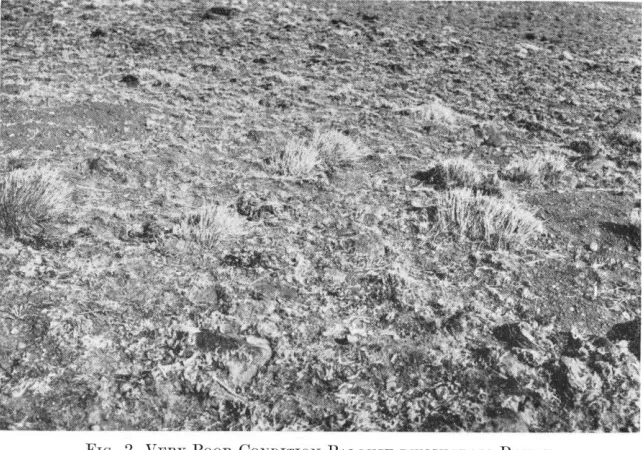
nial grasses and require d only one acre to concerned in this pnper. It might be graac a cow for onr month may hnve de- called the rangr-polenfial approach since t&orated until it, now produces only it expresses current production in terms annual weeds and grasses and may reqnirc of the ultim;ttF potential for the same area 10 acres to produce a cow month of feed. (Figs. 1, 2). This classification may Yet, both might be classified as in thr indicnt,e t,o a minor extent a temporary
same condition. forage ahundnnce or shortage resulting
This type of range-condition classifirn- from recent growing condit,iom. Prop- t,ion might apt,ly be termed the clima/ic erly t,rained t,echnicians, however, make approach. lt is typified by the mont,hly little nllowmrr for such temporary flu+ range-summary reports published for the tuations. The basis for the range-poten- various range-livestock states. t,i:tl approach lirs in the assumption that
This concept of condition has a place. This place, howver, is strictly one of the temporary effect, of growing conditions on forage production. It cannot be ex- tended to indicate the relative grazing values of various ranches or range units, or to show the sust,ained improvanent on a run-do\vn range.
The range-polenlial approach
The second concept of range condition is the one with which ve are primarily
ESSENTIALS
OF A RANGE CONDITION CLASSIFICATIOhTEssentially, under the range-potential concept, the more forage an area is pro- ducing the hetter the range condition. As the method is most commonly used in field surveys today the follon%,g clasws have been adopted.
Excellent: Range producing 8O-lOO70 of possible forage (Fig. 1).
therefore, it is necessary to determine the amount of forage being produced. This figure must then he analyzed to ascertain its relative value with respect to the maximum production possible on the area.
Although an evaluation of present forage production is the first step in de- termining condition it is only one of several. The final classification is an exprwsion of the combined effect of all the factors involved.
Good: Range producing GO-80~0 of possible forage.
LFair: Range producing 40-607, of possible forage.
Poor: Range producing ZO-40% of possible forage.
Very Poor: Range producing less than 2075 of possible forage (Fig. 2).
It is seen from the above that range condition, for practical purposes, has been defined in terms of forage production. In order to classify a range as to condition,
RANGE CONDITION METHOD OF FORAGE SURVEY 5
Density
Forage, being in a continual state of flux, does not lend itself well to classifica- tion. This is perhaps particularly true with respect to forage-production classi- fications. For this reason, it is desirable, or even essential to measure all the major factors that may affect production. In some instances field guides for range- condition analyses have been developed that omit the density factor. It is the conviction of the writer that in omitting this factor we deprive ourselves of an essential tool for determining not only range condition but even forage evalua- tion per se.
The amount of forage required to sus- tain a grazing animal is expressed as vol- ume. Volume reflects not only height of forage; it also reflects ground cover or density. Thus, a range capable of sup- porting .4 of a complete ground cover is not in excellent condition when it is cur- rently supporting only a .2 cover. An added indication of the essential nature of the density factor is seen in the fact that many ranges, when classified without density, would seem to be in excellent condition. These same ranges, when rated as to density in addition to other factors, would be classed as no more than fair. This condition has been observed many times on ranges overgrazed for years by sheep. In these instances the coarser grasses were grazed lightly or not at all when mature. Seedlings of these species, however, were grazed wherever they appeared. At the same time the fine grasses were grazed out. As the old perennial grasses gradually died they were not replaced and the density was gradually lowered. Yet, their vigor was excellent and as a consequence a consider- able amount of litter, often accumulated. Furthermore, the areas involved were essentially level and the soils porous so
that there was no measurable erosion. If these ranges were to be judged on a basis of plant composition, litter, forage vigor, and erosion, but excluding density, they would appear to be in excellent con- dition. Yet they are not producing the amount of forage required for an excel- lent-condition range. Including a meas- ure of density in cases of this sort and, indeed, in all estimates of grazable forage produced, would seem to be essential.
Erosion
Failure to record degree of current erosion may lead to an over-evaluation of range condition and consequently of a safe stocking rate. A range where erosion is active must have more forage left un- grazed than one where there is little or no erosion. When erosion is one of the factors used in determining range condi- tion, the matter of a safe stocking rate is determined by virtue of the correct con- dition classification. For example, a range might rate as excellent and have a stocking rate of 1 acre per cow month of forage if current erosion were slight or negligible. This same range if producing the same amount of forage, but with moderate erosion would be classified as good and would carry the recommenda- tion by definition (good = GO-8Oa/, of full production) that about l+ acres be allowed per cow month. The approxi- mate rule can be followed that other fac- tors remaining unchanged, moderate ero- sion will reduce a condition rating one class; severe erosion will reduce it two, or occasionally more, classes.
either uulled UD or starved out bv con- ” tinued close grazing. After a number of years this results in almost pure stands of rhentgrass composed largely of the old coarse plants. The accumulation of nn- grazed dead material in the plants makes them gradually more and more unpalat- able to sheep and as R result they charac- teristically possess good to excellent
rigor. Yet, 8s mentioned under the
discussion of density, this range may be in no more t,han fair condition.
generally indicate an improving range. Old gullies completely grown o\‘er may indicate a range that MS once in poor condition but t,hat has recovrred to the excellent level (Fig. 3).
Forage vigor
Forage vigor, though used as a criterion for determining condition, is probably the least dependable ol those commonly em- ployed. The rw.son for this can bc show, best by cx-ample. ‘1 range long over-
grazed by sheep gradually changes in composition. In the Mouse bunchgrass region of the Sorthmest, for example, the fine-leaved Sandberg bluegrass (Pea
secunda) and Idaho fescue (F~stuca
idahocnsis) are heavily grazed. This ulti- mately may result in their partial or com- plete disappearance. Mature plants of the accompanying bluehunch wheatgrass
(Agropyron spicalum) are very lightly grazed. Seedlings of this species, how ever, being small and good sheep feed, have little chance for survival, being
RANGE CONDITION METHOD OF FORAGE SURVEY 7
low, that the stocking rate is less than
would be expected from the vigor of the plants. It should be noted in this exam- ple, also, that omission of density as a rating factor would further weaken the classification.
It is not recommended that forage vigor be abandoned as one of the criteria for determining range condition. It should, however, be used with care and with due consideration for the factors that might make it misleading.
Litter
On open grassland ranges litter has proved to be one of the most reliable fac- tors employed in determining condition ratings. Rather generally on open grass- lands, an increase in litter indicates an improvement in condition. Moderate to abundant litter provides a surface layer of organic material that protects the soil surface from the erosive and puddling action of raindrops and surface runoff. It also constitutes part of the raw material for humus formation. And, likewise im- portant, an accumulation of litter indi- cates that past grazing use was not ab- normally heavy.
In forested areas, as contrasted with open grassland, abundant litter may not indicate unused forage or, for that matter, that any forage was produced. The litter may be derived largely or entirely from fallen leaves, needles, or other tree- derived material. This may provide adequate erosion control and improve the soil. It does not, however, indicate range condition as defined by forage-pro- duction classes. This fact must be con- sidered in classifying timbered ranges.
A DYNAMIC APPROACH
Range-condition surveys have sup- planted the reconnaissance and square- foot surveys as a Soil Conservation Serv- ice forage evaluation method. The methods formerly used were compara-
tively slow and gave results of no more
value in ranch planning than the more rapid range-condition method.
The greatest asset of the range-condi- tion method, however, lies in its dynamic approach. The reconnaissance and square-foot systems classify a range into forage types based solely on current as- pect. They do not indicate whether a range is improving or deteriorating, nor do they indicate whether a range once produced, and is again capable of produc- ing, more forage than at present. These two methods are, therefore, static in their approach. The range-condition method, in contrast, is an analysis of present pro- duction expressed in terms of possible future production. Emphasis is also laid on the direction of current changes in range condition to determine whether present range-management practices are benefiting or harming the range (Fig. 3). This dynamic approach, together with its relative simplicity, have given the method a popularity among practical- minded ranchers that the older systems never enjoyed.
PROPOSED MODIFICATIONS
Four condition classes
No range survey method yet devised has proven entirely satisfactory. Because of the complexity of forage it is possible that none ever will be. Several defects, some of which are remediable, exist in the method as it is commonly used for surveys today.
In most instances a breakdown into 4 condition classes rather than 5 would be adequate. Several years’ field experience in making range condition surveys indi- cates that the following 4 classes would serve in most instances and might possi- bly be universally adequate:
Excellent : 75-100yO of possible forage
8 R. R. HUMPHREY
Good: 50-75% of possible forage pro- duction.
Fair: 25-50% of possible forage pro- duction.
Poor: Less than 25% of possible forage production.
Depleted areas would not be classed as poor condition but would be mapped separately as “depleted”. This reduc- tion of the number of classes would sim- plify field surveys, reduce compilation time, and provide a breakdown more readily accepted by most ranchers. The slight sacrifice in detail would not ad- versely affect ranch planning.
Modi$cation for sheep grazing Sheepmen object to the method because they say it frequently does not correctly classify their ranges for sheep use. This objection is justified, for the method ex- presses condition in terms of maximum forage production regardless of kind of livestock. Thus, for example, a Palouse bunchgrass range generally produces the maximum amount of forage when blue- bunch wheatgrass is the principal species. Bluebunch wheatgrass, however, because of its coarseness, makes poor sheep feed. This range, therefore, might rate excellent in terms of forage production for cattle, but no more than fair for sheep. If, on the other hand, the bulk of the wheatgrass were replaced by Sandberg bluegrass, a classification according to present stand- ards would rate this range as no more than fair. Because of the value of Sand- berg bluegrass as spring sheep feed, how- ever, the sheepman would probably con- sider this range as excellent. And, in terms of forage production for sheep, he would be right.
In areas where sheep raising is an im- portant industry separate range-condi- tion classifications should be set up for cattle and sheep. This would involve enlarging our concept to permit basing
the classes on kind of livestock to be run, rather than on total volume produced regardless of kind of livestock, as at present.
Preparation of condition guides The objection is raised by some that the method is difficult to apply broadly because, as a prerequisite to its use, de- scriptive guides must first be made of the types involved. This is true. However, the time required for the field work of preparing such a guide generally runs into no more than 2 to 5 days. The training obtained in observing successional trends and causes for these trends generally proves in itself to more than pay for the time expended. Careful analysis of for- age types and grazing management prob- lems frequently will show that extensive areas can be included in a single so-called type. This should be true particularly of National Forest areas or on Indian Reservations where the local administra- tive problems common on Soil Conserva- tion Districts may not obtain.
It is believed, therefore, that the time required to lay the ground-work requisite to application of the range-condition method is one of the definite benefits of the method rather than one of its draw- backs. The condition of many of our public and private ranges today would seem to indicate that we must be forced to stop and consider what is happening to our forage resources. If the range- condition method will succeed where pre- vious methods have failed, it may be worth adopting universally at any cost of time.
Subtype mapping
RANGE CONDITION METHOD OF FORAGE SURVEY 9
surveyor will ask himself these questions before mapping a new subtype.
1. Is there enough change in composi- tion, density, erosion, litter, or plant vigor to indicate a different condi- t ion class?
2. Is there a marked change in factors that should affect allowable grazing? These factors include erodibilit,y of soils, steepness of slope, direction of slope, potential productivity of site, presence of rocks, down timber, or dense brush.
3. Are there special range management or other recommendations that ap- ply to one area and not to anot’her that would be masked if no sub- division were made?
When the answer is no to all 3 of these questions there will generally be no need to subtype.
The use of estimates
The objection has been raised that the condition method, like other widely used range-survey systems, relies on estimates rather than on verifiable measurements. This is largely correct; density and forage composition are still estimates. In a sense erosion, plant vigor, and litter are also based on estimates. With due con- sideration for the inaccuracy of estimates as compared with exact measurements, however, the information derived from condition surveys has proved to be ade- quate for planning on many hundred- thousand acres of range land. This rec- ord has extended over a period of several years, long enough to indicate fairly con- clusively that the method is serving its purpose.
In discussing the adequacy of any method, the use to which the result,s will be put should be considered. Forage production, livestock prices, overhead and, indeed, most items involved in a ranch operation are subject to wide fluc-
tuations. This being so, there is little to be gained, and perhaps much to be lost, by gearing any one operation as, for example, a forage evaluation method, down to a higher degree of accuracy. The means should justify the end, but no more than that. A more accurate system does not seem to be needed in ranch planning.
Condition ratings in timber
The writer is aware of no unified ap- proach to rating range condition in dense timber where competition pre- cludes the production of much forage. Two approaches seem to be most com- monly used. One considers condition in terms of the effect of livestock upon it; the other in terms of the effect of all factors.
Range condition is defined in terms of potential forage production. On open grassland the factor that usually prevents development to the potential is grazing pressure from either domestic livestock or game. animals. Even here, however, other influences are sometimes important. Abandoned cropland, for example, on which the native sod was destroyed by plowing, may rate poor or very-poor condition. Reseeding to native or intro- duced species may be necessary to restore such areas within a reasonable period of time to excellent condition. The po- tential, however, is still there and the correct treatment will bring it out.
10 R. R. HUMPHREY
it may correctly be classed as being in very-poor condition.
Whether it may be economically de- sirable to remove the timber in order to produce more forage does not seem to be involved. The basic fact is that a range- condition classification is a classification of forage resources. In making such a
classification, therefore, present as com- pared with potential, forage production is the only factor to be considered. For economic or other reasons it may be desirable to maintain a dense stand of timber or brush. Yet, from a forage production viewpoint, this area is of little value and consequently must be given a low condition rating.
LITERATURE CITATIONS
1. BAILEY, R. W. 1945. Determining Trend of Range Watershed Condition Essential to Success in Management. Jour. For., 43 : 733-737.
2. COSTELLO, D. F. 1945. Reading the Range. The American Hereford Jour- nal, 3 pp., July.
3. COSTELLO, D. F., AND G. T. TURNER. 1944. Judging Condition and Utilization of Shortgrass Ranges on the Central Great Plains. USDA Farmers Bull. No. 1949. 21 pp.
4. ELLISON, LINCOLN, AND A. R. CRDFT. 1944. Principles and Indicators for
Judging Condition and Trend of High Range Watersheds. Intermountain For- est & Range Esperimcnt, Station, Rc- search Paper No. 6. 65 pp. Apr. 5. HUMPHREY, R. R. 1945. Some Funda-
mentals of the Classification of Range Condition. Jour. For. 43 : 646-647. 6. HUMPHREY, R. R. 1945. Range Condi-
tion : A Classification of the Palousc Grass Type. U. S. Soil Conservation Service. 13 pp. Multilithed. May. 7. HuhwHREY, R. R. 1947. Range Forage
Evaluation by the Range Condition Method. Jour. For. 45: 10-16.
8. HUMPHREY, R. Et., AND 1’. B. LISTE:R. 1941. Native Vegetation as a Criterion for De- termining Correct Range Mnnagcment and Run-off Characteristics of Grazing Lands. Jour. For. 39 : 837-842.
9. PARKER, K. W., AND I’. V. WOODHEAD. 1944. What’s Your Range Condition? American Cattle Producer, 4 pp., Nov. 10. REID, E. H., AND G. D. PICKFORD. 1946.
Judging Mountain Meadow Range Con- dition in Eastern Oregon. USDA Cir- cular No. 748,31 pp.
11. RENNER, F. G., AND E. A. JOHNSON. 1942. Improving Range Conditions for War- time Livestock Production. USDA Farmers Bull. No. 1921. 18 pp. 12. SPENCE, L. F. 1938. Range Management
for Soil and Water Conservation. The Utah Juniper. 9: 18-25.