The effect of stable stratification on vortex
stretching in open channel flow
Konstantin Borynyak1, *, and Michael Hrebtov1
1Institute of Thermophysics of SB RAS, 630090, Ac. Lavrentiev ave. 1, Novosibirsk, Russia
Abstract. We present the results of direct numerical simulation of stably stratified open channel flow. The main goal of the paper is to check the effect of thermal stratification on the dynamics of vortex interactions. By comparing the vortex stretching in neutral and stratified cases we show that imposing the stratification leads to an increase of the ratio between positive and negative vortex stretching magnitudes in the flow. That indicates the change in spectral transfer of turbulent energy.
1 Introduction
Stably stratified channel flow attracts increasing attention in scientific community over past decade ([1-3]). Due to the increase of available computational power more and more flow configuration are becoming ready for a direct numerical simulation. Stably stratified channel flow is a numerically low-cost model for a night atmospheric boundary layer, where the relatively hot air flows over the colder ground. Depending on the ratio between the shear and negative buoyancy the flow may become fully turbulent, laminar, or intermittent, with the dynamic alternation of turbulent and laminar spots.
The turbulent collapse in low Reynolds number channel flows, where the negative buoyancy completely suppresses the turbulence, was studied by several authors [3,4], showing that there exist a critical Richardson number preceding the collapse. With a slightly less than critical Richardson number the turbulent and laminar patches become very unstable and dynamic. In such conditions we might expect the largest influence of the stratification on the vortex interaction process. The internal gravity waves accompanying the transition from turbulent to laminar regimes were detected in the central part of the channel [2]. Their activity was shown to remain even after the transition to fully laminar regime. The comparison between the channel flow and open channel flow, where the upper boundary has free-slip condition [5] shows that the internal waves activity although sufficiently weaker is still present in open channel flows at the upper boundaries.
In this short paper we consider the effect of stable stratification on the vorticity dynamics, namely on the vortex stretching. The vortex stretching is considered the main source for the growth of 3D instabilities leading to the formation of forward turbulence cascade. The prevalence of positive stretching promotes the transfer of turbulent energy to the small scales. So the change of rate of occurrence of positive and negative vortex stretching events their relative strength should affect the spectral energy transfer process.
2 Computational details
We simulate the open channel flow with a relatively low Reynolds number (Re u h / 180, where u is a friction velocity, - kinematic viscosity and h - the open channel height). We studied two configurations: with a neutral stratification (Ri Tgh u/ 2 0
, where is thermal expansion coefficient, g is gravitational acceleration and T is temperature difference between top and bottom boundaries) and stable stratification (Ri 240). The Prandtl number value was equal to 0.71.
The computational domain size was 8π × 4π × 1 with 512 × 50 × 512 grid points respectively. In longitudinal and transversal directions the grid was uniform, while in vertical direction the grid was clustered toward the wall with the grid step range:
0.1 5.5 y
.
We used a DNS solver based on an open-source CFD package called OpenFOAM. OpenFOAM has been verified for a number of scientific and engineering applications [6,7]. The governing equations of incompressible fluid flow with Boussinesq approximation for buoyancy force are sampled using the finite-volume method with second order accuracy in space and time.
Fig. 1. Compaison of mean vertical profiles obtained in current simulation (lines) and taken from [3] (dots) for cases with stable and neutral stratification. Left: Mean longitudinal velocity and
2 Computational details
We simulate the open channel flow with a relatively low Reynolds number (Re u h / 180, where u is a friction velocity, - kinematic viscosity and h - the open channel height). We studied two configurations: with a neutral stratification (Ri Tgh u/ 2 0
, where is thermal expansion coefficient, g is gravitational acceleration and T is temperature difference between top and bottom boundaries) and stable stratification (Ri 240). The Prandtl number value was equal to 0.71.
The computational domain size was 8π × 4π × 1 with 512 × 50 × 512 grid points respectively. In longitudinal and transversal directions the grid was uniform, while in vertical direction the grid was clustered toward the wall with the grid step range:
0.1 5.5 y
.
We used a DNS solver based on an open-source CFD package called OpenFOAM. OpenFOAM has been verified for a number of scientific and engineering applications [6,7]. The governing equations of incompressible fluid flow with Boussinesq approximation for buoyancy force are sampled using the finite-volume method with second order accuracy in space and time.
Fig. 1. Compaison of mean vertical profiles obtained in current simulation (lines) and taken from [3] (dots) for cases with stable and neutral stratification. Left: Mean longitudinal velocity and
temperature. Right: Reynolds stress and turbulent heat flux.
Periodic boundary conditions were prescribed at the streamwise and spanwise boundaries. A no-slip boundary condition was set up for the bottom wall and a free-slip condition was set for a top boundary. Fixed temperature values (of 1 and 0) were used at top and bottom boundaries respectively.
3 Results and discussion
The selected Richardson number value (240) is showing a very strong intermittency with large triangle-shaped turbulent spots. The spots are advected downstream with the mean velocity and slowly changing their shape. This should make the effect of stable stratification on vortex dynamics as large as possible for the selected Reynolds number value (180). In the case of neutral stratification turbulent vortices occupy the entire volume of the channel.
3.1 The mean fields
Figure 1 shows the mean velocity and temperature fields together with Reynolds stress and turbulent heat flux profiles for both simulated cases. The effect of stratification on the mean fields is very strong leading to increase of the bulk velocity, decrease of Reynolds stress and turbulent heat flux. The mean temperature profile also becomes closer to the laminar one.
The flow configuration was similar to the one reported in [3], so the mean fields obtained in the simulation were compared with the ones from [3]. The comparison shows good agreement between the two simulations in both mean profiles and stresses.
3.2 The effect of stratification on vortex stretching
The vortex stretching term (S i ij jS , where Sij is a strain rate tensor and is vorticity)
in the enstrophy equation shows the production of enstrophy by vortex interactions. If S is positive the vortex tube is stretched longitudinally and its cross-section area is diminished so that the volume of the tube remains unchanged. That in general leads to the spectral transfer of the energy toward the small scales. But it is possible for the S to be negative, meaning that the vortex tube is shortened and widened, thus transferring the energy towards large scales of the flow and decreasing the local dissipation rate. It is worth noting that in two-dimensional flows S is exactly zero.
To distinguish between these two processes the separate contributions of positive and negative vortex stretching into the net one were computed. For each horizontal plane the positive and negative parts of S were integrated separately and then divided over the area of the computational part of plane. Then some averaging in time was performed to acquire the sufficient statistics.
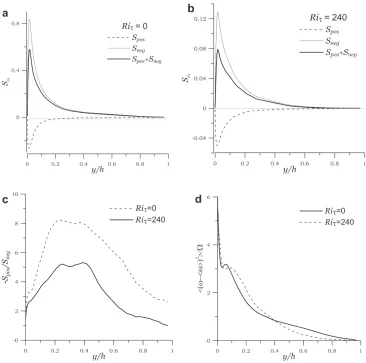
Figure 2a,b shows the result of this operation. It can be seen that the negative contribution is sufficiently smaller than the positive one. Qualitatively the behaviour of positive and negative stretching profiles is the same, showing a maximum close to the laminar layer and rapidly diminishing toward the wall. In both cases this behaviour is similar, but in stratified case the magnitude of total vortex stretching maximum is about 1.5 times larger than in neutral one, while the mean enstrophy ( 2 2, the angular
brackets mean the averaging operation) has the opposite behaviour (Ω neut/ Ω sat=1.64).
Figure 2c shows the Spos/Sneg profiles. It can be seen that this ratio grows with distance
from the wall and getting to its peak at y/h=0.3 in both cases. This point is well in the turbulent region of the flow and much further from the wall than the peak in vortex stretching. As for the values in Fig2c it can be seen that the stratified flow has about 0.75 times lower ratio of positive to negative stretching than the neutral one, which is a clear indication of the influence of stratification on the vortex dynamics.
However as it was mentioned earlier the mean enstrophy (Ω) is 1.64 times lower in a stratified case than in neutral one. Figure 2d. shows the profiles of vorticity variance normalized by the mean enstrophy over the whole volume. It is seen that in stratified case the profile has less steep decay with distance from the wall at y/h<0.4 and more steep decay than the neutral one further from the wall. It is interesting to note that this change in the behaviour occurs at the same distance from the wall where the decay of Spos/Sneg starts.
Figure 2c shows the Spos/Sneg profiles. It can be seen that this ratio grows with distance
from the wall and getting to its peak at y/h=0.3 in both cases. This point is well in the turbulent region of the flow and much further from the wall than the peak in vortex stretching. As for the values in Fig2c it can be seen that the stratified flow has about 0.75 times lower ratio of positive to negative stretching than the neutral one, which is a clear indication of the influence of stratification on the vortex dynamics.
However as it was mentioned earlier the mean enstrophy (Ω) is 1.64 times lower in a stratified case than in neutral one. Figure 2d. shows the profiles of vorticity variance normalized by the mean enstrophy over the whole volume. It is seen that in stratified case the profile has less steep decay with distance from the wall at y/h<0.4 and more steep decay than the neutral one further from the wall. It is interesting to note that this change in the behaviour occurs at the same distance from the wall where the decay of Spos/Sneg starts.
Fig. 2. The vertical profiles of: plane averaged positive, negative and total vortex stretching (a,b); the ratio of mean positive to mean negative vortex stretching (c); vorticity variance over horizontal plane normalized by total (volumetric) vorticity variance.
4. Conclusion
The present study shows that the stable stratification has significant effect on vortex dynamics, decreasing the ratio of magnitudes of mean positive and negative vortex stretching. That could be the indication of the change in cascade of turbulent energy transfer. Further Investigation may be in determining which mechanism is responsible for this increase of negative vortex stretching, excluding the effect of the interaction of vortices with the mean shear, and testing this with different Re/Ri pairs.
This work was supported by Russian Science Foundation (grant №16-19-00119).
References
1. K. Yeo, B. Kim and C. Lee, J. Turbul. ,10, 17 (2009)
2. M. García-Villalba and J.C. del Álamo, Phys. Fluids, 23 (2011) 3. P. He and S. Basu, Nonlin. Processes Geophys., 22 (2015) 4. O. Flores, J.J. Riley, Boundary-Layer Meteorol. 139 (2011)
5. E. Deusebio, P. Schlatter, G. Brethouwer, and E. Lindborg, J. Phys.Conf. Ser., 318
(2011)
6. F. Flores, R. Garreaud, and R. Muñoz, Comput. Fluids, 82 (2013)
![Fig. 1. Compaison of mean vertical profiles obtained in current simulation (lines) and taken from [3] (dots) for cases with stable and neutral stratification](https://thumb-us.123doks.com/thumbv2/123dok_us/8126707.1354195/2.482.67.417.296.604/compaison-vertical-profiles-obtained-current-simulation-neutral-stratification.webp)