Zagreb Polynomials and Redefined Zagreb Indices of silicon-carbon Si C I p q2 3
,
and
2 3 ,
Si C II p q
Young Chel Kwun , Abaid ur Rehman Virk , Waqas Nazeer ,∗, Wei Gao and Shin Min Kang
1. Department of Mathematics, Dong A University, Korea; [email protected]
2. Department of Mathematics, University of Management and Technology, Lahore Pakistan;
3. Department of Mathematics, Division of Science and Technology, University of Education Lahore Pakistan
4. School of Information Science and Technology, Yunnan Normal University, Kunming 650500, China; [email protected]
5. Department of Mathematics and RINS, Gyeongsang National University, Jinju 52828, Korea,
Corresponding Author: [email protected] ; +92-321-4707379
Abstract
The application of graph theory in chemical and molecular structure research far exceeds people's expectations, and it has recently grown exponentially. In the molecular graph, atoms are represented by vertices and bonded by edges. In this report, we study the silicon-carbon Si C I p q2 3
,
and
2 3 , .
Si C II p q We compute several Zagreb polynomials and Redefined Zagreb indices of these silicon-carbons.
Keywords: Silicon, Zagreb index, Zagreb polynomial.
1. Introduction
Silicon has many advantages over other semiconductor materials: it is minimal effort, it is non-toxic, basically its accessibility is unlimited, and it is involved in purging, development for many years behind it. It is used for all cutting-edge electronics badget
The most reliable structures of two-dimensional (2D) silicon-carbon monolayer mixes with different stoichiometric blends were expected in [1] which in light of the molecule swarm streamlining signified as (PSO) method joined with thickness utilitarian hypothesis optimization.
Graphene sheets are effectively limited to [2,3], and from this point on, this honeycomb structure's 2D material is very much due to its surprising mechanical, electronic and optical properties (including its anomalous quantum effect). To a large extent, it aroused a strong interest in research lobby, overwhelming electronic conductivity and
high mechanical quality. In particular, the intriguing electronic properties of graphene make this 2D material potentially useful for faster, smaller electronic products.
Like carbon, silicon also has a honeycomb structure of two-dimensional allotropes, particularly siliconene. So far, a series of efforts have been made to open a band gap on the sheets of silicene. In addition, a two-dimensional silicon-carbon (Si-C) monolayer can be viewed as an undoped two-dimensional carbon monolayer - graphene and an undoped two-dimensional monolayer of silicon - between the siliconene Tuning material. A great deal of effort has been read [4,5] to predict the most stable structure of SiC sheet for more data.
In this paper we study Zagreb polynomials and Redefined Zagreb indices of Silicon Carbide structures.
2. Basic Definitions
Many studies have shown that there is a strong intrinsic link between the chemical properties of chemical compounds and drugs (such as boiling point and melting point) and their molecular structure. The topological index defined on the structure of these chemical molecules can help researchers better understand the physical characteristics, chemical reactivity and biological activity. Therefore, the study of topological indices of chemical substances and chemical structures of drugs can make up for the lack of chemical experiments and provide theoretical basis for the preparation of drugs and chemical substances.
In the past two decades, a large number of digital map invariants (topological indices) have been defined and used for correlation analysis in theoretical chemistry, pharmacology, toxicology and environmental chemistry.
The first and second Zagreb indices are one of the oldest and most well-known topological indices defined by Gutman in 1972 and are given different names in the literature, such as the Zagreb group index, Sag. Loeb group parameters and the most common Zagreb index. The Zagreb index is one of the first indices introduced and has been used to study molecular complexity, chirality, ZE isomers and heterogeneous systems. The Zagreb index shows the potential applicability of deriving multiple linear regression models.
1
( )
( ) ( u v)
uv E G
M G d d
and
2
( )
( ) ( u v).
uv E G
M G d d
For details see [7]. Considering the Zagreb indices, Fath-Tabar ([8]) defined first and the second Zagreb polynomials as
1
( )
( , ) du dv
uv E G
M G x x
and
2
( ) ( , ) d du v.
uv E G
M G x x
The properties of M G x1( , ), M2( , )G x polynomials for some chemical structures have been studied in the literature [9,10].
After that, in [11], the authors defined the third Zagreb index
3
( )
( ) ( u v).
uv E G
M G d d
and the polynomial
3
( ) ( , ) du dv.
uv E G
M G x x
In the year 2016, [12] following Zagreb type polynomials were defined
( )
4
( )
( , ) du du dv
uv E G
M G x x
( )
5
( )
( , ) d dv u dv
uv E G
M G x x
,
( )
( , ) adu bdv a b
uv E G
M G x x
' ,
( )
( , ) du a dv b. a b
uv E G
M G x x
Ranjini et al. [13] redefines the Zagreb index, ie, the redefined first, second and third Zagreb indices of graph G. These indicators appear as
1
1
Re u v
uv E PD u v
d d
ZG G
d d
1
2
ReZG u v
uv E PD u v
d d
G
d d
1
3
ReZG u v u v .
uv E PD
G d d d d
For details about topological indices and its applications we refer [15-22].
3. Silicon Carbide Si C I p q2 3
,
Figure 1 and Figure 2 show two-dimensional molecular diagrams of silicon carbide
2 3
Si C I . In order to describe its molecular graph, we have set this way: we define p as
the number of connected units in a row (chain), and q as the number of connected rows, the number of p cells per connection. In Figures 3 and 4, we demonstrate how cells are connected in one row (chain) and how one row is connected to another row. We will use Si C I p q2 3
,
to represent this molecular graph.Figure 2. Sheet of Si C I p q2 3
,
for p=4 and q=3Figure 3. Sheet of Si C I p q2 3
,
for p=4 and q=1 AFigure 4. Sheet of Si C I p q2 3
,
for p=4 and q=2Theorem 1. Let Si C I p q2 3
,
be the Silicon Carbide. Then
1.
3 4 5 61 2 3 , 2 1 6 8 9 1 5 9 1 3 7 .
M S i C I x x p q x p q x p q p q x
2. M2
Si C2 3I x,
x2x3
p2q x
4
6p8q9
x6
15pq9p13q7
x9.3.
23 2 3 , = 15 8 11 7 2 3 4 4 .
M Si C I x pq p q p q xx
4.
3 4
8
10
184 2 3 , 2 6 8 9 15 9 13 7 .
M Si C I x x x p q x p q x pq p q x
5.
6 12
8
15
185 2 3 , 2 6 8 9 15 9 13 7 .
M Si C I x x x p q x p q x pq p q x
6.
2 2 3
, 2 3
3
, =2 7 10 9 2 1 15 9 13 7
15 3 5 1 .
a a b a
a b
b
M Si C I x x p q x p q x pq p q x
pq p q x
7.
1 2 1 3 2 2 2 3
, 2 3
3 3
' , 2 6 8 9
15 9 13 7 .
a b a b a b a b
a b
a b
M Si C I x x x p q x p q x
pq p q x
Proof
We can see from [14] that the total number of vertices are 10pq and total number of edges are 15pq2p3 .q
The edge set of Si C I p q2 3
,
with p q, 1 has following five partitions,E1,2
e u v E
S i C2 3I
p q,
|du 1,?dv
, 1,3
S i C2 3
,
| u 1,?v
,E e u vE I p q d d
E2 ,2
e uvE
Si C2 3I
p q,
|du 2,?dv
,爘E2 ,3
eu vE
Si C2 3I
p,q
du 2 ,牋dv 3 .
And
3,3
2 3
爘E e uvE Si C I p,q du 3,?dv .
Now
1,2 1,
E
1,3 1,
E
2,2 2 ,
E p q
And
3,3 15 9 13 7. E pq p q
2 3{1,2} 2 3 1,3 2 3 2,2 2 3
2
2,3 3
1 2 3
,
1 2 1 3 2 2
, , ,
2 3
1. ( , , )
u v
d d uv E Si C I p q
uv E Si C I p q uv E Si C I p q uv E Si C I p q
uv E Si C I
M Si C I p q x x
x x x
x
2 3,3 3 3 3 , ,3 4 4
2 2 2
1,2 3 1,3 3 2,2 3
5 6
2 2
2,3 3 3,3 3
, , ,
, ,
p q uv E Si C I p q x
E Si C I p q x E Si C I p q x E Si C I p q x E Si C I p q x E Si C I p q x
3 4 4 5 6
3 4 5 6
= 2 6 1 8( 1) 15 9 13 7
2 1 6 8 9 15 9 13 7 .
x x p q x p q x pq p q x
x p q x p q x pq p q x
2 3{1,2} 2 3 1,3 2 3 2,2 2 3
2 2,3 3
2 2 3
,
1 2 1 3 2 2
, , ,
2 3
2. ( , , )
u v d d uv E Si C I p q
uv E Si C I p q uv E Si C I p q uv E Si C I p q
uv E Si C
M Si C I p q x x
x x x
x
2 3,3 3 3 3 , ,2 3 4
2 2 2
1,2 3 1,3 3 2,2 3
6 9
2 2
2,3 3 3,3 3
, , ,
, ,
I p q uv E Si C I p q
x
E Si C I p q x E Si C I p q x E Si C I p q x
E Si C I p q x E Si C I p q x
2 3 4 6 9
2 3{1,2} 2 3 1,3 2 3 2,2 2 3
2 2,3 3 2 3
,
2 1 3 1 2 2
, , ,
3 2
3. ( , , )
v u
d d uv E Si C I p q
uv E Si C I p q uv E Si C I p q uv E Si C I p q
uv E Si C
M Si C I p q x x
x x x
x
2 3,3 3 3 3 3 , ,1 2 0
2 2 2
1,2 3 1,3 3 2,2 3
1 0
2 2
2,3 3 3,3 3
, , ,
, ,
I p q uv E Si C I p q x
E Si C I p q x E Si C I p q x E Si C I p q x E Si C I p q x E Si C I p q x
2 2 2= 2 6 8 9 15 9 13 7 15 8 11 7 6 8 8
= 15 8 11 7 2 3 4 4 .
x x p q p q x pq p q
pq p q p q x x
pq p q p q x x
2 3{1,2} 2 3 1,3 2 3 2,2 2 3
2
2,3 3
4 2 3
,
3 4 8
, , ,
10
4. ( , , )
u u v
d d d
uv E Si C I p q
uv E Si C I p q uv E Si C I p q uv E Si C I p q
uv E Si C
M Si C I p q x x
x x x
x
2 3,3 3 18 , ,3 4 8
2 2 2
1,2 3 1,3 3 2,2 3
10 18
2 2
2,3 3 3,3 3
, , ,
, ,
I p q uv E Si C I p q
x
E Si C I p q x E Si C I p q x E Si C I p q x
E Si C I p q x E Si C I p q x
3 4 8 10 18
x x p2q x 6p8q9 x 15pq9p13q7 x .
2 3{1,2} 2 3 1,3 2 3 2,2 2 3
2
2,3 3
5 2 3
,
6 12 8
, , ,
15
5. , ,
v u v
d d d
uv E Si C I p q
uv E Si C I p q uv E Si C I p q uv E Si C I p q
uv E Si C I
M Si C I p q x x
x x x
x
2 3,3 3 18 , ,6 12 8
2 2 2
1,2 3 1,3 3 2,2 3
15 18
2 2
2,3 3 3,3 3
, , ,
, ,
p q uv E Si C I p q
x
E Si C I p q x E Si C I p q x E Si C I p q x
E Si C I p q x E Si C I p q x
6 12 8 15 18
x x p2q x 6p8q9 x 15pq9p13q7 x .
2 3{1,2} 2 3 1,3 2 3 2,2 2 3
, 2 3
,
2 3 2 2
, , ,
6. , ,
u v
ad bd
a b
uv E Si C I p q
a b a b a b
uv E Si C I p q uv E Si C I p q uv E Si C I p q
M Si C I p q x x
x x x
2 22,3 3 3,3 3
2 3 3 3
, ,
2 3 2 2
2 2 2
1,2 3 1,3 3 2,2 3
2
2,3 3
, , ,
a b a b
uv E Si C I p q uv E Si C I p q
a b a b a b
x x
E Si C I p q x E Si C I p q x E Si C I p q x
E Si C
2 3 3 3
2
3,3 3
2 3 2 2 2 3 3 3
2 2
, ,
2 6 8 9 15 9 13 7
=2 7 10 9 2 1 15 9
a b a b
a b a b a b a b a b
a a b
I p q x E Si C I p q x
x x p q x p q x pq p q x
x p q x p q x pq
3 3 13 715 3 5 1
a
b
p q x
pq p q x
2 3
{1,2} 23 {1,3} 23 2,2 23
2 2,3 3 `
, 2 3
1 2 1 3 2 2
2 3 7. ( , )
u v
d a d b a b
uv E Si C I
a b a b a b
uv E Si C I uv E Si C I uv E Si C I
a b uv E Si C
M Si C I x x
x x x
x
2 3,3 3
3 3
1 2 1 3 2 2
2 2 2
1,2 3 1,3 3 2,2 3
2 3 3 3
2 2
2,3 3 3,3 3
a b
I uv E Si C I
a b a b a b
a b a b
x
E Si C I x E Si C I x E Si C I x
E Si C I x E Si C I x
1 2 1 3
2 2
2 3
3 3 x a b x a b p2q x a b 6p8q9x a b 15pq9p13q7 x a b.
Theorem 2. Let Si C I p q2 3
,
be the Silicon Carbide. Then,1. ReZG1
Si C I p q2 3
,
15pq.2. 2
2 3
53 79 67
Re , 15 .
10 10 60
ZG Si C I p q pq p q
3. ReZG3
Si C I p q2 3
,
15pq290p430q126.
2 3
2 2 2
1,2 3 1,3 3 2,2 3
1 2 3
,
, , ,
1. Re ,
1 2 1 3 2 2
1 2 1 3 2 2
u v
u v uv E Si C I p q
uv E Si C I p q uv E Si C I p q uv E Si C I p q
d d
ZG Si C I p q
d d
2 2
2,3 3 , 3,3 3 ,
2 2 2
1,2 3 1,3 3 2,2 3
2
2,3 3
2 3 3 3
2 3 3 3
3 4 4
, , ,
2 3 4
5 ,
6
uv E Si C I p q uv E Si C I p q
E Si C I p q E Si C I p q E Si C I p q
E Si C I p q
2
3,3 3
6 ,
9
3 4 5 2
( 2 ) 6 8 9 15 9 13 7
2 3 6 3
20 26 3 4 15 14
15 1 5 6 2
3 3 2 3 2 3
E Si C I p q
p q p q pq p q
pq p q
6 20 26 9 8 45 28
15
3 6
15 .
pq q
pq
2 32 2 2
1,2 3 1,3 3 2,2 3
2 2 3
,
, , ,
2. Re ,
1 2 1 3 2 2
1 2 1 3 2 2
u v
u v uv E Si C I p q
uv E Si C I p q uv E Si C I p q uv E Si C I p q d d
ZG Si C I p q
d d
2 22,3 3 , 3,3 3 ,
2 2 2
1,2 3 1,3 3 2,2 3
2
2,3 3
2 3 3 3
2 3 3 3
2 3 4
, , ,
3 4 4
6 ,
5
uv E Si C I p q uv E Si C I p q
E Si C I p q E Si C I p q E Si C I p q
E Si C I p q
2 3,3 3 9 , 62 3 6 3
( 2 ) 6 8 9 15 9 13 7
3 4 5 2
36 27 48 39 2 3 54 21
15 1 2
5 2 5 2 3 4 5 2
E Si C I p q
p q p q pq p q
pq p q
10 72 135 20 96 195 40 45 648 630
15
10 10 60
53 79 67
15 .
10 10 60
pq p q
pq p q
2 32 2 2
1,2 3 1,3 3 2,2 3
3 2 3
,
, , ,
3. Re ,
1 2 1 2 1 3 1 3 2 2 2 2
2
u v u v uv E Si C I p q
uv E Si C I p q uv E Si C I p q uv E Si C I p q
ZG Si C I p q d d d d
2 22,3 3 , 3,3 3 ,
2 2 2
1,2 3 1,3 3 2,2 3
2
2,3 3 3,3
3 2 3 3 3 3 3
6 , 12 , 16 ,
30 , 54
uv E Si C I p q uv E Si C I p q
E Si C I p q E Si C I p q E Si C I p q
E Si C I p q E
2 3 ,
6 12 16 2 30 6 8 9 54 15 9 13 7 15 290 430 126.
Si C I p q
p q p q pq p q
pq p q
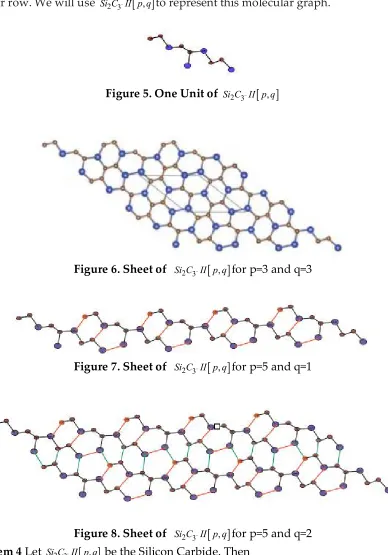
4. Silicon Carbide Si2C3-I I[p, q]
cells connected in a row (chain), and with q, we represent the number of connected rows, the number of rows per connection It is p units. In Figures 7 and 8, we
demonstrate how cells are connected in a row (chain) and how a row is connected to another row. We will use Si C II p q2 3
,
to represent this molecular graph.Figure 5. One Unit of Si C II p q2 3
,
Figure 6. Sheet of Si C II p q2 3
,
for p=3 and q=3Figure 7. Sheet of Si C II p q2 3
,
for p=5 and q=1Figure 8. Sheet of Si C II p q2 3
,
for p=5 and q=2 Theorem 4 Let Si C II p q2 3
,
1. M1
S i C2 3II x,
2x3
2p2q1
x4 2 4
p 4q7
x5
1 5p q1 3p1 3q1 1
x6.2. M2
Si C2 3II x,
2x2x32
pq x
42 4
p4q7
x6
15pq13p13q11
x9.3.
23 2 3 , 15 11 11 11 4 2 2 3 .
M Si C II x pq p q p q xx
4.
3 4
8
10
184 2 3 , 2 2 2 4 4 7 15 13 13 11 .
M Si C II x x x p q x p q x pq p q x
5.
6 12
8
15
185 2 3 , 2 2 2 4 4 7 15 13 13 11 .
M Si C II x x x pq x p q x pq p q x
6.
2 2 3
, 2 3
3
, =3 2 5 5 7 2 1 15 13 13 11
15 5 5 3 .
a a b a
a b
b
M Si C II x x p q x p q x pq p q x
pq p q x
7.
1 2 1 3 2 2 2 3
, 2 3
3 3
' , =2 2 2 4 4 7
15 13 13 11 .
a b a b a b a b
a b
a b
M Si C II x x x p q x p q x
pq p q x
Proof: :Let G be the graph of Si C II p q2 3
,
where we define p as the number of connected unit cells in a row (chain) and by q we represents the number of connected rows each with p number of cells.From the graph of Si C II p q2 3
,
we can see that the total number of vertices are 10pq and total number of edges are 15pq3p3 .q
The edge set of Si C II p q2 3
,
with p q, 1 has following five partitions,E1, 2
e u v E
S i C2 3II
p,q
|du 1,?dv
,1,3
S i C2 3 I
,
| u 1,?v
,E e u v E I p q d d
E2 ,2
eu vE
S i C2 3II
p,q
|du 2,?dv
,爘E2 ,3
e uvE
S i C2 3II
p,q
du 2 ? ?dv 3 .
And
3,3
2 3
爘E e u vE Si C II p,q du 3,?dv .
Now
1,2 2,
E
1,3 1,
E
2,2 2 2 , E p q
And
3,3 15 13 13 11. E pq p q
2 3{1,2} 2 3 1,3 2 3 2,2 2 3
2,3 1 2 3
,
1 2 1 3 2 2
, , ,
2 3
1. ( , , )
u v
d d uv E Si C II p q
uv E Si C II p q uv E Si C II p q uv E Si C II p q
uv E Si
M Si C II p q x x
x x x
x
2 3 3,3 2 3
3 3
, ,
3 4 4
2 2 2
1,2 3 1,3 3 2,2 3
5 6
2 2
2,3 3 3,3 3
, , ,
, ,
C II p q uv E Si C II p q x
E Si C II p q x E Si C II p q x E Si C II p q x E Si C II p q x E Si C II p q x
3 4 4 5 6
3 4 5 6
=2 2 2 8 8 14 15 13 13 11 2 2 2 1 2 4 4 7 15 13 13 11 .
x x p q x p q x pq p q x
x p q x p q x pq p q x
2 3{1,2} 2 3 1,3 2 3 2,2 2 3
2,3
2 2 3
,
1 2 1 3 2 2
, , ,
2 3
2. ( , , )
u v d d uv E Si C II p q
uv E Si C II p q uv E Si C II p q uv E Si C II p q
uv E S
M Si C II p q x x
x x x
x
2 3 3,3 2 3
3 3
, ,
2 3 4
2 2 2
1,2 3 1,3 3 2,2 3
6 9
2 2
2,3 3 3,3 3
, , ,
, ,
i C II p q uv E Si C II p q
x
E Si C II p q x E Si C II p q x E Si C II p q x
E Si C II p q x E Si C II p q x
2 3 4 6 9
2 3 4 6 9
2 2 2 8 8 14 15 13 13 11
2 2 2 4 4 7 15 13 13 11 .
x x p q x p q x pq p q x
x x p q x p q x pq p q x
2 3{1,2} 2 3 1,3 2 3 2,2 2 3
2, 3 2 3
,
2 1 3 1 2 2
, , ,
3 2
3. ( , , )
v u
d d uv E Si C II p q
uv E Si C II p q uv E Si C II p q uv E Si C II p q
uv E
M Si C II p q x x
x x x
x
2 23 3 3,3 3
3 3
, ,
1 2 0
2 2 2
1,2 3 1,3 3 2,2 3
1 0
2 2
2,3 3 3,3 3
, , ,
, ,
Si C II p q uv E Si C II p q x
E Si C II p q x E Si C II p q x E Si C II p q x E Si C II p q x E Si C II p q x
2 2=2 2 2 8 8 14 15 13 13 11 15 11 11 11 8 8 12
= 15 11 11 11 4 2 2 3
x x p q p q x pq p q
pq p q p q x x
pq p q p q x
x2.
2 3{1,2} 2 3 1,3 2 3 2,2 2 3
2,3
4 2 3
,
3 4 8
, , ,
10
4. ( , , )
u u v
d d d
uv E Si C II p q
uv E Si C II p q uv E Si C II p q uv E Si C II p q
uv E S
M Si C II p q x x
x x x
x
2 3 3,3 2 3
18
, ,
3 4 8
2 2 2
1,2 3 1,3 3 2,2 3
10 18
2 2
2,3 3 3,3 3
, , ,
, ,
i C II p q uv E Si C II p q
x
E Si C II p q x E Si C II p q x E Si C II p q x
E Si C II p q x E Si C II p q x
3 4 8 10 18
3 4 8 10 18
2 2 2 8 8 14 15 13 13 11
2 2 2 4 4 7 15 13 13 11 .
x x p q x p q x pq p q x
x x p q x p q x pq p q x
2 3{1,2} 2 3 1,3 2 3 2,2 2 3
2,3
5 2 3
,
6 12 8
, , ,
15
5. , ,
v u v
d d d
uv E Si C II p q
uv E Si C II p q uv E Si C II p q uv E Si C II p q
uv E Si
M Si C II p q x x
x x x
x
2 3 3,3 2 3
18
, ,
6 12 8
2 2 2
1,2 3 1,3 3 2,2 3
15 18
2 2
2,3 3 3,3 3
, , ,
, ,
C II p q uv E Si C II p q
x
E Si C II p q x E Si C II p q x E Si C II p q x
E Si C II p q x E Si C II p q x
6 12 8 15 18
6 12 8 15 18
2 2 2 8 8 14 15 13 13 11
= 2 2 2 4 4 7 15 13 13 11 .
x x p q x p q x pq p q x
x x p q x p q x pq p q x
2 3{1,2} 2 3 1,3 2 3 2,2 2 3
, 2 3
,
2 3 2 2
, , ,
6. , ,
u v
ad bd
a b
uv E Si C II p q
a b a b a b
uv E Si C II p q uv E Si C II p q uv E Si C II p q
M Si C II p q x x
x x x
2 22,3 3 3,3 3
2 3 3 3
, ,
2 3 2 2
2 2 2
1,2 3 1,3 3 2,2 3
, , ,
a b a b
uv E Si C II p q uv E Si C II p q
a b a b a b
x x
E Si C II p q x E Si C II p q x E Si C II p q x
2 3 3 3
2 2
2,3 3 3,3 3
2 3 2 2 2 3 3 3
, ,
2 2 2 8 8 14 15 13 13 11
=3 10 10 14
a b a b
a b a b a b a b a b
a
E Si C II p q x E Si C II p q x
x x p q x p q x pq p q x
x p q x
2 2 3
3
2 2 3
2 2 2 15 13 13 11
15 5 5 3
=3 2 5 5 7 2 1 15 13 13 11
a b a
b
a a b a
p q x pq p q x
pq p q x
x p q x p q x pq p q x
3
2 3
{1,2} 23 {1,3} 23 2,2 23
2,3 `
, 2 3
1 2 1 3 2 2
2 3
7. ( , )
u v
d a d b a b
uv E Si C II
a b a b a b
uv E Si C II uv E Si C II uv E Si C II
a b uv E
M Si C II x x
x x x
x
23 3,3 23
3 3
1 2 1 3 2 2
2 2 2
1,2 3 1,3 3 2,2 3
2 3 3 3
2 2
2,3 3 3,3 3
a b Si C II uv E Si C II
a b a b a b
a b a b
x
E Si C II x E Si C II x E Si C II x E Si C II x E Si C II x
1 2 1 3 2 2 2 3 3 3
1 2 1 3 2 2 2 3 3 3
2 2 2 8 8 14 15 13 13 11
=2 2 2 4 4 7 15 13 13 11
a b a b a b a b a b
a b a b a b a b a
x x p q x p q x pq p q x
x x p q x p q x pq p q x
b.
Theorem 2
: Let Si C II p q2 3
,
be the Silicon Carbide. Then,
4. 1
2
3
ReZG Si C II p q , 15pq.
5. 2
2
3
79 79 107
Re , 15 .
10 10 60
ZG Si C II p q pq p q
2 3
2 2 2
1,2 3 1,3 3 2,2 3
1 2 3
,
, , ,
1. Re ,
1 2 1 3 2 2
1 2 1 3 2 2
u v
u v uv E Si C II p q
uv E Si C II p q uv E Si C II p q uv E Si C II p q
d d
ZG Si C II p q
d d
2 2
2,3 3 , 3,3 3 ,
2 2 2
1,2 3 1,3 3 2,2 3
2 2,3
2 3 3 3
2 3 3 3
3 4 4
, , ,
2 3 4
uv E Si C II p q uv E Si C II p q
E Si C II p q E Si C II p q E Si C II p q
E Si
2 3,3
3 3
5 6
, ,
6 9
3 4 5 2
2( ) (2 2 ) 8 8 14 15 13 13 11
2 3 6 3
20 26 20 26 4 35 22
15 2 2 3
3 3 3 3 3 3
C II p q E Si C II p q
p q p q pq p q
pq p q
3
6 20 26 6 20 26 9 4 35 22
15
3 3 3
15 .
pq p q
pq
2 32 2 2
1,2 3 1,3 3 2,2 3
2 2 3
,
, , ,
2. Re ,
1 2 1 3 2 2
1 2 1 3 2 2
u v
u v uv E Si C II p q
uv E Si C II p q uv E Si C II p q uv E Si C II p q d d
ZG Si C II p q
d d
2 22,3 3 , 3,3 3 ,
2 2 2
1,2 3 1,3 3 2,2 3
2 2,3
2 3 3 3
2 3 3 3
2 3 4
, , ,
3 4 4
uv E Si C II p q uv E Si C II p q
E Si C II p q E Si C II p q E Si C II p q
E Si
2 3,3 3 3 6 9 , , 5 62 3 6 3
2( ) (2 2 ) 8 8 14 15 13 13 11
3 4 5 2
48 39 48 39 4 3 84 3
15 2 2
5 2 5 2 3 4 5
C II p q E Si C II p q
p q p q pq p q
pq p q
3 2
20 96 195 20 96 195 80 45 1008 990
15
10 10 60
79 79 107
15 .
10 10 60
pq p q
pq p q
2 32 2 2
1,2 3 1,3 3 2,2 3
3 2 3
,
, , ,
3. Re ,
1 2 1 2 1 3 1 3 2 2 2 2
u v u v uv E Si C II p q
uv E Si C II p q uv E Si C II p q uv E Si C II p q
ZG Si C II p q d d d d
2 22,3 3 , 3,3 3 ,
2 2 2
1,2 3 1,3 3 2,2 3
2 2,3 3
2 3 2 3 3 3 3 3
6 , 12 , 16 ,
30
uv E Si C II p q uv E Si C II p q
E Si C II p q E Si C II p q E Si C III p q
E Si C
2 3,3 3, 54 ,
2(6) 12 16 2 2 30 8 8 14 54 15 13 13 11 15 430 430 198.
II p q E Si C II p q
p q p q pq p q
pq p q
Concluding Remarks
In this paper, we have computed several algebraic Zagreb type polynomials and first, second and third Zagreb indices for the silicon-carbon Si C I p q2 3
,
and
2 3 , .
Si C II p q
Our results are important for the researcher working in this area of research and applicable in many areas of applied sciences, for example, chemistry, physics, electronics, etc.
References
1. Li, P.; Zhou, R.; Zeng, X.C. The search for the most stable structures of silicon– carbon monolayer compounds. Nanoscale 2014, 6, 1168–1175.
2. Novoselov, K.S.; Geim, A.K.; Morozov, S.V.; Jiang, D.; Zhang, D.Y.; Dubonos, S.V.; Grigorieva, I.V.; Firsov, A.A. Electric field effect in atomically thin carbon films. Science 2004, 306, 666–675.
3. Novoselov, K.S.; Mccann, E.; Morozov, S.V.; Falko, V.I.; Katsnelson, M.I.; Zeitler, U.; Jiang, D.; Schedin, F.; Geim, A.K. Unconventional quantum Hall effect and Berry’s phase of 2pi in bilayer graphene. Nat. Phys. 2006, 2, 177–187.
4. Li, Y.; Li, F.; Zhou, Z.; Chen, Z. Highly Stable Chiral (A)6–B Supramolecular Copolymer. A Multivalency-Based Self-Assembly Process. J. Am. Chem. Soc. 2011, 133, 900–908.
5. Zhou, L.; Zhang, Y.; Wu, L. SiC2 Siligraphene and Nanotube. Novel Donor Materials in Excitonic Solar Cells. Nano Lett. 2013, 13, 5431–5436.
6. Das, K. C., Xu, K., & Nam, J. (2015). Zagreb indices of graphs. Frontiers of
Mathematics in China, 10(3), 567-582.
7. I. Gutman, K. C. Das, The first Zagreb index 30 years after, MATCH-Commun. Math. Comput. Chem. 50 (2004) 83-92.
8. G. H. Fath-Tabar, Old and new Zagreb index, MATCH-Commun. Math. Comput. Chem. 65 (2011) 79-84.
9. Gutman I, Das KC. The first Zagreb index 30 years after. MATCH Commun Math Comput Chem 2004; 50: 83-92.
10.Gutman I. New bounds on zagreb indices and the zagreb co-indices. Bol Soc Paran Mat 2013; 31(1): 51-5.
12.Bindusree, A. R., Cangul, I. N., Lokesha, V., & Cevik, A. S. (2016). Zagreb polynomials of three graph operators. Filomat, 30(7), 1979-1986.
13.Ranjini PS, Lokesha V, Usha A. Relation between phenylene and hexagonal squeeze using harmonic index. Int J Graph Theory 2013; 1:116-21
14.Imran, M., Siddiqui, M. K., Naeem, M., & Iqbal, M. A. (2018). On Topological Properties of Symmetric Chemical Structures. Symmetry, 10(5), 173.
15.Alaeiyan, M., Farahani, M. R., & Jamil, M. K. (2016). Computation of the fifth geometric-arithmetic index for polycyclic aromatic hydrocarbons pahk. Applied Mathematics and Nonlinear Sciences, 1(1), 283-290.
16.Jamil, M. K., Farahani, M. R., Imran, M., & Malik, M. A. (2016). Computing eccentric version of second zagreb index of polycyclic aromatic hydrocarbons pahkpahk. Applied Mathematics and Nonlinear Sciences, 1(1), 247-252.
17.Farahani, M. R., Jamil, M. K., & Imran, M. (2016). Vertex PIv topological index of titania carbon nanotubes TiO2 (m, n). Appl. Math. Nonl. Sc, 1(1), 175-182.
18.Gao, W., & Zali, M. R. (2016). Degree-based indices computation for special chemical molecular structures using edge dividing method. Applied
Mathematics and Nonlinear Sciences, 1(1), 94-117.
19.Basavanagoud, B., Gao, W., Patil, S., Desai, V. R., Mirajkar, K. G., & Balani, P. (2017). Computing First Zagreb index and F-index of New C-products of Graphs. Applied Mathematics and Nonlinear Sciences, 2(1), 285-298.
20.Lokesha, V., Deepika, T., Ranjini, P. S., & Cangul, I. N. (2017). Operations of Nanostructures via SDD, ABC4 and GA5 indices. Applied Mathematics and Nonlinear Sciences, 2(1), 173-180.
21.Hosamani, S. M., Kulkarni, B. B., Boli, R. G., & Gadag, V. M. (2017). QSPR analysis of certain graph theocratical matrices and their corresponding energy. Applied Mathematics and Nonlinear Sciences, 2(1), 131-150.
22.Sardar, M. S., Zafar, S., & Zahid, Z. (2017). Computing topological indices of the line graphs of Banana tree graph and Firecracker graph. Applied Mathematics and Nonlinear Sciences, 2(1), 83-92.
23.Basavanagoud, B., Desai, V. R., & Patil, S. (2017). (β, α)− Connectivity Index of Graphs. Applied Mathematics and Nonlinear Sciences, 2(1), 21-30.
24.Ramane, H. S., & Jummannaver, R. B. (2016). Note on forgotten topological index of chemical structure in drugs. Applied Mathematics and Nonlinear


![Figure 5-8 shows a two-dimensional molecular map of silicon carbide Si C II2 3. In order to describe its molecular graph, we set this way [14]: we define p as the number of unit](https://thumb-us.123doks.com/thumbv2/123dok_us/7892524.1309861/12.595.66.523.98.663/figure-dimensional-molecular-silicon-carbide-molecular-define-number.webp)