Effect of deformation and orientation on spin orbit density dependent nuclear
potential
RajniMittal,,RajKumar, andManoj K.Sharma
School of Physics and Materials Science, Thapar University, Patiala, Punjab, India.
Abstract.Role of deformation and orientation is investigated on spin-orbit density dependent part VJ of nu-clear potential (VN=VP+VJ) obtained within semi-classical Thomas Fermi approach of Skyrme energy density
formalism. Calculations are performed for24−54Si+30Si reactions, with spherical target30Si and projectiles 24−54Si having prolate and oblate shapes. The quadrupole deformationβ
2is varying within range of 0.023≤ β2≤0.531 for prolate and -0.242≤β2≤-0.592 for oblate projectiles. The spin-orbit dependent potential gets influenced significantly with inclusion of deformation and orientation effect. The spin-orbit barrier and
posi-tion gets significantly influenced by both the sign and magnitude ofβ2-deformation. Si-nuclei withβ2<0 have higher spin-orbit barrier (compact spin-orbit configuration) in comparison to systems withβ2>0. The possible role of spin-orbit potential on barrier characteristics such as barrier height, barrier curvature and on the fusion pocket is also probed. In reference to prolate and oblate systems, the angular dependence of spin-orbit potential is further studied on fusion cross-sections.
1 Introduction
The aspect of nuclear deformations has been continually probed to analyze the fusion processes. A lot of work has been done by taking one of the target or projectile as deformed nucleus [1–4]. When the nuclear deforma-tions are incorporated in theoretical calculadeforma-tions, it is in-herently necessary to account for the relative orientation of the projectile and the target in the fusion dynamics. The orientation of the colliding nuclei has a significant effect
not only on the fusion barrier height but also on the com-pactness of the touching configuration. In order to have better understanding of fusion barrier, the contribution of nuclear interaction potential plays a significant role. In the Skyrme energy density formalism (SEDF) [5–7], the spin-orbit dependent (VJ) and spin-orbit independent (VP)
po-tential add up to give the total nuclear popo-tential. Therefore within this approach one can study effect of deformation
and orientation on individual contribution of nuclear po-tential. In most of the previous studies [8, 9], the spin-orbit part was overlooked by either studying nuclei with the ma-jor shell closed for both protons and neutrons or taking its contribution to be small. Evidently, the contribution of spin-orbit potential in fusion dynamics is appreciable [4].
In the present work, the role of deformation (quadrupole deformedβ2) and orientation is investigated
on spin-orbit density dependent potential VJ of nuclear
potential. Here, an effort is made to analyse the possible
role of orientation degree of freedom on spin-orbit part via differentβ2-deformed shapes. To facilitate discussion on
VJ due to shape and orientation of deformed nuclei,
cal-culations are performed for24−54Si+30Si reactions having
e-mail: [email protected]
quadrupole deformation (β2) within range of 0.023≤β2≤
0.531 (for prolate) and -0.242≤β2≤-0.592 (for oblate).
Calculations are done within the SEDF using SKRA force [10]. The Skyrme parameter set obtained from SKRA force seem to address the nuclear interactions adequately.
The above mentioned reactions are chosen because the target30Si is spherical, whereas projectiles are weakly and
highly deformed with prolate (p) and oblate (o) shapes. The ground state deformation of nuclei are taken from the work of Moller and Nix [11]. It is manifested from the calculations that, independent of the magnitude of prolate (β2>0) deformed nuclei, the spin-orbit barrier height (VJB)
(the spin-orbit barrier height (VJB) is the maximum value
of VJand the corresponding position is spin-orbit barrier
position (RJB).) increases (corresponding spin orbit
bar-rier position RJBdecreasing) fromθ=00to 900. For highly
prolate nuclei, the spin-orbit barrier height and spin-orbit barrier position get influenced significantly in comparison to weakly prolate nuclei. In case of oblate shape nuclei (β2<0), irrespective of magnitude of deformation, the
op-timum angle (highest spin-orbit barrier and lower interac-tion radius) is obtained at (00, 1800). The effect of
ori-entation on VJ is much prominent for nuclei with β2<0
as compare toβ2>0. Further the effect of spin-orbit term
is explored on fusion cross-sections (σf usion) obtained by
using Wong formula [12].
The purpose of this paper is two fold (i) to study the role of orientation on spin-orbit density part of nuclear po-tential. (ii) to see the effect of spin-orbit density
This work is organized as follows: Section 2 contains the methodology, which includes Skyrme Energy Density Formalism (SEDF) and Wong formula. Calculations and results are discussed in Section 3 and finally the outcome is summarized in Section 4.
2 Methodology
2.1 Semi-Classical Skyrme Energy Density Formalism (SEDF)
The SEDF in semiclassical Extended Thomas Fermi (ETF) method [6] provides a convenient way for calcu-lating the interaction potential between two nuclei. In the Hamiltonian density, the kinetic energy densityτas well as the spin-orbit density Jare functions of the nucleon
densityρq, q=n, p. The nucleus-nucleus interaction
po-tential in SEDF, based on semiclassical ETF model, is
VN(R)=E(R)−E(∞)=
H(r)dr−
H1(r)dr−
H2(r)dr
(1) Above equation which is nuclear interaction potential cal-culated by using slab approximation method as discussed later in reference to Eq. (3).
The Skyrme Hamiltonian density in Eq. (1) reads as,
H(ρ, τ, J)= 2
2mτ
+1
2t0
(1+1
2x0)ρ2−(x0+ 1
2)(ρ2n+ρ2p)
+ 1
12t3ρα
(1+1
2x3)ρ2−(x3+ 1
2)(ρ2n+ρ2p)
+1
4
t1(1+12x1)+t2(1+12x2)
ρτ
−14
t1(x1+12)−t2(x2+12)
(ρnτn+ρpτp)
+ 1
16
3t1(1+12x1)−t2(1+12x2)
(∇ρ)2
−161
3t1(x1+12)+t2(x2+12)
×(∇ρn)2+(∇ρ
p)2
−12W0ρ∇ ·J+ρn∇ ·Jn+ρp∇ · Jp
−161 (t1x1+t2x2)J2+(t1−t2)(J2p+J2n)
(2)
Here, ρ = ρn +ρp, τ = τn+τp, and J = Jn +Jp
are the nuclear, kinetic energy and spin-orbit densities, re-spectively. m is the nucleon mass, andxj,tj(j=0,1,2,3),
αandW0are the Skyrme force parameters. In Eq. (2), the
last two terms of Hamiltonian corresponds to spin-orbit effect. Author of [10] has introduced new Skyrme
param-eter set known as SKRA force, whose paramparam-eters are t0=
-2895.4 MeV fm3, t
1 =405.5 MeV fm5, t2 =-89.1 MeV
fm5, t
3=16660 MeV fm3+3α, x0=0.08, x1=0, x2=0.2,
x3 =0, α=0.1422, W0 =129 MeV fm5. This force is
found to account better for nuclear interactions and satis-factory describes finite nuclei at low and medium energy. Since our present study involves the nucleon interaction at low energy, such force is expected to give reasonably good results. For the proximity potential, Guptaet al.[13] introduce the slab approximation of semi-infinite nuclear matter with surfaces parallel to xy plane, moving in z-direction, and separated by distance s having minimum value s0. Then, the interaction potential VN(R) between
two nuclei separated by R=R1+R2 +s is given as (for
more detail see Ref. [6, 13, 14]),
VN(R) = 2πR¯ ∞
s0 e(s)ds
= 2πR¯
{H(ρ, τ, J)−[H1(ρ1, τ1, J1)
+H2(ρ2, τ2, J2)]}dz
= 2πR¯
{(H(ρ)−[H1(ρ1)+H2(ρ2)])
+(H(J)−[H1(J1)+H2(J2)])}dz
= VP(R)+VJ(R). (3)
Here, VP(R) and VJ(R) are spin-orbit density independent
and dependent parts of nuclear interaction potential. ¯Ris the mean curvature radius defining the geometry of the system. Hence nuclear potential derived within the SEDF approach is a sum of spin-orbit dependent (VJ) and
inde-pendent (VP) part. Then, adding the Coulomb (VC) and
centrifugal (V) interactions to the nuclear interaction
po-tential VN(R), we get the total interaction potential for
de-formed and oriented nuclei [15], as
VT(R) = VN(R,Ai, βλi, θi,T)
+Vc(R,Zi, βλi, θi,T)
+V(R,Ai, βλi, θi,T). (4)
Here, βλi,λ =2, 3, 4 are the static quadrupole,
oc-tupole, and hexadecapole deformations and i=1, 2
repre-sents the projectile and target respectively. In the present work, the deformation effects up to quadrupole (β2i) are
included.
The deformation effect in Eq. (4) is introduced via the
nuclear radii, as follows:
Ri(αi,T)=R0i(T)[1+
λ
βλiYλ(0)(αi)] (5)
Here, R0iis the half-density nuclear radius at temperature
T=0 obtained by fitting the experimental data to
respec-tive polynomials in the nuclear mass region A =4-238
[14, 16]. The T-dependence in the Eq. (5) is introduced as in [17]. In above expression, T is related to the incom-ing center-of-mass energy Ec.m.or the compound nucleus
(CN) excitation energy E∗
CNthrough semi-classical
statis-tical relation [18] as
E∗
This work is organized as follows: Section 2 contains the methodology, which includes Skyrme Energy Density Formalism (SEDF) and Wong formula. Calculations and results are discussed in Section 3 and finally the outcome is summarized in Section 4.
2 Methodology
2.1 Semi-Classical Skyrme Energy Density Formalism (SEDF)
The SEDF in semiclassical Extended Thomas Fermi (ETF) method [6] provides a convenient way for calcu-lating the interaction potential between two nuclei. In the Hamiltonian density, the kinetic energy densityτas well as the spin-orbit density Jare functions of the nucleon
densityρq, q=n, p. The nucleus-nucleus interaction
po-tential in SEDF, based on semiclassical ETF model, is
VN(R)=E(R)−E(∞)=
H(r)dr−
H1(r)dr−
H2(r)dr
(1) Above equation which is nuclear interaction potential cal-culated by using slab approximation method as discussed later in reference to Eq. (3).
The Skyrme Hamiltonian density in Eq. (1) reads as,
H(ρ, τ, J)= 2
2mτ
+1
2t0
(1+1
2x0)ρ2−(x0+ 1
2)(ρ2n+ρ2p)
+ 1
12t3ρα
(1+1
2x3)ρ2−(x3+ 1
2)(ρ2n+ρ2p)
+1
4
t1(1+12x1)+t2(1+12x2)
ρτ
−14
t1(x1+12)−t2(x2+12)
(ρnτn+ρpτp)
+ 1
16
3t1(1+12x1)−t2(1+12x2)
(∇ρ)2
−161
3t1(x1+12)+t2(x2+12)
×(∇ρn)2+(∇ρ
p)2
−12W0ρ∇ ·J+ρn∇ ·Jn+ρp∇ · Jp
−161 (t1x1+t2x2)J2+(t1−t2)(J2p+J2n)
(2)
Here, ρ = ρn +ρp, τ = τn+τp, and J = Jn +Jp
are the nuclear, kinetic energy and spin-orbit densities, re-spectively. m is the nucleon mass, andxj,tj(j=0,1,2,3),
αandW0are the Skyrme force parameters. In Eq. (2), the
last two terms of Hamiltonian corresponds to spin-orbit effect. Author of [10] has introduced new Skyrme
param-eter set known as SKRA force, whose paramparam-eters are t0=
-2895.4 MeV fm3, t
1=405.5 MeV fm5, t2 =-89.1 MeV
fm5, t
3=16660 MeV fm3+3α, x0=0.08, x1=0, x2=0.2,
x3 =0,α =0.1422, W0 =129 MeV fm5. This force is
found to account better for nuclear interactions and satis-factory describes finite nuclei at low and medium energy. Since our present study involves the nucleon interaction at low energy, such force is expected to give reasonably good results. For the proximity potential, Guptaet al.[13] introduce the slab approximation of semi-infinite nuclear matter with surfaces parallel to xy plane, moving in z-direction, and separated by distance s having minimum value s0. Then, the interaction potential VN(R) between
two nuclei separated by R=R1+R2 +s is given as (for
more detail see Ref. [6, 13, 14]),
VN(R) = 2πR¯ ∞
s0 e(s)ds
= 2πR¯
{H(ρ, τ, J)−[H1(ρ1, τ1, J1)
+H2(ρ2, τ2, J2)]}dz
= 2πR¯
{(H(ρ)−[H1(ρ1)+H2(ρ2)])
+(H(J)−[H1(J1)+H2(J2)])}dz
= VP(R)+VJ(R). (3)
Here, VP(R) and VJ(R) are spin-orbit density independent
and dependent parts of nuclear interaction potential. ¯Ris the mean curvature radius defining the geometry of the system. Hence nuclear potential derived within the SEDF approach is a sum of spin-orbit dependent (VJ) and
inde-pendent (VP) part. Then, adding the Coulomb (VC) and
centrifugal (V) interactions to the nuclear interaction
po-tential VN(R), we get the total interaction potential for
de-formed and oriented nuclei [15], as
VT(R) = VN(R,Ai, βλi, θi,T)
+Vc(R,Zi, βλi, θi,T)
+V(R,Ai, βλi, θi,T). (4)
Here, βλi, λ=2, 3, 4 are the static quadrupole,
oc-tupole, and hexadecapole deformations and i=1, 2
repre-sents the projectile and target respectively. In the present work, the deformation effects up to quadrupole (β2i) are
included.
The deformation effect in Eq. (4) is introduced via the
nuclear radii, as follows:
Ri(αi,T)=R0i(T)[1+
λ
βλiYλ(0)(αi)] (5)
Here, R0iis the half-density nuclear radius at temperature
T=0 obtained by fitting the experimental data to
respec-tive polynomials in the nuclear mass region A =4-238
[14, 16]. The T-dependence in the Eq. (5) is introduced as in [17]. In above expression, T is related to the incom-ing center-of-mass energy Ec.m.or the compound nucleus
(CN) excitation energy E∗
CNthrough semi-classical
statis-tical relation [18] as
E∗
CN= ACN8 T2−T (6)
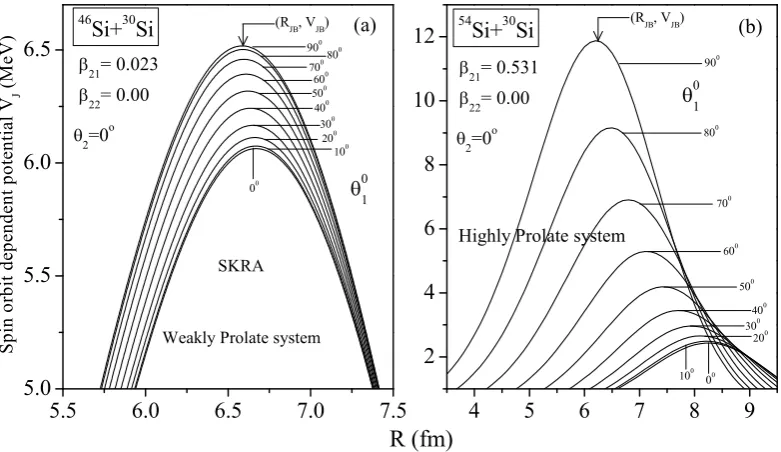
Figure 1.Figure shows the variation of spin-orbit dependent part VJ(R) of interaction potential, plotted for different orientation degree
of freedomθ(a) for weakly prolate and (b) for highly prolate deformed nuclei. VJBrepresent the maximum value of VJand RJBis corresponding position, different for different orientations.
2.2 Wong formula
According to Wong [12], the fusion cross-section, in terms of angular-momentumpartial waves, for deformed and oriented nuclei (with orientation anglesθi), lying in same
planes, and colliding with center-of-mass energy (Ec.m.), is
σ(Ec.m., θi)= π
k2
(2+1)P(Ec.m., θi), (7)
withk=
2µEc.m.
2 , andµas the reduced mass. Here, the
penetrabilityP is describes by the Hill-Wheeler [19, 20]
approximation,
P=
1+exp
2π(V
B(Ec.m., θi)−Ec.m.) ω(Ec.m., θi)
−1
, (8)
with ω(Ec.m., θi), evaluated at the barrier position
R = RB corresponding to the maximum barrier height V
B(Ec.m., θi).
Wong has applied some approximations, and replaced the-summation in Eq.(7) by an integral, giving the fusion
cross-section [12] as,
σ(Ec.m., θi)=R 0 B2ω0 2Ec.m. ln
1+exp
2π
ω0(Ec.m.−V 0 B)
, (9)
Here, one may use the interaction between deformed nu-clei of radiiRiwith deformation parametersβλiand
mak-ing orientation anglesθiwith respect to the collision axis.
Hence, the fusion cross-section integrated over the angles
θi(i=1,2) is obtained as
σ(Ec.m.)= π/2
θ1,θ2=0σ(Ec.m., θ1, θ2)sinθ1dθ1sinθ2dθ2. (10)
3 Calculation and Result
Within the framework of Skyrme Energy Density Formal-ism (SEDF), the role of deformation and orientation of col-liding nuclei is investigated on spin-orbit density part VJ
of nuclear potential (VN=VP+VJ) using SKRA force [10].
For the purpose of study, various Si-induced reactions
i.e. 24Si+30Si, 26Si+30Si, 28Si+30Si, 38Si+30Si 40Si+30Si, 42Si+30Si, 44Si+30Si,46Si+30Si, 48Si+30Si, 50Si+30Si, 52Si+30Si and54Si+30Si are considered. Above mentioned
reactions are so chosen because, the target is spherical and projectiles corresponds to either prolate or oblate shapes. It is to be mentioned here that, for the nuclei which are not discovered experimentally, the relevant details are taken from the theoretical work of Moller and Nix [11].
First of all, we study the effect of orientation on
spin-orbit potential by considering weakly and highly prolate systems i.e.46Si+30Si and54Si+30Si respectively as shown
in left and right panels of figure 1. The variation of VJ
is shown for different orientation degree of freedomθi.e.
from 00 to 900. It is observed in figure 1(a) that, for
weakly prolate system withβ21=0.023 andβ22=0.00, VJ
is increasing slowly with the change in orientation of pro-jectile from 00to 900. At an orientationθ=00, the height of
spin-orbit barrier is∼6.0 MeV, which for orientation an-gle ofθ=900, increases to∼6.5 MeV. Apparently, the
spin-orbit barrier position RJBis also affected by the orientation
angles between the projectile and target as the maximum RJBcorresponds toθ1=00and the minimum toθ1=900. On
changing the orientation fromθ1=00to 900, the spin-orbit
Figure 2.Same as Figure 1 but for oblate shape nuclei.
Table 1.The spin-orbit barrier height VJBand spin-orbit barrier position RJBof various prolate and oblate deformed systems with their optimum orientations [21]. The coulomb barrier VCBis also shown in table below.β2-deformations are taken from the theoretical
work of Moller and Nix [11].β21andβ22represents the deformation of projectile and target respectively.
AP AT θ1 θ2 β21 β22 VCB VJB RJB
(Si) (Si) (MeV) (MeV) (fm)
Prolate deformed nuclei
38 30 90 0 0.234 0 26.360 8.185 6.0 46 30 90 0 0.023 0 25.092 6.526 6.6 52 30 90 0 0.490 0 25.254 11.323 6.2 54 30 90 0 0.531 0 25.119 11.875 6.2
Oblate deformed nuclei
24 30 180 0 -0.242 0 29.320 11.695 5.2 26 30 180 0 -0.353 0 29.266 14.548 5.1 28 30 180 0 -0.478 0 29.351 19.11 4.9 40 30 180 0 -0.592 0 29.975 26.321 5.1 42 30 180 0 -0.321 0 26.554 13.169 5.7 44 30 180 0 -0.263 0 26.110 11.502 5.9 48 30 180 0 -0.398 0 26.232 16.467 5.7 50 30 180 0 -0.422 0 26.154 17.794 5.7
Similar results are obtained for highly prolate system i.e. for54Si+30Si reaction withβ
21=0.531 andβ22 =0.00
as depicted in figure 1(b). One may clearly see that, the enhancement in magnitude of VJ with respect to
orien-tation degree of freedom is significantly high for highly prolate as compare to weakly prolate system. At an ori-entation angle of 900, VJof highly prolate system is∼6
MeV higher than weakly prolate system.
Further, the effect of orientation on spin-orbit part is
analyzed through weakly and highly oblate shape nuclei as shown in figure 2. It is evident from the figure that, regard-less of magnitude of deformation, the decrement in
magni-tude of spin-orbit barrier height VJBis observed from
ori-entation 00 to 900(see figure 2(a) and figure 2(b)). The
higher spin-orbit barrier and lowest spin-orbit position is attained atθ1=00,θ2=1800. On changing the orientation of
projectile from 00to 900, the V
Jget affected as following:
(i) the VJBof weakly oblate system is decreased by a
fac-tor of∼6.0 MeV and shifted the spin-orbit barrier position
∼0.6 fm towards higher interaction radius i.e. more elon-gated. (ii) for highly oblate system, the VJBis decreased
by∼23.0 MeV and RJBmoved∼2.0 fm towards higher
Figure 2.Same as Figure 1 but for oblate shape nuclei.
Table 1.The spin-orbit barrier height VJBand spin-orbit barrier position RJBof various prolate and oblate deformed systems with their optimum orientations [21]. The coulomb barrier VCBis also shown in table below.β2-deformations are taken from the theoretical
work of Moller and Nix [11].β21andβ22represents the deformation of projectile and target respectively.
AP AT θ1 θ2 β21 β22 VCB VJB RJB
(Si) (Si) (MeV) (MeV) (fm)
Prolate deformed nuclei
38 30 90 0 0.234 0 26.360 8.185 6.0 46 30 90 0 0.023 0 25.092 6.526 6.6 52 30 90 0 0.490 0 25.254 11.323 6.2 54 30 90 0 0.531 0 25.119 11.875 6.2
Oblate deformed nuclei
24 30 180 0 -0.242 0 29.320 11.695 5.2 26 30 180 0 -0.353 0 29.266 14.548 5.1 28 30 180 0 -0.478 0 29.351 19.11 4.9 40 30 180 0 -0.592 0 29.975 26.321 5.1 42 30 180 0 -0.321 0 26.554 13.169 5.7 44 30 180 0 -0.263 0 26.110 11.502 5.9 48 30 180 0 -0.398 0 26.232 16.467 5.7 50 30 180 0 -0.422 0 26.154 17.794 5.7
Similar results are obtained for highly prolate system i.e. for54Si+30Si reaction withβ
21=0.531 andβ22 =0.00
as depicted in figure 1(b). One may clearly see that, the enhancement in magnitude of VJ with respect to
orien-tation degree of freedom is significantly high for highly prolate as compare to weakly prolate system. At an ori-entation angle of 900, VJof highly prolate system is∼6
MeV higher than weakly prolate system.
Further, the effect of orientation on spin-orbit part is
analyzed through weakly and highly oblate shape nuclei as shown in figure 2. It is evident from the figure that, regard-less of magnitude of deformation, the decrement in
magni-tude of spin-orbit barrier height VJBis observed from
ori-entation 00to 900(see figure 2(a) and figure 2(b)). The
higher spin-orbit barrier and lowest spin-orbit position is attained atθ1=00,θ2=1800. On changing the orientation of
projectile from 00to 900, the V
Jget affected as following:
(i) the VJBof weakly oblate system is decreased by a
fac-tor of∼6.0 MeV and shifted the spin-orbit barrier position
∼0.6 fm towards higher interaction radius i.e. more elon-gated. (ii) for highly oblate system, the VJB is decreased
by∼23.0 MeV and RJBmoved∼2.0 fm towards higher
interaction radius.
Figure 3. Total interaction potential VT (MeV) of40Si+30Si re-action as a function of inter nuclear distance R (fm) plotted with and without spin-orbit density effects at optimum orientations
θopt.1 =1800andθ2opt.=00.
Moreover, on comparing VJBof weakly prolate (figure
1(a)) and weakly oblate system (figure 2(a)) at their re-spective optimum orientations, we find that, in comparison to weakly prolate system, VJBof weakly oblate system is
increased∼5.2 MeV. However, VJBof highly oblate
sys-tem is∼14.4 MeV higher than highly prolate system (see figure 1(b) and 2(b)). This analysis is further extended for other Si+Si reactions, where magnitude of deformation is
in between 0.023 ≤β2≤0.531 for prolate and -0.242 ≤ β2≤-0.592 for oblate systems. All prolate/oblate
projec-tiles show similar result as we discussed above (therefore not shown here to avoid repetition). Table 1 summarizes the result for all considered reactions with their spin-orbit barrier height and position at the optimum orientations (θ1, θ2).
The present study suggest that, the magnitude of pro-late/oblate deformations and corresponding orientation
an-gle between the colliding nuclei, significantly influence the spin-orbit barrier height and position. Moreover, the compactness of the system also get affected within the sign
ofβ2-deformation.
Now in order to see the role of spin-orbit part in the total interaction potential (VT=VP+VJ+VC=VN+VC), the
spin-orbit independent potential (VP) and Coulomb
po-tential (VC) parts are added to it. figure 3 shows the
total interaction potential with and without the contribu-tion of spin-orbit effect for 40Si+30Si reaction plotted at
Coulomb barrier energy i.e. ECB=29.98 MeV
(tempera-ture T=2.87 MeV). It is clear that, impact of spin-orbit
part is significant on fusion pocket rather than on fusion barrier height. Pocket becomes more shallower with in-clusion of VJ. Moreover, the barrier curvature (ω) also
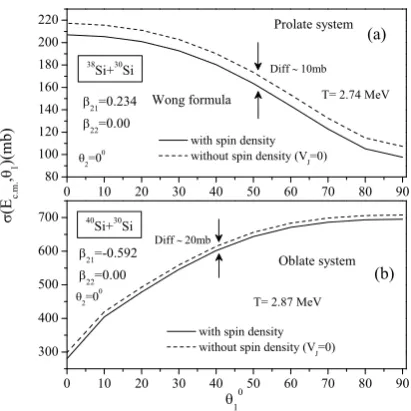
Figure 4. Variation of fusion cross-sectionσf usionat each angle with and without spin density effects (a) for prolate and (b) for
oblate shape nuclei, plotted at their coulomb barrier energy (see Table 1).
gets reduced with the inclusion of spin-orbit potential. In view of this point, it would be of further interest to study the influence of spin-orbit part on fusion cross-sections. The fusion cross-sections are calculated with and without the inclusion of spin-orbit density part in the total interac-tion potential and plotted at different orientations as shown
in figure 4. Calculations are performed for 38Si+30Si
and40Si+30Si reactions with respective prolate and oblate
shapes. Since no experimental data is available for these reactions, therefore cross-sections are estimated at their respective Coulomb barrier energy (see Table 1). It is ob-served that, the spin-orbit density part decreases the fusion cross-sections to a small extent within the Wong formula. This fall offin cross-section is about∼10 mb for prolate
system and∼20 mb for oblate system. As expected, for prolate system (as shown in figure 4(a)), independent of spin orbit effect, the fusion cross-sections are decreasing
with increase in orientation angle of colliding nuclei with maxima at θ2=00. On the other hand, for oblate nuclei, σf usionincreases with increase in orientation angle of
col-liding nuclei and become maximum atθ2=900 as shown
in figure 4(b). For in between configurations the fusion cross-sections vary smoothly as a function of orientation angle.
4 Summary
A systematic study is carried out to see the influence of de-formation and orientation on spin-orbit density part VJby
employing various prolate and oblate shape nuclei within the Skyrme Energy Density Formalism. The deformation is included upto β2 lying within range of 0.023 ≤ β2≤
0.531 for prolate and -0.242≤β2≤-0.592 for oblate
pro-late deformed nuclei, higher spin-orbit barrier and lowest spin-orbit barrier position corresponds to orientation 900,
which for oblate shape nuclei changes to orientation an-gle 00. The spin-orbit barrier and position is significantly
influenced by both the sign and magnitude of deforma-tion. The oblate shape nuclei (β2<0) exhibit higher
spin-orbit barrier (and lowest barrier position) in comparison to prolate systems (β2>0). Also, the pocket of total
interac-tion potential become more shallower with the inclusion of spin-orbit effect. In addition to this, the angular
depen-dence of spin-orbit part is studied on fusion cross-section by taking both prolate and oblate systems. It is observed that, fusion cross-sections are maximum atθ2=00for
pro-late andθ2=900 for oblate nuclei and their magnitude
re-duces slightly after inclusion of spin-density effect.
5 Acknowledgment
The financial support from the department of science and technology (DST), is gratefully acknowledged.
References
[1] A. Iwamoto and P. Moller, Nucl. Phys. A 605, 334 (1996).
[2] D. Jain, R. Kumar and M. K. Sharma, Nucl. Phys. A
915, 106-124 (2013).
[3] Rajni, R. Kumar and M. K. Sharma, Phys. Rev. C90, 044604 (2014).
[4] D. Jain, M. K. Sharma, Rajni, R. Kumar and R. K. Gupta, Eur. Phys. J. A50, 155 (2014).
[5] D. Vautherin and D. M. Brink, Phys. Rev. C5, 626 (1972).
[6] R. K. Gupta, D. Singh, and W. Greiner, Phys. Rev C
75, 024603 (2007).
[7] J. Bartel and K. Bencheikh, Eur. Phys. J. A14, 179 (2002).
[8] C. Ngoet al., Nucl. Phys. A240, 353 (1975); C. Ngo
et al., Nucl. Phys. A 252, 237 (1975).
[9] Fl. Stancu and D. M. Brink, Nucl. Phys. A270, 236 (1976).
[10] M. Rashdan, Mod. Phys. Lett.15, 1287 (2000). [11] P. Moller and J. R. Nix, Nucl. Phys. A 361, 117
(1981).
[12] C. Y. Wong, Phys. Rev. Lett.31, 766 (1973). [13] P. Chattopadhyay and R. K. Gupta Phys. Rev. C30,
1191 (1984).
[14] R. K. Gupta, D. Singh, R. Kumar, and W. Greiner, J. Phys. G: Nucl. Part. Phys.36, 075104 (2009).
[15] R. K. Gupta, M. Balasubramaniam, R. Kumar, N. Singh, M. Manhas, and W. Greiner, J. Phys. G: Nucl. Part. Phys.31, 631 (2005).
[16] L. R. B. Elton, Nuclear Sizes (Oxford University Press, London, 1961); H. de Vries, C. W. de Jager, and C. de Vries, At. Data Nucl. Data Tables 36, 495 (1987). [17] S. Shlomo and J. B. Natowitz, Phys. Rev. C44, 287
(1991).
[18] K. J. LeCouteur and D. W. Lang, Nucl. Phys.13, 32 (1959).
[19] D. L. Hill and J. A. Wheeler, Phys. Rev. 89, 1102 (1953).
[20] T. D. Thomas, Phys. Rev.116, 703 (1959).
![Table 1. The spin-orbit barrier height Vtheir optimum orientations [21]. The coulomb barrier VJB and spin-orbit barrier position RJB of various prolate and oblate deformed systems withCB is also shown in table below](https://thumb-us.123doks.com/thumbv2/123dok_us/8124002.1353640/4.595.100.484.102.331/orientations-barrier-barrier-position-various-prolate-deformed-systems.webp)