Cooling Load Estimation in Air Conditioning System
Dr.I.Satyanarayana 1, Banavath Srinu 21
Prnicipal& Professor of Mechanical Engineering, Sri Indu Institute of Engineering and Tech., Sheriguda(V), Ibrahimpatnam(M), Hyderabad, Telangana, India. Email:[email protected]
2PG student of Mechanical Engineering, Sri Indu Institute of Engineering and Tech., Sheriguda(V),
Ibrahimpatnam(M)Hyderabad, Telangana, India.Email:[email protected]
Abstract
The project titled” COOLING LOAD ESTIMATION IN AIR CONDITIONING SYSTEM” is an effort to apply our knowledge of mechanical and thermal engineering in analysis of air conditioning and to estimate the cooling load for a given space. This project report also documents the analysis of the components of air conditioner. Cooling load estimation depends upon significant building parameters like orientation, window glass shade type, number of glass panes used, wall insulation, roof type and floor type can be easily investigated. Effects of all these parameters have been investigated for a typical building block to arrive at an intelligent decision.
Many laboratory tests and research investigations have shown that the fundamental requirement for human comfort is physiological, and can be summed up by saying that optimum conditions for comfort are those existing when the body can maintain complete thermal equilibrium, with only minor adjustments in heat regulating mechanism of the body. When compared to the earlier times today’s air conditioners are compact, efficient, effective, attractive, eco-friendly .Air condition is not only useful in providing human comfort but also used in many fields like food preservation, cold storage, transport air conditioning, medical sciences and varied industrial applications.
Most notably, and evaluation of the air conditioning for optimization of its efficiency came through the fruitful combination of mechanical engineering, thermal engineering, physiological sciences, and most important is the human comfort.
1. Introduction
Applying mechanical and thermal engineering concepts, an air conditioner was designed for the human comfort and other necessary objection. This project report delineates norms and the procedure for the estimation of the heat load on the air conditioner.
Being socially conscious technocrat I choose to invest my time, effort, and engineering knowledge into clearly understanding the
mechanism underlying within the air conditioner which became a necessity in today’s world .We chose to concentrate more on cooling load calculations because through this we can understand the heat gain sources so that we can have check on them the next time we switch on an A.C.
1.1 REFRIGERATION
The term "refrigeration" may be defined as the process of removing heat from a substance under controlled conditions. It also includes the process of reducing and maintaining the temperature of a body below the general temperature of its surroundings. The device that serves this purpose is called "refrigerator". Refrigerator has become a part of day –to-day life of man. It has become a necessity in this world of technology. In other words the term refrigeration means continued extraction of heat from a body whose temperature is below the surrounding temperature.
The refrigerant is a heat carrying medium which during their cycle in the refrigeration system absorbs heat from a low temperature system and discards it to high temperature body. There are many types of refrigerants that are widely being used. Some of them are Freon-22, R-134a, R-11, R-12, R-100, etc. AIR CONDITIONING
:
i.e. supplying and maintaining desirable internal atmospheric conditions for human comfort, irrespective of external conditions. It also deals with the conditioning of air for industrial processes, food processing, storage of foods and other materials.
Figure1.1 AC Model
AIR REFRIGERATION CYCLES:
Air refrigerator working on Bell-Coleman cycle (Reverse Brayton cycle):
Figure:2 T-S and P-V diagrams
Fig :3 Bell coleman cycle
This is an important cycle frequently employed in gas cycle refrigeration systems. This may be thought of as a modification of reversed Carnot cycle, as the two isothermal processes of Carnot cycle are replaced by two isobaric heat transfer processes. This is also called as Joule or Bell-Coleman cycle.
Process 1-2: Reversible, adiabatic compression in a compressor .Gas at low pressure is compressed isentropically from state 1 to state 2.
Process 2-3: Reversible, isobaric heat rejection in a heat exchanger. Hot and high pressure gas flows through a heat exchanger and rejects heat sensibly and isobarically to a heat sink. The enthalpy and temperature of the gas drop during the process due to heat
SCOPE OF THE PROJECT:
This research briefly introduces the principal components of cooling load of a building, namely, wall transmission, solar effect, internal heat gain (light, equipment, occupants) orientation of building, etc. The indoor design condition was set at 24 OC and a relative humidity of 50% applied to buildings of different constructions. The outdoor condition was extracted from long term climatic data obtain from Meteorological Department of Ghana. Chapter 1 deals with the introduction to the topic and the objective of embarking on such a project. Chapter 2 is on literature review on definition of load terms and simplified method of estimation of cooling load.
2.
Literature Review
The basic concept behind air conditioning is known to have applied in ancient Egypt, where reeds were hung in windows and were moistened with trickling water. The evaporation of water cooled the air blowing through the window. This process also made the air more humid
Andersson et al. [1] designed heating and cooling loads for a sample residential building at different orientations, using a development version of the building energy analysis computer program BLAST. They identified that the total loads were found to be higher for north than south orientation except in extreme southern latitudes of the U.S.
Omar et al. [2] calculated the hourly cooling load due to different kinds of wall, roof and fenestration using transfer function method (TFM). The output of this method was compared with the well-known Carrier program and the results were acceptable. In the case of cooling load, when the results were compared with the ASHRAE examples, some differences were noticed due to wall and roof. They also studied the effects of changing the wall color on cooling load.
uninsulated buildings, as the absorptance was changed from one to zero, the total energy load decreased by 32%, while for insulated buildings, it decreased by 26% inAmman. Whereas the decrease was about 47% for uninsulated and 32% for insulated buildings in Aqaba.
Kulkarni et al. [4] optimized cooling load for a lecture theatre in a composite climate in India. The lecture theatre had a dimension of 16m×8.4m×3.6m and was situated at Roorkee (28.58oN, 77.20oE) in the northern region of India. The monthly, annual cooling load and cooling capacity of air conditioning system was determined by a computer simulation program. They reported that the use of false celling, ceramic tiles on roof and floor, electro chromic reflective colored, 13mm air gap, clear glass gave the best possible retrofitting option.
3.
Analysis and Evaluation
As the main objective of our project was analysis of air conditioning for optimum efficiency, I went to nizam’s institute of medical sciences (nims) to see that how a centralized AC plant has been set up there and do analysis for our project based on their results and conclusions.
• The compressor being used is semi-hermetic compressor. The multistage has been introduced to the compressors. So each AC equipment has 4 compressors, a condenser, muffler to each and every compressor, expansion valve, chiller pipes, safety valves, pressure gauges etc.
• The condenser is water cooled, that is water acts as the secondary refrigerant. The capacity of each compressor is 86 TR i.e. 86*4=344 TR is the capacity of each AC equipment. There are 6 such AC equipments that make a centralized AC.
• The refrigerant is R134a. Semi-hermetic means the compressor is in built with the motor.
• The condenser is water cooled. It is shell and water cooled condenser with counter-flow type of heat exchanger. Here the water gets heated up and flows to the cooling tower where the water gets cooled.
Example of hospital space
Figure4 : layout of room
Internal heat gains:
Figure 5: internal heat gains
The next component of the space cooling load is the heat that originates within the space. Typical sources of internal heat gain are people, lights, cooking processes, and other heat generating equipment, such as motors, appliances, and office equipment.
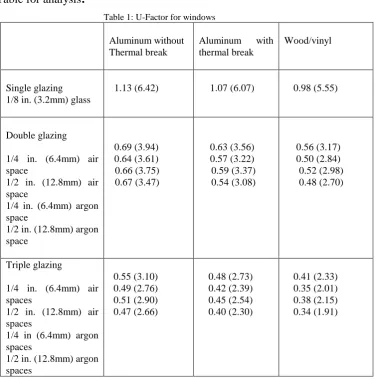
Table for analysis
:
Table 1: U-Factor for windows
Aluminum without Thermal break
Aluminum with thermal break
Wood/vinyl
Single glazing 1/8 in. (3.2mm) glass
1.13 (6.42) 1.07 (6.07) 0.98 (5.55)
Double glazing
1/4 in. (6.4mm) air space
1/2 in. (12.8mm) air space
1/4 in. (6.4mm) argon space
1/2 in. (12.8mm) argon space
0.69 (3.94) 0.64 (3.61) 0.66 (3.75) 0.67 (3.47)
0.63 (3.56) 0.57 (3.22) 0.59 (3.37) 0.54 (3.08)
0.56 (3.17) 0.50 (2.84)
0.52 (2.98) 0.48 (2.70)
Triple glazing
1/4 in. (6.4mm) air spaces
1/2 in. (12.8mm) air spaces
1/4 in (6.4mm) argon spaces
1/2 in. (12.8mm) argon spaces
0.55 (3.10) 0.49 (2.76) 0.51 (2.90) 0.47 (2.66)
0.48 (2.73) 0.42 (2.39) 0.45 (2.54) 0.40 (2.30)
0.41 (2.33) 0.35 (2.01) 0.38 (2.15) 0.34 (1.91)
Calculations:
Conduction through Windows:
Conduction heat gain through the west-facing windows: • U-factor = 0.63 Btu/hr•ft2•°F [3.56 W/m2•°K]
• Total area of glass = 8 windows x (4 ft x 5 ft) = 160 ft2 [8 x (1.2 m x 1.5 m) = 14.4 m2] • CLTD hour=17 = 13ºF [7°C]
[ = 0.63 × 160 × 13 = 1,310 Btu/hr
= 3.56 × 14.4 × 7 = 359 W]
Internal Heat Gains:
Internal heat gain from people: • Number of people = 18
• Sensible heat gain/person = 250 Btu/hr [75 W] • Latent heat gain/person = 200 Btu/hr [55 W]
• CLF = 1.0 (because the space temperature set point is increased at night) QS = 18 people x 250 Btu/hr per person x 1.0 = 4,500 Btu/hr
= 18 × 250 × 1.0 = 4,500 Btu/hr
= 18 × 200 = 3,600 Btu/hr
4.
Results and Discussion
Summary of Space Cooling LoadsSpace load components sensible load
Btu/hr [W]
latent load
Btu/hr [W]
Conduction through roof 12,312 [3,563]
Conduction through exterior wall 502 [144]
Conduction through windows 1,310 [359]
Solar radiation through windows 22,733 [6,447]
People 4,500 [1,350] 3,600 [990]
Lights 22,097 [6,480]
Equipment 8,184 [2,404] 1,540 [450]
Infiltration 2,988 [876] 3,969 [1,159]
Total space cooling load 74,626 [21,623] 9,109 [2,599]
Ventilation 6,640 [2,047] 8,820 [2,709]
Total coil cooling load 81,266 [23,670] 17,929 [5,308]
5. Conclusion
Finally, the cooling coil in the air-conditioning system that serves this space must be capable of handling the sensible and latent loads for the space, plus any additional loads that affect the coil only. In our example, outdoor air for ventilation is the only additional load affecting the cooling coil. Based on the calculations performed in Period Two, the total load on the cooling coil is 99,195 Btu/hr (8.3 refrigeration tons) [28,978 W].
References
[1] Andersson,B., Wayne P. and Ronald K., " The impact of building orientation on residential heating and cooling" , Energy and Buildings,1985; 8; 205-224. [2] Omar et al. [2], “calculated the hourly cooling load due to different kinds of wall, roof and fenestration using transfer function method (TFM)”. [3] Shariah,A., Bassam S., Akram R. and Brhan T.," Effects of absorptance of external surfaces on heating and cooling loads of residential buildings in Jordan" Energy Conversion and Management,1998; 39; 273-284.
[4] Kulkarni K., P.K. Sahoo and Mishra M., “Optimization of cooling load for a lecture theatre in a composite climate in India” Energy and Buildings, 2011; 43; 1573-1579.
[5] Suziyana M. D., Nina S. N., Yusof T. M. and. Basirul A. A. S., “Analysis of Heat Gain in Computer Laboratory and Excellent Centre by using CLTD/CLF/SCL Method” Procedia Engineering, 2013; 53; 655 – 664.
[6] Hani H. Sait, “Estimated Thermal Load and Selecting of Suitable Air-Conditioning Systems for a Three Story Educational Building” Procedia Computer Science, 2013; 19; 636 – 645.
[7] Suqian Y., Jiaping L., GeXiangrong and Xiang H., “The Research of Cooling Load and Cooling Capacity Calculation Methods of Spinning Workshop” Procedia Environmental Sciences, 2011; 11; 597 – 603. [8] Foudaa A., Melikyan Z., Mohamed M.A. and Elattar H.F., “A modified method of calculating the heating load for residential buildings” Energy and Buildings, 2014; 75; 170–175.
[9] Duanmu L., Wang Z., ZhaiZ.andXiangli L., “A simplified method to predict hourly building cooling load for urban energy planning” Energy and Buildings, 2013; 58; 281–291.
[10] Christian A., Gueymard and Thevenard D., “Monthly average clear-sky broadband irradiance database for worldwide solar heat gain and building cooling load calculations” Solar Energy, 2009; 83; 1998– 2018.
[11] Abdullatif E., Ben-Nakhi, Mohamed A., and Mahmoud, “Cooling load prediction for buildings using general regression neural networks” Energy Conversion and Management, 2004; 45; 2127–2141. [12] Fernando D.M., Jose M. C.L., Antonio C.A., “Uncertainty in peak cooling load calculations” Energy and Buildings, 2010; 42; 1010–1018
[13] MehmetAzmi et al. “investigated the effects of different outdoor design conditions on cooling loads and air conditioning systems”
[14] NaouelDaouas, “A study on optimum insulation thickness in walls and energy savings in Tunisian buildings based on analytical calculation of cooling and heating transmission loads” Applied Energy, 2011; 88; 156–164