1 | P a g e Reduction of Anisotropic Volume Expansion and the Optimization of
Specific Charge Capacity in Lithiated Silicon Nanowires
Donald C Boone*
*- Nanoscience Research Institute 4423 Lehigh Rd Suite 371 College Park, Maryland 20740 USA. Email: [email protected].
Abstract: This computational research study analyzes the increase of the specific charge capacity that comes with the reduction of the anisotropic volume expansion during lithium ion insertion within silicon nanowires. This research paper is a continuation from previous work that studied the expansion rate and volume increase. It has been determined that when the lithium ion concentration is decreased by regulating the amount of Li ion flux, the lithium ions to silicon atoms ratio, represented x, decreases within the amorphous lithiated silicon (a-LixSi) material. This results in a decrease in the volumetric strain of the lithiated silicon nanowire as well as a reduction in Maxwell stress that was calculated and Young’s elastic module that was measured experimentally using nanoindentation. The conclusion as will be seen is that as there is a decrease in lithium ion concentration there is a corresponding decrease in anisotropic volume and a resulting increase in specific charge capacity. In fact the amplification of the electromagnetic field due to the electron flux that created detrimental effects for a fully lithiated silicon nanowire at x=3.75which resulted in over a 300% volume expansion becomes beneficial with the decrease in lithium ion flux as x approaches 0.75 which leads to a marginal volume increase of ~25 percent. This could lead to the use of crystalline silicon, c-Si, as an anode material that has been demonstrated in many previous research work to be ten times greater charge capacity than carbon base anode material for lithium ion batteries.
Introduction
The lithiated silicon nanowire has the potential of being a great advancement in anode material in lithium ion batteries (LIBs). As well documented in the current literature of research on LIBs, the specific charge capacity (scc)
of lithiated silicon has been measured to be greater than 10 times that of carbon base anode batteries. Unfortunately the overwhelming volume expansion in excess of 300% of the silicon nanowire during lithiation has made this material ineffective for the future of lithium ion batteries due to the resulting fracture and failure of this material. This volume expansion appears to occur during full lithiation described by the lithium-silicon material LixSi where x=3.75 defines the state where the liathiated silicon nanowire is at full lithiation. When this occurs the volume expands at an uncontrollable anisotropic rate where the <110> crystallography direction could possibly increase 12 times greater than that of the <111> crystallography direction within the silicon nanowire. In this computation research work it will be demonstrated that this volume expansion could be avoided if the lithium ion flux rate is decrease where x < 3.75. The paper will draw heavily on the previous work done by Boone [1, 2] however information will come from other sources that will be indispensable in the calculation of volumetric strain and hence the volume expansion.
Analysis
For this research work, there will be a special notion that will be used throughout this study to indicate the orthogonal directions that are essential element in the presentation of this paper. As an example, the mathematical variables and functions that have directional characteristics will have subscripted notations that will indicate which orthogonal direction is being represented. For an example:
𝐴 = 𝐴
〈 〉i=j=1 or 2 or 3;
(
1
)
𝐴 = 𝐴
〈 〉𝐴 = 𝐴
〈 〉𝐴 = 𝐴
〈 〉2 | P a g e The model of the computational research that will be presented is based on a single silicon diamond crystal lattice with lithium ions and electron flux diffusing in opposite directions through the stationary silicon atoms [1, 2]. There will be two main independent variables that will be utilized throughout this work. As previously discuss the independent variable x in LixSi will be the lithium ion concentration for lithiated silicon where x=the ratio between lithium ion and silicon atoms. The second independent variable will be known as the average negative charge differential 𝑛 define as the difference between the numbers of negative free electrons or electron flux and the number of positive lithium ions or lithium ion flux per unit volume that flows into our computational model that is being studied.
The volume expansion and geometric configuration of the silicon nanowire at full lithiation can best be demonstrated by deriving a set of equations from the Cassini oval geometry [3]. In this study, the computational model simulated the nanowire volume increase slightly above 300% upon the conclusion of lithium ion insertion. There was a volume change ∆𝑉 in each of the three orthogonal directions of <110>, <111> and <112>. However, this study will focus exclusively on
∆𝑉
since it was calculated that approximately 96% of the volume increase was in that <110> direction.∆𝑉
〈 〉= ∆𝑉 = 𝑉
∆ ⃗∆ ⃗(2)
with 𝑉 being the total maximum volume increase and is define as 𝑉 = ∆𝑉 + ∆𝑉 + ∆𝑉 (Figure 1). In terms of the maximum increase in volume, 𝑉 can be thought of as being approximately equivalent to
∆𝑉
at𝑛 =6 because there is a negligible volume expansion in the <111> and <112> directions. The three volumetric strains are defined 𝜀 . 𝜀 , 𝜀 in each of the orthogonal directions. The definition of ∆𝑟⃗ is the decrease in the length of the transition state vector 𝑟⃗ that can be further explained in [2].
𝑉
= 𝜀 + 𝜀 + 𝜀
(3)
𝑉
≈ ∆𝑉
= 𝜀
𝜀 ≈ 𝜀 ≈ 0
at
𝑛
=6
(4)
Since there is only one primary direction that will be analyzed, namely <110> direction, therefore Young’s Modulus
𝕐 will be used in the calculation of volumetric strain𝜀 .
𝜀 =
𝕐𝔼(5)
where 𝔼 is the Maxwell stress equation defined in [1]. The determination of Young’s Modulus 𝕐 came from experimental data in the research paper Wang et.al [4] where a nanoindentation apparatus was used to measure 𝕐
at varies concentration x values under dry and wet conditions. The values used in this research paper under the lithiated dry conditions are as follows:
Li
xSi concentration
x=0.75
x=1.00
x=1.50
x=2.25
x=3.00
x=3.75
3 | P a g e
Figure 1. Most of the volume increase is in the <110> direction as displayed in the red rectangle area. Reprinted from Mathematical and Computational Applications - MDPI, October 2017. Copyright by the author under the terms and conditions of the Creative Commons Attribution (CC BY 4.0).
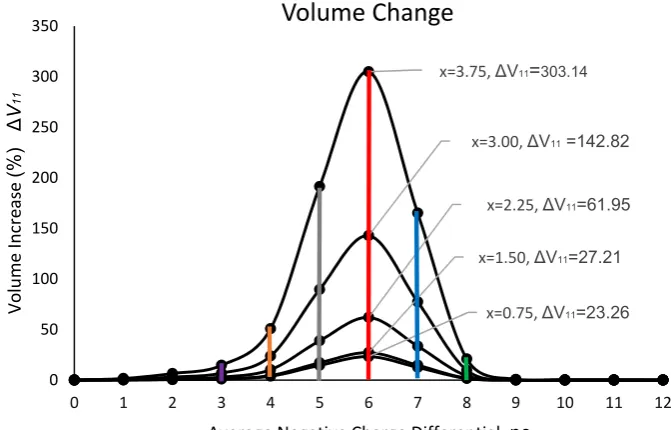
Figure 2. The maximum volume increase at 𝑛 =6 for each corresponding concentration x which is equal to the ratio of the number of lithium ion to silicon atoms (Li/Si) for LixSi composite material. As the concentration x decreases there is a corresponding decrease in the amount of volume change.
x=0.75, ΔV11=23.26
x=1.50, ΔV11=27.21
x=2.25, ΔV11=61.95
x=3.00, ΔV11=142.82
x=3.75, ΔV11=303.14
0 50 100 150 200 250 300 350
0 1 2 3 4 5 6 7 8 9 10 11 12
Vo
lu
m
e
In
cre
as
e
(%)
Δ
V
11
Average Negative Charge Differential
nc
Volume Change
303.14
10.57
= 2.30
0 50 100 150 200 250 300 350
0 5 10 15 20 25 30 35 40
Volume Increase (%)
Average Negative Charge Differential
Volume Change
𝑛
∆𝑉 =
∆𝑉 =
at𝑛 = 6
at𝑛 =12
4 | P a g e The display in figure 2 are the volume changes at different lithium ion concentration levels defined by x. As x decreases so does the maximum volume at 𝑛 =6. The definition of the current within the lithiated silicon nanowire is defined as
𝐼
=
⃗where
𝑁 = 𝑛 𝑎 (6)
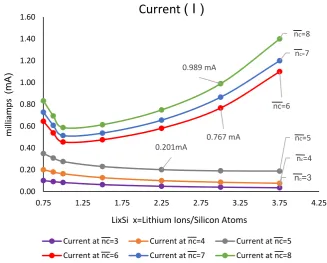
The current is defined by the silicon lattice constant a, the electron charge constant e, the electric field 𝑬⃗𝟏𝟏 in the <110> direction, lithium ion mass 𝑚 and the angular momentum 𝜔 of the lithium ion.
Figure 3. The current within the lithiated silicon nanowire for 𝑛 < 6 is approximately constant at any x value. However at 𝑛 ≥ 6 the electron flux experience an optical amplification through an increase of the electromagnetic field. The current increases nonlinearly as the concentration x increases.
The specific charge capacity 𝑞 is defined as
𝑞
= 1 + 𝜀
(
7
)
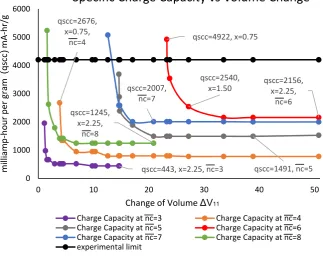
where in addition to the parameters stated above for the current, 𝑁 is the number of lithium ions within the computational model. The 𝑞 is stated below in figure 4 and 5 versus the concentration x=Li/Si and volume change
∆𝑉 respectively.
nc=3
nc=4
0.201mA
nc=5 0.767 mA
nc=6 nc=7
0.989 mA
nc=8
0.00 0.20 0.40 0.60 0.80 1.00 1.20 1.40 1.60
0.75 1.25 1.75 2.25 2.75 3.25 3.75 4.25
milliamps
(m
A
)
LixSi x=Lithium Ions/Silicon Atoms
Current
( I )
5 | P a g e Figure 4. The highest specific charge capacity 𝑞 is when 𝑛 =6 is at x ≥ 2.25, however at x< 2.25 the 𝑞
steadily increases for all the 𝑛 values. At 𝑛 6, the 𝑞 at optical amplification reaches the experimental limit of 4200 milliamp-hour per grams.
Figure 5. The specific charge capacity 𝑞 is dependent on the change of volume. As it can be seen for each nc value, the lower the volume increase correspond to a low concentration x. When x<1.00, the 𝑞 becomes exponentially large to the point of where the concentration is x=0.75.
979 nc=3 nc=4 nc=5 2156 2425 nc=6 2000 nc=7 3910 2620 1410 nc=8 experimental limit 0 1000 2000 3000 4000
0.75 1.25 1.75 2.25 2.75 3.25 3.75 4.25
mi
lliamp
-hour per g
ram
(q
scc)
mA-hr/g
LixSi x=Lithium Ions / Silicon Atoms Charge Capacity at nc=3 Charge Capacity at nc=4 Charge Capacity at nc=5 Charge Capacity at nc=6 Charge Capacity at nc=7 Charge Capacity at nc=8 experimental limit
qscc=443, x=2.25, nc=3 qscc=2676, x=0.75, nc=4 qscc=1491, nc=5 qscc=4922, x=0.75 qscc=2540,
x=1.50 qscc=2156, x=2.25, nc=6 qscc=2007, nc=7 qscc=1245, x=2.25, nc=8 0 1000 2000 3000 4000 5000 6000
0 10 20 30 40 50
milliamp -h our p er g ram ( qs cc ) mA-hr/g
Change of Volume ΔV11
Specific Charge Capacity vs Volume Change
6 | P a g e Summary
As was demonstrated, the specific charge capacity 𝑞 of the lithiated silicon nanowire can be increased to experimental limits and possibly beyond if the concentration x is reduced during lithiation process. With the reduction of the concentration x also comes a decrease in the volume expansion. The increase in volume should be less than 50% increase of the original silicon nanowire volume. If it is possible to design a lithium ion battery where the lithium ion flux concentration rate can be regulated below x=2.25 and at the same time work in concert with electron flux, crystalline silicon, c-Si, can be used as a great improvement in charge capacity for lithium ion batteries.
References
[1] Boone, D.C. Maxwell stress to explain the mechanism for the anisotropic expansion in lithiated silicon nanowires. AIP Adv.2016, 6, 125027.
[2] Boone, D.C. Quantum Coherent States and Path Integral Method to Stochastically Determine the Anisotropic Volume Expansion in Lithiated Silicon Nanowires; Math. Comput. Appl. 22,41, October 2017
[3] Karatas, M. A Multi Foci Closed Curve: Cassini Oval, Its Properties and Applications. Dogus Univ. Derg.2013, 14,231-248
[4]Wang, Yikai; Zhang, Qinglin; LI, Dawei; Hu, Jiazhi; Xu, Jiagang; Dang, Dingying; Xiao, Xingcheng; Cheng, Yang-Tse; Mechanical Property Evolution of Silicon Composite Electrodes Studies by Environmental
Nanoindentation; Advanced Energy Materials; January 2018
[5] Xiao Hua Liu, He Zheng, Li Zhong, Shan Huang, Khim Karki, Li Qiang Zhang, Yang Liu, Akihiro Kushima, Wen Tao Liang, Jiang Wei Wang, Jeong-Hyun Cho, Eric Epstein, Shadi A. Dayeh, S. Tom Picraux, Ting Zhu, Ju Li, O John P. Sullivan, John Cumings, Chunsheng Wang, Scott X. Mao, Zhi Zhen Ye, Sulin Zhang, Jian Yu Huang, Anisotropic Swelling and Fracture of Silicon Nanowires during Lithiation, Nano Letter 11 p3312-3318 2011
[6] Xiao Hua Liu, Feifei Fan, Hui Yang, Sulin Zhang, Jian Yu Huang, Ting Zhu, Self-Limiting Lithiation in Silicon Nanowires, ACS NANO 7 (2) p1495–1503 2013
[7] Akihiro Kushima, Jian Yu Huang, Ju Li, Quantitative Fracture Strength and Plasticity Measurements of Lithiated Silicon Nanowires by In Situ TEM Tensile Experiments, ACS NANO vol. 6 No. 11 P9425-9432 2012
[8] Ill Ryu, Jang Wook Choi, Yi Cui, William D. Nix, Size-Dependent Fracture of Si Nanowire Battery Anodes, Journal of the Mechanics and Physics of Solids 59 (2011) p1717-1730
[9] Ekin D. Cubuk, Wei L. Wang, Keije Zhao, Joost J. Vlassak, Zhiang Suo, Efthimios Kaxiras, Morphological Evolution of Si Nanowires upon Lithiation: A First Principles Multiscale Model, Nano Letter 2013, 13 2011-2015
[10] Sung Chul Jung, Jang Wook Choi, Young-Kyu Han, Anisotropic Volume Expansion of Crystalline Silicon during Electrochemical Lithium Insertion: An Atomic Level Rationale, ACS Publication Nano Letter 12 p5342-5347 2012
[11] James R. Chelikowsky, Marvin L. Cohen, Semiconductors: A Pillar of Pure and Applied Physics, Journal of Applied Physics 11, 112812 (2015)
[12] Jung Wei Wang, Yu He, Feifei Fan, Xiao Hua Liu, Shuman Xia, Yang Liu, C. Thomas Harris, Hong Li, Jian Yu Huang, Scott X. Mao, Ting Zhu, Two-Phase Electrochemical Lithiation in Amorphous Silicon, Nano Letter 13, 2013