
Article
1
Psychological Intervention Using Motivational
2
Coaching in Dance Sport: A single case study
3
David Peris-Delcampo 1, *, Nora Taipe-Nasimba2, Violeta Expósito3 and Enrique Cantón4
4
1 Psychologist. Department of methodology. Faculty of psychology. University of Valencia. Spain;
5
[email protected] http://orcid.org/0000-0002-7588-1522
6
2 Psychologist. Line of motivation, physical activity and health. Faculty of psychology. University of
7
Valencia. Spain; [email protected] http://orcid.org/0000-0001-9480-8454
8
3 Psychologist. Line of motivation, physical activity and health. Faculty of psychology. University of
9
Valencia. Spain; [email protected] http://orcid.org/0000-0002-2312-8707
10
4 Psychologist. Director line of motivation, physical activity and health. Department of basic psychology.
11
Faculty of psychology. University of Valencia. Spain; [email protected]
12
http://orcid.org/0000-0001-6869-617X
13
* Correspondence: [email protected]; Tel.: +34-609126807 (D.P.)
14
15
Abstract: The work shows a single case intervention based on the motivational coaching model the
16
"Cantón’s Giraffe", theoretically and experimentally proven in a 20-years-old dancesport
17
practitioner, who considered improving her execution with her dance partner. Methodological
18
triangulation was used [34], combining a test-retest quantitative measure (Using Ryff Psychological
19
Wellbeing Scales; the Rosenberg Self-Esteem Questionnaire and an ad-hoc instrument for the
20
motivational force assessment) and subjective analysis of the responses from the interviews
21
conducted. A three-phase intervention protocol was used [33]: identification, intervention, and
22
follow-up. The results show an improvement in reevaluation scores, an increase in the subjective
23
evaluation, and participant satisfaction and perceived resources raised at the end of the
24
intervention. These results are in line with previous similar studies.
25
Keywords: motivation; well-being; self-steem; psychology; sport
26
27
1. Introduction
28
Based on the new psychological demands of the society, it is necessary to find useful tools with
29
good theoretical foundation, applied and efficient for professional psychological intervention [1];
30
which seek growth and personal development, not necessarily oriented to correct defects. Positive
31
Psychology [2,3] is based on this idea, since it focuses on achieving results and developing personal
32
well-being rather than detecting and correcting discomfort.
33
Sharing the positive approach, coaching [4,5] is framed as a process of accompaniment in which
34
an expert (commonly coach) generates a facilitating environment for the client (coachee), who
35
achieves his objectives using his own resources [6,7]. It can be understood as a behaviour
36
modification strategy, which produces a change in the client through reflection, learning,
37
self-discovery, and action [8]; in which the coaching expert will bring new strategies to the client or
38
coachee [9] only if it essential. Thus, in coaching the expert must know how to generate the process
39
of change and be competent with the elements of the process; therefore, it is important to be a
40
psychologist expert in coaching to carry out the psychological intervention and manage aspects
41
related to the mental field [10,11,5,12].
42
Positive psychology perspective studies eudaimonic psychological well-being, which refers to
43
live fully in the pursuit of our goals or seek satisfaction derived from the self-realisation of our
44
potential [13]; different from searching for positive experiences minimizing the negative ones [14].
45
From this perspective, the person seeks to enhance human qualities and achieve happiness.
46
From this positive approach, based on several classical motivational theories such as
47
Motivation Achievement Theory [15], Self-efficacy [16-17,18], Motivational Force Theory or
48
"Expectations x Value" [19-22] and Goal Theory [23-27,21]; Cantón [28,29] develops a motivational
49
intervention model from the perspective of coaching under the metaphorical name: "Canton’s
50
Giraffe". Different motivational components conform the four-part model, which adopts the figure
51
of a giraffe. The four parts represent the motivational factors explored in this psychological
52
intervention from the coaching approach.
53
Psychological interventions using "Cantón’s Giraffe" model have been proven to be effective
54
and efficient in different contexts such as adapted swimming [30], female’s football [31] or rhythmic
55
gymnastics [32], where an intervention protocol designed exclusively [33] was used for this model.
56
2. Materials and Methods
57
2.1. Design
58
To carry out this intervention only a methodological triangulation design was used [34], which
59
combines both quantitative and qualitative procedures. The first one consists of a test-reevaluation
60
(pre and post intervention), while the qualitative procedure involves interviews of analysis and
61
subjective evaluation of his progress and perceived changes.
62
2.2. Participants
63
The participant is a 20-years-old college student, who has been practicing competitive ballroom
64
dancing for 14 years, standard (English and Viennese waltz, tango, slow fox, and quickstep) and Latin
65
style (samba, cha-cha-cha, rumba, paso doble, and jive). She had never worked with a psychologist
66
before, lives with her family and her current dance partner is also her boyfriend. Both have proposed
67
as a goal to perform with good level the ten style ballroom dances for the Spain Championship in
68
September.
69
Prior to the intervention, the participant was informed of the intervention conditions and the
70
possibility of its publication, after her agreement she signed the informed consent, following the
71
recommendations of the ethics committee of the Faculty of Psychology of the University of Valencia,
72
available at:
73
https://www.uv.es/ethical-commission-experimental-research/en/ethics-research-humans/preguntes-f
74
requents.html
75
2.2. Participants
76
Regarding the quantitative instruments, the following questionnaires were used to assess pre and
77
post-test variables:
78
• Rosenberg Self-Esteem Scale [35] in Spanish adaptation [36], which evaluates the subjective
79
assessment of personal skills with a Cronbach alpha of 0.80 and a Likert scale from 4
80
("Strongly agree") to 1 ("Strongly disagree") for the first five items, and from 1 ("Strongly
81
agree") to 4 ("Strongly disagree") for the last five items.
82
• Ryff's Psychological Well-Being Scale [37,38] in Spanish adaptation of Díaz,
83
Rodríguez-Carvajal, Blanco, Moreno-Jiménez, Gallardo, Valle & van Dierendock [39] with
84
good reliability (Cronbach's alpha between 0.84 and 0.70). This version has 29 items on a
85
Likert scale from 1 ("Strongly disagree") to 6 ("Strongly agree”) and grouped into six
86
subscales: self-acceptance, environmental mastery, positive relationships, purpose in life,
87
personal growth, and autonomy.
88
• Ad-hoc motivational force scale, which evaluates two fundamental aspects of motivation:
89
perceived expectation of achieving the goal and the value of the expected goal. Three items
90
related to group classes, private rounds, and Saturday measured value: improving my
91
scale from -10 ("minimum value") to +10 ("maximum value"). Furthermore, expectations
93
were also evaluated using the same three items scored on a scale from 0 ("minimum
94
expectation") to 1 ("high expectation"). Finally, the expectations score was multiplied for
95
value score in order to obtain the motivational force, being 0 ("minimum motivational force")
96
and 10 ("maximum force").
97
2.3. Intervention Protocol
98
The "Canton’s Giraffe" model (Figure 1) was used for this intervention and it begun with the
99
“head”, which corresponds to the goal or achievement, which must comply twelve characteristics and
100
an accurate catalyst motivation [28]. Among those, the goal needs to be specific and temporarily
101
planned.
102
103
104
Figure 1. The ‘Cantón’s Giraffe’ motivational coaching model [28,29].
105
106
Secondly, the "Neck" represents the motivational force that, according to Vroom [22], is the result
107
of the balanced combination of positive expectation and the value granted to the goal.
108
Thirdly, identification of self-confidence ("body"), based on three supports [40,41]: (the)
109
perception of self-efficacy (I can), self-esteem (I’m worth), and self-concept (I am).
110
Finally, the information inputs and the self-confidence formation source ("legs") on which the
111
motivational experience is based are identified. The most important is direct experience with similar
112
goals or tasks ("I do"). Another relevant input is the "I hear" that refers to both the self-talk and
113
messages from others about the goal and the person ability to handle it. Also, interpretations and
114
perceptions of the physiological sensations awakened by the goal are important for the self-confidence
115
motivation ("I feel"). Similarly, indirect experiences of people who have achieved similar goals ("I see")
116
conform another relevant contribution.
117
The intervention followed the three-phase protocol of Cantón & Peris-Delcampo [33]. The first
118
phase was used to identify and obtain information about strengths and weaknesses of the motivational
119
components, qualitatively and quantitatively measured. The second phase of the intervention involves
120
exploring the components of the "Canton’s Giraffe" motivational model, and the third phase consists
121
of a quantitative assessment. Also, a follow-up meeting is included to determine if there is
122
maintenance of the motivational changes achieved.
123
The intervention was based on the coaching methodology [6,7,12] where the professional
124
promotes reflection and questions, thus the client or coachee reaches his/her own conclusions.
125
Table 1. Model set of questions for each part of the “Cantón’s Giraffe” semi-structured interview.
127
Goal (Head) Strenghts (Neck) Confidence (Body)
Base (legs)
What is your goal?
From 1 to 10, what value do you grant
to you goal?
Do you think you can really achieve
it?
What are you feelings when you
dance?
Why is it important to you?
Do you think it is possible to achieve
your goal?
What characteristics
define you?
Have any of your friends encouraged
you to do it? Have any of your friends set similar
goals? Have you set similar goals?
128
2.4. Procedure
129
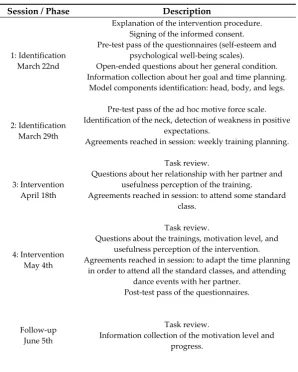
The intervention began in March and ended in May, which involved four biweekly sessions and
130
a following-up session in June. Below is a summary table of the content and structure of the sessions
131
(Table 2), which will be explained in more detail.
132
Table 2. Structure and content of the sessions.
133
Session / Phase Description
1: Identification March 22nd
Explanation of the intervention procedure. Signing of the informed consent. Pre-test pass of the questionnaires (self-esteem and
psychological well-being scales). Open-ended questions about her general condition. Information collection about her goal and time planning.
Model components identification: head, body, and legs.
2: Identification March 29th
Pre-test pass of the ad hoc motive force scale. Identification of the neck, detection of weakness in positive
expectations.
Agreements reached in session: weekly training planning.
3: Intervention April 18th
Task review.
Questions about her relationship with her partner and usefulness perception of the training. Agreements reached in session: to attend some standard
class.
4: Intervention May 4th
Task review.
Questions about the trainings, motivation level, and usefulness perception of the intervention. Agreements reached in session: to adapt the time planning
in order to attend all the standard classes, and attending dance events with her partner.
Post-test pass of the questionnaires.
Follow-up June 5th
Task review.
Information collection of the motivation level and progress.
134
The first session (March 22nd) began by explaining the procedure of the intervention, followed
135
by the signature of the informed consent. Subsequently, the client was asked open-ended questions
136
of the situation. Additionally, the participant completed the Ryff’s Psychological Well-being scale
138
and the Rosenberg Self-esteem questionnaire.
139
The participant reported having experienced ups and downs with her dance partner, since they
140
are not getting the results they expect in Latin style in national competitions. Her partner, whom she
141
has been dancing for two years, blamed her and the insufficient hours they practice for the situation.
142
In consequence, she felt overwhelmed because they were not being able to perform the ten style
143
ballroom dances in a competition, which was the goal they had set at the beginning of the season for
144
this Spain Championship, and had tried since they started dancing together.
145
Then she was asked why performing the ten style ballroom dances were so important for her;
146
she answered, "Performing the ten style dances is something I have loved since I was a child.
147
Although it involves a high level of effort and dedication, I feel it is something I have to do. Any
148
competent dancer must perform the ten dances in order to control the body and movements". From
149
the moment she started dancing with her current partner (two years ago), she set this goal and
150
established it for September. She thought they had postponed this goal due to her college demands
151
and decrease training hours. She started not attending weekly to dance classes due to fatigue; when
152
she did she felt disoriented, unwilling to make an effort, and reluctant to participate. She also felt
153
ridiculous when she was asked to dance in front of everyone.
154
Private lessons were not useful either. “I cannot practice the lessons, so I quickly forget them",
155
so she decided to quit private lessons during work exams periods. Neither she attended on
156
Saturdays, when they used to perform a simulation of the competition and performed rounds of all
157
dances, because she claimed not to have time to loose even though it lasted two hours.
158
Following the “body of the giraffe”, she was asked if she truly believed she could achieve that
159
goal, if she felt capable. Although she repeated constantly she was going to act ridiculously, she
160
believed she could do it with effort and over time. She affirmed she was capable and confident in her
161
abilities, although she showed low self-confidence avoiding demonstrating her low proficiency in
162
standard dance "I'm not a complete useless, I can assume that I won’t be as good as others but I can
163
improve over time and do not make a fool of myself”.
164
Later, she was asked if she was new to a friend, currently practicing the ten style ballroom
165
dances, who started practicing half of it. She commented that many people from the academy used
166
to practice only Latin style but decided to complete the ten style dances over time. To the question
167
"Did any of those friends encourage you to do it too?" she affirmed they had tried to encourage her
168
by saying that she would be absolutely capable with effort. However, she hesitated to attend any
169
standard class because she thought she would make a fool of herself. Therefore, it was detected a
170
weakness in the “I hear” leg, specifically in the self-talk.
171
However, it was detected a strength in the “I feel” leg; she felt good dancing and inhibited
172
everything. Finally, in relation to the “I do” leg ("Have you ever had any bad experience at the
173
academy that stopped you from doing standard?"), another strength was detected since she claimed
174
not having any bad experiences in the academy with the standard style ("I've tried dancing waltz
175
and I’m not bad at it").
176
In this first session, depending on the weaknesses detected, particularly in the “I hear” leg
177
(Self-talk) and the body (Self-confidence), it was necessary to work on the initiation of activity and
178
classes attendance.
179
In the second session (March 29th), the neck (motivating force) is identified through the ad-hoc
180
Motivational Force Scale, which showed a weakness in this model component: low achievement
181
expectations in reference to her improve, her physical condition, and her confidence in her
182
performance on the floor during both private and group classes. The participant also was asked how
183
she felt during the week. She claimed to have attended more classes, but she believed she needed to
184
establish short-term goals such as attending private and group Latino classes (Wednesday at 10 pm
185
and Tuesday at 9 pm, respectively) without excuses. In order to have a better planning of the time,
186
she committed to write weekly trainings and classes she would attend.
187
When she was asked about her trainings she answered, "when we trained every day, we
188
the previous week”. She also claimed feeling great, at the same level as her classmates. However, she
190
affirmed they stopped training before classes due to the lack of time. Moreover, she expressed her
191
disappointment with the last competition "even though we worked hard in the past a new couple
192
beat us in a short time, and cannot stand that". She found support in her teacher, who claimed,
193
"national courts were unreliable, that we had to focus on improving our dance, and they would
194
value it and would have no choice but give us an outright first place". This reflection helped her to
195
realise that winning was not the most important achievement but, as her teacher said, doing
196
everything possible to improve their dancing was. At the end of the session, she said she had
197
decided to attend classes because one of her best friend had insisted so much.
198
The third session (April 18th) began with the review of the previous weeks and the client’s
199
feelings about it, especially with her partner. His attitude towards her changed since she started
200
writing down on the calendar all the classes she attended "he is seeing how I’m trying, and he is no
201
longer angry at my "laziness"”. In addition, both attended the training sessions marked on the
202
calendar without backing out, and they felt very proud of it. Despite the days the participant was
203
more tired and felt like things were not going as planned, she assured she was trying not to blame
204
herself of the situation, as she also had a good day.
205
When she was asked about her initial reticence to attend classes, she pointed out her attitude “I
206
used to think I was going to make a fool of myself, also that the teacher was ignoring me. Now I try
207
not to think those things”. She considered classes very important to grow as a dancer. Hence, she
208
evaluated the possibility of attending standard classes for mastering the ten style dances. Although
209
she agreed this task, she believed she would not have enough time for all the training sessions and
210
the new classes, also she felt insecure about her standard style level compared to her classmates.
211
In summary, the participant felt more motivated to attend classes; she learnt to be more
212
organised, and their relationship improved. She did no longer attend class apathetic; whenever she
213
felt weak, she did not attribute it to her lack of ability.
214
The fourth session (May 4th) also began reviewing last week progress and asking about the
215
trainings. She affirmed she had attended all the schedule of classes; also that the planning had been
216
very relevant to the improvement of her relationship, since her partner did not blame her for the
217
mistakes, but supported her whenever she thought she was making a fool of herself. She attended
218
some standard style classes and assured she would try to adapt her planning in order to attend all
219
classes. She admitted she had felt restless the previous week due to college demands, consequently,
220
attending classes had required a greater effort on her part but she attended anyway. She said
221
“whenever I can not attend classes I talk to my teacher, and attend the children ones"; thus, her
222
teacher noticed her involvement and helped her and paid more attention to her. The relationship
223
with her teacher improved and she stopped taking criticism negatively: "If she tells me what I’m
224
doing wrong, it is not because I'm useless. Clearly I am insecure and I will always be, but I try to
225
improve. My teacher helps me a lot telling me all the dance events that students can take part". In
226
order to achieve her goal and improve her dance technique, she agreed to attend those events as an
227
important step to reach success.
228
Regarding the usefulness of the intervention, she stated that the aspects worked on during the
229
sessions had been useful and had helped her to better planning classes attendance, realising the
230
importance of participating in classes.
231
Ultimately, the participant filled up the assessment instruments and set a date for the follow-up
232
session.
233
After one month (June 5th) the follow-up took place, in which she showed progress in her
234
motivation and also a confidence improvement. She affirmed she was regularly attending classes,
235
both Latin and Standard styles, and also dance events proposed by her teacher. Moreover, she
236
assured her partner continued supporting her, and both were increasingly convinced they would be
237
able to perform the ten style dances in September. Therefore, the changes observed during the
238
intervention have been maintained over time.
239
0 2 4 6 8 10
Range
Items
MOTIVATIONAL FORCE SCORE
Test Re-test
This section may be divided by subheadings. It should provide a concise and precise
241
description of the experimental results, their interpretation as well as the experimental conclusions
242
that can be drawn.
243
The results obtained after the intervention are shown below, both graphically (Figure 2 and
244
Figure 3) and in table format (Table 3).
245
246
247
Figure 2. Psychological Well-being scores.
248
249
250
Figure 3. The ‘Cantón’s Giraffe’ motivational coaching model [28,29].
251
Table 3. Most significant changes after the intervention.
252
253
Variable Pre Post Changes
Self-esteem 27/40 30/40 +3
Psychological Well-being
10 25 40 55 70 85 100
Range
Scales
PSYCOLOGICAL WELL-BEING SCORES
Self-acceptance 50/100 60/100 +10
Positive relationships 100/100 100/100 0
Autonomy 72,22/100 72,22/100 0
Environmental mastery 90/100 90/100 0
Personal growth 91,66/100 91,66/100 0
Purpose in life 80/100 80/100 0
Motivational Force (Expectations x Value) Improve my dance
Group classes 0,3x8=2,4/10
0,4x8=3,8/10 0,2x8=1,6/10
0,7x9=6,3/10 0,8x9=7,2/10 0,6x9=5,4/10
+3,9
+3,4
+3,8
Private classes Saturday rounds
Increase confidence on the floor
Group classes 0x7=0/10
0x7=0/10 0,2x7=1,4
0,5x8=4/10 0,5x8=4/10 0,6x8=4,8/10
+4
+4
+4,8
Private classes Saturday rounds
Improve physical resistance
Group classes 0x6=0
0x6=0 0,5x6=3
0,4x7=2,8/10 0,3x7=2,1/10 0,8x7=5,6/10
+2,8
+2,1
+2,6
Private classes Saturday rounds
254
The positive changes can be observed in both the figures and the table, which show
255
improvements in the subscales Self-acceptance and Self-esteem. The positive experiences she had in
256
successfully completing tasks successfully and actively participating in classes, favored these results
257
and improved her self-confidence and self-efficacy for the goal achievement, and the relationship
258
with her partner and teachers.
259
In addition, increases have been observed in the three Motivational Force items, especially in
260
Increasing confidence on the floor (Saturday rounds, private and group classes), Improving my
261
dance (Saturday rounds, private and group classes), and, to a lesser extent Improving physical
262
resistance (Saturday rounds, private and group classes). In all cases both, expectations of
263
achievement and value, have positively changed, showing a greater confidence in achieving the goal
264
in the three points raised, due to the increase attendance in classes and training sessions, which she
265
considered very important to acquire the necessary skills to face her goal. Additionally, the
266
participant had an increase in motivation to attend classes as a result of the positive experiences
267
during the classes, such as learning new dance styles and accepting criticism from her teachers as
268
part of the learning process.
269
These quantitative results were congruent with the subjective perception of the participant and
270
the changes observed, revealing the importance of temporarily organizing the steps to achieve the
271
goal and benefit from the resources available, for example, participating more actively in classes. As
272
a result, her confidence increased and the relationship with both her partner and teacher
273
strengthened.
274
4. Discussion
275
In view of the results from the psychological intervention in the dance practitioner woman,
276
both the reevaluation scores and the subjective considerations improved, showing the effectiveness
277
of the intervention. Especially, the results regarding the motive force (measured through an ad-hoc
278
instrument) turned out greater for both the main goal and the dependent sub-goals. The perception
279
participant assured that "the sessions have helped me to organize myself better"), were the most
281
significant conclusions of the intervention; and also, according to her words, the most important
282
conclusions.
283
These results are parallel to similar interventions which used the "Canton’s Giraffe" in different
284
sport disciplines such as adapted swimming [30], Women's Futsal [31] or rhythmic gymnastics [32].
285
The coaching approach itself favours the expert creativity in this method [7], while the "Canton’s
286
Giraffe" model is a great guide for gradually working on the motivational elements required to
287
achieve the established objectives. Hence, each intervention is unique depending on the
288
circumstances of it, as observed in the current intervention and the ones mentioned above, all
289
followed the structure and protocol of “Canton’s Giraffe” and showed effectiveness despite certain
290
differences in each process. This question can be understood as an advantage of the application of
291
the model, since it really fits the coachee needs due to its agile, fast and justified structure; as
292
limitations, it depends to some extent on the skills and creativity of the professional involved, and
293
also on the client’s involvement in the process.
294
As a single case design, it presents the limitations inherent to these studies, particularly those
295
related to the difficulty of controlling and measuring all the variables involved in the process.
296
Studies of this type are important for professionals of applied psychology to "polish" a very
297
agile and fast-application tool: the "Canton’s Giraffe" (strongly grounded in theory, among other
298
things). For further research, we recommend increasing this type of studies (in order to delimit more
299
the structure and the application’s protocol), and also to carry out research involving a greater
300
number of subjects to compare their results.
301
Author Contributions: Conceptualization, D.P., V.E., E.C. and N.T.; methodology, D.P., E.C. and V.E;
302
validation, D.P., E.C. and V.E.; formal analysis, D.P., V.E. and E.C.; investigation, D.P., V.E., E.C. and N.T.;
303
resources, D.P and E.C; data curation, D.P., V.E., E.C. and N.T.; writing—original draft preparation, N.T., V.E.,
304
D.P. and E.C.; writing—review and editing, N.T., V.E., D.P. and E.C.; visualization, D.P., V.E., E.C. and N.T.;
305
supervision, D.P., V.E., E.C. and N.T.; project administration, D.P., E.C., V.E. and N.T”.
306
Funding: “This research received no external funding”.
307
Conflicts of Interest: The authors declare no conflict of interest.
308
References
309
310
1. Cantón, E. The professional specialization in Sport Psychology. J. Psychology sport physical exercise 2016, 1,
311
1-12. DOI: https://doi.org/10.5093/rpadef2016a2
312
2. Seligman, M.E.P. The President´s Adress. APA 1998 Annual Repport. American Psychologist 1999, 54, 1-12.
313
559-562
314
3. Seligman, M.E.P.; Csikszentmihalyi, M. Positive Psychology: An Introduction. American Psychologist 2000,
315
55, 5-14. DOI:10.1037/0003-066X.55.1.5
316
4. Passmore, J.; Oades, L. G. Positive Psychology: Coaching. The Coaching Psychologist 2014, 10, 68-70.
317
5. Passmore, J.; Oades, L. G. Positive Psychology: Coaching Techniques: Gratitude. The Coaching Psychologist
318
2016, 12, 34-35.
319
6. Peris-Delcampo, D. Coaching: how can we use it successfully. Psychological Information 2014, 107, 11-22.
320
DOI: http://dx.medra.org/10.14635/IPSIC.2014.107.2
321
7. Peris-Delcampo, D. Basic concepts of sport psychology and coaching for managers of sport companies; Círculo
322
Rojo: Almería, Spain, 2016.
323
8. García-Naviera, A. Professional application of coaching in sport: a unique case study. The Coaching
324
Psychologist 2013, 13, 101-112. DOI: https://doi.org/10.5944/ap.14.1.19255
325
9. Buceta, J. M. Coach´s Skills; National University of Distance Education: Madrid, Spain, 2016.
326
10. Cantón, E. Is coaching psychology? Who can apply Coaching and in what environments?. Psychological
327
Information 2014b, 107, 2-10. DOI: http://dx.medra.org/10.14635/IPSIC.2014.107.1
328
11. Caperán, J. A.; Peris-Delcampo, D. From executive coaching to other fields of application: An option to
329
optimize the work of the psychologist. Psychological Information 2014, 107, 22-33. DOI:
330
12. Peris-Delcampo, D. Key points for the efficient coaching application as a tool for the psychological
332
intervention in sport. Proceedings of the 14th World ISSP Congress of Sport Psychology, Sevilla, Spain,
333
July 2017.
334
13. Ryan, R. M.; Huta, V.; Deci, E. L. Living well: a self-determination theory perspective on eudaimonia. J. of
335
Happiness Studies 2008, 9, 139-170.
336
14. Ryan, R. M.; Deci, E. L. On happiness and human potentials: a review of research on hedonic and
337
eudaimonic well-being. Annual Review of Psychology 2001, 52, 141-166. DOI: 10.1146/annurev.psych.52.1.141
338
15. Bandura, A. Social learning theory; Englewoods Cliffs, NJ: Prentice-Hall., 1977.
339
16. Bandura, A. Self-efficacy mechanism in human agency. American Psychologist 1982, 37, 122-147. DOI:
340
10.1037/0003-066X.37.2.122
341
17. Bandura, A. Self-efficacy: The exercise of control; NJ: Freeman and Co. Publishers: Nueva York, 1997.
342
18. White, R. W. Motivation Reconsidered: The concept of competence. Psychological Review 1959, 66, 297-333.
343
19. Atkinson, J.W. Motivational determinants of risk-taking behavior. Psychological Review 1957, 64, 359-372.
344
DOI: 10.1037/h0043445
345
20. Atkinson, J. W. Personality, motivation and action; Preaeger: New York, 1983.
346
21. Tolman, E. C. Principles of performance. Psychological Review 1955, 62, 315-326.
347
22. Vroom, V. H. Work and Motivation; John Wiley: New York, 1964.
348
23. Deci, E. L.; Ryan, R. M. The general causality orientations scale: Self-determination in personality. J. of
349
Research in Personality 1985, 19, 109-134. DOI: https://doi.org/10.1016/0092-6566(85)90023-6
350
24. Dweck, C. S. Self-theories and goals: Their role in motivation, personality and development. Proceedings
351
of the Symposium on Motivation, Nebraska, 1990; Deinstbier, R. A., Eds.; Lincoln: University of Nebraska;
352
38, 199-235.
353
25. Ford, M. E. Motivation humans: Goal, emotions and personal agency beliefs; Newbury Park, CA: Sage, 1992.
354
26. Locke, E. Toward a theory of task motivation and incentives. Organizational Behavior and Human
355
Performance 1968, 3, 157-189.
356
27. Locke, E. A.; Latham, G. P. A theory of goal setting and task performance; Englewoods Cliffs, NJ: Prentice-Hall,
357
1990.
358
28. Cantón, E. Cantón´s Giraffe”: A model of motivational strategy applied from the perspective of coaching; CSV:
359
Granada, Spain, 2013.
360
29. Cantón, E. A motivational strategy model applied from the perspective of coaching. The Coaching
361
Psychologist 2014a, 10, 26-34.
362
30. Peris-Delcampo, D; Expósito, V.; Cantón, E. Psychological intervention in swimming adapted from the
363
coaching motivational perspective. Psychological Information 2016, 112, 59-73. DOI:
364
http://dx.medra.org/10.14635/IPSIC.2016.112.5
365
31. Colás, J. M.; Peris-Delcampo, D.; Expósito, V.; Cantón, E. Psychological intervention from motivational
366
coaching using "The Canton's giraffe model" in an indoor football player. J. Psychology sport physical exercise
367
2017, 2, 1-14. DOI: https://doi.org/10.5093/rpadef2017a12
368
32. Sánchez, A. I.; Expósito, V.; Peris-Delcampo, D.; Cantón, E. Unique case study in rhythmic gymnastics
369
from the perspective of motivational coaching using the model "Canton’s Giraffe”. Psychological
370
Information 2018, 115, 154-169. DOI: http://dx.medra.org/10.14635/IPSIC.2018.115.3
371
33. Cantón, E.; Peris-Delcampo, D. Psychological intervention in sport from the motivational coaching
372
perspective. Proceedings of the 14th World ISSP Congress of Sport Psychology, Sevilla, Spain, July 2017.
373
34. Castañer, M.; Camerino, O.; Anguera, M. T. Mixed methods in the research of physical activity and sport
374
sciences. Apunts. Physical Education and Sports 2013, 112, 31-55. DOI:
375
10.5672/apunts.2014-0983.es.(2013/2).112.01
376
35. Rosenberg, M. Society and the adolescent self-image; Princeton University Press: Princeton, New Jersey, 1965.
377
36. Vázquez, A.; Jiménez, R.; Vázquez-Morejón, R. Rosenberg's self-esteem scale: Reliability and validity in
378
Spanish clinical population. Psychological Information 2004, 22, 247-255.
379
37. Ryff, C. Beyond Ponce de Leon and Life satisfaction: New directions in quest of successful aging. Int. J. of
380
Behav. Dev. 1989a, 12, 35-55. DOI: https://doi.org/10.1177/016502548901200102
381
38. Ryff, C. Happiness is everything, or is it? Explorations on the meaning of psychological well-being. J. of
382
Personality and Social Psychology 1989b, 57, 1069-1081.
383
39. Díaz, D.; Rodríguez-Carvajal, R.; Blanco, A.; Moreno-Jiménez, B.; Gallardo, I.; Valle, C.; van Dierendock.
384
40. Covington, M. V. Goal theory, motivation and school achievement: An integrative review. Annual Review
386
Psychology 2000, 51, 171-200. DOI: 10.1146/annurev.psych.51.1.171
387
41. Harter, S. The development of self-representations. In Handbook of child psychology, 5th ed.; Damon, W.,
![Figure 1. The ‘Cantón’s Giraffe’ motivational coaching model [28,29].](https://thumb-us.123doks.com/thumbv2/123dok_us/7852214.1302118/3.595.167.453.245.465/figure-canton-s-giraffe-motivational-coaching-model.webp)
![Figure 3. The ‘Cantón’s Giraffe’ motivational coaching model [28,29].](https://thumb-us.123doks.com/thumbv2/123dok_us/7852214.1302118/7.595.86.493.148.716/figure-canton-s-giraffe-motivational-coaching-model.webp)
