ISSN 2286-4822 www.euacademic.org
Vol. II, Issue 7/ October 2014
Impact Factor: 3.1 (UIF) DRJI Value: 5.9 (B+)
Application of Used Tea Leaves for Multi Functions
MOHAMMED NSAIF ABBAS
Environmental Engineering Department College of Engineering The University of Mustansiriyah Baghdad, Iraq
Abstract:
Agricultural residues are considered itself as important source for many useful substances; e. g. used tea leaves (UTL) containing enzymes which are necessary in some biological fields as well as it has many environmental and agricultural uses. In this paper the exploitation from UTL was conducted by firstly extraction of peroxidase enzyme from UTL, then remove of zinc ions from simulated synthetic aqueous solution (SSAS) by the residue i.e. (UTLR), after that preparing promoted activated carbon from (UTLR) i.e. (ACUTLR), thereafter remove thiophenol (as a model of sulfur and phenolic compounds) from SSAS using prepared ACUTLR and finally prepare rodenticide from the adsorption process of thiophenol. The results show the ability of UTL to produce a suitable amount of peroxidase enzyme and also show good capability to remove zinc ions from SSAS while promoted activated carbon prepared ACUTLR exhibit perfect portability to eliminate thiophenol from SSAS. The waste of process demonstrates high performance when used as rodenticide. By this way it can get rid from one of more agricultural wastes amount which is UTL, produced benefit substance i.e. peroxidase enzyme, remove zinc ions polluted water , prepare promoted activated carbon (ACUTLR) and eliminate thiophenol contaminant from SSAS with suitable, economic, benefit and eco-friendly method.
1. Introduction
Environmental Pollution by a various types of heavy metal sources is prevalent in water and wastewater and has become an increasingly serious problem in recent years (Liu et. al., 2004). Heavy metal ions are frequently existed in the effluents of municipal wastewaters and wastewaters of multiple industries such as battery manufacturing, electroplating, leather tanning, metal finishing, paint manufacturing, steel fabrication etc. (Lu and Chiu, 2006).The presence of heavy metals for instance cadmium, chromium, cobalt, copper, iron, lead, lithium, mercury, nickel and zinc which are amongst the most common pollutants presence in the different industrial and municipal wastewaters may result in a major concern and can cause serious water pollution (Cesur and Balkaya, 2007). Heavy metal ions are reported as priority pollutants because they threaten the environment due to their toxicity, carcinogenicity and their mobility in natural water ecosystems which may cause damage to various systems of the human body (Witharana et. al., 2010).
heavy metals from them such as chemical precipitation, solvent extraction, oxidation, reduction, ion exchange, dialysis, electrodialysis, filtration, fixation, solidification, electrochemical processes, membrane separations, reverse osmosis, evaporation, etc. (Abbas and Abbas, 2013a). all are often show many disadvantages or flaws before, during and after treatment process and have several downsides such as expensive, high operational cost, need particular equipment, required continuous perpetuate, incomplete removal, decreases the efficiency of remediation during the process, long time for treatment, low selectivity, uses of high reagent, high energy consumption, generation of toxic slurries or other waste products that are difficult to be eliminated and require safe way to dispose them and ineffective for low metal concentrations (around 1–100 mg/l) (Abbas and Abbas, 2013b). It is well-known that selective removal of metal ions in dilute solutions is very difficult by conventional wastewater treatment approaches (Abbas and Abbas, 2013c). Therefore increased attention is being paid to necessitate the development of innovative, reliable, low-cost and applicable alternative technologies for treatment instead of commonly non-effective processes for removing of heavy metals from polluted water bodies particularly in developing countries which overwhelmingly suffer from water resources deficiency and drinkable water crisis (Abbas and Abbas, 2013d).
traditional methods through various importance, usefulness and advantages properties such as high efficiency, low initial operating cost, simplicity of design, ease of operation, economic, insensitivity to toxic substances, suitable for most types of contaminated wastewater and complete removal of contaminants even from dilute solutions (Abbas, 2014a).
Adsorption is also effective and attractive method for the removal of many pollutants that are not easily biodegradable (including heavy metals) and provides the ways for regeneration, recovery of costly substances from the wastewater and utilize in different routes from the adsorbing material remaining after the end of remediation process (Abbas, 2014b). In recent years, to address the growing problem of water pollution, highly recommended using adsorption method as considered a sustainable technology and economically feasible for the remediation of wastewater streams (Abbas, 2014c). Activated carbon has been extensively used for decades as a as a good candidate for adsorbing pollutants like the heavy metals from water and wastewater compared with other sorbent materials due to its versatility, high microporosity, structural characteristics, significant adsorption capacity, efficiency and low operating costs (Abbas, 2014d; Abbas and Abbas, 2013e). Activated carbon has large specific surface area which increases the percentage of adsorption capacity of pollutants, for instance, only one gram of activated carbon has a specific surface area reach to more than 500 m2 (Abbas,
2014e).
and Abbas, 2014a). Therefore, there has been a growing demand for an efficient new and inexpensive adsorbents material to be used as an alternative for activated carbon for the removal of heavy metals from wastewaters (Abbas and Abbas, 2014b).
The attention began to focus on low-cost materials which have strong capability to adsorb pollutants from wastewater (Abbas and Abbas, 2014c). A substance can be termed as a low cost adsorbent if it requires little processing, is available in nature, or is a by-product of waste material (Abbas et. al., 2014).In agricultural countries, agricultural wastes are found in huge quantities, different species and variety forms (Joodi and Abbas, 2104a; Joodi and Abbas, 2104b). These wastes constitute large economical source and possible to achieve more benefits if exploited optimally. One form of exploitation these wastes is used it as natural adsorbent materials due to their ability, low cost and do not required any pretreatment mostly and another form of exploitation is to convert it activated carbon as low-cost material with good performance for adsorption process (Joodi and Abbas, 2104a). One of the most important agricultural wastes in the world is used tea leaves (UTL) due to its free availability. UTL represents the one of largest product harvest in the world and one of the strategic crops which relied upon by the most of the world’s population in their daily food. Thus, UTL is produced in huge quantity because most people dispose a good amount of UTL every day (Joodi and Abbas, 2104a). UTL is clean, and show excellent capacity for pollutant adsorption when used as a natural adsorbent or when converted to activated carbon. On the other hand UTL has suitable substances like peroxidase enzyme which is used in the fields of molecular biology and immunohistochemistry, also known as histochemistry (Zia et. al., 2011).
measure serum or urine levels of glucose (Kharatmol and Pandit, 2012). Peroxidase enzyme has the ability to target and bind to certain biomarkers found in cancerous cells and produce a stain reaction when introduced to biopsy samples (Nouren et. al., 2013). Peroxidase enzyme is considered particularly useful for such tests due to being highly stable and open to reacting with a variety of donor molecules (Shank et. al., 2013; Souza et. al., 2010). The present study focuses on the removal of zinc ions (Zn+2) from simulated synthetic aqueous
solutions (SSAS). Zinc is extensively used in various industries; these include galvanisation and brass manufacture. However zinc is an essential micronutrient but an excess of Zn can cause health problems such as stomach cramps, skin irritation, nausea and anaemia.
Very high levels of Zn can damage the pancreas, upset protein metabolism and cause arteriosclerosis. Hence it is necessary to reduce Zn from water/wastewater to acceptable levels. The main target of present study firstly extracted peroxidase enzyme from used tea leaves (UTL), after that remove zinc ions from (SSAS) using used tea leaves residue (UTLR) after peroxidase enzyme extraction by adsorption technique, then prepared activated carbon (ACUTLR) from UTLR remaining from previous step and tested in thiophenol (as a model of phenol and sulfur compounds) removal process using adsorption technique and finally prepare a rodenticide from the waste of the process. So, it can produce useful substances (peroxidase enzyme and activated carbon) and get rid of toxic and serious contaminants (zinc ions and thiophenol) using cheap and no-valuable material which is UTL at the same time in economic, benefit and eco-friendly method.
2. Experimental Work
2.1 Used tea leaves (UTL)
were washed three times with excess double distilled water to remove dust, impurities and other fine dirt particles that may be attached to the UTL.
2.2 Extraction of peroxidase enzyme from UTL
UTL were first thoroughly washed with running tap water and then with triple distilled water. After that 25 g of UTL were cut into small pieces and homogenized in a blender with 100 mL of 0.05 M sodium phosphate buffer of pH 6.5 using for 30 s. The homogenate was filtered through organza cloth and soon afterwards through Whatman® No. 1 filter paper. The filtrate was centrifuged at 5,000 rpm for 20 min. After the supernatant was collected the remaining residue was subjected to the same extraction procedure described previously. The supernatant obtained was the peroxidase enzyme crude extracts used for the determination of peroxidase enzymatic activity (Souza et. al., 2010; Zia et. al., 2011; Kharatmol and Pandit, 2012; Nouren et. al., 2013; Shank et. al., 2013).
2.2.1 Peroxidase enzyme assay
Peroxidase enzyme activity was determined by guaiacol (C7H8O2) as substrate and using colorimetrically method using
a thermo – genesys 10 UV USA spectrophotometer. The reaction mixture contained (0.015 M and 1 ml) guaiacol, (0.003 M and 1 ml) of H2O2, (50 μl and the total volume of 3 ml) of
crude peroxidase enzyme extract (maintained in an ice bath) and (0.01 M, pH 6.5, 950 μl) sodium phosphate buffer. The reaction was carried out at room temperature 25 °C by continuously measuring the absorbance for 5 min. All reactions were repeated in triplicate. One unit of peroxidase enzyme activity was defined as the amount of enzyme catalyzing the oxidation of 1 μmol of guaiacol in 1min in the assay conditions. The activity was calculated using the equation (1) where ΔA/t
is the variation of absorbance at λ = 470 nm per min (min-1),
-1), lp is the cuvette path length 1 (cm), FStoi is the stoichiometric
factor; 0.25 and Vs is the sample volume (μl) (Souza et. al.,
2010; Zia et. al., 2011; Kharatmol and Pandit, 2012; Nouren et. al., 2013; Shank et. al., 2013).
2.2.2 Purification of peroxidase enzyme
Solid ammonium sulphate ((NH4)2SO4) (561 mg) was added to
1ml crude extract of UTL in order to get 80 % saturation. It was left over night at 4°C. After that it was centrifuged at 5,000 rpm for 20 min at 4°C, the precipitate was dispensed in 0.1 M sodium phosphate buffer of pH 6.5 and dialyzed against distilled water (Souza et. al., 2010; Zia et. al., 2011; Kharatmol and Pandit, 2012; Nouren et. al., 2013; Shank et. al., 2013)
2.3 Adsorption of Zinc Ions Using Used Tea Leaves Residue (UTLR)
UTLR is the tea leaves remaining after extraction of peroxidase enzyme. Batch experiments were intended to test the removal of zinc ions by adsorption technique through treat SSAS of zinc at desired concentration, various dosages of the UTLR (adsorbent media), agitation speed, temperature and pH of Zn+2SSAS. The pH value was adjusted using 0.1 N NaOH and
0.1 N HCl solutions. The Batch experiments were conducted in 250 ml round bottom flasks with working volume of 100 ml in thermostat adjusted water bath shaker (New Brunswick Eppendorf M1223-0050/J, MODEL G76D) to optimize the process parameters. All the experiments were carried out in triplicates and average results were used, to decrease the error. The range of various process parameters was varied as initial concentration (1-100 mg.l-1), agitation speed (100-400 rpm),
ions in the collected samples after Zn+2SSAS treated with
UTLR was achieved by centrifuged the suspensions and the supernatant was analyzed by a standard spectrophotometric method using an atomic absorption spectrometer (GBC SensAA 969 AAS) at the maximum wavelength absorbance λ=214 nm, using reagent water as reference. The amount adsorbed and percentage removal of zinc ions at UTLR was determined using the following equations:
(1)
(2)
where is the amount of zinc ions adsorbed onto UTLR (mg.g-1); is the initial concentration of zinc ions (mg.l-1) at
; is the concentration of zinc ions at (mg.l-1); is
the initial solution volume (l); m is the UTLR weight (g); and is thepercentage removal of zinc ion using UTLR.
2.4 Synthesis of Promoted Activated Carbon
The raw material used in the synthesis of promoted activated carbon process was the UTLR used in removal zinc ions in previous section. The synthesis process was achieved as follows. 50 g of UTLR was dried in a desiccator (Cole-Parmer EW-08909-13) to remove the moisture and then dried with PID controller laboratory drying oven (SSL DO10070) overnight at 105°C. It was then impregnated with the activating agent zinc chloride (ZnCl2) by adding the dried UTLR to 100 ml zinc
chlorideprepared solution containing 1.1 g ZnCl2 per 100 ml of
water and leave overnight to ensure the access of ZnCl2 to the
interior of the UTLR and until a homogeneous mixture is obtained. After the end of this period, above solution of zinc loaded UTLR and ZnCl2 was filtered, dried at 105°C, activated
under N2 atmosphere at 500°C for 2.5 hours, soaked with
remove the excess of zinc ions, filter again using filtration paper, and washed with double distilled water twice.
Thus promoted activated carbon from loaded UTLR (ACUTLR) was produced. Finally, the promoted activated carbon prepared was dried at 105°C, and become ready for using. The chemical element composition of promoted activated carbon prepared is typically comprises 84.04% C, 4.45% O, 1.03% Zn, 0.17% H, 0.06% S, 0.08% N, 2.54% ash constituent, and 7.63% loss on ignition and impurities.
2.4.1 Characterization of synthetic Activated Carbon from UTLR (ACUTLR)
Three types of characterization techniques have been studied for characterizing the activated carbons synthesis from UTLR according to the information of structure, morphology and porosity.
2.4.1.1 SEM analysis
A scanning electron microscope (SEM) characterization was performed using SEM device (FEI Quanta 400 FEG scanning electron microscope) operated at 300 kV/SE and 50°C inclination. Before analysis, the activated carbon synthesis sample was prepared for electrical conduction. The detection limit of the system was about 1 wt% and the penetration depth was about 1 μm. The micrographs of the activated carbon of UTLR (size 20 μm) provided by the SEM were recorded using photographic techniques.
2.4.2.1 FTIR analysis
was crushed in a mortar to obtain a homogeneous powder which was then introduced into a mould to obtain very fine plates. The plates were then introduced into the spectrophotometer for analysis. The wave number was found to vary between 4000 and 500 cm-1.
2.4.2.3 Specific surface area and porosity
Specific surface areas of synthesis activated carbon (ACUTLR) were estimated using nitrogen (N2) physical adsorption
isotherm data on the surface of the synthesis activated carbon by the Brunauer, Emmett, and Teller (BET) method. A 0.1 g of ACUTLR sample was outgassed overnight at 180°C prior to adsorption measurements. Nitrogen adsorption isotherm experiments were evaluated at (the normal boiling point of N2 at 1 atm) over relative pressure ratios of N2
in the range using a volumetric adsorption apparatus (Micromeretics ASAP 2010, USA). The pore structure characteristics of the ACUTLR were determined by nitrogen adsorption-desorption at using an automatic (Micromeretics ASAP 2010, USA) volumetric sorption apparatus. Prior to gas adsorption measurements, sample of 0.1 g was oven-dried at 105°C during 24 hours and degassed at 300 °C under vacuum conditions for at least 10 hours. The specific pore volume of ACUTLR was calculated through the amount of nitrogen adsorption isotherms were measured over a relative pressure range from approximately 10-5 to 0.98
converted to liquid volume assuming the density of nitrogen was (0.808 g.cm–3). Pore diameter of prepared ACUTLR can
be calculated from the specific pore volume by:
2.4.2 Adsorption of Thiophenol Using ACUTLR
thiophenol removal from SSAS contaminated with C6H6S using
ACUTLR.
2.5 Adsorption Isotherms and Adsorption Kinetics
2.5.1 Adsorption Isotherms
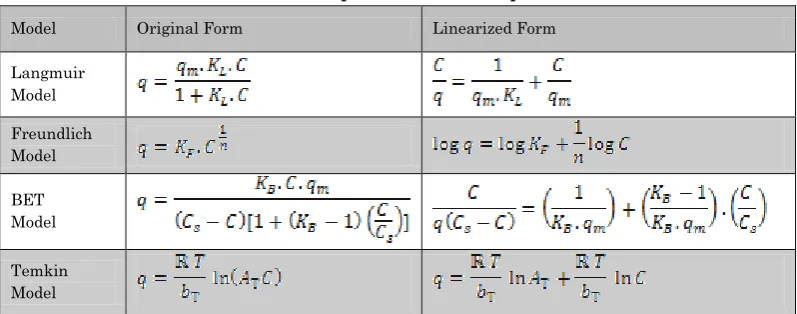
Adsorption isotherms are the suitable way to evaluate the adsorption process. Adsorption isotherms can be performed by changing the initial concentrations of contaminants, and keeping the other operational parameters are constant, which are pH, temperature, treatment time and agitation speed. Broadly, the removal efficiency increases when the concentration of contaminant increases until reaches saturation or equilibrium state at which there is no more contaminant uptake by the adsorbent. To describe adsorption isotherms there are many models. In this study, the models that are used listed in Table 1 with their mathematical expressions.
Table 1 The mathematical expressions of adsorption isotherm models
Model Original Form Linearized Form Langmuir
Dubinin-Radushkevich Model Harkins-Henderson Model Toth Model Equation Redlich-Peterson Model
where:
Redlich-Peterson Model Parameters.
Toth Model Constants.
theadsorbed amount per adsorbent amount (ml.g-1).
the adsorbed amount required to form a monolayer.
the Freundlich equilibrium constant that related to the
intensity of adsorption.
the Harkins-Henderson intensity of adsorption constant.
the concentration of adsorbed substance(ml.l-1).
the concentration of solute at the saturation of all layers (ml.l-1).
the Langmuir equilibrium constant (l. mg -1).
the Freundlich equilibrium constant that related to the total
adsorption capacity (mg. g -1).
the BET constant.
the Harkins-Henderson adsorption capacity equilibrium constant (mg/g)(mg/l)1/nh.
the universal gas constant = 8.314 J.mol-1.K-1
the Temkin isotherm equilibrium binding constant (l/g). the Temkin isotherm constant.
the theoretical isotherm saturation capacity (mg/g).
the Dubinin–Radushkevich isotherm constant (mol2.kJ-2).
(3)
In Dubinin-Radushkevich model the approach was usually applied to distinguish the physical and chemical adsorption of metal ions with its mean free energy, E per molecule of adsorbate (for removing a molecule from its location in the sorption space to the infinity) can be computed by the relationship:
(4)
where is denoted as the isotherm constant.
From the Langmuir equation, a further analysis can be made on the basis of a dimensionless equilibrium parameter, RL, also known as the separation factor. It is given by the expression:
(5)
The value of RL lies between 0 and 1 for favourable adsorption, RL >1 represents unfavourable adsorption, RL =1 represents linear adsorption and the adsorption process is irreversible if RL = 0.
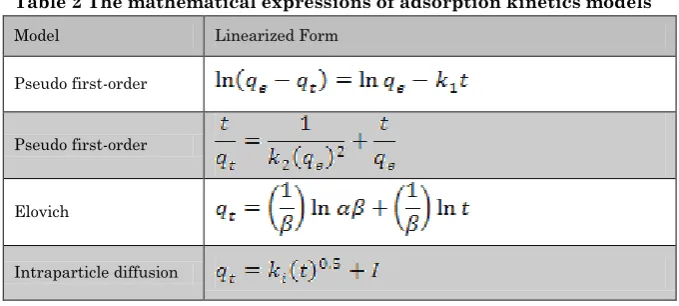
2.5.2 Adsorption Kinetics
Table 2 The mathematical expressions of adsorption kinetics models
Model Linearized Form Pseudo first-order
Pseudo first-order
Elovich
Intraparticle diffusion
where:
the adsorption capacities at equilibrium (mg.g-1).
the adsorption capacities at time t, (mg.g-1).
the pseudo first-order rate sorption constant (min-1).
the pseudo second-order rate sorption constant (g.mg-1.min
-1).
α the rate of chemisorption at zero coverage (mg.g-1.min-1). β the extent of surface coverage and activation energy for chemisorption (g.mg-1).
the intra-particle diffusion rate constant.
3. Results and Discussion
3.1 Peroxidase Enzyme extractions
3.2 Characterization of Synthetic Activated Carbon from UTLR (ACUTLR)
3.2.1 SEM Analysis-Samples’ Surface and Chemical Compositions
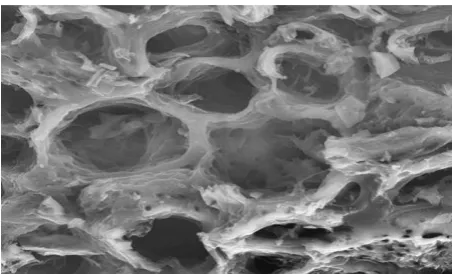
SEM micrographs of surface of the synthesis activated carbon represented by Figure 1 shows that the ACUTLR presents all of the cavities to the level of their surfaces. Indeed, the zinc chloride ZnCl2 permits the development of the porosity of
materials, more than there is in the precursor (UTLR), so producing more opened pores of the synthesis activated carbon ACUTLR. The ACUTLR has a compact structure and homogeneous surface with a developed porosity, because in this material some micropores are observed. However, the analysis of the sample ACUTLR practically show little presence of zinc; but does not show chlorine which could explain the rather good adsorbent properties observed particularly for this activated carbon. The little content of zinc (in spite of zinc ions adsorption and long period of impregnation with zinc chloride) and no existence of chlorine may be due to the effect of the treated with strong acid that is hydrochloric acid. This may be explain the reason of three results which are first decrease the zinc content in the ACUTLR less than expected, second zero content of chlorine and third the presence of hydrogen in the chemical composition of ACUTLR.
3.2.2 FTIR analysis
Zinc ion promoted activated carbon from loaded UTLR (ACUTLR), in the powdered form, were scanned and recorded between 4000 and 400cm-1. The FTIR analysis of ACUTLR was
shown in Figure 2. According to Figure 2, numerous chemical functional groups have been identified onto ACUTLR. The peak of 3410 cm-1 indicates the presence of asymmetric vibration of
, suggesting the hydroxyls groups and chemically absorbed water on the surface. The peak of 2924 cm-1 indicates the
presence of stretch in (alkane H). The peak of 2854 cm-1
indicates the presence of stretch in aldehydes. The peak of 1732 cm-1 indicates the presence of stretch in esters. The
peaks of 1651 cm-1, 1558 cm-1 and 1516 cm-1 indicate the
presence of stretch deformations in aliphatics. The peak of 1458 cm-1 indicates the presence of stretch in
phenol. The peaks of 1369 cm-1and 1323 cm-1 indicate the
presence of stretch in ether or aliphatic groups. The peak of 1292 cm-1, indicates the presence of stretch in amide
III. The peak of 1230 cm-1 indicates the presence of
stretch in aromatic rings. The peaks of 1165 cm-1, 1145 cm-1,
1080 cm-1 and 1045 cm-1 indicate the presence of
stretch in primary and secondary alcohols. The peaks less than 1000 cm-1 is referred to
Figure 2 FTIR of Synthetic Activated Carbon from UTLR (ACUTLR)
3.2.3 Specific Surface Area, Pore Volume and Pore Diameter
The specific surfaces area, pore volume, and average pore diameter of ACUTLR were determined through N2 adsorption
isotherm and the results are shown in Table 3. The high value of specific surface area shows that the entry of N2 gas molecules
to the existing pores in the ACUTLR are not restricted but possible and the pores are opened sufficiently. In addition, this result makes it possible to explain the influence of the residence time of the preparation of the ACUTLR. The longer residence time, higher specific surface area and more pores are opened (0.285 cm3/g and 1.75 nm). The impregnation ratio with zinc
chloride (ZnCl2) effects on porous volume also like affects the
specific surface area and porosity. The higher impregnation ratio means higher specific surface area and porous volume for materials produced from the same UTLR.
Table 3 Synthesis Activated Carbon (ACUTLR) Characterization
Surface Area, (m2/g)
Total Pore Volume,
(cm3/g)
Pore Diameter, (nm)
3.3 Adsorption of Zinc Ions and Thiophenol Using UTLR and ACUTLR respectively
3.3.1 Effect of Agitation Speed
The effect of agitation speed on removal efficiency of zinc ions and thiophenol was studied by varying the speed of agitation from 100 to 400 rpm, while keeping the other variables constant at optimum values. As can be seen from Figure 3 the removal efficient generally increased with increasing agitation speed. The removal efficiency of UTLR and ACUTLR adsorbents increased when agitation speed increased from 100 rpm to 400 rpm. This is due to the fact that, the increase of agitation speed, improves the diffusion of zinc ions and thiophenol towards the surface of the UTLR and ACUTLR adsorbents respectively.
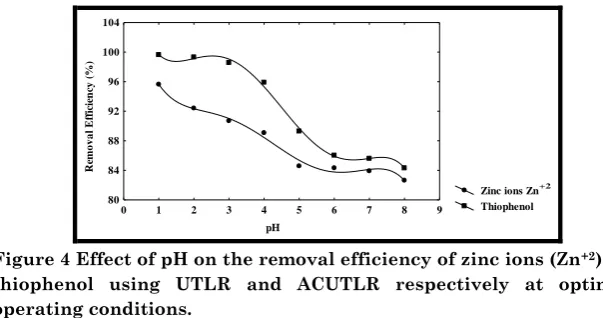
3.3.2 Effect of pH
due to the strong interaction between the ion positive charges and functional groups negative charges.
3.3.3 Effect of the adsorbent dosage
The dependence of zinc ions and thiophenol adsorption on dose was studied by varying the amount of adsorbents of UTLR and ACUTLR respectively from 0.1 to 1.50 g while keeping other parameters constant at optimum values. Figure 5 represents the substances removal efficiencies. From the figure it can observed that, the removal efficiencies were increased with increasing the dose of adsorbent until reach adsorption. This suggests that after the solution reaches saturated phase, the maximum adsorption sets in and hence the amount of ions bound to the adsorbent and the amount of substances remain constant even further addition of dose of adsorbent.
3.3.4 Effect of contact time
The increase on the removal of zinc ions and thiophenol from water was observed by increasing the time from 10 -600 minutes when UTLR and ACUTLR were used. Figure 6 shows the amount of substances adsorbed onto both raw adsorbents at different time while all other parameters keeping constants at optimum values. This may be due to the fact that when the treatment time increasing and the solution spend longer time than that spend it when the time of treatment decreased, so the adsorbent material uptake more amount of substances, therefore the removal efficiency was increased.
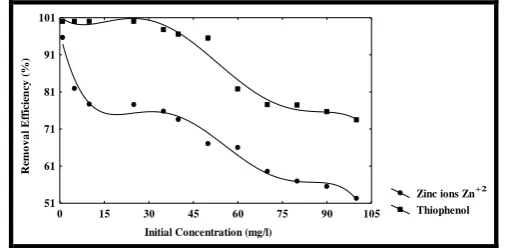
3.3.5 Effect of initial concentration
The effect of initial concentration on the adsorption of zinc ions and thiophenol by UTLR and ACUTLR respectively is investigated employing different values ranging from 1-100 mg.l-1. Result indicates that the adsorption efficiency decreases
which had filled the possible available sites, so the adsorption efficiency remains suitable to low and moderate concentration. As the initial concentration increases, the available pores become insufficient to adsorb further substances and much of its still in suspension and no more substance can be adsorbed, therefore the percent removal was decreased with increasing initial concentration.
Zinc ions Zn+2 Thiophenol
Agitation Speed (rpm)
R em o v a l E ff ic ie n cy ( % ) 55 65 75 85 95 105
50 100 150 200 250 300 350 400 450
Figure 3 Effect of agitation speed on the removal efficiency of zinc
ions (Zn+2) and thiophenol using UTLR and ACUTLR respectively at
optimum operating conditions.
Zinc ions Zn+2
Thiophenol pH R em o v a l E ff ic ie n cy ( % ) 80 84 88 92 96 100 104
0 1 2 3 4 5 6 7 8 9
Figure 4 Effect of pH on the removal efficiency of zinc ions (Zn+2) and
Zinc ions Zn+2 Thiophenol Adsorbent Dosage (g)
R em o v a l E ff ic ie n cy ( % ) 45 55 65 75 85 95 105
0.0 0.2 0.4 0.6 0.8 1.0 1.2 1.4 1.6
Figure 5 Effect of adsorbent dosage on the removal efficiency of zinc
ions (Zn+2) and thiophenol using UTLR and ACUTLR respectively at
optimum operating conditions.
Zinc ions Zn+2 Thiophenol
Contact Time (min)
R em o v a l E ff ic ie n cy ( % ) 60 65 70 75 80 85 90 95 100 105
5 10 15 20 25 30 35 40 45 50 55 60 65
Figure 6 Effect of contact time on the removal efficiency of zinc ions
(Zn+2) and thiophenol using UTLR and ACUTLR respectively at
optimum operating conditions.
Zinc ions Zn+2 Thiophenol
Initial Concentration (mg/l)
R em o v a l E ff ic ie n cy ( % ) 51 61 71 81 91 101
0 15 30 45 60 75 90 105
Figure 7 Effect of initial concentration on the removal efficiency of
zinc ions (Zn+2) and thiophenol using UTLR and ACUTLR
respectively at optimum operating conditions.
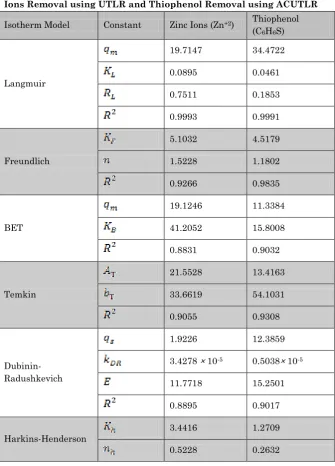
3.4.1 Adsorption Isotherms
The isotherm constants were calculated from the experimental data and presented in Table 4. The value of R2 was higher for
Langmuir isotherm than the other isotherm models; that mean Langmuir equation represented the adsorption process very well.
3.4.2 Adsorption Kinetics
In order to determine the sorption kinetic models of zinc ions (Zn+2) and thiophenol from SSAS, the pseudo first order, the
pseudo second order, the simple Elovich model and the intraparticle diffusion model were applied to the obtained data from experimental work. The calculations were conducted at optimum operation condition to find the best kinetic model. The adsorption kinetic constant and correlation coefficients of these models were calculated and given in Table 5. Good correlation coefficients R2 were observed indicating that zinc ions and thiophenol uptake processes can be approximated with the pseudo second order kinetics model and intraparticle diffusion model respectively which have the best correlation coefficient among other adsorption kinetic models. Thus, the pseudo second order kinetics and intraparticle diffusion model were the pathways to reach equilibrium.
4. Preparation of Rodenticide from Thiophenol Adsorption Process Residue
The residue remaining after removal of thiophenol from SSAS by adsorption process was collected, a prelude to prepare a simple rodenticide. Before the residue give to the rats, the rats were left for one week and nurtured with normal feed to make sure that it’s were not suffer from anything leading to death.
without any pretreatment. Another control animal sample was also used to compare the results. The results were fate the rats in different periods are shown in Table 6.
Table 4 Parameter Values of Adsorption Isotherms Constants for Zinc Ions Removal using UTLR and Thiophenol Removal using ACUTLR
Isotherm Model Constant Zinc Ions (Zn+2) Thiophenol
(C6H6S)
Langmuir
19.7147 34.4722
0.0895 0.0461
0.7511 0.1853
0.9993 0.9991
Freundlich
5.1032 4.5179
1.5228 1.1802
0.9266 0.9835
BET
19.1246 11.3384
41.2052 15.8008
0.8831 0.9032
Temkin
21.5528 13.4163
33.6619 54.1031
0.9055 0.9308
Dubinin-Radushkevich
1.9226 12.3859
3.4278 × 10⁻⁵ 0.5038× 10⁻⁵
11.7718 15.2501
0.8895 0.9017
Harkins-Henderson
3.4416 1.2709
0.9105 0.9281
Toth
135.1419 37.2611
9.7283 3.5238
1.5537 3.8219
0.9476 0.9462
Redlich-Peterson
10.4926 7.1258
1.4427 1.5086
1.2328 0.5308
0.8732 0.8841
Table 5 Parameter Values of Adsorption Kinetics Constants for Zinc Ions Removal using UTLR and Thiophenol Removal using ACUTLR
Kinetic Model Constant Zinc Ion (Zn+2) Thiophenol
(C6H6S)
Pseudo first-order
12.3541 8.4125
3.144 ×10⁻³ 5.287 ×10⁻⁴
0.9825 0.8622
Pseudo second-order
13.9617 9.5205
3.772 ×10⁻³ 6.8579 ×10⁻⁵
0.9993 0.8925
Elovich
4.0257 3.3362
6.667 ×10⁻¹ 5.263 ×10⁻¹
8.143 ×10⁻¹ 7.742 ×10⁻¹
Intraparticle diffusion
9.3614 ×10⁻¹ 5.631 ×10⁻²
1.354 4.7682
Table 6: Hours lead to kill rat when it nurtured with treated thiophenol adsorption residue
Thiophenol Adsorption Residue to Rotten Fruit Ratio (wt %)
0.1 0.2 0.3 0.4 0.5 0.6 0.7 0.8 0.9 1
96 73 44 36 22 20 17 12 9 5.5
5. Conclusions
The following conclusions can be drawn:
a. It is possible to use the used tea leaves with easy, simplest and economical methods to produce peroxidase enzyme.
b. It can use the residue of previous step i.e. after extraction of peroxidase enzyme in removing zinc ions from SSAS with good efficiency reach to more than 99% for initial concentration 1mg/l, pH 1, agitation speed 400 rpm, contact time 60 minutes and adsorbent dosage 1.5 g of UTLR.
c. It can prepare promoted activated carbon from the waste remaining from zinc ions removal (ACUTLR) using zinc chloride (ZnCl2) with high surface area reach to 613.25
m2/g.
d. Maximum removal efficiency of thiophenol (as a model of sulfur and phenol removal) using ACUTLR reach to more than 97.99% for initial concentration of 100 mg/l. e. It can be prepared good rodenticide from the waste of
thiophenol adsorption process used after mixed with some rotten fruit which has sweet test.
REFERENCES
Abbas F. S., (2013), “Thorium removal from waste water using Banana peel and employment of Waste Residue”, Advances in Natural and Applied Sciences, 7(3): 336-344, ISSN 1995-0772.
Abbas M. N. and Abbas F. S., (2013 a), “Iraqi Rice Husk Potency to Eliminate Toxic Metals from Aqueous Solutions and Utilization from Process Residues”, Advances in Environmental Biology, 7(2): 308-319, ISSN 1995-0756.
Abbas M. N. and Abbas F. S., (2013 b), “Utilization of Iraqi Rice Husk in the Removal of Heavy Metals from Wastewater”, Research Journal of Environmental and Earth Sciences 5(7): 370-380, ISSN: 2041-0484.
Abbas M. N. and Abbas F. S., (2013 c), “The Predisposition of Iraqi Rice Husk to Remove Heavy Metals from Aqueous Solutions and Capitalized from Waste Residue”, Research Journal of Applied Sciences, Engineering and Technology 6(22): 4237-4246, ISSN: 2040-7459.
Abbas M. N. and Abbas F. S., (2013 d), “The Feasibility of Rice Husk to Remove Minerals from Water by Adsorption and Avail from Wastes”, Research Journal of Applied Sciences, WSEAS Transactions On Environment And Development, Issue 4, Volume 9, October, E-ISSN: 2224-3496.
Abbas M. N. and Abbas F. S., (2013 e), “Manufacturing of Phenol using Reactive Distillation, Developing and Mathematical Analysis”, LAMBERT Academic Publishing.
Abbas M. N. and Abbas F. S., (2014 a), “Rice Husk as a Biosorbent Packed bed, Management, Utilization and Improvement compressive strength of concrete”, LAMBERT Academic Publishing.
Exploitations and No Pollutants Remain”, LAMBERT Academic Publishing.
Abbas M. N. and Abbas F. S., (2014 c), “Application of Rice Husk to Remove Humic Acid from Aqueous Solutions and Profiting from Waste Leftover”, WSEAS Transactions on Biology and Biomedicine, Volume 11, 2014, Art. #9, pp. 62-69, E-ISSN: 1109-9518.
Abbas M. N., (2014 a), “Phosphorus removal from wastewater using rice husk and subsequent utilization of the waste residue”, Desalination and Water Treatment, Taylor &
Francis, (1-8)
http://www.tandfonline.com/doi/abs/10.1080/19443994.20 14.922494#.U8dSapSSwjw
Abbas M. N., (2014 b), “Production of Liquefied Natural Gas Using Radioactive Waste and Agricultural Residue”, European Academic Research Vol. II, Issue 2/ May, ISSN 2286-4822. www.euacademic.org
Abbas M. N., (2014 c), “Pomegranate Peels: Source of Antioxidants Extraction and Natural Dentifrices Preparation”, European Academic Research Vol. II, Issue 3/ June, ISSN 2286-4822. www.euacademic.org Abbas M. N., (2014 d), “Converting Banana Peels from
Agricultural Residues to Advantageous Substances”,
under publishing.
Abbas M. N. (2014 e), “Optimal Exploitation of Orange Peels in Sustainable Development Accessing to Zero Residue Level”, under publishing.
Abbas M. N., (2014 f), “Leveraging of Agricultural Tailings and Industrial Wastes Together in Black Ink Preparation”,
under publishing.
Abbas M. N., Abbas F. S. and Ibraheem S. A., (2014), “Removal of Cyanide Ion from Wastewater Using Banana Peel and Utilization from Residue”, Journal of Asian Scientific Research, 4(5): 239-247.
Rice Husk Used as a Raw Material for Treating Tannery Wastewater”, Australian Journal of Basic and Applied Sciences, 7(2): 511-528, ISSN 1991-8178.
Abbas M. N., Husain A. A. and Abbas F. S., (2013 b), “Phenol Removal from Wastewater Using Rice Husk”, Diyala Journal for Pure Sciences, Vol:9 No:4, October.
Abbas M. N., Abdulhaq A., Farhan A. and Hussein S. N., (2012), “Catalytic Cracking of Heptane Using Prepared Zeolite”, Journal of Asian Scientific Research 2(12):927-948.
Atieh M. A. (2011), “Removal of Zinc from Water Using Modified and Non-Modified Carbon Nanofibers”, 2nd
International Conference on Environmental Science and Technology IPCBEE vol.6 (2011), IACSIT Press,
Singapore.
Cesur H. and Balkaya N. (2007), “Zinc removal from aqueous solution using an industrial by-product phosphogypsum”, Chemical Engineering Journal 131 (2007) 203–208.
Ghorbani M., Eisazadeh H. and Ghoreyshi A. A. (2012), “Removal of Zinc Ions from Aqueous Solution Using Polyaniline Nanocomposite Coated on Rice Husk”, Iranica Journal of Energy & Environment 3 (1): 83-88,
ISSN 2079-2115, DOI:
10.5829/idosi.ijee.2012.03.01.3343.
Joodi A. S. and Abbas M. N., (2014 a), “Profiting from Cooked Tea Leaves Waste in Eco-Friendly Method”, Advances in Research 2(3): 179-187, Article no. AIR.2014.005
SCIENCEDOMAIN international
www.sciencedomain.org
Joodi A. S. and Abbas M. N., (2014 b), “Removal of Phenol from Aqueous Solutions using Potato Peel”, Australian Journal of Basic and Applied Sciences, 8(2) February, Pages: 115-123. ISSN: 1991-8178.
from cabbage leaves (Brasicca olearacea var. capitata)”, J Biochem Tech 4(1): 531-540 ISSN: 0974-2328.
Liu H. L., Chen B. Y., Lan Y. W., Cheng Y. C. (2004), “Biosorption of Zn(II) and Cu(II) by the indigenous
Thiobacillus thiooxidans”, Chemical Engineering
Journal 97 (2004) 195–201, www.elsevier.com/locate/ces Lu C. and Chiu H. (2006), “Adsorption of zinc (II) from water
with purified carbon nanotubes”, Chemical Engineering
Science 61 (2006) 1138 – 1145,
www.elsevier.com/locate/ces
Mishra U., Paul S. and Bandyopadhaya M. (2013), “Removal of zinc ions from wastewater using industrial waste sludge: A novel approach”, Environmental Progress & Sustainable Energy, Volume 32, Issue 3, pages 576– 586, October. DOI: 10.1002/ep.11665.
Nouren S., Bhatti H. N., Bhatti I. A. and Asgher M. (2013), “Kinetic and Thermal Characterization of Peroxidase from Peels Of Citrus Reticulata Var. Kinnow”. The Journal of Animal & Plant Sciences, 23(2), Page: 430-435 ISSN: 1018-7081.
Shank L. P., Riyathong T., Lee V. S. and Dheeranupattana S. (2013), “Peroxidase Activity in Native and Callus Culture of Moringa Oleifera Lam”, Journal of Medical and Bioengineering Vol. 2, No. 3, September.
Souza D. P. B., Costa I. C. R., Paiva L. M. C., Oestreicher E. G., Berezuk M. E. and Cardozo-Filho L. (2010), “Peroxidase activity in Spondias dulcis” , Acta Scientiarum. Technology Maringá, v. 32, n. 4, p. 341-345. DOI: 10.4025/actascitechnol.v32i4.6244.
Witharana A., Jayaweera M. and Manatunge J. (2010), “Investigation of Zinc Removal Capacities of Different Sorbent Materials to be Used in Constructed Wetlands”,
Zia M. A., Kousar M., Ahmed I., Iqbal H. M. N. and Abbas R. Z. (2011), “Comparative study of peroxidase purification from apple and orange seeds”, African Journal of Biotechnology Vol. 10(33), pp. 6300-6303, 6 July.
Available online at