www.euacademic.org DRJI Value: 5.9 (B+)
Concept Maps: A Support Teaching Tool to
Meaningful Learning
CARLOS HENRIQUE DE SOUZA MEDEIROS1
North Fluminense State University – UENF Brazil ELIZANGELA TONELLI2
North Fluminense State University - UENF Brazil TALITA NASCIMENTO DOS SANTOS3
North Fluminense State University – UENF Brazil FABRÍCIO MORAES DE ALMEIDA4
Federal University of Rondonia Brazil
Abstract:
The search for learning resources to promote a substantial and meaningful learning has been the focus for many studies and researches directed to the acquisition of non-arbitrary knowledge, ie., knowledge that act as "anchor" for new information and new ideas. Based on this premise this article proposes a study on the student´s perception about the use of concept maps as a support teaching to Meaningful Learning and as a facilitator in organizing and understanding content covered in the Literature´s lessons. The study
1 Doctor in Communication by UFRJ; Professor; Cognition and Language
Program Master Coordinator. E-mail: [email protected].
2 Faperj Scholarship, Cognition and Language Program Mastering at North
Fluminense State University - UENF. [email protected]
3 FaperjScholarship, Cognition and Language Program Mastering at North
Fluminense State University - UENF
4 PhD in Physics (UFC), with post-doctorate in Scientific Development
was developed from a non-probabilistic sample of 25 students from public school. After build the maps they rated the efficacy and potential of this support tool and considered easy to use the concept maps and very effective in understanding and assimilation of contents.
Key words: Concept Map; Meaningful Learning; Support Teaching.
1. Introduction
Psychology has long been trying to understand how individuals assign meanings to things and abstracts a significant learning about them. This process of human capacity for understanding is intrinsically linked to the cycles of actions that make man evolve as a personal and social being within the dynamics of the meaning assignment process, ie, it is a cycle in our cognitive structure in which new concepts are acquired and new concepts will modify existing concepts giving them more inclusive characteristics, which makes us more capable of a greater power of understanding and discussion of the context that surrounds us.
According to Hunt (apud MOLINA et al 2006, 25) to develop the capacity to learn is perhaps the most important commitment of the individual of the XXI century. It is therefore, the proposal of education to foster the acquisition of knowledge through meaningful learning. However, one of the greatest difficulties of the educator is to find a strategy or teaching tool that encourages this process and produce more effective results at the time of checking the knowledge acquired. The search for teaching resources, which favors a substantial and meaningful learning, has been the focus of many studies and researches directed to the acquisition of non-arbitrary knowledge, ie, knowledge that act as "anchor" for new information and ideas, as proposes the theory of David Ausubel, one of the representatives of cognitivism.
raised the demand for techniques to facilitate the learning. For this reason the graphical representation defined in the form of concept map has proved an effective tool in the organization of ideas and the promotion of meaningful learning. According to Soto (2004) with this technique it´s possible to develop potentially the understanding of what you read and even improve the speaking and verbal comprehension.
Based on this assumption, in this study, it was asked students´ opinion about the effectiveness of concept maps in understanding the content taught in the classroom. By the relevance proposed to the use of concept maps as instrumentalization of meaningful learning, the aim of this study was to investigate the use of concept map feature as a facilitator in understanding and organization of new knowledge, abstracted from the pragmatic content applied in the classroom, as well as other benefits that may add to the teaching and learning process in the subject of Literature.
As anchor for understanding the functioning of the concept maps, it was necessary, however briefly, the literature review on studies of cognitive psychology as well as Ausubel's proposal presented in the theory of meaningful learning in order to understand how the new concepts interact with specific concepts hierarchized in the cognitive structure of the individual and the relationship they have with the proposed use of concept maps as well as their characteristics and implications made by other authors.
2. A brief overview about the cognitive theory
psychology finds focus in the study of the dynamics of consciousness: how the human beings develop the "understanding" of what is around them. (MOREIRA and MASINI 1982).
Unlike behaviorism that, according to Ausubel (1980) is a peripheral nature that summarizes learning to stimulus and response, cognitivism attempts to describe how occurs the formation of concepts, the understanding of the structure and syntax language, as well as what happens when men lie and organize the world around them distinguishing systematically the different from the same.
Moreira and Masini (1982) define cognition as the process through which the world of meaning arises. As men is relating with the world, they assign meanings to everything around them. These meanings are starting points for the allocation of other meanings. Hence then arises the cognitive structure that becomes an "anchor" for other subsequent meanings.
3. Ausubel´s learning proposal
According to Ausubel, the most important aspect in the teaching and learning process is "what the learner already knows", because learning comes from the student and not simply from the concept that he is taught. The teaching, in this case, enter as a "facilitator" and it’s only effective when it manipulates the variables that regulate learning". (AUSUBEL et al 1980, 13)
organized and interacted. Ausubel claims that new ideas and information can be learned and retained as long as relevant and inclusive concepts stay adequately clear and available in the cognitive structure of the individual and this way, working out as anchorage point for new ideas and concepts" (AUSUBEL, cited in MOREIRA and MASINI 1982).
When there is interaction between the new idea and the relevant concepts existing in the cognitive structure, in a manner clearly articulated and precisely differentiated, occurs what is called meaningful learning, ie, "the interaction among the relevant and inclusive concepts and the new material, ideas and information that present a logical structure, available in the cognitive structure. (AUSUBEL, cited in MOREIRA and MASINI 1982).
These specific concepts that relate to new information are defined by Ausubel as "subsumers" that exist in the cognitive structure of the individual. The subsumers act as "anchors" for the new concepts making learning substantially significant.
Ausubel considers the cognitive structure as a hierarchical structure of concepts in which more specific elements of knowledge are connected and assimilated into the more inclusive more general concepts.
As meaningful learning occurs, new concepts are being formed, developed and differentiated due to the interactions that occur in the learner´s cognitive structure. This process is facilitated when more general and more inclusive elements are presented first and progressively differentiated by details and specifications. Ausubel calls this process "progressive differentiation", which should be considered at the time of planning the content to be taught, because according to him it is easier to capture different aspects of a whole from a more inclusive concept than getting the whole from differentiated aspects.
explore the relationships between concepts and propositions in order to highlight the differences and similarities to these conceptual hierarchies bring effects in the information processing and assimilation. Ausubel calls this of "interactive reconciliation”.
4. Concept Map: Contributions and Benefits
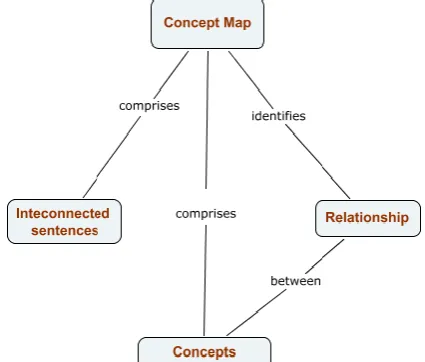
In a broader sense, concept maps are diagrams showing relationships between two or more dimensions of a concept. The concepts appear in boxes, while the relationship between them is made by linking phrases. These phrases are called "proposition" and serve as structures that develop a key role in the representation of the relationship between two concepts or more. In Picture 1 we can view an example of a concept map dealing with the issue at hand:
Figure 1: Example of a concept map. Source: (based in NUNES, at al,
2005.)
learning. Novak was based on meaningful learning theory of David Ausubel and he sees the conceptual maps as "meaningful representations for relate concepts in the form of propositions"(NOVAK 1984).
Concept maps work as facilitative strategies and can illustrate the conceptual framework of individual's knowledge about a particular content. It's a way to turn written text into a visual language. According to Lima, concept maps are a diagram form specifically intended to provide a visual language similar to the characteristics of natural language text, in the sense that they can be subject to syntactic and semantic constraints and its ability representation may vary from a very informal way to a form extremely formal. (LIMA 2004)
As a way to connect one idea to another, the concept map is very similar to the idea of rhizome (root in Stem, underground format and is characterized by the ability to issue new branches) proposed by Deleuze and Guattari (1995). In the authors' view, the rhizome has different and branched forms, but that "[...] any point of a rhizome can be connected to any other" (DELEUZE and GUATTARI 1995).
Concept maps work as a hypertext which an idea rooted in a pre-existing concept connects to other dimensions. Also complements Deleuze and Guattari (1995) that the main feature of the rhizome is connect the dots. They explain that the Rhizome is made of plateaus which communicate with each other through microcracks, like in the brain. Each plateau can be read in any position and put into relation with each other. (DELEUZE and GUATTARI 1995)
Still keeping the idea of hypertext, Okada (2006) illustrates the concept map as a "hypertext portrait of the mind." According to the author, human thinking is not linear, it is built by networks and associations in which new knowledge connects with a knowledge already built and that can update it and even refute it.
how we give meaning to them. The concept map is a cognitive drawing that expresses a network of thoughts that a dynamic movement are externalized and internalized simultaneously.
The purpose of the concept map is not classify concepts but organizing them hierarchically involving cognitive of who uses it maintaining its authenticity without limiting their knowledge idiosyncratically.
5. Methods and Materials
This study is a quantitative and qualitative research on the opinion of 2nd year high school students from Federal Institute of Espírito Santo about the use of concept maps as an instrument to facilitate the understanding and assimilation of the Literature subject in the 3rd quarter of 2012.
In total 25 questionnaires were applied to 25 students before and after the preparation of the maps. The questionnaire was designed with open and closed questions and divided into two parts: the first aimed to profile the group of respondents with questions such as: age, gender, and a brief survey of the criteria that students use to understand the contents in classroom. The second part of the questionnaire was applied after the construction of the map on the criteria used for choosing the concepts to the maps, and their categorization. Other inquiries were made in order to evaluate the approach of the concept maps in Literature classes, such as: the degree of ease in the preparation, assessment of potential and effectiveness as a teaching resource and association of different subjects in the same context.
6. Results and Discussion
order to investigate which strategies students often use to learn new content, among the responses, it was observed that 30% of students try to assimilate the new information to what they already know. This reinforces Ausubel´s theory that all learning comes from what we already know. 28% of students take notes of what they consider important, 15% participate in class discussion, ask questions, 8% seek help from a classmate and 5% do research on the subject, as Table 1 below:
What do You usually do to understand a new content?
FREQUENCY OF
ANSWERS PERCENTAGE
Assimilate to what already knows 18 30
Ask questions 8 14
Participate in class discussion 9 15
Take notes 17 28
Do research on the subject 3 5
Ask for classmates´ help 5 8
TOTAL 60 100
Table 1: Learning Strategies used by students
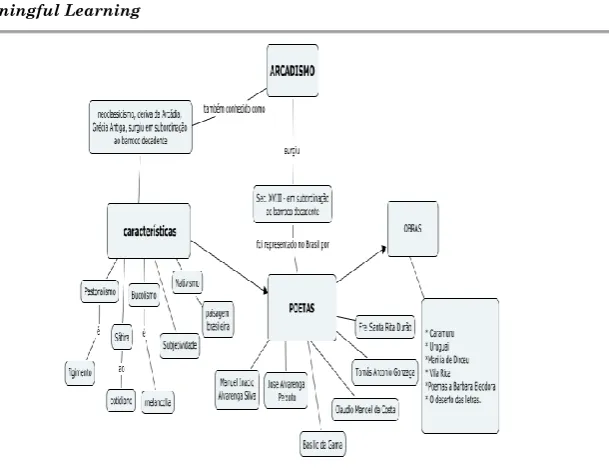
Before proposing the construction of the map, it was distributed to students an written material about the arcadist movement in Brazil with information such as the definition of the term, the historical context, features of the movement, Brazilian poets and their literary works.
Figure 2. Conceptual map built by student A
After the construction of the concept maps, it was asked about the criteria that students used to select the first keyword. All students, ie 100%, responded that they departed from the concept considered comprehensive. Then, in possession of the constructed maps, they were asked to write the word concept they considered as "more comprehensive concept", "intermediate concept" and "less comprehensive concept”. Through the categorization of the similar terms, we found that over half of the students considered the concept "Arcadism"5 as more comprehensive, the “features" of arcadic movement” (definition of the term, bucolic, melancholy, pastoralism, etc.) as intermediate concepts and "poets" as less comprehensive concepts, as illustrated in table 2, below.
5 Arcadism is a literary school that emerged in Europe and Brazil in the
Table 2: Criteria choices for word concepts.
As discussed earlier, the choice of concepts and the criteria of coverage not imply a unique and exclusive way of building the map. It is made idiosyncratically, based on own experience and on the way to see, feel, and act. Thus, based on the classification of most of the students, is presented an example of a concept map done in the Literature class, for a greater understanding of this construction process.
As for effectiveness and potential use of maps in Literature classes, 37% of respondents indicated the effective use in understanding the content, 27%, in the organization of ideas, 18% in the assimilation of the concepts, 10% as an organized form of take important notes and 8% of the responses also appeared as a simple way to review the content. As shown in the table 1 below.
In which situation below do you consider more effective to use the concept map?
FREQUENCY OF
ANSWERS
PERCENTAGE
In the content comprehension 23 37
In the organization of ideas 17 27
In the assimilation between concepts 11 18
In the organization of how to take important notes 6 10
In a simple way to review contents 5 8
TOTAL 62 100
Table 3: Capability and effectiveness of the use of conceptual maps.
asked the students to ascribe a rate regarding the use of this tool in the literature classes, considering 1-very bad, 2-bad, 3-regular, 4-good and 5 - very good. According to the results, 48% of the students said it is “very good”, 44% said “good” and 8% and “average”, as shown in graph 4.
Graph 1: Evaluation of the use of concept maps as a support in Literature classes.
As the degree of ease in preparation and map creation, 8% of the students considered "very easy", 50% "easy" and 42% considered "average". Finally, we asked about the the contribution of the conceptual map in the assimilation of the addressed content and 75% of the students responded that "the map provided an integrated view of the subject," 15% said "the map was confusing and very complex" and 5% didn´t answer.
7. Final Considerations
Through the presentation of the concept maps constructed by students of 2nd year of high school, it was possible to see how the subsumers interact with new information in a dynamic and organized process, by means of propositions.
internalize it again in the cognitive structure so as to make it an "anchor” to a new idea, symbol or potentially meaningful material, thus favoring the classes and students.
The approach of concept maps in the classroom is seen by the students as a means to support learning in a free way to express the knowledge constructed.
It was concluded that more than a tool, the concept map is also an educational resource that can be used by teachers and students as a way of assessing educational goals, systematize and organize instructional material as well as articulate previous knowledge to new knowledge. From this study, it also intends to evaluate the effectiveness of using concept maps in other curriculum components.
It was concluded that more than one tool, the concept map is also an educational resource that can be used by teachers and students as a way of assessing educational goals, systematize and organize instructional material as well as articulate the knowledge prior to the foreground. From this study, it also intends to evaluate the effectiveness of using concept maps in other curriculum components.
BIBLIOGRAPHY:
Ausubel, D.P, Novak, J.D. & Hanesian, H. 1980. Psicologia educacional. Rio de Janeiro:Interamericana.
Deleuze, G. and F. Guattari. 1995. F. Mil platôs: Capitalismo e esquizofrenia.Rio de Janeiro: Editora 34.
Lima, G.A.B. 2004. “Mapa conceitual como ferramenta para organização do conhecimento em sistema de hipertextos e seus aspectos cognitivos.” Belo Horizonte: Perspect. ciênc. inf. 9(2): 134-145.
Molina, A. et al. 2006. Potencializar a capacidade de aprender e pensar. São Paulo: Madras.
A teoria de David Ausubel. São Paulo: Editora Moraes. Novak, J.D. and Gowin, D.B. 1984. Learning how to learn. New
York: Cambridge University Press.
Nunes, S. da C. and Costa, L. C. A. C. da. Os mapas conceituais como organizadores de hipertextos para os ambientes de ensino a distância – EAD. 2005. Available at: <http://www.liberato.com.br/upload/arquivos
/0131010717404016.pdf> Accessed on 15 maio 2013. Okada, A.L.P. 2002. Web Maps: um Guia para Construção do
Conhecimento em Ambientes Virtuais de Aprendizagem. Availavle:
<www.nuted.ufrgs.br/oficinas/criacao/webmaps.pdf> Acessado em 20 maio de 2013.