Mutaphrase: Paraphrasing with FrameNet
Michael Ellsworth and Adam Janin
{infinity,janin}@icsi.berkeley.edu International Computer Science Institute
1947 Center Street, Suite 600 Berkeley, CA 94704-1105 USA
Abstract
We describe a preliminary version of Mu-taphrase, a system that generates para-phrases of semantically labeled input stences using the semantics and syntax en-coded in FrameNet, a freely available lexico-semantic database. The algorithm generates a large number of paraphrases with a wide range of syntactic and semantic distances from the input. For example, given the in-put “I like eating cheese”, the system out-puts the syntactically distant “Eating cheese is liked by me”, the semantically distant “I fear sipping juice”, and thousands of other sentences. The wide range of generated paraphrases makes the algorithm ideal for a range of statistical machine learning prob-lems such as machine translation and lan-guage modeling as well as other semantics-dependent tasks such as query and language generation.
1 Introduction
A central tenet of statistical natural language pro-cessing (NLP) is “there’s no data like more data”. One method for generating more data is to restate each phrase in a corpus, keeping similar seman-tics while changing both the words and the word sequence. The efficacy of this approach has been well-established in many areas, including automated evaluation of machine translation systems (Kauchak and Barzilay, 2006), text summarization (Kittredge, 2002), question answering (Rinaldi et al., 2003),
document retrieval (Zukerman and Raskutti, 2002), and many others.
Most of the reported work on paraphrase gener-ation from arbitrary input sentences uses machine learning techniques trained on sentences that are known or can be inferred to be paraphrases of each other (Bannard and Callison-Burch, 2005; Barzi-lay and Lee, 2003; BarziBarzi-lay and McKeown, 2001; Callison-Burch et al., 2006; Dolan et al., 2004; Ibrahim et al., 2003; Lin and Pantel, 2001; Pang et al., 2003; Quirk et al., 2004; Shinyama et al., 2002). Mutaphrase instead generates paraphrases algorith-mically using an input sentence and FrameNet, a freely available lexico-semantic resource (informa-tion regarding FrameNet, including relevant termi-nology, is presented in Section 2).
3YNTAX 3IMILAR
$IFF ER
EN T
3
EMAN
TICS
) LIKE EATING CHEESE
%ATING CHEESE IS LIKED BY ME ) LIKE TO SNACK ON BREAD ) FEAR SIPPING JUICE
[image:1.612.333.512.474.605.2]4O SIP ON JUICE DISTURBS ME
Figure 1: Syntactic and semantic similarity to I like eating cheese.
Conceptually, the Mutaphrase algorithm takes a semantic specification of a sentence, provided by an automatic semantic parser such as Shalmaneser (Erk
and Pad´o, 2006), and recursively replaces each se-mantically parsed phrase with a sese-mantically similar phrase. To generate each new phrase, each of the se-mantic parts of the original phrase is mapped, using FrameNet data, onto a new word or phrase whose position and syntactic marking may be quite differ-ent.
The Mutaphrase algorithm outputs a large set of paraphrases with a variety of distances from the in-put in terms of both syntax and semantics; see Fig-ure 1. Depending on the needs of the application, fil-tering can be applied to limit the distance to a desired range. For example, language modeling may bene-fit from a wider variety of semantic outputs, since if I like eating cheese is in-domain, then I like sip-ping juice is also likely in-domain. Other applica-tions, e.g. Question Answering, require more strin-gent limits on semantic distance. See Section 4.
1.1 Current Limitations
The current implementation of Mutaphrase suffers from several limitations. Perhaps the most signifi-cant is that the input sentences must be semantically labeled using FrameNet annotations. Since no au-tomated systems for FrameNet-specific annotation are currently incorporated into our algorithm, input is limited to hand-annotated sentences. Also, cer-tain types of semantic ill-formedness are permitted (e.g. I like sipping meat), and some types of syntax are not well supported (e.g. conjunctions, relative-clauses). We believe all these factors can be ad-dressed; they are covered briefly in Future Work (Section 4). We confine ourselves in other sections to describing the core Mutaphrase algorithm as cur-rently implemented.
2 FrameNet
The primary resource used in Mutaphrase is FrameNet (Fontenelle, 2003; FrameNet, 2007b), a lexico-semantic database that describes con-cepts and their interrelations, wordform and word-sequence information, syntactic categories, and mappings between conceptual and lexical/syntactic information. All of these are grounded in hand-annotated examples of real-world sentences. At a slightly more abstract level, FrameNet can be de-scribed as providing a two-way mapping between
meaning (semantics) and form (syntax, wordforms, sequences).
2.1 Semantics
The conceptual information is represented using
frames, where a frame is a type of schema or
sce-nario (e.g. Motion, Commercial transaction), and
frame elements (FEs), which are the participants
and parameters of the frames (e.g. Motion.Path, Commercial transaction.Buyer). Frames and their frame elements are related and mapped with a lim-ited type of conceptual ontology involving Inher-itance (i.e. subtype), Subframe (i.e. temporal sub-part), Using (i.e. presupposition) and a few other re-lation types.
2.2 Syntax
On the form side, the representation is more min-imal. Wordforms and word-sequences are repre-sented so that words with multiple wordforms (e.g. take/took) and word sequences with wordforms (e.g. take/took off ) can be referred to as unitary objects. We have a category Support (and the more specific label ‘Copula’) for pieces of multi-word expressions that are optional for expressing the semantics of the whole (e.g. take in take a bath). FrameNet also rep-resents a small but sufficiently rich set of syntactic categories of English (i.e. phrase types or PTs, such as ‘Sfin’, i.e. finite sentence) and syntactic relations (i.e. grammatical functions or GFs, e.g. ‘Object’).
2.3 Syntax-Semantics Bindings
The most vital part of the FrameNet data for our Mu-taphrase algorithm is the mappings between seman-tics and syntax. There are several categories pertain-ing to this in the data. Lexical units (LUs) are a pair-ing of words/word sequences with the frame each evokes. The valences for each LU are sequences in which semantic and form information pertinent to phrases are paired. They are not stored in the database, so we have created a process that produces them entirely automatically (see 3.2). For example, for the LU hand in the Giving frame and possible in the Likelihood frame, we have the following anno-tated sentences:
1. [She]Donor/N P/Ext[handed]T arget
[a bag]T heme/N P/Obj
2. [It]N ull[was]Copula [possible]T arget[that he
had been hoping to frighten
Steve]Hypothetical event/Sf in(that)/Dep
Example 1 above shows a typical valence, in which most of the positions are semantically labeled with a frame element which is paired with syntac-tic GF and PT information. The second annotation (2) is more complex, exemplifying each of the major categories that make up the positions of a valence. The categories are:
1. a Null element, with syntax but no semantics (usually there or it)
2. a Support or Copula with its wordforms
3. a Target (i.e. an LU or word that is part of an LU) with its wordforms, conceptually repre-senting a frame
4. a frame-element/phrase-type/grammatical-function phrase description, which puts together semantic (FE) information with syntax (GF and PT); the PT also indicates fixed words (e.g. the word that in the example above)
We can abstract away from the individual sen-tences, preserving only the sequences of positions with their features, as in the following representa-tion of sentence 2 above:
Null(it), Copula, Target(possible), Hypotheti-cal event/Dep/Sfin(that)
These abstract valences are the basis for the al-gorithm we present here. There are typically be-tween two and ten basic patterns associated with each annotated lexical unit, encompassing alterna-tions in the realization of FEs such as Active/Passive (I recommended her vs. She was recommended by me), the Dative Alternation (He handed the paper to Stephen vs. He handed Stephen the paper), optional elements (I ate dinner vs. I ate) and many more.
Basing our algorithm on rearranging the fillers of these FEs allows us to abstract away from syn-tax, since the FEs of a frame express the same rela-tions regardless of the LU or syntax they occur with. Some meaning differences between LUs within the
same frame (e.g. drink vs. eat) are not overtly mod-eled in FrameNet. Other resources, such as Word-Net, could provide added information in cases re-quiring finer granularity (see Section 4).
3 Mutaphrase Algorithm
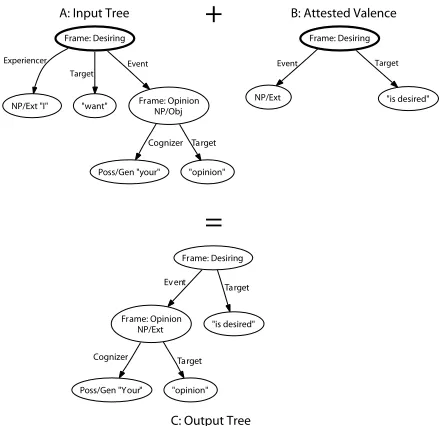
At a very high level, the paraphrase algorithm that we use is as follows: we begin with a sentence with frame-semantic annotation, replace each lexical unit and its associated frame Elements with an alternative valence, then filter the output for its syntactic and semantic fit with the original sentence. The valences may be drawn from either the same LU, an LU of the same frame, or an LU of a related frame.
Frame: Desiring
Frame: Opinion NP/Ext
Event
"is desired" Target
Poss/Gen "Your" Cognizer
"opinion" Target
+
=
NP/Ext "I" "want" Frame: OpinionNP/Obj
Poss/Gen "your" Cognizer
"opinion" Target Frame: Desiring
Experiencer Event Target
NP/Ext "is desired" Frame: Desiring Event Target
B: Attested Valence A: Input Tree
[image:3.612.316.539.267.480.2]C: Output Tree
Figure 2: Algorithm Sketch: A syntactic/semantic tree of the original sentence (A) is rearranged to match a different valence (B), producing a new tree (C); thus I want your opinion yields the paraphrase Your opinion is desired.
frame with the new valence. The output is shown in Figure 2C.
The remainder of this section describes in more detail how this algorithm is implemented.
3.1 Building a Syntax/Semantics Tree from FrameNet Data
Because the FEs of the original sentence are often filled by phrases with their own annotation, the ini-tial syntactic/semantic annotation is (conceptually, at least) in the form of a graph. Typically, the graph is nearly a tree, with few or no non-tree edges1. Hereafter, we will use the term ‘tree’ even for the cases where there are non-tree edges.
Since the data are not organized in this format in the FrameNet output, we have implemented a rou-tine which can turn FrameNet data into a syntactico-semantic tree; tree examples can be seen in Fig-ure 2A and FigFig-ure 2C.
3.2 Building Ordered Valences from FrameNet Data
As mentioned in Section 2.3, we have constructed a routine to parse FrameNet data to produce the va-lences for each LU of a frame. The basic output is an ordered list of syntactico-semantic elements, op-tional aposiop-tional features (e.g. passive +/-), and the frequency of the pattern.2
One innovation of our algorithm is its ability to handle multiword LUs. It simply identifies each word of the LU as a separate element in the list, marking each with the label ‘Target’. Thus the or-dered valences of take off.v in the Undressing frame include, among others:
• Wearer/NP/Ext, take/Target, off/Target, Cloth-ing/NP/Obj; Frequency: 57/68
(e.g. I TOOK OFF my watch)
• Wearer/NP/Ext, take/Target, Clothing/NP/Obj,
1These non-tree edges are introduced when a phrase is an
FE of more than one frame. In keeping with normal syntactic analysis, we treat the node as non-local to all but one parent.
2
Although frequency of a particular pattern in the FrameNet data is not strictly representative of the frequency of that pattern in the corpus, a close examination reveals that the rank order of patterns is largely identical, i.e. the most common pattern in FrameNet represents the most common pattern in the corpus. How useful this inexact statistical data will be is the subject of future research.
off/Target; Frequency: 7/68 (e.g. You TAKE your shoes OFF)
One way of thinking about the valence set is that it represents possible orderings of subparts of a phrase that is semantically a frame instance and syntacti-cally a phrase headed by the Target (see, for exam-ple, Figure 2B). This semantic/syntactic information is detailed enough to build the syntax of a phrase, given FrameNet-style semantics.
3.3 Core algorithm
Once the input has been turned into a tree and there is a set of alternative ways of expressing each frame that is in the input, the algorithm then recurses downward and then, as it returns up, replaces each phrase/frame node with a set of alternative phrases. In the simplest case, these phrases are built from all the valences that are attested for the frame that the original phrase expressed3. In other words, our al-gorithm is a recursive tree-rewrite in which the cur-rent valence of the curcur-rent LU is replaced by many alternate valences of many different LUs.
In the recursion, word and phrase nodes not headed by an LU are kept the same (except for pro-nouns, which are expanded to all their wordforms, e.g. me to I/me/my/mine). The child phrases of such an unparaphrased node, if they are headed by an LU or pronoun, can be paraphrased as long as the paraphrases match the phrase type and grammatical function of the original child phrase.
In Figure 2, the original sentence (represented in Figure 2A) has the phrase representing the De-siring frame replaced with an alternative phrase evoking the same frame (Figure 2B) to produce a new, roughly semantically equivalent sentence (Fig-ure 2C) by expressing the same set of frames in the same FE relations to each other.
In practice, we have to throw away at the outset many of the valences because they include FEs that are not in the input sentence4 or because they have syntactic requirements of their child phrases which
3Our algorithm will work just as well with related frames
as long as the relevant FEs are mapped in the FrameNet data. Controlling the distance, direction, and relation-types of related frames that are included for paraphrase (if any) is one way to control the degree of semantic diversity of the paraphrase out-put. See further Section 3.4.
4Thus attempting to use the valence Experiencer/NP/Ext,
cannot be filled by a paraphrase of the child phrases. For example, for the input sentence I gave presents to friends, the code can output 560 (unfiltered) para-phrases. A random selection from the output in-cludes Presents bequeathed to friends, I handed in presents, and Presents donated by I. Of these, the first and last are filtered out as not filling the original sentential context and the last, in addition, is filtered out because of the mismatch between the pronoun wordform I and the non-subject grammatical func-tion.
To further refine the paraphrases, we must elimi-nate examples that are not compatible with the input sentence. In our current implementation, our algo-rithm filters out incorrect syntax during the recursion over the tree. Ultimately, we will also filter out mal-formed semantics. The rest of this section is devoted to an explication of the details of this filtering.
3.4 Syntactic/Semantic Compatibility
For both syntax and semantics, the degree of via-bility of a paraphrase can be divided up into two components: well-formedness and similarity. Syn-tactic and semantic well-formedness is always desir-able and the algorithm seeks to maximize it in ways that are outlined below. Similarity between the orig-inal sentence and its paraphrases (or among the para-phrases), however, may be more or less desirable de-pending on the task. Figure 1 shows an example of the various degrees of syntactic and semantic simi-larity of the paraphrase output. To maintain flexibil-ity, we will need several control parameters to allow us to filter our output for syntactic/semantic similar-ity.
3.4.1 Syntactic Compatibility
Syntactic incompatibilities most commonly result from gross mismatches between the Phrase Type called for in a new valence and the Phrase Type pos-sibilities available for the child phrase.
For example, if the initial sentence for paraphrase is I want your opinion as in 1 below (repeated from Figure 2), Valence 2 below represents a PT mis-match, since I, an NP filler of the Experiencer role
want another chance) when paraphrasing the initial sentence
in Figure 2 will not work, since there is nothing in the original to fill the Degree FE mentioned here.
in the original sentence, is not modifiable into an ad-jective phrase (AJP).
1. Experiencer/NP/Ext, want/Target, Event/NP/Obj
2. There/Null, be/Copula, Experiencer/AJP/Dep, desire/Target, Event/PP(for)/Dep
(e.g. There is a public desire for transparency)
3. There/Null, be/Copula, desire/Target, Experiencer/PP(in)/Dep, Event/PP(for)/Dep (e.g. There was a desire in America for home rule)
This filtering is vital, as otherwise valence 2 would yield the awful There is me desire for your opinion.
However, phrase types that are not exact matches may nevertheless be compatible with each other. Va-lence 3, for example, is compatible with the original valence, since the original Experiencer and Event FEs were filled by NPs, to which prepositions can be added to match the PP realizations required by Valence 3. This yields another paraphrase of the sentence in Figure 2: There is a desire in me for your opinion. Similarly, full sentential clauses can be modified to match VPs by truncation of the Ex-ternal (subject) argument, etc. A phrase from the original sentence may also be omitted to match an empty phrase in the paraphrase, as seen in the omis-sion of the Experiencer in the paraphrase in Figure 2. These alternations provide more variety in the po-tential phrase types of the paraphrases. Which syn-tactic modifications are allowed should be an ex-ternally controllable parameter, but this has not yet been implemented. In general, allowing fewer types of modification should move the average output left-ward in the syntax/semantic similarity graph in Fig-ure 1 (toward more syntactic similarity).
the pattern is found in the FrameNet data. Our al-gorithm currently produces a ranked list of para-phrases based on exactly this frequency parameter, and downstream processing can choose a cut-off fre-quency or n-best to reduce the total output.
3.4.2 Semantic Filtering
Lexical units of the same frame are not necessar-ily synonyms; they may be antonyms or coordinate terms (i.e. co-hyponyms). For example, cheese and juice are both in the Food frame, but I like eating cheese and I like eating juice are certainly not a se-mantic match! In fact, the second is a sese-mantically ill-formed modification of the first. Similarly, like and hate are both in the Experiencer subject frame. While I hate eating cheese is similar to I like eat-ing cheese in describeat-ing an attitude toward eateat-ing cheese, they are not an exact semantic match either; in this case, however, the lack of semantic similarity does not lead to semantic ill-formedness.
For some tasks such as expanding a language model, exact semantic match is not necessary, but for tasks that require strict semantic match, there are several simple ways to increase robustness.
Tighter filtering, of whatever kind, will move the average output of the algorithm downward in the syntax/semantic similarity graph in Figure 1 (toward more semantic similarity).
3.5 Preliminary Results
We have implemented the above algorithm to the point that it is capable of producing paraphrases of arbitrary input sentences that have received proper FrameNet annotation. A large number of para-phrases with a variety of phrase types are produced, but the lack of semantic filtering occasionally leads to semantically ill-formed results. The output is ranked purely according to the frequency in the FrameNet data of the valences used to build the para-phrase.
For the sentence I like eating cheese, the para-phraser produced 8403 paraphrases, of which the following was top-ranked: I resented drinking cheese, which suffers from the semantic mismatch problems discussed in Section 3.4.2. Some other output at random:
• I am interested in cheese devouring.
• I was nervous that cheese’s ingested.
• I’m worried about gobbling down cheese.
• My regrets were that cheese was eaten by me.
Since most of the annotation in the Ingestion frame (the frame for eat, etc.) concerns eating rather than drinking, the majority of the output is semanti-cally well-formed. The paraphrases generated from the Experiencer subject frame (the frame for like, in-terested, regret, etc.) are more uniformly felicitous, even if semantically quite divergent from the mean-ing of the original. Both the infelicity of drinkmean-ing cheese and the semantic divergence appear to be ad-dressable by refining semantic tightness using Word-Net. Averaging over senses, words like gobble and ingest have lower WordNet-based semantic distance from eat than drink.
For the sentence Nausea seems a commonplace symptom, the paraphraser outputs 502 paraphrases, of which the following was top-ranked: It seems a commonplace sign. Other output at random:
• Tiredness looks indicative.
• Queasiness smelt of a commonplace sign.
• Sleepiness appears a commonplace sign.
• Queasiness smelt indicative queasiness.
• Somnolence appears to be indicative.
Longer sentences (e.g. Locally elected school boards, especially in our larger cities, become the prey of ambitious, generally corrupt, and invari-ably demagogic local politicians or would-be politi-cians) currently take excessive amounts of time and memory to run, but typically produce 10,000+ para-phrases. Pruning earlier during paraphrase genera-tion should help address this issue.
4 Future Work
an automated parser is not typically compatible with FrameNet markup. Although this is mostly “a sim-ple matter of programming”, some linguistic tools must be developed to convert between formats (e.g. to infer FrameNet phrase types from part-of-speech tags).5 Second, it is not yet clear how the inevitable errors introduced by the parser will affect the Mu-taphrase algorithm6. We plan to use application-dependent measures to judge the effects of parsing errors.
Certain types of semantic ill-formedness cannot be detected by the current version of Mutaphrase. A typical example is I like sipping beef as a paraphrase of I like eating cheese. We can guarantee semantic well-formedness by limiting paraphrases to morpho-logically related words (e.g. consume, consumption) and/or by choosing only the FrameNet LUs which are in the same WordNet (Fellbaum, 1998; Word-Net, 2006) synset or higher in the WN hierarchy than the original LU (e.g. eat to consume). Clearly this will exclude many well-formed paraphrases, so for tasks in which breadth is more important than accuracy of paraphrase, we anticipate experiment-ing with WordNet hierarchy distances between the original and paraphrase LUs as a quantitative mea-sure of semantic similarity as a proxy for semantic well-formedness.
Currently, paraphrase scores are computed sim-ply from the frequency of a particular valence in FrameNet data. We plan to significantly extend scoring to simultaneously rate each paraphrase on its WordNet similarity, syntactic edit distance7, and language model scores. We also plan to measure the correlation between these estimated scores and both human-judged paraphrase accuracy and application dependent metrics, e.g. extension of in-domain lan-guage models by paraphrase.
WordNet can also be used to provide additional paraphrases beyond the particular valences attested in FrameNet. For example, we plan to use WordNet
5
It is worth noting that the current SemEval competition (FrameNet, 2007a) should lead to more complete automatic FrameNet-style annotation.
6An anecdotal example from a semantic parse of I was
pre-pared for a hound, but not for such a creature as this. (Doyle,
1902) assigns prepared to the Cooking creation frame, leading to the interesting paraphrase I was tenderized for a hound....
7We plan to base the syntactic distance on the edit distance
between the original and paraphrase syntactic valences.
to generate synonyms of target words so that, for ex-ample, adore could be used anywhere like is used even if adore never appears in the FrameNet data.
Finally, the structure of the Mutaphrase algorithm makes multi-lingual paraphrase possible. This re-quires FrameNet-like data in other languages, and several projects are underway to provide just such a resource (FrameNet, 2007d; FrameNet, 2007c; SALSA, 2007). We plan to exploit these as they be-come available.
5 Conclusions
We have presented the Mutaphrase algorithm, a sys-tem for generating a large set of paraphrases of se-mantically marked input sentences using FrameNet. The generated sentences range widely in their sim-ilarity to the input sentence both in terms of syntax and semantics. Various methods of filtering the out-put for well-formedness and semantic and syntactic similarity were presented.
Although the current implementation suffers from a number of limitations, we believe these can be addressed, eventually providing a fully automated paraphrase system suitable for use in a variety of sta-tistical natural language processing systems.
Acknowledgments
This work was partly supported by the European Union 6th FWP IST Integrated Project AMI (Aug-mented Multi-party Interaction, FP6-506811), and by the Swiss National Science Foundation through NCCR’s IM2 project.
References
U. Baldewein, K. Erk, S. Pad´o, and D. Prescher. 2004. Semantic role labelling with similarity-based general-ization using EM-based clustering. In R. Mihalcea and P. Edmonds, editors, Senseval-3: Third International
Workshop on the Evaluation of Systems for the Seman-tic Analysis of Text, pages 64–68, Barcelona, Spain,
July. Association for Computational Linguistics.
C. Bannard and C. Callison-Burch. 2005. Paraphrasing with bilingual parallel corpora. In Proceedings of the
43rd annual meeting of the Association for Computa-tional Linguistics (ACL), pages 597–604, Ann Arbor,
June.
alignment. In Proceedings of the Human Language
Technology Conference (HLT), pages 16–23,
Edmon-ton, Canada, May.
R. Barzilay and K. McKeown. 2001. Extracting para-phrases from a parallel corpus. In Proceedings of the
Annual Meeting of the Association for Computational Linguistics (ACL), pages 50–57, Toulouse, July.
C. Callison-Burch, P. Koehn, and M. Osborne. 2006. Improved statistical machine translation using para-phrases. In Proceedings of the Human Language
Tech-nology Conference (HLT), pages 17–24, New York
City, June.
W. Dolan, C. Quirk, and C. Brockett. 2004. Unsuper-vised construction of large paraphrase corpora: Ex-ploiting massively parallel news sources. In
Proceed-ings of the 20th International Conference on Compu-tational Linguistics (COLING), Geneva, Switzerland,
August.
A.C. Doyle. 1902. Hound of the Baskervilles. Project Gutenburg web site.
http://www.gutenberg.org/dirs/etext02/bskrv11a.txt.
K. Erk and S. Pad´o. 2006. Shalmaneser — a flex-ible toolbox for semantic role assignment. In
Pro-ceedings of the Fifth International Conference on Lan-guage Resources and Evaluation (LREC), pages 527–
532, Genoa, Italy, May.
C. Fellbaum. 1998. WordNet: An Electronic Lexical
Database. The MIT Press, May.
T. Fontenelle, editor. 2003. International Journal of
Lex-icography Special Issue on FrameNet and Frame Se-mantics. Oxford University Press, September. volume
16(3).
FrameNet. 2007a. The FrameNet task on SemEval web site. http://nlp.cs.swarthmore.edu/semeval/
tasks/task19/summary.shtml.
FrameNet. 2007b. FrameNet web site. http://framenet.icsi.berkeley.edu.
Japanese FrameNet. 2007c. Japanese FrameNet web site. http://jfn.st.hc.keio.ac.jp/.
Spanish FrameNet. 2007d. Spanish FrameNet web site. http://gemini.uab.es:9080/SFNsite.
A. Ibrahim, B. Katz, and J. Lin. 2003. Extracting struc-tural paraphrases from aligned monolingual corpora. In Proceedings of the Second International Workshop
on Paraphrasing, pages 57–64, Sapporo, Japan, July.
D. Kauchak and R. Barzilay. 2006. Paraphrasing for automatic evaluation. In Proceedings of the Human
Language Technology Conference (HLT), pages 455–
462, New York City, June.
R. Kittredge. 2002. Paraphrasing for condensation in journal abstracting. Journal of Biomedical
Informat-ics, 35(4):265–277.
D. Lin and P. Pantel. 2001. Discovery of inference rules for question-answering. Natural Language
Engineer-ing, 7(4):343–360.
K. Litkowski. 2004. Senseval-3 task: Automatic labeling of semantic roles. In R. Mihalcea and P. Edmonds, editors, Senseval-3: Third International Workshop on
the Evaluation of Systems for the Semantic Analysis of Text, pages 9–12, Barcelona, Spain, July. Association
for Computational Linguistics.
D. Moldovan, R. Gˆırju, M. Olteanu, and O. Fortu. 2004. SVM classification of FrameNet semantic roles. In Rada Mihalcea and Phil Edmonds, editors,
Senseval-3: Third International Workshop on the Evaluation of Systems for the Semantic Analysis of Text, pages 167–
170, Barcelona, Spain, July. Association for Computa-tional Linguistics.
B. Pang, K. Knight, and D. Marcu. 2003. Syntax-based alignment of multiple translations: Extracting para-phrases and generating new sentences. In
Proceed-ings of the Human Language Technology Conference (HLT), pages 102–109, Edmonton, Canada, May.
C. Quirk, C. Brockett, and W. Dolan. 2004. Monolingual machine translation for paraphrase generation. In
Pro-ceedings of the 2004 Conference on Empirical Meth-ods in Natural Language Processing, pages 142–149,
Barcelona Spain, July.
F. Rinaldi, J. Dowdall, K. Kaljurand, M. Hess, and D. Moll´a. 2003. Exploiting paraphrases in a question answering system. In Proceedings of the Second
In-ternational Workshop on Paraphrasing, pages 25–32,
July.
SALSA. 2007. SALSA Project web site.
http://www.coli.uni-saarland.de/projects/salsa/.
Y. Shinyama, S. Sekine, K. Sudo, and R. Grishman. 2002. Automatic paraphrase acquisition from news articles. In Proceedings of Human Language
Tech-nology Conference (HLT), pages 40–46, San Diego,
March.
WordNet. 2006. WordNet web site. http://wordnet.princeton.edu.
I. Zukerman and B. Raskutti. 2002. Lexical query para-phrasing for document retrieval. In Proceedings of the
19th International Conference on Computational Lin-guistics (COLING), pages 1–7, Taipei, Taiwan,