D
enoising and
C
ompression of
E
CG for
M
emory
O
ptimisation in
M
obile
D
evices
K Joseph
,
PG Scholar1R Raja Kishore
,
M.Tech, Assistant Professor2Dr. M. Narsing Yadav
,
Ph.D, Professor & HOD3Malla Reddy Institute of Engineering and Technology, Medchal, Secunderabad, Telangana 500014
[email protected]
1[email protected]
2[email protected]
3Abstract
Owing to the growing demand for mobile healthcare and fitness monitoring devices, there is a need of optimization of memory space keeping in mind the device size constraints. Monitoring of various organs in a person has been developed for which the person has to go to a hospital or a diagnostic centre. And the monitoring of the heart has become very crucial as the death rates due to cardiac arrests have increased with no age barriers. Mobile ECG devices are growing fast due to the increasing
health consciousness in every person and
organizations.
The smaller devices to wear, the easier they are to carry. Mobile ECG sensors are prone to a lot of noise. This paper discusses on denoising technique using wavelet transform. The size constraints have pushed researchers to develop codes for memory optimization, to limit the capacity of Memory devices, and thus reducing the size to a certain extent. In this paper, set partitioning in hierarchical trees (SPIHT) coding algorithm is used for compression. SPIHT has achieved a lot of prominent success in compression of images. SPIHT for one dimensional signal is used. Wavelet transform along with SPIHT coding algorithm and encryption of the compressed data is discussed using a couple pre recorded ECG signals generated in MATLAB.
keywords:ECG signal compression, wavelet signal processing, portable heart monitoring.
1. Introduction
Image compression techniques, especially non-reversible or lossy ones, have been known to grow computationally more complex as they grow more efficient, confirming the tenets of source coding theorems in information theory that a code for a (stationary) source approaches optimality in the limit of infinite computation (source length). Notwithstanding, the image coding technique called embedded zerotree wavelet (EZW), introduced by
Shapiro [1], interrupted the simultaneous progression of efficiency and complexity. This technique not only
was competitive in performance with the most complex techniques, but was extremely fast in execution and produced an embedded bit stream. With an embedded bit stream, the reception of code bits can
be stopped at any point and the image can be decompressed and reconstructed. Following that significant work, we developed an alternative exposition of the underlying principles of the EZW technique and presented an extension that achieved even better results.
This paper discusses on denoising technique using wavelet transform. The size constraints have pushed researchers to develop codes for memory optimization, to limit the capacity of Memory devices, and thus reducing the size to a certain extent. In this paper, set partitioning in hierarchical trees (SPIHT) coding algorithm is used for compression. SPIHT has achieved a lot of prominent success in compression of images. SPIHT for one dimensional signal is used. Wavelet transform along with SPIHT coding algorithm and encryption of the compressed data is discussed using a couple pre recorded ECG signals generated in MATLAB.
2. Literature review
A. Wavelet Compression of ECG Signals by the Set Partitioning in Hierarchical Trees (SPIHT) Algorithm
Zhitao Lu, Dong YounKim,and William A. Pearlman Electrical, Computer and Systems Engineering Department Rensselaer Polytechnic Institute
the one-dimensional (1-D) case and connected it to pressure of ECG information. Investigations on chose records from the MIT-BIH arrhythmia database uncovered that the proposed codec is essentially more proficient in compression and in computation than previously proposed ECG compression schemes.
B. ECG Signal Denoising By Wavelet Transform Thresholding
MikhledAlfaouri and Khaled Daqrouq, Communication and Electronics Engineering Department of Philadelphia University, Jordan, 1992
In this paper, the threshold value of ECG signal determination is proposed utilizing Wavelet Transform coefficients, in light of another approach. Contrasted and the Donoho's technique for flag denoising the strategy displayed is having better outcomes for ECG signals by the proposed calculation.
3. Related Work
A. Wavelet Transform
Wavelet transform (WT) represents an image as a sum of Wavelet functions (wavelets) with different locations and scales [5]. Any decomposition of an image into wavelets involves a pair of waveforms: one to represent the high frequencies corresponding to the detailed parts of an image (Wavelet function) and one for the low frequencies or smooth parts of an image (scaling function). The result of wavelet transform is a set of wavelet coefficients, which measure the contribution of the wavelets at these locations and scales. While embedded zero tree like algorithms are applied, a wavelet transform is performed on the image. This result is a multiscale representation. The transform reduces the correlation between neighboring pixels. The energy of the original image is concentrated in the lowest frequency band of the transformed image. Additionally, self similarities between different scales which result from the recursive application of the wavelet transform step to the low frequency band can be observed. Consequently, based upon these facts good compression performance can be achieved if those coefficients are first transmitted which represent most of the image energy.
B. SPIHT Coder
The SPIHT algorithm is very efficient in transmission of ordering information, essentially involves a scalar quantization operation. The essence of the set portioning is to first classify the elemental coding units based on their magnitude and then to quantize
them in a successive refinement framework. The elemental coding unites are scalar wavelet coefficients.
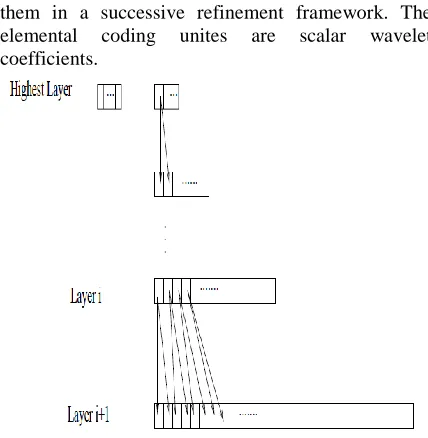
Figure 1: The temporal orientation tree
Figure 2: The diagram of the proposed method
4 Coding Algorithm
After the wavelet transform, we use the SPIHT algorithm to encode the wavelet coefficients. The SPIHT algorithm has received widespread recognition for its notable success in image coding [1]. We have also implemented it in the case of one dimension (1D) for coding wavelet packet transforms of audio signals and obtained very good compression performance [8]. Here we apply the SPIHT algorithm to the wavelet (purely dyadic) transform of ECG signals.
4.1 Temporal Orientation Trees
As shown in Figure 1, a tree structure, called ”temporal orientation tree”, defines the temporal relationship in the wavelet domain. Every point in layer i corresponds to 2 points in the next layer i+1, with the arrow indicating the parent-offspring relation. This definition is analogous to that of spatial orientation trees in [1]. Each node either has no offspring or 2 offspring. In a typical 1-D signal, most of the energy is concentrated in low frequency bands, so that the coefficients are expected to be better magnitude-ordered as we move downward following the temporal orientation tree to the leaves (terminal nodes).
4.2 Set Partitioning Sorting Algorithm
The same set partitioning rule is defined in the encoder and decoder. The subset of subband coefficients ci in the subset T is said to be significant for bit depth n if maxi∈T {|ci|} ≥ 2n, otherwise it is said to be insignificant. If the subset is insignificant, a 0 is sent to the decoder. If it is significant, a 1 is sent to the decoder and then the subset is further split according to the temporal orientation tree until all the significant sets are a single significant point. In this stage of coding, called the sorting pass, the indices of the coefficients are put onto three lists, the list of insignificant points (LIP), the list of insignificant sets (LIS), and the list of significant points (LSP). In this pass, only bits related to the LSP entries and binary outcomes of the magnitude tests are transmitted to the decoder. In implementation, we grouped together the entries in the LIP and LIS which have the same parent into an entry atom. For each entry atom in LIP, we estimated a pattern in both encoder and decoder to describe the significance status of each entry in the current sorting pass. If the result of the significance test of the entry atom is the same as the specified pattern, we can use one bit to represent the status of the whole entry atom which otherwise had two entries and representation of significance by two bits. If the significance test result does not match the pattern, we transmitted the result of the significance test for each entry in the atom. Since the ECG signal has periodic characteristics, we correctly estimated the pattern with high probability, so were able to save one bit frequently enough to give noticeable improvement in compression performance.
4.3 Refinement Pass
After each sorting pass, we get the significant coefficients for the threshold 2n, and then send to the decoder the nth most significant bit of every coefficient found significant at a higher threshold. By transmitting the bit stream in this ordered bit plane
fashion, we always transmit the most valuable (significant) remaining bits to the decoder.
The outline of the full coding algorithm is as follows: 1. Initialization. Set the list of significant points (LSP) as empty. Set the roots of similarity trees in the lists of insignificant points (LIP) and insignificant sets (LIS). Set the significance threshold 2n with n = log2(max(i)|ci|)
2. Sorting pass. Using the set partitioning algorithm distribute the appropriate indices of the coefficients to the LIP, LIS and LSP.
3. Refinement pass: For each entry in the LSP significant for higher n, send the nth most significant bit to the decoder.
4. Decrement n by one and return to step 2 until the specified bit rate is reached.
5 Simulation Results
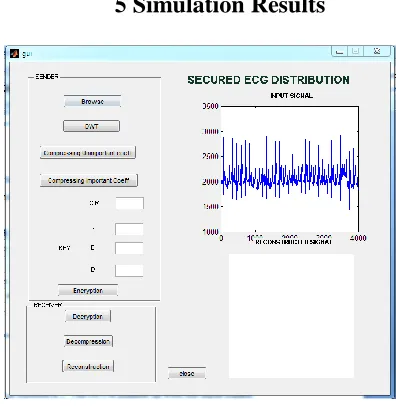
Figure 3: GUI with an input signal
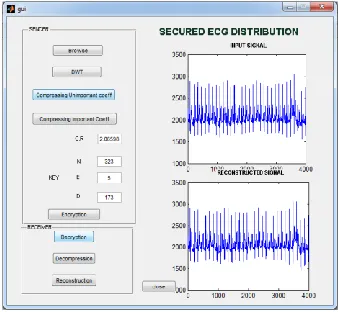
Figure 5: The input signal is encrypted
Figure 6: reconstructed signal
6. Conclusion
In this paper, we have analyzed different wavelet transforms and also the SPIHT compression technique. The ECG signals generated through MatLab where subject to test, and the algorithms where applied to them to observe the results. Using this proposed system we can implement these algorithms in the presently evolving mobile health care devices and fitness monitoring wearable equipment to optimize the data being stored without loss of any major data.
References
[1] A. Said and W. A. Pearlman, “A New, Fast and Efficient Image Codec Based on Set Partitioning in Hierarchical Trees,”, IEEE Trans. on Circuits and
Systems for Video Technology, Vol. 6, pp. 243–250, June 1996.
[2] S. Jalaleddine, C. Hutchens, R. Strattan and W. Coberly, “CG data compression techniques - A unified approach”, IEEE Trans. on Biomedical Engineering, Vol. 37, pp. 329–343, 1990.
[3] A. G. Ramakrishnan, SupratimSaha, “ECG Coding by Wavelet-Based Linear Prediction”, IEEE Trans. on Biomedical Engineering, Vol. 44, pp. 1253–1261, Dec. 1997.
[4] Michael L. Hilton, “Wavelet and Wavelet Packet Compression of Electrocardiograms”, IEEE Trans. on Biomedical Engineering, Vol. 44, pp. 394–402, May 1997.
[5] A. Djohan, T. Q. Nguyen, and W. J. Tompkins, “ECG compression using discrete symmetric wavelet transform”, 17th Int. Conf. IEEE in Medicine and Biology, 1995.
[6] S. Mallat, A Wavelet Tour of Signal Processing, Academic Press. 1997.
[7] A. Enis Cetin, Hayrettin Koymen and M. CengizAydn, “Multichannel ECG Data Compression by Multirate Signal Processing and Transform Domain Coding Techniques”, IEEE Trans. on Biomedical Engineering, Vol. 40, pp. 495–499, May 1993
[8] Zhitao Lu and W. A. Pearlman, “An Efficient, Low-Complexity Audio Coder Delivering Multiple Levels of Quality for Interactive Applications”, Proceedings of 1998 IEEE Second Workshop on Multimedia Signal Processing, Dec. 7-9,1998 Redondo Beach, CA, pp. 529–534.
[9] M. Antonini, M. Barlaud, P. Mathieu, and I. Daubechies, “Image Coding Using Wavelet Transform”, IEEE Trans. Image Processing, Vol. 1, pp. 205–220, Apr. 1992.
Author profile 1:
Mr. K Joseph, completed B.Tech in Electronics & CommunicationEngineering in 2011 from Holy Mary Institute of Technology and Science, Affiliated to JNTU-Hyderabad, Telangana, India and M.Tech in Wireless & Mobile, Communications in 2017(pursuing) from Malla Reddy Institute of Engineering and Technology , Affiliated to JNTU- Hyderabad, Telangana, India.
Area of interest includes research in Biomedical Image processing.
E-mail id:[email protected]
.
Author profile 2:
Mr. Rajakishore is currently working asAssociate Professor in the Department of Electronics & Communications Engineering in Malla Reddy Institute of Engineering &Technology, Affiliated to JNTU Hyderabad, Telangana. He received his B.Tech from Pondicherry University, Puducherry and M.Tech from Pondicherry University, Puducherry. His area of interest includes wireless sensor networks, Wireless Communications Email id: [email protected]
Author profile 3:
Dr. M. Narsingh Yadav is currently working as Head of the Department in Malla Reddy Institute of Engineering and Technology, Affiliated to JNTU-Hyderabad, Telangana. He has Completed his B.Tech from Gurunanak Engineering College, affiliated to JNTU-Hyderabad in 2006 and he did masters MS under university of California SAN DIEGO. He did his Ph.D (Wireless Networking) from university of California ANGLES in 2010.His Area of interest includes Electronics Advanced digital Communication and Wireless sensor networks.