Scholarship@Western
Scholarship@Western
Electronic Thesis and Dissertation Repository
6-23-2016 12:00 AM
The Effect Of Mesh-Type Bubble Breakers On Two-Phase Vertical
The Effect Of Mesh-Type Bubble Breakers On Two-Phase Vertical
Co-Flow
Co-Flow
Alan Kalbfleisch
The University of Western Ontario
Supervisor Kamran Siddiqui
The University of Western Ontario
Graduate Program in Mechanical and Materials Engineering
A thesis submitted in partial fulfillment of the requirements for the degree in Master of Engineering Science
© Alan Kalbfleisch 2016
Follow this and additional works at: https://ir.lib.uwo.ca/etd
Part of the Energy Systems Commons, Heat Transfer, Combustion Commons, and the Other Mechanical Engineering Commons
Recommended Citation Recommended Citation
Kalbfleisch, Alan, "The Effect Of Mesh-Type Bubble Breakers On Two-Phase Vertical Co-Flow" (2016). Electronic Thesis and Dissertation Repository. 3946.
https://ir.lib.uwo.ca/etd/3946
This Dissertation/Thesis is brought to you for free and open access by Scholarship@Western. It has been accepted for inclusion in Electronic Thesis and Dissertation Repository by an authorized administrator of
i
Abstract
It is proposed that mesh-type bubble breakers can be used in two-phase gas-liquid vertical
cocurrent pipe flow to enhance the heat and mass transfer rates. Two experimental studies
were performed to investigate the effect of mesh-type bubble breakers with varying
geometries on two-phase flow behaviour. The first used highspeed imaging to measure
bubble size and observe the resulting flow regime for two-phase vertical co-flow consisting
of air and water. A Froude number correlation that can be used to predict the bubble size
generated by mesh-type bubble breakers is proposed. Flow regime maps for two-phase flow
in the presence of bubble breakers with varying geometry were produced. The second study
investigated two-phase flow heat transfer. A correlation to predict the two-phase Nusselt
number (limited to superficial liquid and gas Reynolds number of ReSL < 2000 and
ReSG < 100 respectively) was proposed. A thorough investigation of the effect of mesh-type
bubble breakers on two-phase heat transfer is discussed.
Keywords
Two-Phase Flow, Cocurrent, Experimental Fluids, Bubble Breakup, Flow Regime,
ii
Acknowledgments
I would like to acknowledge Dr. Kamran Siddiqui for his continued support and guidance
iii
Table of Contents
Abstract ... i
Acknowledgments... ii
Table of Contents ... iii
List of Tables ... vi
Chapter 3 ... vi
List of Figures ... vii
Chapter 1 ... vii
Chapter 2 ... viii
Chapter 3 ... x
Chapter 1 ... 1
1 Introduction ... 1
1.1 Global Demand for Air Conditioning ... 1
1.2 Vapor Compression Refrigeration ... 3
1.3 Heat Absorption Refrigeration ... 5
1.4 Challenges with the small-scale implementation of heat absorption cycle ... 8
1.5 Absorber Improvements... 9
1.6 Bubble Formation Process ... 10
1.7 Two-Phase Flow Regimes ... 17
1.8 Motivation ... 20
1.9 Objectives ... 21
1.10Research Impact ... 21
1.11Thesis Outline ... 21
1.12Co-Authorship Statement... 22
iv
2 Bubble Size Prediction and Flow Regime Analysis for Two-Phase Vertical Co-flow in
the Presence of a Mesh-Type Bubble Breaker ... 26
2.1 Introduction ... 26
2.2 Nomenclature ... 31
2.3 Experimental Setup and Procedure ... 32
2.4 Results and Discussion ... 40
2.4.1 Bubbly Flow Analysis... 40
2.4.2 Flow Regime Characterization ... 53
2.5 Conclusion ... 69
2.6 References ... 70
Chapter 3 ... 75
3 Two-Phase Vertical Co-Flow Heat Transfer in the Presence of a Mesh-Type Bubble Breaker ... 75
3.1 Introduction ... 75
3.2 Nomenclature ... 79
3.3 Experimental Setup and Procedure ... 81
3.4 Results and Analysis ... 91
3.4.1 Two-Phase Convective Heat Transfer Coefficient (no bubble breaker) ... 91
3.4.2 Influence of the Bubble Breaker on Heat Transfer ... 97
3.5 Conclusion ... 113
3.6 References ... 113
Chapter 4 ... 118
4 Conclusion ... 118
4.1 Overview ... 118
4.2 Contribution ... 121
vi
List of Tables
Chapter 3
Table 3.1: Two-Phase Flow Regime Characterization with no Bubble Breaker Present ... 94
Table 3.2: Two-Phase Flow Regime Characterization with Bubble Breakers of Varying Pore
vii
List of Figures
Chapter 1
Figure 1.1: Schematic of a vapor-compression refrigeration cycle. ... 5
Figure 1.2: Schematic of a heat absorption refrigeration cycle. ... 7
Figure 1.3: A schematic of an air-cooled vertical tubular absorber depicted in a study by
Fernández et al. [25]. ... 11
Figure 1.4: Two stages of bubble formation (Expansion and Detachment) as proposed by
Ramarkrishin et al. [26]. ... 12
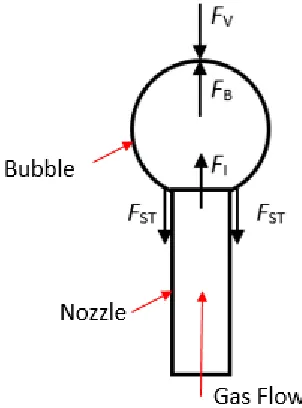
Figure 1.5: Force balance of a bubble in stagnant liquid during the expansion phase. For a
low gas flowrate, the Viscous Drag force (Fv) and Gas Intertia Force (FI) would be
negligible... 13
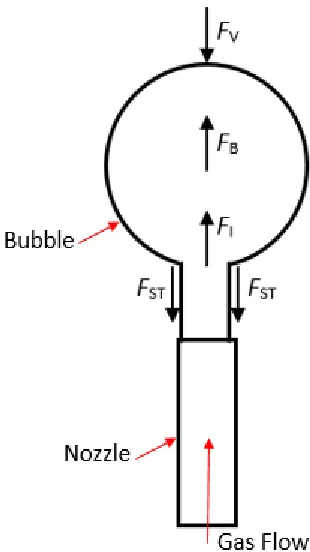
Figure 1.6: Force balance of a bubble in stagnant liquid during the detachment phase. ... 14
Figure 1.7: Force balance of a bubble during the expansion phase (left) and the detachment
phase (right) in an upward flowing liquid. ... 15
Figure 1.8: Bubble shapes during bubble formation from a submerged vertical nozzle in
upward flowing liquid as predicted by Terasaka et al. [29].. ... 16
Figure 1.9: Two-phase vertical flow regimes proposed by Hewitt and Roberts [30].. ... 18
Figure 1.10: Flow regime map for vertical tubular two-phase cocurrent flow proposed by
viii
Chapter 2
Figure 2.1: Schematic of the experimental setup. ... 34
Figure 2.2: Bubble Breaker cross section showing various geometric parameters; bubble
breaker thickness (t), diameter (Dbb) and pore size (S). ... 35
Figure 2.3: Schematic of the positioning of the bubble breaker in the center pipe and other
related parameters; the distance between the nozzle tip and bubble breaker (H) and the
bubble breaker length (L). ... 36
Figure 2.4: Illustration of the major and minor axes detection of an individual bubble in an
image segment. ... 37
Figure 2.5: The identified bubbles approxiated as ellipses are shown plotted over an original
image. ... 38
Figure 2.6: Qualitative comparison of the two-phase flow without a bubble breaker and in the
presence of bubble breakers with different pore sizes (shown underneath the respective
images). The bubble breaker was located 25 mm downstream of the nozzle tip. The length of
each bubble breaker was L/Dbb=1. The liquid and gas flow rates in all the images were
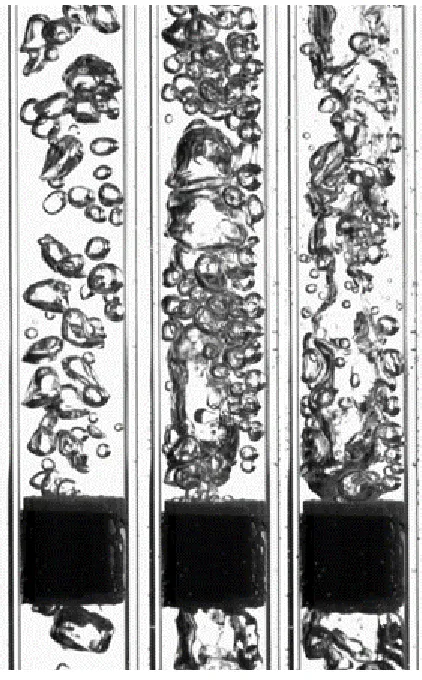
QL=2.5 LPM and QG=0.5 LPM, respectively. ... 41
Figure 2.7: Mean diameters of bubbles generated by bubble breakers of different pore sizes
versus the volumetric gas-liquid flow ratios for gas-liquid vertical co-flow. ... 42
Figure 2.8: The size distribution of bubbles generated by a bubble breaker with a pore size of
S=2mm for three gas-liquid flow ratios. ... 45
Figure 2.9: Froude number versus the normalized diameter of nozzle-generated bubble. The
Froude number correlation proposed by Sada et al. [19] is plotted as the dashed line. ... 47
Figure 2.10: Modified shape factors plotted versus the modified Froude for all cases. The
ix
lengths and positions of the bubble breaker of 2 mm pore size. The correlation from Equation
(9) is also plotted for comparison. ... 52
Figure 2.12: Images of Two-Phase flow with no bubble breaker. From left to right the images
show bubbly flow (QL=0.63 LPM, QG=0.2 LPM, GLR=0.32), slug flow (QL=0.63 LPM,
QG=1.0 LPM, GLR=1.59), and churn flow (QL=0.63 LPM, QG=2.0 LPM, GLR=3.17). ... 54
Figure 2.13: Images of Two-Phase flow after passing through a bubble breaker (S=2mm,
H=25mm, L/Dbb=1). From left to right the images show bubbly flow (QL=0.63 LPM, QG=0.5
LPM, GLR=0.79), slug flow (QL=0.63 LPM, QG=1.5 LPM, GLR=2.38), and churn flow
(QL=0.63 LPM, QG=2.5 LPM, GLR=3.97). ... 55
Figure 2.14: Flow transition chart for cases without a bubble breaker over a range of air and
water flow rates. The coloured symbols depict each flow regime (blue=bubble, green=slug,
red=churn). ... 56
Figure 2.15: Flow transition charts for the cases with bubble breakers of different pore sizes
(1-4 mm). The length of the bubble breaker and the height above the nozzle tip remain
constant at L/Dbb=1 and H=25mm, respectively. ... 58
Figure 2.16: Image sequence showing the slug formation downstream of a bubble breaker
with a pore size of S=1mm at a liquid flowrate of QL=3.2LPM and a gas flowrate of
QG=1.5LPM (GLR=0.47). The time interval between images is 0.005 seconds. The gas slug
regions are highlighted by red outlines. ... 59
Figure 2.17: An image sequence, illustrating the formation of a tip at the leading edge of a
nozzle-generated bubble at liquid and gas flowrates of QL=3.2LPM and QG=1.5LPM
(GLR=0.47). The time separation between images is 0.003 seconds. ... 61
Figure 2.18: An image showing the flow of a gas region through a bubble breaker that is
unable to split the bubble into multiple pores due to the bubble tip formed after detaching
x
positions above the nozzle tip for two different pore sizes. ... 64
Figure 2.20: Flow transition charts for bubble breakers with two different lengths... 66
Figure 2.21: Slug formation of a gas region passing through a bubble breaker with a length of
L/Dbb=0.5. Images are separated by 0.006 seconds. ... 67
Chapter 3
Figure 3.1: The schematic of the apparatus used to measure the two-phase heat transfer rate.
Separate computers were used to record the data from the in-flow thermocouples and the
thermal camera. A PID Temperature controller was used to keep the water reservoir at a
constant temperature of Tb=80oC. Three fans (not shown in the schematic) were placed in a
vertical series beside the stainless steel pipe to provide forced convection cooling. ... 82
Figure 3.2: Bubble Breaker cross section showing various geometric parameters; bubble
breaker thickness (t), diameter (Dbb) and pore size (S). ... 83
Figure 3.3: A schematic showing the placement of three small fans to induce a uniform
horizontal airflow across the vertical stainless steel pipe causing forced convection heat
transfer to occur between the pipe surface and the surrounding air.. ... 96
Figure 3.4: A temperature plot of a two-phase flow with a superficial liquid Reynolds
number of ReSL=1150 and a superficial gas Reynolds number of ReSG=40. ... 87
Figure 3.5: Local convective heat transfer coefficients along the pipe length for a two-phase
flow (ReSL=1150 and ReSG=40). The error bars represent propagated measurement error from
the thermocouples and flowmeters. ... 89
Figure 3.6: The measured Nusselt number for a single phase flow at different Reynolds
number compared to the classical Nusselt number for laminar pipe flow with constant surface
heat flux, NuL=4.36 [33]. The error bars represent the root mean square of the propagated
xi
superficial gas and liquid Reynolds numbers. The error bars represent the root mean square
of the propagated errors from the local heat transfer coefficient values. ... 92
Figure 3.8: Two-phase Nusselt number plotted vs. the liquid-to-gas Reynolds number ratio.
The best-fit equation is also plotted. ... 96
Figure 3.9: Convective heat transfer coefficients for two-phase vertical pipe flow with and
without bubble breakers at a superficial liquid Reynolds number of ReSL=380 and different
superficial gas Reynolds numbers. ... 99
Figure 3.10: Convective heat transfer coefficients for two-phase vertical pipe flow with and
without bubble breakers at a superficial liquid Reynolds number of ReSL=1150 and different
superficial gas Reynolds numbers. ... 100
Figure 3.11: Convective heat transfer coefficients for two-phase vertical pipe flow with and
without bubble breakers at a superficial liquid Reynolds number of ReSL=1900 and different
superficial gas Reynolds numbers. ... 101
Figure 3.12: Highspeed camera images of the flow generated by three bubbles breakers at the
same flow conditions (ReSG=40 and ReSL=380). ... 104
Figure 3.13: High-speed camera images of the flow generated by three bubbles breakers at
the same flow conditions (ReSG=79 and ReSL=380). ... 106
Figure 3.14: High-speed camera images of the flow generated by three bubbles breakers at
the same flow conditions (ReSG=40 and ReSL=1150). ... 108
Figure 3.15: High-speed camera images of the flow generated by three bubbles breakers at
the same flow conditions (ReSG=79 and ReSL=1150). ... 109
Figure 3.16: Local convective heat transfer coefficients along the length of the pipe for all
three bubble breakers and in the absence of a bubble breaker for a two-phase flow with
Chapter 1
1
Introduction
1.1
Global Demand for Air Conditioning
Global energy demand for residential air conditioning has increased in recent years. In
Canada, energy demand for residential space cooling has increased by 68% from 1990 to
2009 [1]. In the United States, the percentage of homes with air conditioning has
increased from 68% in 1993 to 87% in 2009 [2]. Throughout the world, developing
countries have seen even larger increases in residential air conditioning demand. In urban
China, the number of air conditioning units per household increased from 8 units per 100
households in 1995 to 106 units per 100 households in 2009 [3]. India stands out as
another country with the potential for a significant increase in air conditioning demand
[4]. In spite of the fact that only a small fraction of India’s population can afford air
conditioner, its potential demand for cooling is twelve times that of the United States [4].
Air conditioning is used to provide thermal comfort in building interiors. If temperatures
inside a building are too high for thermal comfort, an air conditioning system is used to
remove heat, reduce the interior temperature, and maintain it in the thermal comfort
range. Energy demand for air conditioning can fluctuate due to outdoor temperatures and
solar radiation intensity. In Ontario, Canada, this leads to peak energy demands in the
Summer months that are too great for its base supply from Nuclear and Hydro [5]. During
peak times, natural gas power plants must be turned on to overcome the higher energy
demand. Using natural gas to produce electricity is more harmful to the environment than
the base energy sources, as it produces greenhouse gases. Electricity produced by natural
gas is also more expensive than the base energy sources causing Ontario electricity prices
to be higher during times of peak demand [6]. Other issues can arise from peak energy
demands from air conditioning units such as blackouts. In 2012, a power outage in India
caused by overloading of power stations left an area populated by 670 million people
without power [7]. Fluctuations in power demand for air conditioning units can overload
Studies have been done to predict the effect of global warming, population growth and
economic trends on the demand of residential air conditioning. A study by Petri and
Calderia [8] analyzed historical data from weather stations and used current models of
global warming to predict the change in cooling degree-days (CDD) throughout regions
in the United States. Cooling degree-days are defined as the number of degrees that a
day’s temperature is above 65oF [8]. For example, if the average daily temperature in a
region over a period of 30 days is 70oF, the CDD value for that period is 150. The
number of cooling degree-days in a region can be used to estimate the amount of energy
required for air conditioning. The median yearly CDD value for the contiguous United
States is expected to increase to 2215 by 2080 from a value of 792 in 2010 [8]. Although
all regions in the United States are expected to see an increase in CDD values, the largest
increases will be seen in southern United States with high historical CDD values. For
example, the CDD value for California is expected to increase by 1962 and the CDD
value for Southern Texas is expected to increase by 2250 [8]. The increase in CDD
values in regions that already have high demand for air conditioning will lead to even
larger peak energy demands during periods of high outdoor temperatures.
Sivak [9] presented an estimation for global energy demand for air conditioning. In his
study, current populations and CDD values for metropolis regions throughout the world
were used to predict the potential global air conditioning energy demand. If ownership of
air conditioning systems throughout the world is equal to the current level of ownership
in the United States, it is estimated that the global energy demand for air conditioning is
50 times higher than that of the United States [9]. Energy for air conditioners already
accounts for 5% of the 3800 TWh of electricity produced yearly in the United States
[10, 11]. A study by Isaac and van Vurren [12] projects the increase in global demand for
air conditioning as a function of income trends, population growth and increase in global
temperature due to global warming. At current ownership of air conditioning units, global
energy demand for air conditioning by 2100 is expected to increase by 72% from its 2000
level, due to global warming alone [12]. When population growth and economic trends
are added, global demand energy demand for air conditioning is estimated to grow to
10000 TWh by 2100 from 300 TWh in 2000 [12]. A large factor in the estimated increase
warming due the increase in energy use. Since most of the world’s electricity is currently
produced by sources that generate greenhouse gases, the increase in energy demand for
air conditioning will increase the production of greenhouse gases. This in turn will
increase global temperatures leading to a further increase in the demand for air
conditioning. This cycle causes the predicted global energy demand for air conditioning
to increase exponentially [12].
The studies discussed previously have all assumed that the technology for electricity
generation, building design and air conditioning remains unchanged. By producing
electricity with renewable resources such as solar, wind or hydro that don’t produce
greenhouse gases, the acceleration of global warming caused by an increase in air
conditioning demand could be curtailed. Change in building design and materials used in
residential buildings can reduce the energy needed to cool an interior space. The main
goal of the change in building design is to reduce the solar radiation entering the space
(directly or indirectly) or the internal heat gains. Use of double skin roofs have been
shown to reduce heat gain by solar radiation through a building roof by 50% [13]. Heat
gain through windows can be substantially reduced by installing double pane windows
with optimal spacing and shading [14]. Planting trees in urban areas has also been
suggested to provide shade in summer months that prevents solar radiation from entering
residential buildings [15]. Recent technological improvements have also made air
conditioning systems more energy efficient leading to a decrease in energy needed for
cooling. Residential air conditioning systems on the market today can be up to 40% more
efficient than systems sold 10 years ago [16].
1.2
Vapor Compression Refrigeration
Air conditioning and refrigeration systems currently used in residential and commercial/
institutional sectors operate on vapor-compression refrigeration cycle. A schematic of the
vapor-compression refrigeration cycle is shown in Figure 1.1. Various thermodynamics
processes involved in the complete refrigeration cycle are described below [17]. A
refrigerant, typically R-104A, flows throughout the cycle. Beginning at state (1) in
Figure 1.1, a mixed phase liquid-gas refrigerant at a low pressure and low temperature
The temperature of the refrigerant must be below the temperature of the cooling
environment to allow heat transfer from the air in the cooling environment to the
refrigerant in the evaporator (Q̇E). As the refrigerant flows through the evaporator, the
heat being transferred from the interior air causes the refrigerant to undergo a phase
change to a vapor form at a constant temperature. The refrigerant leaves the evaporator as
a saturated vapor and enters the compressor at state (2). The compressor adds energy to
the refrigerant in the form of work (ẆComp). The pressure and temperature of the
refrigerant are increased and the refrigerant leaves the compressor as a superheated vapor
at state (3). After the compressor, the superheated vapor refrigerant enters the condenser.
The condenser is located outside of the cooling environment allowing heat to be
transferred from the refrigerant to the warm environment, typically outside atmosphere
(Q̇Con). The compressor must add enough energy to the refrigerant to increase its
temperature to a higher value than the temperature of the atmospheric air to allow heat
transfer from the refrigerant to the atmospheric air to occur. The heat transfer from the
refrigerant causes its enthalpy to decreases. The refrigerant undergoes a phase change at
constant temperature and exits the condenser as saturated liquid at state (4). The
refrigerant then enters the expansion valve. The expansion valve causes a reduction in
pressure and temperature at constant enthalpy, bringing the refrigerant back to the mixed
phase liquid-gas at state (1).
The energy demand for air conditioning in the form of electricity is the energy required to
operate the compressor. Compressing a vapor to increase its temperature and pressure is a
very energy intensive process. Typically, the efficiency of a residential air conditioning
system is measured as the energy efficiency ratio (EER). The EER is the ratio of the
cooling output (Q̇E, BTU/h) to the electricity input required for the compressor (ẆComp,
W). In Canada, air conditioning units that receive an ENERGY STAR® rating must have
Figure 1.1: Schematic of a vapor-compression refrigeration cycle.
1.3
Heat Absorption Refrigeration
An alternative refrigeration process exists that requires less energy in the form of
electricity to operate: the heat absorption refrigeration cycle. A schematic of the heat
absorption refrigeration cycle is shown in Figure 1.2. Components such as the evaporator,
condenser and expansion valve are common to both the vapor compression refrigeration
cycle and the heat absorption refrigeration cycle and operate in the same way. The
primary difference between the two cycles is that the heat absorption refrigeration cycle
is heat-driven. That is, the heat absorption refrigeration cycle does not have a compressor
and instead uses a secondary absorption cycle. Another difference between the two
systems is that they both use different types of refrigerants. Various thermodynamics
processes involved in the heat absorption refrigeration cycle are described below based
Starting at state (1) in Figure 1.2, the low temperature and low pressure ammonia enters
the evaporator as a mixed phase liquid-gas flow. Similar to the evaporator component in
the vapor-compression cycle, heat is removed from the cooling environment space by
ammonia which leads to its phase transformation into the vapor form. The ammonia
leaves the evaporator as saturated vapor and enters the absorber at state (2). The absorber
component is unique to the heat absorption refrigeration cycle. The saturated vapor
ammonia is mixed with a high temperature liquid water-ammonia mixture. The saturated
vapor ammonia is absorbed into the liquid mixture, increasing the ammonia
concentration. During the absorption process, heat must also be transferred from the
ammonia-water mixture to the outside atmosphere (Q̇A). After the ammonia vapors are
fully absorbed, the high concentration mixture enters a pump at state (3). The pump
increases the pressure of the mixture by inputting energy in the form of work (ẆP). After
leaving the pump, the high pressure, high concentration ammonia-water mixture enters a
heat exchanger at state (4) to recover heat from the low concentration ammonia-water
mixture entering the absorber. The high concentration mixture, after recovering the heat,
enters the generator at state (5). Heat is added to the mixture (Q̇G) causing ammonia to
desorb from the liquid mixture in the form of superheated vapor. The remaining low
concentration liquid exits the generator at state (6) and enters the heat exchanger allowing
heat to be recovered by the high concentration mixture. After the heat exchanger, the low
concentration liquid enters an expansion valve at state (7) to reduce its pressure to be
equal to the pressure of the ammonia vapor exiting the evaporator at state (2). The low
pressure, low concentration ammonia-water mixture is fed back into the absorber at state
(8). The pure ammonia superheated vapor that was separated by the heat added to the
generator enters the condenser at state (9). Similar to the vapor compression cycle, heat is
transferred from the refrigerant in the condenser to the warm environment or outside
atmosphere causing the refrigerant (ammonia) to loose enthalpy and undergo phase
transformation at a constant temperature. The ammonia exits the condenser as saturated
liquid at state (10) and enters an expansion valve to reduce its temperature and pressure at
constant enthalpy before entering back into the evaporator as a mixed phase liquid-gas
Figure 1.2: Schematic of a heat absorption refrigeration cycle.
The main advantage of a heat absorption refrigeration cycle compared to a
vapor-compression cycle is the reduction of electricity needed to operate the system. In the heat
absorption refrigeration cycle, the only electrical energy input needed is for operation of
the pump. Although both the pump, in the heat absorption refrigeration cycle, and the
compressor, in the vapor-compression cycle, are used to increase the pressure of the
refrigerant, increasing the pressure of a liquid via a pump requires far less energy than
increasing the pressure of a vapor via a compressor (due to the lower specific volume of
the former). The primary input energy required for the heat absorption refrigeration cycle
is for the generator in the form of thermal energy. For large industrial cooling, the input
energy for the generator can be obtained in the form of waste heat from industrial
processes. For example, waste heat from natural gas combustion for electricity generation
is used as the heat input for absorption refrigeration systems for cooling applications in
the oil and gas industry [18]. For smaller applications like residential cooling, it has been
proposed that solar thermal heat can be used as the input heat for the heat absorption
1.4
Challenges with the small-scale implementation of heat
absorption cycle
The number of residential air conditioning units has increased substantially in recent
years. It has been estimated that currently 100 million households have an air
conditioning system in the United States alone [2]. Demand for air conditioning will rise
drastically due to strengthening economies in developing countries and rising global
temperatures resulting in a large increase in global energy demand [8-12].
As mentioned earlier, the heat absorption refrigeration system requires a heat source. In
large-scale applications in the industrial sector, these systems operate on industrial waste
heat which is often of high grade. The waste heat in residential units is not significant and
mostly in the form of low grade heat. A potential heat source for the residential
applications is solar thermal energy. It is not only an excellent source of high-grade heat
but also a clean energy source. It should be noted that regions with high air conditioning
demand are typically those with high solar insolation.
Currently, no small-scale solar heat absorption refrigeration systems are commercially
available for use as residential air conditioning systems. Many studies have been
conducted to investigate the feasibility of such a system for residential or other small
scale cooling applications. Aman et al. [20] performed a thermodynamic analysis for a
solar heat absorption refrigeration system intended to provide 10kW (34000 BTU/hr) of
cooling to a residential building. The analysis found that the system could operate with a
generator temperature of TG=80oC, a temperature easily attainable by a roof mounted
solar collector. The input energy required for the pump was found to be ẆP=0.89 mW.
For a vapor-compression system with the same cooling requirement and an EER of 10.7,
the electrical input required to operate the compressor would be ẆComp=3.2 kW. The
electrical input for the heat absorption refrigeration cycle is almost negligible when
compared to the vapor-compression system.
The study by Aman et al. [20] identifies the areas of potential concern when using a heat
absorption refrigeration cycle for residential cooling. The study found that the rate of heat
required by the evaporator and condenser components. This is especially concerning for
the absorber unit. Since the temperature of the fluid in the absorber unit is lower as
compared to the condenser, rate of heat transfer from the absorber to the outside
atmosphere would be lower than that of the condenser. The absorber unit was also found
to have the highest rate of exergy loss, affecting the overall efficiency of the system.
Hourly analysis of a small-scale solar heat absorption refrigeration system was performed
by Ozgoren et al [21]. Their study simulated solar conditions of Southern Turkey and
used available models of evacuated-tube solar collectors to predict the performance of a
system designed to provide 3.5kW (12000 BTU/hr) of cooling to residential and office
buildings. Their analysis showed that the coefficient of performance (COP), the ratio of
cooling capacity (Q̇E) to the input energy required for the generator (Q̇G), increased with
increasing generator temperature for TG > 110oC. The study also showed that the heat
transfer rate required for the absorber unit (Q̇A), increased with increasing generator
temperature. The heat transfer rate required for the absorber unit can be up to four times
that of the cooling capacity of the system [21]. Boudehenn et al. [22] performed an
experimental study on a 5kW (15200 BTU/hr) cooling capacity heat absorption
refrigeration cycle. A full scale system was built and tested in a lab using hot water to
provide heating for the generator. A comparison between the experimental results and a
theoretical thermodynamic model revealed a significant decrease in the performance of
the experimental apparatus due to limitations of the mass transfer rate of the absorber unit
[22].
1.5
Absorber Improvements
Both in theoretical and experimental studies, the absorber unit of the heat absorption
refrigeration cycle appears to limit the performance of the cycle for use as a small-scale
residential air conditioning system. Castro et al. [23] compared two types of absorber
units for use in a small-scale heat absorption refrigeration cycle. Theoretical and
experimental studies were performed on both a falling film absorber (used by Boudehenn
et al. [22]) and a cocurrent bubble column absorber. Both the theoretical and
experimental results revealed that a bubble column absorber has a higher rate of mass
falling film absorber. Use of bubble column absorbers can allow for more efficient and
more compact small-scale heat absorption refrigeration systems.
Despite being more compact than a falling film absorber, a bubble column absorber is
quite sizeable when compared to a conventional vapor-compression system. Studies by
Fernandez et al. predicted the number of tubes and length of tubes needed for air-cooled
[24] and water-cooled [25] vertical tubular absorbers for use in a small-scale heat
absorption refrigeration system. Using an air-cooled system, which is more likely to be
used in a residential setting, the modelled absorber unit required 60 tubes with a length of
1.1m each, representing a total footprint of 0.9m2. Just the absorber unit alone is
comparable in size to an entire conventional vapor compression refrigeration unit. If the
components of the system are too large when compared to a conventional vapor
compression refrigeration system, a small-scale heat absorption refrigeration system may
not be desirable for use as a residential air conditioning unit.
The studies by Fernandez et al. [24-25] also showed that in a vertical tubular absorber in
which the gas is injected into a vertically flowing liquid from a single nozzle, the flow
regime at the entrance of the absorber would be a churn or slug flow rather than a bubbly
flow due to the high gas-liquid volumetric flowrates ratio. This flow regime limits mass
transfer rate between the gas and liquid phases as the surface area to volume ratio of the
gas-liquid interface is reduced. Since the length of the vertical tubular absorber is
dependent on the mass transfer rate, it is possible to reduce the length of the absorber
tubes if the flow regime can be changed from churn to bubbly, increasing the interfacial
area between liquid and vapor phases. This would allow for more compact and efficient
vertical tubular absorbers and heat absorption refrigeration systems that are designed for
residential use.
1.6
Bubble Formation Process
Vertical tubular absorbers, as seen in Figure 1.3, typically come in the form of a bundle
of vertical tubes. In each individual tube, the liquid phase of the absorber enters through
an opening at the bottom of the tube causing a vertical upward liquid flow. A small
cocurrently into the upward flowing liquid. As the gas and liquid travels cocurrently up
the tube, the gas phase is absorbed into the liquid phase and exits the tube at the top outlet
as a single phase liquid flow. The mass transfer rate between the gas and liquid phase is
highly dependent on the surface area to volume ratio of the gas phase. A two-phase flow
with a larger interfacial area between the gas and liquid phase will have a higher mass
transfer rate. For designers of vertical tubular absorbers, it is important to know the
bubble size or flow type generated by the single nozzle.
Figure 1.3: A schematic of an air-cooled vertical tubular absorber depicted in a study by Fernández et al. [25].
Bubble formation from a single nozzle in cocurrently upward flowing liquid has been
studied extensively by many researchers. The size of the bubble generated by the nozzle
depends on many variables. The general mechanism for bubble formation from a
submerged nozzle was proposed by Ramarkrishin et al. [26]. Bubble formation from a
submerged nozzle occurs in two stages: Expansion Stage and Detachment Stage (see
Figure 1.4: Two stages of bubble formation (Expansion and Detachment) as proposed by Ramarkrishin et al. [26].
They proposed a model to predict the size of the bubble at the end of the expansion stage
as well as at the detachment stage for a bubble forming from a vertical nozzle in stagnant
liquid. During the expansion phase, the bubble grows as a sphere. The volume at a given
time in the expansion phase is determined by the gas flowrate and the time since the
formation began. The size of the bubble at the end of the expansion stage can be
determined from a force balance of the upward and downward forces acting on the
bubble, which are depicted in Figure 1.5. At small gas flowrates, the end of the expansion
phase occurs when the buoyancy (FB) of the bubble in the liquid becomes greater than the
force of surface tension (FST) holding the bubble to the nozzle. As the gas flowrate
increases, the inertia of the gas flow adds an upward force (FI) on the bubble. The
increased flowrate also increases the rate of expansion of the bubble, which in turn,
causes a downward force due to the viscous drag (FV) from the liquid resisting the
Figure 1.5: Force balance of a bubble in stagnant liquid during the expansion phase. For a low gas flowrate, the Viscous Drag force (Fv) and Gas Intertia Force (FI)
would be negligible.
During the detachment stage, the upward forces, mainly the buoyancy, is greater than the
viscous drag resisting the bubble’s upward movement and the surface tension that holds
the bubble to the nozzle. This causes the bubble to accelerate upwards. As the bubble
accelerates upwards, a thin column of gas keeps the bubble in contact with the nozzle and
allows it to continue expanding. Detachment occurs when the buoyancy force becomes
greater than the force of the surface tension of the gas column. As the surface tension
force decreases with increasing local radius, the surface tension of the gas column
decreases as the bubble travels further from the nozzle tip. Once the buoyancy and gas
inertia overcomes the surface tension, the gas column breaks in the middle, closing out
the spherical bubble at the bottom, and allowing a new bubble formation to begin at the
nozzle [26]. Similar to the expansion phase, the upward movement of the expanding
bubble is resisted by the viscous drag of liquid. The force balance for the detachment
Figure 1.6: Force balance of a bubble in stagnant liquid during the detachment phase.
For tubular absorbers, the upward co-flowing liquid exerts additional drag force on the
bubble causing an early bubble detachment that results in smaller bubble size when
compared to bubble formation in stagnant liquid. A study by Sada et al. [27] identified
the upward forces aiding bubble detachment. Like bubble formation in stagnant liquid,
the gas inertia and bubble buoyancy result in an upward force that opposes the surface
tension holding the bubble to the nozzle. Since the upward flowing liquid must move
around the spherical bubble, the liquid exerts a drag force (FD) on the bubble in the
upward direction. This increases the magnitude of the net the upward force opposing the
surface tension, resulting in smaller bubbles due to early detachment. The force balance
for a bubble in the expansion and detachment phase in upward co-flowing liquid is shown
Figure 1.7: Force balance of a bubble during the expansion phase (left) and the detachment phase (right) in an upward flowing liquid.
Ramarkrishin et al. [26] discussed the effects of surface tension on the bubble size at
detachment. At low gas flowrates in stagnant fluid, the surface tension and buoyancy
equally contribute to the bubble detachment. As the surface tension of the bubble
increases, the bubble size at detachment increases. As the flowrate increases, the
influence of surface tension on the detached bubble size decreases. Sada et al. [27] also
discussed the effect of surface tension on bubble formation in co-flowing liquid. Due to
the addition of the upward drag force from the co-flowing liquid, the influence of surface
tension decreases further. For inertia (from both the gas and liquid phases) dominated
two-phase flow, surface tension has a negligible effect on bubble size [27].
Another variable that effects the detached bubble size is the nozzle diameter. In the study
by Sada et al. [27] it was observed that a decrease in nozzle size resulted in a decrease in
bubble size at the detachment. If the gas and liquid flowrates remain the same, as the
nozzle diameter decreases, the gas velocity in the nozzle increases, resulting in an
increase in the inertial force of the gas flow acting upwards on the bubble, causing an
F
DF
DF
DF
DGas Flow
Liquid Flow
Bubble
early bubble detachment. For capillary nozzles (diameters <<1mm), it has been shown
that the liquid flow rate has negligible effect on the bubble size [28].
Terasaka et al. [29] reported that the bubble shape at detachment in a liquid co-flow
cannot be spherical. During the expansion stage, the bubble initially has the spherical
shape when it is smaller in size. As it grows, the viscous drag of the co-flowing liquid
stretches the bubble vertical deforming it shape as shown in Figure 1.8. They proposed a
two-dimensional finite element model to predict the bubble shape during formation and
the final bubble volume at detachment. The finite element model considered a balance
between the pressure of the surrounding liquid and the pressure inside of the bubble. It
also considered the force balance between the bubble buoyancy, gas inertia, liquid drag
and surface tension (expressed as the equivalent radii of the gas stem attaching the bubble
to the nozzle) for prediction of detached bubble volume. They compared their predicted
bubble volume from their non-spherical model to the size predicted by spherical bubble
models proposed in previous studies like Sada et al. [27]. It was found that the spherical
bubble models were still able to accurately predict the bubble volume despite not
accurately predicting the bubble shape at the detachment.
Figure 1.8: Bubble shapes during bubble formation from a submerged vertical nozzle in upward flowing liquid as predicted by Terasaka et al. [29].
The model proposed by Terasaka et al. showed the effect of liquid pressure on the bubble
size at detachment [29]. An increase in pressure of the liquid phase generally causes a
pressure exerts a greater force onto the thin column of gas that attaches the bubble to the
nozzle. This increased force causes the gas column to collapse and detach a smaller
volume bubble when compared to the bubble volume at a decreased pressure. The
pressure effect on bubble size is mainly due to the hydrostatic pressure of the liquid
column. An increase in liquid velocity will decrease the static pressure of the liquid,
however, the increased inertial force will be more than the decrease in the effect of
pressure on the gas column.
1.7
Two-Phase Flow Regimes
The gas flow into a wall-bounded liquid stream could establish a specific structure of the
two-phase flow that depends on the gas and liquid flow rates (GLR). At low gas flow
rates, the gas injected into the liquid forms individual bubbles that are dispersed into the
liquid stream and each bubble remained surrounded by the liquid phase. This flow regime
is called the bubbly flow. As the gas flow rate increases, the bubbles begin to form and
detach more frequently. Eventually the frequency becomes great enough that the bubbles
begin to coalesce after they detach from the nozzle. If the gas flowrate is increased
further, the expansion of the bubble at the nozzle will be fast enough that it coalesces
with the previously detached bubble while still connected to the nozzle. This leads to
flow regimes that can no longer be classified as bubbly flow as there is no clear
separation between bubbles. Through observation of two-phase vertical pipe flow using
x-ray and flash photography, Hewitt and Roberts [30] identified five different flow
regimes namely, Bubble, Slug, Churn, Annular and Wispy (see Figure 1.9). Bubble, or
bubbly flow is defined as dispersed spherical gas bubbles evenly dispersed in the liquid
phase. As the gas flowrate increases, the bubbles begin to coalesce to form the plug or
slug bubbles present in the slug flow regime. Slug bubbles expand to the pipe wall
causing an intermittent flow of regions of gas and liquid. Slug flow then transitions to
Churn flow as the slug bubbles begin to coalesce and there are limited liquid breaks
between gas phases. Eventually, the gas to liquid flow ratio becomes high enough that the
gas flow becomes the dominant flow in Annular and Wispy flow where the gas
predominantly occupies the core of the tube and the liquid flow is pushed along the tube
Figure 1.9: Two-phase vertical flow regimes proposed by Hewitt and Roberts [30].
Through observations of the flow regimes at different flow conditions, Hewitt and
Roberts [30] also proposed a flow regime map for the two-phase flow in vertical tubes
(see Figure 1.10). This map can be used to predict the flow regime present in a vertical
Figure 1.10: Flow regime map for vertical tubular two-phase cocurrent flow proposed by Hewitt and Roberts [30]. The subscripts l and v represent liquid and
gas respectively.
A bubbly flow regime is most desirable for a vertical tubular absorber as it has the
highest surface area to volume ratio. More surface area of the gas phase will allow for
higher mass transfer rates from the gas phase to the liquid phase. Flow regimes such as
slug or churn flow is undesirable as the surface area to volume ratio of the gas phase is
decreased, reducing the mass transfer rate when compared to a bubbly flow. Vertical
tubular absorbers for use in small scale heat absorption refrigeration systems, the required
gas and liquid flowrates are expected to produce slug or churn flow in a conventional
single nozzle system [24, 25], which affects the mass transfer rate. Hence, it is desirable
that the flow regime in the absorber should be bubbly flow to allow for the maximum
1.8
Motivation
The need for more efficient air conditioning systems has motivated the current research.
Increasing demand for air conditioning will increase global energy demand, resulting in
potential blackouts as energy production struggles to accommodate peak demands. It can
also accelerate the effects of global warming, causing exponential growth as more energy
produced by greenhouse gas emitting sources is needed to provide thermal comfort in
homes throughout the world. The development of a more efficient air conditioning
system, which reduces energy demand from non-renewable resources, is needed. The
heat absorption refrigeration cycle has the potential to greatly reduce energy demand for
residential air conditioning if solar thermal energy is used as its driving energy source.
Studies have been done to test the feasibility of implementing a small-scale heat
absorption refrigeration as a residential air conditioning system and found that the
absorber unit limited the systems performance and design. The performance and size of
the absorber unit is limited by its need for high rates of mass and heat transfer in a
two-phase flow. The present study has been done to improve the understanding of two-two-phase
gas-liquid flow behaviour in vertical circular pipes and to investigate means to improve
the efficiency of a vertical tubular absorber. The investigation focuses on the use of
passive devices to improve the heat and mass transfer rates in the vertical tubular
absorbers. Use of mesh-type bubble breakers in vertical two-phase cocurrent flow has
been shown to be able to reduce the size of a bubble produced by a single gas nozzle in a
two-phase vertical cocurrent flow, thus being a means to increase the mass transfer rate
of a two-phase flow [31]. The previous study on mesh-type bubble breakers [31] is
limited to low liquid and gas flowrates and only covers the bubble breaker’s effect on the
bubbly flow regime. The study also neglects the bubble breaker’s effect on heat transfer,
an important design variable of vertical tubular absorbers. The current study expands on
the previous bubble breaker investigation to investigate the bubble breaker’s effect on a
larger range of two-phase flow regimes, the effect of varying bubble breaker geometry on
flow behaviour, and the effect of mesh-types bubble breakers on heat transfer in
1.9
Objectives
The specific objectives of this research work are to investigate the effect of various bubble
breaker parameters in vertical two-phase cocurrent flow, on,
The bubble size distribution
The transitional behaviour of various two-phase flow regimes
The two-phase convective heat transfer coefficient1.10 Research Impact
The results of the current investigation can be used in the development of compact
vertical tubular absorbers for use in small-scale heat absorption refrigeration systems. By
investigating the effect of mesh-type bubble breakers on two-phase flow behaviour,
estimations of their effect on the mass transfer rate in a vertical tubular absorber can be
made. The study on the bubble breaker’s effect on heat transfer in two-phase flow can be
used to make estimates on the heat transfer rate of a vertical tubular absorber. By varying
the geometry of the bubble breakers in both the flow characterization study and the heat
transfer study, the results can be used to optimize the bubble breaker design to maximize
the enhancement of heat and mass transfer rates.
1.11 Thesis Outline
The first chapter is intended to provide a broader overview of the problem of increasing
energy demand for air conditioning and the challenges of implementing solar thermal
heat absorption refrigeration systems as residential air conditioning units. In many studies
that review the feasibility of small-scale solar thermal heat absorption refrigeration
systems, the absorber unit is shown to limit the system performance. The main cause of
the limitation is the reduced mass transfer rates between a gas and liquid phase. It has
been proposed that mesh-type bubble breakers can be used to increase the surface area to
volume ratio of the gas-liquid interface in a vertical tubular absorber to increase the mass
The second chapter focuses on the investigation of the effect of various parameters of
mesh-type bubble breakers on the bubble size and two-phase flow regime transitions.
The parameters considered in this investigation are the pore size, length and position of
the bubble breaker. A wide range of gas and liquid flow rates were considered that
covered the two-phase flow regimes from bubbly to churn.
The third chapter investigated the effect of mesh-type bubble breakers on heat transfer in
two-phase vertical pipe flow. The results of the effectiveness of mesh-type bubble
breakers as heat transfer enhancement devices are presented and discussed. The effect of
flow regimes on two-phase convective heat transfer is also discussed.
The fourth chapter summarizes the objectives and scope of the present work along with
the key findings from this research. Some future recommendations are also provided to
extend this work and address some unanswered questions from this research.
1.12 Co-Authorship Statement
This thesis has been written in an integrated article format. The second chapter, titled
“Bubble Size Prediction and Flow Regime Analysis for Two-Phase Vertical Co-flow in
the Presence of a Mesh-Type Bubble Breaker” has been submitted to the International
Journal of Multiphase Flow as a separate paper and is co-authored by Kamran Siddiqui.
The third chapter, titled “Two-Phase Vertical Co-Flow in the presence of a Mesh-Type Bubble Breaker” is also co-authored by Kamran Siddiqui and will be submitted to an
1.13 References
[1] "Energy Efficiency Trends in Canada, 1990 to 2009." Natural Resources Canada.
September 7, 2012. Accessed April 19, 2016.
http://oee.rncan.gc.ca/publications/statistics/trends11/chapter3.cfm?attr=0.
[2] “Air Conditioning in nearly 100 million U.S. homes.” U.S. Energy Information
Administration. August 19, 2011. Accessed April 19, 2016.
https://www.eia.gov/consumption/residential/reports/2009/air-conditioning.cfm.
[3] Auffhammer, M. 2014, “Cooling China: The Weather Dependence of Air Conditioner Adoption.” Frontiers of Economics in China, 9(1), pp. 70-84.
[4] Davis, Lucas. "Air Conditioning and Global Energy Demand." Energy Institute at
Haas. April 27, 2015. Accessed April 19, 2016.
https://energyathaas.wordpress.com/2015/04/27/air-conditioning-and-global-energy-demand/.
[5] Hydro One Networks, Ontario Energy Board, 2003, “Electricity Demand in Ontario.”
[6] "Electricity Prices." Ontario Energy Board. Accessed April 19, 2016.
http://www.ontarioenergyboard.ca/oeb/Consumers/Electricity/ElectricityPrices.
[7] Pidd, Helen. "India Blackouts Leave 700 Million without Power." The Gaurdian.
July 31, 2012. Accessed April 19, 2016.
http://www.theguardian.com/world/2012/jul/31/india-blackout-electricity-power-cuts.
[8] Petri, Y. and Calderia, K. 2015, “Impacts of global warming on residential
heating and cooling degree-days in the United States.” Scientific Reports, 5, pp.
12427-12441.
[9] Sivak, M. 2013, “Will AC Put a Chill on Global Energy Supply?” American
Scientist, 101(5), pp. 101-104.
[10] “Air Conditioning.” Energy.Gov, Accessed April 19, 2016.
http://energy.gov/energysaver/air-conditioning.
[11] “Electricity Data.” U.S. Energy Information Administration, Accessed April 19,
2016.
[12] Isaac, M. and Van Vurren, D.P., 2009, “Modeling global residential sector energy demand for heating and air conditioning in the context of climate change.” Energy
Policy, 37(2), pp. 507-521.
[13] Biwole, P.H., Woloszyn, M. and Pompeo, C., 2008, “Heat transfers in a double-skin roof ventilated by natural convection in summer time.” Energy and
Buildings, 40, pp. 1487-1497.
[14] Aydin, O., 2006, “Conjugate heat transfer analysis of double pane windows.”
Building and Environment, 41, pp. 109-116.
[15] Kuhns, M., “Planting Trees For Energy Conservation: The Right Tree in the Right Place.” Forestry: Utah State University, Accessed April 19, 2016.
http://forestry.usu.edu/htm/city-and-town/tree-selection/planting-trees-for-energy-conservation-the-right-tree-in-the-right-place.
[16] “Air Conditioning Your Home.” Natural Resources Canada, Accessed April 19,
2016.
http://www.nrcan.gc.ca/energy/publications/efficiency/residential/air-conditioning/6051.
[17] Moran, M. J., and Shapiro, H.N., 2007, Fundamentals of Engineering
Thermodynamics, Hoboken, NJ: John Wiley.
[18] Kalinowski, P., Hwang, Y., Radermacher, R., Al Hashimi, S, and Rogers, P., 2009, “Application of waste heat powered absorption refrigeration system to the LNG recovery process.” International Journal of Refrigeration, 32, pp. 687-694 [19] Nkwetta, D.N., and Sandercock, J., 2016, “A state-of-the-art review of solar
air-conditioning systems.” Renewable and Sustainable Energy Reviews, 60, pp. 1351-1366.
[20] Aman, J., Ting, D.S., and Henshaw, P., 2014, “Residential solar air conditioning:
Energy and exergy analyses of an ammonia-water absorption cooling system.”
Applied Thermal Engineering, 62, pp. 424-432.
[21] Ozgoren, M., Bilgili, M. and Babayigit, O., 2012, “Hourly performance prediction
of ammonia–water solar absorption refrigeration.” Applied Thermal Engineering,
40, pp. 80-90.
Absorption Chiller for Solar Cooling Applications.” Energy Procedia, 30, pp. 35-43.
[23] Castro, J., Oliet, C., Rodiriguez, I., and Olivia, A., 2009, “Comparison of the
performance of falling film and bubble absorbers for air-cooled absorption
systems.” International Journal of Thermal Sciences, 48, pp. 1355-1366. [24] Fernandez, J., Uhia, F.J., and Sieres, J., 2007, “Analysis of an air cooled
ammonia–water vertical tubular absorber.” International Journal of Thermal
Sciences, 46, pp. 93-103.
[25] Fernandez, J., Sieres, J., Rodriguez, C., and Vazquez, M., 2005, “Ammonia–water absorption in vertical tubular absorbers.” International Journal of Thermal
Sciences, 44, pp. 277-288.
[26] Remakrishnan, S., Kumar, R., and Kuloor, N.R., 1969, “Bubble formation under constant flow conditions.” Chemical Engineering Science, 24 pp. 731-747. [27] Sada, E., Yasunishi, A., Katoh, S., and Nishioka, M. 1978, “Bubble formation in
flowing liquid.” The Canadian Journal of Chemical Engineering, 56, pp.
669-672.
[28] Chuang, S.C., and Goldschmidt, V.W., 1970 “Bubble Formation Due to a
Submerged Capillary Tube in Quiescent and Coflowing Streams.” Journal of
Basic Engineering, 92(4), pp. 705-711.
[29] Terasaka, K., Tsuge, H., and Matsue, H. 1999, “Bubble formation in cocurrently upward flowing liquid.” The Canadian Journal of Chemical Engineering, 77, pp. 458-464.
[30] Hewitt, G.F, and Roberts, D.N. 1969, “Studies of two-phase flow patterns by
simultaneous x-ray and flash photography.” (AERE-M--2159), Technical report,
Atomic Energy Research Establishment, Harwell (England)
[31] Gadallah, A.H. and Siddiqui, K., 2015, “Bubble breakup in co-current upward flowing liquid using honeycomb monolith breaker.” Chemical Engineering
Chapter 2
2
Bubble Size Prediction and Flow Regime Analysis for
Two-Phase Vertical Co-flow in the Presence of a
Mesh-Type Bubble Breaker
2.1
Introduction
Bubble column reactors are essential components in many chemical and mechanical
processes involving two-phase flows in which the mixing of gas and liquid phases is
required [1-3]. They are widely used due to their capability to allow high rates of heat
and mass exchange between gas and liquid phases. The basic structure of a bubble
column reactor is a vertical cylinder containing flowing or stationary liquid with gas
injected at the bottom of the vessel in the form of bubbles that rise and mix with the
liquid phase and facilitate the heat and/or mass exchange. In the biochemical industry,
bubble column reactors are used as bioreactors for the production of proteins, enzymes
and antibiotics as well as other industrial products [7-12]. Other chemical processes such
as wastewater treatment also utilize bubble column reactors [13-14]. For mechanical
applications, bubble column reactors are used as absorbers units for heat absorption
refrigeration systems [15-17].
In bubble column reactors, the size of the bubble entering the liquid domain is an
important design parameter, since it has a direct influence on the two-phase exchange
process. A large single bubble will have relatively small surface area to volume ratio
compared to numerous small bubbles with the same cumulative volume as the large
bubble. The smaller surface area to volume ratio reduces the interfacial area between the
two phases, which results in the lower heat and mass exchange rates between the two
phases. The growth and detachment of bubbles formed in a two-phase gas liquid vertical
cocurrent flow from a conventional single vertical gas nozzle has been well documented
in the scientific literature. Sada et al. [18] performed an experimental study to measure
the size of single and coalesced bubbles that detached from a single nozzle in an
unbounded vertical liquid flow. Their results show that the bubble size for liquid-inertia
gas inertial forces, bubble buoyancy forces and the liquid drag on the generated bubble,
to the bubble size and nozzle diameter. They observed that the bubble size increases with
increasing gas flow rate and decreases with increasing liquid flow rate. Teresaka et al.
[19] also investigated the bubble formation in upward flowing liquid in a column.
Through observation of bubble growth at the nozzle tip, they proposed a non-spherical
bubble growth model considering the balance of internal and external pressure forces as
well as the inertial forces from both gas and liquid flows exerted onto the bubble
interface. The model predicted the growth of the bubble volume at the nozzle and the
volume of the bubble after detachment. The bubble size predictions from their model
were in good agreement with experimental results over a range of gas-liquid flow rates
ratio (GLR). However, the model was not able to accurately capture the shape of the
formed bubbles. Chen et al. [20] proposed an interfacial element model to predict the
shape and growth of non-spherical bubbles. They compared the bubble size predicted
from their model with the experimental results from Teresaka et al. [21] and found the
model predictions to be in good agreement with the experimental data. The model also
effectively predicted the shape of a single bubble forming at a nozzle in an upward liquid
flow.
In some applications of bubble column reactors, the ratio of gas-liquid flow rates (GLR)
exceeds the condition at which a single vertical nozzle can produce bubbly flow [15, 16].
Hence, two-phase flow regimes at higher GLRs have been studied in the past. Hewitt [21]
and Hewitt and Roberts [22] studied two-phase flow regimes in both vertical and
horizontal pipes. Through experimental observation of two-phase vertical co-flow, they
identified four regimes: Bubbly, Slug, Churn and Annular. Generally, as the GLR
increases, the flow regime transitions from a bubbly flow to slug, to churn and finally to
annular flow. It has been found that the flow conditions at which the transition from
bubbly to slug flow regime occurs is not very sensitive of the pipe geometry [23]. Flow
transition maps were created to predict the flow regime based on the fluid properties and
flowrates of both phases [21, 22]. However, these maps are valid for the fully developed
Ujang et al. [24] and Waltrich et al. [25] studied the evolution of two-phase flow from the
entrance region to the fully developed region. These studies show that the flow regime is
not only dependent on the GLR but also that the flow regime changes along the length of
the pipe as the gas regions coalesce. When the gas is injected into the liquid flow, the
initial flow regime may not be the same as the predicted regime from the flow transition
maps proposed by Hewitt, and Hewitt and Roberts [21, 22]. A two-phase flow with gas
and liquid flowrates corresponding with a slug flow regime can begin as a bubbly flow
regime at the pipe entrance immediately downstream of the gas nozzle. As the two-phase
flow continues through the pipe, the initial nozzle generated bubbles begin to coalesce
forming plug and slug bubbles eventually reaching its fully developed flow regime as
predicted by Hewitt [21], and Hewitt and Roberts [22].
For bubble column reactors that operate at high GLRs, the regime is not expected to be of
the bubbly flow, which constitutes the highest surface area to volume ratio for the gas
phase. Hence, to achieve higher mass exchange in the column reactors at high GLRs, a
mechanism needs to be used to break large (slug or churn) gas regions and transition the
regime back to bubbly flow which otherwise would be in slug or churn flow mode.
Several techniques have been reported in literature to generate smaller bubbles or to
break large bubbles. Fadavi et al. [26] investigated the use of a sparger and found a
reduction in the bubble size by adding a rotational flow with a passive swirl device to the
liquid before the gas was released through the sparger. This swirl increased the shearing
force from the rotational liquid and caused early bubble detachment that resulted in
smaller bubble generation. The effect of rotational flow was also investigated by Sobrino
et al. [27]. They used a perforated plate, rotating at a set speed, to release gas into a
fluidized bed. It was found that an increase in the rotational speed of the bed decreased
the bubble size at detachment due to the increase in shearing forces. Manabu et al. [28]
investigated the use of a porous nozzle in a stationary water bath. At low gas flow rates,
the porous nozzle was found to reduce the size of the injected bubbles. As the gas flow
rate increased, the pores’ effectiveness reduced and the gas region similar to the slug
regime was formed in the pipe. They concluded that the pore has no effect at the higher
The generation of turbulent liquid flow is a common way to control bubble and droplet
size in two-phase flows. The study of turbulence in two-phase flow is dated back to the
pioneering work of Kolmogorov and Hinze [29, 30]. Their studies showed that the size of
a stable liquid droplet in a turbulent liquid flow is dependent on the integral length scale
of the turbulent flow and the turbulent intensity. They proposed a critical Weber number
to predict the stable droplet size in a two-phase flow that relates the shear stress of a
turbulent eddie to the surface tension of the dispersed phase. If the Weber number of a
flow is greater than the critical Weber number, the turbulent shear stress would cause the
droplet to split until the stable droplet size has reached. The same relation can be used in
gas-liquid flows to predict the stable bubble size when the liquid flow is turbulent. In
recent years, studies have been performed to estimate the critical Weber number and
stable bubble or droplet size for a range of specific flows including gas-liquid flow in
tubes [31-34]. By increasing the turbulent intensity in a gas-liquid flow, the chance and
frequency of bubble break-up can be increased allowing smaller and more dispersed
bubbles to be generated.
Passive devices placed downstream of a single nozzle or bubble dispersion system have
also been studied as mechanisms to break up bubbles into smaller daughter bubbles.
These devices can be used to add a shearing force to the flow similar to that of a turbulent
eddie. Miyahara et al. [35, 36] investigated bubble breakup in a two-phase vertical
co-flow by using an orifice plate and a converging-diverging nozzle. Bubbles were formed
from a single nozzle in an upward flowing liquid. The two-phase flow continued through
an orifice plate or converging-diverging nozzle forcing a turbulent jet to form. The
increased turbulence broke the initial bubble into multiple smaller daughter bubbles. A
critical Weber number correlation was developed as a function of the Reynolds number
of the flow through the orifice [36]. The use of multiple sieve trays has been shown to
increase mixing of liquid and gas phases for a variety of flow regimes [37-39]. The
positioning of the trays, the pore size and the opening ratio of the sieves can affect the
bubble size distribution, liquid mixing and gas holdup in a vertical tube. Wire meshes
were studied by Prasser et al. [40] and were found to significantly reduce the size of a




![Figure 1.9: Two-phase vertical flow regimes proposed by Hewitt and Roberts [30].](https://thumb-us.123doks.com/thumbv2/123dok_us/7728705.1265016/30.612.152.509.73.291/figure-phase-vertical-flow-regimes-proposed-hewitt-roberts.webp)