Available Online atwww.ijcsmc.com
International Journal of Computer Science and Mobile Computing
A Monthly Journal of Computer Science and Information Technology
ISSN 2320–088X
IJCSMC, Vol. 4, Issue. 3, March 2015, pg.150 – 157
RESEARCH ARTICLE
Implementation of Session Initiation
Protocol in MANET using ns2
Sheeba P
1, Ms. Vandana C P
2¹Scholar, Department of Information Science and Engineering, New Horizon College of Engineering, Bangalore, India
²Assistant Professor, Department of Information Science and Engineering, New Horizon College of Engineering, Bangalore, India
Abstract— Session Initiation Protocol (SIP) is a well established protocol used as a signalling and session establishment protocol for Voice over IP( VoIP) in stable infrastructure networks. SIP relies on the centralised registry and proxy servers for identifying the callee destination. Centralised servers cannot be used in Mobile Ad-hoc Network (MANET) as MANETs are infrastructure less. In this paper, we have adapted SIP to MANETs considering the servers as logical entities instead of physical entities. The SIP messages are carried by the Adhoc on demand distance vector routing (AODV) protocol. Network simulator 2(ns2) is the simulation environment used to simulate SIP in MANET and performance of the same is evaluated.
Keywords— SIP, MANET, VoIP, AODV
I. INTRODUCTION
In Mobile adhoc network(MANET) there are no centralized entities. MANETs are basically infrastructure less networks in which each node acts as a router. Voice applications on MANETs[1] will have various advantages especially in emergency situations like natural disasters (storms, hurricanes) when the infrastructure networks are no longer working. They can provide help to the relief operations communication. Session initiation protocol is a widely used protocol for creating and managing sessions to facilitate voice and other multimedia communications. SIP is adapted to MANETs as it is very robust[2].
A. SIP Overview
The Session Initiation Protocol has two entities: the user agents and the servers( Registry, Redirect, Proxy) The user agents are the caller and the callee. The Registry server is used for registration of SIP user agents to maintain their contact information. The proxy is used for interpreting the request message and forwarding it to the next hop in the route. Basically it routes the request messages. They can also be used for policing certain requests like not to process certain requests. The Redirect server is used for call forwarding to different domains[3].
acknowledgement, the session is setup and the communication resumes. The session is destroyed when one of the participating parties sends a bye message to the other and receives a response in turn[5].
B. ns2 Overview
Fig 1. ns2 architecture[6]
ns2 simulator is an Object-oriented Tcl (Otcl) script interpreter. It has a simulation event scheduler and network component object libraries, and network setup module libraries. Toolkit Command Language (Tcl/OTcl) scripts help in setting up and configuring network topologies i.e for creating the front end. TclCL provides linkage for class hierarchy, object instantiation, variable binding and command dispatching [6].
II. PROPOSED MODEL OF SIP IN MANET
The session initiation protocol is adapted to MANET environment. Each mobile node is a SIP agent. Each node contains the proxy and redirect servers as logical entities only.
Fig 2
.
Discovery phase 1: the path requesting phase(S-sender, R-Receiver) Fig 3. Discovery phase 2: the path response phase PREQPREQ PREQ
3
4
PREQ
PREQ
PREQ 2 1
S
1
1
PRES PRES
3
4 S
R 2
Fig 4.The Inviting Phase: the call set-up phase
Fig 5 .The acknowledgement phase
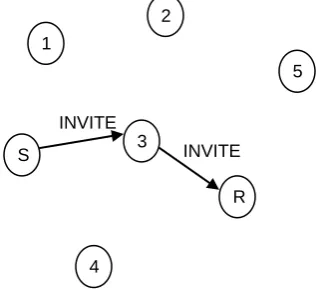
In figure 2 the Path Discovery phase, the sender that is the SIP user agent broadcasts the PathRequest(PREQ) message to its immediate neighbours i.e the neighbouring nodes under its radio coverage. The PREQ message is again broadcasted by the neighbouring nodes until it reaches the destination node. The destination node then replies with a Path Response (PRES) message to the sender as in figure 3. The sender then sends an INVITE message to the receiver as in figure 4 and the receiver responds with an OK message as in figure 5. The session is established and the sender and receiver can communicate[7].
OK OK
3
4 S
R 2
5 1
INVITE INVITE
3
4 S
R 2
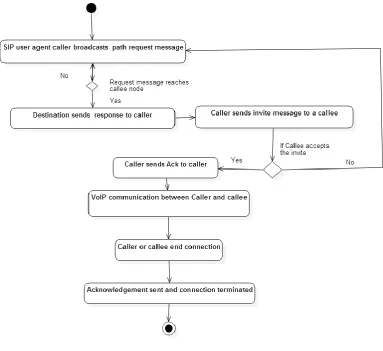
Fig 6. Flow chart for SIP call set up in MANET
Figure 6 is a flow chart which shows the step by step functioning of SIP in MANET. The caller sip user agent sends a broadcast message to its immediate neighbours who inturn broadcast the same until it reaches the destination. The destination callee sip user agent responds to the message. If destination is unreachable an error message is generated. The caller sends an invite message, to the callee and the callee responds with an OK message. Now the session is setup between caller to callee and VoIP communication takes place.The caller or callee decide to disconnect the communication by sending a BYE message that will be acknowledged with an OK message.
III.IMPLEMENTATION OF SIP IN NS2
A Tcl script is created where the network parameters like the no of nodes in the network topology, type of traffic, bit rate, the network layer and transport layer protocol used are mentioned. The routing protocol used in the implementation is AODV[8]. TCP is used at the transport layer. SIP is implemented as an application layer protocol. A SIP agent of type application is created. This agent is bound to the routing protocol agent AODV[9] [10]. The Tcl script creates the simulation object and initializes the simulation parameters. The NAM window object is created to provide graphical view of the simulation.
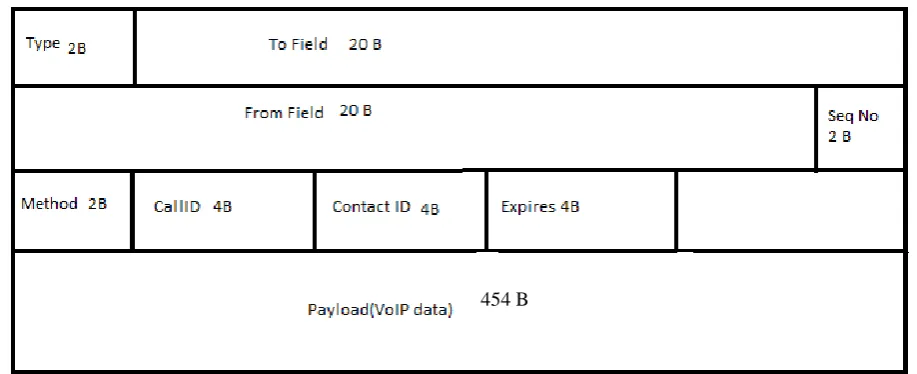
Fig 7.SIP header format
Code snippet for defining the SIP header as in figure 7 is as follows:
struct SIP_Header {
int type; /* message type like PREQ PRES INVITE OK */
char usrname[…]; /* To field in SIP header */
char url[…]; /* URL part To field in SIP header */ …
int seqNo; /* SIP sequence number */
int method; /* corresponding Method */
double callerID;
struct sipAddress ContactID; /* Contact field in SIP message , further requests should be sent */
…};
pseudocode is as follows:
class SIP_AgentClass : public TclClass {
SIP_AgentClass: TclClass("Agent/SIPAGENT"){} TclObject* create(){…}
}
The proxy and redirect server agents are created in a similar manner. All the classes are derived from the base class TclClass. The agents are created in the constructors. The SIP responses are similar to HTTP responses like 1XX, 2XX, 4XX. These response texts are initialised in the header files. ns2 enables tracing. The trace file logs the communication information. From the trace file the throughput and packet delivery ratio(PDR) of the various parameters are calculated. GNUPlot is used to plot a graph using awk scripts.
IV.SIMULATION PARAMETERS
The Session Initiation Protocol in MANET is simulated using Network Simulator 2(ns2). The network topology has 50 mobile nodes.
Table 1: Simulation parameters
PARAMETER VALUE
Area 1000m * 1000m
Simulation time 100 seconds No of nodes 50
MAC protocol 802.11
Callee node Node 2 Data rate 1mbps Routing protocol AODV Routed protocol IP
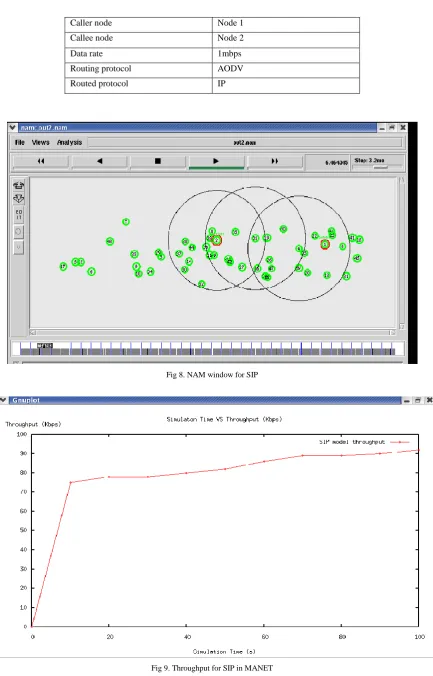
Fig 8. NAM window for SIP
Fig 9. Throughput for SIP in MANET
figure 9 it can be inferred that the throughput is steadily increasing with time. The maximum throughput is 92kbps.
Throughput = received_data*8/DataTransmissionPeriod
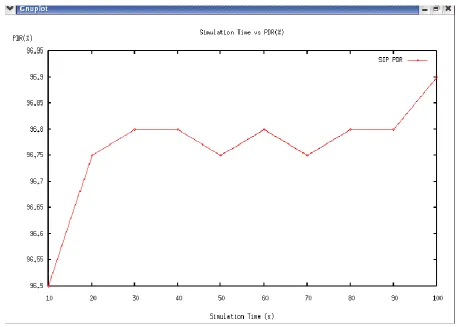
Fig 10. Packet Delivery Ratio for SIP in MANET
The calculation of Packet Delivery Ratio (PDR) is based on the received and generated packets as recorded in the trace file. In general, PDR is defined as the ratio between the received packets by the destination and the generated packets by the source. Packet Delivery Ratio is calculated using awk script which processes the trace file and produces the result.
packet_delivery_ratio = received_packets/generated_packets*100;
The packet delivery ratio is also increasing with time and the maximum PDR is 96.9% for 100 seconds.
V. CONCLUSION AND FUTURE WORK
The session initiation protocol is implemented for VoIP traffic in MANET. A simulation for 50 mobile nodes in a MANET environment was carried out using ns2 simulator. Logging of packet transfer between the caller and the callee was enabled. The throughput and Packet Delivery Ratio(PDR) was calculated using awk scripts and plotted using GNUPlot. The maximum throughput obtained is 92kbps and maximum PDR is 96.9%. The future work includes VoIP Codec implementation for SIP and achieving QoS(Quality of service) like jitter, delay, performance for VoIP communication.
R
EFERENCES[1] C.Sivaram Murthy and B.S Manoj, Ad Hoc wireless Networks, Pearson Education, Second Edition India, 2001.
[2] Gonzalo Camarillo, SIP Demystified, McGraw-Hill, 2002.
Sheeba P et al,International Journal of Computer Science and Mobile Computing, Vol.4 Issue.3, March- 2015, pg. 150-157
[4] Dr.S.S.Dhenakaran and A.Parvathavarthini, “An Overview of Routing Protocols in Mobile Ad-Hoc
Network”, International Journal of Advanced Research in Computer Science and Software Engineering, Volume 3, Issue 2,2013
[5] SIP.[online]. Available : https://www.ietf.org/rfc/rfc3261.txt
[6] The Network Simulator ns-2.[online]. Available : http://www.isi.edu/nsnam/ns/
[7] Sheeba P, Vandana C P, “A New SIP-Based Application Layer Protocol for VoIP in MANET”, IJERT, Volume. 4, Issue. 01, January, 2015
[8] AODV.[online]. Available: http://www.ietf.org/rfc/rfc3561.txt
[9] C. Perkina, E.B. Royer, and S. Das, Ad-hoc On-Demand Distance Vector Routing, RFC 3561, IETF org, July 2003.