Exploiting a Large Strongly Comparable Corpus
Thierry Etchegoyhen, Andoni Azpeitia and Naiara P´erez
Vicomtech-IK4Donostia / San Sebasti´an, Spain
{tetchegoyhen, aazpeitia, nperez}@vicomtech.org
Abstract
This article describes a large comparable corpus for Basque and Spanish and the methods employed to build a parallel resource from the original data. TheEITBcorpus, a strongly comparable corpus in the news domain, is to be shared with the research community, as an aid for the development and testing of methods in comparable corpora exploitation, and as basis for the improvement of data-driven machine translation systems for this language pair. Competing approaches were explored for the alignment of comparable segments in the corpus, resulting in the design of a simple method which outperformed a state-of-the-art method on the corpus test sets. The method we present is highly portable, computationally efficient, and significantly reduces deployment work, a welcome result for the exploitation of comparable corpora.
Keywords:Comparable corpora, Alignment, Corpus exploitation, Basque, Statistical machine translation
1.
Introduction
Comparable corpora are a useful resource to overcome the issue of scarce parallel data in some language pairs and domains, providing statistical machine translation systems (Brown et al., 1990; Koehn, 2010) with the necessary data to increase overallMTquality (Munteanu and Marcu, 2005; Irvine and Callison-Burch, 2013). In this paper, we de-scribe a large comparable corpus for Basque and Spanish and the methods employed to build a parallel resource from the original data.
Our first contribution is thus a description of the first large corpus for the Basque-Spanish language pair in the news domain, based on content professionally created by the EITBBasque public broadcasting services. This resource will be shared with the research community, as a basis for further advances in comparable corpora exploitation and data-driven machine translation. Additionally, the resource will contribute to advancing research on a minority lan-guage with scarce publically available resources.
The second contribution of this paper is the evaluation of a simple method for the alignment of comparable seg-ments,1which improves significantly over the state-of-the-art aproaches we tested on the corpus in terms of F1 mea-sure. The approach we describe, which is based on the Jac-card index and lexical set expansion, also improves over existing methods in terms of simplicity and deployment ef-fort.
We first describe the EITBandIVAP corpora in Section 2, which feed the alignment methods described in the remain-der of the paper. Section 3 presents the alignment methods we used for document and segment aligment. In section 4, we discuss the results obtained on theEITBcorpus. Finally, Section 5 presents concluding remarks and a description of future work.
1Hereafter, we use the termsegmentto refer to sentences as
well as smaller independent linguistic units.
2.
Corpora
The EITB corpus is composed of news written by jour-nalists of the Basque Country’s public broadcast service.2 The news are written independently in Basque and Span-ish but refer to the same specific events. The corpus can thus be categorized as strongly comparable, following stan-dard terminology (Skadin¸a et al., 2012), and its exploitation should provide a solid basis for the development of generic Basque-SpanishSMTsystems.
The original dataset is composed of 59XMLdocuments in Basque and 57 in Spanish, covering five years of news con-tent generation, from 2009 to 2013. Each one of these files contains varying amounts of news items with the following structure:
• <id>: An integer identifying the news item. Note that these numbers have no established correspondence be-tween languages, i.e. they cannot be used to align news between languages.
• <title>: The title of the news item.
• <link>: The originalHTMLpublication link.
• <pubDate>: Date of publication.
• <description>: Textual content of the news item, typically amounting to one or two small paragraphs.
• <category>: Indicates the broad category to which the news item belongs (Culture, Sports, Economy, etc.).
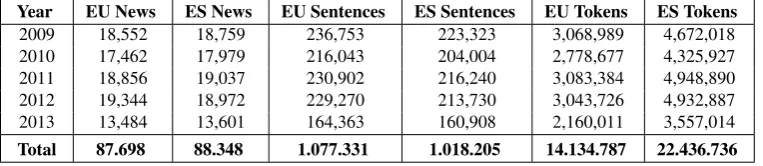
As specific news are generated independently, they can be considered independent documents and were extracted as such. Details about the corpus are described in Table 1. With over one million sentences per language, this bilin-gual corpus is the largest available for the Basque-Spanish language pair. The corpus covers political news, sports and cultural events, among others, and thus offers a relatively broad representation in terms of topics and vocabulary.
2
Year EU News ES News EU Sentences ES Sentences EU Tokens ES Tokens
2009 18,552 18,759 236,753 223,323 3,068,989 4,672,018 2010 17,462 17,979 216,043 204,004 2,778,677 4,325,927 2011 18,856 19,037 230,902 216,240 3,083,384 4,948,890 2012 19,344 18,972 229,270 213,730 3,043,726 4,932,887 2013 13,484 13,601 164,363 160,908 2,160,011 3,557,014
Total 87.698 88.348 1.077.331 1.018.205 14.134.787 22.436.736
Table 1: OriginalEITBcorpus
To be able to align segments in theEITBcomparable cor-pus, a minimal amount of bilingual correspondences is needed. At present, the only large bilingual dataset freely available for the Basque-Spanish pair is the collection of translation memories released by the Instituto Vasco de Ad-ministraci´on P´ublica (IVAP),3which consist of professional translations of public administration texts.
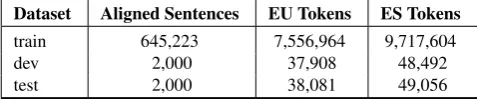
We extracted the textual content in the originalTMX trans-lation memories, and performed sentence aligment with the HunAlign toolkit (Varga et al., 2005). After corpus cleanup, which involved removing segments with corrupt characters and erroneously tagged translation units, we prepared the parallel datasets shown in Table 2. Each sentence in the corpus was tokenized and truecased, using truecasing mod-els trained on the original texts in both languages. The
train,devandtestdatasets were used to respectively train, tune and evaluate a phrase-basedSMTsystem (Koehn et al., 2003), using the Moses toolkit (Koehn et al., 2007), which serves as a component for one of the alignment methods de-scribed in the next section. Lexical translation tables were created with theGIZA++ toolkit (Och and Ney, 2003).
3.
Alignment
To extract a bitext from the original XMLdocuments that constitute theEITBcorpus, the source and target sets need to be mined for alignable segment pairs. An exhaustive search would apply to the Cartesian product of the source and target sets (Ion, 2012), a highly resource-consuming process. Alternative approaches that reduce the search space have been designed using document alignment as a first step (Fung and Cheung, 2004; Ion et al., 2011), or cross-language information retrieval (CLIR) techniques, where target segments are retrieved through search en-gine indexing and querying (Rauf and Schwenk, 2011; Munteanu and Marcu, 2005; Stef˘anescu et al., 2012). We first applied search space reduction through document alignment, and then performed segment alignment.
3.1.
Document alignment
As news may have been generated in one language but not in the other, there is no strict one-to-one correspondence be-tween the files that form the original document set. In order to reduce the search space of alignment candidates, we first performed document alignment using theEMACCtool (Ion et al., 2011),4which follows an Expectation Maximization
3
http://opendata.euskadi.eus/catalogo/-/memorias-de-traduccion-del-servicio-oficial-de-traductores-del-ivap/
4Available as part of the Accurat toolkit:
http://www.accurat-project.eu/index.php?p=accurat-toolkit, see (Skadin¸a et al., 2012).
approach for the alignment of textual units in comparable corpora.
The alignment was created with default parameter values, with a maximum of 3 target document alignments to con-sider. Given the size of the initial corpus and manual ex-amination of the results, the default values offered a good compromise in terms of number of alignments and align-ment quality.
The document alignment process with EMACC generated alignments for 94% of the Spanish source documents, and 92% of the target Basque documents —a satisfactory por-tion of the initial data considering that the alignment of comparable documents is a difficult task for which align-ments can only be approximated.
3.2.
Segment alignment
The data in the aligned documents described in the previous section served as input to the segment alignment methods. In order to test the accuracy of said methods, a dataset of 500 source and target sentences was manually aligned and verified. To test recall we built two additional datasets that extended this test set with unaligned data: a first dataset with 500 additional unaligned source and target sentences, and a second dataset with 500 additional unaligned source sentences and 1000 additional unaligned target sentences. In the next sections, we describe the methods that were used for segment alignment and their results on these test sets.5
3.2.1. LEXACCalignment
LEXACC(Stef˘anescu et al., 2012) is a fast parallel sentence mining algorithm, based onCLIR, which has proved effec-tive for the task. It uses the Lucene search engine6in two major steps: target sentences are first indexed by the search engine, and a search query is built from a translation of con-tent words in the source sentence to retrieve alignment can-didates. The approximated translation used for the query is constructed usingIBMmodel 1 lexical translation tables (Brown et al., 1993), extracted from seed parallel corpora using theGIZA++ toolkit. For our purposes, the tables were based on theIVAPcorpus described in Section 2. LEXACC is part of the Accurat toolkit and can be used in conjunc-tion withEMACC, having Lucene searches narrowed down
5
To keep the comparative segment alignment results as fair as possible, all preliminary steps before segment alignment (i.e., document alignment, indexing, queries, searches and results) have been kept strictly identical between methods. Sentences were like-wise tokenised and truecased with identical tools and models, us-ing the tools provided in the Moses distribution.
6
Dataset Aligned Sentences EU Tokens ES Tokens
train 645,223 7,556,964 9,717,604
dev 2,000 37,908 48,492
test 2,000 38,081 49,056
Table 2:IVAPcorpus
to the documents aligned by the document aligner. We fol-lowed this approach for the experiments presented here, us-ing the document alignments described in Section 3.1. The alignment metric inLEXACCis a translation similarity measure based on 5 feature functions briefly described here (see (Stef˘anescu et al., 2012) for a detailed description):
• f1: A feature measuring the source-target candidate
pair’s strength in terms of content word translation, based on named entity matching, string similarity and lexical translation probability scores as given byGIZA tables.
• f2: A feature similar tof1but applying to functional
words, as identified in manually created stop word lists.
• f3: This feature measures alignment obliqueness
(Tufis¸ et al., 2006), with crossing content word ments viewed as an estimator of source-target align-ment strength.
• f4: A binary feature modeling the assumed tendency
of parallel segments to start, respectively end, with aligned word translations.
• f5: A second binary feature with value 1 if both the
source and target segments end with the same punctu-ation, and 0 otherwise.
The similarity measure is then computed according to the sum of weighted feature functions, with optimal weights determined by means of logistic regression. The opti-mized weights were computed on a training set formed with 9500 positive parallel examples from IVAP and an equal amount of non-parallel negative examples; the evaluation set contained 500 positive and 500 negative examples. Fi-nal scores are computed in both translation directions and symmetrized by arithmetic average.
An accuracy of0.95was obtained on theIVAPtest sets with the optimized weights; results on theEITBtest sets are pre-sented in Section 4.
3.2.2. Feature adaptation
Given the morpho-syntactic properties of Basque and ini-tial results, we explored variants of the original feature set inLEXACC. Featuresf3andf4were prime candidates for
replacement, as free word order in Basque and mirror syn-tactic structures in both languages casted doubt on the use-fulness of features based on crossing alignments or finding corresponding alignments in specific sentential positions. Furthermore, as several classes of functional words are ag-glutinated in Basque, and proper segmentation would re-quire the use of a complete morpho-syntactic analyser, fea-turef2was considered as a potential candidate for
replace-ment as well. We experireplace-mented with several combinations of features, and selected the following four:
• f10: A feature measuring the source to target candidate pair’s strength in terms of content word translation.
• f20: A feature measuring the target to source candidate pair’s strength in terms of content word translation.
• f30: A feature measuring the amount of common ties between source and target segments, where enti-ties were defined as capitalized in-sentence tokens not found in the lexical translation tables.
• f40: The original binary feature f5, which indicates
if the source and target segments end with the same punctuation.
Additionally, we experimented with simplified similarity scoring: for the first 3 features, the score was incremented by 1 if a corresponding word was found in either the lexical tables or as an entity, instead of using translation proba-bilities directly. The reason for this change was the differ-ence in domain between theIVAPandEITBcorpora: lexical translation probabilities established for one domain were not necessarily representative of lexical distributions in the other domain, and entities were likely not to overlap be-tween the two domains. In Section 4 we show that this adapted feature set and scoring gave significant improve-ments over the originalLEXACCsetup.
3.2.3. STACCalignment
Feature-based approaches to segment similarity can raise difficulties in terms of adaptation to new language pairs. Although the originalLEXACCfeature set was designed for cross-linguistic application, the features were not optimal for the Basque-Spanish pair and additional work was nec-essary to determine and test better feature sets, along with scoring variants. This type of time-consuming adaptation effort seems unavoidable in any feature-based approach to segment similarity, in order to better exploit comparable corpora for new language pairs and domains.
Another issue comes from the computation of the similar-ity measure between segments. InLEXACC, a core part of the final score is computed by evaluating each source token against each target token and measuring translation corre-spondences using lexical translation probabilities for each token pair. This approach suffers from being a translation heuristic, which does not properly tackle translation fertil-ity, nor the validity of lexical translation probabilities with-out contextual disambiguation.
building process, removing their use from the computation of segment similarity would be an improvement in terms of precision and efficiency.
To tackle these shortcomings, we explored an alternative approach, termedSTACC,7whose main steps are described below. We describe two variants of the approach, one us-ing a completeSMTsystem and the other relying on lexical translation tables only. Both variants were tested against theEITBtest sets, with results presented in section 4. TheSTACCapproach relies on the Jaccard coefficient (Jac-card, 1901), which measures set similarity by taking the ratio of set intersection over union. This index has been standardly used as a measure of text similarity and applied to comparable documents by (Skadin¸a et al., 2012) and (Paramita et al., 2013) for instance, where Jaccard similar-ity is computed between a portion of the sentences found in bilingual documents and overall document comparability is measured as the average of these sentence-level scores. We adopt and extend the use of this index in the STACC ap-proach.
Letsbe the source segment,Cthe set of target alignment candidates retrieved from a CLIR search-based step, as in the LEXACC approach,Tsthe set of translated source
to-kens andKcthe set of tokens from a given candidate
seg-mentcinC. The basicSTACCsimilarity score is given in equation 1:
scorestacc=
|Ts∩Kc| |Ts∪Kc|
(1)
To account for morphological variation, we integrated a set expansion step using longest common prefixes (LCP): for each token pair in st and current candidate ci, if a
com-mon prefix is found with a minimal length of 3 characters, the prefix is added to both theTsandKc sets. This
sim-plified approach to stemming removes the need to rely on manually constructed endings lists to compute similarity or on a complete morphological analyzer, which might not be available at all for under-resourced languages. It is also computationally more efficient: instead of matching each source and target word against every potential ending, with hundreds of possible endings in a language like Basque, only the prefixes of the two words in the considered pairs need to be compared usingLCP. Furthermore, the operation is performed on the set differences betweenTsandKc, i.e.
to the tokens that are not members of the other set, thus applying to the minimal relevant sets of tokens.
The second set expansion operation is meant to account for potential named entities and involves including in both set representations all tokens that are present in capitalised form; numbers are added as well, as they can act as indi-cators of comparability, when they represent dates in par-ticular, and are likely to be absent from translation tables. This operation is performed while creating the set represen-tations from the initial tokenised and truecased strings, thus adding negligible computational cost.
Finally, note that no filtering is performed, with punctuation and functional words kept alongside content words in the final sets.
7
Which stands for Set-Theoretic Alignment for Comparable Corpora.
On the basis of this core method involving the Jaccard in-dex and set expansions, we tested a first variant, termed STACC MT, where the initial set of translated tokensTsis
created by machine translating the source segment using a phrase-basedSMTsystem trained on theIVAPparallel cor-pus, as mentioned in section 2. As lexical translation ta-bles are a prerequisite for any type of comparable segment alignment, a core set of parallel segments is needed in any case, from which a phrase-basedSMTsystem can be built without additional resources. This approach relies on the precision of the completeSMTsystem to provide the opti-mal translation for the source sentence, handling translation fertility and phrasal translation through the tuned log-linear combination of features that define the model.8 The score in this variant is computed according to equation 1. The second variant, to which we will refer asSTACC LEX, relies only on lexical translation tables. Two translated sets are used to compute the similarity score:Tstcontains the
k-best lexical translations for each source token, andTtsthe
k-best lexical translations for each token in the alignment candidate.9 WithSas the set of tokens in the source seg-ments, the Jaccard scores are computed in each direction and averaged, as shown in Equation 2.
scorestacc lex =
This variant has the potential advantage of capturing more translation options than the first approach based on machine-translated candidates, through the use of sets of lexical translations. It also enables the use of bi-directional translation information without the need to train a complete MTsystem in both directions. Finally, it removes the need to fully translate the source segments, thus providing for a faster computation of the overall alignment. Note that the core of this approach is similar to the symmetrised use of lexical translations in LEXACCas a component feature in their model, with the marked difference that the actual probabilities are discarded and replaced with set member-ship in order to minimise the impact of domain differences between lexical tables and the comparable corpora at hand. The STACC approach thus addresses the identified short-comings and offers a simple, principled and more efficient computation of alignments. These advantages translate into better alignment results on our reference sets, and better material for the exploitation of the corpus, as shown in the following section.
4.
Results
Two sets of results are described below. We first present the alignment results that were obtained with the compet-ing methods described in the previous section, then turn to an evaluation of theSMTsystems that were trained on the different alignment sets.
8
The use of fully machine translated source sentences as a basis to determine segment similarity has been explored by oth-ers, although with different similarity metrics. See for instance (Sarikaya et al., 2009), (Abdul-Rauf and Schwenk, 2009) and (Ya-suda and Sumita, 2008).
9
4.1.
Alignment results
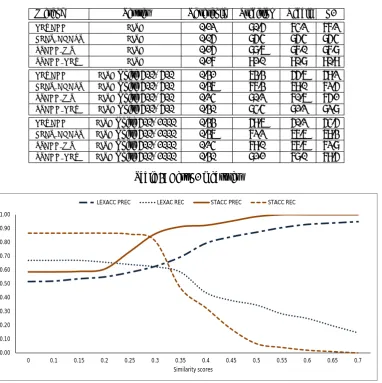
Table 3 presents the best F1-measure scores achieved by each method, the similarity threshold at which it was achieved and the corresponding precision and recall scores. Precision was computed as the ratio of correct alignments over predicted alignments, while recall was measured as the ratio of correct alignments over total correct alignments.
It is worth noting that recall and precision were measured over the alignments assigned by each method on a single pass. Further processing can improve over these alignments by discarting, for each aligned source segment, those align-ments for which a different source segment obtained a bet-ter score, with more correct alignments surfacing as a re-sult. We do not present results along these lines to main-tain a fair comparison between theLEXACCandSTACC ap-proaches, as the former does not include this additional pro-cessing step.
Since an appropriate goal for the extraction of parallel data from comparable corpora is to find the largest amount of alignments with satisfactory precision, the F1 measure is a good indicator of the fruitfulness of a given alignment method. On all three test sets, STACCalignment provides markedly better F1 scores in both variants of the approach, with the lexical variant giving the best results.
Interestingly, the feature-adapted version ofLEXACC pro-vides competitive results. One possible reason is the re-moval of features that were assumed to be detrimental in the case of Basque, as hypothesised in Section 3.2.2. A second likely explanation is the modified scoring that was employed in this version for the lexical translation feature, with translation probabilities discarded and a score of 1 be-ing assigned to matchbe-ing lexical translations. In effect, this renders the modifiedLEXACCscore similar to set member-ship, thus approximating the results obtained withSTACC.
Another interesting aspect of the comparative analysis we performed concerns the evolution of precision and recall given similarity scores. Figure 1 shows results along these lines, with a visualisation of average precision and recall scores for the three test sets.
Both methods exhibit similar evolutions in terms of recall and precision, the main difference being the comparatively smoother drop ofLEXACCrecall over a larger portion of the scoring range. This similarity demonstrates that the differ-ences in terms of best F1 scores are not due to local scoring peaks but to the consistently higher marks obtained with STACC.
Overall,STACCprovides the best balance between the num-ber of alignments it can identify and the precision in iden-tifying correct alignments. Thus, this method proved to be the optimal choice to retrieve the largest amount of pre-cise alignments in theEITBcorpus. On the entireEITB cor-pus, 368184 parallel segments were extracted using LEX-ACCand 596492 using the STACC LEX variant; segment similarity thresholds were set at 0.33 forLEXACCand 0.30 forSTACC, the optimal marks according to the results on the noisiest test sets. Details of the aligned corpus are shown in Table 4.
Method Segments EU Tokens ES Tokens
LEXACC 368,184 5,756,838 7,605,144
STACC 596,492 10,875,355 16,537,244
Table 4: Extracted alignments
4.2.
Translation results
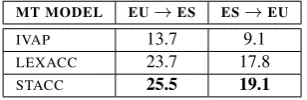
One major goal in exploiting comparable corpora is the cre-ation of parallel resources to help develop data-driven trans-lation systems. In order to evaluate the impact of the differ-ent aligned datasets created by the methods we examined, we trainedSMTsystems and measured their quality in terms of theBLEUautomated metric (Papineni et al., 2002). All systems are phrase-based models built with the Moses toolkit, with phrases of length 5, a distortion limit of 6 and surface factors only. The language models were trained on the target side of the bitexts, using the KENLM toolkit (Heafield, 2011) to generate 5-gram models with modified Kneser-Ney smoothing (Heafield et al., 2013). Parameters of the log-linear models were tuned withMERT(Och, 2003) on a set of 2000 sentences extracted from the aligned sets and the models were evaluated using the Multeval toolkit (Clark et al., 2011) on test sets composed of 1678 manually verified aligned sentences.
MT MODEL EU→ES ES→EU
IVAP 13.7 9.1
LEXACC 23.7 17.8
STACC 25.5 19.1
Table 5:BLEUresults for Basque-Spanish
Table 5 presents the results in terms of BLEU, taking the IVAPout-of-domain models as baselines. These results first show the gain obtained with the extracted in-domainEITB parallel corpora over theIVAPbaselines, providing another example of the value of comparable corpora for the devel-opment of SMTmodels. The results also show the signif-icant improvements obtained withSTACCalignment, con-firming the value of the approach.
5.
Conclusion
In this paper, we described theEITBcorpus, a large strongly comparable Basque-Spanish corpus in the news domain. This resource is to be shared with the research community, as an aid for the development and testing of methods in comparable corpora exploitation, and as a basis for the im-provement of data-driven machine translation systems for this language pair.10
We also explored several methods for the alignment of com-parable segments in the corpus, using publically available resources and assessing their usefulness for the corpus at hand. This work resulted in the design of theSTACC simi-larity metric, based on the Jaccard index and expanded
lex-10
The corpus will be made available in the META
-SHARE repository (http://www.meta-share.eu/) as the
Basque Spanish EIT B comparable corpus, under the
CC-BY- NC- SAlicence for academic users and theMS- C
Method Testset Threshold Precision Recall F1
LEXACC EITB 0.12 80.5 74.2 77.2
FEAT ADAPT EITB 0.05 85.4 85.4 85.4
STACC MT EITB 0.15 88.6 87.0 87.8
STACC LEX EITB 0.17 91.0 90.8 90.9
LEXACC EITBNoise 500+500 0.31 63.3 55.6 59.2
FEAT ADAPT EITBNoise 500+500 0.36 76.3 69.0 72.5
STACC MT EITBNoise 500+500 0.24 80.2 70.6 75.1 STACC LEX EITBNoise 500+500 0.30 84.4 81.2 82.8
LEXACC EITBNoise 500+1000 0.33 59.6 50.2 54.5
FEAT ADAPT EITBNoise 500+1000 0.36 72.2 66.6 69.3
STACC MT EITBNoise 500+1000 0.24 79.0 67.6 72.8 STACC LEX EITBNoise 500+1000 0.30 81.1 78.0 79.5
Table 3: Best F1 measures
0.00 0.10 0.20 0.30 0.40 0.50 0.60 0.70 0.80 0.90 1.00
0 0.1 0.15 0.2 0.25 0.3 0.35 0.4 0.45 0.5 0.55 0.6 0.65 0.7 Similarity scores
LEXACC PREC LEXAC REC STACC PREC STACC REC
Figure 1: Evolution of average precision and recall
ical sets. We experimented with two variants of the proach, both of which outperformed a state-of-the-art ap-proach on our test sets. This simple apap-proach gave opti-mal results in terms of segment alignment, as well asBLEU scores of the derivedSMTsystems.
The method we presented is highly portable, computation-ally efficient, and significantly reduces deployment work, a welcome result for the exploitation of comparable corpora. In future work, we will explore its usefulness in other domains and for different language pairs.
AcknowledgementsThe authors wish to thank Euskal Ir-rati Telebista, for providing the resources and agreeing to share them with the research community, and the three anonymousLRECreviewers for their constructive feedback. This work was partially supported by the Basque Govern-ment through its funding of project PLATA (Gaitek Pro-gramme, 2012-2014).
6.
References
Abdul-Rauf, S. and Schwenk, H. (2009). On the use of comparable corpora to improve SMT performance. In
Proceedings of the 12th Conference of the European Chapter of the Association for Computational
Linguis-tics, EACL ’09, pages 16–23, Stroudsburg, PA, USA. Association for Computational Linguistics.
Brown, P. F., Cocke, J., Pietra, S. A. D., Pietra, V. J. D., Jelinek, F., Lafferty, J. D., Mercer, R. L., and Roossin, P. S. (1990). A statistical approach to machine transla-tion. Computational linguistics, 16(2):79–85.
Brown, P. F., Pietra, V. J. D., Pietra, S. A. D., and Mer-cer, R. L. (1993). The mathematics of statistical ma-chine translation: Parameter estimation. Computational linguistics, 19(2):263–311.
Clark, J. H., Dyer, C., Lavie, A., and Smith, N. A. (2011). Better hypothesis testing for statistical machine transla-tion: Controlling for optimizer instability. In Proceed-ings of the 49th Annual Meeting of the Association for Computational Linguistics: Human Language Technolo-gies: Short Papers - Volume 2, HLT ’11, pages 176–181, Stroudsburg, PA, USA. Association for Computational Linguistics.
Fung, P. and Cheung, P. (2004). Mining very non-parallel corpora: Parallel sentence and lexicon extraction via bootstrapping and E.M. In Proceedings of Empirical Methods in Natural Language Processing, Barcelona, Spain, pages 57–63.
estimation. InACL (2), pages 690–696. The Association for Computer Linguistics.
Heafield, K. (2011). Kenlm: Faster and smaller language model queries. InProceedings of the Sixth Workshop on Statistical Machine Translation, WMT ’11, pages 187– 197, Stroudsburg, PA, USA. Association for Computa-tional Linguistics.
Ion, R., Ceaus¸u, A., and Irimia, E. (2011). An expecta-tion maximizaexpecta-tion algorithm for textual unit alignment. In Proceedings of the 4th Workshop on Building and Using Comparable Corpora: Comparable Corpora and the Web, pages 128–135. Association for Computational Linguistics.
Ion, R. (2012). PEXACC: A parallel sentence mining al-gorithm from comparable corpora. In Proceedings of the 8th International Conference on Language Resources and Evaluation, Istanbul, Turkey, pages 2181–2188. Irvine, A. and Callison-Burch, C. (2013). Combining
bilingual and comparable corpora for low resource ma-chine translation. InProceedings of the Eighth Workshop on Statistical Machine Translation, pages 262–270. Jaccard, P. (1901). Distribution de la flore alpine dans le
bassin des Dranses et dans quelques r´egions voisines.
Bulletin de la Soci´et´e Vaudoise des Sciences Naturelles, 37:241 – 272.
Koehn, P., Och, F. J., and Marcu, D. (2003). Statistical Phrase-based Translation. In Proceedings of the 2003 Conference of the North American Chapter of the Asso-ciation for Computational Linguistics-Volume 1, pages 48–54. Association for Computational Linguistics.
Koehn, P., Hoang, H., Birch, A., Callison-Burch, C., Fed-erico, M., Bertoldi, N., Cowan, B., Shen, W., Moran, C., Zens, R., et al. (2007). Moses: Open source toolkit for statistical machine translation. InProceedings of the 45th Annual Meeting of the ACL, pages 177–180. Asso-ciation for Computational Linguistics.
Koehn, P. (2010). Statistical machine translation. Cam-bridge University Press.
Munteanu, D. S. and Marcu, D. (2005). Improving ma-chine translation performance by exploiting non-parallel corpora. Computational Linguistics, 31(4):477–504. Och, F. J. and Ney, H. (2003). A systematic comparison
of various statistical alignment models. Computational linguistics, 29(1):19–51.
Och, F. J. (2003). Minimum error rate training in statistical machine translation. InProceedings of the 41st Annual Meeting on Association for Computational Linguistics -Volume 1, ACL ’03, pages 160–167, Stroudsburg, PA, USA. Association for Computational Linguistics. Papineni, K., Roukos, S., Ward, T., and Zhu, W.-J. (2002).
Bleu: A method for automatic evaluation of machine translation. InProceedings of the 40th Annual Meeting on Association for Computational Linguistics, ACL ’02, pages 311–318, Stroudsburg, PA, USA. Association for Computational Linguistics.
Paramita, M. L., Guthrie, D., Kanoulas, E., Gaizauskas, R., Clough, P., and Sanderson, M. (2013). Methods for collection and evaluation of comparable documents.
InBuilding and Using Comparable Corpora, pages 93– 112. Springer.
Rauf, S. A. and Schwenk, H. (2011). Parallel sentence generation from comparable corpora for improved SMT.
Machine translation, 25(4):341–375.
Sarikaya, R., Maskey, S., Zhang, R., Jan, E.-E., Wang, D., Ramabhadran, B., and Roukos, S. (2009). Itera-tive sentence-pair extraction from quasi-parallel corpora for machine translation. InProceedings of InterSpeech, Brighton, UK, pages 432–435.
Skadin¸a, I., Aker, A., Mastropavlos, N., Su, F., Tufis, D., Verlic, M., Vasil¸jevs, A., Babych, B., Clough, P., Gaizauskas, R., et al. (2012). Collecting and using com-parable corpora for statistical machine translation. In
Proceedings of the 8th International Conference on Lan-guage Resources and Evaluation, Istanbul, Turkey. Stef˘anescu, D., Ion, R., and Hunsicker, S. (2012). Hybrid
parallel sentence mining from comparable corpora. In
Proceedings of the 16th Conference of the European As-sociation for Machine Translation, pages 137–144. Varga, D., N´emeth, L., Hal´acsy, P., Kornai, A., Tr´on, V.,
and Nagy, V. (2005). Parallel corpora for medium den-sity languages. InRecent Advances in Natural Language Processing (RANLP 2005), pages 590–596.