c
2004 Hindawi Publishing Corporation
Face Recognition Using Local and Global Features
Jian Huang
Department of Computer Science, Hong Kong Baptist University, Kowloon Tong, Hong Kong Email:[email protected]
Pong C. Yuen
Department of Computer Science, Hong Kong Baptist University, Kowloon Tong, Hong Kong Email:[email protected]
J. H. Lai
Department of Mathematics, Zhongshan University, Guangzhou 510275, China Email:[email protected]
Chun-hung Li
Department of Computer Science, Hong Kong Baptist University, Kowloon Tong, Hong Kong Email:[email protected]
Received 30 October 2002; Revised 24 September 2003
The combining classifier approach has proved to be a proper way for improving recognition performance in the last two decades. This paper proposes to combine local and global facial features for face recognition. In particular, this paper addresses three issues in combining classifiers, namely, the normalization of the classifier output, selection of classifier(s) for recognition, and the weighting of each classifier. For the first issue, as the scales of each classifier’s output are different, this paper proposes two methods, namely, linear-exponential normalization method and distribution-weighted Gaussian normalization method, in normalizing the outputs. Second, although combining different classifiers can improve the performance, we found that some classifiers are redundant and may even degrade the recognition performance. Along this direction, we develop a simple but effective algorithm for classifiers selection. Finally, the existing methods assume that each classifier is equally weighted. This paper suggests a weighted combination of classifiers based on Kittler’s combining classifier framework. Four popular face recognition methods, namely, eigenface, spectroface, independent component analysis (ICA), and Gabor jet are selected for combination and three popular face databases, namely, Yale database, Olivetti Research Laboratory (ORL) database, and the FERET database, are selected for evaluation. The experimental results show that the proposed method has 5–7% accuracy improvement.
Keywords and phrases:local and global features, face recognition, combining classifier.
1. INTRODUCTION
Face recognition research started in the late 70s and has be-come one of the active and exciting research areas in com-puter science and information technology areas since 1990. Basically, there are two major approaches in automatic recog-nition of faces by computer [1,2], namely, constituent-based recognition (we called as local feature approach) and face-based recognition (we called as global feature approach).
A number of face recognition algorithms/systems have been developed in the last decade. The common approach is to develop a single, sophisticated, and complex algorithm to handle one or more face variations. However, developing a single algorithm to handle all variations (including pose vari-ation, luminance varivari-ation, light noise, etc.) is not easy. It is
known that different classifiers have their own characters to handle different facial variations and certain classifiers may be only suitable for one specific pattern. Moreover, the mis-classified samples may not be overlapped. Therefore, com-bining different classifiers’ output to draw a final conclusion can improve the performance.
Ackermann and Bunke [3] combined two full-face (global) classifiers, namely, HMM, eigenface, and a profile classifier for face recognition in 1996. They proposed dif-ferent schemes for combining classifiers. Encouraging results have been shown. As their testing images mainly are captured under well-controlled lighting environment and the individ-ual method has achieved good results, the improvement us-ing combinus-ing classifiers was not significant.
combining classifiers in 1998. They developed a nice theoret-ical framework and suggested four combination rules. They also applied the rules in combining face, voice, and finger-print recognition for person authentication. The results are encouraging. Moreover, they pointed out that sum rule, in general, gives a relatively good result.
Tax et al. [5] further discussed the topic of combin-ing multiple classifiers by averagcombin-ing or by multiplycombin-ing. They pointed out that averaging-estimated posterior probabilities would give good performance when posterior probabilities are not well estimated. However, averaging rule does not have solid Bayesian foundation.
This paper proposes to make use of both local features and global features for face recognition. Many face recog-nition algorithms have been developed and we have se-lected four current and popular methods, namely, eigenface [6,7,8], spectroface [9], independent component analysis (ICA) [10,11,12,13,14], and Gabor jet [15,16] for com-bination. The preliminary version of this paper has been re-ported in [17]. The contributions of this paper are mainly on how to combine these methods to draw the final conclusion and are summarized as follows:
(i) two normalization methods for combining each clas-sifier’s output;
(ii) a simple but efficient algorithm for selecting classifiers; (iii) a weighted combination rule.
The organization of this paper is as follows. Section 2 gives a brief review on Kittler’s combining classifier theory [4] and the four face recognition methods.Section 3presents our proposed normalization methods. Our proposed classi-fier selection algorithm and weighted combination rule are reported in Section 4. Section 5gives the experimental re-sults. Conclusion is given inSection 6.
2. A BRIEF REVIEW ON EXISTING METHODS
This section is divided into two parts. The first part out-lines the classifier combination theory developed by Kittler et al. [4]. The second part reviews the four face recognition methods, namely, eigenface, spectroface, ICA, and Gabor jet that we are going to use for classifier combination.
2.1. Review on combination theoretical framework Consider a face image Z to be assigned to one of the m possible classes (ω1,ω2,. . .,ωm) and let xi be the
measure-ment vector to be used by theith classifier. So, in the mea-surement space, each class ωk is modeled by the
probabil-ity densprobabil-ity function p(xi|ωk), and its prior probability of
occurrence is denoted by p(ωk). The joint probability
dis-tribution of the measurement extracted by the classifiers is p(x1,x2,. . .,xR|ωk), whereRis the number of features to be
used for classification. A brief description of classifier com-bination schemes and strategies [4] is as follows.
Classifier combination scheme: product rule
The product rule quantifies the likelihood of a hypothesis by combining the a posteriori probability generated by each
in-dividual classifier and is given as follows:
assignZ−→ωk0
Classifier combination scheme: sum rule
In the product rule, if we assume that the a posteriori prob-ability computed by the respective classifiers will not deviate dramatically from the a priori probability, the sum rule can be obtained as follows:
Classifier combination scheme: max rule
In the sum rule, if we approximate the sum by the maximum of the a posteriori probabilities and assume equal a priori ones, we get the following:
assignZ−→ωk0
Classifier combination strategy: min rule
From the product rule, by bounding the product of the a pos-teriori probabilities and under the assumption of equal a pri-ori ones, we get the following:
assignZ−→ωk0
2.2. Review on face recognition methods
This paper proposes to make use of both local features and global features for face recognition, and performs experi-ments in combining two global feature face recognition algo-rithms, namely, principal component analysis (PCA), spec-troface, and two local feature algorithms, namely, Gabor wavelet and ICAs. The brief descriptions on each method are as follows.
2.2.1. Principle component analysis (eigenface) This idea of using the PCA for face recognition [6,8] was first proposed by Sirovich and Kirby [7]. Consider face images of sizek×k. LetX= {Xn∈Rd|n=1,. . .,N}be an ensemble
of row vectors of training face images. ThenXcorresponds to ad×N-dimensional face space. PCA tries to find a lower dimensional subspace to describe the original face space. Let
E(X)= 1
face vectorX, we get a modified ensemble of vectors,
X=Xn,n=1,. . .,N
, Xn=Xn−E(X). (6)
The autocovariance matrixMfor the ensembleXis defined as follows:
M=cov(X)=E(X·X), (7)
whereM is ad×dmatrix. The eigenvectors of the matrix Mform an orthonormal basis forRd. Now the PCA of a face
vectoryrelated to the ensembleXis obtained by projecting vector y onto the subspace spanned bykeigenvectors cor-responding to the topk eigenvalues of the autocorrelation matrix M in descending order, wherek is smaller thanN. This projection results in a vector containingk coefficients a1,. . .,ak. The vectoryis then represented by a linear
com-bination of the eigenvectors with weightsa1,. . .,ak.
2.2.2. Spectroface
Spectroface method [9] combined the wavelet transform and the Fourier transform for feature extraction. Wavelet trans-form is first applied to the face image in order to eliminate the effect of different facial expression and reduce the resolu-tion of the image. Then we extract the holistic Fourier invari-ant features (HFIF) from the low-frequency subband image. There are two types of spectroface representations, namely, the first-order spectroface and the second-order spectro-face. The first-order spectroface extracts features, which are translation invariant and insensitive to the facial expres-sions, small occlusion, and minor pose changes. The second-order spectroface extracts features that are translation, on-the-plane rotation, and scale invariant, and insensitive to the facial expressions, small occlusion, and minor pose changes. The second-order spectroface is outlined as follows. Apply-ing the Fourier transform on a certain low-frequency sub-band image f(x,y), its spectrum is given byF(u,v). By flip-ping the DC component (the term with zero frequency) that is the upper-left corner of the two-dimensional fast Fourier transform (FFT) to the center of the spectrum, we can find a natural center for polar coordinate. Hence the spectrum F(u,v) can be rewritten in polar form asF(ρ,ϕ). In [9], a moment transform is defined as follows:
Cnm= 1
The amplitude values|Cnm|have been proved to be invariant
to translation, scale, and on-the-plane rotation [9]. Hence we can extract the second-order spectroface feature matrix C = [|Cnm|] that is invariant to translation, on-the-plane
rotation, and scale, and insensitive to the facial expressions, small occlusions, and minor pose changes.
2.2.3. Independent component analysis
ICA is a statistical signal processing technique. The concept of ICA can be seen as a generalization of the PCA, which only impose independence up to the second order. The basic idea
of ICA is to represent a set of random variables using basis functions, where the components are statistically indepen-dent or as indepenindepen-dent as possible (as it is only an approxi-mated solution in practice) [10,11,12,13,14,16]. We clas-sified ICA as a local feature technique because the ICA basis represents image locally.
Here, the density of probability defines the so-called in-dependence. Two random variables are statistically indepen-dent if and only if the joint probability density isfactorizable, namely, p(y1,y2) = p1(y1)p2(y2). Given two functionsh1 andh2, the most important property of independent random variables is defined as follows:
Eh1y1h2y2=Eh1y1Eh2y21. (9)
A weaker form of independence is uncorrelated. Two ran-dom variables are said to be uncorrelated if their covariance is zero:
Ey1y2=Ey1Ey2. (10)
So independence implies uncorrelation, but uncorrelated variables are only partly independent. For simplifying the problem and reducing the number of free parameters, many ICA methods constrain the estimation procedure so that it always gives uncorrelated estimates of the independent com-ponents [14].
Applying the ICA on face recognition, the random vari-ables will be the training face images. Letting xi be a face
image, we can construct a training image set{x1,x2,. . .,xm}
which are assumed to be linear combinations ofn indepen-dent componentss1,s2,. . .,sn. The independent components
are mutually statistically independent and with zero-mean. We denote the observed variables xi as an observed vector
X=(x1,x2,. . .,xm)Tand the component variablessias a
vec-torS=(s1,s2,. . .,sm)T. The relation betweenSandXcan be
modeled asX=AS, whereAis an unknownm×nmatrix of full rank, called the mixing/feature matrix. The columns ofA represent features, andsisignals the amplitude of theith
fea-ture in the observed datax. If the independent components sihave a unit variance, that is,E{sisi} =1,i =1, 2,. . .,n, it
will make independent components unique, except for their signs.
2.2.4. Local Gabor wavelet (Gabor jet)
Since Daugman applied Gabor wavelet on iris recognition in 1988 [16], Gabor wavelet has been widely adopted in the field of object and face recognition. Wiskott et al. [15] developed a system for face recognition using elastic bunch graph match-ing usmatch-ing Gabor wavelet.
This paper selects 23 points (instead of 48), as shown in Figure 1, for recognition. These points lie at the corner or nonsmooth positions of important landmarks on face im-ages as these locations contain more information than other points in smooth regions. All landmarks are selected manu-ally.
Figure1: Twenty-three points are marked manually on the face im-age.
wavelet response is defined as a convolution of the object im-age with a family of Gabor kernels with different orientations and scales:
j(x)=
I(x)ϕj(x−x)d2x (11)
with the Gabor kernels as follows:
ϕj(x)=
The Gabor kernels are given by the shapes of plane waves with wave vectorkjrestricted by a Gaussian envelope
func-tion. We perform the transformation by 5 different frequen-cies and 8 orientations. So we get 40 Gabor wavelet coeffi -cients{j =ajexp(iφj), j =1,. . .,40}for one jet. Then
the comparison between two face images becomes the com-parisons of jets on the two images. The similarity between two jets is given as follows:
Sa(,)=
wheredis a relatively small displacement between two jets and.
3. PROPOSED NORMALIZATION METHODS
We have reviewed four popular facial feature extraction methods, and outputs of each method are in different scales. Spectroface, PCA, and ICA use distance measurement for classification, while local Gabor wavelet use similarity surement. To combine the four methods, the distance mea-surement and the similarity meamea-surement from the out-puts of different classifiers should be normalized at the same scale. Transformation is proposed to solve the prob-lem. The transformation must not affect the order of the ranking of the transformed data. So these transforms should be monotone functions. We propose two normalization methods, namely, linear-exponential normalization method (LENM) and distribution-weighted gaussian normalization
method (DWGNM). The LENM is developed based on tra-ditional normalization method, which will be discussed in Section 3.1. The DWGNM is developed based on the con-cept of normal distribution. The experimental results (in Section 5) show that both normalization methods give very good results.
3.1. Two basic transforms for scale normalization Suppose the original data are in the range of DataIn = [α1,α2], and we want to convert them to the range of DataOut=[β1,β2]. Ackermann and Bunke [3] proposed the following two normalization transformations, namely, lin-ear transformation and logistic transformation. The linlin-ear transformation is by:
A logistic transformation can be performed with the follow-ing steps. First, use the linear transformation in (14) to con-vert the input data into scopeS=[0.0, 100.0]. Then the lo-gistic transformation is given as follows:
Slog= exp(α+βS)
1 + exp(α+βS). (15)
Generally, the parametersα > 0 andβ > 0, which control the intersection with theX-axis and slope, respectively, can be determined empirically.
To solve the combining problem, we propose to convert the distance measurement to similarity measurement (or es-timated probability) with scale normalization. But the two above-mentioned transformations cannot be used as a nor-malization method directly in the data fusion process be-cause the input data consists of both distance measurement and similarity measurement and they are inversely related. So we propose LENM based on the logistic transformation. Then we propose DWGNM based on the properties of nor-mal distribution function.
We denote the distance between patternZiand the
train-ing sampleZjwithdi j,Si jis the similarity between them, and
pi jis the estimated probability that patternZibelongs to the
class of training sampleZj. We denoteσas follows:
σ =
i,jd2i j
N , (16)
whereNis the total number of the distances.
di j=
expα+βdi j
1 + expα+βdi j
. (18)
As we know that the similarity between two patterns is versely proportional to the distance between them. So an in-verse relationship can be denoted as the following:
Similarity=k 1 that it is difficult to estimate the appropriate values ofα,β if we do not know the exact scale of each classifier output. Therefore, we further modify this method as follows.
First, we convertdi jinto scope [0.0, 10.0] just as in (17),
Second, we compute the similarity as follows:
S1
not want the exponential term exp(σ) to be too large. In this way, the parametersα,βcan be estimated easily.
We can also normalize the similarity measurement to es-timated probability measurement. This is done in the follow-ing manner. Usfollow-ing the linear transformation in (14) to con-vertS1
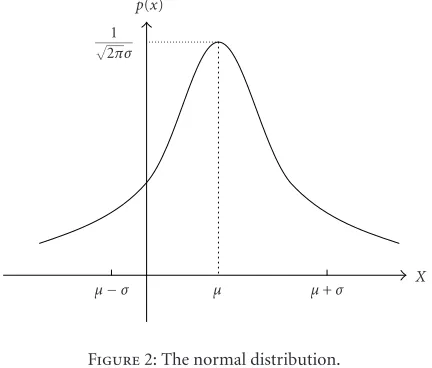
The linear-exponential normalization is developed based on the logistic transformation. Though the determination ofα, βis not a problem, but we still need to determine the param-eters. Therefore, we design another method from the distri-bution density function perspective [18]. We know that the distribution of a large number of random data will obey the normal distribution. So we propose the DWGNM based on the concept of the normal distribution. Along this direction, we propose to employ the normal distribution as shown in Figure 2, as a weighting factor of the normalization.
The normal distribution function with meanµand vari-anceσ2is given as follows:
X
Figure2: The normal distribution.
p(x)=√1 2πσe
−(X−µ)2/2σ2
, −∞< x <+∞. (24)
Figure 2shows that the closer the point is toµ, the largerp(x) will be. The rate of declination is controlled byσ. In employ-ing the normal distribution, we have the followemploy-ing modifica-tions:
(i) only the positive side is used, as distance is always pos-itive;
(ii) the peak of the distribution is normalized from 1/(√2πσ) to 1;
(iii) the mean is shifted to zero, that is,µ=0.
Then we can compute the similarity as follows:
S2i j=exp
Again, we can also convert the similarity measurement to estimated probability measurement. IfS2
i j ∈ [S21,S22], using
4. PROPOSED CLASSIFIER SELECTION ALGORITHM AND WEIGHTED COMBINATION RULE
This section is divided into two parts. The first part reports the proposed classifier selection algorithm. The second part reports the proposed weighted combination rule.
4.1. Classifier selection algorithm
Decision
Figure3: Pattern recognition system with classifier selection.
will be? From our experience, some classifiers are redundant. In the worst case, the redundant classifiers may degrade the performance. Therefore, in this section, we design and de-velop a simple but efficient classifier selection algorithm to select the best set of classifiers for recognition.
It is well known that a pattern recognition system consists of two stages, namely, training stage and recognition stage. The proposed classifier selection algorithm is performed at the training stage as shown inFigure 3. Suppose there is a set of p input classifiers; our classifier selection algorithm removes the redundant classifiers and eventually selects q (q ≤ p) classifiers to be employed in the recognition stage. The detailed classifier selection algorithm is presented below. The proposed method is based on the leave-one-out al-gorithm and is an iterative scheme. Assume that the combin-ing classifier scheme is fixed. The basic idea of the scheme is that if one classifier is redundant, the accuracy will increase if that classifier is removed from combination. Based on this idea, the following algorithm is proposed.
Suppose we havepclassifiers to be combined, denoted by a set of classifiersC0= {cj, j=1, 2,. . .,p}. LetOabe the
ac-curacy obtained when all classifiers are used for combination andAk = {aki, i = 1, 2,. . .,p}be the accuracy obtained at
thekth iteration, whereak
i represents the accuracy obtained
when the classifierciis removed. The set of classifiers after
kth iteration is denoted byCk= {cj, j=1, 2,. . .,pandcj∈/
RC}, where RC is the set that contains all redundant classi-fiers (RC is a null set at the beginning).
In the first iteration, we take one of the classifiers out and the rest are used for combination. We will obtain a set of accuracyA1 = {a1i, i = 1, 2,. . .,p}. The highest
accu-racyHA1is determined, whereHA1 = a1i1 = maxi{a
1
i}. If
HA1 ≥ Oa, then the classifierci0 will be removed fromC0
and inserted in RC. A new set of classifiers C1 is obtained, whereC1= {cj, j=1, 2,. . .,pandcj∈/ RC}and RC is
up-dated from null set to{ci1}. Otherwise, all classifiers should
be kept for combination and the iteration stops.
If the classifier is removed in the previous iteration, an-other iteration is required. To present a general case, suppose that thekth iteration is required. In the (k−1)th iteration, we get Ck−1 = {cj, j = 1, 2,. . .,pandcj ∈/ RC}and RC
is updated as well. Again, we take one of the classifiers out fromCk−1 and determine a set of accuracies by combining the rest of classifiers. A set of accuracies is then obtained Ak = {aki, i = 1, 2,. . .,p}(assign a negative value toakq if
and RC is updated. Another iteration is then proceeded. If HAk< HAk−1, the iteration will stop. The setCk−1, contain-ing the rest of classifiers, will be used for combination.
We will demonstrate the proposed algorithm using the FERET database inSection 5.4.
4.2. Weighted combination rule
Kittler et al. [4] presented a nice and systematic theory framework for combining classifiers. The performance on their framework is very encouraging. This paper will make some modifications based on the sum rule in their frame-work. As we know, Kittler et al.’s theory framework consid-ered all classifiers equally, that is, contributions to each clas-sifier to the final decision are equal. This paper proposes to weight each classifier with a confidence function to repre-sent the degree of contributions. As the recognition accuracy of each classifier is directly related to the confident, we can generate confidence function as a weighting function. Here, again the recognition accuracy a priori information is ac-quired at the training stage.
Letribe the recognition accuracy of each classifier and
the sum of the recognition accuracyr =qj=1rj, whereqis
the number of classifiers you want to combine. In our case, we assume that a priori probability of each class is equal. That is,
Then we can get the weighted combination rule based on ex-pression (2) as follows:
assignZ−→ωk0
Here,ri/ris the weighting function that satisfies q
normal centered happy left glass no glasses
right sad sleeping surprised winking
Figure4: Images of one person from Yale database.
Figure5: Images of one person from Olivetti database.
Figure6: Images of one person from the FERET database.
methods using the four combination rules. The results on the proposed weighted combination rule are given in Section 5.3.Section 5.4illustrates the steps in the proposed classifier selection algorithm to find the best set of classi-fiers for recognition. The result shows that the eigenface (PCA) method is redundant with the other methods and can be removed. Finally,Section 5.5 reports a microscopic analysis on why combining global and local features can im-prove the performance. Before describing the detailed ex-perimental results, let’s discuss the testing face databases in Section 5.1
5.1. Databases
Three public available face databases, namely, Yale face database, Olivetti research laboratory (ORL) face database, and FERET database are selected to evaluate the performance of the proposed method.
In Yale database, there are 15 persons and each person
consists of 11 images with different facial expressions, illumi-nation, and small occlusion (by glasses). And the resolution of all images is 128×128. Image variations of one person in the database are shown inFigure 4.
In Olivetti database, there are 40 persons and each person consists of 10 images with different facial expressions, small scale, and small rotation. Image variations of one person in the database are shown inFigure 5.
Table1: Results on original Yale database.
Method Rank 1 (%) Rank 2 (%) Rank 3 (%)
Spectroface 90.8333 94.1667 96.6667
PCA 72.5000 80.0000 81.6667
ICA 70.8333 79.1667 84.1667
Local Gabor wavelet 87.5000 95.0000 96.6667
Table2: Results of LENM on Yale database.
Scheme Rank 1 (%) Rank 2 (%) Rank 3 (%)
Similarity measurement (22)
Product rule 92.5000 97.5000 99.1667
Sum rule 93.3333 97.5000 100.000
Min rule 76.6667 86.6667 88.3333
Max rule 91.6667 95.0000 95.0000
Estimated probability measurement (23)
Product rule 89.1667 96.6667 97.5000
Sum rule 92.5000 97.5000 99.1667
Min rule 83.3333 87.5000 91.6667
Max rule 91.6667 96.6667 97.5000
Table3: Results of DWGNM on Yale database.
Scheme Rank 1 (%) Rank 2 (%) Rank 3 (%)
Similarity measurement (25)
Product rule 93.3333 97.5000 100.000
Sum rule 94.1667 97.5000 100.000
Min rule 76.6667 86.6667 88.3333
Max rule 93.3333 96.6667 97.5000
Estimated probability measurement (26)
Product rule 92.5000 95.8333 98.3333
Sum rule 94.1667 97.5000 100.000
Min rule 81.6667 86.6667 90.0000
Max rule 91.6667 95.8333 97.5000
As the number of individuals in Yale and ORL databases is relatively small, we will make use of the FERET database for evaluating the proposed classifier selection algorithm in Section 5.4. Moreover, we would like to highlight that the ob-jective of this paper is to demonstrate the advantages and ef-ficiency of combining local and global features for face recog-nition. The following experiments will demonstrate the im-provement of combining global and local features over each individual method. The accuracy can be further increased if more or different training images are used.
5.2. Results of proposed normalization methods
5.2.1. Results on Yale database
In this experiment, only the normal images are used for training and all other images are used for testing. Table 1 shows the rank 1 to rank 3 results (rank(n) is considered as a correct match if the target image is located at the topn im-ages on the list). The rank 1 accuracies for these four methods are ranging from 70.8% to 90.8%. Please note that the per-formance is not as good as that stated in the original article because of two reasons:
(i) only one face image is used for training,
(ii) the two poor lighting images (left and right images) are also used for testing.
Table4: Results on Olivetti database.
Method Rank 1 (%) Rank 2 (%) Rank 3 (%)
Spectroface 77.8571 81.7857 86.4286
PCA 70.3571 78.9286 82.8571
ICA 72.8571 81.7857 85.0000
Local Gabor wavelet 53.9286 60.7143 66.0714
Table5: Results of LENM on Olivetti database.
Scheme Rank 1 (%) Rank 2 (%) Rank 3 (%)
Similarity measurement (22)
Product rule 83.5714 88.9286 90.7143
Sum rule 85.0000 89.2857 91.0714
Min rule 62.1429 73.5714 80.3571
Max rule 84.2857 89.6429 91.4286
Estimated probability measurement (23)
Product rule 83.9286 88.2143 90.3571
Sum rule 84.6429 89.2857 91.0714
Min rule 76.7857 82.5000 87.8571
Max rule 62.5000 70.3571 75.0000
Table6: Results of DWGNM on Olivetti database.
Scheme Rank 1 (%) Rank 2 (%) Rank 3 (%)
Similarity measurement (25)
Product rule 82.5000 88.5714 90.7143
Sum rule 83.2143 88.9286 90.7143
Min rule 71.4286 76.4286 80.7143
Max rule 81.7857 87.5000 89.2857
Estimated probability measurement (26)
Product rule 83.5714 88.9286 91.0714
Sum rule 84.6429 88.5714 91.0714
Min rule 77.1429 82.1429 87.1429
Max rule 67.5000 74.2857 80.3571
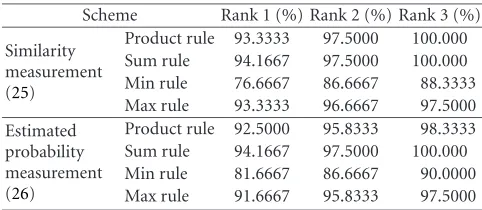
Now we see the results on combining classifiers. Same ex-periment settings but different normalization methods are used. For each normalization method, all four combination schemes are used to evaluate the performance of each combi-nation. Again, rank 1 to rank 3 accuracies are recorded. The results of LENM and DWGNM are tabulated in Tables2and 3, respectively.
Results of LENM inTable 2shows that among the four rules, sum rule provides the best result based on either simi-larity or estimated probability. The rank 1 accuracy is 93.33% while the rank 3 accuracy is 100.00%. Comparing with best performance inTable 1, which is spectroface, there is around 2.5% improvement.
Results of DWGNM are better than these of LENM. As shown in Table 3, the result of DWGNM with sum rule is 94.17%, which is around 0.8% higher than that of LENM.
5.2.2. Results on Olivetti database
Similar experiments are performed using Olivetti database. The first frontal-view image for every person is used for training, while the rest of the 7 images are used for testing. Table 4shows the results on Olivetti database. The rank 1 ac-curacy is ranging from 53.93% to 77.86%.
Table7: Results of DGWNM on Yale database.
Scheme Rank 1 (%) Rank 2 (%) Rank 3 (%)
Similarity measurement (25)
Sum rule 94.1667 97.5000 100.000
Weighted combination rule 95.0000 97.5000 100.000
Estimated probability measurement (26)
Sum rule 94.1667 97.5000 100.000
Weighted combination rule 95.0000 97.5000 100.000
Table8: Results of DGWNM on Olivetti database.
Scheme Rank 1 (%) Rank 2 (%) Rank 3 (%)
Similarity measurement (25)
Sum rule 83.2143 88.9286 90.7143
Weighted combination rule 84.2857 89.2857 90.7143
Estimated probability measurement (26)
Sum rule 84.6429 88.5714 91.0714
Weighted combination rule 85.0000 89.2857 90.7143
the four rules are evaluated and rank 1 to rank 3 accuracies are recorded. It can be seen that the sum rule gives the best performance among the four rules. The highest rank 1 accu-racy reaches 85.0%. Comparing with the best performance for individual method, 7.2% improvement is obtained.
5.3. Results of proposed weighted combination rule
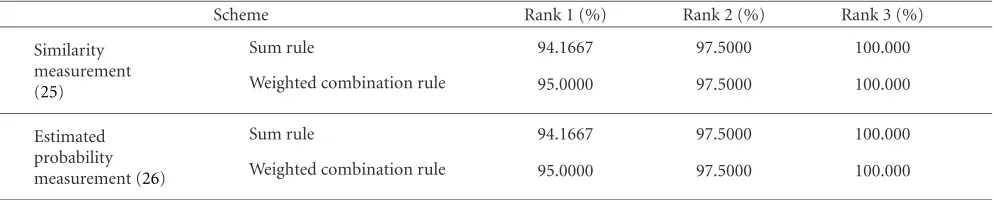
In the above section, we have seen the performance of two proposed normalization methods on two popular face databases. Now we will compare the performance of the sum rule, which gives the best performance in Kittler et al. combi-nation theory, with our proposed weighted combicombi-nation rule using DWGNM.
5.3.1. Results on Yale database
The experiments are the same as before, except the weighted combination rule is added for comparison. The results are shown inTable 7. It can be seen that for both similarity mea-surement (based on (25)) and estimated probability mea-surement (based on (26)), the proposed weighted combina-tion rule performs better than the sum rule by 0.8%.
5.3.2. Olivetti database
The results on ORL database are shown inTable 8. It can be seen that the weighted combination rule gives a better per-formance than that of sum rule by 0.4–1%.
5.4. Results of classifier selection algorithm
The detailed classifier selection algorithm has been reported inSection 4.1. This section demonstrates its performance. As mentioned, the number of individuals in both Yale and ORL
face databases is small. FERET face database is used in this section. We divide the 70 individuals into two groups. Group 1 consists of 30 individuals and is used for selection of clas-sifier in training stage. Group 2 consists of 40 individuals, which are not overlapped in Group 1, is used for testing. DWGNM with estimated probability measure is used in all experiments in this section.
5.4.1. Selection of classifier in training stage
Out of 70, 30 people in Group 1 are used for selection of classifier. The rank 1 to rank 3 accuracies of each method are tabulated inTable 9. It can be seen fromTable 9that the com-bination accuracy is 90.6667%. That is theOa =90.6667%
(please refer toSection 4.1for definition). For the first iter-ation, we take one classifier out and combine the rest. The results are shown inTable 10. It can be seen that the highest accuracy is 94.6667%, which is higher than 90.6667% when the PCA method is taken out. So another iteration is per-formed.
In the second iteration, only three classifiers are left and the experiment is repeated. The results are shown in Table 11. It can be seen that all accuracies are dropped below 94.6667%. This implies that we should keep all the remaining classifiers and the iteration stops. Thus the PCA algorithm is removed and the remaining three methods are kept and used in the recognition stage.
5.4.2. Performance in recognition stage
Table9: Results of the FERET database on Group 1 face images.
Method Rank 1 (%) Rank 2 (%) Rank 3 (%)
Spectroface 85.3333 89.3333 93.3333
PCA 76.0000 84.0000 87.3333
ICA 81.3333 90.6667 92.6667
Local Gabor wavelet 80.6667 84.6667 88.0000
Sum rule 90.6667 94.6667 96.0000
Table10: Performance with one classifier removed.
Spectroface PCA ICA Gabor wavelet Accuracy
× 80.6667%
× 94.6667%
× 94.0000%
× 87.3333%
Table11: Performance with two classifiers removed.
Spectroface ICA Gabor wavelet Accuracy
× 87.3333%
× 94.0000%
× 93.3333%
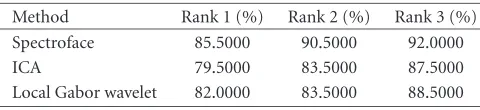
a reference. It can be seen that the rank 1 accuracy of each method ranges from 79.5% to 85.5%.
The overall performance in integrating all three proposed idea is shown in the last row inTable 13. The rank 1 accu-racy is 92.5%. Comparing with the sum rule with all four classifiers, where the rank 1 accuracy is 90.5%, the proposed method gives a 2% improvement. Comparing with the spec-troface, which gives the best result for single algorithm, per-formance is improved by 7%.
5.5. Microscopic analysis
This section further investigates why combining global and local features can improve the performance. The “right lighting” image Figure 4 and the “sad” image Figure 4 in Yale database are used for demonstration. The first im-age is selected because it is the hardest imim-age for recogni-tion. Most of the techniques are unable to handle such a poor and nonlinear lighting. This image also shows that the global feature techniques fail to handle illumination prob-lem, while local feature techniques perform well. On the other hand, the second image shows that the local feature fails to recognize the image, while the global feature perform good.
Here, we only extract the detailed ranking of rig.img and sad.img when matching with each of the 15 persons. DWGNM is used and the results are recorded and tabulated in Tables14and15.
InTable 14, the first column indicates the person num-ber, ranging from 1 to 15. The second to fifth columns are
Table12: Results of the FERET database on images in Group 2.
Method Rank 1 (%) Rank 2 (%) Rank 3 (%)
Spectroface 85.5000 90.5000 92.0000
ICA 79.5000 83.5000 87.5000
Local Gabor wavelet 82.0000 83.5000 88.5000
Table13: Overall performance of the FERET database on images in Group 2.
Method Rank 1 (%) Rank 2 (%) Rank 3 (%)
DWGNM + Sum Rule 90.5000 94.5000 95.5000
DWGNM + Classifier Selection algorithm + Weighted combination rule
92.5000 95.0000 95.5000
the four individual methods. Each entry indicates the rank when the right image is matched with that person. Rank 1 means the right image is correctly recognized, while rank 15 means the poor matching. It can be seen that none of the single individual method provides a satisfactory result.
The four combination rules and our proposed combina-tion schemes are employed and evaluated. The results are tabulated in the sixth to tenth columns. The results show that the performance, in general, can be improved to com-bine different methods. In particular, sum rule performs the best among the four rules, and data fusion with weighting performs better than that the sum rule. This can be explained that the misclassified image by different classifiers may not be overlapped. If one method misclassifies an image, the other method may compensate the error to get a correct classifi-cation. The use of weight function can further improve the classification performance. It can be seen from the results in last column.
Similar results on sad.img are obtained as shown in Table 15. It can be seen that both ICA and Gabor techniques do not give a satisfactory result. However, this error can be compensated by the spectroface and PCA. Finally, correct classification is obtained.
6. CONCLUSIONS
This paper successfully combines local and global features for face recognition. The key factor is how to combine the fea-tures. Along this direction, we have addressed three issues in combining classifiers based on Kittler et al. framework and developed solutions in each issue as follows:
(1) the normalization method for combining different classifiers’ output;
(2) a classifier selection algorithm; (3) a weighted combination rule.
Table14: Microscopic analysis of the right image.
Class no. Spectroface PCA ICA Gabor Sum rule Product rule Min rule Max rule Weighted combination rule
1 2 12 1 7 3 3 12 2 3
2 1 3 1 1 1 1 1 1 1
3 9 7 1 1 1 1 2 1 1
4 1 2 1 1 1 1 1 1 1
5 1 5 1 1 1 1 1 1 1
6 1 1 1 1 1 1 1 1 1
7 1 2 1 1 1 1 1 1 1
8 1 6 4 1 2 2 1 5 1
9 1 6 1 1 1 1 1 1 1
10 1 1 1 1 1 1 1 1 1
11 1 1 1 1 1 1 1 1 1
12 1 10 1 1 1 1 2 1 1
13 1 1 1 1 1 1 1 1 1
14 1 2 1 2 1 1 1 1 1
15 1 7 4 1 1 1 1 1 1
Table15: Microscopic analysis of the sad image.
Class no. Spectroface PCA ICA Gabor Weighted combination rule
1 1 1 1 1 1
2 1 1 1 1 1
3 1 1 2 1 1
4 1 1 1 1 1
5 1 1 1 1 1
6 1 1 4 1 1
7 1 1 2 1 1
8 1 1 2 7 1
9 1 1 8 1 1
10 1 1 1 1 1
11 1 1 1 1 1
12 1 1 3 1 1
13 1 1 1 1 1
14 1 1 1 1 1
15 1 1 1 1 1
ACKNOWLEDGMENTS
This project was supported by the Science Faculty Research Grant, Hong Kong Baptist University. The third author was partially supported by the National Natural Science Founda-tion Council (NNSFC) no. 60144001. We would like to thank Yale University, Olivetti Research Laboratory, and Colorado State University for providing the face image databases.
REFERENCES
[1] R. Chellappa, C. L. Wilson, and S. Sirohey, “Human and ma-chine recognition of faces: a survey,” Proceedings of the IEEE, vol. 83, no. 5, pp. 705–741, 1995.
[2] G. Chow and X. Li, “Towards a system for automatic facial feature detection,” Pattern Recognition, vol. 26, no. 12, pp. 1739–1755, 1993.
[3] B. Ackermann and H. Bunke, “Combination of classifiers on the decision level for face recognition,” Tech. Rep. IAM-96-002, Institut f¨ur Informatik und angewandte Mathematik, Universit¨at Bern, Germany, January 1996.
[4] J. Kittler, M. Hatef, R. P. W. Duin, and J. Matas, “On combin-ing classifiers,” IEEE Trans. on Pattern Analysis and Machine Intelligence, vol. 20, no. 3, pp. 226–239, 1998.
[5] D. M. J. Tax, M. van Breukelen, R. Duin, and J. Kittler, “Com-bining multiple classifiers by averaging or by multiplying?,”
Pattern Recognition, vol. 33, no. 9, pp. 1475–1485, 2000. [6] G. C. Feng, P. C. Yuen, and D. Q. Dai, “Human face
recog-nition using PCA on wavelet subband,” SPIE Journal of Elec-tronic Imaging, vol. 9, no. 2, pp. 226–233, 2000.
[7] L. Sirovich and M. Kirby, “Low-dimensional procedure for the characterization of human faces,”Journal of Optical Soci-ety of America, vol. 4, no. 3, pp. 519–524, 1987.
[8] M. Turk and A. Pentland, “Eigenfaces for recognition,” Jour-nal of Cognitive Neuroscience, vol. 3, no. 1, pp. 71–86, 1991. [9] J. H. Lai, P. C. Yuen, and G. C. Feng, “Face recognition using
holistic Fourier invariant features,” Pattern Recognition, vol. 34, no. 1, pp. 95–109, 2001.
[10] P. C. Yuen and J. H. Lai, “Face representation using indepen-dent component analysis,”Pattern Recognition, vol. 35, no. 6, pp. 1247–1257, 2002.
[12] C. Jutten and J. Herault, “Independent component analysis versus PCA,” inProc. European Signal Processing Conference (EUSIPCO ’88), J. L. Lacoume, A. Chehikian, N. Martin, and J. Malbos, Eds., pp. 643–646, Grenoble, France, September 1988.
[13] A. Hyv¨arinen, “Fast and robust fixed-point algorithms for in-dependent component analysis,”IEEE Transactions on Neural Networks, vol. 10, no. 3, pp. 626–634, 1999.
[14] A. Hyv¨arinen and E. Oja, “Independent component analysis: Algorithms and applications,” Neural Networks, vol. 13, no. 4-5, pp. 411–430, 2000.
[15] L. Wiskott, J. M. Fellous, N. Kr¨uger, and C. von der Mals-burg, “Face recognition by elastic bunch graph matching,”
IEEE Trans. on Pattern Analysis and Machine Intelligence, vol. 19, no. 7, pp. 775–779, 1997.
[16] J. G. Daugman, “Complete discrete 2-D Gabor transforms by neural networks for image analysis and compression,” IEEE Trans. Acoustics, Speech, and Signal Processing, vol. 36, no. 3, pp. 1169–1179, 1988.
[17] J. Huang, P. C. Yuen, and J. H. Lai, “Combining local and global features for face recognition,” inProc. Asian Conference on Computer Vision (ACCV ’02), January 2002.
[18] J. Sherrah, S. Gong, and E-J. Ong, “Face distribution in simi-larity space under varying head pose,”Image and Vision Com-puting, vol. 19, no. 12, pp. 807–819, 2001.
[19] B. Jeon and D. A. Landgrebe, “Decision fusion approach for multitemporal classification,”IEEE Transactions on Geoscience and Remote Sensing, vol. 37, no. 3, pp. 1227–1233, 1999. [20] P. J. Phillips, H. Moon, S. A. Rizvi, and P. J. Rauss, “The
FERET evaluation methodology for face-recognition algo-rithms,” IEEE Trans. on Pattern Analysis and Machine Intel-ligence, vol. 22, no. 10, pp. 1090–1104, 2000.
Jian Huang received his B.S. degree and M.S. degree in mathematics and applied mathematics from Zhongshan University in 1999 and 2002, respectively. Currently, he is pursuing the Ph.D. degree in the De-partment of Computer Science, Hong Kong Baptist University, Hong Kong. His research interests include pattern recognition, face recognition, linear discriminant analysis al-gorithm, and kernel method.
Pong C. Yuenreceived his B.S. degree in electronic engineering with first class hon-ours in 1989 from City Polytechnic of Hong Kong, and his Ph.D. degree in electrical and electronic engineering in 1993 from the University of Hong Kong. Currently, he is an Associate Professor in the Department of Computer Science, Hong Kong Baptist versity. Dr. Yuen was a recipient of the Uni-versity Fellowship to visit the UniUni-versity of
Sydney in 1996. He was associated with the Laboratory of Imag-ing Science and EngineerImag-ing, Department of Electrical Engineer-ing. In 1998, Dr. Yuen spent a six-month sabbatical leave in The University of Maryland Institute for Advanced Computer Studies (UMIACS), University of Maryland at college park. He was associ-ated with the Computer Vision Laboratory, Center for Automation Research (CFAR). His major research interests include human face recognition, signature recognition, and medical image processing.
J. H. Lai received his M.S. degree in ap-plied mathematics in 1989 and his Ph.D. in mathematics in 1999 from Zhongshan (Sun Yat-Sen) University, China. Currently, he is a Professor in the School Mathemat-ics and Computational Science, Zhongshan (Sun Yat-Sen) University, China. He is also the board member of Chian’s Image and Graphics Association. His current research interests are in image processing, pattern recognition, computer vision, and wavelet analysis.