R E S E A R C H
Open Access
Robust proactive eavesdropping in
UAV-enabled wireless communication
networking
Wei Wu
1, Yujing Wang
2, Jianlin Mo
3*and Jian Liu
4Abstract
In this paper, we considered a robust beamforming design problem for a proactive eavesdropping via jamming, in which a full-duplex legitimate monitor tries to eavesdrop on a suspicious communication link between the secondary pairs in an unmanned aerial vehicle (UAV)-enabled cognitive radio network. Due to the channel estimation errors, we assume that the channel state information is not perfectly known. To ensure the successful eavesdropping, jamming signals are designed to disrupt the suspicious receivers and the primary receiver at the same time, which should have the good tradeoff between those two effects. We aimed to maximize the achievable eavesdropping rate under the transmitting power constraint at the legitimate monitor and the interference temperature constraint at the primary receiver, which was formulated as a non-convex problem with infinite constraints. We firstly transform the original problem into a simplified one with finite constraints. Then, an analytical solution in significant low-complexity is proposed by decomposing the simplified problem. Numerical results are finally presented to evaluate the performance of our proposed schemes in UAV-enabled wireless communication networking.
Keywords: Unmanned aerial vehicles, Robust, Cognitive radio, Proactive eavesdropping, Beamforming
1 Introduction
Unmanned aerial vehicles (UAVs) have attracted a large amount of attention over recent years[1–3]. Their applica-tions, such as surveillance, aerospace imaging, and cargo transportation, are widely studied. Extensive researches are also devoted to the use of drones as different types of wireless communication platforms, such as aeronauti-cal mobile base stations (BS) [4,5], mobile relays [6], and flight cloud computing [7,8].
In a UAV-assisted network, UAVs are deployed to pro-vide wireless connectivity to ground users[9]. In practice, UAVs can move freely in three-dimensional space for better performance. Due to UAVs’ high mobility, the deployment of drone-assisted communication systems is more flexible, which makes them particularly suitable for on-demand applications or accidents. Furthermore, the UAV-ground link is more likely to have a line-of-sight
*Correspondence:[email protected]
3Electronic Information and Automation College of ABA, 623002 Sichuan, China
Full list of author information is available at the end of the article
(LoS) channel than the ground-to-ground link in the ter-restrial system; thus, it can provide a higher link capac-ity. In addition, UAV-assisted communication provides additional design freedom for performance improvements by dynamically optimizing the UAV position to best meet communication requirements [10].
However, an inevitable problem in UAV-assisted net-work is the scarcity of wireless spectrum. Cognitive radio (CR), a promising technology to overcome spectrum over-crowding and scarcity, is considered a key technology to meet the critical requirements. UAVs may need to share the spectrum with existing wireless devices (e.g., cellular mobiles on the ground) for communications[11–13].
Wireless security has attracted a lot of researchers’ attention recently, while the extensive work were often proposed to secure wireless communications against eavesdropping as illegitimate attacks [14–16]. In the UAV-assisted network, UAV wireless connection is an easy point of target when there is no strong protec-tion against malicious hackers. Some effective means, such as encrypted channel and redundant coding, are widely used to enhance the security while safeguarding
UAV from unauthorized access and disruption. However, criminals or terrorists may potentially use UAV-enabled wireless communications to establish suspicious links for crimes and terrorism [17,18]. Therefore, more and more demands were proposed for legitimate organizations, such as government agencies, e.g., to eavesdrop these suspi-cious links[19, 20]. We thus intend to address the issue about the proactive eavesdropping in UAV-enabled wire-less communication networking. It is worth noting that the flight trajectory and the placement of the UAV can be optimized for improving the communication perfor-mance, respectively. However, the mobility of UAVs is controlled by a suspicious user instead of the legitimate eavesdropper. In such a scenario, the proactive eavesdrop-per is a independent user, and the CSI between the eaves-dropper and the suspicious transmitter can be estimated in a near-instantaneous manner[21,22]. By contrast, the CSI between the eavesdropper and the receivers (primary receiver and secondary receiver) cannot be extracted. Therefore, we can assume that we know the statistical information of the channel between the eavesdropper and the receivers[23,24].
The average eavesdropping rate over Rayleigh fading channels, defined as the suspicious communication rate multiplied by the non-outage probability, is maximized in [25]. Furthermore, it is considered to maximize the eavesdropping non-outage probability and the relative eavesdropping rate by optimizing the jamming power allo-cation over different fading states in [26]. On the other hand, multi-antenna wireless legitimate surveillance sys-tems with non-ignored loop-channel are presented in [27]. It is worth noting that the aforementioned works on
wireless surveillance mainly focus on the three-node sys-tems with the suspicious parts and the legitimate monitor. The proactive eavesdropping in the scenario of CR net-work has not been investigated hitherto. In this paper, the suspicious users are set as the secondary users in a CR net-work; meanwhile, a full-duplex legitimate monitor tries to decode the messages in the suspicious link. The main contributions are summarized as follows:
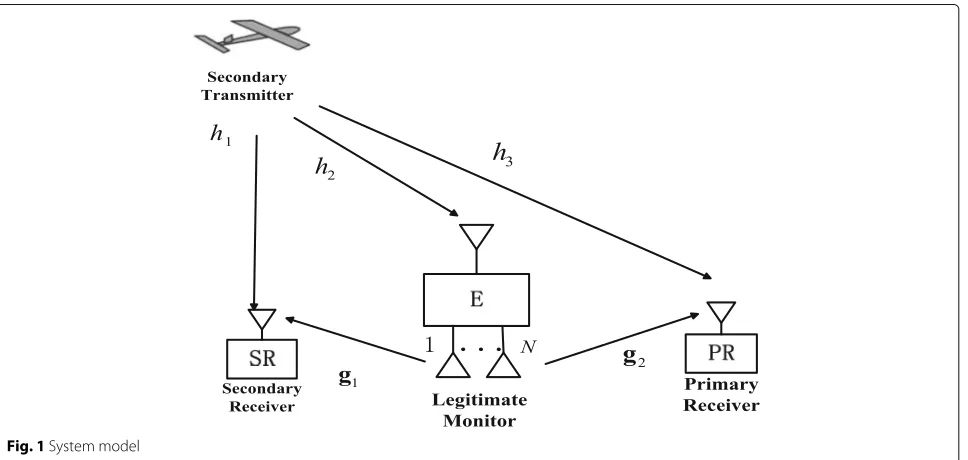
1. We propose an efficient jamming scheme for proac-tive eavesdropping in the new UAV-enabled suspicious communication scenario with partial CSI between ST and SR, ST and PR, E and SR, and ST and E, which is shown in Fig.1. The total interference power to PR caused by E and ST should be controlled below a threshold for all the possible channel realization within an uncertainty set.
2. We formulate an optimization problem to maxi-mize the achievable eavesdropping rate by optimizing the jamming vector. First, the original problem with infinite constrains is transformed into a problem with finite con-straints. Then, an analytical solution in closed-form or significant low-complexity is presented.
3. Numerical results reveal that the uncertainty of the channels influences the eavesdropping rate and the eaves-dropping probability to a large extent. Furthermore, it is also certificated that our proposed solution has the better performance over the traditional solutions.
The rest of this paper is organized as follows. Section2
explains the main methods of this paper. Section 3
introduces the system model of robust legitimate eaves-dropping in a CR network, and then formulates the eavesdropping beamforming design problem. Section 4
divides the original problem into three sub-problems and
proposes the optimal solution to the problems in a closed-form. Section 5 provides the simulation results. Finally, Section6concludes the paper.
2 Methods
In a UAV-based wireless communication network, air-to-ground channel is an LoS channel that easily acquires channel knowledge. However, when a monitor attempts to monitor a terrestrial user, the channel between the mon-itor and the ground user is still affected by the complex environment on the ground. In this case, we assume that its statistical information is known and attempts to obtain a robust design. In such a scenario, we need to establish a robust optimization problem, which commits to get the best solution in the worst case.
The robust optimization problem involves infinite con-straints. One common method to solve such problem is to use the S-procedure lemma to convert the infinite con-straints. The optimal solution is obtained by decomposing the optimal matrix, which should permit that its rank equals to 1. However, the drawback of this method is the high computational complexity. In this paper, we directly consider the worst case of the target and the boundary condition of the constrained space, then convert infinite constraints into finite constraints. Through the transfor-mation of the triangle inequality, the semi-closed form solution of the original problem is finally obtained. The superiority of this approach lies in lower computational complexity and clear physical meaning.
3 System model and problem formulation
As shown in Fig.1, we consider a suspicious wireless com-munication link from a secondary transmitter ST to a secondary receiver SR in a CR network, where a legitimate monitor E is intended to eavesdrop this link via jamming. ST and SR are both equipped with single antenna, and E is deployed with one antenna for eavesdropping (receiving) andN antennas for jamming (transmitting). When the primary user is inactive, it is clearly not the effect of the eavesdropping process. If the primary user is active, it is worth noting that the transmission information of the pri-mary user in CR communication is useless for SR and E, so it can be treated as background noise. The scheme of the proactive eavesdropping would not be influenced by the primary user. The channels from ST to SR, from ST to E, from ST to PR, from E to SR, and from E to PR are denoted byh1,h2,h3,g1, andg2, respectively. It is worth
noting that downlink communication channels where the UAV sends messages to the ground users are dominated by line-of-sight (LoS) links, and the Doppler effect due to the UAV’s mobility is assumed to be perfectly compen-sated. Therefore, the channel power gain from the UAV to each ground user follows the free-space path loss model given by
hk =β0d−k2,k∈ {1, 2, 3}, (1)
whereβ0denotes the channel power gain at the reference
distanced0 = 1 meter (m), anddk denotes the distance between ST and each ground user.
The legitimate monitor can operate in a full-duplex mode to enable simultaneous eavesdropping and jam-ming. Furthermore, we assume that the receiving antenna and the transmitting antennas at E are isolated [28], so that the self-interferences can be perfectly canceled at E. E obtains the perfect CSI on the channelh2as a receiver.
However, due to the channel estimation errors and the limited cooperation between ST, SR, and E, it is assumed that the legal monitor does not know the CSI on the chan-nelh1,h3,g1, andg2perfectly. Instead, it is reasonable to assume that E has the knowledge which is bounded within the uncertain sets described by the following regions:
ηei=gi|gi= ˆgi+gi,gHi gi≤εei,i∈ {1, 2}, (2)
where gˆ1 and gˆ2 are the estimators of the channels at
E; g1,g2 are the corresponding channel estimation
errors.εe1,εe2 determine the quality of the CSI
estima-tions.
We consider that ST transmits with the powerPS, which satisfiesPS≤Pt. Moreover, for anywsatisfyingw2≤Pe as the beamforming vector at E, the interference to PR due to the suspicious transmission and the jamming signals sent by E can be expressed as: IT=PSh32+ gH2w2.
To ensure reliable detection at SR, adaptive rate trans-mission is adopted at ST based on the channel perceived at SR. For any fixedw, the robust transmission rate at ST is formulated as:
where σ2 refers to the variance of the Gaussian noises. In this case, the transmitting power at ST is given by the following Lemma.
ProofFor any fixedw, it can be observed that the chan-nel capacity of the suspicious link is limited by two con-straints: one is the transmit power constraint at ST; the other is the interference temperature constraint at SR. The following problem is considered to obtain the maximum robust transmission rate of the suspicious link:
max
For problem (5), at least one constraint is active since the objective function increases with the increase ofPS. The optimal solution to (5) can be expressed as (4). The proof is thus completed.
On the other hand, the capacity of the eavesdropping channel from ST to E is:
RE(w)=log2
1+ PS(w)h2
2
σ2 . (6)
According to [30], the legitimate monitor can success-fully eavesdrop the suspicious communication if and only ifRE(w)≥RS(w), since in this case the legitimate moni-tor can decode the information sent by ST with arbitrary small error probability. As a result, the effective eaves-dropping rate is given byRev(w) = RS(w). On the other hand, ifRE(w) <RS(w), it is impossible for E to decode the information from ST without any error. In this case, the eavesdropping rate is defined asRev(w) =0. In sum-mary, the effective eavesdropping rate can be expressed as:
Rev(w)=
RS(w) ifRE(w)≥RS(w)
0 otherwise . (7)
The objective of the legitimate monitor is to maximize the eavesdropping rateRev(w) by optimizing the beam-forming vectorw. This problem is thus formulated as the following: Then, based on the definition in (7), the objective function can be replaced byRS(v,p)with an additional constraint
RE(v,p) ≥ RS(v,p). Meanwhile, by substituting (3) and
Note that the problem (9) is equivalent to the problem (8) due to the logarithmic transformation between rate and signal-to-interference-plus-noise ratio (SINR).
Remark 1An important observation is that the con-straint(9a)in the above problem remains invariant when
ˆ
g2undergoes any arbitrary rotation. Without loss of
gener-ality, we assume thatgˆ2andgˆ1have the same phase, i.e.,
Since problem (9) is subject to an infinite number of constraints. The traditional method about S procedure [31] could be applied to transform the problem (9) into a semidefinite program. However, in this paper, we are going to transform the original problem into a prob-lem with finite constraints to get analytical results. In the following section, we firstly study several important constraints about problem (9). Then, we will analyze for them.
Lemma 2 Problem (9) has the same optimal solution with the following problem:
Proof First, we denote the objective function of problem (9) and (10) asf1andf2, respectively. It can be observed
the other hand, it can be proved by contradiction that f2 ≤ f1. We assume that there exist another parameters
g12∈ηe1satisfyingf2> PSh1
2
pgH12v2+σ2. It can be obtained that
gH12v2 ≤ gH11v2, which contradicts our presumption, i.e.,f1=f2. Similarly, for problem (9), only the constraints
in problem (10) are active constraints. The proof is then completed.
Moreover, the transmit power at ST can also be trans-formed into
Then, we will analyze for the constraints of problem (10). For (10c), the following lemma is proposed:
Lemma 3If the optimal solution to problem(9)satisfies that p=0, the constraint(10c)could rewrite as
andPS(v,p)is an non-decreasing function with respect to
p. This result contradicts our presumption.
For (10a), two cases are discussed corresponding to the conditions that if (10a) is a equality or not. When the opti-mal{v∗,p∗}causes that (10a) is not a equality,PS(v,p)=
Pt is obtained due to the fact that another picking of
PS(v,p) only supports for the equality of (10a). Then, sub-problem 1 (SP1) is proposed
(SP1) : max
solution for problem (9). Otherwise, constraint (10a) is a equality for the optimal solution of (9).
In the case when constraint (10a) is a equality, another two SPs are proposed
optimal solution for problem (9).
4.1 Optimal solution for SP1
Before we proceed to solve SP1, an important property is proposed as follows.
Remark 2For i ∈ {1, 2}, by applying the triangle inequality, the constraint can be transformed as follows
gHi0v ≤ gHi v ≤ gHi1v. (16)
By using Remark2, SP1 can be transformed into
max
f1(v)= δ
It is easy to obtain that the optimal solution to SP1 is
v1= ˆ
4.2 Optimal solution for sP2
By using Remark2, SP2 can be transformed into
max
Substitute (19b) into the objective function of (22) and it can be observed that the optimal solution to problem (22) can be obtained if the following function
f2(v)=
In the following lemma, the optimal beamform-ing vector v at (23) is proposed with an important property.
Proof The proof of Lemma4could be divided into two parts. The first part is to prove thatvis of the formαvgˆ −
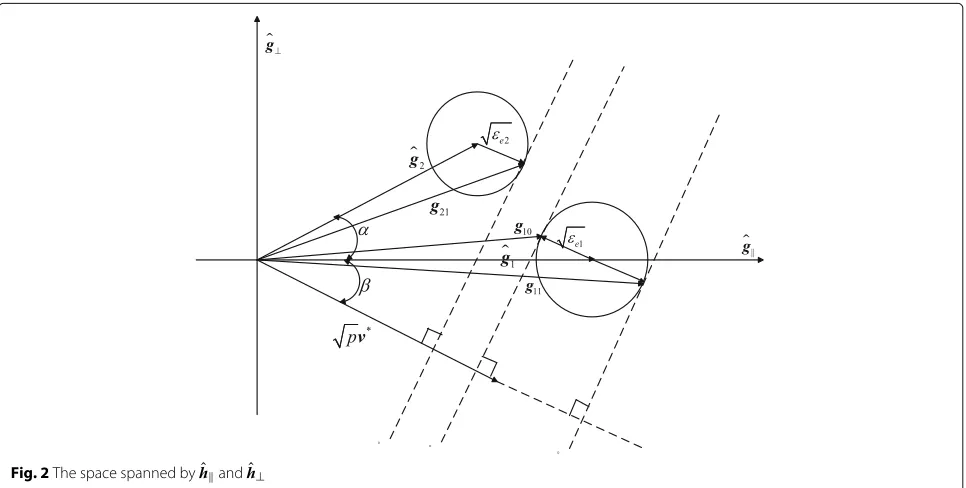
From Lemma4, we learn that the optimal vectorvis shown to lie in a two-dimensional (2-D) space spanned by
ˆ
gandgˆ⊥. So, it can be searched on the space as depicted in Fig.2.
It can be obtained from Fig.2that
ˆ
f2(β) is a single variable optimization problem. To find
the optimal β, we should firstly observe that the feasi-ble region for the variafeasi-ble β is [ 0,π/2 −α]. And p =
δ/(ˆg1cos(β)−√εe1)2 ≤Peshould be satisfied. So,βis in the range of [ 0, min(π/2−α,β1)], whereβ1satisfies
ˆg1cos(β1) = max(π/2−α,√δ/Pe+ √εe1). However,
the first-order derivative off2(β)is too complex to get a
closed-form result. Then, the globally optimal solution of f2(β)could be searched for in the feasible region.
By using Lemma4, the optimal solution{v2,p2}can be
obtained withβ2, which is the optimal solution off2(β):
αv=cos(β2),βv=sin(β2),
p2= δ
(ˆg1cos(β2)−√εe1)2
. (25)
4.3 Optimal solution for SP3
For SP3, Lemma 4 is also applicable, and the following equations are proposed:
p3(ˆg2cos(α+β)+√εe2)2=δ1,
p3(ˆg1cos(β)−√εe1)2=δ,
(26)
whereδ1=−P(ˆh3 + √εa3)2.
It is easy to obtain{β3,p3}by solving the equations at
(26) with the regular mathematical tools and the optimal vectorv3is proposed as follows
v3=cos(β3)gˆ−sin(β3)gˆ⊥. (27) 5 Simulation results and discussions
Simulation results are provided in this section, in which E is equipped with one antenna for receiving and (N = 4) antennas for transmitting. Meanwhile, ST, SR, and PR
each use a single antenna. It is assumed the channels are drawn that each element is generated by indepen-dent CSCG variable distributed asCN(0, 1)forgˆ1andgˆ2,
respectively. The corresponding distance is assumed to be d1 = 200m,d2 = d3 = 500m. For simplicity, the
uncer-tainties of all channels are assumed to beεe1 = εe2 = ε,
whereεspecifies the size of the uncertainty set.
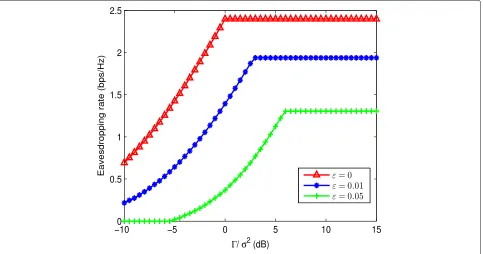
Figure3illustrates robust eavesdropping rate versus the interference temperature limit at PR.Pt/σ2 = Pe/σ2 = 10 dB while /σ2 is in the range of [−10 dB, 10 dB]. Note that ε = 0 corresponds to the scenario when perfect knowledge of all the channels is known. When the constraint in Theorem 1 is not satisfied,{vi,pi},i ∈
{2, 3} may be the optimal solution. In this case, robust eavesdropping rate will increase with the increase of until {v1,p1} is a feasible solution. Moreover, it can be
observed that robust eavesdropping rate is higher whenε is smaller, which can be explained that with more accurate CSI, E can better obtain the information about the sus-picious link and achieve successful eavesdropping more effectively.
Figure4depicts the eavesdropping rate versus the max-imum transmit power at E. The parameter Pt/σ2 is 10 dB while /σ2 is 0 dB.Pe/σ2increases from −5 dB to 10 dB. Similarly, higher robust eavesdropping rate can be observed with smallerε. The curves are increasing with the increase ofuntil the upper bound is obtained.
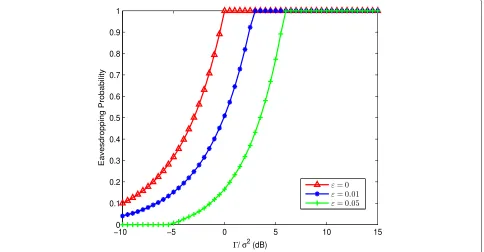
Figure5 illustrates the eavesdropping probability ver-sus the interference temperature limit at PR, where the eavesdropping probability is denoted by the ratio of the
Fig. 4Eavesdropping rate versus the maximum transmit power at E
successful eavesdropping to the sum eavesdropping, suc-cessful eavesdropping is defined as the cases that the eavesdropping rate can not be larger corresponding to the known conditions. Pt/σ2 = Pe/σ2 = 10 dB while
/σ2 is in the range of [−10 dB, 10 dB]. Note that
ε = 0 corresponds to the scenario when perfect knowl-edge of all the channels is known. In such a scene,
the eavesdropping probability gets the best performance. Moreover, it can be observed that robust eavesdrop-ping probability increases to 1 more quickly when ε is smaller, which can be explained that with more accurate CSI, E can better obtain the information about the sus-picious link and achieve successful eavesdropping more effectively.
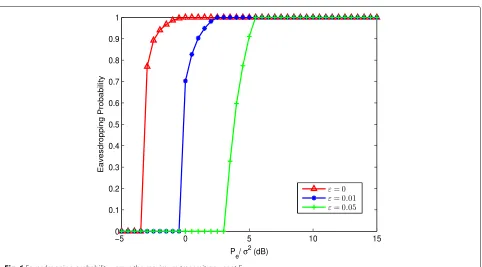
Fig. 6Eavesdropping probability versus the maximum transmit power at E
Figure 6 depicts the eavesdropping probability versus the maximum transmit power at E. The parameterPt/σ2 is 10 dB while /σ2 is 0 dB. P
e/σ2 increases from −5 dB to 10 dB. Similarly, higher eavesdropping probabil-ity is obtained with smaller ε. The curves are increas-ing with the increase of until the upper bound is obtained.
Figure 7 depicts the eavesdropping rate versus the uncertainty of all channels. We compare our approach with the traditional solution in [33], which does not incor-porate the robust cases. Whenε = 0, the CSI is com-pletely known, and these two solutions have the same eavesdropping rate. With the increases ofε, our approach achieves better eavesdropping rate than the other one.
The gap also becomes larger due to the uncertainty of the CSI.
The parameterPt/σ2is 10 dB while/σ2is 0 dB.Pe/σ2 increases from −5 dB to 10 dB. Similarly, higher robust eavesdropping rate can be observed with smallerε. The curves are increasing with the increase of until the upper bound is obtained.
6 Conclusion
This paper has investigated a new robust information surveillance problem under the UAV-enabled CR net-work. A proactive eavesdropping scheme has been con-sidered to monitor the suspicious transmission between the suspicious UAV transmitter and the ground receiver via jamming. The full-duplex legitimate monitor adap-tively optimizes the transmission beamforming vector to maximize the eavesdropping rate, which is formulated as a non-convex semi-infinite optimization problem. To solve it, we have transformed it into a problem with finite constraints, then the optimal solution in low-complexity were proposed. The numerical results show the superi-ority of our proposed schemes in UAV-enabled wireless communication networking.
Abbreviations
BS: Base station; CR: Cognitive radio; LoS: Line-of-sight; UAV: Unmanned aerial vehicle
Acknowledgments Not applicable.
Authors’ contributions
WW is the main author of the current paper. WW contributed to the development of the ideas, design of the study, theory, result analysis, and article writing. YW carried out the experimental work and the data collection and interpretation. JM finished the analysis and interpretation of data and drafted the manuscript. JL conceived and designed the experiments and undertook revision works of the paper. All authors read and approved the final manuscript.
Funding
This work was supported in part by the National Natural Science Foundation of China (61901231), the Natural Science Foundation of Jiangsu Province of China (BK20180757), the Project of Educational Commission of Jiangsu Province of China (18KJB510028), the Introducing Talent Research Start-Up Fund of Nanjing University of Posts and Telecommunications (NY218100, NY219072), and the Aba Prefecture Applied Technology Research and Development Fund Project (19YYJSYJ0035).
Availability of data and materials
Data sharing not applicable to this article as no data sets were generated or analyzed during the current study.
Competing interests
The authors declare that they have no competing interests.
Author details
1Nanjing University of Posts and Telecommunications, 210003 Nanjing, China. 2Dean’s office of ABA, 623002 Sichuan, China.3Electronic Information and
Automation College of ABA, 623002 Sichuan, China.4College of Information Engineering, Nanjing University of Finances and Economics, 210003 Nanjing, China.
Received: 25 September 2019 Accepted: 11 November 2019
References
1. C. Li, S. Zhang, P. Liu, F. Sun, J. M. Cioffi, L. Yang, Overhearing protocol design exploiting inter-cell interference in cooperative green networks. IEEE Trans. Veh. Technol.65(1), 441–446 (2016)
2. R. Q. Hu, Y. Qian, An energy efficient and spectrum efficient wireless heterogeneous network framework for 5G systems. IEEE Commun. Mag. 52(5), 94–101 (2014)
3. W. Wu, F. Zhou, P. Li, P. Deng, B. Wang, V. C. M. Leung, in2019 IEEE International Conference on Communications (ICC). Energy-efficient secure NOMA-enabled mobile edge computing networks, (Shanghai, 2019) 4. C. Li, P. Liu, C. Zou, F. Sun, J. M. Cioffi, L. Yang, Spectral-efficient cellular
communications with coexistent one- and two-hop transmissions. IEEE Trans. Veh. Technol.65(8), 6765–6772 (2016)
5. Y. Zeng, J. Lyu, R. Zhang, Cellular-connected UAV: potential, challenges, and promising technologies. IEEE Wirel. Commun.26(1), 120–127 (2019) 6. C. Li, F. Sun, J. M. Cioffi, L. Yang, Energy efficient MIMO relay transmissions via joint power allocations. IEEE Trans. Circ. Syst.61(7), 531–535 (2014) 7. W. Wu, X. Yin, P. Deng, T. Guo, B. Wang, Transceiver design for Downlink
SWIPT NOMA Systems With Cooperative Full-Duplex Relaying. IEEE Access. 7, 33464–33472 (2019)
8. F. Zhou, Y. Wu, H. Sun, Z. Chu, in2018 IEEE International Conference on Communications (ICC). UAV-enabled mobile edge computing: offloading optimization and trajectory design, (Kansas City, 2018).https://doi.org/10. 1109/icc.2018.8422277
9. C. Li, H. J. Yang, F. Sun, J. M. Cioffi, L. Yang, Adaptive overhearing in two-way multi-antenna relay channels. IEEE Sig. Process. Lett.23(1), 117–120 (2016) 10. X. Hong, P. Liu, F. Zhou, S. Guo, Z. Chu, Resource allocation for secure
UAV-assisted SWIPT systems. IEEE Access.7, 8-24257 (2019)
11. W. Wu, B. Wang, Robust secrecy beamforming for wireless information and power transfer in multiuser MISO communication system. EURASIP J. Wirel. Commun. Netw.1(2015), 161 (2015)
12. F. Zhou, Y. Wu, R. Q. Hu, Y. Qian, Computation rate maximization in UAV-enabled wireless powered mobile-edge computing systems. IEEE J. Sel. Areas Commun.36(9), 1927–1941 (2018)
13. J. Cao, Z. Bu, Y. Wang, H. Yang, J. Jiang, H. Li, Detecting prosumer-community group in smart grids from the multiagent perspective. IEEE Trans. Syst. Man Cybern.-Syst.49(8), 1652–1664 (2019) 14. Y. Liu, H.-H. Chen, L. Wang, Physical layer security for next generation
wireless networks: theories, technologies, and challenges. IEEE Commun. Surv. Tutor.19(1), 347–375 (2016)
15. S. Y. Park, D. J. Love, Outage performance of multi-antenna multicasting for wireless networks. IEEE Trans. Wirel. Commun.8(4), 1996–2005 (2009) 16. H. Zhang, L. Duan, R. Zhang, in2019 IEEE International Conference on
Communications (ICC). Proactive Eavesdropping of Two Suspicious Communication Links via Jamming, (2019).https://doi.org/10.1109/icc. 2019.8761976
17. J. Xu, L. Duan, R. Zhang, Surveillance and intervention of infrastructure-free mobile communications: a new wireless security paradigm. IEEE Wirel. Commun.24(4), 152–159 (2017)
18. H. Zhang, L. Duan, in2018 IEEE Global Communications Conference (GLOBECOM). Going beyond secrecy rate via information jamming, (2018). https://doi.org/10.1109/glocom.2018.8647745
19. H. Lu, H. Zhang, H. Dai, W. Wu, B. Wang, Proactive eavesdropping in UAV-aided suspicious communication systems. IEEE Trans. Veh. Technol. 68(2), 1993–1997 (2019)
20. B. Li, Y. Yao, H. Zhang, Y. Lv, Energy efficiency of proactive cooperative eavesdropping over multiple suspicious communication links. IEEE Trans. Veh. Technol.68(1), 420–430 (2019)
21. Y. Zeng, X. Xu, R. Zhang, Trajectory design for completion time minimization in UAV-enabled multicasting. IEEE Trans. Wirel. Commun. 17(4), 2233–2246 (2018)
22. C. Li, H. J. Yang, F. Sun, J. M. Cioffi, L. Yang, Multiuser overhearing for cooperative two-way multiantenna relays. IEEE Trans. Veh. Technol.65(5), 3796–3802 (2016)
24. J. Cao, C. Ding, B. Shi, Motif-based functional backbone extraction of complex networks. Phys. A Stat. Mech. Appl.526, 121123 (2019) 25. J. Xu, L. Duan, R. Zhang, Proactive eavesdropping via jamming for rate
maximization over Rayleigh fading channels. IEEE Wirel. Commun. Lett. 5(1), 80–83 (2016)
26. J. Xu, L. Duan, R. Zhang, Proactive eavesdropping via cognitive jamming in fading channels. IEEE Trans. Wirel. Commun.16(5), 2790–2806 (2017) 27. C. Zhong, X. Jiang, F. Qu, Z. Zhang, Multi-antenna wireless legitimate
surveillance systems: design and performance analysis. Wcsp2017.16(7), 4585–4599 (2017)
28. H. Cai, Q. Zhang, Z. Li, J. Qin, Proactive monitoring via jamming for rate maximization over MIMO Rayleigh fading channels. IEEE Wirel. Commun. Lett.21(9), 2021–2024 (2017)
29. R. Zhang, Y.-C. Liang, Exploiting multi-antennas for opportunistic spectrum sharing in cognitive radio networks. IEEE J. Sel. Top. Sig. Process. 2(1), 88–102 (2008)
30. Y. Zeng, R. Zhang, Wireless information surveillance via proactive eavesdropping with spoofing relay. IEEE J. Sel. Top. Sig. Process.10(8), 1449–1461 (2016)
31. Y. Pei, Y. Liang, L. Zhang, K. Teh, K. Li, Secure communication over MISO cognitive radio channels. IEEE Trans. Wirel. Commun.9(4), 1494–1502 (2010)
32. L. Zhang, Y. Liang, Y. Xin, Poor V.H., Robust cognitive beamforming with partial channel state information. IEEE Trans. Wirel. Commun.8(8), 4143–4153 (2009)
33. P. Li, H. Zhang, W. Wu, H. Dai, B. Wang, in2018 IEEE Global Communications Conference (GLOBECOM). Proactive eavesdropping via jamming in cognitive radio networks, (2018).https://doi.org/10.1109/glocom.2018.8647517
Publisher’s Note