Rudimentary Concepts Of Cloud Computing
Approaches And Future Challenges For V ANET
System
Venkatamangarao Nampally, Dr. M. Raghavender Sharma
Abstract: Due to ubiquitous technology development in VANET system causes several technical problems in the deployment of many embedded sensors to increase its communication facilities through expanding the communication range in the field of wireless networking of Ad hoc networks. VANET system has to be solved future challenges in both standard and network perspectives. A key solution for future challenges is properly specifying the communication requirements of VANET system applications and properly deriving the appropriate parameters of network. VANET systems future challenges enable us in developing the network and provide significant development opportunities in order to get better communication services. But unfortunately, even now secure data dissemination, effective use of available resources in network, and reducing the cost of computation are the major challenges of VANET system. In this paper we discuss various future challenges of VANET system by using cloud computing. Cloud computing increases the scalability and reliability of network. This paper discusses various future challenges of VANET and implementation of some major networking cloud methods along with rudimentary concepts.
Index Terms: VANET system, Ubiquitous, Perspective, Cloud Computing, Embedded Sensors, Data Dissemination, Data Latency, SDVN, Heterogeneous Network, Infotainment Service, CC-V .
—————————— ——————————
1
.INTRODUCTION
VANET is one of the fundamental pervasive technologies for providing comfort, safe, and efficient transportation services to passengers as well as drivers by using wireless communication technology. It is a quite prominent research area in which every participating vehicular node (vehicle) acts as a router to provide better services by using wireless technology in their radio coverage. It is a term used to describe the spontaneous ad hoc network which is formed by every participating vehicle node in VANET system [1].Rapid increase in number of vehicles in major cities of different countries causes traffic accidents and also traffic congestion problem on road. So, it is necessary to introduce advanced road traffic intelligent transport systems to control the movement of vehicular nodes and to monitor the problems of VANET in order to overcome these traffic problems [2]. These advanced services can increase the road safety conditions. VANET has been increased its momentum and services but at the same time it faces serious problems like traffic accidents, traffic congestion problem, polluting the environment of network system and communication problems at global level. In VANET each node is equipped with efficient embedded sensors. Each device in VANET environment can be connected with wired or wireless connection. In VANET a RSU (Road Side Unit) is fixed infrastructure with powerful computing sensors acts as cloud directory which will store information for future use [3]. VANET is neither restricted geographical area nor it can be predictable due to its highly dynamic environment characteristics. It is obvious that to implement the smart technologies and standards in the VANET environment system to obtain good communication facilities for achieving efficient
and reliable secure communication which can be potentially decrease the number of accidents on highway [4].
VANET provides two types of services to provide better services as safety and non-safety services. Safety services require low latency and high reliability. Data latency means amount of time between sender and receiver. Reliability is the success rate of the sending messages from sender node to receiver node. Safety messages are warnings in emergency conditions. In contrary to it, non-safety services do not require low latency and high reliability. Again non-safety applications categorized as: Traffic management services and infotainment services [5]. Traffic management services are used to control the traffic flow and to control the traffic congestion problem in VANET system. And infotainment services can be utilized to retrieve and gather the required information to facilitate entertainment services. Even though, VANET provides much feasibility for disseminating messages among vehicular nodes from source node to destination node, it faces secure problem in network perspective. It is challenging task to provide better communication because of fast topology, network disruption. So to overcome this problem research has to be done in better and secure way such that available resources are utilized at maximum. VANET uses different communication standards like WAVE; DSRC etc. in order to provide better communication at various countries. DSRC is a short range communication system for provide safety and infotainment services in both commutation methods V2V and V2I in VANET radio coverage. DSRC is allocated by FCC (Federal Communications Commission) at 75MHz spectrum in the range 5.850 to 5.925 GHz band. Normally, communication range in VANET is 100-300 meters. But by using advanced communication protocols in communication standards, we can increase the communication range [6].
————————————————
Venkatamangarao Nampally is currently pursuing PhD program in Computer Science from Department of Computer Science, Osmania University, Hyderabad, Telangana state, India. E-mail: [email protected]
Dr. Mamillapally Raghavender Sharma is currently working as assistant professor in the Dept. of Statistics, University College of Science, Osmania University, Hyderabad, Telangana state, India.
1800 IJSTR©2019
In the architecture of VANET main components are OBU (on-Board Unit), RSU (Road Side Unit), AS (authentication Server) and communication control authorities at various levels like CA (central authority), RA (Roadside Authority) etc. Ad hoc cloud structure combines mobile Ad hoc and vehicle Ad hoc to form cloud in VANET environment in order to control and store the communication traffic problems and communication parameters. In VANET messages which are delivered and received among vehicular nodes are categorized as: time critical event messages, non real time messages [7]. Transmission of time critical message plays a very significant role in VANET for safety applications because these require always low latency. But infotainments services do not need to be delivered to the edge servers since the destination of those messages are apparent. So, in this case some networking devices such as switches or routers need to discriminate the time critical event messages from infotainment messages to send them to appropriate destinations.
1.1 Requirements and Key Challenges of VANET
There are many problems which are being faced in VANET system environment. But important problems are:
Data Dissemination: data dissemination means to spread data widely to nearby authenticated vehicular clusters such that reducing the probability of collision
Data Transfer Standards: in VANET communication among vehicular nodes will be possible by using some data transfer standards like IEEE 802.11p, p1609.
Information Transfer Protocol: the VITP (Vehicle Information Transfer Protocol) infrastructure can be used to provide traffic oriented services and location based services to users using information retrieval from vehicular embedded sensors and taking advantage of on-board GPS (Global Positioning System) navigation system. Connectivity among Available Resources: it is obvious
that every VANET user must to be get connection among available all resources in order to provide excellent services.
Mobility of Vehicular Nodes: mobility means to be moved freely and easily in normal situations. IETF (Internet Engineering Task Force) defined MIPv4/v6 (Mobile Internet Protocol version 4 or 6) and FMIPv6 (Fast MIP
version 6) as mobility protocols for best mobility in VANET system.
Security and Privacy in Data Transfer: security feature plays a significant role in every network system. In the same way it plays a tremendous significant role in VANET system also. In order to provide better security features we use algorithms which have combination of cryptography with number theory principles.
The main challenges in vehicular cloud are security, privacy of data, network scalability, signal attenuation, and mobility.
1.2 Cloud Computing in VANET System Environment The CC-V is a recent technology combining the cloud computing with VANET. Cloud computing in VANET (CC-V) is a large repository of configurable computing resources. It is tremendous technology used to retain our information which exists inside a communication. To obtain authentication is major challenge in cloud environment [8]. It is a latest computing method and provides a pioneering production replica for association to implement IT (Information Technology). Cloud computing is also known as utility computing. Accomplishment of cloud computing obtains advanced requirements and giving proper services in VANET communication. Cloud enables us to get scalability and resource pooling. As cloud computing is evolving by leaps and bounds the boundaries between the services are vague in VANET.
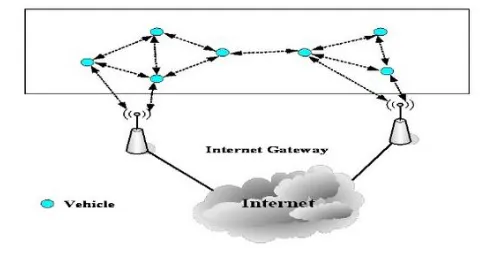
Fig. 1. System model of VANET environment.
Fig. 2. VANET environment. Key Challenges
In VANET system clouds are categorized as: Vehicular Clouds
Vehicles using Clouds Hybrid Clouds
Each cloud gives particular set of services depending upon the underlying communication paradigm. And each cloud sub-categorized into various methods. For convenience, we provide taxonomy of VANET cloud below. Vehicular cloud formed as combination of VANET and some cloud paradigms [9].
The challenges of VANET faced in cloud computing environment are mobile authenticity, conditional anonymity and virtualization. Researchers should be focused their concentration in CC-V to solve some main problems.
Simple architectural design Authentication issues Data offloading Data isolation
Application design and deployment Localization issues
Heterogeneous vehicle environment Intermittent connection
Support of network intelligence
By using cloud computing feature developers do not need large capital outlays in hardware to deploy to provide internet service. In present, VANET authorities use ILD (Inductive Loop Detector) for traffic monitoring. The multilevel view in the cloud helps providing route plan and improving the overall situations of the traffic system.
Cloud computing changed the computation and communication scenario by decoupling computational assets from physical infrastructure thereby enabling visualization [10]. Logically VANET clouds inherit their parental long chased security.
1.3 Applications of Cloud Computing in VANET Parking management
Traffic management and monitoring Safety oriented
Alert management
Vehicle maintenance controlling Data storage applications
Emergency messages management 1.4 Issues of Cloud Computing in VANET
Confidentiality issue Privacy and security issue Communicational issue Data security issue Information retrieval issue
Cloud computing is worked on two major dimensions of research in VANET system. The framework of CC-V improves the reliability an efficiency of the ITS applications.This paper is organized as follows. In section 1 we define fundamental concepts of VANET and cloud computing in VANET system. In section 2 we discussed some related works in VANET cloud computing fields. In section 3 we provide methods in cloud computing. In section 4 we gave conclusion and at last we give references which were used in preparing this paper.
2 RELATED
WORK
Recently cloud computing feature has .been increased its development in the field of communication in VANET system environment. It has been happened because usage of powerful embedded sensors in VANET communication. Cloud computing requires high speed internet, parallel processing and virtualization. Hence fast and efficient information spraying is an essential precondition for CC-V in VANET system.Po-Ting Wie [11] envisaged the next paradigm shift from VANET to CC-V by merging VANET with cloud computing. In [12] Sumraa and co-others recommended a way to notify the accurate point by using the location of nearby vehicle nodes. The authors in [13] proposed a heterogeneous network called SDVN (Software Defined Vehicular Ad hoc Network) for improving the scalability of vehicular nodes in VANET. Similarly in [14] the authors designed RSU-CRM (Road Side Unit-Cloud Resource Management) for VANET system to Fig. 4. VANET Cloud Taxonomy
1802 IJSTR©2019
increase the QoS (Quality of Service) features. Many researches on cloud computing in VANET have been done mainly in two major themes including cloud computing in VANET (CC-V) and Vehicle using Cloud (VuC). With cloud computing we can solve communication messages storage and retrieval for propagating safety messages to nearby authenticated vehicle nodes in VANET system. Cloud computing allows us to store the VANET data in a way that users can reutilize it to enhance the performance of network.In [15] authors described how to address location awareness services using cloud computing in VANET system. In modern days cloud computing is ultimate solution to any type problems. The big type benefit of cloud computing is any user an access data from anywhere and anytime. In cloud on can store massive data at any centralized data base. Cloud services enable its users in business context also to operate IT applications on an OpEX(Operating Expenses which can be defined as the funds an organizing sector uses to run its daily business) which model rather than capEX(Caapital expenditures allows users to store the data and these are spending your business put towards fixed assets) model.Bernstein et al. [16] described PaaS (Platform as a service) approach for the mobile domain with possible available potential applications. With usage of cloud resources, the data processed efficiently according to user requirement. But vehicular cloud is not applicable if service providers are very highly dynamic in nature.Zhang et al. [17] proposed a method which combines vehicular clouds and cloudlets in order to provide computing capabilities to Smartphone. This mechanism depends on two conditions: first is a reliable connection between Smartphone and CC-V. Second is availability of resources in vehicle cloud. Vehicular clouds are enriched with dynamicity as vehicle can move unexpectedly which is affected the performance of vehicular cloud. Modern storage of a cloud is totally different with traditional cloud storage service which is managed by cloud storage service. Ghazizhadeh et al. [18] proposed a prediction model based on fault tolerance for task distribution in a vehicular cloud in VANET. The entire framework CC-V is based on volunteer computing where a vehicular node shares their computing power with other vehicular node in VANET. In CC-V to control internet traffic a cluster head is defined who is responsible for task distribution and data gathering.Dressler et al. [19] proposed a data storage and data retrieval framework based on VCP (Virtual Cloud Protocol) which was designed to work on built-in storage of parked vehicles. It utilizes the concepts of hash table by use of hashing. Vehicles data storage services are not only limited to the data offloading mechanism, but also the combined storage capabilities. Mensi et al. [20] developed a framework to utilize the storage capacity of volunteer vehicles for VANET environment.Authors in [21] try to solve the security issue in VANET using cloud computing. Normally, cloud computing has three layers in its structure. First is cloud layer which is depends upon the stationary data centers and available vehicular resources. Second is client layer which is designed and developed by many end cloud users. Last but not least is communication layer which is main for data communication in a CC-V and to ensure the connection between client located in the lower layer and VANET cloud server. Salibitam et al. [22] proposed a novel computing mechanism for VANET cloud in VANET. Individual cloud service providers would be responsible for technical operation of their cloud in VANET.Mershed and Artil
[23] tried to solve the problem by enabling the vehicular nodes to discover their needed services. Bessani et al. [24] designed a scheme to solve security issues of cloud computing in data communication of VANET system by using cryptography. Cachin et al. [25] did a comprehensive survey on data integrity and consistency in clouds. Vehicles share their location information in he form of communication waypoints with cloud infrastructure in VANET with optimal routing algorithm. Qin et al. [26] discovered a could-based routing mechanism in VANET which provides efficient routing services in CC-V.Leng and Zhao [27] proposed an intelligent internet-of-vehicles system to collect traffic congestion information from external environments in real time from cloud computing for VANET system. Vehicular distributing computing in CC-V is always has numerous favorable solutions in ordinary distributing computing in VANET system.One form of cloud computing is the ECC (Edge Cloud Computing) framework interconnects edge devices of IOT (Internet of things) with conventional cloud computing. This is also called as MEC (Multi-access Edge Computing). MEC is identified as a key architectural technology for Iota and mission critical problems in CC-V. One of the critical challenges in cloud computing is end-to-end responsiveness between the clouds and associated vehicular nodes in VANET. In order to address the end-to-end-responsiveness problem cloudlet is proposed [28] in cloud computing. In order to facing the future problems in cloud computing SDN (Software Defined Network) and NFV (Network Function Virtualization) are being developed. NFV enables edge devices to provide computing services and to operate network all functions in VANET system.
3 METHODOLOGY
Future VANETs and its applications will go beyond the current trend and integrate with new emerging technologies which introduce new functionalities in VANET system services. One of key solutions for VANETs future problems will be heterogeneous with implementation of below methods where the OBUs of the vehicles are equipped with powerful communication technologies like IEEE 802.11p.
Detailed information about the creation and submission of images for articles can be found at: http://www.ijstr.org. We strongly encourage authors to carefully review the material
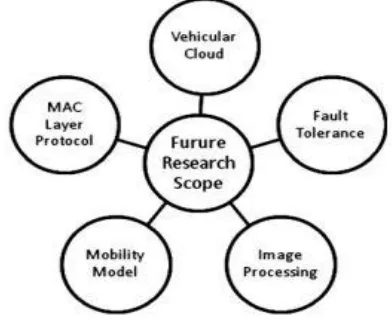
3.1 VANET Future Research Scope
In VANET research will have done on below features in order to get better communication in VANET system.
Vehicular cloud Fault tolerance Image processing Mobility model MAC layer protocol
3.1.1 Vehicular Cloud
Cloud computing has various advantages only when this is implemented in vehicular network from software to hardware. This also provides on-demand resources to needy user.
3.1.2 Fault Tolerance
This mechanism has been developed to limit the fault in the system. In VANET scenario, if any wrong goes with a vehicular node then problem will be created in whole network system and packet drop occurs. So, in order to overcome this problem in a way such that removes the fault tolerance from the system.
3.1.3 Image Processing
Now a day in greatest technologies image processing is in top 5 lists. It is wide area of research. A vehicular node can take the user image and track the user by placing the camera in vehicle. Such a way we can provide safety to use in VANET system.
3.1.4 Mobility Model
Mobility means to move freely within network or network cluster. It is the most challenging area to be solved to overcome this mobility model properly in real-time scenario.
3.1.5 MAC Layer Protocol
The main task of MAC (Medium Access Control) Layer Protocol in network is to make fast data exchange among vehicular nodes in VANET. So, in every part of network we can involve with this Protocol. However, next generation VANET system has special requirements of autonomous vehicles with low latency, connectivity, high mobility, and real-time applications which are not solved by conventional cloud computing. So, merging of fog computing with conventional cloud computing may be a potential solution for several issues in present and future VANET system.
3.2 Cloud Computing Platforms
The cloud service can be classified into distribution models in the form of layers. Every cloud computing platform has allows with various services.
Naas(Network as a Service) Stash(Storage as a service) Camas(Computing as a Service) Peas(Platform as a service) Iasi(Infrastructure as a Service) SessS(Sensing as a Service)
This classification in the form of a tree is depicted as:
3.3 Vehicular Edge Cloud computing
It is equal to a form of cloud computing which connects various IoT edge devices and conventional cloud computing. It consists of virtualized data centers distributed in different data locations. It has flexibility technology with providing high bandwidth and low latency. It provides cloud services with better performance. Even though, VANET uses the cloud computing to solve the many existing problems, still there are some fundamental problems related to communication. Based on the unstoppable development of cloud computing in VANET system we can solve existing problems by using three types of mechanisms in ECC. These mechanisms are:
Fog Computing
MEC(Multi-access Edge Computing) Cloudlets
3.3.1 Fog Cloud Computing
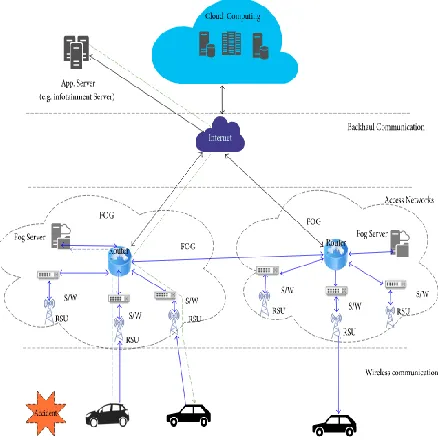
The fog platform is between the conventional cloud environment data centers and vehicular nodes. In fog computing environment all type of communication will be done using IP (Internet Protocol). It provides low latency service. A fog server connects the cloud and other fog devices using wired connections on the internet.
Fig. 7. Cloud services various forms
1804 IJSTR©2019
3.3.2 MEC (Multi-access Edge Computing)
This MEC technology is developed as to be implemented at the communication base stations of VANET in order to provide flexible and efficient services to users of VANET. It moves the traffic computing and services from a main operating cloud to edge of the network. The main purpose of MEC is to integrate the all the base stations of VANET in communication way. The MEC server provides best connectivity among base stations and nodes, data storage management, and accurate data sharing services.
3.3.3 Cloudlets
A cloudlet is used in VANET as a flexible solution which deals in critical network connectivity situations. A cloudlet is a network performance enhanced small cloud data center.
4
C
ONCLUSIONVANET is an emerging and prominent research area with tremendous developing technologies in networks especially in network security. In future VANET will have to be followed fast communication with security. By reading this paper a user of VANET able to understand fundamental concepts about cloud computing. Here we outlined key challenges to be resolved in VANET. Moreover, we present overview of cloud computing and different mechanisms in edge computing which fall under the same umbrella.
ACKNOWLEDGMENT
The authors would like to thank to all who have supported for preparation of this paper.
REFERENCES
[1] Kamini and Rakesh Kumar, ― VANET Parameters and applications : A Review‖, Global Journal of Computer Science and Technology, vol. 10, Issue. 7, pp. 72, 2010. [2] H. Hartenstain and K. P. Laberteaux, ―VANET : Vehicular
Applications and Inter Networking Technologies‖, Wisley Online Library, 2010.
[3] Venkatamangarao Nampally and Dr. M. Raghavender Sharma, ― Incresing Information Shareability by Using NTBS Clustering Approach for VANET‖, IPASJ International Journal of Computer Science, vol. 5, issue. 10, October 2017.
[4] E. Hossain, G. Chow, V. C. M. Leung et al., ― Vehicular telematics over heterogeneous wireless networks : a survey ―, Computer Communications, vol. 33, no. 7, pp. 775-793, 2010.
[5] Wenshuang Liang, Zhuorong Li, Hongyong Zhang, Shenling Wang and Rangfang Bie, ― Vehicular Ad Hoc Networks : Architectures, Research Issues, Methodologies, Challenges, and Trends‖, College of Information Technology and Science, Beijing Normal University, Beijing 100875, China.
[6] Venkatamangarao Nampally and Dr. M. Raghavender Sharma, ― Information Sharing Standards in Communication for VANET ―, International Journal of Scientific Research in Computer Science Applications and Management Studies, vol.7, issue.4, July 2018. [7] R. I. Meneguette, L. F. Bittencourt, and E. R. M. Medaira, ―
A Seamless flow mobility management architecture for Vehicular Communication Networks ―, Journal of Communications and Networks, vol.15, no.2, pp.207-216, 2013.
[8] Ashwini Abhale, Sumit Khandelwal and Uma Nagara, ―Shifting VANET to Cloud – Survey‖, International Journal of Advanced Research in Computer Science and Software engineering, vol.3, issue.11, November 2013.
[9] Hussain, J. Son, H. Eun and S. Kimand H, ―Rethinking Vehicular Communications: Merging VANET with Cloud Computing‖, IEEE 4 th Conference on Cloud Computing Technology and Science, , South Koria, 2012.
[10]M. Armbrust,, A. Fox, R. Griffith, A. D. Joseph, R. Katz, A. Konwinski, G. Lee, D. Patterson, A. Rabkin, I. Stoika, and M. Zaharia,, ―A View of Cloud Computing‖, Commun. ACM, vol.53, no.4, pp.50-58, 2010.
[11]Po-Ting Wei, Tai-Chi Wang, Shih-Yu Chang and Yeh-Ching Chung, ―Computing Traffic Information in the Cloud‖, International Journal of Grid and High Performance Computing, vol.6, no.1, pp.21-31, January Fig. 8. Fog computing structure in VANET
2014.
[12]Sumraa, H. Hasbullaha, J. Mananb, I. Ahmedc and M. Y. Aalsalemd, ―Trusted computing in Vehicular Ad hoc Network(VANET)‖, Computer Science Journal, vol.1, pp.928-933.
[13]Z. He, J. Cao and Xliu, ―SDVN: Enabling rapid network innovation for heterogeneous vehicular communication‖, IEEE Network, vol.30, no.4, pp.10-15, 2016.
[14]M. A. Salahudin, A. Al-Faqaha and M Gouani, ―Software Defined Networkink for RSU clouds I support of internet of vehicles‖, IEEE Internet of Things Journal, vol. 2, no. 2, pp. 133-144, 2015.
[15]Samuel Kofi Erskine and Khaled M. Elliethy, ―Secure Intelligent Vehicular Network Using Fog Computing‖, Eletronics MDPI, vol.8, 2019.
[16]D. Bernstein, N. Vidovic, and S. Modi, ―A Cloud PaaS for high scale function and velocity mobile applications – withreference application as the fully connected car‖, Proceedings of Systems and Networks Communications(ICSNC), 5 th International conference, pp.117-123, 2010.
[17]H. Zhang, Q. Zhang and X. Du, ―Toward vehicle-assisted cloud computing for smartphones‖, IEEE Trans. Veh. Technol., vol.64, no.12, pp.5610-5618, 2015.
[18]P. Ghazizhadeh, S. Olariu, A. G. Zhadeh and S. El-Tawab, ―in services computing(SCC)‖, IEEE International Conference on. Towards fault tolerant job assignment in vehicular cloud, pp.17-24, 2015.
[19]F. Dressler, P. Handle and C. Sommer, ―Towards a vehicular cloud-using parked vehicles as a temporary network and storage infrastructure‖, In Proceedings of the 2014 ACM International workshop on wireless and mobile technologies for smart cities, ACM, pp.11-18, 2014. [20]N. Mensi, M. Gouzani and A. makhlouf, ―study of vehicular
cloud during traffic congestion‖, In Proceedings of the Control Engineering and Information Technology(CEIT), IEEE 4 th International Conference , IEEE, pp.1-6, 2016. [21]Md. Ali Al Mamun, KharulAnam, Md. FakrulAlamOnik and
A M Esfar- E- Alam, ―Development of cloud computing into VANET to create Ad hoc cloud network architecture‖, In Proceedings of the World Congress on Engineering and Computer Science, WCECS, vol.1, October 2012.
[22]Salibitam, A. Mellouk and S. Zeadally, ―VANET cloud: a generic cloud computing model for Vehicular Ad hoc Networks‖, IEEE Wireless Communications, vol.22, no.1, pp.96-102, 2015.
[23]K. Marshed and H. Artail, ―Finding a STAR in a vehicular cloud‖, IEEE Intelligent Transport systems, vol.5, no. 2, pp. 55-68, 2013.
[24]A.Bessani, M. correia, B. Quiresma, F. Andre and P. Sousa, ―DepSky: Dependable and secure storage in a cloud-of-clouds‖, In Proceedings of 6 th conference on computer systems (EuroSys’11), Salzburg, Australia. [25]C. Cachin, I. Keidar, and A. Shraer, ―Trusting the cloud‖,
SIGACT news, vol.40, no. 2, pp. 81-86, 2009.
[26]Y. Qin, D. Haung and X. Zhang, ―Vehicloud: cloud computing facilitating routing in vehicular networks‖, proceedings of IEEE 11 th Int. Con. on Trust, Security and privacy in compting and communication, 2012.
[27]Y. Leng and L. Zhao, ―Novel design of intelligent internet of vehicles management system based on cloud computing and internet-of-things‖, in Proc. of Int. Conf. Electron. Mech. Eng. Inf. Technology, Harbin, China, vol.
6, pp. 3190-3193, 2011.
[28]Z. Sanaii, S. Abolfazli, A. Gani and R. Byya, ―Heterogeneity in mobile cloud computing: taxonomy and open challenges‖, IEEE Commun. Serv. Tutorials, vol.16, pp. 369-392, 2014.
Authors Profile
Dr. M. Raghavender Sharma
completed Bachelor of Science in Mathematics, Master of Science in Statistics, and achieved Doctoral Degree in Statistics, all degrees
from OsmaniaUniversity,
Hyderabad, Telangana, India.
Currently he is working as
assistant professor in the
department of statistics at University College of Science, Osmania University, Hyderabad, Telangana, India. He is supervising many PhD Scholars (in statistics and Computer Science subjects)and he has published more than 25 articles in national, international journals. He has excellent teaching track record with 30 years teaching experience and 20 years Research experience. He published above 25 journals.
Mr. Venkatamangarao Nampally ([email protected]) pursued Bachelor of Science in Computer Science, Master of Science in Computer Science and Master of Technology in Computer Science & Engineering, all degrees from