International Journal in Management and Social Science (Impact Factor- 4.358)
GREEN BUILDING : A NEW WAVE IN INDIA
Ms. Mamta(Assistant Professor)
Janki Devi Memorial College , University of Delhi
Abstract
India is experiencing anincredible growth in the construction and real estate industry. Due to this rise in the construction sector raised many issues related to the environment and sustainability.As per economic policy forum, in its report mentioned that in India the energy consumption in buildings is for heating, ventilation and air Conditioner accounts for between 45% and 65% of total electricity consumption. Another study states that the construction sector of India emits about 22% of the total annual emission of CO2 which is very harmful for the environment. So to handle the adverse situation a new and important concept is emerging in India that is Green Building. So this article gives you the understanding about the green buildings, How the green building get rating from the rating agencies, Importance of green buildings, and examples of some companies and organization that are taking the advantage of green wave and is flourishing.
Keywords: Green Building, Green House gas, Sustainability, LEED, IGBC
Introduction
The construction industry of India has seena greatprogress over the last few years. In today‟s scenario,the major portion of our GDP consist of construction industry as in 2011 the industry solely contributed nearly
6708 billion to the national GDP.
Figure 1
According to IBEF (India brand equity foundation) the market size of real estate in india
International Journal in Management and Social Science (Impact Factor- 4.358)
So as the industry is spreading it has also witnessed the considerable transformation from traditional building manufacturing to the green building manufacturing. So this green building concept came into limelight from the last few years .A large number of consumers these days are becoming aware of sustainability and thus demand for the energy efficient buildings that can help in minimizing the adverse effect on the environment. As per economic policy forum, in its report mentioned that in India the energy consumption in buildings for heating, ventilation and Air Conditioner accounts for between 45% and 65% of total electricity consumption. As per the study of khaled A. Al- Sallel in his paper(review of Buildings Energy Challenges), the construction sector of Indiaemits about 22% of the total annual emission of CO2which is very harmful for the surroundings. So to tackle the adverse situation it is important to use energy saving appliances instead of conventional appliances that consume less energy couldhelp in saving 20,000 megawatts energy annually. By using smarter lighting system in the buildings that if lights remain on by mistake then it can automatically be switches off when nobody is present in the room can helps in saving the energyor by using air based flushing system toilets or the recycled water can also be used to reduce the wastage of water . To reduce the GHG (Greenhouse gas) emission,Solar thermal systems can also be installed in the buildings. There is potential to reduce GHG emissions by 142 megatonnes a year by 2020 through the adoption of energy-efficient measures. These simple techniques can helps in making your building a green building that is safer for you to live in.So now the question raise here is what is Green Building? What are the advantages of Green buildings? What are the famous structures in India that are labeled as Green Building? What is the procedure to get the green building certification?So to start with the meaning of Green Building.
What is Green Building?
A green building is one which uses lesser energy, water, natural resources & creates less waste and is healthier& safer for the people to live in. Some of the features of green building are:
Energy saving to the extent of 30 - 40 %
A green building has a great capacity to reduce the energy consumption. As few studies had also proved that installing energy saving appliances can remarkablyreduce the energy and also helps in savings our natural resources.
Enhanced indoor air quality
International Journal in Management and Social Science (Impact Factor- 4.358)
which is one of the main cause of dust mites and bacteria and generation of deadly diseases. So goodventilation systems enhanced the air quality of the building and protect the people from the diseases.
Higher productivity of occupants
Green building consists of the non- toxic material,proper ventilation which helps in reducing the toxic gases, bacteria and also balanced the temperature of indoorand thus make safer and healthier for the people.
Use of non-toxic material
Green buildings are built from renewable, non-toxic, reusable and recyclable materials. For manufacturing building low emission material are used like nowadays low volatile organic compounds paints are used by the constructor .VOC Paints are dangerous for the environment it quickly enter into air and create a ozone and cause air pollution. Soby using non-toxic material also enhanced the life occupancy.
Increased watersaving upto 20% - 30% and efficient use of water recycling
Water saving is another important factor in sustainable building. Water can be wasted by leaking (toilet leaking can waste up to 90 gallons per day), pool showers, while doing construction work and from other activities. Recycling rainwater and using it for toilet flushing, gardening, washing and other way can save waste-water.
• Less Costly
Green building is considered to be expensive than the conventional building.But this theory is not true as per the Californian Sustainable Building Task Force carried out a study in 2003, according to this study even 20% of investment into green building will elaborate 10 times more saving. So there is no significant difference in prices.
How the Green Building gets their certification and what is the Rating System in India?
International Journal in Management and Social Science (Impact Factor- 4.358)
has 2190 LEED registered buildings and 398 LEED certified buildings with 1.26 billion square feet buildup area. Now how to get the LEED certification the building project must has to get them rated from the rating agencies.The three main rating systems for Green buildings in India are:
1. IGBC 2. GRIHA 3. BEE
Other rating scheme:
1. EDGE
1. Indian Green Building Council (IGBC)
Indian Green Building Council (IGBC) has licensed the LEED Green Building Standard from the U.S. Green Building Council and is responsible for providing the LEED Certificate in India. Giving a brief of IGBC. IGBC is formed by Confederation of Indian Industry (CII) in 2001 and is deliberately doing effort to promote ecofriendly concept in the Indian industry. IGBC is the non- profit research institution having its offices in CII-Sohrabji Godrej Green Business Centre, which is itself a LEED certified Green building and was awarded with the prestigious Platinum rated green building rating in India. Since then the Green Building movement in India has boost up and get the recognition.
IGBC promotes sustainabilitybased on the principles of five performances in the following areas:
Sustainable site development Water saving
Energy efficiency Materials selection
Indoor environmental quality
IGBC has also launched different rating programs to suit variety of building types.
a) IGBC Green Homes Version b) IGBC Green Factory Building c) IGBC Green SEZs
International Journal in Management and Social Science (Impact Factor- 4.358)
e) LEED 2011 for India - New Construction f) LEED 2011 for India
Registration Process:
a) Registration is the initial step in IGBC. Project team interested in IGBC certification must first register itself by submitting the necessary documents and other important information as required by IGBC. And once the project is registered the project team can start preparing for documentation to satisfy mandatory requirements.
Certification
a) To get the IGBC rating, the project must satisfy all the requirements and the must score the minimum number of credit points. At preliminary stage the project team is expected to provide supporting documents after the preliminary submission, review is done by third party assessors and review comments would be provided within 30 working days.
b) The next phase involves submission of clarifications to preliminary review queries and final submittal within 30 days and then the rating is awarded.
2. Green Rating for Integrated Habitat Assessment (GRIHA)
GRIHA is India‟s own rating system developed by TERI and Ministry of New and Renewable Energy, GOI. The ratingprocess begins with the online submission of documents as per the prescribed criteria followed by onsite visit by a team of professionals from GRIHA Secretariat. GRIHA rating system consists of 34 criteria categorized in four different sections.
a) Site selection and site planning
b) Conservation and efficient utilization of resources c) Building operation and maintenance
d) Innovation
3.Bureau of Energy Efficiency (BEE)
International Journal in Management and Social Science (Impact Factor- 4.358)
building.BEE has launched the Energy Conservation Building Code (ECBC). This code is set for energy efficiency standards for design and construction with any building of minimum conditioned area of 1000 Sqmts and a connected demand of power of 500 KW. The Reserve Bank of India‟s buildings in Delhi and Bhubaneswar, the CII Sohrabji Godrej Green Business Centre and many other buildings have received BEE 5 star ratings.
4. EDGE (Excellence in Design for Greater Efficiencies) Program in India
The IFC, a member of the World Bank Group, and the Confederation of Real Estate Developers Associations of India (CREDAI), a body of private real estate developers, have also promoting green buildings in the country through IFC‟s EDGEcertification.EDGE focuses on energy and water efficiency in buildings.Itallows the builders and home-owners to choose environment-friendly technical solutions while capturing costs and projected savings. And the result is saving of atleast 20% in energy,water and material according to the IFC Report.Serge Devieux, IFC‟s Regional Director for South Asia said that “We aim to help builders introduce cost-effective green features into their designs and work with financial institutions and the government, to support their widespread adoption.”
Now have a glance on some of the famous green buildings in India?
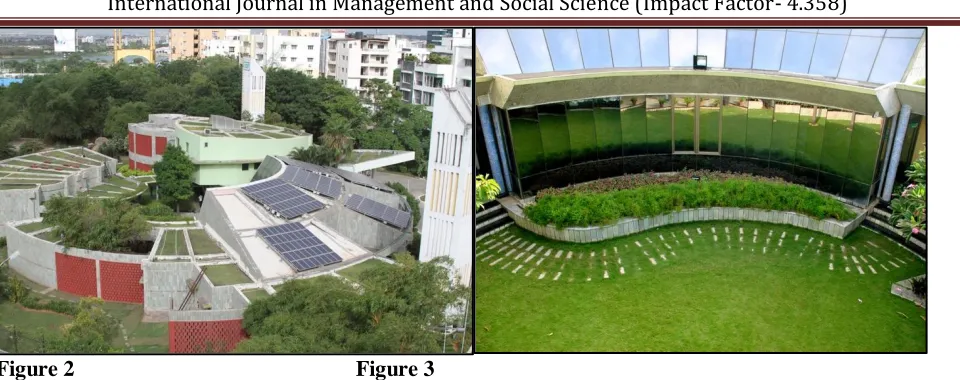
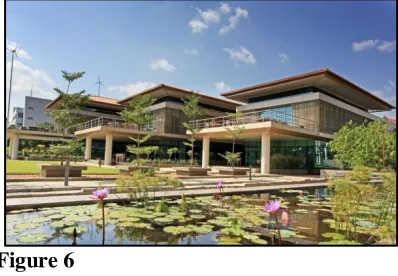
1. CII - Sohrabji Godrej Green Business Centre
International Journal in Management and Social Science (Impact Factor- 4.358)
Figure 2 Figure 3
2. Biodiversity Conservation India Ltd (BCIL) – Bangalore
BCIL-ZED (ZED stands for “Zero Energy Development”) is one of Asia‟s largest Green Building platinum-rated residential apartment complex is achieving lots of awards related to the designing and the structure of building. BCIL did not use bricks, concrete blocks,Chemical paints in its construction.
Figure 4
3. ITC Green Centre- Gurgaon
The ITC Green Centre is also certified as one of the world's greenest buildings located in the city's famous hub, Gurgaon, the ITC (Indian Tobacco Company) Green Centre, a 170,000 square foot office complex had captured the prestigious LEEDS Platinum Award in 2004. The USGBC has re-certified the ITC Green Centre in 2012 as the world's highest Platinum rated green building. As per the ITC
sources the energy use by ITC Green centre has reduced by 51% and every drop of the
rainwater is recycled and used for the gardening in the building.
International Journal in Management and Social Science (Impact Factor- 4.358)
Figure 5
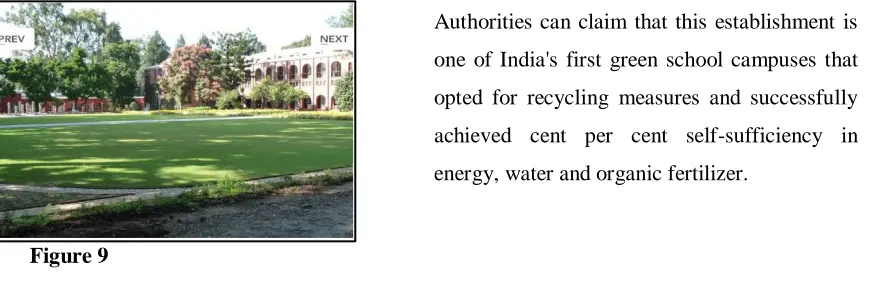
4. Suzlon Energy Limited –Pune
Suzlon Energy Limited has also succeeded in adding its name in the famous green building list. The building has three floors and is sited on 10.5 acres area. It achieved LEED for new construction Platinum certification from the IGBC, as well as Five-Star GRIHA certification. As per the organization report, 5% of its annual energy is generated on-site through conventional and building-integrated photovoltaic panels (20%) and wind turbines (80%).
Figure 6
5. Birla International School, Jaipur
Even the international schools are also into the race of green building rating system. Apart from corporate sector and residential areas many schools are also taking the initiative to provide the healthier and safer environment to the students and so they are getting their registration done for the rating.
Hillary Clinton, then US secretary of state said when she visited the Green Centre"This building may not be a regular stop on the tourist map, and no one would confuse it with the TajMahal. But it is a monument to the future,".
International Journal in Management and Social Science (Impact Factor- 4.358)
Figure 7
6. Solar Air Conditioning- Turbo Energy Limited, Chennai
The R & D Administrative Building of TEL was awarded with the prestigious Platinum award from LEED USGBC in 2009 and had got 62 points out of 69 from Leed.The solar air conditioning in Turbo Energy systems in Chennai uses solar power to control the air in the building by using photovoltaic cells to generate electricity form solar energy to be used for lighting of the office. Albido paint was applied on the roof with reflectivity of 82% and shading effect by solar dishes.
Figure 8
7. Doon School Residential Buildings
The old buildings at the Doon School, Dehradun, were demolished and five duplex three-bed room masterresidences were constructed. The exterior of the buildings have exposed brickwork with sloping profile sheeting.
Figure 9
The building has on/off type day lighting control to reduce artificial lighting energy consumption. Rain water from roof harvested in ponds through pipes and this water is then used for the factory usage, gardening and for other purpose.
The LEED India has thus awarded the prize to Birla international school for its splendid environment friendly Green building
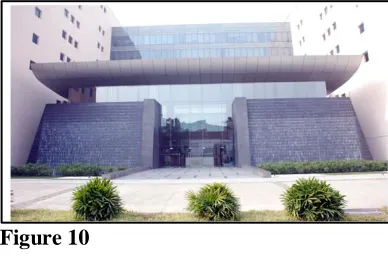
International Journal in Management and Social Science (Impact Factor- 4.358) 8. Nokia - Gurgaon
Another India‟s most sustainable buildings is the office of Nokia in Gurgaon which has been awarded the Green Building Award and prestigious LEED „Gold‟ rating by USGBC. It‟s smart lighting and ventilation systems, high-efficiency chillers, heat recovery wheel, green guard certified furniture and online CO2 monitoring system makes it most sustainable & reliable building.According to Nokia India officials, benefits realised from the green establishment include 30 per cent energy savings, 35 per cent water savings and improved health (not quantifiable) of its occupants over a sustained period.
Figure 10
9. Indira Gandhi International Airport – Delhi T3
Terminal 3 has been awarded green building “LEED INDIA GOLD” rating from IGBC. The „Leadership in Energy and Environmental Design New Construction' rating was awarded to T3 for features like sustainability, water efficiency, energy and atmosphere, material and resources, indoor environmental quality and innovation in design categories.
Figure 11
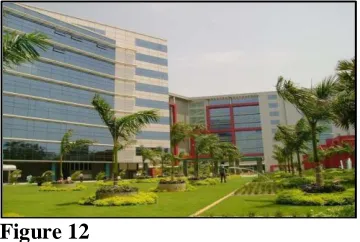
10.Olympia Tech Park, Chennai
By effective usage of grey water in the building, Olympia Techpark in Chennai has able to meet its heating and cooling requirements. They have a dual pumping line where the treated gray water is used for flushing
"The recorded energy consumption at the Nokia office in Gurgaon is 143.96 KWH/SqMtr per year," Kaul said. In 2011, Nokia used 40 per cent of renewable electricity.
Important features of T3: Sustainability Water efficiency
Energy and atmosphere, Material and resources
International Journal in Management and Social Science (Impact Factor- 4.358)
or in irrigation. With a HVAC system they are able to have cool, indoor comfort when it‟s hot outside providing a year-round indoor comfort solution.
Figure 12
11.RMZ Millenia Business Park, Chennai
RMZ Millenia Business Park in Chennai is the famous net zero energy building. Its design emphasizes conservation featuring trees to reduce adverse environmental impact, adequate natural light and shaded landscaped areas to reduce ambient temperature.
Figure 13
It is just a beginning for the green buildings concept in India. India has a significantly hugeopportunities for manufacturing the green building. According to the vice-chairman of IGBC, Goa, Bharat Kamat, “by the year 2030 India will expected to reach to building 100billion sqft from the existing 25 billion sqft”. India has over 2,380 registered green building projects and is amongst the top five countries in the world involved in spearheading the global green building movement.According to the latest US Green Building Council report, India has been ranked third on the list of top 10 countries in LEED outside America, Canada followed by China occupy the top two slots in the ranking of the top 10 countries for LEED outside the US. The ranking of the top 10 countries is based on cumulative gross square meters (GSM) of space certified to LEED in each nation as of April 2014, a statement said. Canada tops the list, with 17.74 million GSM of LEED space with 4,068 total LEED-registered projects, representing. China and India, two of the world's fastest growing economies, took second and third place on the list having 14.30 million and 11.64 million GSM of
LEED-certified space respectively, the statement said.
International Journal in Management and Social Science (Impact Factor- 4.358)
To gear up the green building concept in India the Energy and Resources Institute (TERI) and the US Green Building Council (USGBC) have entered into a strategic collaboration for the development of high performance buildings in India and Southeast Asia. So now it is also the responsibility of the citizens to save the environment and move their step ahead for the sustainability.
References:
(n.d.). Promoting sustainable and inclusive grownth in emerging economies. delhi.
Sallal, K. A. (2014). A Review of Buildings Energy Challenges. International journal of Environment and Sustainability, 3(1), 42.
http://www.thealternative.in/lifestyle/10-green-building-innovations-in-india/
https://igbc.in/igbc/
http://en.wikipedia.org/wiki/Green_building_in_India
http://www.greenbuildingcongress.com/site/gbc/aboutevent.jsp
www.ifc.org/edge
https://greenbuildingsindia.wordpress.com/2013/07/04/biodiversity-conservation-india-ltd-bcil-green-building-in-banglore/
http://www.aprekh.org/files/K_R_Ramamoorthy.pdf http://in.usgbc.org/projects/suzlon-one-earth
https://www.equitymaster.com/research-it/sector-info/construction/Construction-Sector-Analysis-Report.asp
http://www.ibef.org/industry/real-estate-india.aspx
http://www.kpmg.com/IN/en/IssuesAndInsights/ArticlesPublications/Documents/Indian-real-estate-Opening-doors.pdf
http://ibnlive.in.com/news/dmrc-observes-world-green-building-week/500996-3-244.html
International Journal in Management and Social Science (Impact Factor- 4.358)
http://timesofindia.indiatimes.com/home/environment/developmental-issues/India-in-top-five-position-in-spearheading-the-global-green-building-movement-IGBC/articleshow/30368691.cms
http://timesofindia.indiatimes.com/home/environment/the-good-earth/India-3rd-on-list-of-green-buildings-countries-outside-US/articleshow/34572733.cms
http://www.business-standard.com/content/b2b-manufacturing-industry/teri-and-usgbc-to-promote-green-buildings-in-india-114070700772_1.html
http://greencleanguide.com/2012/08/22/three-primary-rating-systems-for-green-buildings-in-india/
http://timesofindia.indiatimes.com/city/kolhapur/MEDA-KMC-to-hold-joint-workshop-Building-Code-in-city-on-Thursday/articleshow/46053806.cms
http://timesofindia.indiatimes.com/city/gurgaon/Top-green-award-for-Gurgaon-school/articleshow/40294274.cms
https://www.economic-policy-forum.org/wp-content/uploads/2014/05/Green-Buildings-final.pdf
http://www.castaliahomes.com/blog/advantages-disadvantages-green-building/
http://web.b.ebscohost.com/ehost/detail/detail?sid=247c7897-b2a8-4478-9bd6-7a0309823a9a%40sessionmgr198&vid=0&hid=101&bdata=JnNpdGU9ZWhvc3QtbGl2ZQ%3d%3d#db=n5 h&AN=DBV5BEN9085EEB9818206C1