IJEDR1402146
International Journal of Engineering Development and Research (www.ijedr.org)2190
Basic Encoding and Decoding Process of QR Code
using Text and Image
1Rathod Rinkalkumar M, 2Prof. Kalpesh R Jadav 1P.G Student, 2Assistant Professor
E&C Dept, PIET Limda,vadodara,Gujarat,India.
1[email protected],2[email protected]
______________________________________________________________________________________________________
Abstract - In this paper discusses about in many commercial applications QR codes use, because of the different basic structure of QR codes with respect to the other two-dimensional bar codes with widely used in high speed. There are four basic types of mode conversion QR code numeric characters, alphabet and symbols, binary and Chinese characters encoded data. QR Code encoding and decoding different methods which provide secure communication with less cost than the other two-dimensional barcodes .In this QR Code instead of text use small size of image like Black white and Color image which give reliable Result, good error correction, good quality Result for communication.
Key Words: QR Code Overview, QR Code encoding of text, QR Code encoding of image
________________________________________________________________________________________________________
I.
ENCODING PROCEDURE OVERVIEWData Analysis
The data were analyzed to determine the input stream will be included in a variety of characters. QR code contains several methods by character code to allow a different subset of characters [2] to be converted is valid. It can basically have character sets supported by ISO/IEC 646 and ISO/IEC 10646. QR Code has four types of conversion mode - numerical characters, alphanumerical/signs, binary, and Chinese characters - for encoding the data.[1] [6]
1. Numeric Mode - Numeric mode encodes data from the decimal digit set (0 - 9)
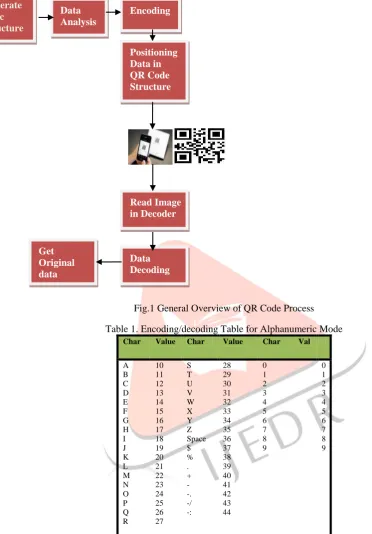
2. Alphanumeric Mode - Alphanumeric Mode encodes data from a set of 45 characters, i.e. 10 numeric digits (0 - 9) 26 alphabetic characters (A - Z) and 9 symbols (SP, $, %, *, +, -, ., /, :). As shown in Table2 is representation of various modes of characters during encoding and decoding process.
3. Kanji Mode – The Kanji mode handles Kanji characters in accordance with the Shift JIS system based on JIS X 0208. [2]
Data Encodation
The data will be encoded into the Binary numbers of ‗0‘ and ‗1‘ depending on the encoding rule.
Error Correction Functionality
IJEDR1402146
International Journal of Engineering Development and Research (www.ijedr.org)2191
Fig.1 General Overview of QR Code Process
Table 1. Encoding/decoding Table for Alphanumeric Mode
Char Value Char Value Char Val
A B C D E F G H I J K L M N O P Q R 10 11 12 13 14 15 16 17 18 19 20 21 22 23 24 25 26 27 S T U V W X Y Z Space $ % . + - -. -/ -: 28 29 30 31 32 33 34 35 36 37 38 39 40 41 42 43 44 0 1 2 3 4 5 6 7 8 9 0 1 2 3 4 5 6 7 8 9
After capture image of QR Code we can apply reverse process by using above Fig.1 normalize the image and place image in require position to read it and Read Image in Decoder and then Decoding of Data and get back Get Original data. Here is below given some basic Information of encoding and decoding algorithm of QR Code by using Reed-Solomon.
Reed-Solomon Algorithm
IJEDR1402146
International Journal of Engineering Development and Research (www.ijedr.org)2192
K Symbols 2t Symbols
Fig.2 RS (n, k) Code
Each symbol consists of m number of bits. which means that the encoder takes k data symbols and adds parity symbols to make an n symbol codeword. The relationship between symbol size, m, and the size of the codeword, n, is given
n = 2^m - 1 Eq. (1)
The RS code can correct upto t number of symbol errors where t is given by t = n- k/2 Eq. (2)
Reed-Solomon Encoding
1. Finite (Galois) Field Arithmetic
Reed-Solomon codes are based on a specialist area of mathematics known as Galois fields or finite fields. A finite field has the property that arithmetic operations (+,-, x, / etc.) on field elements always have a result in the field. A Reed-Solomon encoder or decoder needs to carry out these arithmetic operations. [5] [4]
2. Generator Polynomial
A Reed-Solomon codeword is generated using a special polynomial. All valid code words are exactly divisible by the generator polynomial. The general form of the generator polynomial is shown in Eq. (3):
g(x) = (x-αi)( x-αi+1)….( x-αi+2t) Eq. (3) And the codeword is constructed using:
c(x) = g(x).i(x) Eq. (4)
Where in Eq. (4) g(x) is the generator polynomial, i(x) is the information block, c(x) is a valid codeword and a is referred to as a primitive element of the field.
The 2t parity symbols in a systematic Reed-Solomon codeword are given by in Eq. (5) p(x) = i(x). xn-k mod g(x) [4] Eq. (5)
Reed-Solomon Decoding
A Reed-Solomon decoder attempts to identify the position and magnitude of up to t errors (or 2t erasures) and to correct the errors or erasures. The received codeword r(x) is the original (transmitted) codeword c(x) plus errors represented as shown in Eq. (6)
r(x) = c(x) + e(x) Eq. (6)
where e(x) representing an error polynomial with the same degree as c(x) and r(x). Once the decoder evaluates e(x) we can get the original codeword by adding e(x) to r(x). [4]
II. ENCODING AND DECODING OF DATA IN QR CODE SIMULATION RESULT
Enter Text as input for Encoding
Fig.3 simulation Result of encoding of Text
IJEDR1402146
International Journal of Engineering Development and Research (www.ijedr.org)2193
Fig.4 Simulation Result of Encoded QR Code for Text
Fig.5 Simulation Result of Decoding QR Code for Text
Input Black white Image
Fig.6 Simulation Result of input original Black white Image
IJEDR1402146
International Journal of Engineering Development and Research (www.ijedr.org)2194
Fig.8 Simulation Result of Encoded QR Code for Black white Image
Fig.9 Simulation Result of Decoding of Black white Image
Fig.10 Simulation Result of Difference between original and decoding image
Input color Image
Fig.11 Simulation Result of input original color Image
IJEDR1402146
International Journal of Engineering Development and Research (www.ijedr.org)2195
Fig.13 Simulation Result of Encoded QR Code for color Image
Fig.14 Simulation Result of Decoding of color Image
Fig.15 Simulation Result of Difference between original and decoding image
III.CONCLUSION
The QR code has a higher information carrying capacity, safety, and error-correcting capability so that the QR code has been widely used in the international and domestic. In QR Code RS Algorithm which reduces the complexity of decoding, improve error correction, and improves the recognition rate of QR Code. Since the process of implementing the algorithm, the implementation method are not only applicable to QR Code, process is not only true for the two-dimensional bar code, but also applies to the field of systems using RS shorten codes. RS Algorithm is which give better error correction capability in burst input data. By using RS Algorithm here we get reliable result for text and Black White and Color Image with good error correction by adding Parity checks with input message. We also see in this noise if noises are present after decoding of image in difference between original image and decoding image.
REFERENCE
[1] Eryang Chen, Lin Lei, ―Research and Realization of Encoding on QR Code‖, International Congress on ImageandSignalProcessing,2012,pp:1299-1302.
[2] International Standard, Information technology — Automatic identification and data capture techniques — Barcode symbology — QR Code, ISO/IEC 18004:2000(E), Firstedition2000-06-15.
[3] Chun Jin and Jianghong Yuan, Leilei Li, Eryang Chen, Gang Han, Tao Tang ‖ Optimization of RS Error-Correcting Decoding Algorithm for QR Code Verified in Android Phone‖, International Conference on BioMedical Engineering and Informatics (BMEI),2012 pp:573-576.
[4] Sanjeev Kumar, Ragini Gupta‖ Bit Error Rate Analysis of Reed-Solomon Code for Efficient Communication System‖, International Journal of Computer Applications, September 2011,Volume 30– No.12
[5] R. E. Blahut, "Transform Techniques for Error Control Codes," IBM Journal of Research and Development, Volume 23, pp. 299-315.