Low Temperature Catalytic
Heaters
THE CATAHEAT RANGE
OF FLAMELESS COMBUSTION SYSTEMS
By
J.
D.
MacConnell
Matthey Bishop Inc., Malvern, Pennsylvania
Platinum group metal catalysts are incorporated in the Cataheat flameless Combustion systems designed by Matthey Bishop to burn hydrocarbon fuels. These systems are safer and more escient than radiant heaters with an openflame. They are used i n portable heaters for a wide range of agricultural, industrial and recreational purposes.
The small radiant heaters that burn hydrocarbon fuels
-
propane, butane, me- thane/natural gas and liquid hydrocarbon fuels - are used widely because of their simple design, their portability, and the ready availability of fuels. The open flame heater presents obvious disadvantages as follows. An upset heater is a grave fire risk where the surroundings are flammable and this restricts usage in, for example, farm buildings. If there is incomplete combustion of the fuel then the flame tends to smoke and a build-up of soot occurs on the heater. And, most important, the temperature of the flame may exceed IOOO'C with much energy being wasted in heating the surrounding atmos- phere and in the emission of visible lightenergy.
T o avoid these problems it is necessary to suppress the flame, to ensure efficient combustion and to reduce emission of useless energy. The solution is to use a catalyst that permits combustion of the hydrocarbon fuels at much lower temperatures. A suitable catalyst enables oxidation of the fuel to take place a t a much lower energy level than would otherwise be possible. For example, using propane as fuel, combustion can take place on a catalyst at about 400"C, much lower than the 1000°C quoted above for a naked flame.
The properties of the platinum group metals have led to their wide use as catalysts
in oxidation reactions, including the oxidation of hydrocarbons. Technical staff in the Chemicals Division of Matthey Bishop have studied how these properties can best be adapted to construct low temperature cat- alytic heaters. They have developed a range of such platinum group metal catalysts, which are known as Cataheat, each of which is designed to operate with a specific type of fuel. Basically the Cataheat systems consist
of platinum group metals supported on new and improved substrates to produce catalytic burning surfaces suitable for use with each fuel. The characteristics of three types of Cataheat unit are summarised in the table opposite. Cataheat L has been developed for the combustion of liquid fuel such as white gasoline, Cataheat P for the combustion of propane or butane, and Cataheat M for combustion of methane/natural gas.
Cataheat systems reduce the temperature at which the oxidation reaction of combustion takes place to well below that at which com- bustion occurs in a flame. The reaction is still, of course, exothermic but the heat that is
Fig. 1 T h e S u p e r - R a y propane gas catalytic heater was developed m a i n l y f o r chicken brooders. M a d e by I m p a l a Industries Inc. f o r sale to farmers by the Anderson B o x Company of Indianapolis, it incorporates a tubular Catahsat jlameless combustion system .fafabricated by Matthey Bishop Inc. T h i s type of u n i t is particularly economic in f u e l consumption. Although the air in the brooder p e n does not feel very w a r m the chicks are penetrated b y the infra-red radiation and hence feel comfortable
carbon fuel to carbon dioxide and water during combustion on a Cataheat system.
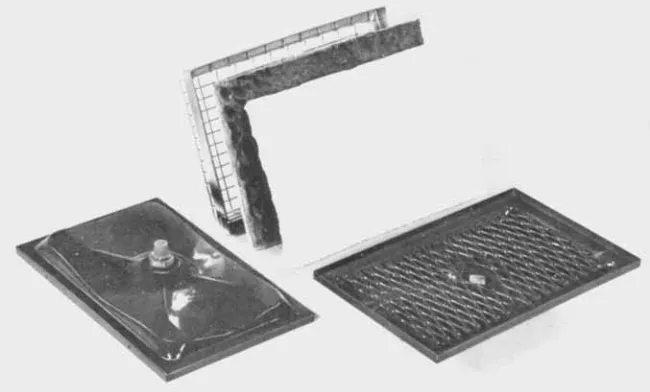
The general design of Cataheat units is
clear from Figs. z and 3. I n a typical unit the gaseous fuel is fed in through an orifice in the metal dish which serves as a reservoir of gas behind the catalyst pad. The dish is designed to spread the gas evenly to all
parts of the pad, otherwise there may be a temperature gradient across the face of the pad of something like IOO deg C while com- bustion is taking place. The combustion takes place on the surface of the fibres of the cat- alyst pad. A filter pad may be included as well. The front face of the catalyst pad is protected by strong wire mesh or by a
Operating Characteristics of Cataheat Units
Rating J/m2 (Btu/i n2)
Cataheat L 123 x 1 0 6
(liquid) (75)
Cataheat P 123 x106
(HD5 propane) (75)
Cataheat M 123 x 1 0 6
West Texas natural gas)
(methane- (75)
Air-free CO Measured by A.G.A. Pro- cedu res, p.p.m.
125
100
150
Approx. Ignition Temp.,
"C
250-280
250
330
Approx. Unburned
Surface Hydrocarbons Temp., as Hexane, "C p.p.m.
300-420 6000
290-500 1500
360-470 5000
Life, h
5000
+
1 0 , ~ +
1
o,ooo+
bustion can take place. Starting up with complex pilot lights or automatic electric ignition may be used but simple ignition with a match is normally sufficient with small heaters. I n those heaters fuelled with a liquid hydrocarbon, the vapour, which is heavier than air, must permeate the pad from below before it can be ignited. The catalyst must be preheated by one or other ignition method to about 120°C, at which temperature catalytic combustion commences.
The life of a Cataheat system, apart from gross physical damage, has proved to be the life of the catalyst. Eventual failure of the catalyst depends upon the quality of the fuel, impurities in which may be adsorbed on to active catalytic sites on the surface of the platinum group metals in the Cataheat system. Thus if pure fuel is used the life of a catalyst pad should be infinite. What deactivation does occur is unlikely to be due to sulphur in these strongly oxidising conditions but rather to traces of volatile metals in the fuel. Such traces accumulate on the catalyst and eventually have a deleterious effect. Signs of catalyst deactivation are evidenced by in- perforated metal screen. The most common
shape of catalyst pad (and therefore of heater) is rectangular,
Most heaters based on Cataheat units operate at gas pressures between four inches (10 cm) of water column and 15 p.s.i.g. (1.0 bar). T o commence operation
the units must be heated to raise the catalyst temperature to that at which catalytic com-
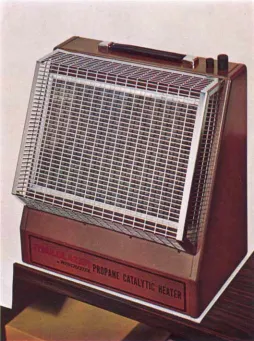
F i g 4 . The Trailblazer by Wznchester propane cataZytic heater manufactured by the Turner Corporation Division
of Olirt Corporation f o r out- door use. This model, which has a rectangular Cataheat system, operatw on gaseous propane with electric ignition. The Cataheat p ad can be seen behind the protective grill
creasing difficulty in lighting and by some parts of the pad surface ceasing to radiate heat. When this happens it is a simple matter to replace the pad with a new one.
Heater Standards
Although catalytic heater units have been developed in the United States, regulations governing their operation have not yet been finalised. Therefore Matthey Bishop along with heater manufacturers are applying standards which were designed for the traditional type of radiant heater with the open flame. The American Gas Association (A.G.A.) standards specify that the concen- tration in free air of carbon monoxide from such a heater should not exceed 200 p.p.m., air free basis. I n closed rooms with low
oxygen levels (15.1 per cent) the carbon
monoxide level should not exceed 500 p.p.m. Tests by Matthey Bishop over long periods of operation of Cataheat systems have indicated unburned hydrocarbon concentrations on the face of the catalyst pad of less than 1500 p.p.m., air free basis as hexane, and of carbon monoxide of less than IOO p.p.m. A.G.A. pro- cedures confirmed that the closed-room concentration of carbon monoxide was less than 50 p.p.m. The above tests were carried out using HD5 grade propane gas as fuel with heat emission of 123 x 106 J/mz (10,000
Btu/ftz). The emission readings remained unchanged over 2500 hours.
Fig. 5 The Coleman Company propane catalytic heater i n use i n camp for keeping a tent warm with complete safety
replace the oxygen burned up the com- bustion reaction will continue as long as fuel is supplied to the Cataheat system. However, the total reaction a t any one moment depends on the catalyst surface area. Hence, once the catalytic surface is fully operational, the rate of air flow is unimportant and the Cataheat system cannot be blown out. The unit is turned off by stopping the fuel supply. It is advisable, therefore, to fit a regulator to con- trol this supply.
Cataheat Applications
Cataheat flameless combustion units have been incorporated in heaters produced for the American market by several manu- facturers. Designs of heater based on the catalyst principle can be broadly classified into three major fields of application. These are recreational, agricultural and industrial.
The recreational applications cover the smallest types of heater, used for example in the heating of tents, cabins and any outdoor
use where heat is necessary for body comfort. In addition such heaters can be used for boats and for small vehicles such as golf carts. Figures 4, 5 and 6 show typical units for the above applications.
In the agricultural industry the advantages of Cataheat units are particularly apparent, especially in animal raising.
Animal raising benefits from warm con- ditions for stock and the first usc of catalytic heaters for this work 'was in 1969. Results were good and there has since been con- siderable demand for these heaters from farmers, particularly because of their re- duced fire risk in farm buildings.
Fig. 6 A Coleman liquid fuel (pure naphtha) unit which uses a Matthey Bishop Inc. Cata- heat L system. This type of camp heater has become very popular with outdoor en- thusiasts and is made in two sizes
ment Station has reported the results of tests demonstrating the superiority of flameless catalytic heaters over other gas-fuelled brooders and over electric units. These tests have revealed that the amount of pro- pane consumed in comparison to other types
of gas heaters was far less, while there were no major differences between the temperature of pens, the mortality of birds, or the feed efficiency. The advantages of catalytic heaters in this connection are stated as: almost complete combustion of gases with no emission of harmful fumes, the lightweight portable units enable easy observation of the poultry, the infra-red heat is directed down- wards and does not heat up the rest of the brooder houses, the flameless heater Is practically fireproof. Tests showed that day-old chicks moved about more freely under a tubular catalytic heater than under traditional units. The air in the pens did not feel as warm but the infra-red radiation
penetrated the chicks and they felt com- fortable.
Industrial uses include heaters for small factory vehicles. Trolley-borne units can be installed wherever heat is wanted tem- porarily, on a building site, for example, or elsewhere when public utility workers are out of doors. Further industrial uses extend to drying operations such as paint application, and to anywhere that safe radiant energy is
needed.