Journal of Hepatocellular Carcinoma
Dove
press
O r i g i n a l r e s e a r C H
open access to scientific and medical research
Open access Full Text article
Chemoembolization with drug-eluting
microspheres (DeM-TaCe) for hepatocellular
carcinoma: single-center review of safety
and efficacy
Vl Bishay1
K Maglione1
r Khanna2
KM lee1
aM Fischman1
ra lookstein1
e Kim1
1Department of radiology, icahn school of Medicine at the Mount sinai Hospital, new York, nY, Usa; 2Department of radiology, Queens Hospital Center, Jamaica, nY, Usa
Correspondence: Vl Bishay
Department of radiology, icahn school of Medicine at the Mount sinai Hospital, Box 1234 One gustave levy Place, new York, nY, Usa
Tel +1 212 241 1497
email [email protected]
Purpose: This study examines the safety and efficacy of transarterial chemoembolization using doxorubicin-loaded 30–60 µm QuadraSphere microspheres (DEM-TACE) for the treatment of hepatocellular carcinoma.
Materials and methods: Over 10 weeks, patients with hepatocellular carcinoma. (Child–Pugh A/B: 65%/35%) were embolized with 30–60 µm QuadraSphere microspheres. Excluded patients had previous locoregional therapy, macrovascular invasion, extrahepatic disease, Child–Pugh score .B7, ECOG performance status .0, and total bilirubin .3 mg/dL. Technical success, minor and major complications, 30-day hospital readmission rate, and 30-day mortality were assessed. α-Fetoprotein levels before and after treatment were compared. Local response was evaluated by radiologic tumor response per modified Response Evaluation Criteria in Solid Tumors 1 month after treatment.
Results: Thirty tumors (mean size, 2.3 cm; range, 1.0–4.9 cm) were treated in 20 patients (16 male and 4 female; mean age, 64.7 years). There were no major complications. Thirty-day mortality was 0%. Minor complications included postembolization syndrome in 16.7% of cases and transient rise in liver enzymes requiring no therapy. Mean α-fetoprotein levels trended down following treatment (71.8±201.9 ng/mL vs 53.4±116.7 ng/mL), but were not statistically significant. Complete response was achieved in 30% of patients, partial response in 35%, stable disease in 30%, and progression of disease in 5%. Overall objective response was 65%. Mean follow-up was 10.4 months (range, 2–16.4 months).
Conclusion: DEM-TACE with doxorubicin-loaded 30–60 µm QuadraSpheres is feasible, well tolerated, and associated with promising tumor response in early and intermediate stage disease.
Keywords: microspheres, carcinoma, liver, tumor
Introduction
Hepatocellular carcinoma (HCC) is the most common primary hepatic malignancy1 diagnosed in over half a million people worldwide, including roughly 20,000 new cases in the United States annually.2 Over the past 20 years, the incidence of HCC in the United States has nearly doubled.3 Owing to late diagnosis, an overwhelming majority of patients (85%–90%) are ineligible for curative treatments at the time of diagnosis.4 Transcatheter arterial chemoembolization (TACE) is the standard of care, according to the Barcelona Clinic Liver Cancer (BCLC) staging system for patients with multinodular HCC, preserved liver function, good performance status, and absence of vascular invasion or extrahepatic spread.5
Journal of Hepatocellular Carcinoma downloaded from https://www.dovepress.com/ by 118.70.13.36 on 24-Aug-2020
For personal use only.
Number of times this article has been viewed
This article was published in the following Dove Press journal: Journal of Hepatocellular Carcinoma
Dovepress Bishay et al
Conventional TACE (cTACE) using lipiodol as a delivery vehicle for chemotherapeutic agents has been shown to improve survival in patients with unresectable HCC in ran-domized controlled trials.6–8 TACE utilizing drug-eluting beads (DEB-TACE) was developed to allow a more predict-able release of chemotherapeutic agents as well as to provide more sustained drug release.9 In a prospective, randomized Phase II study, DEB-TACE was shown to have no significant difference in treatment related to serious adverse events at 30 days compared with cTACE, but decreased liver toxicity than the doxorubicin group.10 Similarly, Sacco et al11 found a significant increase in alanine aminotransferase level 24 hours after treatment, which was statistically greater after cTACE than with DEB-TACE.
The majority of studies on the safety and efficacy of DEB-TACE have utilized .300 µm LC/DC beads loaded with dox-orubicin (Biocompatibles, BTG).12–16 A different drug-eluting platform utilizing drug-eluting microspheres for TACE (DEM-TACE), known as QuadraSpheres (Merit Medical, South Jordan, UT, USA), is available in 30–60 µm sizes when dry, with the ability to proportionally expand in size to 120–240 µm when exposed to aqueous solution. Theoretical advantages of a smaller platform include increased distal penetration and embolization of target tissue.2,13 Padia et al2 demonstrated that the clinical advantages of smaller-diameter drug-eluting platforms over larger ones are decreased fatigue and postembolization syndromes. Yet, beyond animal stud-ies, case studstud-ies, and a single prospective study looking at 45 patients treated with 30–60 µm HepaSpheres, there is little data on the use of DEM-TACE for the treatment of HCC.17–19
We report safety and efficacy results of DEM-TACE using doxorubicin-loaded 30–60 µm QuadraSpheres in the treat-ment of HCC at our institution.
Materials and methods
This was a retrospective study approved by a local Institutional Review Board. We conducted a search through our clinical database to identify patients having undergone chemoembolization for HCC with DEM-TACE over a 10-week period beginning in October 2012.
Included patients had a diagnosis of HCC based on imaging criteria recommended by American Association for the Study of Liver Diseases (AASLD) guidelines – contrast-enhanced multidetector CT (MDCT) or magnetic resonance imaging (MRI) demonstrating “intense arterial uptake fol-lowed by ‘washout’ of contrast on venous-delayed phases”.5 Stratification followed the BCLC staging system.20 All the
cases were discussed in a multidisciplinary meeting involving surgical, medical, and interventional specialties. Included patients were those with stage B disease who had not yet undergone locoregional therapy. Patients with BCLC stage A disease not amenable to curative treatment with resection or ablation due to lesion location, such as high dome lesions and those adjacent to the heart or bowel, and those awaiting transplant requiring locoregional control in the interim, were also included in this study. Our liver transplantation surgeons’ preference is not to pursue ablation for potential transplant candidates as the waitlist in New York State for orthotopic liver transplant is in excess of 18 months.
Exclusion criteria included previous locoregional therapy, macrovascular invasion, extrahepatic disease, Child–Pugh score .B7, ECOG .0, and total bilirubin .3 mg/dL. Demographic data was collected, including sex, age, etiology of cirrhosis, and Child–Pugh score for cirrhosis mortality. Pre-DEM-TACE α-fetoprotein (AFP) and liver enzyme levels and synthetic function tests were obtained. Immediate post-treatment liver enzyme and synthetic function tests (within 3 days) as well as the same tests performed closest to 1 month from intervention were collected. Two consecutive follow-up AFP levels were averaged and defined as the posttreatment level. Additional data including technical success, minor and major complications based on SIR Classification,21 length of in-patient stay, 30-day hospital readmission rate, and 30-day mortality were reviewed.
Tumor characteristics at baseline and local response fol-lowing treatment were assessed according to the modified Response Evaluation Criteria in Solid Tumors (mRECIST) guidelines.22 Selected target HCC lesions were those described as RECIST-measurable – well-delineated lesions that can be accurately measured in at least one dimension as 1 cm or more, suitable for remeasurement, and demonstrat-ing definitive arterial enhancement.22 All imaging evalua-tion was performed by a single, board-certified diagnostic radiologist from the abdominal imaging section with 8 years of experience.
Baseline imaging and follow-up imaging assessment at approximately 5 weeks post-DEM-TACE was performed with contrast-enhanced MDCT or MRI. Pre-imaging and initial follow-up imaging was performed with the same modality. Imaging acquisition was based on AASLD guidelines for imaging-based diagnosis of HCC. MDCT of the abdomen was performed with 5 mm thick contiguous slices. Noncontrast scan and postcontrast scans timed for arterial and portal venous enhancement in the liver were performed. In a subset, equi-librium phase scan was also obtained. MRI of the abdomen
Journal of Hepatocellular Carcinoma downloaded from https://www.dovepress.com/ by 118.70.13.36 on 24-Aug-2020
Dovepress DeM-TaCe for hepatocellular carcinoma
was performed with a 1.5 or 3 T magnet per departmental liver mass protocol, including HASTE, fat-saturated T2, T2*, T1 in- and opposed-phase, diffusion-weighted and dynamic fat-suppressed VIBE-LAVA sequences before and after the administration of Eovist (postcontrast scans at 20, 60, and 180 seconds and delayed scans at 10 and 20 minutes).
DEM-TACE was performed using a fixed protocol. Arterial access was achieved via the transfemoral or transra-dial approach. Celiac and superior mesenteric arteriograms were performed to assess arterial anatomy, as well as to evaluate tumor vascularity and portal vein patency prior to treatment. DEM-TACE was performed via segmental or subsegmental catheterization of the hepatic artery branch(es) feeding the tumor with a microcatheter (Renegade Hi-Flo, Boston Scientific or Progreat, Terumo) followed by delivery of the chemoembolic agent. Each 30–60 µm vial of Quadra-Spheres was preloaded with 50 mg doxorubicin. After recon-stituting the doxorubicin powder into 20 mL 0.9% normal saline, half the doxorubicin liquid, 10 mL (25 mg), was injected into the 30–60 µm QuadraSphere vial and allowed to stand for 10 minutes. The entire contents of the microsphere/ doxorubicin admixture were then drawn into a syringe that contained the remaining half of the reconstituted doxorubicin liquid. Per manufacturer suggestion, 1 hour was allotted to optimize the uptake of the doxorubicin into the microspheres prior to delivery.
Each vial of doxorubicin-loaded QuadraSpheres was diluted with 20 mL of nonionic iodinated contrast medium, with 10 minutes allotted to allow for microsphere expansion. The solution was gently agitated utilizing a three-way stop-cock prior to delivery. The suspension was delivered in 1 mL aliquots at an approximate rate of 1–3 mL/min. The endpoint for delivery of QuadraSpheres to the target lesion was oblit-eration of the neovascularity and near stasis of the branch vessel. A completion angiogram was performed several minutes post-initial DEM-TACE, and DEM-TACE was reini-tiated until previous endpoint if neovascularity was noted. For patients with bilobar disease, a staged embolization was performed to treat all targeted lesions (two treatments approximately 3 weeks apart). Patients were admitted for overnight observation.
Results
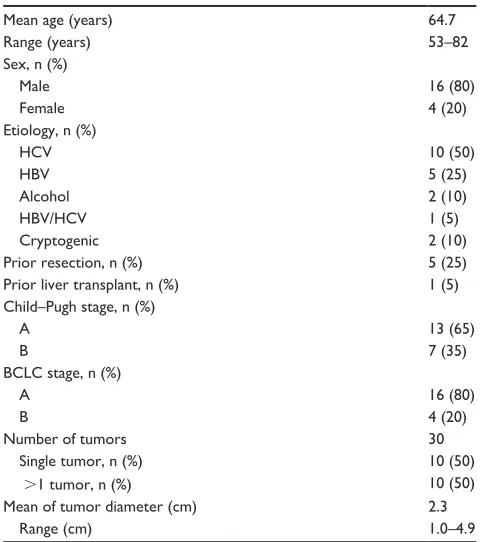
A total of 30 tumors (mean size, 2.3 cm; range, 1.0–4.9 cm) were treated in 20 patients (16 male and 4 female; mean age, 64.7 years). Etiology of cirrhosis included hepatitis C virus (HCV; n=10), hepatitis B virus (HBV; n=5), alcohol (n=2), combined HCV/HBV (n=1), and cryptogenic
(n=3). Five patients (25%) underwent hepatic resection prior to DEM-TACE, and one patient underwent previous orthotopic liver transplantation. Child–Pugh class was A for 65% of patients (n=13) and B for 35% (n=7). Sixteen patients (80%) were BCLC stage A, and four were stage B (20%). Patient demographics and clinical characteristics are listed in Table 1. In two cases, patients were treated with a staged approach, with two sessions less than 1 month apart (17 and 28 days). Technical success was achieved in all cases.
There were no major complications during follow-up. Minor complications in the cohort included postemboliza-tion syndrome in four of 24 cases (16.7%), and transient rise in liver enzymes requiring no therapy. Liver enzyme and synthetic function tests and AFP levels are shown in Figures 1–6. There was no statistically significant differ-ence between pre- and post-DEM-TACE liver synthetic function tests (prothrombin time and albumin) or liver enzyme levels. The mean pre-DEM-TACE AFP levels were 71.8±201.9 ng/mL. Mean values after embolization were 53.4±116.7 ng/mL, which was not a statistically significant decrease (unpaired t-test, P=0.7). All patients were dis-charged on postoperative day 1 as initially planned. There were no hospital readmissions within 30 days, and 30-day mortality was 0%.
Table 1 Patient demographics and tumor characteristics
Mean age (years) 64.7
range (years) 53–82
sex, n (%)
Male 16 (80)
Female 4 (20)
etiology, n (%)
HCV 10 (50)
HBV 5 (25)
alcohol 2 (10)
HBV/HCV 1 (5)
Cryptogenic 2 (10)
Prior resection, n (%) 5 (25)
Prior liver transplant, n (%) 1 (5)
Child–Pugh stage, n (%)
a 13 (65)
B 7 (35)
BClC stage, n (%)
a 16 (80)
B 4 (20)
number of tumors 30
single tumor, n (%) 10 (50)
.1 tumor, n (%) 10 (50)
Mean of tumor diameter (cm) 2.3
range (cm) 1.0–4.9
Abbreviations: HCV, hepatitis C virus; HBV, hepatitis B virus; BClC, Barcelona Clinic liver Cancer stage.
Journal of Hepatocellular Carcinoma downloaded from https://www.dovepress.com/ by 118.70.13.36 on 24-Aug-2020
Dovepress Bishay et al
0 1
Pre-DEM-TACE
total bilirubin Immediate post-DEM-TACE total bilirubin
1 month post-DEM-TACE total bilirubin 3
0.5 1.5 2 2.5 3.5 4
3rd quartile Maximum Median Minimum 1st quartile
Total bilirubin level (mg/dL)
Figure 1 Box plot of total bilirubin (mg/dl) levels at baseline, immediately following DeM-TaCe, and 1 month post-DeM-TaCe.
Abbreviation: DeM-TaCe, drug-eluting microspheres transcatheter arterial chemoembolization.
0 20 40 60 80 100 120 140 160 180
Pre-DEM-TACE ALT Immediate post-DEM-TACE ALT
1 month post-DEM-TACE ALT
1st quartile
3rd quartile Maximum Median Minimum
ALT level (IU/L)
Figure 2 Box plot of alT (iU/l) levels at baseline, immediately following DeM-TaCe, and 1 month post-DeM-TaCe.
Abbreviations: alT, alanine aminotransferase; DeM-TaCe, drug-eluting microspheres transcatheter arterial chemoembolization.
10 50 100 150 200 250 300
Pre-DEM-TACE AST Immediate
post-DEM-TACE AST DEM-TACE AST1 month
post-1st quartile
3rd quartile Maximum Median Minimum
AST level (IU/L)
Figure 3 Box plot of asT (iU/l) levels at baseline, immediately following DeM-TaCe, and 1 month post-DeM-TaCe.
Abbreviations: asT, aspartate aminotransferase; DeM-TaCe, drug-eluting microspheres transcatheter arterial chemoembolization.
10
Pre-DEM-TACE prothrombin time
Post-DEM-TACE prothrombin time 12
14
16 1st quartile
3rd quartile Maximum Median Minimum 18
20
Prothrombin time (seconds)
Figure 4 Box plot of prothrombin time (seconds) at baseline and following DeM-TaCe.
Note: Taken as the average of two levels following embolization, one within 3 days and one closest to a month after locoregional therapy.
Abbreviation: DeM-TaCe, drug-eluting microspheres transcatheter arterial chemoembolization.
Posttreatment imaging was performed at a mean of 37 days (range, 20–60 days). Local response rates are pre-sented in Table 2. Complete response (CR) was achieved in 30% of patients, partial response (PR) was seen in 35%, stable disease (SD) in 30%, and progression of disease (PD) in 5%. Overall objective response (CR + PR) was seen in 65% of cases. Overall mean follow-up time was 10.4 months (range, 2–16.4 months), with one patient lost to follow-up after initial posttreatment imaging.
Discussion
Several studies have shown that a smaller drug-eluting platform may have advantages compared with a larger-caliber drug-eluting platform or conventional TACE with lipiodol.2,8,13,18,23 Varela et al8 found that peak serum doxorubi-cin levels were significantly lower following DEB-TACE than after cTACE, suggesting that there is a higher concentration of the chemotherapeutic agent sustained within the target lesion. Similarly, van Malenstein et al23 found this to be true
for DEM-TACE as compared with cTACE. A more recent study by Malagari et al18 compared peak serum doxorubicin levels in 24 patients after DEM-TACE with 30–60 µm Hepa-Spheres to three patients treated by cTACE and supported the same finding. While cTACE works by rapid release of a chemotherapeutic agent from a lipiodol solution (t½ =1 hour), DEB-TACE exploits ion exchange, which allows for slow, sustained release of the chemotherapeutic agent over a longer period (t½ =150 hours for 100–300 µm microspheres). This is thought to increase the time of interaction between the chemotherapeutic drug and tumor cells, while simultaneously decreasing systemic concentrations of the drugs, leading to greater tolerability.24
Regarding comparisons of QuadraSpheres with DEBs, Sottani et al compared several pharmacokinetic parameters of patients treated with epirubicin loaded HepaSpheres with patients treated with loaded DC beads over a 24-hour
Journal of Hepatocellular Carcinoma downloaded from https://www.dovepress.com/ by 118.70.13.36 on 24-Aug-2020
Dovepress DeM-TaCe for hepatocellular carcinoma
2
Pre-DEM-TACE albumin Post-DEM-TACE albumin 3
2.5 3.5 4
3rd quartile Maximum Median Minimum 1st quartile 5
4.5
Albumin level (g/dL)
Figure 5 Box plot of albumin (g/dl) at baseline and following DeM-TaCe.
Note: Taken as the average of two levels following embolization, one within 3 days and one closest to a month after locoregional therapy.
Abbreviation: DeM-TaCe, drug-eluting microspheres transcatheter arterial chemoembolization.
1,000
100
10
1
Pre-DEM-TACE AFP Post-DEM-TACE AFP
1st quartile Minimum
Median Maximum 3rd quartile
AFP level (ng/mL)
Figure 6 aFP (ng/ml) levels at baseline and following DeM-TaCe.
Note: Taken as the average of two levels following embolization, one within 3 days and one closest to a month after locoregional therapy.
Abbreviations: aFP, α-fetoprotein; DeM-TaCe, drug-eluting microspheres transcatheter arterial chemoembolization.
Table 2 rates of local overall response according to the mreCisT criteria at follow-up
Response type Rates of local overall response, n (%)
Cr 6 (30)
Pr 7 (35)
sD 6 (30)
PD 1 (5)
Abbreviations: Cr, complete response; Pr, partial response; sD, stable disease; PD, progression of disease; mRECIST, modified Response Evaluation Criteria in solid Tumors.
period. The study found a statistically significant higher peak of serum epirubicin concentration at 5 minutes in patients treated with DC beads relative to those treated with HepaSpheres. Both had detectable serum concentrations at 24 hours, suggesting that both types of beads are capable of sustained release kinetics.25
In addition to achieving lower peak serum concentrations, and thereby, presumably, higher intratumoral concentrations, Padia et al2 found that patients treated with smaller caliber LC beads (100–300 vs 300–500 µm) had a significantly lower incidence of postembolization syndromes and a trend toward a higher instance of EASL CR relative to those treated with larger beads. Gupta et al compared the pharmacokinetic profile of TACE with doxorubicin-loaded QuadraSpheres (DEM-TACE) with that of TACE with doxorubicin, lipiodol, and Embospheres. A third group underwent direct hepatic arterial infusion (HAI) of doxorubicin. The QuadraSpheres group demonstrated the lowest peak plasma
concentra-tion of doxorubicin of the three – an indicaconcentra-tion of higher tumor retention. Furthermore, the intratumoral level of doxorubicin was greater in the QuadraSpheres group at each time point measured with extended intratumoral detection of doxorubicin beyond the time frame of the other two groups (14 days vs 1 and 3 days for the HAI and TACE groups, respectively).26–28
Although promising as a drug-eluting delivery agent, little data exists on the feasibility of employing 30–60 µm Quadra-Spheres for the treatment of HCC in clinical practice. Only a single prospective study of 45 patients with HCC treated with HepaSpheres (a study by Malagari et al18) is present in the literature. Furthermore, the majority of patients in that study had HBV as the underlying etiology for their HCC. For their patient population, Malagari et al18 found that the treatment was well tolerated with an acceptable safety profile and a good rate of objective response (68.9%). In contrast, the majority of patients in our cohort had HCV. Our study helps confirm the feasibility and safety of a novel drug-eluting platform in a broader patient population.
In our single-center study, 30 tumors were treated with 30–60 µm QuadraSpheres in 21 patients. The patient popula-tion consisted of a male majority, with HCV being the most common etiology for HCC. Overall, although only short-term follow-up was available for our cohort, DEM-TACE did prove to be well tolerated. All patients were discharged on postopera-tive day 1, with the only complications being postembolization syndrome in four patients and minor (type A) complications related to a transient rise in liver enzymes. Overall, there were no statistically significant differences between baseline labora-tory values and postembolization laboralabora-tory values. Although not a statistically significant decline, there was a downward trend in AFP levels following treatment, suggesting response to embolization. CR was achieved in 30% of patients, and the overall objective response rate was 65%, comparable to the response found by Malagari et al.
There are several limitations to this study. This is a single-institution, retrospective study with a small number of patients and does not offer a comparison with cTACE or
Journal of Hepatocellular Carcinoma downloaded from https://www.dovepress.com/ by 118.70.13.36 on 24-Aug-2020
Dovepress Bishay et al
DEB-TACE. The majority of patients were BCLC A, which may result in a higher objective response rate according to mRECIST. Most significantly, this is only a short-term follow-up study.
Despite these limitations, our initial single-center expe-rience demonstrates that DEM-TACE utilizing doxorubicin-loaded 30–60 µm QuadraSpheres is feasible and well tolerated, and is associated with promising tumor response in early and intermediate stage disease.
Disclosure
AM Fischman is a consultant/speaker in Terumo Interventional Systems, Surefire Medical Inc., and Philips Healthcare. RA Lookstein is a consultant in Cordis Corp and Bayer Health-care. He is also the Speaker of Boston Scientific Corp. Advisory Board and a DSM at WL Gore and Associates, Inc. E Kim is on the Advisory Board of Onyx Pharmaceuticals and Nordion. He is also a consultant in Philips Healthcare. The authors report no other conflicts of interest in this work.
References
1. Bosch FX, Ribes J, Diaz M, Cleries R. Primary liver cancer: worldwide inci-dence and trends. Gastroenterology. 2004;127(5 Suppl 1):S5–S16. 2. Padia SA, Shivaram G, Bastawrous S, et al. Safety and efficacy of
drug-eluting bead chemoembolization for hepatocellular carcinoma: comparison of small-versus medium-size particles. J Vasc Intervent
Radiol. 2013;24(3):301–306.
3. El-Serag HB. Hepatocellular carcinoma: recent trends in the United States. Gastroenterology. 2004;127(5 Suppl 1):S27–S34.
4. Hung H. Treatment modalities for hepatocellular carcinoma. Curr
Cancer Drug Targets. 2005;5(2):131–138.
5. Bruix J, Sherman M. Management of hepatocellular carcinoma: an update. Hepatology. 2011;53(3):1020–1022.
6. Llovet JM, Real MI, Montana X, et al; Barcelona Liver Cancer Group. Arterial embolisation or chemoembolisation versus symptomatic treatment in patients with unresectable hepatocellular carcinoma: a randomised controlled trial. Lancet. 2002;359(9319):1734–1739. 7. Llovet JM, Bruix J. Systematic review of randomized trials for
unresect-able hepatocellular carcinoma: chemoembolization improves survival.
Hepatology. 2003;37(2):429–442.
8. Varela M, Sala M, Llovet JM, Bruix J. Treatment of hepatocellular carcinoma: is there an optimal strategy? Cancer Treat Rev. 2003;29(2): 99–104.
9. Kettenbach J, Stadler A, Katzler IV, et al. Drug-loaded microspheres for the treatment of liver cancer: review of current results. Cardiovasc
Intervent Radiol. 2008;31(3):468–476.
10. Lammer J, Malagari K, Vogl T, et al. Prospective randomized study of doxorubicin-eluting-bead embolization in the treatment of hepato-cellular carcinoma: results of the PRECISION V study. Cardiovasc
Intervent Radiol. 2010;33(1):41–52.
11. Sacco R, Bargellini I, Bertini M, et al. Conventional versus doxorubicin-eluting bead transarterial chemoembolization for hepatocellular carcinoma. J Vasc Intervent Radiol. 2011;22(11): 1545–1552.
12. Reyes DK, Vossen JA, Kamel IR, et al. Single-center phase II trial of transarterial chemoembolization with drug-eluting beads for patients with unresectable hepatocellular carcinoma: initial experience in the United States. Cancer J. 2009;15(6):526–532.
13. Malagari K, Chatzimichael K, Alexopoulou E, et al. Transarterial chemoembolization of unresectable hepatocellular carcinoma with drug eluting beads: results of an open-label study of 62 patients. Cardiovasc
Intervent Radiol. 2008;31(2):269–280.
14. Dhanasekaran R, Khanna V, Kooby DA, et al. The effectiveness of locoregional therapies versus supportive care in maintaining survival within the Milan criteria in patients with hepatocellular carcinoma.
J Vasc Intervent Radiol. 2010;21(8):1197–1204; quiz 204.
15. Prajapati HJ, Dhanasekaran R, El-Rayes BF, et al. Safety and efficacy of doxorubicin drug-eluting bead transarterial chemoembolization in patients with advanced hepatocellular carcinoma. J Vasc Intervent
Radiol. 2013;24(3):307–315.
16. Prajapati HJ, Spivey JR, Hanish SI, et al. mRECIST and EASL responses at early time point by contrast-enhanced dynamic MRI predict survival in patients with unresectable hepatocellular carcinoma (HCC) treated by doxorubicin drug-eluting beads transarterial chemoemboliza-tion (DEB TACE). Ann Oncol. 2013;24(4):965–973.
17. Lee KH, Liapi EA, Cornell C, et al. Doxorubicin-loaded QuadraSphere microspheres: plasma pharmacokinetics and intratumoral drug concen-tration in an animal model of liver cancer. Cardiovasc Intervent Radiol. 2010;33(3):576–582.
18. Malagari K, Pomoni M, Moschouris H, et al. Chemoembolization
of hepatocellular carcinoma with hepasphere 30–60 µm. Safety and
efficacy study. Cardiovasc Intervent Radiol. 2014;37(1):165–175. 19. Jarzabek M, Jargiello T, Pyra K, Budzynska A, Przyszlak M,
Szczerbo-Trojanowska M. [Chemoembolization (DEM-TACE) in hepa-tocellularcarcinoma. Report of a case and review of treatment standards in advanced stage disease]. Przegl Lek. 2012;69(7):386–389. 20. Llovet JM, Di Bisceglie AM, Bruix J, et al; Panel of Experts in
HCC-Design Clinical Trials. HCC-Design and endpoints of clinical trials in hepa-tocellular carcinoma. J Natl Cancer Inst. 2008;100(10):698–711. 21. Sacks D, McClenny TE, Cardella JF, Lewis CA. Society of
Interven-tional Radiology clinical practice guidelines. J Vasc Intervent Radiol. 2003;14(9 Pt 2):S199–S202.
22. Lencioni R, Llovet JM. Modified RECIST (mRECIST) assessment for hepatocellular carcinoma. Semin Liver Dis. 2010;30(1):52–60. 23. van Malenstein H, Maleux G, Vandecaveye V, et al. A randomized
phase II study of drug-eluting beads versus transarterial chemoem-bolization for unresectable hepatocellular carcinoma. Onkologie. 2011;34(7):368–376.
24. Emerich DF, Snodgrass P, Lafreniere D, et al. Sustained release chemo-therapeutic microspheres provide superior efficacy over systemic ther-apy and local bolus infusions. Pharm Res. 2002;19(7):1052–1060. 25. Sottani C, Poggi G, Quaretti P, et al. Serum pharmacokinetics in
patients treated with transarterial chemoembolization (TACE) using two types of epirubicin-loaded microspheres. Anticancer Res. 2012;32(5):1769–1774.
26. Gupta S, Wright KC, Ensor J, Van Pelt CS, Dixon KA, Kundra V. Hepatic arterial embolization with doxorubicin-loaded superabsorbent polymer microspheres in a rabbit liver tumor model. Cardiovasc Intervent Radiol. 2011;34(5):1021–1030.
27. Bilbao JI, de Luis E, Garcia de Jalon JA, et al. Comparative study of four different spherical embolic particles in an animal model: a morphologic and histologic evaluation. J Vasc Intervent Radiol. 2008;19(11):1625–1638.
28. Namur J, Citron SJ, Sellers MT, et al. Embolization of hepatocellular carcinoma with drug-eluting beads: doxorubicin tissue concentra-tion and distribuconcentra-tion in patient liver explants. J Hepatol. 2011;55(6): 1332–1338.
Journal of Hepatocellular Carcinoma downloaded from https://www.dovepress.com/ by 118.70.13.36 on 24-Aug-2020
Journal of Hepatocellular Carcinoma
Publish your work in this journal
Submit your manuscript here: http://www.dovepress.com/journal-of-hepatocellular-carcinoma-journal
The Journal of Hepatocellular Carcinoma is an international, peer-reviewed, open access journal that offers a platform for the dissemina-tion and study of clinical, transladissemina-tional and basic research findings in this rapidly developing field. Development in areas including, but not limited to, epidemiology, vaccination, hepatitis therapy, pathology and
molecular tumor classification and prognostication are all considered for publication. The manuscript management system is completely online and includes a very quick and fair peer-review system, which is all easy to use. Visit http://www.dovepress.com/testimonialsphp to read real quotes from published authors.
Dovepress
Dove
press
DeM-TaCe for hepatocellular carcinoma
Journal of Hepatocellular Carcinoma downloaded from https://www.dovepress.com/ by 118.70.13.36 on 24-Aug-2020