Listening Skill Development With Enhanced
Technology Using Scripted And Unscripted Texts
Dorris Lourdes R, Dr. S. Mercy Gnana Gandhi
Abstract: Abstract: The challenge in EFL classroom is to make the students more attentive and focused. Computer being an electronic machine has become a part of human life and it plays a key role in Education. This research paper analyses the impact and outcome of Comp uter Enhanced Language Learning and its effect on the student learners of English Language. It is necessary to accept the fact that second language learners are facing difficulties in understanding the language completely to speak in English. This research investigates the efficiency of intermediate college students in comprehending Listening exercises, using two varied methods. The methodology of using Scripted and Unscripted texts was experimented. To analyse the effectiveness of both the methods, three different sets of students were chosen from three different institutions , who were made to listen to the audio conversation of native speakers. An exploratory design was used, where the learners were allocated to an unscripted group or the scripted group. The groups listened to the conversation through Unscripted and Scripted method. The focus was given to both Scripted and Unscripted method of language learning through Listeners. The results proved that the usage of scripted conversation to develop the listening skil ls of participant language learners is remarkably higher than the unscripted method of language development. The research also showed the reduction of anxiety among the students when listening to English using the technology.
Keywords: Skill Development, Listening, Scripted, Unscripted, language learning, Technology
—————————— ——————————
1.
INTRODUCTION
THE remarkable development of newer Multimedia technology has tremendously changed the method of teaching the English language. English as a universal language gives a ―consciousness to the speakers to make more effort to our communication capacity‖. Here, the teachers’ role paves way to the comfort zone of the students realize that English language is now, not a non-native language. In every English speaking circumstance, students do not actively interact for many reasons. Syllabus, texts and classroom materials have to be designed on their interests, providing the essential needs of present day technologies and focusing task based teaching English language. In most of the engineering colleges, students prefer to learn in the traditional way. They find themselves less in using computers. The Multimedia Computer Assisted Language Learning will be totally new to the students. This research discusses on the present day engineering students’ preference for Multimedia learning, for acquiring language skills. Despite the fact of proven study, in many ways second language learners are facing difficulties in understanding the language completely to speak in the English world. Many researchers recommended this exhausting track from the conversing text to which the learners are revealed in second language learners’ classroom. To investigate this issue, this research evaluates the understanding performance of university learners of English as a second language. The learners are allowed to hear the recorded audio version through the computers in modern classroom method for Scripted and Unscripted test.
2
REVIEW
OF
LITERATURE
According to Brown (2001), ―Listening competence is universally larger than speaking competence‖. ―Listening involves making sense of spoken language, normally accompanied by other sounds and visual input, with the help of our relevant prior knowledge and the context in which we are listening‖ commented Schmitt (2002). It is felt that there is a proven difficulty in not only teaching but also in assessing the students’ level of understanding a language. It is understood that listening skill has taken the right place in evaluating a language learner rather than the involvement of other skills such as reading, writing and speaking. Nachoua
(2012) is of the view that no one can deny the effect of CALL on improving the listening skills of the students. Computer strategy can definitely be introduced in language learning environment to increase capability and knowledge of the students. According to Mercy Gnana Gandhi (2017), ―The implementation of the multimedia into educational institutes requires major changes in traditional learning and teaching‖. Following the entry of media CALL, mixed media language focuses started to show up in instructive foundations. While mixed media offices offer numerous open doors for language learning with the coordination of content, pictures, sound and video, these open doors have regularly not been completely used. Meihami and Varmaghani (2013) examined the practical benefits of computers in the process of language learning particularly in improving the listening skills of the learners. The results show an obvious change in comprehending listening tasks and exercises, due to the usage of CALL and its materials. While using CALL materials, learners get less exhausted as compared to using traditional method. J.D.Brown, (2012) is of the view that Unscripted method of conversational speech is more difficult to comprehend for a listener, who has English as a second language. Mercy Gnana Gandhi (2011) says ―we use stimulus response type of software for interactive multimedia, which will enhance the capabilities and values of effective teachers and students’. Generally, it is observed that the language learners, show much interest in multimedia lessons, through which they can perform in a better way than in the conventional method of classroom teaching. Since they are free to access the lessons anytime, copy and transfer to their required platform, the learners immerse themselves in multimedia zone. As far as the questions concerned, the scripted method of language development through listening encourages multiple choice questions. Ennis (2012) stresses the fact that multiple choice questions always encourage Self learning and promote independency.
3 UNSCRIPTED
VS
SCRIPTED
TEXT
pauses, breaks, wrong words, discourse makers and repetitive expressions. Moreover, the speaker may be inaudible with unclear words. Hence, it is called as ―uncertain phenomena‖. The articulation, tone and accents is totally different, when both the methods are compared. This may disturb the L2 listening process. Most of all the research on Scripted and Unscripted method concluded that scripted conversing texts are easy to comprehend. Hence, it is universally accepted that unscripted method and scripted method have different grammar patterns. In Unscripted method, the conversation takes the major role with its originality, whereas the teacher plays the audio. But students get the comprehension to play their role in the real life situation in scripted method.
4 ROLE
OF
UNCERTAIN
PHENOMENA
Uncertain phenomena are the countless silent pauses, uncertainness, false starts, filled pause, wordiness and repetition and the existence of uncertain phenomena affects the speech rate. However, the long pause permits the listeners to prepare. Moreover, through repetition, the listener gains another chance to get the clarity, when he heard and missed it for the first time.
5 EQUATIONS
All the native speakers talk exceptionally in colloquial conversations, informal dialogues and is less accepted in formal conversation. Mainly, the connected discourse is hereditary in all the native speakers. In natural speech, connected discourse has fixed rules used to reform pronunciation of words, dictionary or the citation. The phonological characteristic of connected discourse seems to be concord in literature. The second language learners have no disclosure to this type of discourse, which seems to be real in this case.
6 THE
USE
OF
UNSCRIPTED
METHOD
IN
CLASSROOM
Various studies clarify the difference between Scripted and Unscripted method of learning a language. No doubt, the unscripted texts are totally unplanned, with a natural conversational tone. Besides, the learner finds it difficult to understand the natural flow of a native speaker and hence it is proved in the results of the tests taker. However, the usage of
Unscripted texts is invited in the classroom of second language learners, ―to disclose the listener to the natural intonation of the second language and to make listeners to train in the different process of figuring meaning form the piece of discourse that may not completely comprehend‖. The characteristic of Unscripted conversing language texts seems to be more complicated for second language listeners. Henrichsen (1984) found that second language leaners of English had more problems in understanding the condensation, devaluation and consumption of a conversational language. But the fact is that the use of real conversing texts may help the learners, to gain listening skills and give the learners to know about the tradition, culture and the linguistic pattern of the English language. It never helps the learners to gain speaking skill. Numerous scholars are also against exposing the unscripted texts, lectures, real text, mainly for slow learners. They discuss about the types of lectures and texts, which may constantly destroy the learners that lead to lose interest in the language and frustration. In longitudinal studies, research and survey was taken for the second language learners. One group was under Unscripted teaching classroom and another group was under scripted method of teaching. About a month of period the scores of second language learners was measured and compared. It is found that the students in the Scripted text classroom achieved more marks than the other Unscripted one. These measures conclude that the scripted method gains communicative competence and orally acquires the language with proper intonation and pronunciation than the unscripted classroom.
7 METHODOLOGY
8
PROCEDURE
In the Scripted and Unscripted method, the learners of second language were monitored by the instructors. They took the test by using computer headphones to listen the audio. The audio was played twice for them from the main computer, to which the rest of the computers were connected. The instructors and volunteers helped the students to settle with the connected computers. This case study in English as listening comprehension test was drafted for the intermediate learners. They were given one minute after each part of the question to correct their errors. The same procedure was followed for the scripted method. In each method the procedure took above thirty minutes. After a week, the scores and the answers were informed to the students.
9
RESULT
AND
DISCUSSION
This study brings out the consolidated performance of second language learners in their listening skill tests using Scripted as well as unscripted methods. The result accommodates practical support for extensively held, real, unscripted method demonstrating the connected discourse and uncertain phenomena. Unscripted conversing speech is harder for second language learners than scripted method. Moreover in the unscripted method, the lectures were constantly from the real text which will be more difficult than the scripted method. In the Scripted method, the second language learners find more interesting, when they learn the language through the language, which they tend to hear with the students. Numerous second language learners have got lower proficiency in comprehension. Only unscripted way of teaching might make the learners to find difficulties in comprehending the real text and they will automatically lose interest in learning the language. The fact is that the unscripted method has been adopted for ages and even now after the sudden growth of technology. But unscripted method to test the listening comprehension is comparatively lower than the scripted method test. Thus, moderating the processes of handling the class and uploading it in the systems is really a burden. But this facilitates the second language communication beyond the unscripted classroom methodology.
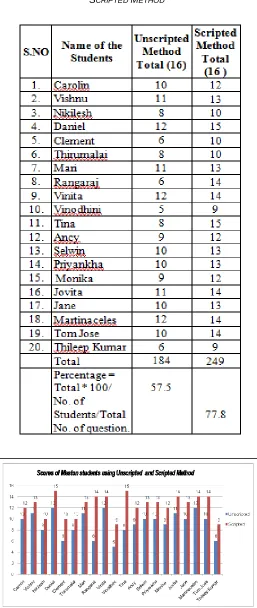
TABLE 1
SCORES OF MESTON STUDENTS USING UNSCRIPTED AND
SCRIPTED METHOD
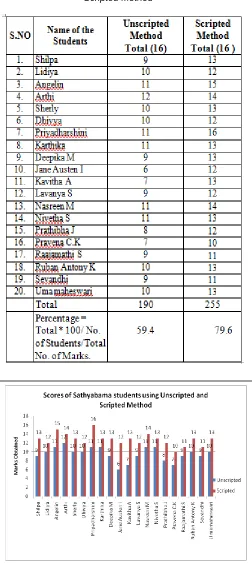
Fig. 2. Comparison of Scores of Loyola students using Unscripted and Scripted Method
Fig. 3. Comparison of Scores of Sathyabama students using Unscripted and Scripted Method
TABLE 3
Scores of Sathyabama students using Unscripted and Scripted Method
TABLE2
SCORES OF LOYOLA STUDENTS USING UNSCRIPTED AND SCRIPTED
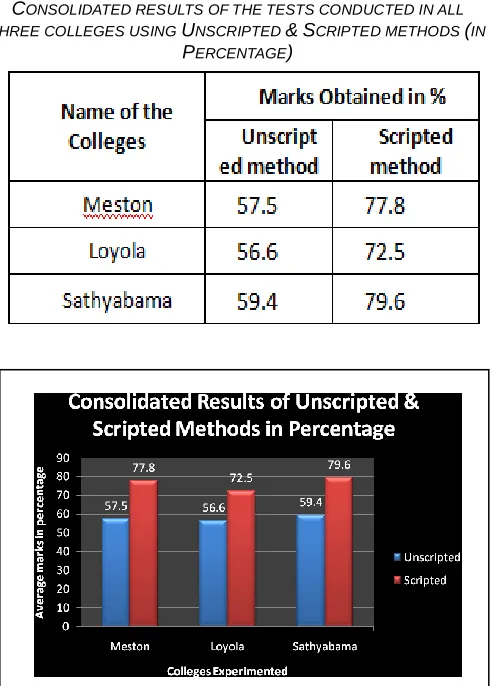
Fig. 3 bar graph implies the performance of the students in terms of percentage, with respect to the usage of Scripted and Unscripted Texts. The x-axis shows the number of colleges participated and y-axis exposes the percentage of the marks in the tests that were conducted. The students of Meston College scored 57.5% in unscripted 77.8% in scripted. Students from Loyola College scored 56.6% in unscripted and scored 72.5% in scripted text. Students from Sathyabama managed to score bit higher than the above two colleges having 59.4% in unscripted and 79.6% in scripted. The overall report shows us that students are capable to score between 57% to 60% in unscripted and 77% to 80% in Scripted. Comparatively, on the whole, these three college students have scored higher in the scripted than the unscripted text. Though the three colleges have three different levels of students, their performance is almost same. Meston is the B.Ed College. Loyola is an arts and science college whereas Sathyabama has Engineering students. With three different package of students with varies mindset, it is proves that Scripted method of learning is more effective than the Unscripted one. Still, in future the Unscripted method has to be encouraged and implemented to enhance students’ vocabulary level.
10
CONCLUSION
The method of teaching the English language has been
changed through tremendous development of newer technology. To make the students more attentive and focus is the biggest challenge in the ELF classroom. It is evident from the learners of English as second language that unscripted listening method is more difficult to comprehend than the scripted method. By taking the advantage of this method the teacher could prepare real material for the listeners and they can also implement the method in second language learners’ classroom. This unscripted feature is more important, since it is a spontaneous, unplanned talk beyond the classroom environment and setting. So, the understanding scores of the listeners considerably low. Only implementing scripted method makes the listeners to adapt the native English slowly. Hence, such comprehension challenge cannot be ignored. Consequently, this unscripted style of teaching is expected to be implemented by technology support.
REFERENCES
[1] Ahn, S. (1987). Sandhi-variation and affective factors as input filters to comprehension of spoken English among Korean learners (Unpublished doctoral dissertation). University of Texas, Austin.
[2] Anderson, A., & Lynch, T. (1988). Listening. New York: Oxford University Press.Google Scholar
[3] Berk, R. A. (2008c). Star tech: The net generation. In C. C. Craig & L.F. Deretchin (Eds.), Teacher education yearbook XVI: Imagining a renaissance in teacher education (pp.131–145). Lanham, MD: Rowman & Littlefield Education.
[4] Britt, M &Aglinskas, C.; (2002): ―Improving Students ability to identify and use source information Cognition and Instructing‖, Vol; 20 (4) pp 485-522.
[5] Brown, H. D. (2001). Teaching by principles an interactive approach to language pedagogy, second edition. Addison Weseley: Longman.
[6] Buck, G. (1995). How to become a good listening teacher? In D. J. Mendelsohn & J. Rubin (Eds.), A guide for the teaching of second language listening (pp. 113–131). San Diego: Dominie Press.Google Scholar
[7] Buck, G. (2001). Assessing listening. Cambridge: Cambridge University Press.CrossRefGoogle Scholar
[8] (Eds.), Literacy, language and learning: The nature and consequences of reading and writing (pp. 105–123). Cambridge:Cambridge University Press.Google Scholar [9] Chang, C.-S. (2009). Gains to L2 listeners from reading while
listening vs. listening only in comprehending short stories. System, 37, 652–663.CrossRefGoogle Scholar
[10]Chang, C.-S., & Millett, S. (2014). The effect of extensive listening on developing L2 listening fluency: Some hard evidence. ELT Journal, 68(1), 31–40.CrossRefGoogle Scholar [11]Chang, C.-S., & Millett, S. (2015). Improving reading rates and
comprehension through audio-assisted extensive reading for beginner learners. System, 52, 91–102.CrossRefGoogle Scholar
[12]Chang, C.-S., & Read, J. (2006). The effects of listening support on the listening performance of EFL learners. TESOL Quarterly, 40, 375–397.CrossRefGoogle Scholar
[13]Chang, C.-S., & Read, J. (2007). Support for foreign language listeners: Its effectiveness and limitations. RELC Journal, 38, 373– 394.CrossRefGoogle Scholar
[14]Chang, C.-S., & Read, J. (2013). Investigating the effects of multiple- choice listening test items in the oral versus written mode on L2 listeners’ performance and perceptions. System, TABLE 4
CONSOLIDATED RESULTS OF THE TESTS CONDUCTED IN ALL
THREE COLLEGES USING UNSCRIPTED &SCRIPTED METHODS (IN
PERCENTAGE)
41, 575– 586.CrossRefGoogle Scholar
[15]Chiang, C. C., & Dunkel, P. (1992). The effect of speech modification, prior knowledge and listening proficiency on EFL lecture learning. TESOL Quarterly, 26, 354– 374.CrossRefGoogle Scholar
[16]Derwing, T., & Munro, M. (2001). What speaking rates do non-native listeners prefer? Applied Linguistics, 22, 324– 337.CrossRefGoogle Scholar
[17]Egbert, J., Paulus, T., & Nakamichi, Y. (2002) The impact of CALL instruction on classroom computer use: A foundation for rethinking technology in teacher education. Language Learning & Technology, 6 (3), 108-126.
[18]Field, J. (2008). Listening in the language classroom. Cambridge: Cambridge University Press.Google Scholar [19]Freedle, R., & Kostin, I. (1999). Does the text matter in a
multiple- choice test of comprehension? The case for the construct validity of TOEFL’s minitalks. Language Testing, 16(1), 2–32.Google Scholar
[20]Gao H. Z., The feasibility and necessity of using multi-media computer to assist second language teaching. Unpublished master’s thesis, Liaoning Normal University, Liaoning, China, 2005.
[21]Gardner, H. (2000). Can technology exploit our many ways of knowing? In D. T. Gordon (Ed.), The digital classroom: How technology is changing the way we teach and learn (pp. 32–35). Cambridge, MA: President and Fellows of Harvard College. [22]Gilmore, A. (2004). A comparison of textbook and authentic
interaction. ELT Journal, 58, 363-374.
[23]Gnana Gandhi, S. Mercy. "Teaching English language to engineering students and the problems faced by the language teachers: Solutions through computers." ELT Weekly Journal 3.81 (2011).
[24]Gnana Gandhi, Mercy (2017). Computer Assisted Language Learning (p.75) ISBN: 978-93-83409-20-4