O R I G I N A L R E S E A R C H
Dispositional Humility Of Clinicians In An
Interprofessional Primary Care Environment: A
Mixed Methods Study
This article was published in the following Dove Press journal:
Journal of Multidisciplinary Healthcare
Masa Sasagawa Paul S Amieux
Bastyr University Research Institute, Kenmore, WA 98028, USA
Video abstract
Point your SmartPhone at the code above. If you have a QR code reader the video abstract will appear. Or use:
https://youtu.be/3lYYf2hyCQI
Objectives: Dispositional humility in professionals is a character trait that allows one to
monitor self-centered occupational drive and to pay attention to the needs of other profes-sionals. The aim of this study is to test whether or not clinicians working in interprofessional team care environments identify the character trait of humility as an important factor for successful collaborative relationships. This study aimed to revise a concept map of disposi-tional humility created through literature review.
Design: An explanatory sequential mixed-methods study was composed of the HEXACO
personality test and the Integrative Medicine Attitude Questionnaire, followed by summative and directed content analyses of one-on-one interview data in order to identify the element of dispositional humility.
Setting:In the State of Washington, USA, where physicians (MD/DO), nurse practitioners
(NP) and naturopathic clinicians (ND) serve Medicaid patients in community clinics.
Participants:6 MDs, 4 NPs, and 11 NDs.
Results: Twenty-one primary care clinicians were enrolled. Fifteen clinicians completed the
interview. It was observed that the: 1) honesty-humility trait (p<0.01), conscientiousness (&p<0.01), and openness to experience (p<0.05) domains of primary care clinicians were statis-tically significantly higher than the reference standards; 2) attitudes toward integrative medicine did not differentiate the different clinician types; and 3) qualitative data supported the component of dispositional humility as a desirable trait in professionals with whom they would like to work.
Conclusion: To maintain high-quality patient care while working as a team, limiting
self-interest while focusing on the needs of others may be necessary and in the best self-interest of patients. An attitude of accepting the principles of integrative medicine has permeated this sample of primary healthcare workers. Both quantitative and qualitative analyses revealed that humility was viewed as an important character trait for successful interprofessional collaboration. A revised concept map of dispositional humility to enhance collaborative relationships was created.
Keywords: primary health care, interprofessional relations, interdisciplinary placement,
dispositional humility, collaboration
Introduction
This study posed the question of whether or not clinicians perceive humility as an important factor for interprofessional collaboration in an integrative primary care setting. Since the early 1990s, US healthcare consumers have spent an increasing amount of healthcare dollars for non-conventional complementary and alternative
medicine.4 As a result of this demand, over the past two decades, conventional
Correspondence: Masa Sasagawa Bastyr University Research Institute, NE, Kenmore, WA 98028, USA
Email [email protected]
Journal of Multidisciplinary Healthcare
Dove
press
open access to scientific and medical research
Open Access Full Text Article
Journal of Multidisciplinary Healthcare downloaded from https://www.dovepress.com/ by 118.70.13.36 on 24-Aug-2020
healthcare systems have been adjusting and responding to
this desire on the part of healthcare consumers.
“Integrative Medicine” is a term used to describe such
combined care in the conventional setting. As an example of this, the implementation of multidisciplinary profes-sional team care was found effective in managing knee
osteoarthritis in a primary care setting;5however, power
dynamics and mistrust among clinicians with different professional healthcare training and credentials can make
professional interactions challenging.6 To maintain
patient-centered professional teamwork, limiting self-interest and focusing on the needs of other professionals
may prove essential; furthermore, “being too arrogant or
self-focused could negatively affect relationship quality”.8 Skills building such as effective communication skills in
primary care increased health outcomes.9 This study
explored the role of a personality factor, dispositional humility, in enhancing the performance and function of integrative healthcare teams.
Dispositional humility is defined as a native capacity
for self-reflection and the ability to achieve a balance
between self-interest and the needs of others.1 Primary
care clinicians who serve patients in community health clinics may possess certain job-related characteristics like altruism. One of the assumptions of this study was that clinicians who choose to serve underprivileged popula-tions (those on Medicaid, for example) may naturally possess dispositional factors that foster positive and pro-ductive relationships not only with patients but also with
professional colleagues. More specifically, people who
elect to work in challenging healthcare work environments and still fulfill their obligations may be associated with the character trait of humility. Nonetheless, one-third of
office-based physicians in the US did not accept new
Medicaid-insured patients in 2011–2012,10 and although
fee increases would be predicted to change this low enroll-ment rate, fee increases did not change the participation
rate in 2018.11 The Association of Family Medicine
Residency Directors (AFMRD) Board, as articulated by
Mark Robinson et al (2008), states that: “Faculty, staff,
and residents spend many hours carefully scrutinizing dean’s letters, transcripts, USMLE scores, letters of
recom-mendation and interview data” for the National Match
process for residency positions. The AFMRD Board looks for character traits consistent with what one would expect in a good family physician, traits that include being trustworthy, loyal, helpful, friendly, courteous, kind, obe-dient, cheerful, thrifty, brave, clean and reverent.12 Many
of the character traits described above can be associated with the character trait of humility; however, assessing the level of humility of individuals can be complex. Truly humble individuals may not proclaim themselves to be humble. Therefore, in order to study humility, along with validated self-reported survey results, other methods to assess humility are needed. This study elected to use a
mixed-methods approach by first having clinicians
self-evaluate a personality trait followed by interviews to iden-tify personality and environmental factors that facilitate or interfere with collaboration. If components of humility emerged from the interview data as personality or envir-onmental factors viewed as important for collaboration,
the data would confirm the perceived importance of
dis-positional humility.
Methods
Patient And Public Involvement
This study investigated the clinician’s characteristics and environment conducive to collaboration. Patients and the public were not involved in recruitment or in the study. The results from this study will be most useful if dissemi-nated to health professional school administrators and clinician recruiters. The targeted population for recruit-ment was primary care clinicians serving Medicaid patients in Seattle, Washington, USA. These clinicians had healthcare professional training backgrounds and cre-dentials in medicine, nursing, or naturopathic medicine. Medicaid-serving clinics were chosen for two reasons: 1) to seek clinicians with dispositional humility that might be demonstrated by working in such inherently stressful and demanding healthcare environments; and 2) naturopathic doctors are licensed and equivalently able to serve Medicaid patients as primary care providers in the State
of Washington. MD/DOs were board-certified family
med-icine physicians or internists; nurse practitioners (NPs)
were master’s level ARNPs; and naturopathic doctors
(NDs) had two to 3 years of residency training after the completion of the doctoral degree. The diagrammatic
pro-cess of this study design is depicted in Supplement A:
Research Design.
Quantitative Data
The 60-item HEXACO personality inventory2is a validated
dispositional assessment tool measuring the six domains of personality: Honesty-Humility, Emotionality, eXtraversion,
Agreeableness, Conscientiousness, and Openness to
Journal of Multidisciplinary Healthcare downloaded from https://www.dovepress.com/ by 118.70.13.36 on 24-Aug-2020
experience, and one of the six, the Honest-Humility (HH) domain, was found to have four facets (subdomains): sincerity, fairness, greed-avoidance, and modesty.13A priori power cal-culation was based on the HH domain with a reference mean
and standard deviation of 3.23 and 0.66, respectively.2 By
assuming the same level of standard deviation and 15% differ-ence between the mean of the sample and the referdiffer-ence point, a sample size of 14 was necessary to obtain a power of 0.8 with an alpha level of 0.05. The 29-item Integrative Medicine
Attitude Questionnaire (IMAQ)3 quantifies two factors: 1)
openness to new ideas and paradigms; and 2) value of both introspection and relationship with patients. Patients’ prefer-ences for integrative medicine have provided the US healthcare system with opportunities for clinicians to work with other clinical professionals with different training and health per-spectives. Primary care clinicians in this study were divided into conventionally trained clinicians (MD, DO, or NP) and complementary and alternative medicine (CAM) trained nat-uropathic doctors (ND). In a 2005 publication, IMAQ scores of conventionally trained clinicians and CAM clinicians were different by a t-score of 12.05 (df = 191). We calculated a sample size of 7 would be sufficient to achieve a statistical power of 0.8 at an alpha level of 0.05 between conventionally trained clinicians versus NDs who were trained from the perspective of CAM. Survey data were collected in the
Research Electronic Data Capture (REDCap) system.14
REDCap is an application developed by Vanderbilt University and collects virtually any type of data in a 21 CFR Part 11, FISMA, and HIPAA-compliant environment. The data in REDCap were downloaded and analyzed using SPSS
ver-sion 2515and GraphPad Prism version 7.01 for Windows.
Qualitative Data
The surveyed participants were invited to participate in a brief semi-structured interview at the end of survey and were able to leave their contact information. The interview was conducted in-person or by telephone. The recorded interview responses were transcribed verbatim and loaded into HyperResearch (v3.5.2) software for coding and sum-mative data analysis. Representative samples (balanced sampling of 2 MDs, 2 NPs, and 2 NDs) from the inter-views were used for the directed content analysis. The directed content analysis was based on a published concept
map paper entitled: “Concept analysis of dispositional
humility among professionals in an interdisciplinary
healthcare environment.”(Figure 1)
Hsieh and Shannon (2005) describe three types of content analyses: conventional, summative, and directed
content analysis.7 Conventional content analysis usually
does not start from preconceived coding expectations, and lets themes emerge as the content is interpreted and coded. Summative content analysis relies on the frequency statistics of abstracted codes. Directed content analysis uses a preconceived model and looks for codes related to
the model; hence the coding is directed.7 The coding,
categorization and thematic extraction of the interview
data were matched to the concept map already created.1
Finally, based on the results from the summative and directed content data analyses, the concept map was
refined. The original study design and protocol modifi
ca-tion were approved by the Bastyr University Instituca-tional
Review Board (IRB: 16–1558). All datasets used and/or
analyzed during the current study are available from the corresponding author upon reasonable request for 7 years from the date of publication.
Results
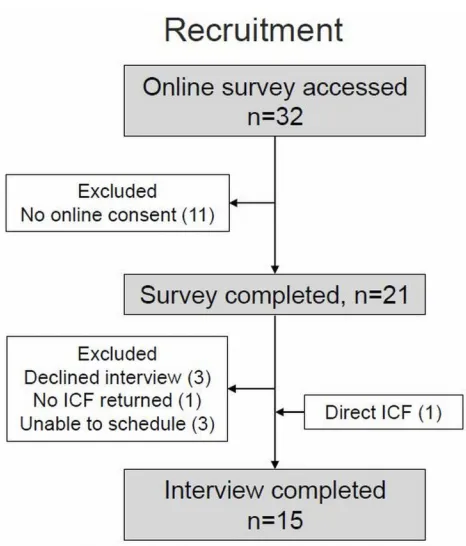
During 2016–17, 32 people accessed the survey and 21
clinicians consented online and completed the survey, and 14 of 21 of the survey participants consented by written informed consent for the interview. One additional clini-cian provided written consent directly for the interview without taking the survey, giving a total of 15 interviews.
Theflow chart of recruitment is diagrammed inFigure 2.
A total of 15 individuals completed the interview (five out of six MDs, two out of four NPs, eight out of eleven NDs) and a total of 21 individuals completed the survey. Their median years of practice were 7.0 (MDs), 8.5 (NPs), 10.0 (NDs) with an overall median of 7.0. Three missing
values werefilled by using the calculated mean value.
HEXACO
Six multiple independent t-tests were conducted for each
domain of HEXACO between the mean of the clinician’s
score and the reference standard. The significance level was adjusted using the Holm-Sidak method for multiple
compar-isons to avoid alpha error.16 Clinicians from this sample
showed higher Honesty/Humility, Conscientiousness, and Openness domains (n=21). The Z-scores were used to depict the relative difference between the clinician’s dispositional factors relative to the reference values, which form a perfect hexagon (yellow line). (Figure 3)
The combination of high HH and Conscientiousness describes a character that is more resilient against work stressors, able to behave conscientiously under stressful conditions, and maintain truthful and non-deceptive
Journal of Multidisciplinary Healthcare downloaded from https://www.dovepress.com/ by 118.70.13.36 on 24-Aug-2020
relationships. It may also indicate the tendency to trust others as well as to become trustworthy individuals them-selves. The openness domain indicates the ability to accept new ideas and criticism from others. By combining these characteristics, these clinicians are consistent with the attributes and consequences of having dispositional humility.
IMAQ
The twenty-one participants were divided into 10 conven-tional clinicians (MD, NP) and 11 complementary and alternative or non-conventional clinicians (ND). The t-tests showed that the clinicians with different profes-sional healthcare training and credentials were not
statis-tically different for the two subdomains: 1) “openness to
new ideas and paradigm” t(19)=1.128, p=0.472; and 2)
“value of both introspection and relationship with
patients”t(19)=0.272, p=0.955. From an integrative
med-icine perspective, non-conventionally trained ND clini-cians were not different from conventionally trained medical and nursing clinicians, or perhaps the conven-tional medical and nursing training had incorporated the
perspective of integrative medicine in the past decade.3
Qualitative Data
We avoided any suggestion of studying the character trait of humility as much as possible during recruitment,
informed consent process, and interview. “Humility”and
conceptually related terms such as“arrogant”or“humble” were not used during conversations unless they were men-tioned by participants. The focus of discussion was to collect information regarding personality and environmen-tal factors that enhance or interfere with collaborative work in interdisciplinary primary healthcare clinics and Figure 1Dispositional humility allows clinicians to have an accurate self-assessment, be open to new ideas, appreciate the contribution of others, and develop generosity. Dispositional humility in leaders can facilitate character development of team members and create an environment characterized by fairness and equality, transparency, non-punitive consequences for reporting errors and near-misses, and a safe and encouraging environment for performing work. However, dispositional humility must be nurtured and developed through professional training because high educational attainment, career andfinancial success, and busy schedules may lead to a sense of self-importance and entitlement that can promote separation of team members into hierarchies based on professional disciplines and specialties. Note: this is not structural equation modeling, and the pathways or factors were not statistically analyzed. Copyright © 2019. Dove Medical Press. Reproduced from Sasagawa M, Amieux P. Concept map of dispositional humility among professionals in an interdisciplinary healthcare environment: Qualitative synthesis. J Multidisciplinary Healthcare. 2019;12:543–554.1
Journal of Multidisciplinary Healthcare downloaded from https://www.dovepress.com/ by 118.70.13.36 on 24-Aug-2020
centers. Authors familiarized themselves with the tran-script before coding. Based on the interview question, codes were categorized into: 1) negative dispositional fac-tors; 2) positive dispositional facfac-tors; 3) positive environ-mental factors; and 4) negative environenviron-mental factors. Coding was repeated iteratively to achieve interpretive saturation. The HyperResearch (v3.5.2) software orga-nized the codes and created the summative statistics. The expressions seem diverse due to the nature of asking open-ended questions; however, some of the expressions were coherent with the attributes and consequences of having
dispositional humility, as described by Figure 1. An
excerpt of the summative content data is shown in Supplement B: Summative Codes.
Below is a list of bullet points of the descriptors of humility extracted by two investigators.
Humility components that emerged as a desirable fac-tor by clinicians
● Friendly, open, and approachable
● Patient-centered (other-oriented and professional
duty-orientated)
● Humility
● Trust
● Modest self-portrayal (accurate self-assessment)
● Be responsible/respectful of other people’s time
Dispositional factors that emerged as a barrier, making the person hard to work with
● Egotistical
● Arrogance
● Closed-minded
● Dogmatic, self-interest medicine (not evidence-based)
● Questionable value (colleagues who hold
non-evi-dence-based beliefs about particular modalities)
Helpful factor/environment for collaboration
● Opportunity to develop trust and collegial relationships
● Open common space to communicate, not separate
rooms
● Increase knowledge of other professional colleagues
● Warm handoffs and fact-to-face interactions
● Developing a culture of mutual respect
Figure 2Shows the overall participation in the two phases of data collection. One MD directly contacted the author for interview participation without completing the online survey. Per protocol, this interview data were included.
Figure 3To illustrate the overall characteristics, each clinician’s HEXACO score was converted to the Z-score based on the reference values. The clinicians showed statistically higher Honesty/Humility, Openness, and Conscientiousness domains com-pared to the reference group of undergraduate college samples. (n=1,126). *Statistical significance at the alpha level 0.05. **Statistical significance at the alpha level 0.01.
Journal of Multidisciplinary Healthcare downloaded from https://www.dovepress.com/ by 118.70.13.36 on 24-Aug-2020
● Having a Reality Check
Environmental or situational hindrance for collaboration
● Unfairness (perceived or real)
● Lack of resources
● Knowledge gap about other professionals
Directed Content Analysis
Six representative interviews out offifteen were analyzed
by two authors independently. Directed content analysis looked for the components of factors associated with the preconceived model (Figure 1).
Themes to improve/reviseFigure 1
Busy Schedule And Lack Of Time
This theme was consistent with previously published data
on primary care clinicians.17 Similar expressions were
found within statements such as requesting more adminis-trative time, spending non-working time with colleagues (to get to know each other), having bad timing for a warm handoff, not planning well, not having work organized, and not respecting the time of colleagues. The conse-quences of this theme were to convey the impression of
arrogance and selfishness that was consistent with the
model.
Lack Of Humility Or Loss Of Humility
Perceptions such as egotistical, arrogant, closed-minded, dogmatic, inflexible and over-confident could be the result of having busy interactions (above) or dispositional issues;
however, lack of humility was confirmed to be a negative
factor to collaborative work.
Professional Training
Clinicians were aware of the need for constant learning. Getting to know colleagues, including their specialties and capacities, was part of a desire to have a smooth working relationship. This was also consistent with the model; however, the interviewees conveyed the message that such learning opportunities did not have to be humiliating; it could be a form of social gathering. Thus, this part of the
model was modified.
Reality Check
During professional training, rigorous training curricula and interaction with mentors, teachers and trainers with advanced skills and knowledge seemed to provide a reality
check or humbling moment. This element of the model
was confirmed by the interview data.
Attributes Of Humility
Many attributes were described in a negative manner such as egotistic, arrogant, self-absorbed, selfish, over-confi
-dent, inflexible, narrow or closed-minded, rather than a
positive manner such as open to new ideas or open-minded.
Consequences
An environment or opportunity to become vulnerable was brought up. This vulnerability may not be a direct conse-quence of dispositional humility but it signifies an envir-onment in which professionals do not have to be afraid to trust and be trusted. In the model, this could be interpreted as a safe and encouraging environment for collaboration because you do not have to be afraid of coworkers who might react negatively to collaboration requests.
Figure 4 shows a modified version of the published
concept map. The themes or dynamic elements that were
not confirmed during the summative and directed content
analyses are in grey scale.
Methods to increase the scientific rigor (design, data
collection, analysis and drawing of conclusions) of this
qualitative analysis are summarized in Table 1. The
left-hand column indicates the components of scientific rigor
discussed by previous researchers, and the right-hand col-umn indicates the process used for this study.
Discussion
High HH indicates prosocial orientation and behaviors as well as the expectation that others will be the same and trustworthy.21 Because conscientiousness also reflects the
level of ethical strength,22by combining these components
together we hypothesize that individuals with high HH and Conscientiousness scores will uphold ethical principles
while developing trusting relationship with others.
Nonetheless, high educational attainment, career and
financial success, busy schedules and stressful
environ-ments may lead to a loss of humility, leading to a sense of self-importance, entitlement, and disregard for the needs of others. Professional training is not only compe-tency-based skill building but in its best manifestations is also a life-long commitment to learning, reassessment and reappraisal of what defines professionalism, and the devel-opment of an ethical culture that promotes a sense of mutual respect and humility. Professionals who lose their
Journal of Multidisciplinary Healthcare downloaded from https://www.dovepress.com/ by 118.70.13.36 on 24-Aug-2020
sense of humility may face a reality check or humbling moment that awakens the sense of humility; however, how one faces and reacts to a reality check or humbling
moment will depend upon the mental and emotional maturity of the individual. Retaliatory behavior and coun-ter-attack against fair and constructive criticism may Figure 4A proposed concept map diagram describing factors associated with dispositional humility and a possible mechanism of how these factors allow clinicians to enhance collaboration among professionals. Thisfigure was made by revisingFigure 1of this article. The three gray scales indicate a new theme/category that appeared in this study (bold), a theme/category that was confirmed by the qualitative analysis (regular), and themes/categories which did not appear in the interview (gray scale).
Table 1Scientific Rigor Of This Qualitative Analysis (Partly From Lincoln Y, guba18)
Rigor Component Collection And Analysis Of Interview Data
Credibility (internal validity) Obtain positive and negative data (easy/hard, facilitative/disruptive personality and environment),
empower participants with positive interactions during the interview, hiding the real agenda (dispositional humility) in ethical ways (IRB approved per protocol)
Dependability (reliability, consistency or stability of data)
(weakness) short interview session (20−30 min interview time), attempt to weight the input from
different clinical credentials, expanding the subject of humility when it was brought up by participants, repeated coding for interpretive saturation referring to the repetition of coding on different days
Confirmability (objectivity) Inductive content analysis but based on the created concept map, offering modest incentive for busy
subjects, conscious effort at reflexivity during the interview
Transferability (external validity) Sample from different clinical credentials or training backgrounds, clinics, and no other stratification
Neutrality19 The sociologist Ann Oakley in 198120argued that Neutrality makes the interviewee an object and does
not support a cooperative engagement relationship from a social constructionism perspective. The PI
found that it was necessary to separate the interviewer’s self-portrayal of humility from that of the
interviewee so that neutrality was maintained.
Journal of Multidisciplinary Healthcare downloaded from https://www.dovepress.com/ by 118.70.13.36 on 24-Aug-2020
indicate a lack of dispositional humility combined with a lack of mental and emotional maturity. The data support the observation that humble clinicians would like to feel safe communicating with colleagues without feeling threa-tened and also to feel encouraged to approach them. Ultimately, well-functioning teams are able to develop a work culture of fairness, equality, and transparency that includes non-punitive consequences for reporting errors and near-misses.
The HH domain was also positively correlated to work
productivity behaviors.23Chirumbolo (2015) also reported
that HH was negatively associated with the feeling of job insecurity and work counter-productivity when gender, age, types of contract, and other HEXACO traits were
controlled.23 Because primary care clinicians experience
a highly stressful job environment,17dispositional humility may reduce compassion-fatigue and increase the
clini-cian’s job satisfaction. Thus, dispositional humility can
be evaluated as a factor of resiliency. For all clinical disciplines (medicine, nursing, and naturopathic medi-cine), the high HH and Conscientiousness scores indicated that these clinicians were resilient to occupational stress
and maintain a high degree of ethical behavior. The fi
nd-ings from the quantitative results were consistent with the expected results of professionals with dispositional
humi-lity. The IMAQ was created 15 years ago in 2003,3and the
incorporation of integrative medicine into professional healthcare training curricula has been rapid. Furthermore, because the median years of practice of the participants in this study was 7 years, many of them had already been exposed to integrative medicine healthcare curricula in their training. As an example of this, a publication from the University of Wisconsin Integrative Medicine Elective Rotation in January 2013 lists learning objectives and
defines integrative medicine as healing-oriented care for
the whole person that focuses on the least invasive, least toxic, and least costly methods to help facilitate self-care,
and emphasizes the personal quality of the doctor–patient
relationship.24Qualitativefindings by both summative and
directed content analyses extracted the descriptions, attri-butes, and some consequences of dispositional humility predicted by the model. The initial model created by literature search concept analysis (Figure 1) was revised (Figure 4). Professionals clearly feel that dispositional humility characteristics are important for interprofessional collaboration.
Limitations of the study include:
1. In the primary care setting, professionals from not only different modalities but also different treatment principles and health philosophies interact in the treatment of, for example, chronic health conditions.
Task-specific collaborations such as in the
emer-gency room or surgery may exhibit different team-work dynamics. The applicability of this model of
dispositional humility was examined specifically for
the integrative primary care setting.
2. The opportunity for collaboration among clinicians with different training and credentials depends on geopolitical regulatory restrictions, and in this par-ticular case, data were obtained from the state of Washington located in the United States.
3. The use of a college undergraduate sample for the reference standard of the HEXACO personality score might introduce a bias in the statistics. The age
and mental maturity of individuals would have infl
u-enced dispositional factors including the HH score. 4. The number for the NP sample (n=4) was minimal.
An attempt was made to enroll 10 clinicians for each clinician type (MD/DO, NP, ND) in order to compare the dispositional factors between medicine and nursing, nursing and naturopathy, and medicine and naturopathy. This analysis was not performed due to the low number of enrollments for a particu-lar clinician type. The number of MD/OD clinicians also did not reach the target number of ten. 5. Close inspection of the balanced sampling for the
directed content analysis resulted in 3 MDs, 1 NP, and 2 NDs. This unbalanced sampling of an NP replaced by an MD might have affected the abstracted data; however, we believe the effect was slight and the hypothesis of discovering the concept of dispositional humility would still be the same.
Possible future research directions are: 1) a sensitivity analysis to test the robustness of the model, for example selecting primary care clinicians at facilities which do not serve Medicaid patients; nonetheless, most community
clinics that are federally qualified service Medicaid
patients; 2) outcomes research on the relationship between the clinician’s dispositional humility and the outcomes of patients. These outcomes are not limited to biomedical improvement of health conditions but also the tendency toward self-care and self-management of health. Because dispositional humility promotes a trusting relationship and genuine partnership, the recognition of the contribution of
Journal of Multidisciplinary Healthcare downloaded from https://www.dovepress.com/ by 118.70.13.36 on 24-Aug-2020
patients toward successful outcomes may influence shared responsibility in healthcare; 3) educational curricular
development. The Association of Family Medicine
Residency Directors describe the character traits that they look for in the National Match as: trustworthy, loyal, help-ful, friendly, courteous, kind, obedient, cheerhelp-ful, thrifty, brave, clean, and reverent.12Many of these character traits are consistent with the concept of dispositional humility, and humility traits in highly determined and intelligent candidates could be facilitated by designing appropriate curricula in professional healthcare training programs; and 4) Personality tests as a tool for candidate selection. Professional identity formation considers the individual’s
psychological development, and the individual’s
recogni-tion of their role in society and their commitment to the
profession.25 Dispositional humility, which may be
reflected by the HH score, is useful for the candidate
selection process for future/current clinicians because it
may influence the clinical team dynamics as well as the
clinical outcomes of patients.
Conclusion
This study demonstrated that the character trait of humility was perceived as important to facilitate productive and suc-cessful interprofessional collaboration by primary care clini-cians working in a community healthcare environment. The attitude toward integrative medicine as measured by two sub-scales did not show a difference among clinicians with
differ-ent professional healthcare training and credentials.
Dispositional characteristics measured by the HEXACO showed that primary care clinicians possess statistically higher
dispositional characteristics for Honesty-Humility,
Conscientiousness and Openness to experience domains. The HH domain represents the tendency to be fair and genuine in dealing with others, while agreeableness represents tolerance and forgiveness. Non-collaborative behaviors are harmful to an organization by directly affecting its functioning or physical
property, or by hurting employees.23 Interpersonal modesty
refers to the tendency to moderate praise or recognition in socially acceptable ways, while humility refers to interperso-nal qualities such as respect and empathy during conflict, and openness toward different cultures or worldviews; thus, humi-lity extends the concept of modesty.26Understanding the con-cept of humility is valuable for developing effective interprofessional collaborative healthcare teams. This study is a first attempt to explore the importance of dispositional humility as perceived by primary care clinicians working in community-based healthcare systems.
Abbreviations
AFMRD, The Association of Family Medicine Residency Directors; ARNP, Advanced Registered Nurse Practitioner; CAM, Complementary and Alternative Medicine; CFR, Code of Federal Regulations; DO, Doctor of Osteopathy; FISMA, Federal Information Security Modernization Act; HEXACO, Designating six domains of personality as Honesty-Humility, Emotionality, eXtraversion, Agreeable-ness, ConscientiousAgreeable-ness, and Openness to experience; HH, Honesty-Humility domain of HEXACO; HIPAA, Health Insurance Portability and Accountability Act; IMAQ, Integrative Medicine Attitude Questionnaire; MD, Medical Doctor; ND, Naturopathic Doctor; NP, Nurse Practitioner; REDCap, Research Electronic Data Capture System; USMLE, United State Medical Licensing Examination.
Ethical Approval And Consent
Bastyr University, Office of Research Integrity IRB:
16-1558. Consent for publication: signed IRB informed consent forms.
Data and materials availability: 7 years from the date of publication at Bastyr University.
Acknowledgements
Authors thank Yoriko Kozuki, Ph.D., Karen Schepp, Ph.D., and Cynthia Price, Ph.D. of the University of Washington School of Nursing. This study was self-funded.
Author Contributions
All authors contributed to data analysis, drafting or revising the article, gavefinal approval of the version to be published, and agree to be accountable for all aspects of the work.
Disclosure
The authors report no conflicts of interest in this work.
References
1. Sasagawa M, Amieux P. Concept map of dispositional humility among professionals in an interdisciplinary healthcare environment: qualita-tive synthesis.J Multidiscip Healthc.2019;12:543–554.
2. Lee K, Ashton M. The HEXACO personality factors in the indigenous personality lexicons of English and 11 other languages. J Pers.
2008;76(5):1001–1054. doi:10.1111/jopy.2008.76.issue-5
3. Schneider CD, Meek PM, Bell IR. Development and validation of IMAQ: integrative medicine attitude questionnaire.BMC Med Educ.
2003;3:5. doi:10.1186/1472-6920-3-5
4. Eisenberg DM, Davis RB, Ettner SL, et al. Trends in alternative medicine use in the United States, 1990–1997: results of a follow-up national survey. JAMA. 1998;280(18):1569–1575. doi:10.1001/ jama.280.18.1569
Journal of Multidisciplinary Healthcare downloaded from https://www.dovepress.com/ by 118.70.13.36 on 24-Aug-2020
5. Loza E, Benito-Ruiz P, Blanco F, de Miguel E, Roman JA. Feasibility and efficacy of a multidisciplinary health care pro-gramme for patients with knee osteoarthritis. Clin Exp Rheumatol.2011;29(6):913–920.
6. McDonald J, Jayasuriya R, Harris MF. The influence of power dynamics and trust on multidisciplinary collaboration: a qualitative case study of type 2 diabetes mellitus. BMC Health Serv Res.
2012;12:63. doi:10.1186/1472-6963-12-63
7. Hsieh HF, Shannon SE. Three approaches to qualitative content analysis. Qual Health Res. 2005;15(9):1277–1288. doi:10.1177/ 1049732305276687
8. Peters A, Rowatt W, Johnson M. Associations between dispositional humility and social relationship quality.Psychology.2011;2(3):155– 161. doi:10.4236/psych.2011.23025
9. Rocque R, Leanza Y. A systematic review of patients’experiences in communicating with primary care physicians: intercultural encoun-ters and a balance between vulnerability and integrity. PLoS One.
2015;10(10):e0139577. doi:10.1371/journal.pone.0139577
10. Decker SL. In 2011 nearly one-third of physicians said they would not accept new medicaid patients, but rising fees may help. Health Aff (Millwood).2012;31(8):1673–1679. doi:10.1377/hlthaff.2012.0294 11. Decker SL. No association found between the medicaid primary care
fee bump and physician-reported participation in medicaid.Health Aff (Millwood).2018;37(7):1092–1098. doi:10.1377/hlthaff.2018.0078 12. Robinson M, Palmer E, Kozakowski S, et al. Core character traits for
family medicine.Ann Fam Med.2008;6(3):278. doi:10.1370/afm.852 13. Lee K, Ashton M The HEXACO personality inventory–revised. A measure of the six major dimensions of personality;2015. Available from:http://hexaco.org/scaledescriptions. Accessed July 18, 2015. 14. Harris PA, Taylor R, Thielke R, Payne J, Gonzalez N, Conde JG.
Research electronic data capture (REDCap) – a metadata-driven methodology and workflow process for providing translational research informatics support. J Biomed Inform. 2009;42(2):377– 381. doi:10.1016/j.jbi.2008.08.010
15. SPSS [computer program]. Amock, NY: IBM;2017.
16. Motulsky H The Holm-Šídák approach to multiple comparisons;
2017. Available from:https://www.graphpad.com/guides/prism/7/sta tistics/index.htm?stat_holms_multiple_comparison_test.htm. Accessed October 1, 2019.
17. Atanes AC, Andreoni S, Hirayama MS, et al. Mindfulness, perceived stress, and subjective well-being: a correlational study in primary care health professionals. BMC Complement Altern Med. 2015;15:303. doi:10.1186/s12906-015-0823-0
18. Lincoln Y, Guba E.Naturalistic Inquiry. Newbury Park CA: Sage Publications;1985.
19. Repley T. Interviews. In: Seale C, Gobo G, Gubrium J, Silverman D, editors. Qualitative Research Practice. London: SAGE Publications;
2007:15–33.
20. Oakley A. Interviewing women: a contradiction in terms? In: Roberts H, editor.Doing Feminist Research. London: Routledge and Kegan Paul;1981:30–61.
21. Pfattheicher S, Bohm R. Honesty-humility under threat: self-uncer-tainty destroys trust among the nice guys. J Pers Soc Psychol.
2018;114(1):179–194. doi:10.1037/pspp0000144
22. Ashton M, Lee K, de Vries R. The HEXACO honesty-humility, agree-ableness, and emotionality factors: a review of research and theory.Pers Soc Psychol Rev.2014;18(2):139–152. doi:10.1177/1088868314523838 23. Chirumbolo A. The impact of job insecurity on counterproductive work behaviors: the moderating role of honesty-humility personality trait.J Psychol.2015;149(6):554–569. doi:10.1080/00223980.2014.916250 24. Rakel D. The salutogenesis-oriented session: creating space and time
for healing in primary care. Explore (NY). 2008;4(1):42–47. doi:10.1016/j.explore.2007.10.016
25. Chen LYC, Hubinette MM. Exploring the role of classroom-based learning in professional identity formation of family practice residents using the experiences, trajectories, and reifications framework. Med Teach.2017;39(8):876–882. doi:10.1080/0142159X.2017.1317729 26. Davis DE, Hook JN, Worthington EL Jr., et al. Relational humility:
conceptualizing and measuring humility as a personality judgment.J Pers Assess.2011;93(3):225–234. doi:10.1080/00223891.2011.558871
Journal of Multidisciplinary Healthcare
Dove
press
Publish your work in this journal
The Journal of Multidisciplinary Healthcare is an international, peer-reviewed open-access journal that aims to represent and publish research in healthcare areas delivered by practitioners of different disciplines. This includes studies and reviews conducted by multi-disciplinary teams as well as research which evaluates the results or conduct of such teams or healthcare processes in general. The journal
covers a very wide range of areas and welcomes submissions from practitioners at all levels, from all over the world. The manuscript management system is completely online and includes a very quick and fair peer-review system. Visit http://www.dovepress.com/testimonials. php to read real quotes from published authors.
Submit your manuscript here:https://www.dovepress.com/journal-of-inflammation-research-journal
Journal of Multidisciplinary Healthcare downloaded from https://www.dovepress.com/ by 118.70.13.36 on 24-Aug-2020