A Monthly Double-Blind Peer Reviewed Refereed Open Access International e-Journal - Included in the International Serial Directories
International Journal in IT and Engineering
http://www.ijmr.net.in email id- [email protected] Page 19
Routing Protocols in Delay Tolerant Network (DTN): A Critical Study and Comparison
Nirbhay K.Chaubey1,Pooja Mistri2 1
Department of Computer Science, Institute of Science and Technology for Advanced Studies and Research, VallabhVidyanagar- 388120, Gujarat, India
Gujarat Technological University, PG School Ahmedabad-382424, Gujarat, India
ABSTRACT
Delay tolerant Network (DTN) became more popular in the research area recently, because of its application. It is a wireless network that communicate with the nodes by storing the message packets in the bundle temporally and whenever relay node or the intermediate node have the chance to send the message to the other node that just encountered by the relay node. The mechanism use for the DTN routing is the store-carry and forward approach. Main challenge for the DTN routing is that it discovers the route through the network without an end to end path so nodes in the network connect to the other nodes instantly. This paper review about DTN, types of routing techniques and its issues, some popular routing protocols and their performance in terms of Delay, message Delivery rate, Overhead, Controlling the number of replications of the node.
Keywords—DTN, Number of Replication, PRoPHET, Spray and wait
I. DELAY TOLERANT NETWORK
In today’s world, Due to internet many of devices (computers, Mobiles) are communicating with each other in all around the world. For the humans better and easy life the technologies are increasing everyday communications so networks are emerging that are different and more Massive.The networks (MANETs VANETs, Wireless Sensor Networks (WSN)) have given new opportunities for the different types of applications. There are number of networks used in connecting and communicating with different devices and it is only possible by some set of protocols known as TCP/IP protocol suite. Principle on which TCP/IP works is based on end-to-end data transfer. However, there are many regions where the assumptions of the internet cannot be satisfied. If at any environment where there is no path between the sources to destination, then TCP/IP fails to work properly or might even stop working completely. Because of such circumstances, a newer network has evolved which is independent end to end connectivity between nodes. This network is called as Delay Tolerant Networks (DTN).DTN has different characteristics from the other wireless networks like intermittent connectivity, low error rates or link failure and large delay [1]. In the environments like disaster relief with limited range of radios, sensing the environment, military purpose, deep space communication, underwater sensing, inter vehicle communication.
A Monthly Double-Blind Peer Reviewed Refereed Open Access International e-Journal - Included in the International Serial Directories
International Journal in IT and Engineering
http://www.ijmr.net.in email id- [email protected] Page 20 destination for routing the data and due to this the thought of the new network DTN is emerging in the mobile network and vehicular network and others according to the application and environment.
Delay Tolerant Network (DTN) is a set of emerging networks that has extremely different characteristics from the other wireless network and internet. E.g. The intermittent connectivity, Large Delays, Low error rates [1] Mostly Large Delay and frequent partitions are there so may be up-to-date information for the stable network is not available so Data transmission is the main issue for the DTN. This is caused by the high mobility and the density of the nodes is very low. This kind of characteristics make the routing difficult in the DTN[1] exist solutions do not work in the environment like DTN networks because assumption is taken for the network is stable and the link failures are infrequent between the nodes. Therefore efficient routing is the still research area in DTN [1].Delay/ Disruption tolerant networks (DTN) also called as intermittently connected mobile networks (ICMN), are wireless networks where the high mobility and low density of the nodes in the network at any given time instance, the probability that there is an end-to-end path from a source to a destination is low[1][2] Delay (or disruption) tolerant networking, provides an alternative approach for a various wireless environments that challenge the limitations of the transport and routing layers in the TCP/IP model. TCP/IP based Internet routing [3] where end-to-end path exists between peers, end-to-end packet drop problem is small and Low delay path between source to destination. DTN routing usually follows store-carry-and-forward; i.e., after receiving some packets, a node stores and carries them around until it contacts another node and then forwards the packets. Since DTN routing relies on mobile nodes to forward packets for each other, the routing performance (e.g., the number of packets delivered to their destinations) depends on whether the nodes come in contact with each other or not.
DTN routing protocols application specific and lacks the support for dynamic situation. There by giving an opportunity to contribute towards building dynamic routing. This raises question:
1. How many copies to be replicated in network? 2. How the message replicate in the network?
An answer to above mentioned questions demands clearly place to efficiency in routing environment. Therefore, dynamic routing protocol is required to satisfy the need and routing objectives.
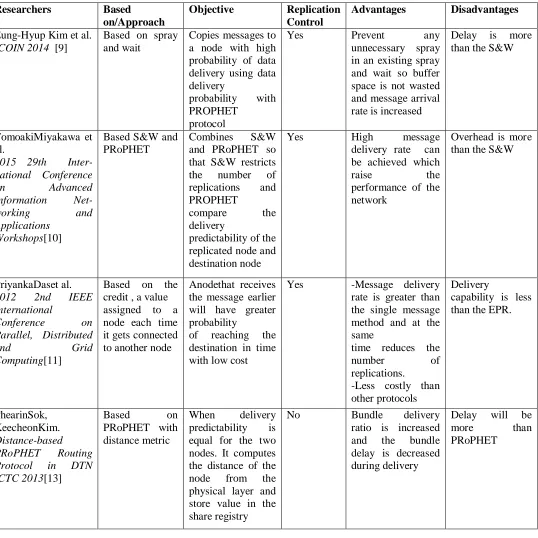
This paper is organized as follows: - Section II introduces the concept and architecture of DTN. Section III presents classification of routing protocol. Some important routing protocols of DTN are discussed in Section IV. Section V contains routing issues. Table 1analyzed and compared various routing technique proposed by the other researcher to solve routing issues in DTN.Finally, Section VI concludes the paper followed by future work.
II. CONCEPT AND ARCHITECTURE OF DTN
A Monthly Double-Blind Peer Reviewed Refereed Open Access International e-Journal - Included in the International Serial Directories
International Journal in IT and Engineering
http://www.ijmr.net.in email id- [email protected] Page 21 in contact with each other. The main advantage of this kind of protocol is flexibility. It can be easily linked with the already existing TCP/IP protocol networks or can be used to link two or more networks together [1-4]. The place of the bundle layer can be seen above the transport layer in the Fig. 1
Fig.1The Position of the bundle layer [Thesis 1]
Bundles are the messages of nodes. By storing and forwarding entire bundles between nodes for the transfer of data from one node to another can be made reliable. The bundles contain source node ID and destination node ID, Time to Live-control information(TTL) and a bundle header. Whole bundles stores and transmit by the bundle layer between different nodes. The layers lower the bundle layers are selecting for their correctness to the communication environment of each filed.In DTNs at any given instant, there may not be any route to the next hop. In this case, the node must buffer the message in persistent storage, until a contact becomes available. Once the next hop stores the bundle in persistent storage, it is said to have taken custody of the bundle, and the node that have sent the message can delete its own copy of the bundle. Instead of waiting for the next hop to become available, the DTN gateways may themselves be mobile. Each node is associated with a persistent storage device like hard disk, where it can store the messages. It is called as persistent storage as it can store the message for amount of time. The persistent storage can be useful in situations when the next node is not available for a very long time, or when the rate of incoming messages is far higher than the rate of outgoing messages [4]
III. CLASSIFICATION OF ROUTING PROTOCOLS
The existing routing protocols in DTNs are classified with respect to their strategies for controlling message copies and forwarding decision of message to the destination [5]
Number of destination: According to the number of destinations nodes to forward messages
and routing can be classified into the three categories:
1) Unicast Routing: Only one destination for the each message.
2) Multicast Routing: Destinations node could be one or group of destination nodes for the each
message
3) Broadcast Routing: All the nodes are the destination for the each message.
Number of copy: Depending on the number of copies utilized in the routing process the routing
A Monthly Double-Blind Peer Reviewed Refereed Open Access International e-Journal - Included in the International Serial Directories
International Journal in IT and Engineering
http://www.ijmr.net.in email id- [email protected] Page 22
1) Single-copy routing protocols: Only a single copy for each message exists in the network at
any time.
2) Multiple-copy routing protocols: Multiple copies of same message can be generated and
distributed into the network. Moreover, multiple copy routing protocols can be further divided into flooding-based and quota based.
a) Flooding-based routing protocol: Dissemination or broadcast a copies of each message to as
many nodes as possible.
b) Quota-based routing protocol: It limits the number of message copies to flood in the
network.
Available Network knowledge: Whether the forwarding decision is based on the knowledge
derived from the nodes’ encounters or not or from their history, protocols can as well be classified into two categories:
1) Deterministic routing protocol: Complete knowledge of node history encounter probability
of nodes and node meeting times and period to make the forwarding decision
2) Non-deterministic routing protocols: Zero knowledge of pre-determined path between
source and destination. These algorithms either forward the messages randomly or prediction based.
IV. POPULAR ROUTING PROTOCOL OF DTN
In this section, some important routing protocols and their strategies for their routing in DTN aredeliberated.
Earlier in 2000, Vahdat and Becker et al.proposedEpidemic Routing Protocol, a flooding-based forwarding algorithm [4].In this Routing, The node in the network which receives the message then it forward a copy of it to the all the node that node encounters so that the message is spread in the whole network by the moving or mobile nodes and in the all the nodes have the same data. Although, the guarantee of the delivery of the message is not provided. This routing is the best approach to reach to the destination. Each message has the unique identifier which stored in the buffer and list of them is called as the summary vector. When the two proximal nodes get contact with each other then they exchange and summarize the summary vector and compare which message they do not have and after that request for the message to the node. When the counter of the packet reaches to the zero then packet is discarded and other approach is to set the Time-to-live (TTL) for each packet in the routing. The packet would copy from one to the other node till the TTL expires. It is useful when there is lack of information regarding network topology and nodes mobility patterns [6]
A Monthly Double-Blind Peer Reviewed Refereed Open Access International e-Journal - Included in the International Serial Directories
International Journal in IT and Engineering
http://www.ijmr.net.in email id- [email protected] Page 23 The major concern of this routing protocol is to improve the delivery predictability and reduce the wastage of the resources in the epidemic routing. In this scenario, initially in the network it will estimate the probabilistic metric for each known node. Delivery predictability (a,b) ∈ [0,1] for the node A for the each known destination B. whenever the nodes a node encounters with the other nodes then they exchange summary vectors as same as the epidemic routing .This summary vector contain the delivery predictability values for the destinations for the each node. The calculations of delivery predictabilities of nodes have three parts. Nodes update their delivery predictability metrics whenever meet each other. Visiting more nodes would be that high delivery predictability values. The calculation for that is shown in the equation 1.
P (a,b) = P(a,b)old + (1 − P(a,b)old) × Pinit. Eq. 1 (Where Pinit is initialization constant)
In the conventional routing protocols that discover the route and forward the packet to the destination on the basis of the shortest path or the lower cost, on the other hand, in the PROPHET whenever the node receives the message there no path to the destination and node carry the message in the buffer and forward it to the encountered node. The limitation of the PROPHET routing is that whenever node meets with the low delivery predictability then there is no guarantee that it would meet the other with higher predictability value during the message life time. The basic difference of Prophet than Epidemic Routing is its forwarding strategy, when two nodes meet, Prophet allows the transfer of a message to the other node only if the delivery predictability of the destination of the message is higher at the other node
Earlier in 2005, T. Spyropoulos, K. Psouniset.al. proposed Spray and Wait (SW) Routing Protocol. This is the replication based routing proposed which control the spreading of messages in the network. The spray and wait protocol assume to have no knowledge of the network topology and mobility of the nodes whether it is random or the repetitive behavior. It just forward the multiple copies of the messages using the flooding [8] The difference between epidemic routing and spray and wait is just that it only spreads the limited number of copy (L)message. This routing consists of two routing:
1)Spray Phase: In this phase according to the network limited number of copy (L) of
messages are spread over the network by the source and other nodes will receive the copy of the message.
2)Wait Phase: After the spreading the copies the all copies of the message is done and the destination node is not encountered with the copy of the message in the spray phase then each of nodes carrying the copies try to send their own copy to destination via direct transmission.
A Monthly Double-Blind Peer Reviewed Refereed Open Access International e-Journal - Included in the International Serial Directories
International Journal in IT and Engineering
http://www.ijmr.net.in email id- [email protected] Page 24 Different methods limiting the number of distributed messages and reduce resource consumption in intermediate nodes but often better performance result compared to the epidemic routing protocol.
V. ROUTING ISSUES IN DTN
In this section some of the important routing issues of DTN are discussed.
Buffer space: Due to Intermittent connectivity, messages must be buffered for long periods and
next node in the communication require enough buffer space to store all the messages that are waiting for future communication opportunities. Hence, intermediate nodes require sufficient buffer space to store all pending messages as per opportunities.
Energy: In DTN, due to the mobility of nodes, energy of the nodes kept wasting this leads to low level of energy. During sending, receiving and storing of messages, nodes required sufficient energy. Therefore, designing energy-efficient routing protocols is one of the challenging issue important to carry our research work.
Processing Power: One of the goals of delay-tolerant networking is to connect devices that overcome the limitation of the traditional networks. These devices may be very small having small processing capability, in terms of CPU and memory. These nodes will not be working for the some routing protocols because of power consumption.
Reliability: Some acknowledgment should be there for reliable delivery of data. If any routing
protocol this ensures successful and stable delivery of data. For example, when a message correctly reaches to a destination, some acknowledgement messages should be sent back from destination to sources for confirmation.
Security: Security is always a significant issue. A message may pass through intermediate nodes
randomly before reaching its final destination. Depending on the security requirements of applications, users may require secure guarantees about the authenticity of a message. The cryptographic techniques may be beneficial for secure intermediate routing.
A Monthly Double-Blind Peer Reviewed Refereed Open Access International e-Journal - Included in the International Serial Directories
International Journal in IT and Engineering
http://www.ijmr.net.in email id- [email protected] Page 25 Table 1.Comparisons analysis of various technique proposed by the researcher to solve Routing Issues in DTN
Researchers Based
on/Approach
Objective Replication Control
Advantages Disadvantages
Eung-Hyup Kim et al. ICOIN 2014 [9]
Based on spray and wait
Copies messages to a node with high probability of data delivery using data delivery
probability with PROPHET
protocol
Yes Prevent any
unnecessary spray in an existing spray and wait so buffer space is not wasted and message arrival rate is increased
Delay is more
than the S&W
TomoakiMiyakawa et al.
2015 29th Inter-national Conference
on Advanced
Information
Net-working and
Applications Workshops[10]
Based S&W and PRoPHET
Combines S&W and PRoPHET so that S&W restricts
the number of
replications and PROPHET
compare the
delivery
predictability of the replicated node and destination node
Yes High message
delivery rate can be achieved which
raise the
performance of the network
Overhead is more than the S&W
PriyankaDaset al.
2012 2nd IEEE
International
Conference on
Parallel, Distributed
and Grid
Computing[11]
Based on the credit , a value assigned to a node each time it gets connected to another node
Anodethat receives the message earlier will have greater probability
of reaching the destination in time with low cost
Yes -Message delivery
rate is greater than the single message method and at the same
time reduces the
number of
replications.
-Less costly than other protocols
Delivery
capability is less than the EPR.
PhearinSok, KeecheonKim. Distance-based
PRoPHET Routing
Protocol in DTN
ICTC 2013[13]
Based on
PRoPHET with distance metric
When delivery
predictability is equal for the two nodes. It computes the distance of the
node from the
physical layer and store value in the share registry
No Bundle delivery
ratio is increased
and the bundle
delay is decreased during delivery
Delay will be
more than
A Monthly Double-Blind Peer Reviewed Refereed Open Access International e-Journal - Included in the International Serial Directories
International Journal in IT and Engineering
http://www.ijmr.net.in email id- [email protected] Page 26 Lee and Nam et al.
ICOIN 2015[14]
Based on
PRoPHET, PRoPHETv2
with contact
duration
If two nodes are encountering frequently then the probability of that nodes increases in the short period of time.
PROPHETV2 is
there with contact duration
consideration.
No Higher delivery
ratio and low
overhead then
PRoPHET in terms of bandwidth and
the average
message size.
Number of
replication to be is not considered
Samuel C. Nelsonet al. Encounter–Based
Routing in
DTNsIEEE
INFOCOM 2009[15]
Encounter-based Routing (EBR), a quota-based
DTN routing
protocol
Predicts the future rate of node that encounters can be roughly predicted by past data
Yes Minimize the delay
and overhead and message delivery rate is increased
also battery
consumption is less
Analysis of
parameter for
variance number of replicas for all
nodes is not
considered
Wang and Shuet al.
2009 Fifth
International
Conference on
Mobile Ad-hoc and Sensor Networks[16]
Based on
Epidemic Routing
ARER counts the forwarding
predictability according to the metrics Replication Density based on the quantity of the replications Also assigns the weight function to the message
Replication
Density ,TTLof the
message and
delivery predictability
Yes Message copies
send is less and message delivery rate is more than
EPR and other
routing protocol
Delay would be more than S&W if the number of copies are less
Shou-Chih Lo et al.
2012 9th
International
Conference on Fuzzy
Systems and
Knowledge Discovery (FSKD 2012) [17]
Replication routing
technique and a message moving
technique to
provide good Congestion control
Information about Buffer occupancy
and delivery
probability of node exchange to all nodes to control congestion
Yes Used in all routing
protocols for
congestion control
It does not
consider the
parameter of
delivery ratio and delay other than
the congestion
control and
depends upon the integrated
A Monthly Double-Blind Peer Reviewed Refereed Open Access International e-Journal - Included in the International Serial Directories
International Journal in IT and Engineering
http://www.ijmr.net.in email id- [email protected] Page 27 Liu and Tang et al.
2012 International
Conference on
Computer Science
and Service System [18]
Based on S&W
with relay
probability (R-ASW)defines from energy and probability of nodes.
If the forwarding probability of the
relay node is
greater than the current node so relay node carry more packets
Yes Improves the
delivery
ratio and reduces
the delay and
overhead
Compared only
with S&W
Xiang FaGuo et al.
2013 IEEE
International
Conference on
Sensing,
Communications and Networking (SECON) [19]
Based on link transmission of connection is quality strong or weak
If message sent to the strong link is more deliverable than the weak link. Replication control can substitute over the strong link and how the strong and
weak link is
defined.
Yes Much lower
overhead is there compared to S&W
Transmission latencies is low
Weak links are defined by the assumption that
contacts are
independent and identically
distributed which does not fits in the real world scenario
XinWanget al.
Mobile Tendency
Based Hybrid
Routing for Partially Connected Networks [21]
Based on
mutli-hop neighbor
discovery mechanism. Find end-to-end path and the partial path in the network.
If end to end path is not found then data will be stored in the buffer and it will replicate the message and send it to the relay according to the opportunities
No Packet delay and
delivery
outperforms then the EPR,S&W and DFR
It is not highly modular for DTN
system and
geographical routing is not considered
Xue and Fan et al. 2009 International
Conference on
Networks Security, Wireless
Communications and
Trusted Computing
[22]
Based on S&w
and Binary
S&W
It counts the
average delivery of
the nodes and
according to that it
will send the
replication to the n nodes using BSW routing
No It have slight higher
average delivery
rate and short
average delay
There is not major difference
between BSW
and if number of copies less
VI. CONCLUSIONAND FUTURE WORKS
A Monthly Double-Blind Peer Reviewed Refereed Open Access International e-Journal - Included in the International Serial Directories
International Journal in IT and Engineering
http://www.ijmr.net.in email id- [email protected] Page 28
Our immediate future plan is to evaluate the existing routing protocols of DTN and then propose a new routing technique which can control the number of replication of the message to the encountered node and give better performance.
VII. REFERENCES
[1] Kevin Fall, “A Delay-Tolerant Network Architecture for Challenged Internets” SIGCOMM’03, August 25-29, 2003, Karlsruhe, Germany. Copyright 2003 ACM
[2] UpendraShevade, Han Hee Song, LiliQiu, Yin Zhang “Incentive-Aware Routing in DTNs” IEEE ICNP 2008
[3] V. Cerf, S. Burleigh, A. Hooke, L. Torgerson, R. Durst, K. Scott, K. Fall, H. Weiss, Delay-Tolerant Network Architecture, DTN Research Group Internet Draft, 2003.
[4] A. Vahdat and D. Becker. Epidemic routing for partially connected ad hoc networks. Technical Report CS-200006, Duke University, April. 2000.
[5] Shally, Harminder Singh Bindra, MamtaGarg,” PERFORMANCE EVALUATION OF RAPID AND SPRAY-AND-WAIT DTN ROUTING PROTOCOLS UNDER BLACK HOLE ATTACK” IJRET: International Journal of Research in Engineering and Technology eISSN: 2319-1163 | pISSN: 2321-7308,Jan 2014 , Volume: 03 Issue: 01
[6] R. S. Mangrulkar, Dr. Mohammad Atique, “Routing Protocol for Delay Tolerant Network: A Survey and Comparison” ICCIT-2010
[7] A. Lindgren, A. Doria, and O. Schelen, “Probabilistic routing in intermittently connected networks,” in The First International Workshop on Service Assurance with Partial and Intermittent Resources (SAPIR), 2004.
[8] T. Spyropoulos, K. Psounis, and C. S. Raghavendra, “spray and wait: an efficient routing scheme for intermittently connected mobile networks,” in Proc. of the ACM SIGCOMM Workshop on Delay- Tolerant Networking (WDTN), 2005.
[9] Eung-Hyup Kim, Jae-Choong Nam, Jae-In Choi, You-Ze Cho, “Probability-based Spray and Wait Protocol in Delay Tolerant Networks”IEEE Information Networking (ICOIN), 2014 International Conference on,2014
[10]TomoakiMiyakawa and Akio Koyama “A Hybrid Type DTN Routing Method Using Delivery Predictability and Maximum Number of Replication”, 2015 29th International Conference on Advanced Information Networking and Applications WorkshopsIEEE,2015
[11]Priyanka Das, KavitaDubey and Tanmay De “Credit Based Routing in Delay Tolerant Networks” 2012 2nd IEEE International Conference on Parallel, Distributed and Grid Computing,IEEE,2012
[12]Priyanka Das, KavitaDubey and Tanmay De “Routing in Delay Tolerant Networks Using Credit Based Spraying” 2012 2nd IEEE International Conference on Parallel, Distributed and Grid Computing,IEEE,2012
[13]PhearinSok, Keecheon Kim “Distance-based PRoPHET Routing Protocol in Disruption Tolerant Network” ICTC 2013,IEEE,2013
[14]Samuel C. Nelson, MehediBakht, and Robin Kravets “Encounter–Based Routing in DTNs”IEEE INFOCOM 2009.
[15] Ho-Jong Lee, Jae-Choong Nam, Won-KyeongSeo, You-Ze Cho, and Soong-Hee Lee, “Enhanced PRoPHET Routing Protocol that Considers Contact Duration in DTNs” , ICOIN 2015,IEEE, 2015
[16]Xin Wang, YantaiShu, Zhigang Jin, QingfenPan,Bu sung Lee, “Adaptive Randomized Epidemic Routing for Disruption Tolerant Networks” 2009 Fifth International Conference on Mobile Ad-hoc and Sensor NetworksIEEE,2009
[17]Shou-Chih Lo, Chuan-Lung Lu, “A Dynamic Congestion Control Based Routing for Delay-Tolerant Networks” 2012 9th International Conference on Fuzzy Systems and Knowledge Discovery (FSKD 2012),IEEE,2012
[18] Jun Liu, Meisi Tang, Geng Yu, “Adaptive Spray and Wait Routing based on Relay-Probability of Node in DTN”2012,IEEE [19] Xiang FaGuo, MunChoonChan,”Plankton: An Efficient DTN Routing Algorithm”, 2013 IEEE International Conference on
Sensing, Communications and Networking (SECON)]
[20]Xin Wang, YantaiShu, Zhigang Jin and Huan Chen, “Directional Forward Routing for Disruption Tolerant Networks”, in Proceedings of the 2009 Asia-Pacific Conference on Communications (APCC’09), Shanghai, China, Oct. 2009
[21]Xin Wang, YantaiShu, “Mobile Tendency Based Hybrid Routing for Partially Connected Networks”, National Natural Science Foundation of China (NSFC) ,2012,IEEE
[22]JingfengXue, Xiumei Fan, Yuanda Cao, Ji Fang, Jiansheng Li “Spray and Wait Routing Based on Average Delivery Probability in Delay Tolerant Network” 2009 International Conference on Networks Security, Wireless Communications and Trusted Computing,IEEE
[23]Delay Tolerant Networking Research Group: http://www.dtnrg.org/ [24]F.Warthman. Delay Tolerant Networks – A Tutorial. 2003.