SimLex-999 for Polish
Małgorzata Marciniak
1, Agnieszka Mykowiecka
1,2, Piotr Rychlik
1Institute of Computer Science, Polish Academy of Sciences1; Polish-Japanese Academy of Information Technology2 Jana Kazimierza 5, Warsaw, Poland; Koszykowa 86, Warsaw, Poland
{mm, agn, rychlik}@ipipan.waw.pl
Abstract
The paper addresses the Polish version of SimLex-999 which we extended to contain not only measurement of similarity but also relatedness. The data was translated by three independent linguists; discrepancies in translation were resolved by a fourth person. The agreement rates between the translators were counted and an analysis of problems was performed. Then, pairs of words were rated by other annotators on a scale of 0–10 for similarity and relatedness of words. Finally, we compared the human annotations with the distributional semantics models of Polish based on lemmas and forms. We compared our work with the results reported for other languages.
Keywords:similarity, synonymy, Polish, distributional models evaluation
1.
Introduction
Distributional semantics methods are commonly used in various linguistic tasks. So creating resources to evaluate them is extremely important. The best known of these, (Gabrilovich, 2017) (Finkelstein et al., 2002), consists of 353 word pairs together with their similarity scores. Human annotators evaluated the similarity of word pairs under-stood as synonymy, relatedness and association of words. Another well-known resource developed for the same pur-pose is SimLex-999 (Hill, 2017) (Hill et al., 2015). It was created to test similarity, but here it was understood as syn-onymy and quasi-synsyn-onymy, which seems to be a hyper-nym/hyponym relation or co-hyponymy. It consists of 999 word pairs rated for this interpretation of similarity. The authors clearly excluded relatedness and association from the similarity relation. Moreover, the resource provides in-formation on part-of-speech, abstract vs. concrete concepts, and independent measures of relatedness of pairs of words for English. Both the above resources were translated into German, Italian and Russian (Leviant and Reichart, 2015) and are available as Multilingual WS353 and Multilingual SimLex999 (Leviant and Reichart, 2017), respectively.1 Many authors (e.g. (Faruqui et al., 2016), (Chiu et al., 2016)) point out the disadvantages of evaluation for distri-butional semantics methods based on isolated tests which are not connected to a whole processing system. For lan-guages with less developed linguistic infrastructure, such as Polish, it is important to provide resources for intrinsic eval-uation too. Therefore, we decided to translate SimLex-999. As it would be interesting to compare results for synonymy and relatedness on the same resource, we rated both types of similarity relation.
2.
Translation
The translation of SimLex-999 into Polish was done by three linguists, native speakers of Polish with good knowl-edge of English, according to the instruction published to-gether with Multilingual SimLex999. The final translation
1The list of English words was copied from the original
SimLex-999 set but new similarity values were assigned.
was agreed by a fourth person with a computational linguis-tics background. She only resolved cases where differences in the three translations occurred, for 585 pairs in fact. As the Multilingual SimLex999 resource includes translation into Russian, a Slavic language with similar linguistic phe-nomena and grammar as Polish, we assumed that the most important issues were taken into account. Additionally, we wanted the translators to pay special attention to the fol-lowing issues, mentioned by Leviant and Reichart in the guidelines.
• As the dataset was intended to test language mod-els, each word should be translated into one word. This caused several problems as many English one-word terms are translated into two one-words in Polish. ‘Sunrise’ and ‘sunset’ in Polish are ’wschód sło´nca’ ‘zachód sło´nca’ (shortened by all three annotators to
wschódandzachód, which are polysemic and can also mean e.g. directions of the world). Moreover, many Polish verbs consist of a verb form and the reflexive pronounsi˛e‘self’ (in Russian a reflexive pronoun is attached to a verb, if it exists). For some verbs, this pronoun is obligatory, e.g.´smia´c si˛e‘laugh’, while for others the existence of the reflexive pronoun changes the meaning of the verb, e.g. słucha´c ‘listen’ and
słucha´c si˛e‘obey’. The translators were ask to avoid verbs composed with the reflexive pronoun if possible.
• In Polish, as in Russian, adjectives have different forms for masculine (stary ‘old’), feminine (stara
‘old’) and neutral (stare‘old’) genders. In translation, we use masculine forms as dictionaries use them as lemmas.
• The translators should prefer interpretations which make the words in a pair more related, e.g. in the pair of words ‘body’ and ‘chest’, for ‘chest’, the translator chose the interpretationklatka piersiowa(shortened to
pier´s) instead ofskrzynia.
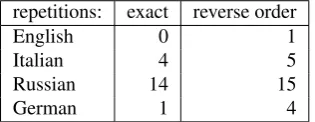
repetitions: exact reverse order
English 0 1
Italian 4 5
Russian 14 15
[image:2.595.92.250.69.130.2]German 1 4
Table 1: Pair duplicates in Multilingual SimLex999 files
[image:2.595.77.263.174.212.2]T1/T2 T2/T3 T1/T3 common pairs 497 534 535 common words 1316 1374 1410
Table 2: Inter translator agreement
SimLex-999 translations only single words are used, we asked the translators to find a similarly related pair of words which is as close as possible to the original one. For exam-ple, ‘groom’ and ‘bride’ is in Polish:pan młodyandpanna młoda, and might be transformed to: narzeczony ‘fiance’ andnarzeczona‘fiancée’. There were only a few such situ-ations.
The original SimLex-999 list contains some pairs with sim-ilar words, e.g. bad–awful, bad–terrible. This can result in creation of two or even more identical pairs after transla-tion. To eliminate this effect, we checked the final agreed data for repetitions, and choose alternative translations for such 22 repeated pairs. In Table 1 we show how may pairs are repeated in other Multilingual SimLex999 data. Table 2 shows the agreement of the translators of SimLex-999 into Polish. The obtained results are worse than those reported in (Leviant and Reichart, 2015) for Russian, Ger-man and Italian, where two translators were involved in each task. The authors reported the following numbers of differently translated 1998 words: Russian 353 words, 17.7%; Italian 196 words, 9.8%; and German 396 words, 19.8%. For Polish, the best inter translator agreement is for T1 and T3 translators; they translated differently 588 words, 29.4%.
One of the reasons for discrepancies in translation are dif-ferent preferences when choosing one of synonyms, e.g. in the pair happy–chearful, the first word was translated identically intoszcz˛e´sliwywhile the second one was either
wesołyorradosny, which are near synonyms, orpogodny, which is a little more distant but still quite close in mean-ing. Sometimes, when an English pair consisted of near synonyms, one Polish word was chosen as a translation of either the first or the second word from the pair, e.g. for the pairweird–strangea Polish worddziwnywas an equiv-alent for bothweirdandstrange. Another source of differ-ences is the lack of an instruction concerning perfective and imperfective verbs, e.g. kupi´c andkupowa´c ‘buy’, which translators used inconsistently. Polish allows for diminu-tive forms of nouns (and even adjecdiminu-tives), which was an-other source of different translations. For example,wujand
wujekboth mean ‘uncle’, while the first one is more offi-cial. Unfortunately, no guidelines were given for spelling. Several English words which are in common use in Polish are written differently in Polish, but the English version is
more popular. For example, ‘gin’ can be written d˙zinor
gin. Cultural differences meant that translators were look-ing for the best equivalent out of several possibilities. For instance, the differences in English and Polish education systems meant that the word ‘college’ was translated into three different wordsuczelnia,uniwersytetandkoled˙z. The best translation was the two word termszkoła wy˙zsza, but, as multi-word units were excluded, we decided to use the first proposal.
3.
Annotation
SimLex-999 contains information on the extent to which two words that make up a pair are similar to each other. The similarity coefficient is the average from many (ap-prox. 50) human (Mechanical Turk) annotations. The sim-ilarity was understood here as the semantic equivalence; thus, the words that are synonyms are the most similar to each other. The annotation instruction was not very elabo-rate and contained two main postulates:
• words that are related are not necessary similar, e.g.
car - tire,
• “it is perfectly reasonable to use one’s intuition ..., es-pecially when you are asked to rate word pairs that you think are not similar at all".
AVG_tr AVG_nontr AVG_all
AVG_tr 1 0.82 0.94
AVG_nontr 0.82 1 0.95
[image:3.595.63.275.68.119.2]AVG_all 0.94 0.95 1
Table 3: Similarity annotation correlation between annota-tors who were translaannota-tors and those who were not
The annotations of relatedness were a little more diverse than in the case of similarity. The highest correlation value (ρ) was equal only to 0.68, while the lowest value of the correlation was nearly the same as for the similarity – 0.53. The average correlation of the annotators was 0.59 while the average correlation with the final average ratings was 0.8.
3.1.
Correlation of the Annotation with Other
Languages
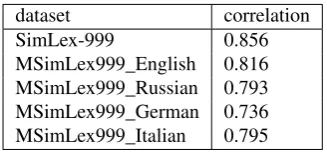
We compared our similarity annotation with the original SimLex-999 annotations and with those obtained by (Le-viant and Reichart, 2015) while translating the data into other languages. The Spearman’s coefficient for the se-quences of all the pairs’ similarity judgments is given in Ta-ble 4. The agreement with English data is relatively high, with greater agreement observed with respect to the orig-inal SimLex-999 annotations. The weakest agreement is observed with the German data (0.74).
[image:3.595.306.540.244.478.2]dataset correlation SimLex-999 0.856 MSimLex999_English 0.816 MSimLex999_Russian 0.793 MSimLex999_German 0.736 MSimLex999_Italian 0.795
Table 4: Cross language similarity agreement (ρ)
The relatedness scores were compared to the association measures calculated for the SimLex-999 by University of South Florida Free Association Norms (Nelson et al., 1998) obtained directly from the SimLex-999 data. The Spear-man’sρin this case is lower (0.54). It is lower even for the correlation with the Polish similarity scores, which is equal to 0.67. The different assumptions made while assigning association scores are already visible when comparing the averages scores from these two sets. In the Free Associa-tion Norms, SimLex-999 pairs got on average associaAssocia-tion of 0.75, while in our annotations the average relatedness score is equal to 5.95. For example, the English pair new-freshhas the association value 1.98, while the Polish pair – 8.57, similarly the English pairsharp-dullhas a score of 1.46, while the Polish equivalentostry-t˛epy– 7.43.
4.
Correlation of the Annotation with Polish
Distributed Models
We checked the manually annotated pairs of words against several distributional models of Polish. For this purpose we prepared 16 300-dimensional models based either on forms
and lemmas from the combined set of two corpora — Na-tional Corpus of Polish (Przepiórkowski, A. et al., 2012) and Polish Wikipedia. All our models were trained with the gensim tool ( ˇReh˚uˇrek and Sojka, 2010) using two neural network architectures: Continuous Bag of Words (CBOW) and Skip-Gram (SG), and two algorithms: hierarchical soft-max and negative sampling. Most of the models are de-scribed in (Mykowiecka et al., 2017a) and are available from (Mykowiecka et al., 2017b). In our experiments we also used two publicly available 100-dimensional CBOW and SG models with negative sampling trained on data from Polish Wikipedia (Rogalski and Szczepaniak, 2016a) avail-able from (Rogalski and Szczepaniak, 2016b) – models 17 and 18 in Table 5. Table 5 contains a list of tested models.
1 f3c-hs forms, cbow, hierarchical softmax 2 f3c-hs50 forms, cbow, hierarchical softmax,
freq. above 50
4 f3c-ns1 forms, cbow, negative sampling, window 1 5 f3c-ns2 forms, cbow, negative sampling, window 2 6 f3c-ns50 forms, cbow, negative sampling,
freq. above 50
7 f3s-ns forms, skip gram, negative sampling 8 f3s-hs forms, skip gram, hierarchical softmax 9 f3s-hs50 forms, skip gram, hierarchical softmax
freq. above 50
10 f3s-ns50 forms, skip gram, negative sampling, freq. above 50
11 l3c-hs lemmas, cbow, hierarchical softmax 12 l3c-ns lemmas, cbow, negative sampling
13 l3c-ns1 lemmas, cbow, negative sampling, window 1 14 l3c-ns2 lemmas, cbow, negative sampling, window 2 15 l3s-ns lemmas, skip gram, negative sampling 16 l3s-hs lemmas, skip gram
17 plc forms, cbow, negative sampling, 18 pls forms, skip gram, negative sampling
Table 5: List of models. Models 1-16 are based on NKJP and Wikipedia and have 300 features. When it is not explic-itly stated, the size of context window is 5. Models 17-18 are based on Wikipedia only, have 100 features and context window of the size 5.
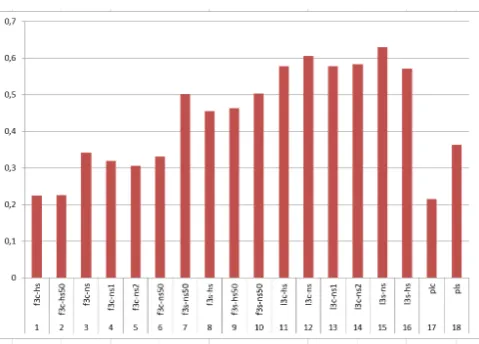
[image:3.595.88.252.416.493.2]to 1. However, both models are also nearly the best in the other task. Limiting the size of the window has a limited and inconsistent influence on form based CBOW models, while it improved the correlation with the similarity scores and decreased the correlation with the relatedness scores for lemma based models. Thus, for lemma based models our conclusions are consistent with (Chiu et al., 2016).
Figure 1: Correlation of MSimLex999_Polish similarities with the cosine similarity of word embeddings for different distributed models
Figure 2: Correlation of MSimLex999_Polish relatedness with the cosine similarity of word embeddings for different distributed models
5.
Conclusions
SimLex-999 is a resource which is frequently used as a reference set for evaluating various NLP solutions. Elab-orating its Polish version may thus help in making com-parisons of results of specific tasks obtained for Polish and other languages. The comparison of the manually obtained list of word similarities with the word embeddings shows that vectors obtained for a smaller data set with the smaller number of features performed worse than the larger mod-els calculated on the bigger corpus. The best model for Polish (trained on NKJP and Wikipedia, 300 features) has
the Spearman’sρcorrelation with the manually annotated data equal to 0.47; while the model trained on Wikipedia, 100 features has a 0.28 correlation). The best correlation reported in (Leviant and Reichart, 2015) (a model trained on Wikipedia; 400 features) is for German — 0.34. The results obtained for the lemma based models confirmed the intuition that the vector similarity is more likely to resem-ble relatedness than the similarity of words, but the results for form based models are not so clear.
The relatedness judgment turned out to be more problem-atic. We obtained values which are different from the asso-ciation values included in University of South Florida Free Association Norms and which do not show high correlation with word embeddings similarity. There may be different reasons for this and further analysis is needed.
The data are available at (Institute of Computer Science, 2017).
6.
Acknowledgments
This work was supported by the Polish National Science Centre project 2014/15/B/ST6/05186 and partially as a part of the investment in the CLARIN-PL research infrastruc-ture funded by the Polish Ministry of Science and Higher Education.
7.
Bibliographical References
Chiu, B., Korhonen, A., and Pyysalo, S. (2016). Intrinsic evaluation of word vectors fails to predict extrinsic per-formance. InProceedings of the 1st Workshop on Evalu-ating Vector-Space Representations for NLP, pages 1–6. Association for Computational Linguistics.
Faruqui, M., Tsvetkov, Y., Rastogi, P., and Dyer, C. (2016). Problems with evaluation of word embeddings using word similarity tasks. In Proceedings of the 1st Work-shop on Evaluating Vector-Space Representations for NLP, pages 30–35. Association for Computational Lin-guistics.
Finkelstein, L., Gabrilovich, E., Matias, Y., Rivlin, E., Solan, Z., Wolfman, G., and Ruppin, E. (2002). Placing search in context: The concept revisited. ACM Transac-tions on Information Systems, 20(1):116–131, January. Hill, F., Reichart, R., and Korhonen, A. (2015).
Simlex-999: Evaluating semantic models with (genuine) simi-larity estimation. Computational Linguistics, 41(4):665– 695, December.
Leviant, I. and Reichart, R. (2015). Judgment lan-guage matters: Multilingual vector space models for judgment language aware lexical semantics. CoRR, abs/1508.00106.
Mykowiecka, A., Marciniak, M., and Rychlik, P. (2017a). Testing word embeddings for Polish. Cognitive Studies, 17.
Przepiórkowski, A., et al., editors. (2012).Narodowy Kor-pus J˛ezyka Polskiego. Wydawnictwo Naukowe PWN, Warsaw.
ˇ
Reh˚uˇrek, R. and Sojka, P. (2010). Software Frame-work for Topic Modelling with Large Corpora. In
[image:4.595.54.294.406.578.2]Challenges for NLP Frameworks, pages 45–50, Val-letta, Malta, May. ELRA. http://is.muni.cz/
publication/884893/en.
Rogalski, M. and Szczepaniak, P. S. (2016a). Word em-beddings for the Polish language. In Leszek Rutkowski, et al., editors,Artificial Intelligence and Soft Computing -15th International Conference, ICAISC 2016, Zakopane, Poland, June 12-16, 2016, Proceedings, Part I, volume 9692 ofLecture Notes in Computer Science, pages 126– 135. Springer.
8.
Language Resource References
Evgeniy Gabrilovich. (2017). The WordSimilarity-353 Test Collection. http://www.cs.technion.ac. il/~gabr/resources/data/wordsim353/
wordsim353.html.
Felix Hill. (2017). SimLex-999. https://www.cl.
cam.ac.uk/~fh295/simlex.html.
Institute of Computer Science, Polish Academy of Sci-ences. (2017). MSimLex999_Polish. http://zil.
ipipan.waw.pl/CoDeS/.
Ira Leviant and Roi Reichart. (2017). Multi-lingual SimLex999 and WordSim353. http: //www.leviants.com/ira.leviant/
MultilingualVSMdata.html.
Agnieszka Mykowiecka and Małgorzata Marciniak and Piotr Rychlik. (2017b). Word embeddings for Polish.
http://dsmodels.nlp.ipipan.waw.pl/.
D. L. Nelson and C. L. McEvoy and T. A. Schreiber. (1998). The University of South Florida word associa-tion, rhyme, and word fragment norms.http://www.
usf.edu/FreeAssociation/.
Marek Rogalski and Piotr S. Szczepaniak. (2016b).
pl-embeddings. http://publications.it.p.