Performance Impact Caused by Hidden Bias of Training Data
for Recognizing Textual Entailment
Masatoshi Tsuchiya
Toyohashi University of Technology1–1 Hibarigaoka, Tempaku-cho, Toyohashi, Aichi, Japan [email protected]
Abstract
The quality of training data is one of the crucial problems when a learning-centered approach is employed. This paper proposes a new method to investigate the quality of a large corpus designed for the recognizing textual entailment (RTE) task. The proposed method, which is inspired by a statistical hypothesis test, consists of two phases: the first phase is to introduce the predictability of textual entailment labels as a null hypothesis which is extremely unacceptable if a target corpus has no hidden bias, and the second phase is to test the null hypothesis using a Naive Bayes model. The experimental result of the Stanford Natural Language Inference (SNLI) corpus does not reject the null hypothesis. Therefore, it indicates that the SNLI corpus has a hidden bias which allows prediction of textual entailment labels from hypothesis sentences even if no context information is given by a premise sentence. This paper also presents the performance impact of NN models for RTE caused by this hidden bias.
Keywords:Recognizing Textual Entailment; Evaluation Methodology; Naive Bayes
1.
Introduction
The quality of a training data is one of the crucial prob-lems when a learning-centered approach including neural network (NN) is employed. (Reidsma and Carletta, 2008) demonstrated that annotation errors of the dialog act cor-pus, which follows a certain systematic pattern, mislead the learning result of Bayesian network. (Zhang et al., 2017) described that the capacity of a NN model is large enough for brute-force memorizing the entire data set, even if its la-bels are random. Thus, an influence for a NN model caused by a certain systematic pattern may become more serious than the influence for other learning-centered methods. Both a method to improve the quality of a training data and a metric to evaluate its reliability are important. As the former method, majority vote of human annotators was widely used (Sabou et al., 2014; Bowman et al., 2015; Al Khatib et al., 2016) As the latter metric, many kind of inter-annotator agreement metrics based on multiple human annotation results were employed, because direct assess-ment of data quality is difficult (Craggs and Wood, 2005; Artstein and Poesio, 2008; Mathet et al., 2012).
This paper proposes a new empirical method to investi-gate a quality of a large corpus designed for the recogniz-ing textual entailment (RTE) task (Condoravdi et al., 2003; Bos and Markert, 2005; MacCartney and Manning, 2009; Marelli et al., 2014a). The proposed method, which is in-spired by a statistical hypothesis test, assesses a quality of a target corpus directly and does not depend on multiple human annotation results unlike the existing metrics. The proposed method consists of two phases: the first phase is to introduce the predictability of textual entailment (TE) la-bels as a null hypothesis which is extremely unacceptable when a target corpus has no hidden bias, and the second phase is to test the null hypothesis for the target corpus us-ing a Naive Bayes (NB) model.
In order to demonstrate the efficiency of the pro-posed method, we investigate two RTE corpora: the Stanford Natural Language Inference (SNLI)
s1 Two boys are swimming in the pool.
s2 Two girls are playing basketball.
s3 Two women are swimming in the pool.
sh Two children are swimming in the pool.
Figure 1: Example sentences of RTE. The textual entail-ment label ofshis determinable if and only if context
in-formation is given by a premise sentence.
corpus (Bowman et al., 2015) and the Sentences In-volving Compositional Knowledge (SICK) corpus (Marelli et al., 2014b). Although the experimental result of the SICK corpus rejects the null hypothesis, the result of the SNLI corpus does not reject it. Thus, the SNLI corpus has a hidden bias to allow prediction of TE labels from hypothesis sentences even if no context information is given by a premise sentence. The other experiment shows that this hidden bias causes the risk that a NN model for RTE works as a entirely different model than its constructor expects.
The major contributions of this paper are following three points:
• This paper proposes a new empirical method to reveal a hidden bias of a large RTE corpus (Section 2.).
• This paper applies the proposed method on the SNLI corpus and the SICK corpus, and reveals the hidden bias of the SNLI corpus (Section 3.).
• This paper also presents that this hidden bias causes the risk that a NN model proposed for RTE works as a entirely different model than its constructor expects (Section 4.).
2.
Proposed Method
Predicted Corpus labels
labels Entailment Neutral Contradiction
Entailment 2275 644 706
Neutral 508 1976 563
Contradiction 585 599 1968
(a) The confusion matrix obtained by the TE label pre-diction model trained and tested on the SNLI corpus. It tries to predict an appropriate TE label for each individual hypothesis sentence.
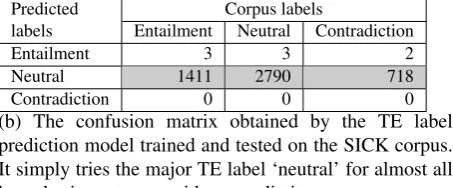
(b) The confusion matrix obtained by the TE label prediction model trained and tested on the SICK corpus. It simply tries the major TE label ‘neutral’ for almost all hypothesis sentences without prediction.
Figure 2: Confusion matrices of TE Label Prediction Models
2.1.
Predictability of TE Labels without Premise
Sentences
The first phase of the proposed method is to derive a null hypothesis which is extremely unacceptable when a target corpus has no hidden bias. We focus the task definition of the target corpus for this phase.
(Marelli et al., 2014a) defined RTE as a task to partition re-lationships between a premise sentence and a hypothesis sentence into three categories: entailment, neutral and con-tradiction. Consider the example sentences shown in Fig-ure 1. When s1is given as a premise sentence and sh is
given as a hypothesis sentence, the relationship betweens1 andsh is labeled entailment. The relationship betweens2 andshis labeled neutral, and the relationship betweens3 andsh is labeled contradiction. These examples indicate
that the TE label is determinable if and only if context in-formation is given by a premise sentence. Based on this observation, the null hypothesis of the proposed method is defined as follows:
Definition of the null hypothesis
The TE label of the hypothesis sentence is deter-minable without the premise sentence.
Because the null hypothesis looks extremely unacceptable, it is appropriate to reveal a hidden bias of the target RTE corpus.
2.2.
TE Label Prediction Model
The second phase of the proposed method is to test statis-tical significance of the null hypothesis for a target corpus. This phase requires two models: the first model is the statis-tical model of the null hypothesis, henceforth referred to as theTE label prediction model, and the second model is the statistical model of the alternative hypothesis, henceforth referred to as the baseline model.
The TE label prediction model is a model which predicts TE labels for hypothesis sentences without context infor-mation of premise sentences. This paper employs a multi-nomial NB model (Wang and Manning, 2012) as the TE label prediction model, which is defined by the following equation:
ply employs all word unigrams of hypothesis sentences as features.
Corpus TE label prediction model Baseline model
SNLI 63.3% 34.3%
SICK 56.7% 56.7%
Table 1: Performance of the TE label prediction model trained and tested on two RTE corpora. The TE label prediction model trained and tested on the SNLI corpus achieves statistically significant accuracy than the baseline model.
The baseline model assigns TE labels for hypothesis tences when no information is given by either premise sen-tences or hypothesis sensen-tences but only the TE label distri-butionP(y)of the target corpus is available. In such case, it is reasonable to assign the TE label which occurs most frequently in the target corpus for all hypothesis sentences. This baseline assignment is defined as follows:
˘
y= argmax y
P(y) (2)
If there is a statistically significant difference between the TE label prediction model and the baseline model, the null hypothesis is not rejected for the target corpus, and it indi-cates that the target corpus contains a hidden bias. Other-wise, the null hypothesis is rejected for the target corpus,
3.
Experiment
This section presents the detailed experimental conditions and the experimental results. The highlight of these results is that the TE label prediction model achieves 63.3% accu-racy for the SNLI corpus.
Table 1 shows the performances of the TE label prediction models trained and tested on two RTE corpora1. The TE
la-bel prediction model, which is trained on the SNLI training hypothesis sentences and their TE labels, achieves 63.3% accuracy on the SNLI test hypothesis sentences without premise sentences. The baseline model based on the SNLI TE label distribution achieves 34.3% accuracy on the same hypothesis sentences. The sign test indicates that there is a statistically significant difference between these models (p= 5.7e−202). On the other hand, the performance of the TE label prediction model trained and tested on the SICK corpus is close to the performance of the baseline model (56.7%). The sign test indicates that there is no statistically significant difference between these models (p= 0.65).
1
Ee He
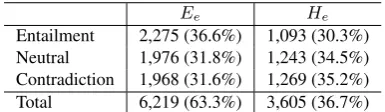
Entailment 2,275 (36.6%) 1,093 (30.3%) Neutral 1,976 (31.8%) 1,243 (34.5%) Contradiction 1,968 (31.6%) 1,269 (35.2%) Total 6,219 (63.3%) 3,605 (36.7%)
Table 2: Empirical classification of the SNLI corpus using the TE label prediction model
Figure 2 clearly shows the difference between the behavior of the TE label prediction model trained on the SNLI corpus and the model trained on the SICK corpus. The left matrix is obtained by the model trained and tested on the SNLI cor-pus, and the right matrix is obtained by the model trained and tested on the SICK corpus. The model of the SICK corpus simply tries the major TE label ‘neutral’ for almost all hypothesis sentences without prediction, although the model of the SNLI corpus tries to predict an appropriate TE label for each individual hypothesis sentence.
These results indicate that the null hypothesis is rejected for the SICK corpus, but it is not rejected for the SNLI corpus. Therefore, hypothesis sentences of the SNLI corpus have a hidden bias to allow prediction of their TE labels without premise sentences.
4.
Discussion
As described in Section 3., hypothesis sentences of the SNLI corpus have a hidden bias to allow pre-diction of their TE labels without premise sentences. The magnitude of the performance impact caused by the hidden bias is important, because the SNLI corpus is widely used as training data by many NN models for RTE (Bowman et al., 2015; Rockt¨aschel et al., 2015; Yin et al., 2016; Mou et al., 2016a; Wang and Jiang, 2016; Liu et al., 2016a; Liu et al., 2016b; Cheng et al., 2016; Parikh et al., 2016; Sha et al., 2016). This section discusses the performance impact of the NN models caused by the hidden bias.
4.1.
Empirical Classification of SNLI Corpus
The test pairs of the SNLI corpus are classified into two subsets using the TE label prediction model trained on the SNLI corpus. The first subset is the empirical easy test set Ee, which consists of all test pairs whose TE labels arepre-dicted correctly by the TE label prediction model. The sec-ond subset is the empirical hard test setHe, which consists
of the rest pairs. Table 2 shows the classification result. 63.3% test pairs of the SNLI corpus were classified asEe,
and the rest pairs were classified asHe.
4.2.
Definitions of NN Models for RTE
Two NN models are prepared to evaluate performance im-pacts caused by the hidden bias. The first model (hence-forth denoted as the parallel LSTM model) was pro-posed by (Bowman et al., 2015) for RTE, and was evalu-ated on the performance difference between RTE corpora by (Mou et al., 2016b). This model is defined by the fol-lowing equations.
The first step is to convert a premise sentence xp and
a hypothesis sentence xh into embedding vectors
us-ing the word embeddus-ing matrix We, which is
initial-ized with the 300-dimension reference GloVe vectors (Pennington et al., 2014). The second step is to convert embedding vectors into two 100-dimension sentence vec-tors with LSTMs, and they are concatenated into a 200-dimension vector. The remaining steps are to predict a TE label with three tanh fully connected layers and then to ap-ply the softmax function.
The second model (henceforth denoted as the se-quential LSTM model), which was proposed by (Rockt¨aschel et al., 2015) for RTE, is defined as fol-lows.
In the second model, two LSTMs are sequentially con-nected. Thus, it is possible to consider that the memory cells of these LSTMs are directly modeling a recognition process unlike the parallel LSTM model. All vectors of the sequential LSTM model are 100-dimension. Although (Rockt¨aschel et al., 2015) proposed the variants with atten-tions between a premise sentence and a hypothesis sen-tence, the attention-less model is employed in this exper-iment, because of its simplicity.
4.3.
Performance Impact of NN Models for RTE
This subsection presents the big performance drop of the NN models caused by the hidden bias.
Table 3 shows the experimental results of these NN mod-els trained and tested on the SNLI corpus. Although both NN models achieve high accuracy for the whole test set and for the empirical easy test setEe, they achieve drastic low
accuracy for the empirical hard test setHe. These
perfor-mance drops mean that a large portion of the high accuracy achieved by both NN models benefits from the empirical easy test setEe.
Table 4 shows the performance which is achieved by the same NN models when all words of premise sentences are replaced by unknown word symbols. Because this replace-ment removes all context information from premise sen-tences, thus the performance of the NN models must drop close to the chance ratio, if the NN models decide TE labels based on context information of premise sentences. Despite this expectation, both NN models achieve obviously higher performance than the chance ratio forEe(36.8%, shown in
Model Related models Ee∪He Ee He
Parallel LSTM model 76.3% (Mou et al., 2016b) 76.8% 87.8% 57.8% Sequential LSTM model 80.9% (Rockt¨aschel et al., 2015) 81.4% 90.1% 65.6%
Table 3: Performance of the NN models for RTE. Performance drops from the empirical easy test setEeto the empirical
hard test setHeare observed for both NN models.
Model Ee∪He Ee He
Parallel LSTM model 54.1% 66.0% 33.7% Sequential LSTM model 48.6% 56.7% 34.7%
Table 4: Performance of the NN models for RTE, when all words of premise sentences are replaced by unknown word symbols. Although all context information is removed by this replacement, both NN models achieve obviously higher performance than the chance ratio for the empirical easy test setEe. This result indicates that both NN models do not work
as RTE models forEe, but work as TE label prediction models forEe.
SNLI SICK
Training Development Test Training Development Test Entailment 183,416 (33.4%) 3,329 (33.8%) 3,368 (34.3%) 1,299 (28.9%) 144 (28.8%) 1,414 (28.7%) Neutral 182,764 (33.3%) 3,235 (32.9%) 3,219 (32.8%) 2,536 (56.4%) 282 (56.4%) 2,793 (56.7%) Contradiction 183,187 (33.4%) 3,278 (33.3%) 3,237 (33.0%) 665 (14.8%) 74 (14.8%) 720 (14.6%)
Total 549,367 9,842 9,824 4,500 500 4,927
Table 5: Statistics of TE labels of two RTE corpora. Although TE labels of the SNLI corpus are balanced, TE labels of the SICK corpus are not balanced.
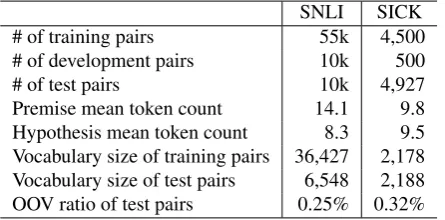
SNLI SICK
# of training pairs 55k 4,500
# of development pairs 10k 500
# of test pairs 10k 4,927
Premise mean token count 14.1 9.8 Hypothesis mean token count 8.3 9.5 Vocabulary size of training pairs 36,427 2,178 Vocabulary size of test pairs 6,548 2,188 OOV ratio of test pairs 0.25% 0.32%
Table 6: Comparison of the SNLI and SICK corpora. Both corpora are extremely similar from the view point of de-scriptive statistics.
work as RTE models forEe, but work as TE label
predic-tion models for Ee. This behavior of NN models for Ee
must be entirely different than their constructor expected.
4.4.
Comparison of SNLI and SICK corpora
The SNLI and SICK corpora, are entirely similar in their sentence domains, English scene descriptions. Both of them use the Flickr30k corpus (Young et al., 2014) as ori-gins of their sentences. It is also exhibited by the small differences of sentence token mean counts as shown in Ta-ble 6. The second is about their vocabulary. The out-of-vocabulary (OOV) ratio of SICK test pairs is 0.15%, when words of SNLI training pairs are regarded as known. This small OOV ratio indicates that SICK test pairs and SNLI training pairs are quite close from the view point of their vocabulary.The SNLI and SICK corpora are different in the method of composing sentences. Hypothesis sentences of the SNLI corpus are composed by human workers, but all sentences of the SICK corpus are derived from original sentences us-ing hand-crafted rules. We think that this difference may be
a cause of the hidden bias revealed by this paper.
5.
Conclusion
This paper proposes a new empirical method to investigate the quality of large RTE corpus. The proposed method con-sists of two phases: the first phase is to introduce the pre-dictability of TE labels as a null hypothesis, and the second phase is to test the null hypothesis using a NB model. The proposed method reveals a hidden bias of the SNLI corpus, which allows prediction of TE labels from hypothesis tences without context information given by premise sen-tences.
This paper also presents that this hidden bias makes a large performance impact on the NN models for RTE. The ex-perimental result shows that a large portion of the high ac-curacy achieved by the NN models benefits from the hid-den bias. The other experimental result shows that a NN model trained on the SNLI corpus does not work as an RTE model, but works as a TE label prediction model, when bi-ased test pairs are given. These results arise a risk that a complex NN model works as an entirely different model than its constructor expects.
6.
Acknowledgments
A part of this research was supported by JSPS KAKENHI Grant No. 15K12097. I would like to express my sincere appreciation to Dr. Mitsuo Yoshida and Dr. Adam Meyers for their valuable comments.
7.
Bibliographical References
Osaka, Japan, December. The COLING 2016 Organizing Committee.
Artstein, R. and Poesio, M. (2008). Inter-coder agreement for computational linguistics. Computational Linguis-tics, 34(4):555–596.
Bos, J. and Markert, K. (2005). Recognising textual en-tailment with logical inference. In Proceedings of Hu-man Language Technology Conference and Conference on Empirical Methods in Natural Language Processing, pages 628–635, Vancouver, British Columbia, Canada, October. Association for Computational Linguistics. Bowman, S. R., Angeli, G., Potts, C., and Manning, C. D.
(2015). A large annotated corpus for learning natural language inference. InProceedings of the 2015 Confer-ence on Empirical Methods in Natural Language Pro-cessing, pages 632–642, Lisbon, Portugal, September. Association for Computational Linguistics.
Cheng, J., Dong, L., and Lapata, M. (2016). Long short-term memory-networks for machine reading. In Pro-ceedings of the 2016 Conference on Empirical Meth-ods in Natural Language Processing, pages 551–561, Austin, Texas, November. Association for Computa-tional Linguistics.
Condoravdi, C., Crouch, D., de Paiva, V., Stolle, R., and Bobrow, D. G. (2003). Entailment, intensionality and text understanding. In Graeme Hirst et al., editors, Pro-ceedings of the HLT-NAACL 2003 Workshop on Text Meaning, pages 38–45.
Craggs, R. and Wood, M. M. (2005). Evaluating discourse and dialogue coding schemes. Computational Linguis-tics, 31(3):289–296, September.
Liu, P., Qiu, X., Chen, J., and Huang, X. (2016a). Deep fusion lstms for text semantic matching. InProceedings of the 54th Annual Meeting of the Association for Com-putational Linguistics (Volume 1: Long Papers), pages 1034–1043, Berlin, Germany, August. Association for Computational Linguistics.
Liu, P., Qiu, X., Zhou, Y., Chen, J., and Huang, X. (2016b). Modelling interaction of sentence pair with coupled-lstms. In Proceedings of the 2016 Conference on Em-pirical Methods in Natural Language Processing, pages 1703–1712, Austin, Texas, November. Association for Computational Linguistics.
MacCartney, B. and Manning, C. D. (2009). An extended model of natural logic. InProceedings of the Eight Inter-national Conference on Computational Semantics, pages 140–156, Tilburg, The Netherlands, January. Association for Computational Linguistics.
Marelli, M., Bentivogli, L., Baroni, M., Bernardi, R., Menini, S., and Zamparelli, R. (2014a). Semeval-2014 task 1: Evaluation of compositional distributional se-mantic models on full sentences through sese-mantic re-latedness and textual entailment. InProceedings of the 8th International Workshop on Semantic Evaluation (Se-mEval 2014), pages 1–8, Dublin, Ireland, August. As-sociation for Computational Linguistics and Dublin City University.
Marelli, M., Menini, S., Baroni, M., Bentivogli, L., Bernardi, R., and Zamparelli, R. (2014b). A SICK cure
for the evaluation of compositional distributional seman-tic models. In Nicoletta Calzolari (Conference Chair), et al., editors, Proceedings of the Ninth International Conference on Language Resources and Evaluation (LREC’14), pages 216–223, Reykjavik, Iceland, may. European Language Resources Association (ELRA). Mathet, Y., Widl ˜A¶cher, A., Fort, K., Franc¸ois, C.,
Galib-ert, O., Grouin, C., Kahn, J., Rosset, S., and Zweigen-baum, P. (2012). Manual corpus annotation: Giving meaning to the evaluation metrics. In Proceedings of COLING 2012: Posters, pages 809–818, Mumbai, India, December. The COLING 2012 Organizing Committee. Mou, L., Men, R., Li, G., Xu, Y., Zhang, L., Yan, R.,
and Jin, Z. (2016a). Natural language inference by tree-based convolution and heuristic matching. In Proceed-ings of the 54th Annual Meeting of the Association for Computational Linguistics (Volume 2: Short Papers), pages 130–136, Berlin, Germany, August. Association for Computational Linguistics.
Mou, L., Meng, Z., Yan, R., Li, G., Xu, Y., Zhang, L., and Jin, Z. (2016b). How transferable are neural networks in nlp applications? InProceedings of the 2016 Conference on Empirical Methods in Natural Language Processing, pages 479–489, Austin, Texas, November. Association for Computational Linguistics.
Parikh, A., T¨ackstr¨om, O., Das, D., and Uszkoreit, J. (2016). A decomposable attention model for natural lan-guage inference. InProceedings of the 2016 Conference on Empirical Methods in Natural Language Processing, pages 2249–2255, Austin, Texas, November. Associa-tion for ComputaAssocia-tional Linguistics.
Pedregosa, F., Varoquaux, G., Gramfort, A., Michel, V., Thirion, B., Grisel, O., Blondel, M., Prettenhofer, P., Weiss, R., Dubourg, V., Vanderplas, J., Passos, A., Cour-napeau, D., Brucher, M., Perrot, M., and Duchesnay, E. (2011). Scikit-learn: Machine learning in Python. Jour-nal of Machine Learning Research, 12:2825–2830. Pennington, J., Socher, R., and Manning, C. (2014).
Glove: Global vectors for word representation. In Pro-ceedings of the 2014 Conference on Empirical Methods in Natural Language Processing (EMNLP), pages 1532– 1543, Doha, Qatar, October. Association for Computa-tional Linguistics.
Reidsma, D. and Carletta, J. (2008). Reliability mea-surement without limits. Computational Linguistics, 34(3):319–326, September.
Rockt¨aschel, T., Grefenstette, E., Hermann, K. M., Ko-cisk´y, T., and Blunsom, P. (2015). Reasoning about en-tailment with neural attention. In Proceedings of The International Conference on Learning Representations (ICLR2016).
Sabou, M., Bontcheva, K., Derczynski, L., and Scharl, A. (2014). Corpus annotation through crowdsourcing: To-wards best practice guidelines. pages 859–866.
De-cember. The COLING 2016 Organizing Committee. Wang, S. and Jiang, J. (2016). Learning natural language
inference with lstm. InProceedings of the 2016 Confer-ence of the North American Chapter of the Association for Computational Linguistics: Human Language Tech-nologies, pages 1442–1451, San Diego, California, June. Association for Computational Linguistics.
Wang, S. and Manning, C. (2012). Baselines and bigrams: Simple, good sentiment and topic classification. In Pro-ceedings of the 50th Annual Meeting of the Association for Computational Linguistics (Volume 2: Short Papers), pages 90–94, Jeju Island, Korea, July. Association for Computational Linguistics.
Yin, W., Sch ˜A14tze, H., Xiang, B., and Zhou, B. (2016). Abcnn: Attention-based convolutional neural network for modeling sentence pairs. Transactions of the Asso-ciation for Computational Linguistics, 4:259–272. Young, P., Lai, A., Hodosh, M., and Hockenmaier, J.
(2014). From image descriptions to visual denotations: New similarity metrics for semantic inference over event descriptions. Transactions of the Association for Com-putational Linguistics, 2:67–78.